

Paper Menu >>
Journal Menu >>
 Open Journal of Applied Sciences, 2013, 3, 21-26 doi:10.4236/ojapps.2013.31B1005 Published Online April 2013 (http://www.scirp.org/journal/ojapps) Numerical Simulations of the Equations of Particle Motion in the Gas Flow Kelong Zheng1*, Liuxiang Zhang2, Haiyan Chen2 1School of Science, Southwest University of Science and Technology, Mianyang, China 2School of Environment and Resource, Southwest University of Science and Technology, Mianyang, China Email: [email protected] Received 2013 ABSTRACT Under the assumption of considering the gravity and without gravity, two different acceleration models to describe par- ticle’ motion in the gas flow are formulated, respectively. The corresponding numerical simulations of these models do not only show the trend of the velocity o f the particle in different density and particle diameter sizes, but also the rela- tionship between the maximum particle velocity and its diameter size. Keywords: Numerical Simulation; Particle Motion; Acceleration; Jet Grinding 1. Introduction The principle of jet grinding is that solids particles are accelerated by high-speed gas flow and fragmented due to multiple particle-particle collisions in interacting gas- particle jet. The development of jet grinding technology mainly includes the development of basic theory of jet grinding and its device, and the former is the foundation of the latter. According to the principle of jet grinding, the grind energy of particles comes from high-speed gas. Therefore, the analysis on the particle acceleration pro- gress is a key point in the design of jet grinding device. Whether the particles in the gas flow can be effectively accelerated and collided at its maximum velocity is the important condition to improve the efficiency of jet grinding. Researches of particles’ acceleration in nozzles have been reported in some literatures [1-3], but there have not any reports about particles’ acceleration in flu- idized bed. If the accelerated distance is too far, when the particle is accelerated to the maximum velocity, it will be affected by the gas flow and solid s, an d slow down ; if the accelerated distance is too close, particle can not be ac- celerated enough. So, to determine the optimal injection distance is very important to improve the efficiency of jet grinding. Reference [4,5] pointed out that it was a pref- erable choice that the accelerated distance of nozzles was as 10 - 20 times as the dimensionless distance, but the result is too wide. On the other hand, although many pa- pers on the analysis of particle motion do not consider the influence of gravity, for tough particle, the gravity, as well as the angle of inclination of the nozzle, has great influence on the efficiency of the fluidized bed. To investigate the particle motion in the high-speed gas flow better, this paper establishes some different mathe- matical models to describe particle acceleration with and without considering gravity, respectively. Meanwhile, numerical simulations show the trend of the velocity of the particle under different conditions and the relation- ship between the maximum particle velocity and its di- ameter size. 2. Particle Acceleration Model without Gravity 2.1. Mathematical Model Without considering gravity, the equation of a single particle motion [6] is as follows 2 0.75 (() ) sd s ss duC ut u dt d (1) where s u is the velocity of particle, is the veloc- ity of gas, ()ut is the gas density, s is the particle den- sity, s d is the particle diameter size and is the particle drag force coefficient. d C Equation (1) indicates the velocity of particle s u is a function in t. By transformation, it can be rewritten to an equation about th e particle velocity and the jet distance, 2 0.75 (() ), sde ss ss duC d uu dx d xu (2) Where x is the dimensionless distance which equals to the ratio of the distance of jet stream section to the nozzle *Corresponding author. Copyright © 2013 SciRes. OJAppS 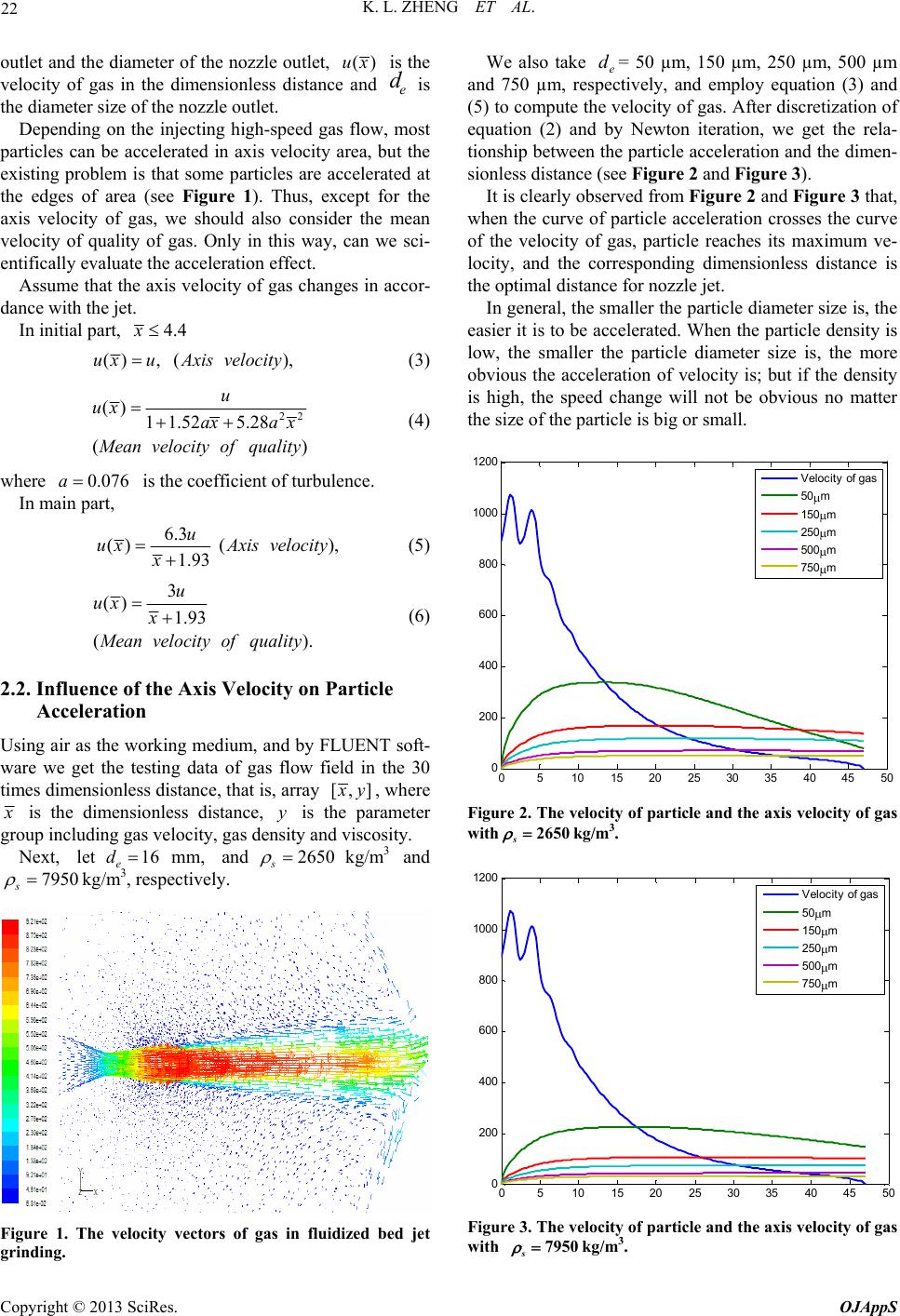 K. L. ZHENG ET AL. 22 outlet and the diameter of the nozzle outlet, ()ux is the velocity of gas in the dimensionless distance and is the diameter size of the nozzle outlet. e d Depending on the injecting high-speed gas flow, most particles can be accelerated in axis velocity area, but the existing problem is that some particles are accelerated at the edges of area (see Figure 1). Thus, except for the axis velocity of gas, we should also consider the mean velocity of quality of gas. Only in this way, can we sci- entifically evaluate the acceleration effect. Assume that the axis velocity of g as changes in accor- dance with the jet. In initial part, 4.4x (), ( ),u xuAxisvelocity (3) 22 () 1 1.525.28 ( u ux axax ) M ean velocity ofquality (4) where is the coefficient of turbulence. 0.076a In main part, 6.3 () ( ), 1.93 u u xAxisvelocity x (5) 3 () 1.93 ( u ux x). M ean velocity ofquality (6) 2.2. Influence of the Axis Velocity on Particle Acceleration Using air as the working medium, and by FLUENT soft- ware we get the testing data of gas flow field in the 30 times dimensionless distance, that is, array [,] x y, wh er e x is the dimensionless distance, is the parameter group including gas v e locity, ga s density an d viscosity . y Next, letmm, and 16 e d2650 s kg/m3 and 7950 s kg/m3, respectively. Figure 1. The velocity vectors of gas in fluidized bed jet grinding. We also take e= 50 µm, 150 µm, 250 µm, 500 µm and 750 µm, respectively, and employ equation (3) and (5) to compute the velocity of gas. After discretization of equation (2) and by Newton iteration, we get the rela- tionship between the particle acceleration and the dimen- sionless distance (see Figure 2 and Figure 3). d It is clearly observed from Figure 2 and Figure 3 that, when the curve of particle acceleration crosses the curve of the velocity of gas, particle reaches its maximum ve- locity, and the corresponding dimensionless distance is the optimal distance for nozzle jet. In general, the smaller the particle diameter size is, the easier it is to be accelerated. When the particle density is low, the smaller the particle diameter size is, the more obvious the acceleration of velocity is; but if the density is high, the speed change will not be obvious no matter the size of the particle is big or small. 05 10 15 202530354045 50 0 200 400 600 800 1000 1200 Velocity of gas 50m 150m 250m 500m 750m Figure 2. The velocity of particle and the axis velocity of gas with s 2650 kg/m3. 05 10 15 20 25 30 35 40 4550 0 200 400 600 800 1000 1200 V elocit y of gas 50 m 150 m 250 m 500 m 750 m Figure 3. The velocity of particle and the axis velocity of gas with s 7950 kg/m3. Copyright © 2013 SciRes. OJAppS  K. L. ZHENG ET AL. 23 For 2650 s kg/m3, when particle diameter is s d = 50 µm, the 0 - 10 times dimensionless distance is the particle’s rapidly accelerating phase, the 10 - 20 times dimensionless distance is its slow rise and slow reduction phase, and the 20 - 30 times dimensionless distance is particle velocity’s sharp decline phase. At 14 times di- mensionless distance, particle reaches its maximum ve- locity of 378 m/s. At the same time, Figure 4 also shows the relationship between the particle maximum velocity and the particle diameter size with particle density s = 5300 kg/m3. 2.3. Influence of the Mean Velocity of Quality on Particle Acceleration Parameters ,, s se dd and d are taken as in sec- tion 2.2. Here we employ equation (4) and (6) to compute the velocity of gas. By the same computation method, we get the relationship between the particle acceleration and the dimensionless distance (see Figure 5 and Figure 6). C From the above figures, we can see that the quality mean velocity of gas flow decays faster than the axis velocity of gas. In 0 - 25 times dimensionless distance, the dif- ference between the quality mean velocity and axis ve- locity increases along with the increase of dimensionless distance, because the gas flow is more and more diver- gent with the increase of the dimensionless distance. In 25 - 30 times, the situation conversed. The main reason is that when gas collision happens in the grinding center, the anti-shock wave will be formed, and then the axis velocity of gas will rapidly decay. The trend of the particle velocity gets something simi- lar to the abovementioned result, but the concrete nu- merical result is slightly different. For 2650 s kg/m3, when particle diameter is ds = 50 µm, the 0 - 8 times di- mensionless distance is the particle’s rapidly accelerating 0100 200 300400 500600 700800 0 50 100 150 200 250 300 Figure 4. The relationship between the particle maximum velocity and the particle diameter size with particle den- sity s = 5300 kg/m3. 05 10 15 20 25 30 35 40 45 50 0 100 200 300 400 500 600 700 800 900 1000 Velocity of gas 50 m 150 m 250 m 500 m 750 m Figure 5. The velocity of particle and the mean velocity of quality of gas with s = 2650 kg/m3. 051015 202530 3540 4550 0 100 200 300 400 500 600 700 800 900 1000 Velocity of gas 50 m 150 m 250 m 500 m 750 m Figure 6. The velocity of particle and the mean velocity of quality of gas with s = 7950 kg/m3. phase, the 8 - 17 times dimensionless distance is its slow rise and slow reduction phase, and the 17 - 30 times di- mensionless distance is particle velocity’s sharp decline phase. At 10 times dimensionless distance, particle reaches its maximum velocity of 223 m/s. Similarly, Figure 7 also shows the changing relation- ship between the particle maximum velocity and the par- ticle diameter size with particle density s = 5300 kg/m3. 3. Particle Acceleration Model with Gravity 3.1. Mathematical Model With considering the gravity of the particle, equation (2) can be revis ed as follows, 2 0.75 (() ), sxd e sx sx ss duC d uu dx d xu (7) Copyright © 2013 SciRes. OJAppS  K. L. ZHENG ET AL. 24 , sy du g dt where (8) , s xsy uu particle, resp mean the horizontal and vertical velocity of the ectively. The particle velocity s u can be obtaine d by 22 , s sx sy uuu (9) Because the direction of movement is no longer hori- zontal, the corresponding angle of zle outlet can appro ximately represent as: inclination of the noz- arctan / y x ll (10) where , x y ll mean the horizontal and vertical displace- ment oarticle at its maximumf the p speed, respectively. 3.2. Influence of the Axis Velocity on Particle Acceleration Here we only take s = 2650 kg/m3 to discuss the in ence of the axis velocity. Other parameters and axis flu- ve- locity are taken as in section 2.2. After discretization of by that th equation (7) and (8) Newton iteration, we also get the relationship between the particle acceleration and the dimensionless distance with gravity (see Figure 8). It can be perceived from the Figure 8 that, the change of particle velocity does not have much impact, with considering the gravity. The main reason for this is e particle density is not high, and particle size is small, which makes the effect of gravity on particle acceleration process not so obvious. However, gravity will produce the vertical direction of the displacement. To achieve better crushing impact, we must adjust nozzle angle ac- cording to the influence of gravity. For example, Figure 9 shows Particle trajectory with s = 2650 kg/m3 and s d = 750 µm. By equation (10), we can get 0.0011 y l m, 0.5680 0.1 . x l m, 0100 200 300400 500 600 700800 20 40 60 80 100 120 140 160 180 Figure 7. The relationship between the particle maximum velocity and the particle diameter size with particle den- sity s 0510 15 20 253035 40 45 50 0 200 400 600 800 1000 1200 Velocity of gas 50 m 150 m 250 m 500 m 750 m Figure 8. The velocity of particle and the axis velocity of gas with s = 2650 kg/m3 under considering gravity. 00.1 0.2 0.30.4 0.5 0.6 0.70.8 0x 10 -3 0. 5 1 1. 5 2 Figure 9. Particle trajectory with s = 2650 kg/m3 and = 750 µm. e may correspondingly increase. To verify this ct, we also present the result in Figure 10 which shows pa s d If high-density and coarse particle for parameters are taken, angl farticle trajectory with s = 7950 kg/m3 and s d = 1000 µm. We get (Figure 11) 0.0068 y lm, 0.7101 x lm, 0.5489 . 3.3. Influence of the Mean Velocity of Quality on Particle Acceleration corre ulations are given as In this section, we also investigate the trend of velocity of the particle by the quality mean velocity of gas. The sponding results of these sim = 5300 kg/m3. follows, The reason is similar to the statement in section Copyright © 2013 SciRes. OJAppS 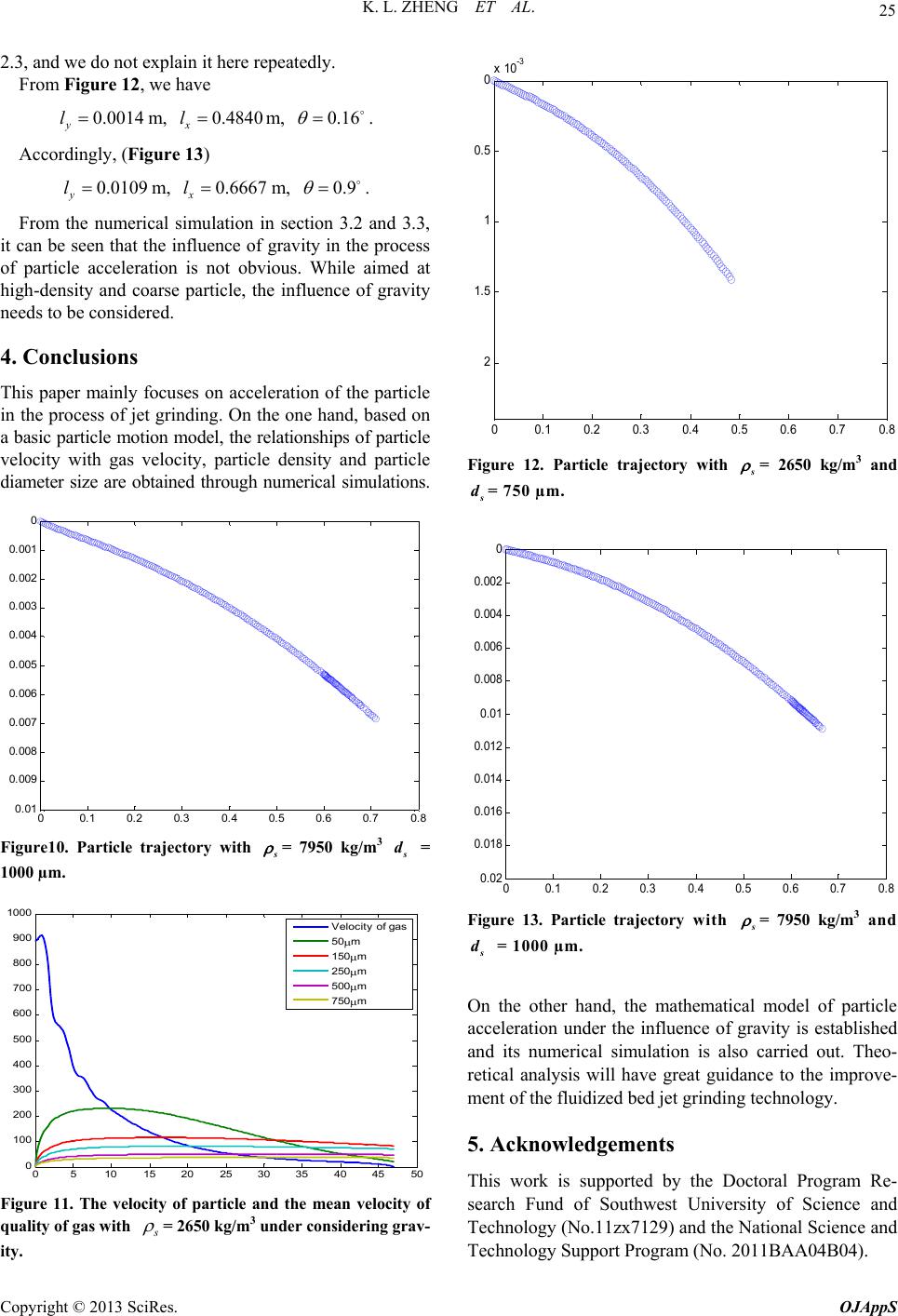 K. L. ZHENG ET AL. 25 2.3, and we do not explain it here repeatedly. From Figure 12, w e h ave 0.0014 y lm, 0.4840 x lm, 0.16 . Accordingly, (Figure 13) 0.0109 y lm, m, . 0.6667 x l0.9 From the numerical simulation in section 3.2 and 3.3, it can be seen that the influence of ity in th of particle acceleration is not obvious. While aimed at hi acceleration of the particle grinding. On the one hand, based on on model, the relationships of particle grave process gh-density and coarse particle, the influence of gravity needs to be considered. 4. Conclusions This paper mainly focuses on in the process of jet a basic particle moti velocity with gas velocity, particle density and particle diameter size are obtained through numerical simulations. 00.1 0.2 0.30.4 0.5 0.6 0.7 0.8 0 0.001 0.002 0.003 0.004 0.005 0.006 0.007 0.008 0.009 0.01 Figure10. Particle trajectory with s = 7950 kg/m3 = 1000 µm. s d 05 10 15 20 2530 3540 4550 0 100 200 300 400 500 600 700 800 900 1000 Vel oci ty of gas 50 m 150 m 250 m 500 m 750 m Figure 11. The velocity of particle and the mean velocity of quality of gas with s 00.1 0.2 0.30.4 0.5 0.6 0.70.8 0x 10 -3 0.5 1 1.5 2 Figure 12. Particle trajectory with s = 2650 kg/m3 and = 750 µm. s d 00.1 0.2 0.30.4 0.5 0.6 0.70.8 0 = 2650 kg/m3 under considering grav- ity. 0. 002 0. 004 0. 006 0. 008 0. 01 0. 012 0. 014 0. 016 0. 018 0. 02 Figure 13. Particle trajectory with s = 7950 kg/m3 and = 1000 µm. Onnd, the mathematical model of particle acceleration r the influence of gravity is established nd its numerical simulation is also carried out. Theo- Re- University of Science and nd the National Science and s d the other ha unde a retical analysis will have great guidance to the improve- ment of the fluidized bed jet grinding technology. 5. Acknowledgements This work is supported by the Doctoral Program search Fund of Southwest Technology (No.11zx7129) a Technology Support Program (No. 2011BAA04B04). Copyright © 2013 SciRes. OJAppS  K. L. ZHENG ET AL. Copyright © 2013 SciRes. OJAppS 26 ol 34, No. 1, 1983, pp. 81-86. doi:10.1016/00 REFERENCES [1] W. Gregor and K. Schönert, “The Efficiency of the Parti- cle Acceleration in a Jet Pipe,” Powder Technology, V. 32-5910(83)87031-4 oropayev and O. Vasilk[2] D. Eskin, S. Vov, “Simulation of 0146-1 Jet Milling,” Powder Technology, Vol. 105, No. 1-3, 1999, pp. 257-265. doi:10.1016/S0032-5910(99)0 ering Estimations of[3] D. Eskin and S. Voropayev, “Engine Opposed Jet Milling Efficiency,” Minerals Engineering, Vol. 14, No. 10, 2001, pp.1161-1175. doi:10.1016/S0892-6875(01)00134-0 [4] S. M. Tasirin and D. Geldart, “Experimental Investigation on Fluidized Bed Jet Grinding,” Powd 105, No. 1-3, 1999, pp. 333-341. er Technology, Vol. doi:10.1016/S0032-5910(99)00156-4 [5] J. Kolacz, “Process Efficiency Aspects for Jet Mill Plant Operation,” Minerals Engineering, Vol. 17 2004, pp. 1293-1296. , No. 11-12, doi:10.1016/j.mineng.2004.07.004 [6] H. Chen, “Study and Application of the Fluidized Bed Jet Grinding and Classifying Technolog Sichuan University, Chengdu, 2007y,” Ph. D. Thesis, . |