

Paper Menu >>
Journal Menu >>
 Open Journal of Applied Sciences, 2013, 3, 15-20 doi:10.4236/ojapps.2013.31B1004 Published Online April 2013 (http://www.scirp.org/journal/ojapps) Geometrically Exact Theory of Contact Interactions – Further Developments and Achievements Alexander Konyukhov1, Karl Schweizerhof2 1Department of Mechanical Engineering, University of Nottingham-Ningbo China, Ningbo, People’s Republic of China 2Institute of Mechanics, Karlsruhe Institute of Technology, Karlsruhe, Germany Email: [email protected], [email protected] Received 2013 ABSTRACT The focus of the current contribution is on the development of the unified geometrical formulation of contact algorithms in a covariant form for various geometrical situations of contacting bodies leading to contact pairs: surface-to-surface, line-to-surface, point-to-surface, line-to-line, point-to-line, point-to-point. The construction of the corresponding com- putational contact algorithms are considered in accordance with the geometry of contact bodies in a covariant form. These forms can be easily discredited within finite element methods independently of order of approximation and, therefore, the result is straightforwardly applied within iso-geometric finite element methods. This ap proach is recently became known as geometrically exact theory of contact interaction [10]. Application for contact between bodies with iso- and anisotropic surface, for contact between cables and curvilinear beams as well as recent development for contact between cables and bodies is straightforward. Recent developments include the improvement of the curve-to-surface (deformable) contact algorithm. Keywords: Contact Finite Element; Surface-to-Surface Contact; Beam-to-Beam Contact; Curve-to-Surface Contact; Covarian t Approach; Geo metrically Exact Contact D es criptio n 1. Introduction Computational contact mechanics has become a sepa- rated branch of computational mechanics during the last decades. A fairly large number of publications including several monographs on computational contact mechanics have been devoted to this development. Modelling of contact interactions became fairly standard in numerous finite element software packages available for engineers. Various aspects of the numerical solution such enforce- ment of contact conditions, possibility to apply high or- der and iso-geometric type of approximation has been considered. One of the important aspects, even though being obvious for everyone, – the geometrical treatment of the contact – is often remains hidden inside the com- putational algorithm. Contact interaction from a geomet- rical point of view can be seen as interaction between deformable surfaces possessing various geometrical fea- tures such as surfaces, edges and vertexes, therefore, geometrical approaches can be exploited. During the last ten years these approaches has formed a basis of the geometrically exact theory of contact interaction, recently published in monograph of Konyukhov and Schweizerhof [10] by Springer. Current contribution is aimed on the overview of this theory with concentration on recent developments. 2. Geometrical Approaches in Computa- tional Contact Mechanics Only a very few publications are devoted to geometrical issues of contact interaction aiming at the final computa- tional models. Gurtin, Wiessmueller and Larche [2] (1998) considered surface tractions on curvilinear interfaces describing them from a geometrical point of view. Jones and Papadopoulos [5] (2006) considered contact de- scribing various mappings from the reference configura- tion employing the Lie derivative. Laursen and Simo [12] (1993) described some contact parameters via geometri- cal surface parameters.Heegaard and Curnier [3] (1996) considered geometrical properties of slip operators. Consistent Linearization The iterative solution of Newton type is a standard way to obtain the solution in the computational contact me- chanics. However, one of the difficult parts is to obtain the full derivative of the functional which is necessary for the fast Newton solver – this procedure is known as linearization. Two approaches for linearization of the final functional representing the work of contact tractio ns can be distinguished in order to obtain co nsistent tangent matrices. The direct approach follows the following se- Copyright © 2013 SciRes. OJAppS  A. KONYUKHOV, K. SCHWEIZERHOF 16 quence: functional – discretization – linearization and the covariant approach follows the rule: functional – lin- earization – discretization.The direct approach, histori- cally motivated by the development of the finite element method, assumes that the discretization is then involved in the process and the linearization is provided with re- gard to the displacement vector u and, therefore, of the discretized system. This leads to the final results con- taining a set of approximation matrices: for surface to surface contact it is described in Wriggers and Simo [16] (1985), Parisch and Luebbing [14](1997), Peric and Owen [15] (1992), Laursen and Simo[12] (1993), for anisot- ropic friction in Alart and Heege [1 ] (199 5), for beam-to- beam type contact in Zavarise and Wriggers [17](2000), Litewka and Wriggers [13] (2002).The complexity in the derivation for curved contact interfaces led to the use ofa code containing an automatic derivation with mathe- matical software, see Heegeand Alart [4] (1996), Krstu- lovic-Opara,Wriggers and Korelc [11] (2002) and other researchers. Open questions and drawbacks of the direct approach can be summarized as follows: A closed form for tangent matrices is available only for linear approximations of surfaces. The structure of the derived matrices is very com- plicated and often not transparent. There is no clear in- terpretation of each part possible. A specification of complex contact interface laws with properties explicitly depending on the surface ge- ometry (e.g. arbitrary a ni s otropy) is not p ossible. A contact description of many geometrical features (curved line-to-curved line, curved line-to-surface) is almost not possible because of the necessity of convec- tive surface coordinates. The fully covariant approach, however, assumes only a local coordinate system associated with the deformed continuum (convective coordinates) and requires exten- sive application of covariant operations (derivatives etc.). This approach historically appeared with the considera- tion of convective variables arising from the surface ap- proximations directly for contact traction and displace- ments: see Simoand Laursen and Simo [12] (1993). Two convective variables1 x , 2 x in a surface covariant basis are used as tangential measure. This approach has many advantages: objectivity is straightforwardly observed because the surface coordinates are used; geometrical interpretation of a measure – line on a surface; geometrical interpretation of a line arized meas- ure – relative tangent velocity of a contact point; the number of history variables is minimal (two for surface interaction); A complex constitutive law for tangent interaction can be easily formulated in a robust form for computa- tion. Expressions for contact tangent matrices are by far less complex within the fully covarian t approach than for direct approach. A fully covariant approach, though, is in tended for the finite element method, but does not assume approxima- tions from the beginning and it serves to describe all n- ecessary for solution parameters based on the geometry of the contacting bodies in the local coordinate system. The method, however, requires a lot of preliminary tran- sformations based on differential geometry of contacting objects (surfaces or even curves) and extensive applica- tion of the tensor analysis especially for differential op- eration and linearization. 3. Development of the Geometrically Exact Theory The development of the ideas started from formulation of contact algorithms in covariant form for non-frictional contact in [6], then for frictional contact in [7]. The basement of the geometrically exact theory of contact interaction with more references is summarized in monograph of Konyukhov and Schweizerhof [10]. In order to formulate goals and describe the development of geometrically exact theory we consider a model contact problem with two bodies possessing smooth surfaces as well as various geometrical features such as edges and vertexes – an example of this is a banana and a knife shown in Figure 1. Considering all possible geometrical situations in which knife and banana can contact each other, the following hierarchical sequence of contact pairs is appearing: 1. Point to point contact pair 2. Point to curve contact pair 3. Point to surface contact pair 4. Curve to curve contact pair 5. Curve to surface contact pair 6. Surface to surface contact pair Figure 1. Contact between bodies with complex geometry. Various geometrical situations are possible: Surface-To- Surface, Curve-To-Surface, Point-To-Curve, Curve-To- Curve and Point-To-Point. Copyright © 2013 SciRes. OJAppS 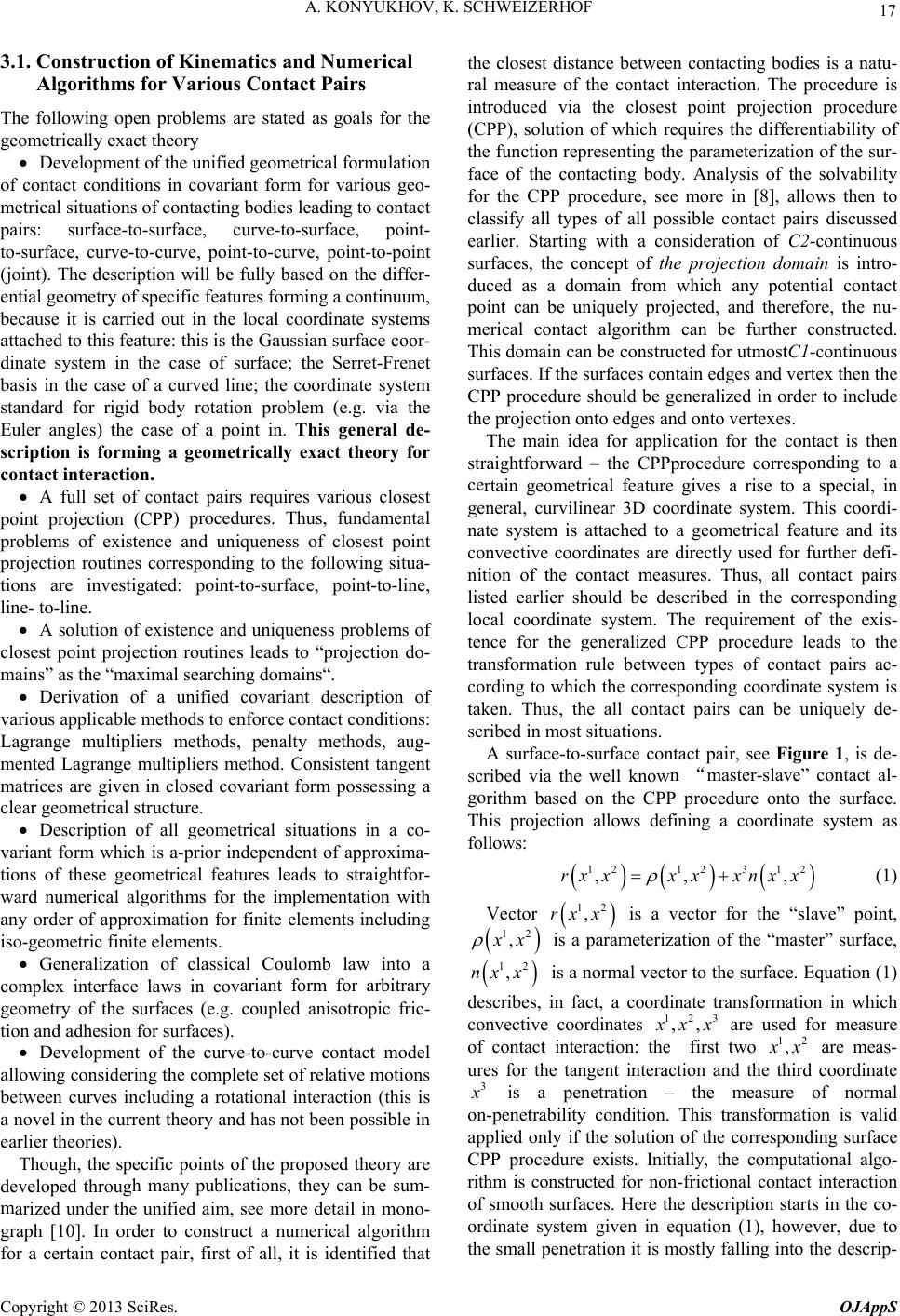 A. KONYUKHOV, K. SCHWEIZERHOF 17 3.1. Construction of Kinematics and Numerical Algorithms for Various Contact Pairs geom riant form for various geo- ) procedures. Thus, fundamental ection routines leads to “projection do- conditions: r independent of approxima- ariant form for arbitrary set of relative motions h many publications, they can be sum- m nding to a ce n “master-slave” contact al- go The following open problems are stated as goals for the etrically exact theory Development of the unified geometrical formulation of contact conditions in cova metrical situations of contacting bodies leading to contact pairs: surface-to-surface, curve-to-surface, point- to-surface, curve-to-curve, point-to-curve, point-to-point (joint). The description will be fully based on the differ- ential geometry of specific features forming a continuum, because it is carried out in the local coordinate systems attached to this feature: this is the Gaussian surface coor- dinate system in the case of surface; the Serret-Frenet basis in the case of a curved line; the coordinate system standard for rigid body rotation problem (e.g. via the Euler angles) the case of a point in. This general de- scription is forming a geometrically exact theory for contact interaction. A full set of contact pairs requires various closest point projection (CPP problems of existence and uniqueness of closest point projection routines corresponding to the following situa- tions are investigated: point-to-surface, point-to-line, line- to-line. A solution of existence and uniqueness problems of closest point proj mains” as the “maximal searching domains“. Derivation of a unified covariant description of various applicable methods to enforce contact Lagrange multipliers methods, penalty methods, aug- mented Lagrange multipliers method. Consistent tangent matrices are given in closed covariant form possessing a clear geometrical structure. Description of all geometrical situations in a co- variant form which is a-prio tions of these geometrical features leads to straightfor- ward numerical algorithms for the implementation with any order of approximation for finite elements including iso-geometric finite elements. Generalization of classical Coulomb law into a complex interface laws in cov geometry of the surfaces (e.g. coupled anisotropic fric- tion and adhesion for surfaces). Development of the curve-to-curve contact model allowing considering the co mplete between curves including a rotational interaction (this is a novel in the current theory and has not been possible in earlier theories). Though, the specific points of the proposed theory are developed throug arized under the unified aim, see more detail in mono- graph [10]. In order to construct a numerical algorithm for a certain contact pair, first of all, it is identified that the closest distance between contacting bodies is a natu- ral measure of the contact interaction. The procedure is introduced via the closest point projection procedure (CPP), solution of which requires the differentiability of the function represen ting the parameterization of the sur- face of the contacting body. Analysis of the solvability for the CPP procedure, see more in [8], allows then to classify all types of all possible contact pairs discussed earlier. Starting with a consideration of C2-continuous surfaces, the concept of the projection domain is intro- duced as a domain from which any potential contact point can be uniquely projected, and therefore, the nu- merical contact algorithm can be further constructed. This domain can be constructed for utmostC1-continuous surfaces. If the surfaces contain edges and vertex then the CPP procedure should be generalized in order to include the projection onto edges and onto vertexes. The main idea for application for the contact is then straightforward – the CPPprocedure correspo rtain geometrical feature gives a rise to a special, in general, curvilinear 3D coordinate system. This coordi- nate system is attached to a geometrical feature and its convective coordinates are directly used for further defi- nition of the contact measures. Thus, all contact pairs listed earlier should be described in the corresponding local coordinate system. The requirement of the exis- tence for the generalized CPP procedure leads to the transformation rule between types of contact pairs ac- cording to which the corresponding coordinate system is taken. Thus, the all contact pairs can be uniquely de- scribed in most situations. A surface-to-surface contact pair, see Figure 1, is de- scribed via the well know rithm based on the CPP procedure onto the surface. This projection allows defining a coordinate system as follows: 12123 12 ,, ,rx xx xxnxx (1) 12 ,rx x Vector is a vector for the “slave” point, 12 , x x is a parameterization of the “master” surface, nx x 12 , is a normal vector to the surface. Equation (1) in fact, a coordinate transformation in which e coordinates 123 ,, describes, convectiv x xx are used for measure of contact interaction: the first two 12 , x x are meas- ures for the tangent internd the third coordinate 3action a x is a penetration – the measure of normal on-penetrability condition. This transformation is valid lied only if the solution of the corresponding surface CPP procedure exists. Initially, the computational algo- rithm is constructed for non-frictional contact interaction of smooth surfaces. Here the description starts in the co- ordinate system given in equation (1), however, due to the small penetration it is mostly falling into the descrip- app Copyright © 2013 SciRes. OJAppS  A. KONYUKHOV, K. SCHWEIZERHOF 18 tion in the Gaussian surface coordinate system arising from the surface parameterization. All contact parameters such as sliding distance and tangent forces are described then on the tangent plane. The linearization procedure is given in a form of covariant derivatives. This leads to a closed form of the tangent matrix subdivided into a main, a rotational and a curvature parts. The evolution equation for contact tangent tractions should be taken in a form of covariant derivatives in order to solve the problem with a Coulomb friction. 3.1.1. Developments within the Theory – Possibility of the Iso-geometric Modeling therefor stem and, of course, ry – Possibility of Anisotropic Contact Interfaces from nisotropic region hm If the projection onto the surface does not exist the ce of low Since all algorithms are formulated in covariant and, e, independent on coordinate sy on types of approximations, the high-order and iso-geo- metric formulation is just straightforwardly applicable. Both Mortar methods with penalty regularization and with Lagrange multipliers are applied. Even the anisotropic enrichment of the approximation keeping mixed linear and high order approximation in one finite element is possible. As a result a contact layer element allowing anisotropic p−refinement is created. A good correlation with the analytical Hertz problem is achieved even within a single contact layer element. 3.1.2. Developments within the Theo A systematic generalization of a contact interface law the Coulomb friction law into the a in a covariant form including various knownvisco-elasto- plastic mechanical models is derived. Thus, a coupled model including anisotropy for tangential adhesion and for friction is obtained. These models formulated via the principle of maximum dissipation in a rate form. Finally, the computational model is derived via the application of the return-mapping scheme to the incremental form. As a result a frictional force is derived in a closed form in- cluding both, the adhesion and the friction tensors. The structure of structural and friction tensors are derived for various types of anisotropy: a uniform orthotropic of a plane given by the spectral decomposition, a non-uni- form orthotropic of a plane inherited with the polar coor- dinate system and a spiral orthotropic of a cylindrical surface. The update algorithm for history variables is developed for the arbitrary coupled anisotropy. The geometrical interpretation of the return-mapping and the update algorithm is considered via the ellipse on the tan- gent plane onto which a contact slave point is projected in the case of elastic sticking behaviour. 3.1.3. Curve - T o- Cur ve Contact Algoritn it is necessary to consider step-by-step the existener in hierarchy CPP i.e. onto the curve and then onto the point. The solution of generalized CPP including all geo- metrical exists in case of regular geometry. Consideration of the existence of the CPP procedure for curve allows defining then the point-to-curve contact algorithm used for the curve-to-surface contact pair in the corresponding curve Serret-Frenet coordinate system, which is con- structed as follows: ,,() ,rsrs res (2) Here, the vector ,,rsr sis a param ector des is describing from the surface, eterization o cu a “slave” point f the “master” rve edge; a unit vcribing the shortest distance ,()cos ()sines ss is written via the unit normal s and bi-normal () s of the curve. The sures: r – for normal interacti – for tangential interaction; convective coordis mea on; s nates used a – for rota- tional interaction. The Curve-To-Curve contact pair re- quires the projection on both curves, therore, there is no classical “master” and “slave” and both curves are equivalent. For the description one of two coordinate systems is taken assigned to the I-th curve: 21 111111 (,, )(),srsre s ef (3) Here, the vector 21 1 ,,sr e second curve is a vector d contact point of th,escribing a 1 s is a pa tio rameteriza- n of the first curvtor describing the short- est distance e; a unit vec 111 ,es is written agaivia the unit normal and bi-normal vector s of the first curve as in equation (2). Equation (3) es the motion of the second contact point in the coordinate system attached to the first curve. Description is symmetric with respect to the choice of the curve choice 1 to 2. The Point-To-Point contact pair is described then in a coordinate system sta n describ ndard for rigid body rotation prob- le the Closest Point Projection (C n curves can be considered con- m (e.g. via the Euler angels), however in the contact situation is very seldom case, and in computations it is rather improbable unless specially treated, and therefore, because of the numerical rounding error would fall into other contact pair types. The construction of the curve-to-curve contact pair begins consistently with PP) procedure providing a shortest distance between curves as a natural measure of normal contact interaction. The CPP procedure leads to a special local coordinate system in which convective coordinates are used directly as measures of contact interaction between curves: nor- mal, tangential and rotational. Several achievements appear to be novel for the curve-to-curve contact description: consideration of any relative motion separately for each curve is possible; Rotational interactions including corresponding ro- tational moments betwee sistently. Copyright © 2013 SciRes. OJAppS 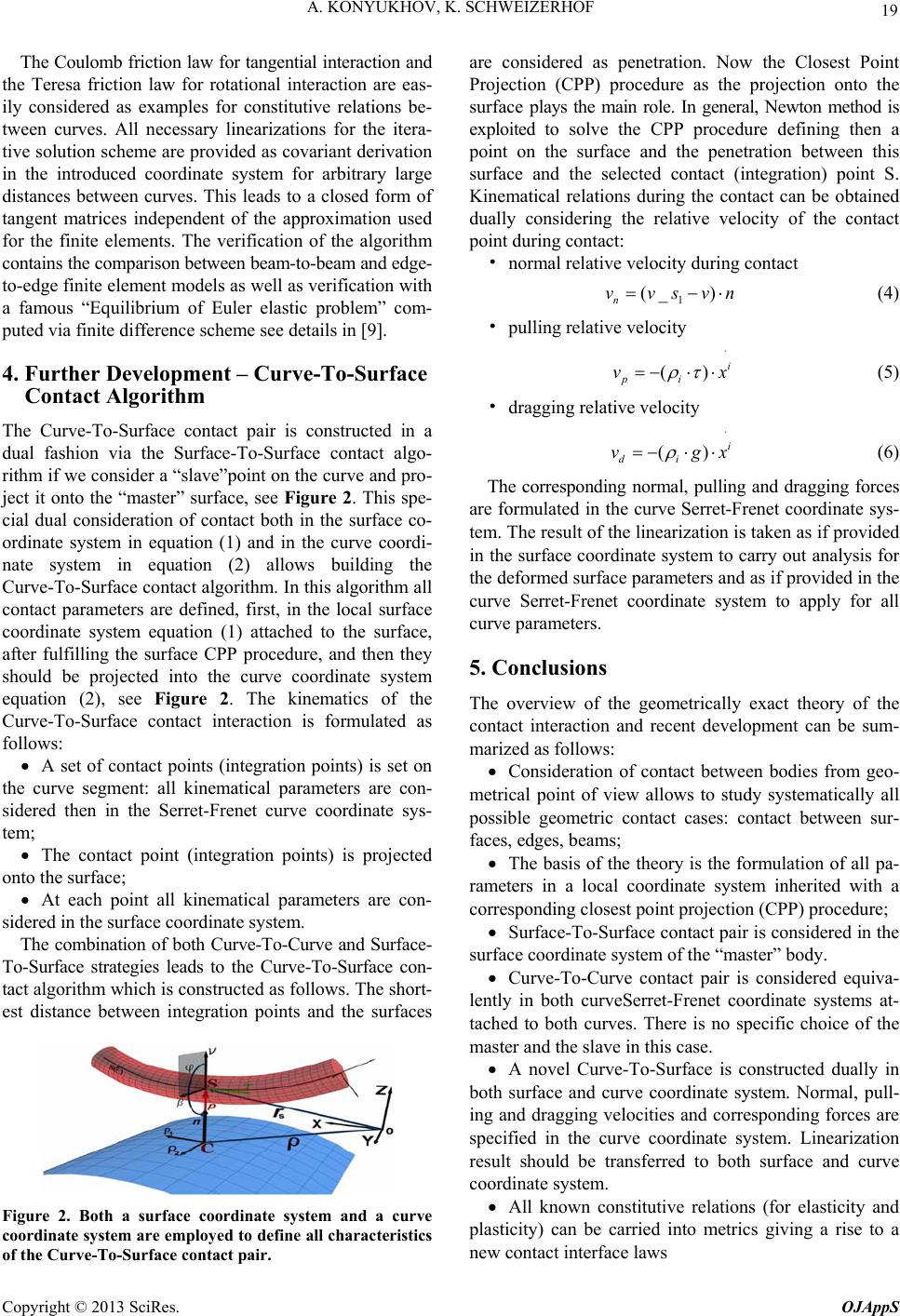 A. KONYUKHOV, K. SCHWEIZERHOF 19 The Coulomb friction law for tangential interaction and the Teresa friction law for rotational interaction are eas- ily ac Contact Algorithm duce-To-Surface contact algo- segment: all kinematical parameters are con- he surface; ace coordinate system. o-Surface con- ta considered as examples for constitutive relations be- tween curves. All necessary linearizations for the itera- tive solution scheme are provided as covariant derivation in the introduced coordinate system for arbitrary large distances between curves. This leads to a closed form of tangent matrices independent of the approximation used for the finite elements. The verification of the algorithm contains the comparison between beam-to-beam and edge- to-edge finite element models as well as verification with a famous “Equilibrium of Euler elastic problem” com- puted via finite difference scheme see details in [9]. 4. Further Development – Curve-To-Surfe The Curve-To-Surface contact pair is constructed in a al fashion via the Surfa rithm if we consider a “slave”point on the curve and pro- ject it onto the “master” surface, see Figure 2. This spe- cial dual consideration of contact both in the surface co- ordinate system in equation (1) and in the curve coordi- nate system in equation (2) allows building the Curve-To-Surface contact algorithm. In this algorithm all contact parameters are defined, first, in the local surface coordinate system equation (1) attached to the surface, after fulfilling the surface CPP procedure, and then they should be projected into the curve coordinate system equation (2), see Figure 2. The kinematics of the Curve-To-Surface contact interaction is formulated as follows: A set of contact points (integration points) is set on the curve sidered then in the Serret-Frenet curve coordinate sys- tem; The contact point (integration points) is projected onto t At each point all kinematical parameters are con- sidered in the surf The combination of both Curve-To-Curve and Surface- To-Surface strategies leads to the Curve-T ct algorithm which is constructed as follows. The short- est distance between integration points and the surfaces Figure 2. Both a surface coordinate system and a cu coordinate system are employ ed to define all characte of the Curve-To-Surface contact pair. n rve stics ri are considered as penetration. Now the Closest Point Projection (CPP) procedure as the projection onto the surface plays the main role. In general, Newton method is exploited to solve the CPP procedure defining then a point on the surface and the penetration between this surface and the selected contact (integration) point S. Kinematical relations during the contact can be obtained dually considering the relative velocity of the contact point during contact: • normal relative velocity during contact n v1 (_ )vsv (4) x • pulling relative velocity ( pi v ) i (5) • dragging relative velocity x() di vg i (6) The corresponding normal, pulling and dragging forces are formulated in the curve Serret- te The overview of the geometrically exact theory of the and recent development can be sum- laws Frenet coordinate sys- m. The result of the linearization is taken as if provided in the surface coordinate system to carry out analysis for the deformed surface parameters and as if provided in the curve Serret-Frenet coordinate system to apply for all curve parameters. 5. Conclusions contact interaction marized as follows: Consideration of contact between bodies from geo- metrical point of view allows to study systematically all possible geometric contact cases: contact between sur- faces, edges, beams; The basis of the theory is the formulation of all pa- rameters in a local coordinate system inherited with a corresponding closest point projectio n (CPP ) proce d ure; Surface-To-Surface contact pair is considered in the surface coordinate system of the “master” body. Curve-To-Curve contact pair is considered equiva- lently in both curveSerret-Frenet coordinate systems at- tached to both curves. There is no specific choice of the master and the slave in this case. A novel Curve-To-Surface is constructed dually in both surface and curve coordinate system. Normal, pull- ing and dragging velocities and corresponding forces are specified in the curve coordinate system. Linearization result should be transferred to both surface and curve coordinate system. All known constitutive relations (for elasticity and plasticity) can be carried into metrics giving a rise to a new contact interface Copyright © 2013 SciRes. OJAppS 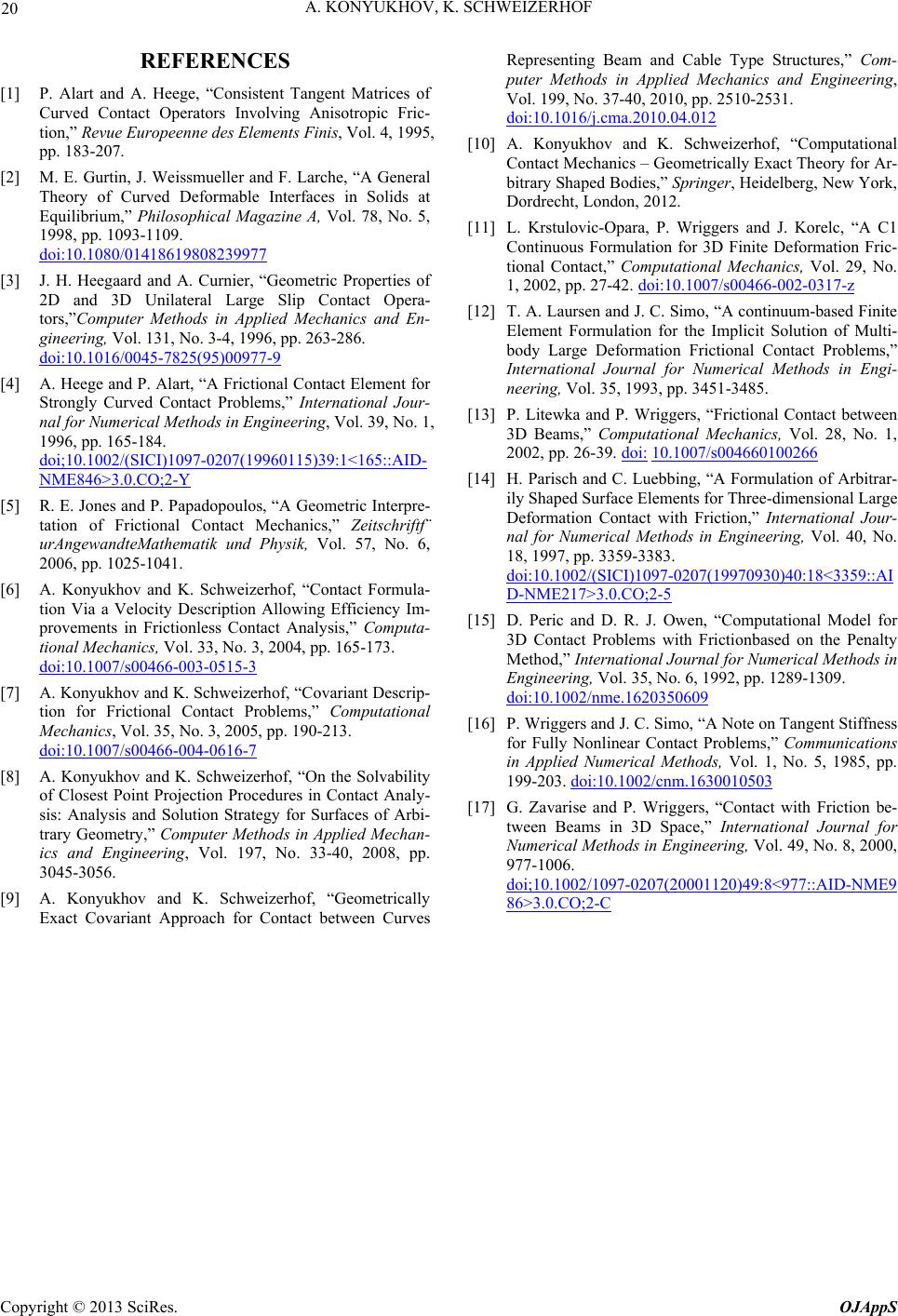 A. KONYUKHOV, K. SCHWEIZERHOF Copyright © 2013 SciRes. OJAppS 20 rs Involving Anisotropic Fric- tion,” Revue Europeenne des Elements Finis, Vol. 4, 1995 pp. 183-207. [2] M. E. Gurtin, che, “A General 418619808239977 REFERENCES [1] P. Alart and A. Heege, “Consistent Tangent Matrices of Curved Contact Operato, J. Weissmueller and F. Lar Theory of Curved Deformable Interfaces in Solids at Equilibrium,” Philosophical Magazine A, Vol. 78, No. 5, 1998, pp. 1093-1109. doi:10.1080/01 3-4, 1996, pp. 263-286. [3] J. H. Heegaard and A. Curnier, “Geometric Properties of 2D and 3D Unilateral Large Slip Contact Opera- tors,”Computer Methods in Applied Mechanics and En- gineering, Vol. 131, No. doi:10.1016/0045-7825(95)00977-9 15)39:1<165::AID- [4] A. Heege and P. Alart, “A Frictional Cont act Element for Strongly Curved Contact Problems,” International Jour- nal for Numerical Methods in Engineering, Vol. 39, No. 1, 1996, pp. 165-184. doi;10.1002/(SICI)1097-0207(199601 NME846>3.0.CO;2-Y [5] R. E. Jones and P. Papadopoulos, “A Geometric Interpre- tation of Frictional Contact Mechanics,” Zeitschriftf¨ urAngewandteMathem 2006, pp. 1025-1041. [6] A. Konyukhov and K. atik und Physik, Vol. 57, No. 6, Schweizerhof, “Contact Formula- 3-0515-3 tion Via a Velocity Description Allowing Efficiency Im- provements in Frictionless Contact Analysis,” Computa- tional Mechanics, Vol. 33, No. 3, 2004, pp. 165-173. doi:10.1007/s00466-00 [7] A. Konyukhov and K. Schweizerhof, “Covariant Descrip- tion for Frictional Contact Problems,” Computational Mechanics, Vol. 35, No. 3, 2005, pp. 190-213. doi:10.1007/s00466-004-0616-7 [8] A. Konyukhov and K. Schweizerhof, “On the Solvability , 2008, pp. of Closest Point Projection Procedures in Contact Analy- sis: Analysis and Solution Strategy for Surfaces of Arbi- trary Geometry,” Computer Methods in Applied Mechan- ics and Engineering, Vol. 197, No. 33-40 3045-3056. [9] A. Konyukhov and K. Schweizerhof, “Geometrically Exact Covariant Approach for Contact between Curves Representing Beam and Cable Type Structures,” Com- puter Methods in Applied Mechanics and Engineering, Vol. 199, No. 37-40, 2010, pp. 2510-2531. doi:10.1016/j.cma.2010.04.012 [10] A. Konyukhov and K. Schweizerhof, “Co Contact Mechanics – Geometricmputational ally Exact Theory for Ar- r 3D Finite Deformation Fric- bitrary Shaped Bodies,” Springer, Heidelberg, New York, Dordrecht, London, 2012. [11] L. Krstulovic-Opara, P. Wriggers and J. Korelc, “A C1 Continuous Formulation fo tional Contact,” Computational Mechanics, Vol. 29, No. 1, 2002, pp. 27-42. doi:10.1007/s00466-002-0317-z [12] T. A. Laursen and J. C. Simo, “A continuum-based Finite Element Formulation for the Implicit Solution of Multi- , Vol. 28, No. 1, body Large Deformation Frictional Contact Problems,” International Journal for Numerical Methods in Engi- neering, Vol. 35, 1993, pp. 3451-3485. [13] P. Litewka and P. Wriggers, “Frictional Contact between 3D Beams,” Computational Mechanics 2002, pp. 26-39. doi: 10.1007/s004660100266 [14] H. Parisch and C. Luebbing, “A Formulation of Arbitrar- ily Shaped Surface Elements for Three-dimensional Large Deformation Contact with Friction,” International Jour- nal for Numerical Methods in Engineering, Vol. 40, No. 18, 1997, pp. 3359-3383. doi:10.1002/(SICI)1097-0207(19970930)40:18<3359::AI D-NME217>3.0.CO;2-5 [15] D. Peric and D. R. J. Owen, “Computational Model for 3D Contact Problems wi th Frictionbased on the Penalty Method,” International Journal for Numerical Methods in Engineering, Vol. 35, No. 6, 1992, pp. 1289-1309. doi:10.1002/nme.1620350609 [16] P. Wriggers and J. C. Simo, “A Note on Tangent Stiff for Fully Nonlinear Contact Prness oblems,” Communications in Applied Numerical Methods, Vol. 1, No. 5, 1985, pp. 199-203. doi:10.1002/cnm.1630010503 [17] G. Zavarise and P. Wriggers, “Contact with Friction be- tween Beams in 3D Space,” International Journal for Numerical Methods in Engineering, Vol. 49, No. 8, 2000, 977-1006. doi;10.1002/1097-0207(20001120)49:8<977::AID-NME9 86>3.0.CO;2-C |