

Paper Menu >>
Journal Menu >>
 Open Journal of Applied Sciences, 2013, 3, 278-284 doi:10.4236/ojapps.2013.33035 Published Online July 2013 (http://www.scirp.org/journal/ojapps) Research of Water Response under the Action of the Infrared Human Body Radiation by Water Conductometric Sensors Gennady G. Shishkin1, Igor M. Ageev1, Yury M. Rybin1, Alexei G. Shishkin2 1Moscow Aviation Institute, National Research University, Moscow, Russia 2Moscow State University, Moscow, Russia Email: [email protected] Received April 26, 2013; revised May 26, 2013; accepted June 2, 2013 Copyright © 2013 Gennady G. Shishkin et al. This is an open access article distributed under the Creative Commons Attribution License, which permits unrestricted use, distribution, and reproduction in any medium, provided the original work is properly cited. ABSTRACT Non-equilibrium thermal and biothermal radiation generated by heated solid materials and hematothermal living organ- isms are studied by water conductometric sensors. Engineering aspects and physical features of developed water con- ductometric sensors are given. Procedure and measuring technique are described. Our experiments show the anomalous behavior of water conductivity and associated differential parameters under water heating by biological objects com- pared with traditional heating sources. Water response to human action strongly depends on psychophysiological and psychoemotional state of the person. Moreover the responses to the action by left and right human hands are substan- tially different and as a rule are specific to the gender. The possible physicochemical mechanisms of such anomalous water behavior are studied. It is suggested that the observed effects are associated with resonant excitation of vibra- tion-rotation energy levels of water under the influence of bioradiation generated by human organism consisting of ap- proximately 70% water. The results obtained have good perspectives for future applications in different fields of human activity. Keywords: Water Electrical Conductivity; Conductometric Sensors; Infrared Human Body Radiation; Bioradiation 1. Introduction At present there is a certain amount of experimental data demonstrating that many electrophysical properties of matter are dependent not only on temperature magnitude but on type of heating source as well [1-4]. This problem is connected with emissivity of heated bodies [1] that can vary within wide limits. It was shown [2] that day long water exposure to copper radiation at room temperature led to the changes of monochromatic coefficient of water transmittance within 6% - 8% in the spectral range of 3000 - 3700 cm−1. The changes in water electrical con- ductivity under the heating by various metallic and di- electric materials are of about the same order [2-4]. The human body is believed to have their own radia- tion which emits into surrounding body space [5]. The existence of human radiation is identified as electromag- netic field generated by and contained within the bio- logical system of a body [6]. The vibration of electro- magnetic field generated by human body is referred as a frequency radiation of human body, which emits their radiation around the body due to its electromagnetic ac- tivities. The radiation of the human body encircles the physical body as a sphere of radiation and vibrates at their own characteristic of frequencies [7]. The experiments in [5] have shown that the character- istic of human body radiation frequency can be even used to classify the gender. The data presented in [8] indicate that there are marked variations in the thermal properties of human skin as reported by various investigators and that the op- tical properties of the skin are functionally related to the water content of the skin and vary as the site of interest is changed. Spectral radiative properties of the human body were studied experimentally in [9] in the region from the ul- traviolet to the far-infrared to analyze the thermal re- sponse of the human body exposed to solar radiation and infrared radiation. Fairly large values for hemispherical reflectances are observed in the visible and near-infrared regions but very small values for hemispherical reflec- tances are observed in the infrared region. The absorption Copyright © 2013 SciRes. OJAppS 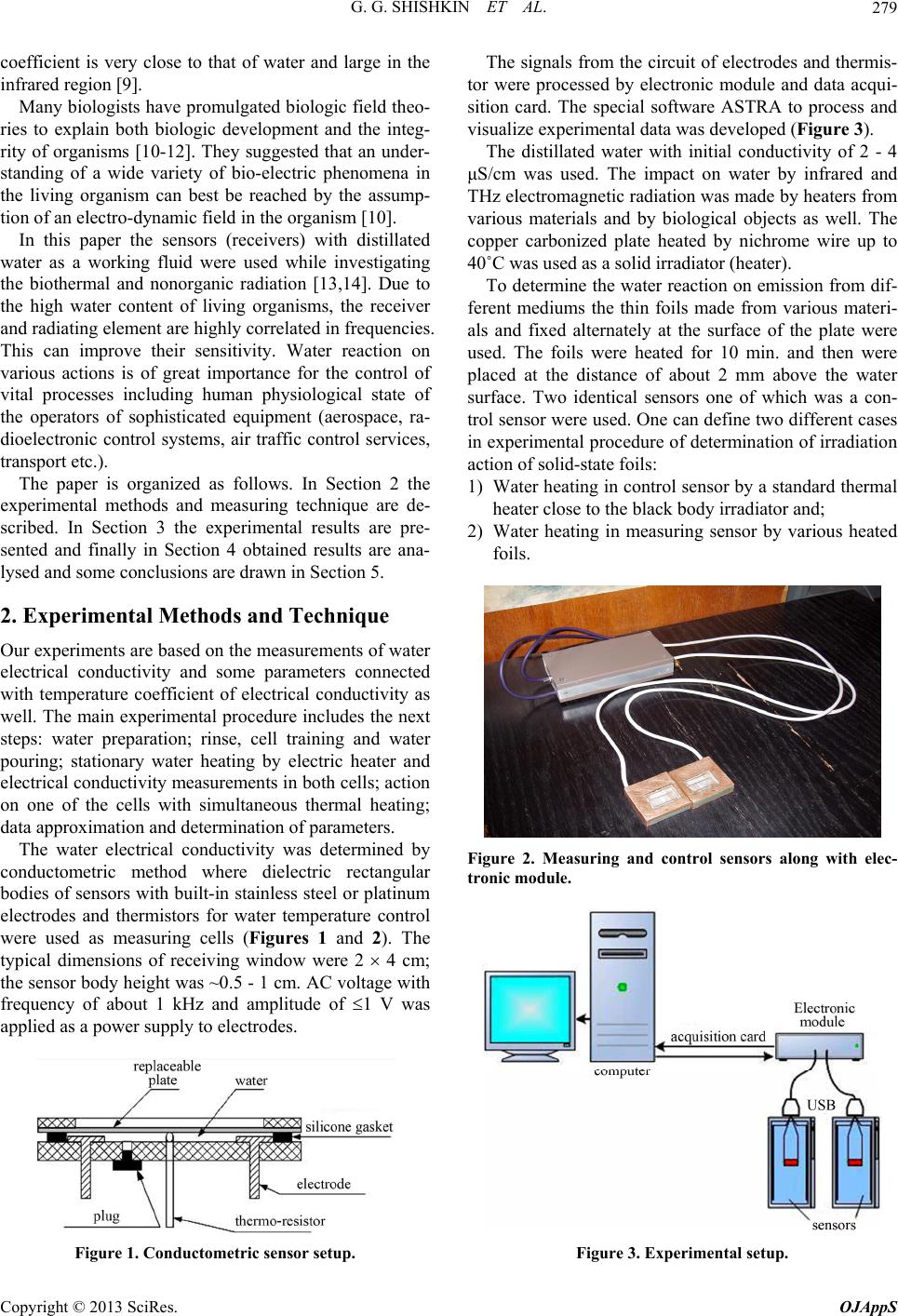 G. G. SHISHKIN ET AL. 279 coefficient is very close to that of water and large in the infrared region [9]. Many biologists have promulgated biologic field theo- ries to explain both biologic development and the integ- rity of organisms [10-12]. They suggested that an under- standing of a wide variety of bio-electric phenomena in the living organism can best be reached by the assump- tion of an electro-dynamic field in the organism [10]. In this paper the sensors (receivers) with distillated water as a working fluid were used while investigating the biothermal and nonorganic radiation [13,14]. Due to the high water content of living organisms, the receiver and radiating element are highly correlated in frequencies. This can improve their sensitivity. Water reaction on various actions is of great importance for the control of vital processes including human physiological state of the operators of sophisticated equipment (aerospace, ra- dioelectronic control systems, air traffic control services, transport etc.). The paper is organized as follows. In Section 2 the experimental methods and measuring technique are de- scribed. In Section 3 the experimental results are pre- sented and finally in Section 4 obtained results are ana- lysed and some conclusions are drawn in Section 5. 2. Experimental Methods and Technique Our experiments are based on the measurements of water electrical conductivity and some parameters connected with temperature coefficient of electrical conductivity as well. The main experimental procedure includes the next steps: water preparation; rinse, cell training and water pouring; stationary water heating by electric heater and electrical conductivity measurements in both cells; action on one of the cells with simultaneous thermal heating; data approximation and determination of parameters. The water electrical conductivity was determined by conductometric method where dielectric rectangular bodies of sensors with built-in stainless steel or platinum electrodes and thermistors for water temperature control were used as measuring cells (Figures 1 and 2). The typical dimensions of receiving window were 2 4 cm; the sensor body height was ~0.5 - 1 cm. AC voltage with frequency of about 1 kHz and amplitude of 1 V was applied as a power supply to electrodes. Figure 1. Conductometric sensor setup. The signals from the circuit of electrodes and thermis- tor were processed by electronic module and data acqui- sition card. The special software ASTRA to process and visualize experimental data was developed (Figure 3). The distillated water with initial conductivity of 2 - 4 μS/cm was used. The impact on water by infrared and THz electromagnetic radiation was made by heaters from various materials and by biological objects as well. The copper carbonized plate heated by nichrome wire up to 40˚C was used as a solid irradiator (heater). To determine the water reaction on emission from dif- ferent mediums the thin foils made from various materi- als and fixed alternately at the surface of the plate were used. The foils were heated for 10 min. and then were placed at the distance of about 2 mm above the water surface. Two identical sensors one of which was a con- trol sensor were used. One can define two different cases in experimental procedure of determination of irradiation action of solid-state foils: 1) Water heating in control sensor by a standard thermal heater close to the black body irradiator and; 2) Water heating in measuring sensor by various heated foils. Figure 2. Measuring and control sensors along with elec- tronic module. Figure 3. Experimental setup. Copyright © 2013 SciRes. OJAppS 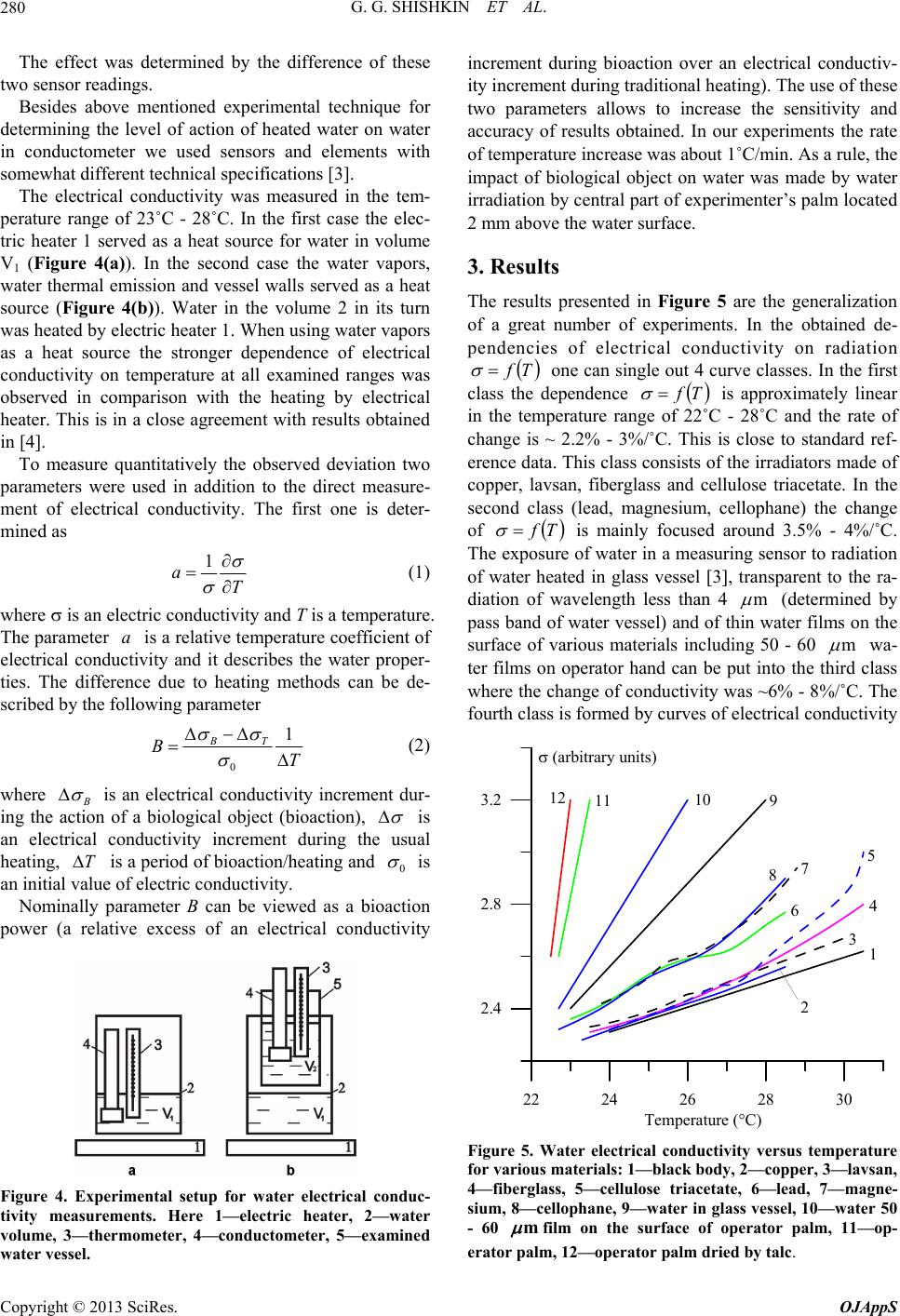 G. G. SHISHKIN ET AL. 280 The effect was determined by the difference of these two sensor readings. Besides above mentioned experimental technique for determining the level of action of heated water on water in conductometer we used sensors and elements with somewhat different technical specifications [3]. The electrical conductivity was measured in the tem- perature range of 23˚C - 28˚C. In the first case the elec- tric heater 1 served as a heat source for water in volume V1 (Figure 4(a)). In the second case the water vapors, water thermal emission and vessel walls served as a heat source (Figure 4(b)). Water in the volume 2 in its turn was heated by electric heater 1. When using water vapors as a heat source the stronger dependence of electrical conductivity on temperature at all examined ranges was observed in comparison with the heating by electrical heater. This is in a close agreement with results obtained in [4]. To measure quantitatively the observed deviation two parameters were used in addition to the direct measure- ment of electrical conductivity. The first one is deter- mined as T a 1 (1) where is an electric conductivity and T is a temperature. The parameter is a relative temperature coefficient of electrical conductivity and it describes the water proper- ties. The difference due to heating methods can be de- scribed by the following parameter a T BTB 1 0 (2) where B is an electrical conductivity increment dur- ing the action of a biological object (bioaction), is an electrical conductivity increment during the usual heating, is a period of bioaction/heating and T0 is an initial value of electric conductivity. Nominally parameter B can be viewed as a bioaction power (a relative excess of an electrical conductivity Figure 4. Experimental setup for water electrical conduc- tivity measurements. Here 1—electric heater, 2—water volume, 3—thermometer, 4—conductometer, 5—examined increment du water vessel. ring bioaction over an electrical conductiv- 3. Results esented in Figure 5 are the generalization ity increment during traditional heating). The use of these two parameters allows to increase the sensitivity and accuracy of results obtained. In our experiments the rate of temperature increase was about 1˚C/min. As a rule, the impact of biological object on water was made by water irradiation by central part of experimenter’s palm located 2 mm above the water surface. The results pr of a great number of experiments. In the obtained de- pendencies of electrical conductivity on radiation Tf one can single out 4 curve classes. In the first dependence Tf class the is approximately linear in the temperature rangC - 28˚C and the rate of change is ~ 2.2% - 3%/˚C. This is close to standard ref- erence data. This class consists of the irradiators made of copper, lavsan, fiberglass and cellulose triacetate. In the second class (lead, magnesium, cellophane) the change of e of 22˚ Tf is mainly focused around 3.5% - 4%/˚C. The expo of water in a measuring sensor to radiation of water heated in glass vessel [3], transparent to the ra- diation of wavelength less than 4 m sure (determined by pass band of water vessel) and of thater films on the surface of various materials including 50 - 60 m in w wa- ter films on operator hand can be put into the th class where the change of conductivity was ~6% - 8%/˚C. The fourth class is formed by curves of electrical conductivity ird 22 24 26 28 30 Te m pe r atu r e ( C) 2.4 2.8 3.2 1 2 3 4 5 6 7 8 9 10 11 12 (arbitrary units) Figure 5. Water electrical conductivity versus temperature for various materials: 1—black body, 2—copper, 3—lavsan, 4—fiberglass, 5—cellulose triacetate, 6—lead, 7—magne- sium, 8—cellophane, 9—water in glass vessel, 10—water 50 - 60 m film on the surface of operator palm, 11—op- erator, 12—operator palm dried by talc. palm Copyright © 2013 SciRes. OJAppS 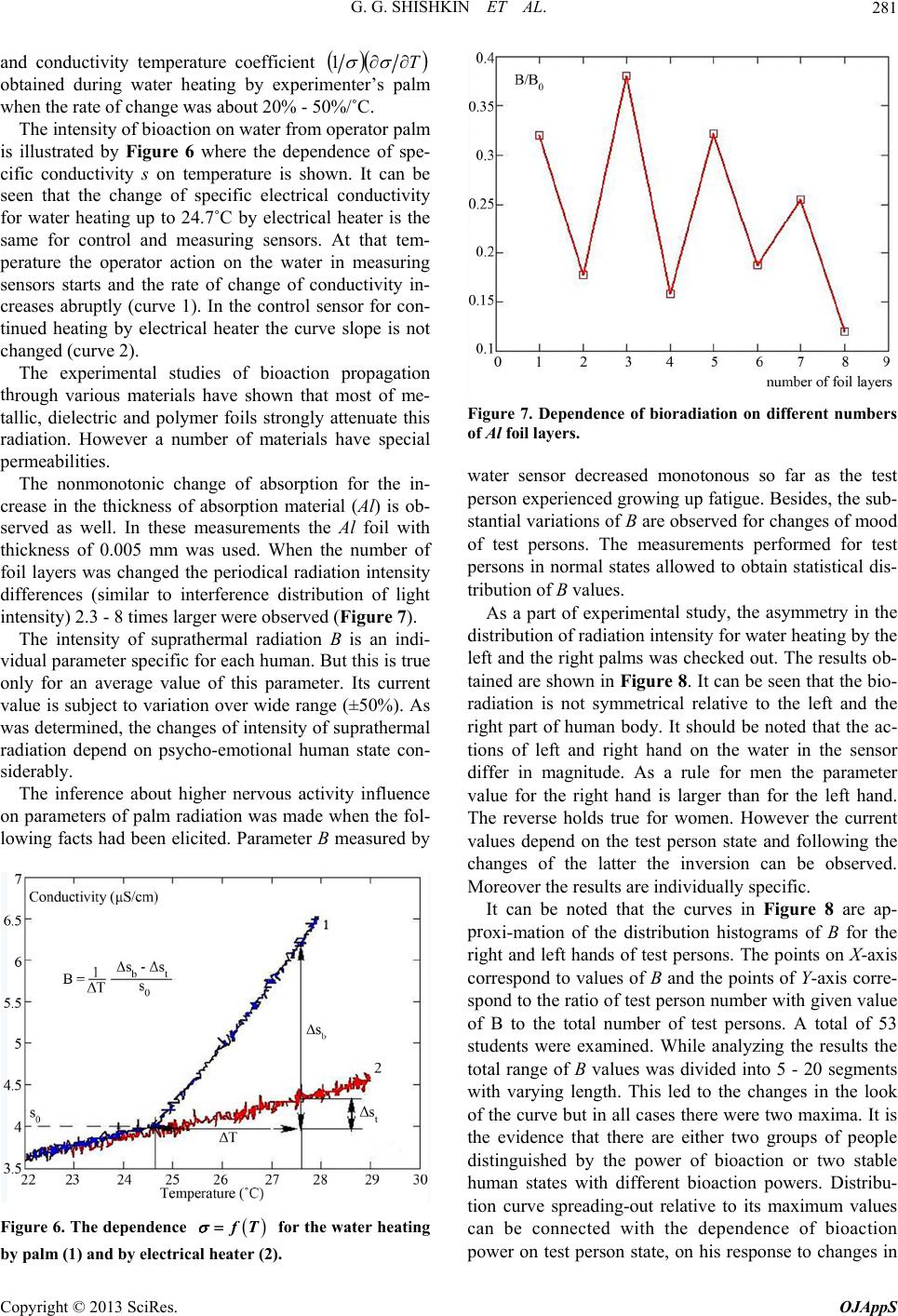 G. G. SHISHKIN ET AL. 281 and conductivity temperature coefficient T1 enter’s palm palm is studies of bioaction propagation th onic change of absorption for the in- cr vi rence about higher nervous activity influence on obtained during water heating by experim when the rate of change was about 20% - 50%/˚C. The intensity of bioaction on water from operator illustrated by Figure 6 where the dependence of spe- cific conductivity s on temperature is shown. It can be seen that the change of specific electrical conductivity for water heating up to 24.7˚C by electrical heater is the same for control and measuring sensors. At that tem- perature the operator action on the water in measuring sensors starts and the rate of change of conductivity in- creases abruptly (curve 1). In the control sensor for con- tinued heating by electrical heater the curve slope is not changed (curve 2). The experimental rough various materials have shown that most of me- tallic, dielectric and polymer foils strongly attenuate this radiation. However a number of materials have special permeabilities. The nonmonot ease in the thickness of absorption material (Al) is ob- served as well. In these measurements the Al foil with thickness of 0.005 mm was used. When the number of foil layers was changed the periodical radiation intensity differences (similar to interference distribution of light intensity) 2.3 - 8 times larger were observed (Figure 7). The intensity of suprathermal radiation B is an indi- dual parameter specific for each human. But this is true only for an average value of this parameter. Its current value is subject to variation over wide range (±50%). As was determined, the changes of intensity of suprathermal radiation depend on psycho-emotional human state con- siderably. The infe parameters of palm radiation was made when the fol- lowing facts had been elicited. Parameter B measured by Figure 6. The depende nce f T for the water heating l heater ( by palm (1) and by electrica2). Figure 7. Dependence of bioradiation on different number ater sensor decreased monotonous so far as the test ental study, the asymmetry in the di are ap- pr s of Al foil layers. w person experienced growing up fatigue. Besides, the sub- stantial variations of B are observed for changes of mood of test persons. The measurements performed for test persons in normal states allowed to obtain statistical dis- tribution of B values. As a part of experim stribution of radiation intensity for water heating by the left and the right palms was checked out. The results ob- tained are shown in Figure 8. It can be seen that the bio- radiation is not symmetrical relative to the left and the right part of human body. It should be noted that the ac- tions of left and right hand on the water in the sensor differ in magnitude. As a rule for men the parameter value for the right hand is larger than for the left hand. The reverse holds true for women. However the current values depend on the test person state and following the changes of the latter the inversion can be observed. Moreover the results are individually specific. It can be noted that the curves in Figure 8 oxi-mation of the distribution histograms of B for the right and left hands of test persons. The points on X-axis correspond to values of B and the points of Y-axis corre- spond to the ratio of test person number with given value of B to the total number of test persons. A total of 53 students were examined. While analyzing the results the total range of B values was divided into 5 - 20 segments with varying length. This led to the changes in the look of the curve but in all cases there were two maxima. It is the evidence that there are either two groups of people distinguished by the power of bioaction or two stable human states with different bioaction powers. Distribu- tion curve spreading-out relative to its maximum values can be connected with the dependence of bioaction power on test person state, on his response to changes in Copyright © 2013 SciRes. OJAppS 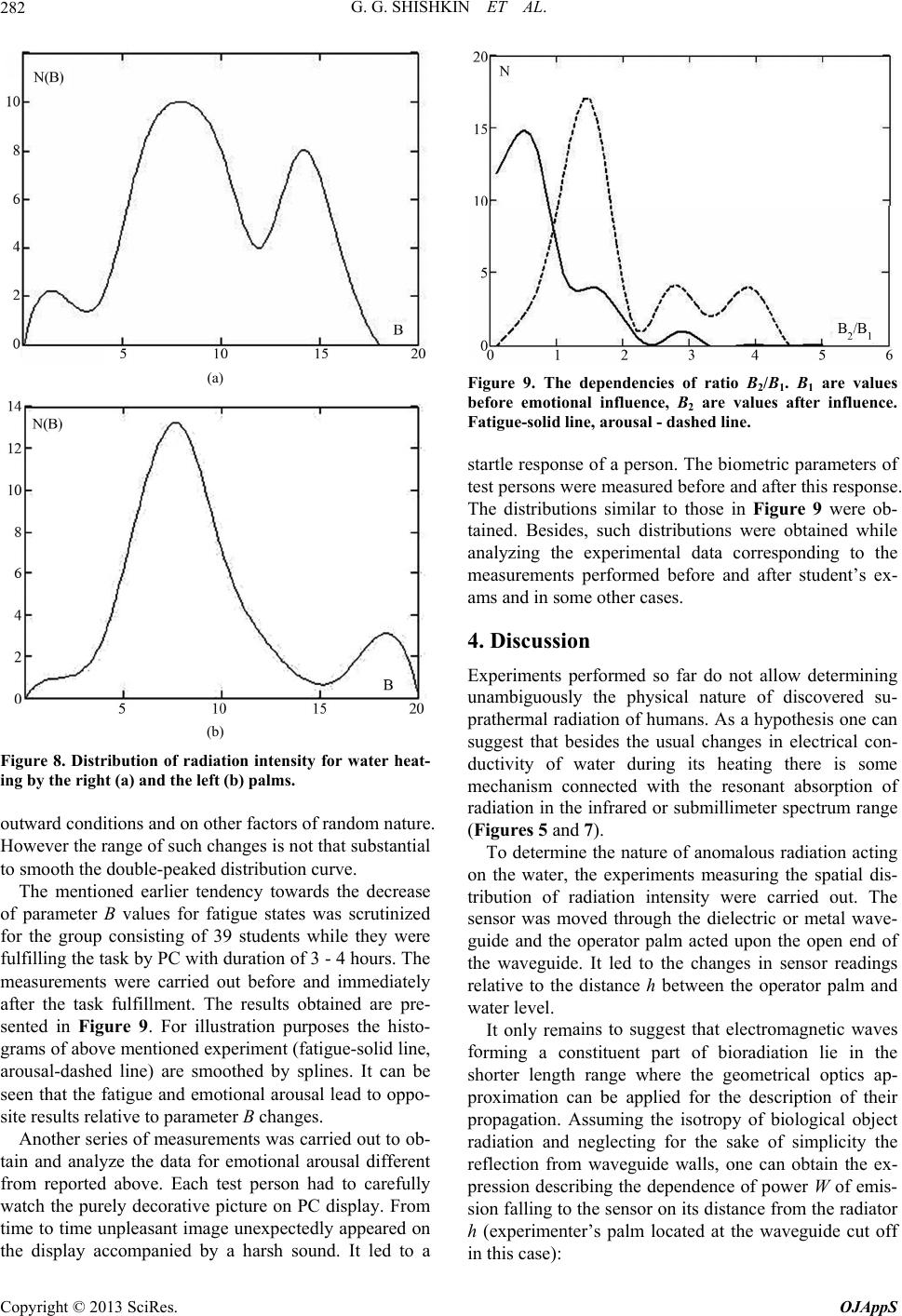 G. G. SHISHKIN ET AL. 282 (a) (b) Figure 8. Distribution of radiation intensity for water heat- utward conditions and on other factors of random nature. decrease of ed out to ob- ta ing by the right (a) and the left (b) palms. o However the range of such changes is not that substantial to smooth the double-peaked distribution curve. The mentioned earlier tendency towards the parameter B values for fatigue states was scrutinized for the group consisting of 39 students while they were fulfilling the task by PC with duration of 3 - 4 hours. The measurements were carried out before and immediately after the task fulfillment. The results obtained are pre- sented in Figure 9. For illustration purposes the histo- grams of above mentioned experiment (fatigue-solid line, arousal-dashed line) are smoothed by splines. It can be seen that the fatigue and emotional arousal lead to oppo- site results relative to parameter B changes. Another series of measurements was carri in and analyze the data for emotional arousal different from reported above. Each test person had to carefully watch the purely decorative picture on PC display. From time to time unpleasant image unexpectedly appeared on the display accompanied by a harsh sound. It led to a Figure 9. The dependencies of ratio B2/B1. B1 are values artle response of a person. The biometric parameters of 4. Discussion ed so far do not allow determining nature of anomalous radiation acting on ains to suggest that electromagnetic waves fo before emotional influence, B2 are values after influence. Fatigue-solid line, arousal - dashed line. st test persons were measured before and after this response. The distributions similar to those in Figure 9 were ob- tained. Besides, such distributions were obtained while analyzing the experimental data corresponding to the measurements performed before and after student’s ex- ams and in some other cases. Experiments perform unambiguously the physical nature of discovered su- prathermal radiation of humans. As a hypothesis one can suggest that besides the usual changes in electrical con- ductivity of water during its heating there is some mechanism connected with the resonant absorption of radiation in the infrared or submillimeter spectrum range (Figures 5 and 7). To determine the the water, the experiments measuring the spatial dis- tribution of radiation intensity were carried out. The sensor was moved through the dielectric or metal wave- guide and the operator palm acted upon the open end of the waveguide. It led to the changes in sensor readings relative to the distance h between the operator palm and water level. It only rem rming a constituent part of bioradiation lie in the shorter length range where the geometrical optics ap- proximation can be applied for the description of their propagation. Assuming the isotropy of biological object radiation and neglecting for the sake of simplicity the reflection from waveguide walls, one can obtain the ex- pression describing the dependence of power W of emis- sion falling to the sensor on its distance from the radiator h (experimenter’s palm located at the waveguide cut off in this case): Copyright © 2013 SciRes. OJAppS 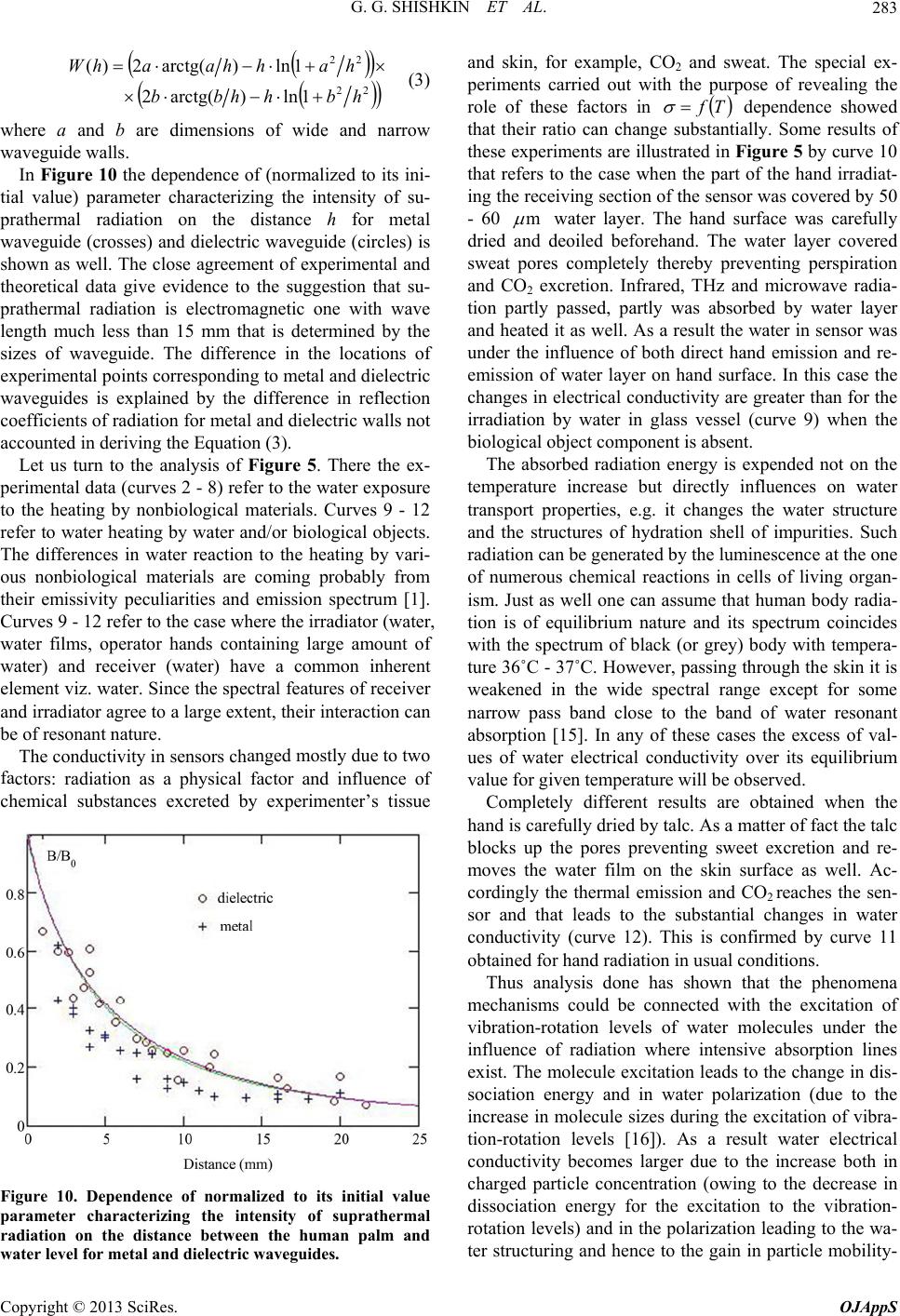 G. G. SHISHKIN ET AL. 283 22 22 1ln)arctg(2 1ln)arctg(2) hbhhbb hahhaa (3) where a and b are dimensions of wide and narrow e dependence of (normalized to its ini- tia 5. There the ex- pe anged mostly due to two fa (hW waveguide walls. In Figure 10 th l value) parameter characterizing the intensity of su- prathermal radiation on the distance h for metal waveguide (crosses) and dielectric waveguide (circles) is shown as well. The close agreement of experimental and theoretical data give evidence to the suggestion that su- prathermal radiation is electromagnetic one with wave length much less than 15 mm that is determined by the sizes of waveguide. The difference in the locations of experimental points corresponding to metal and dielectric waveguides is explained by the difference in reflection coefficients of radiation for metal and dielectric walls not accounted in deriving the Equation (3). Let us turn to the analysis of Figure rimental data (curves 2 - 8) refer to the water exposure to the heating by nonbiological materials. Curves 9 - 12 refer to water heating by water and/or biological objects. The differences in water reaction to the heating by vari- ous nonbiological materials are coming probably from their emissivity peculiarities and emission spectrum [1]. Сurves 9 - 12 refer to the case where the irradiator (water, water films, operator hands containing large amount of water) and receiver (water) have a common inherent element viz. water. Since the spectral features of receiver and irradiator agree to a large extent, their interaction can be of resonant nature. The conductivity in sensors ch ctors: radiation as a physical factor and influence of chemical substances excreted by experimenter’s tissue Figure 10. Dependence of normalized to its initial value water level for metal and dielectric waveguides. parameter characterizing the intensity of suprathermal radiation on the distance between the human palm and and skin, for example, CO2 and sweat. The special ex- periments carried out with the purpose of revealing the role of these factors in Tf dependence showed that their ratio can change substanally. Some results of these experiments are illustrated in Figure 5 by curve 10 that refers to the case when the part of the hand irradiat- ing the receiving section of the sensor was covered by 50 - 60 m ti water layer. The hand surface was carefully dried and deoiled beforehand. The water layer covered sweat pores completely thereby preventing perspiration and CO2 excretion. Infrared, THz and microwave radia- tion partly passed, partly was absorbed by water layer and heated it as well. As a result the water in sensor was under the influence of both direct hand emission and re- emission of water layer on hand surface. In this case the changes in electrical conductivity are greater than for the irradiation by water in glass vessel (curve 9) when the biological object component is absent. The absorbed radiation energy is expended not on the temperature increase but directly influences on water transport properties, e.g. it changes the water structure and the structures of hydration shell of impurities. Such radiation can be generated by the luminescence at the one of numerous chemical reactions in cells of living organ- ism. Just as well one can assume that human body radia- tion is of equilibrium nature and its spectrum coincides with the spectrum of black (or grey) body with tempera- ture 36˚C - 37˚C. However, passing through the skin it is weakened in the wide spectral range except for some narrow pass band close to the band of water resonant absorption [15]. In any of these cases the excess of val- ues of water electrical conductivity over its equilibrium value for given temperature will be observed. Completely different results are obtained when the hand is carefully dried by talc. As a matter of fact the talc blocks up the pores preventing sweet excretion and re- moves the water film on the skin surface as well. Ac- cordingly the thermal emission and CO2 reaches the sen- sor and that leads to the substantial changes in water conductivity (curve 12). This is confirmed by curve 11 obtained for hand radiation in usual conditions. Thus analysis done has shown that the phenomena mechanisms could be connected with the excitation of vibration-rotation levels of water molecules under the influence of radiation where intensive absorption lines exist. The molecule excitation leads to the change in dis- sociation energy and in water polarization (due to the increase in molecule sizes during the excitation of vibra- tion-rotation levels [16]). As a result water electrical conductivity becomes larger due to the increase both in charged particle concentration (owing to the decrease in dissociation energy for the excitation to the vibration- rotation levels) and in the polarization leading to the wa- ter structuring and hence to the gain in particle mobility- Copyright © 2013 SciRes. OJAppS 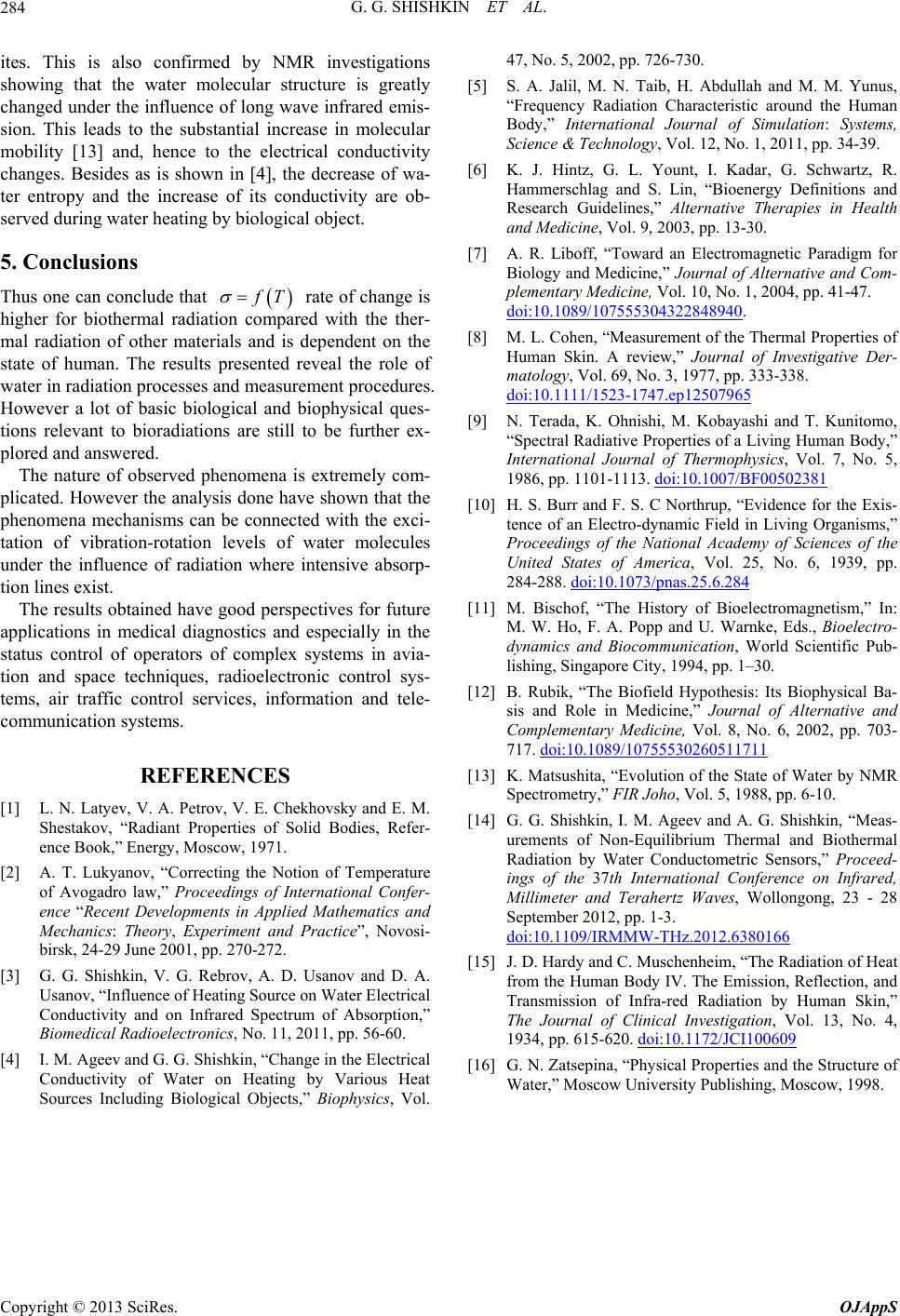 G. G. SHISHKIN ET AL. Copyright © 2013 SciRes. OJAppS 284 ude that ites. This is also confirmed by NMR investigations showing that the water molecular structure is greatly changed under the influence of long wave infrared emis- sion. This leads to the substantial increase in molecular mobility [13] and, hence to the electrical conductivity changes. Besides as is shown in [4], the decrease of wa- ter entropy and the increase of its conductivity are ob- served during water heating by biological object. 5. Conclusions Thus one can concl f T tion comp rate of change is al radiaared with the ther- s and is analysis done have shown that the ph edical diagnostics and especially in st RENCES [1] L. N. Latyev, khovsky and E. M. Shestakov, “Rlid Bodies, R ternational Confer- on Water Electrical dullah and M. M. Yunus, . etic Paradigm for higher for biotherm mal radiation of other material dependent on the state of human. The results presented reveal the role of water in radiation processes and measurement procedures. However a lot of basic biological and biophysical ques- tions relevant to bioradiations are still to be further ex- plored and answered. The nature of observed phenomena is extremely com- plicated. However the enomena mechanisms can be connected with the exci- tation of vibration-rotation levels of water molecules under the influence of radiation where intensive absorp- tion lines exist. The results obtained have good perspectives for future applications in m the atus control of operators of complex systems in avia- tion and space techniques, radioelectronic control sys- tems, air traffic control services, information and tele- communication systems. REFE V. A. Petrov, V. E. Che adiant Properties of Soefer- ence Book,” Energy, Moscow, 1971. [2] A. T. Lukyanov, “Correcting the Notion of Temperature of Avogadro law,” Proceedings of In ence “Recent Developments in Applied Mathematics and Mechanics: Theory, Experiment and Practice”, Novosi- birsk, 24-29 June 2001, pp. 270-272. [3] G. G. Shishkin, V. G. Rebrov, A. D. Usanov and D. A. Usanov, “Influence of Heating Source Conductivity and on Infrared Spectrum of Absorption,” Biomedical Radioelectronics, No. 11, 2011, pp. 56-60. [4] I. M. Ageev and G. G. Shishkin, “Change in the Electrical Conductivity of Water on Heating by Various Heat Sources Including Biological Objects,” Biophysics, Vol. 47, No. 5, 2002, pp. 726-730. [5] S. A. Jalil, M. N. Taib, H. Ab “Frequency Radiation Characteristic around the Human Body,” International Journal of Simulation: Systems, Science & Technology, Vol. 12, No. 1, 2011, pp. 34-39. [6] K. J. Hintz, G. L. Yount, I. Kadar, G. Schwartz, R Hammerschlag and S. Lin, “Bioenergy Definitions and Research Guidelines,” Alternative Therapies in Health and Medicine, Vol. 9, 2003, pp. 13-30. [7] A. R. Liboff, “Toward an Electromagn Biology and Medicine,” Journal of Alternative and Com- plementary Medicine, Vol. 10, No. 1, 2004, pp. 41-47. doi:10.1089/107555304322848940. [8] M. L. Cohen, “Measurement of the Thermal Properties of Human Skin. A review,” Journal of Investigative Der- matology, Vol. 69, No. 3, 1977, pp. 333-338. doi:10.1111/1523-1747.ep12507965 [9] N. Terada, K. Ohnishi, M. Kobayashi and T. Kunitomo, “Spectral Radiative Properties of a Living Human Body,” International Journal of Thermophysics, Vol. 7, No. 5, 1986, pp. 1101-1113. doi:10.1007/BF00502381 [10] H. S. Burr and F. S. C Northrup, “Evidence for the Exis- tence of an Electro-dynamic Field in Living Organisms,” Proceedings of the National Academy of Sciences of the United States of America, Vol. 25, No. 6, 1939, pp. 284-288. doi:10.1073/pnas.25.6.284 [11] M. Bischof, “The History of Bioelectromagnetism,” In: ysical Ba- M. W. Ho, F. A. Popp and U. Warnke, Eds., Bioelectro- dynamics and Biocommunication, World Scientific Pub- lishing, Singapore City, 1994, pp. 1–30. [12] B. Rubik, “The Biofield Hypothesis: Its Bioph sis and Role in Medicine,” Journal of Alternative and Complementary Medicine, Vol. 8, No. 6, 2002, pp. 703- 717. doi:10.1089/10755530260511711 [13] K. Matsushita, “Evolution of the State of Water by NMR “Meas- 2012.6380166 Spectrometry,” FIR Jo ho, Vol. 5, 1988, pp. 6-10. [14] G. G. Shishkin, I. M. Ageev and A. G. Shishkin, urements of Non-Equilibrium Thermal and Biothermal Radiation by Water Conductometric Sensors,” Proceed- ings of the 37th International Conference on Infrared, Millimeter and Terahertz Waves, Wollongong, 23 - 28 September 2012, pp. 1-3. doi:10.1109/IRMMW-THz. iation of Heat [15] J. D. Hardy and C. Muschenheim, “The Rad from the Human Body IV. The Emission, Reflection, and Transmission of Infra-red Radiation by Human Skin,” The Journal of Clinical Investigation, Vol. 13, No. 4, 1934, pp. 615-620. doi:10.1172/JCI100609 [16] G. N. Zatsepina, “Physical Properties and the Structure of Water,” Moscow University Publishing, Moscow, 1998. |