

Paper Menu >>
Journal Menu >>
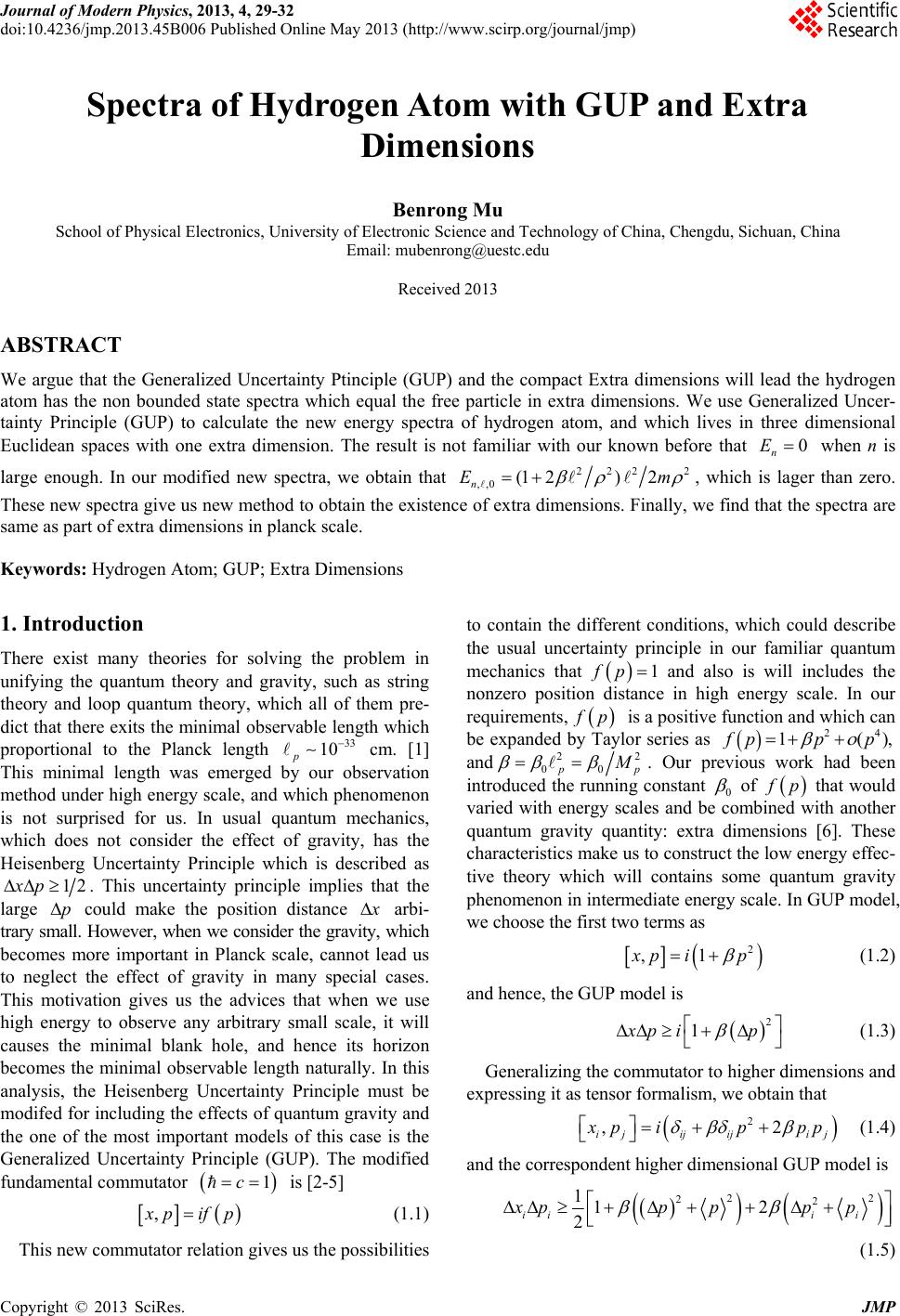 Journal of Modern Physics, 2013, 4, 29-32 doi:10.4236/jmp.2013.45B006 Published Online May 2013 (http://www.scirp.org/journal/jmp) Spectra of Hydrogen Atom with GUP and Extra Dimensions Benrong Mu School of Physical Electronics, University of Electronic Science and Technology of China, Chengdu, Sichuan, China Email: [email protected] Received 2013 ABSTRACT We argue that the Generalized Uncertainty Ptinciple (GUP) and the compact Extra dimensions will lead the hydrogen atom has the non bounded state spectra which equal the free particle in extra dimensions. We use Generalized Uncer- tainty Principle (GUP) to calculate the new energy spectra of hydrogen atom, and which lives in three dimensional Euclidean spaces with one extra dimension. The result is not familiar with our known before that when n is large enough. In our modified new spectra, we obtain that 0 n E 222 2 ,,0 (1 2)2 n Em , which is lager than zero. These new spectra give us new method to obtain the existenc e of extra dimensions. Finally, we find that the spectra are same as part of extra dimensions in planck scale. Keywords: Hydrogen Atom; GUP; Extra Dimensions 1. Introduction There exist many theories for solving the problem in unifying the quantum theory and gravity, such as string theory and loop quantum theory, which all of them pre- dict that there exits the minimal observable length which proportional to the Planck length cm. [1] This minimal length was emerged by our observation method under high energy scale, and which phenomenon is not surprised for us. In usual quantum mechanics, which does not consider the effect of gravity, has the Heisenberg Uncertainty Principle which is described as 33 10 p 12xp . This uncertainty principle implies that the large could make the position distance p x arbi- trary small. How ever, when we cons ider the gravity, which becomes more important in Planck scale, cannot lead us to neglect the effect of gravity in many special cases. This motivation gives us the advices that when we use high energy to observe any arbitrary small scale, it will causes the minimal blank hole, and hence its horizon becomes the minimal observable length naturally. In this analysis, the Heisenberg Uncertainty Principle must be modifed for including the effects of quantum gravity and the one of the most important models of this case is the Generalized Uncertainty Principle (GUP). The modified fundamental commutator 1c is [2-5] , x pifp (1.1) This new commutator relation gives us the po ssibilities to contain the different conditions, which could describe the usual uncertainty principle in our familiar quantum mechanics that 1fp and also is will includes the nonzero position distance in high energy scale. In our requirements, f p is a positive function and which can be expanded by Taylor series as 24 1(), f ppp and 22 00 p p M . Our previous work had been introduced the running constant 0 of f p that would varied with energy scales and be combined with another quantum gravity quantity: extra dimensions [6]. These characteristics make us to construct the low energy effec- tive theory which will contains some quantum gravity phenomenon in intermediate energy scale. In GUP model, we choose the first two terms as 2 ,1 x pi p (1.2) and hence, the GUP model is 2 1 x pi p (1.3) Generalizing the commutator to higher dimensions and expressing it as tensor formalism, we obtain that 2 ,2 ijijiji j x pip pp (1.4) and the correspondent higher dimensional GUP model is 22 22 112 2 iii i xpppp p (1.5) Copyright © 2013 SciRes. JMP 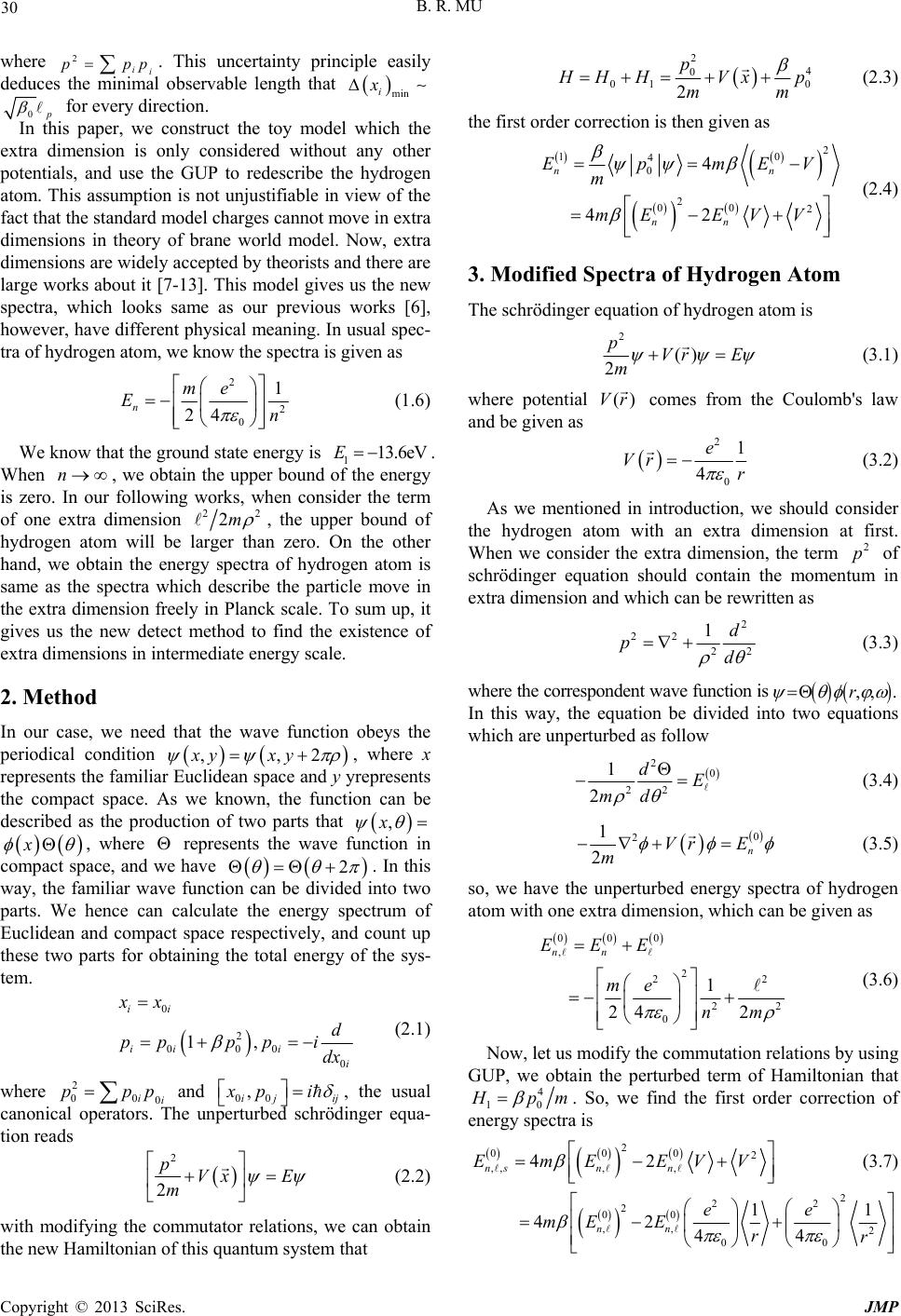 B. R. MU 30 where ii. This uncertainty principle easily deduces the minimal observable length that 2 ppp min i x 0p for every direction. In this paper, we construct the toy model which the extra dimension is only considered without any other potentials, and use the GUP to redescribe the hydrogen atom. This assumption is not unjustifiable in view of the fact that the standard model charges cannot move in extra dimensions in theory of brane world model. Now, extra dimensions are widely accepted by theorists and there are large works about it [7-13]. This model gives us the new spectra, which looks same as our previous works [6], however, have different physical meaning. In usual spec- tra of hydrogen atom, we know the spectra is given as 2 2 0 1 24 nme En (1.6) We know that the ground state energy is 113.6eVE . When , we obtain the upper boun d of the energy is zero. In our following works, when consider the term of one extra dimension n 2 2m2 , the upper bound of hydrogen atom will be larger than zero. On the other hand, we obtain the energy spectra of hydrogen atom is same as the spectra which describe the particle move in the extra dimension freely in Planck scale. To sum up, it gives us the new detect method to find the existence of extra dimensions in intermediate energy scale. 2. Method In our case, we need that the wave function obeys the periodical condition ,,2xy xy , where x represents the familiar Euclidean space and y yrepresents the compact space. As we known, the function can be described as the production of two parts that ,x x , where represents the wave function in compact space, and we have 2 . In this way, the familiar wave function can be divided into two parts. We hence can calculate the energy spectrum of Euclidean and compact space respectively, and count up these two parts for obtaining the total energy of the sys- tem. 0 2 0000 1, ii iii i xx d pppp i dx (2.1) where 2 00i pp0 p i and 00 j , ij i x pi , the usual canonical operators. The unperturbed schrödinger equa- tion reads 2 2 pVx E m (2.2) with modifying the commutator relations, we can obtain the new Hamiltonian of this quantum system that 24 0 01 2 p 0 H HHVx p mm (2.3) the first order correction is then given as 2 10 4 0 2 00 2 4 42 nn nn EpmEV m mE EVV (2.4) 3. Modified Spectra of Hydrogen Atom The schrödinger eq uation of hydrogen ato m is 2() 2 pVr E m (3.1) where potential ()Vr comes from the Coulomb's law and be given as 2 0 1 4 e Vr r (3.2) As we mentioned in introduction, we should consider the hydrogen atom with an extra dimension at first. When we consider the extra dimension, the term of schrödinger equation should contain the momentum in extra dimension and which can be rewritten as 2 p 2 2222 1d pd (3.3) where the correspondent wave function is ,, .r In this way, the equation be divided into two equations which are unperturbed as follow 20 22 1 2 dE md (3.4) 0 2 1 2n Vr E m (3.5) so, we have the unperturbed energy spectra of hydrogen atom with one extra dimension, which can be given as 000 , 2 2 22 0 1 24 2 nn EEE me nm 2 (3.6) Now, let us modify the commutation relations by using GUP, we obtain the perturbed term of Hamiltonian that 4 10 H pm . So, we find the first order correction of energy spectra is 2 000 2 ,,, , 42 nsn n EmE EVV (3.7) 2 22 2 00 ,, 2 00 11 42 44 nn ee mE Err Copyright © 2013 SciRes. JMP 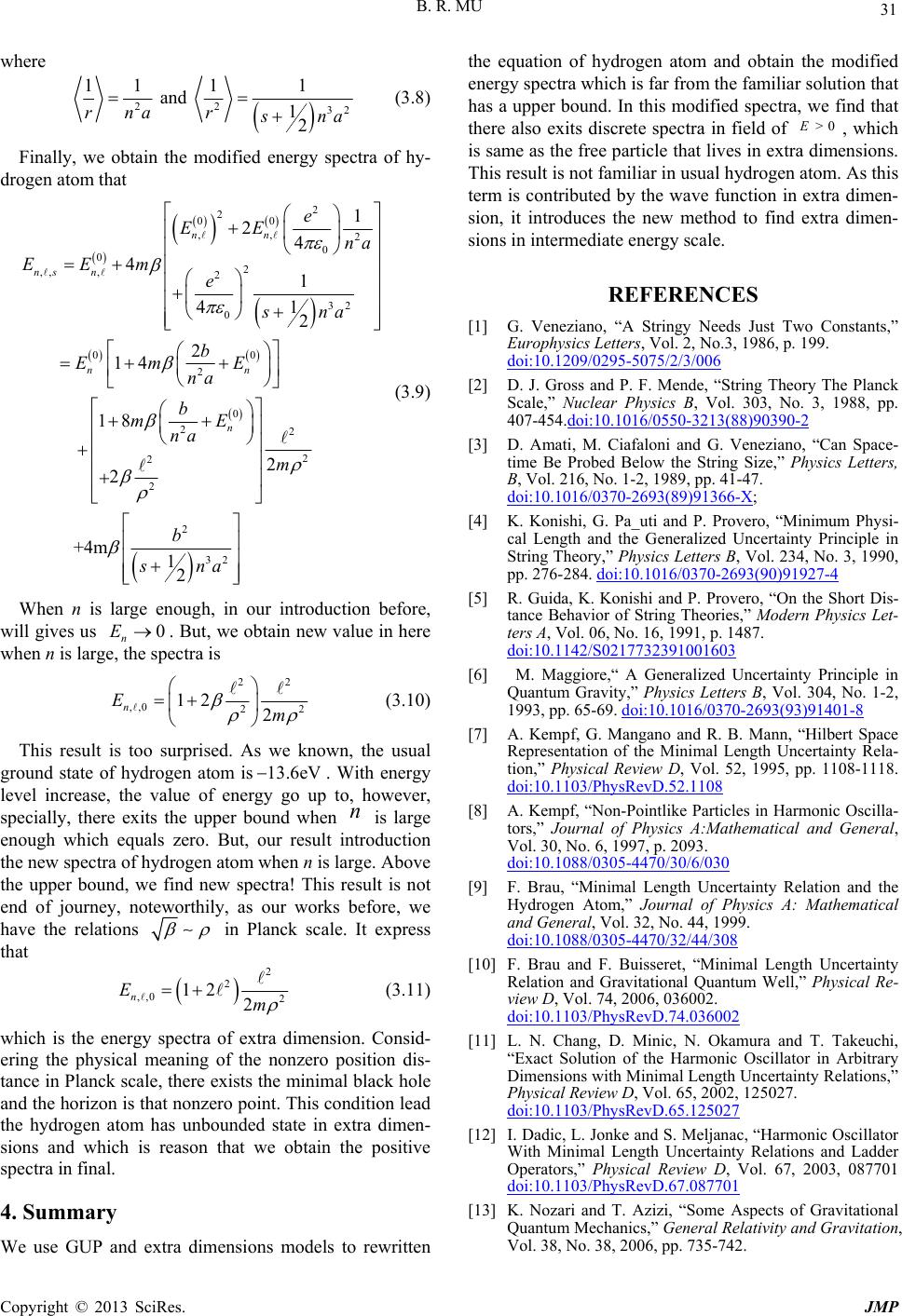 B. R. MU 31 where 22 32 11 11 and 12 rna r s na (3.8) Finally, we obtain the modified energy spectra of hy- drogen atom that 2 2 00 ,, 2 0 02 ,, ,2 32 0 00 2 0 22 2 2 2 2 3 1 24 41 1 42 2 14 18 2 2 +4m12 nn ns n nn n e EE na EEm e sna b Em E na b mE na m b sn 2 a (3.9) When n is large enough, in our introduction before, will gives us . But, we obtain new value in here when n is large, the spectra is 0 n E 22 ,,02 12 2 n Em 2 (3.10) This result is too surprised. As we known, the usual ground state of hydrogen atom is. With energy level increase, the value of energy go up to, however, specially, there exits the upper bound when is large enough which equals zero. But, our result introduction the new spectra of hydrogen atom when n is large. Above the upper bound, we find new spectra! This result is not end of journey, noteworthily, as our works before, we have the relations 13.6eV n in Planck scale. It express that 2 2 ,,0 2 12 2 n Em (3.11) which is the energy spectra of extra dimension. Consid- ering the physical meaning of the nonzero position dis- tance in Planck scale, there exists the minimal black hole and the horizon is that nonzero po int. This condition lead the hydrogen atom has unbounded state in extra dimen- sions and which is reason that we obtain the positive spectra in final. 4. Summary We use GUP and extra dimensions models to rewritten the equation of hydrogen atom and obtain the modified energy spectra which is far from the familiar solution that has a upper bound. In this modified spectra, we find that there also exits discrete spectra in field of >0 E , which is same as the free particle that lives in extra dimensions. This result is not familiar in usual hydrogen atom. As this term is contributed by the wave function in extra dimen- sion, it introduces the new method to find extra dimen- sions in intermediate energy scale. REFERENCES [1] G. Veneziano, “A Stringy Needs Just Two Constants,” Europhysics Letters, Vol. 2, No.3, 1986, p. 199. doi:10.1209/0295-5075/2/3/006 [2] D. J. Gross and P. F. Mende, “String Theory The Planck Scale,” Nuclear Physics B, Vol. 303, No. 3, 1988, pp. 407-454.doi:10.1016/0550-3213(88)90390-2 [3] D. Amati, M. Ciafaloni and G. Veneziano, “Can Space- time Be Probed Below the String Size,” Physics Letters, B, Vol. 216, No. 1-2, 1989, pp. 41-47. doi:10.1016/0370-2693(89)91366-X; [4] K. Konishi, G. Pa_uti and P. Provero, “Minimum Physi- cal Length and the Generalized Uncertainty Principle in String Theory,” Physics Letters B, Vol. 234, No. 3, 1990, pp. 276-284. doi:10.1016/0370-2693(90)91927-4 [5] R. Guida, K. Konishi and P. Provero, “On the Short Dis- tance Behavior of String Theories,” Modern Physics Let- ters A, Vol. 06, No. 16, 1991, p. 1487. doi:10.1142/S0217732391001603 [6] M. Maggiore,“ A Generalized Uncertainty Principle in Quantum Gravity,” Physics Letters B, Vol. 304, No. 1-2, 1993, pp. 65-69. doi:10.1016/0370-2693(93)91401-8 [7] A. Kempf, G. Mangano and R. B. Mann, “Hilbert Space Representation of the Minimal Length Uncertainty Rela- tion,” Physical Review D, Vol. 52, 1995, pp. 1108-1118. doi:10.1103/PhysRevD.52.1108 [8] A. Kempf, “Non-Pointlike Particles in Harmonic Oscilla- tors,” Journal of Physics A:Mathematical and General, Vol. 30, No. 6, 1997, p. 2093. doi:10.1088/0305-4470/30/6/030 [9] F. Brau, “Minimal Length Uncertainty Relation and the Hydrogen Atom,” Journal of Physics A: Mathematical and General, Vol. 32, No. 44, 1999. doi:10.1088/0305-4470/32/44/308 [10] F. Brau and F. Buisseret, “Minimal Length Uncertainty Relation and Gravitational Quantum Well,” Physical Re- view D, Vol. 74, 2006, 036002. doi:10.1103/PhysRevD.74.036002 [11] L. N. Chang, D. Minic, N. Okamura and T. Takeuchi, “Exact Solution of the Harmonic Oscillator in Arbitrary Dimensions with Minimal Length Uncertainty Relations,” Physical Review D, Vol. 65, 2002, 125027. doi:10.1103/PhysRevD.65.125027 [12] I. Dadic, L. Jonke and S. Meljanac, “Harmonic Oscillator With Minimal Length Uncertainty Relations and Ladder Operators,” Physical Review D, Vol. 67, 2003, 087701 doi:10.1103/PhysRevD.67.087701 [13] K. Nozari and T. Azizi, “Some Aspects of Gravitational Quantum Mechanics,” General Relativity and Gravitation, Vol. 38, No. 38, 2006, pp. 735-742. Copyright © 2013 SciRes. JMP  B. R. MU Copyright © 2013 SciRes. JMP 32 doi:10.1007/s10714-006-0262-9 [14] M. M. Stetsko, “Corrections to the ns Levels of The Hy- drogen Atom in Deformed Space With Minimal Length,” Physical Review A, Vol. 74, No. 6, 2006, 062105. doi:10.1103/PhysRevA.74.062105 [15] S. Z. Benczik, “Investigations on the Minimal-Length Uncertainty Relation,” Dissertation for Doctor of Phi- losophy. [16] M. V. Battisti and G. Montani, “The Big-Bang Singular- ity in the Framework of a Generalized Uncertainty Prin- ciple,” Physics Letters B, Vol. 656, No. 1-3, 2007, pp. 96-101.doi:10.1016/j.physletb.2007.09.012. [17] M. V. Battisti and G. Montani, Physics Review D, Vol. 77, 2008,023518. [18] M. V. Battisti, arXiv: 0805.1178. [19] S. Das and E. C. Vagenas, Physics Review Letters, Vol. 101, 2008, 221301. [20] B. Mu, H. Wu and H. Yang, arXiv:0909.3635 [hep-th]. [21] B. Mu, “Spectra of harmonic oscillators with GUP and extra dimensions,” to appear. [22] I. Antoniadis, “A Possible New Dimension at a Few TeV,” Physics Letters B, Vol. 246, No. 3-4, 1990, pp. 377-384. doi:10.1016/0370-2693(90)90617-F [23] N. Arkani-Hamed, S. Dimopoulos and G. R. Dvali, “The Hierarchy Problem and New Dimensions at a Millime- ter,” Physics Letters B, Vol. 429, No. 34, 1998, pp. 263-272.doi:10.1016/S0370-2693(98)00466-3 [24] I. A ntoniadis, N. Arkani-Hamed, S. Di mopoulos and G. R. Dvali, “New Dimensions at a Millimeter to a Fermi and Superstrings at a Tev,” Physics Letters B, Vol. 436, No. 3-4,1998, pp. 257-263. doi:10.1016/S0370-2693(98)00860-0 [25] L. Randall and R. Sundrum, “Large Mass Hierarchy from A Small Extra Dimension,” Physical Review Letters, Vol. 83, 1999, pp. 3370-3373. doi:10.1103/PhysRevLett.83.3370 [26] L. Randall and R. Sundrum, “An Alternative to Compac- tification,” Physical Review Letters, Vol. 83, 1999, pp.4690-444693. doi:10.1103/PhysRevLett.83.4690 [27] G. R. Dvali, G. Gabadadze and M. Porrati, “4D Gravity On A Brane in 5D Minkowski Space,” Physics Letters B, Vol. 485, No. 1-3, 2000, pp. 208-214. doi:10.1016/S0370-2693(00)00669-9 [28] T. Appelquist, H. C. Cheng and B. A. Dobrescu, “Bounds on Universal Extra Dimensions,” Physical Review D, Vol. 64, 2001, 035002. doi:10.1103/PhysRevD.64.035002 [29] D. Cremades, L. E. Ibanez and F. Marchesano, “Standard Model at Intersecting D5-Branes:Lowering the String Scale,” Nuclear Physics B, Vol. 643, No. 1-3, 2002, pp. 93-130. doi:10.1016/S0550-3213(02)00746-0 [30] C. Kokorelis, “Exact Standard Model Structures From Intersecting D5-Branes,” Nuclear Physics B, Vol. 677, No. 1-2, 2004, pp. 115-163. doi:10.1016/j.nuclphysb.2003.11.007 |