

Paper Menu >>
Journal Menu >>
 Journal of Modern Physics, 2013, 4, 23-28 doi:10.4236/jmp.2013.45B005 Published Online May 2013 (http://www.scirp.org/journal/jmp) Acousto-Resonance Spectroscopy of Nonlinear-Optical Crystals in Process of Laser Frequency Conversion O. A. Ryabushkin1,2 , A. V. Konyashkin1,2 , D. V. Myasnikov1,2, V. A. Tyrtyshnyy2, O. I. Vershinin1,2, A. I. Baranov1,2 1Moscow Institute of Physics and Technology, Institutskiy per. 9, Dolgoprudnyy, Russia 2NTO “IRE-Polus”, Vvedensky Sq.1, Fryazino, Russia Email: [email protected] Received 2013 ABSTRACT Dependence of the periodically poled nonlinear-optical lithium niobate (PPLN) crystal temperature on laser power in the course of laser frequency conversion was measured using piezoelectric resonance. Crystal’s temperature tuning curves are precisely measured using concept of the equivalent temperature. Both optical absorption and heat transfer coefficients of the crystal are measured employing kinetics of the crystal equivalent temperature. Keywords: Piezoelectric Resonance; Nonlinear-Optical Crystals; Second Harmonic Generation; Equivalent Temperature 1. Introduction Nonlinear-optical crystals are widely used in various nonlinear-optical processes [1-6]. Due to optical absorp- tion any interaction of the laser radiation with crystals results in its heating. In high-power laser applications optical absorption can cause crystal structural defects formation and even its destruction [7,8]. It is well known that efficient nonlinear frequency conversion occurs when phase matching condition is fulfilled for wavelengths involved [1]. Here the crystal temperature control plays crucial role because tempera- ture deviation from the optimum point results in effi- ciency decreasing. Pump power increase leads to crystal overheating and phase matching violation. In Second Harmonic Generation (SHG) experiments optimum tem- perature is usually determined by adjusting the thermostat temperature while monitoring the output second harmonic power. It is well known that most crystals applied in nonlinear optics possess piezoelectric properties. External radiof- requency electric field excites acoustical vibrations in such crystals due to indirect piezoelectric effect. When external electric field frequency coincides with one of the crystal internal acoustical mode frequency the piezoelec- tric resonance is excited. Strongly temperature-sensitive piezoelectric resonance frequency is a powerful tool for research of nonlinear- optical crystals interaction with laser radiation. It was demonstrated that such important properties as ionic conductivity [9,10] and optical absorption [11-13] can be precisely measured using crystal piezoelectric resonances. Novel method based on the piezoelectric resonance spectroscopy technique was proposed for the accurate temperature determination of nonlinear-optical crystal interacting with laser radiation [12,13]. It was demonstrated that for the extremely wide range of laser power values the internal crystal temperature can be directly determined by measuring its piezoelectric resonance frequency shift [12,13]. Thus measured tem- perature is called crystal equivalent temperature θeq. In this paper we present results of the periodically poled nonlinear-optical lithium niobate (PPLN) crystals tempera- ture measurement in the course of the second harmonic generation of the CW single-mode ytterbium-doped fiber laser radiation. 2. Experiment 2.1. Crystal Samples Two specimens of PPLN crystals were used in the experi- ment. Both are rectangular parallelepipeds with dimen- sions 1 2.6 4.9 mm3 (PPLN1) and 1 × 3 × 10 mm3 (PPLN2) respectively. Crystals are poled along z-axis (1 mm) and quasi-phase-matched for SHG of the 1064 nm wavelength. Crystal’s input and output facets are anti-reflective coated for both 532 nm and 1064 nm. 2.2. Experimental Setup Simplified block-scheme of the experimental setup for the nonlinear-optical crystal’s electrical impedance measure- Copyright © 2013 SciRes. JMP 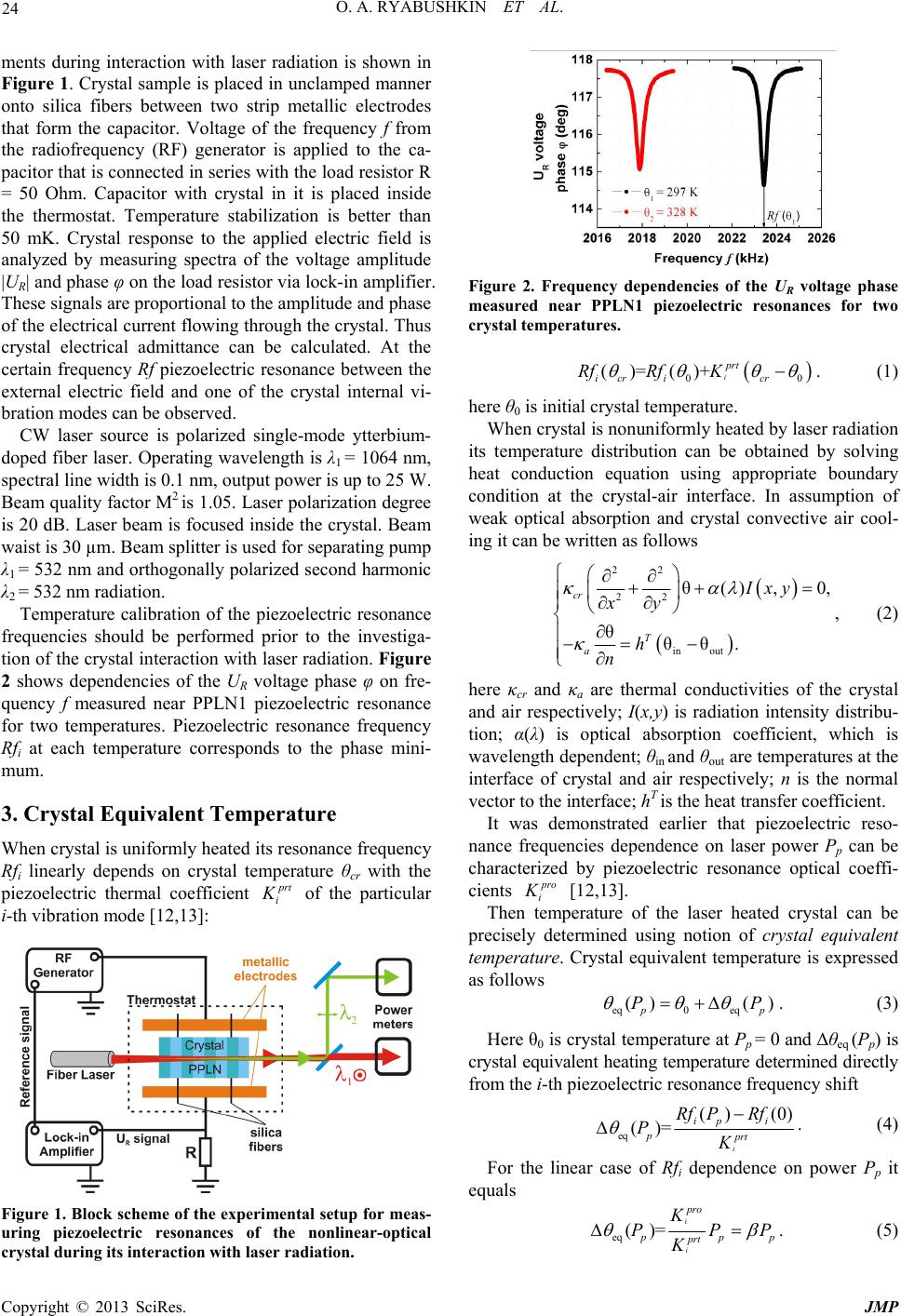 O. A. RYABUSHKIN ET AL. 24 ments during interaction with laser radiation is shown in Figure 1. Crystal sample is placed in unclamped manner onto silica fibers between two strip metallic electrodes that form the capacitor. Voltage of the frequency f from the radiofrequency (RF) generator is applied to the ca- pacitor that is connected in series with the load resistor R = 50 Ohm. Capacitor with crystal in it is placed inside the thermostat. Temperature stabilization is better than 50 mK. Crystal response to the applied electric field is analyzed by measuring spectra of the voltage amplitude |UR| and phase φ on the load resistor via lock-in amplifier. These signals are proportional to the amplitude and phase of the electrical current flowing through the crystal. Thus crystal electrical admittance can be calculated. At the certain frequency Rf piezoelectric resonance between the external electric field and one of the crystal internal vi- bration modes can be observed. CW laser source is polarized single-mode ytterbium- doped fiber laser. Operating wavelength is λ1 = 1064 nm, spectral line width is 0.1 nm, output power is up to 25 W. Beam quality factor М2 is 1.05. Laser polarization degree is 20 dB. Laser beam is focused inside the crystal. Beam waist is 30 µm. Beam splitter is used for separating pump λ1 = 532 nm and orthogonally polarized second harmonic λ2 = 532 nm radiation. Temperature calibration of the piezoelectric resonance frequencies should be performed prior to the investiga- tion of the crystal interaction with laser radiation. Figure 2 shows dependencies of the UR voltage phase φ on fre- quency f measured near PPLN1 piezoelectric resonance for two temperatures. Piezoelectric resonance frequency Rfi at each temperature corresponds to the phase mini- mum. 3. Crystal Equivalent Temperature When crystal is uniformly heated its resonance frequency Rfi linearly depends on crystal temperature θcr with the piezoelectric thermal coefficient prt i K of the particular i-th vibration mode [12,13]: Figure 1. Block scheme of the experimental setup for meas- uring piezoelectric resonances of the nonlinear-optical crystal during its interaction with laser radiation. Figure 2. Frequency dependencies of the UR voltage phase measured near PPLN1 piezoelectric resonances for two crystal temperatures. 0 ()=()+ i prt icr icr RfRf K 0 . (1) here θ0 is initial crystal temperature. When crystal is nonuniformly heated by laser radiation its temperature distribution can be obtained by solving heat conduction equation using appropriate boundary condition at the crystal-air interface. In assumption of weak optical absorption and crystal convective air cool- ing it can be written as follows 22 22 in out θ() ,0, θθθ. cr T a Ixy xy h n , (2) here κcr and κa are thermal conductivities of the crystal and air respectively; I(x,y) is radiation intensity distribu- tion; α(λ) is optical absorption coefficient, which is wavelength dependent; θin and θout are temperatures at the interface of crystal and air respectively; n is the normal vector to the interface; hT is the heat transfer coefficient. It was demonstrated earlier that piezoelectric reso- nance frequencies dependence on laser power Pp can be characterized by piezoelectric resonance optical coeffi- cients pro i K [12,13]. Then temperature of the laser heated crystal can be precisely determined using notion of crystal equivalent temperature. Crystal equivalent temperature is expressed as follows eq0 eq () () p Pp P . (3) Here θ0 is crystal temperature at Pp = 0 and Δθeq (Pp) is crystal equivalent heating temperature determined directly from the i-th piezoelectric resonance frequency shift eq () (0) ()= i ip i pprt Rf PRf PK . (4) For the linear case of Rfi dependence on power Pp it equals eq ()=i i pro pp prt K p P P KP . (5) Copyright © 2013 SciRes. JMP 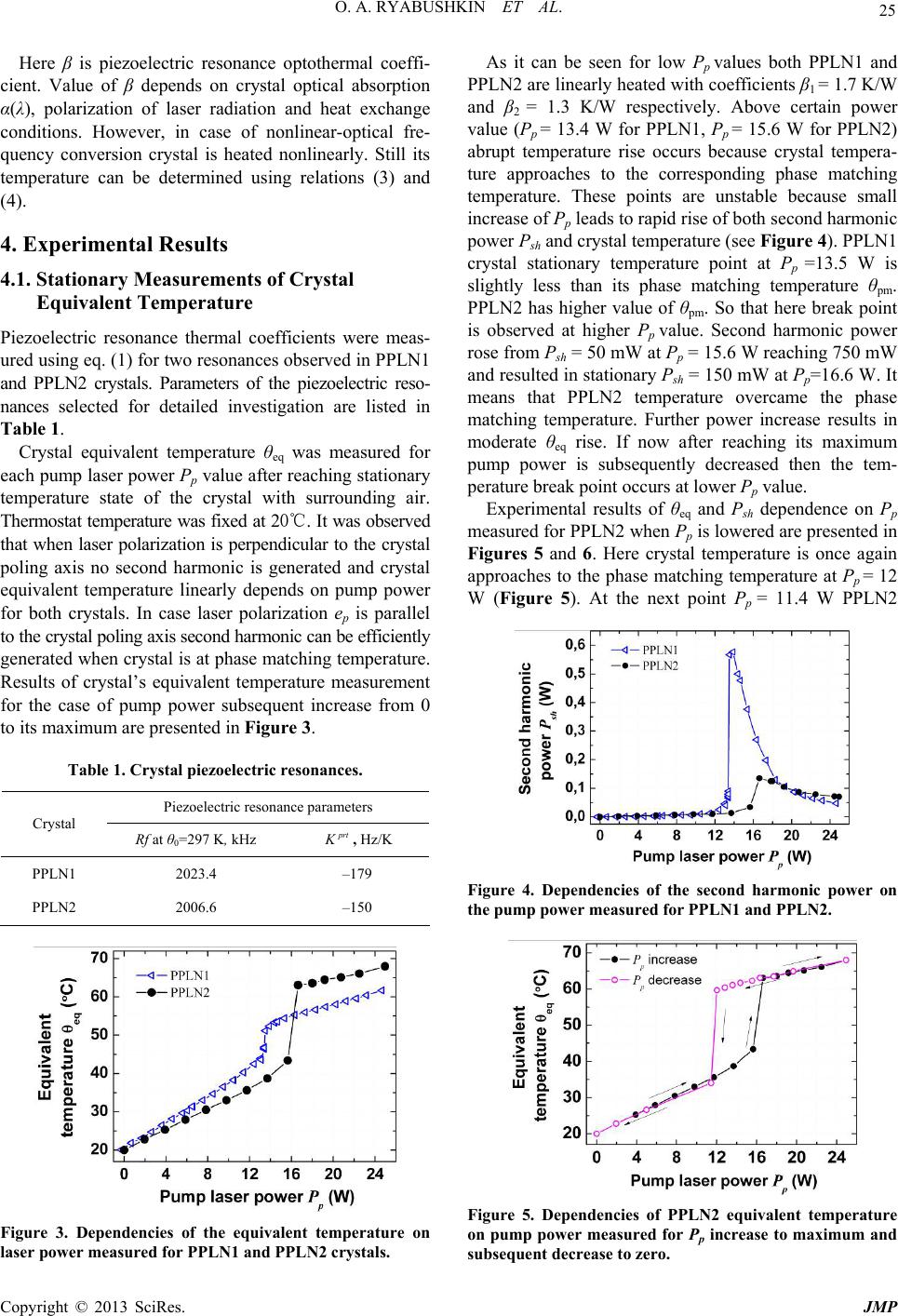 O. A. RYABUSHKIN ET AL. 25 Here β is piezoelectric resonance optothermal coeffi- cient. Value of β depends on crystal optical absorption α(λ), polarization of laser radiation and heat exchange conditions. However, in case of nonlinear-optical fre- quency conversion crystal is heated nonlinearly. Still its temperature can be determined using relations (3) and (4). 4. Experimental Results 4.1. Stationary Measurements of Crystal Equivalent Temperature Piezoelectric resonance thermal coefficients were meas- ured using eq. (1) for two resonances observed in PPLN1 and PPLN2 crystals. Parameters of the piezoelectric reso- nances selected for detailed investigation are listed in Table 1. Crystal equivalent temperature θeq was measured for each pump laser power Pp value after reaching stationary temperature state of the crystal with surrounding air. Thermostat temperature was fixed at 20℃. It was observed that when laser polarization is perpendicular to the crystal poling axis no second harmonic is generated and crystal equivalent temperature linearly depends on pump power for both crystals. In case laser polarization ep is parallel to the crystal poling axis second harmonic can be efficiently generated when crystal is at phase matching temperature. Results of crystal’s equivalent temperature measurement for the case of pump power subsequent increase from 0 to its maximum are presented in Figure 3. Table 1. Crystal piezoelectric resonances. Piezoelectric resonance parameters Crystal Rf at θ0=297 K, kHz prt K , Hz/K PPLN1 2023.4 –179 PPLN2 2006.6 –150 Figure 3. Dependencies of the equivalent temperature on laser power measured for PPLN1 and PPLN2 crystals. As it can be seen for low Pp values both PPLN1 and PPLN2 are linearly heated with coefficients β1 = 1.7 K/W and β2 = 1.3 K/W respectively. Above certain power value (Pp = 13.4 W for PPLN1, Pp = 15.6 W for PPLN2) abrupt temperature rise occurs because crystal tempera- ture approaches to the corresponding phase matching temperature. These points are unstable because small increase of Pp leads to rapid rise of both second harmonic power Psh and crystal temperature (see Figure 4). PPLN1 crystal stationary temperature point at Pp =13.5 W is slightly less than its phase matching temperature θpm. PPLN2 has higher value of θpm. So that here break point is observed at higher Pp value. Second harmonic power rose from Psh = 50 mW at Pp = 15.6 W reaching 750 mW and resulted in stationary Psh = 150 mW at Pp=16.6 W. It means that PPLN2 temperature overcame the phase matching temperature. Further power increase results in moderate θeq rise. If now after reaching its maximum pump power is subsequently decreased then the tem- perature break point occurs at lower Pp value. Experimental results of θeq and Psh dependence on Pp measured for PPLN2 when Pp is lowered are presented in Figures 5 and 6. Here crystal temperature is once again approaches to the phase matching temperature at Pp = 12 W (Figure 5). At the next point Pp = 11.4 W PPLN2 Figure 4. Dependencies of the second harmonic power on the pump power measured for PPLN1 and PPLN2. Figure 5. Dependencies of PPLN2 equivalent temperature on pump power measured for Pp increase to maximum and subsequent decrease to zero. Copyright © 2013 SciRes. JMP 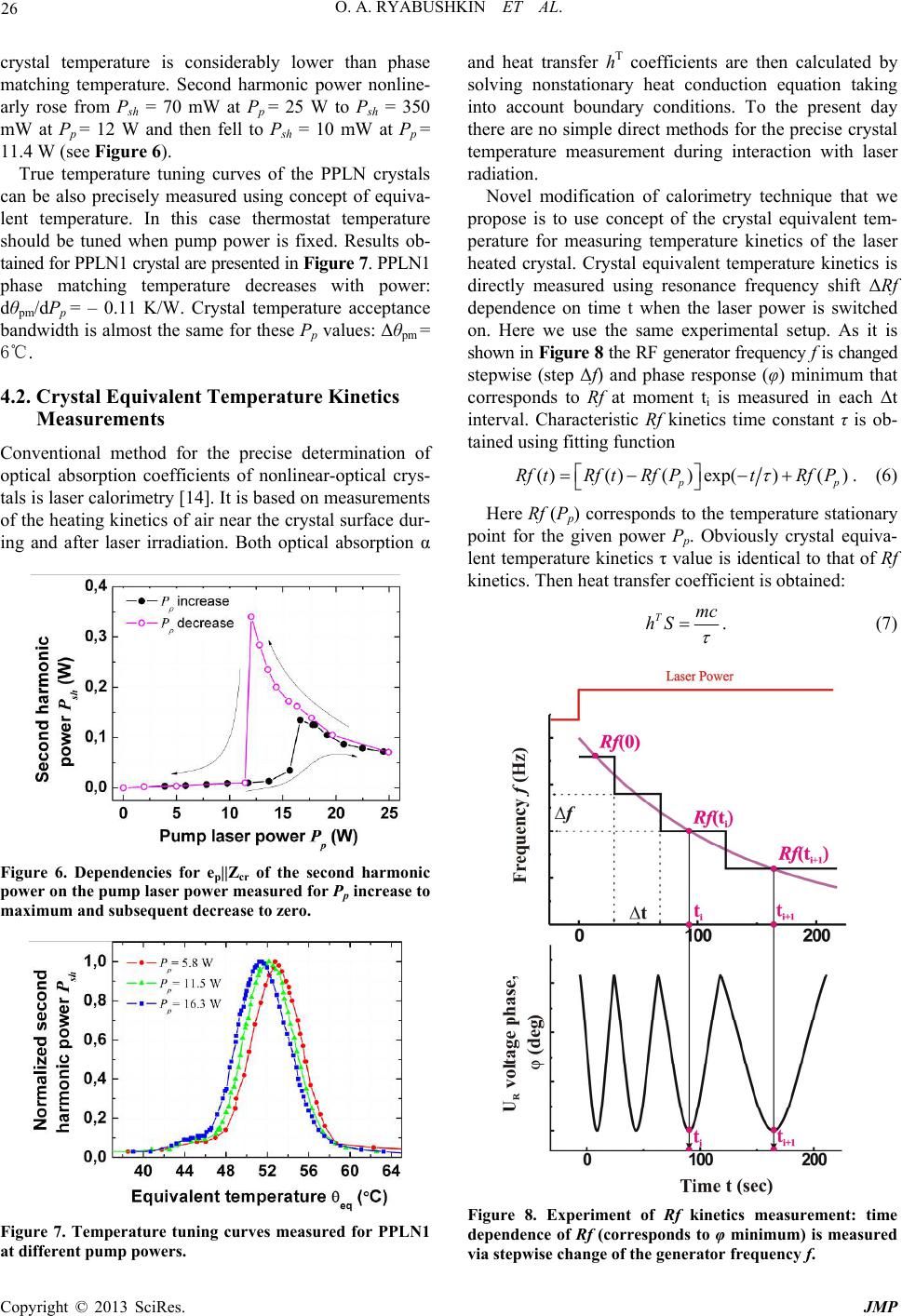 O. A. RYABUSHKIN ET AL. 26 crystal temperature is considerably lower than phase matching temperature. Second harmonic power nonline- arly rose from Psh = 70 mW at Pp = 25 W to Psh = 350 mW at Pp = 12 W and then fell to Psh = 10 mW at Pp = 11.4 W (see Figure 6). True temperature tuning curves of the PPLN crystals can be also precisely measured using concept of equiva- lent temperature. In this case thermostat temperature should be tuned when pump power is fixed. Results ob- tained for PPLN1 crystal are presented in Figure 7. PPLN1 phase matching temperature decreases with power: dθpm/dPp = – 0.11 K/W. Crystal temperature acceptance bandwidth is almost the same for these Pp values: Δθpm = 6℃. 4.2. Crystal Equivalent Temperature Kinetics Measurements Conventional method for the precise determination of optical absorption coefficients of nonlinear-optical crys- tals is laser calorimetry [14]. It is based on measurements of the heating kinetics of air near the crystal surface dur- ing and after laser irradiation. Both optical absorption α Figure 6. Dependencies for ep|| Zcr of the second harmonic power on the pump laser power measured for Pp increase to maximum and subsequent decrease to zero. Figure 7. Temperature tuning curves measured for PPLN1 at different pump powers. and heat transfer hT coefficients are then calculated by solving nonstationary heat conduction equation taking into account boundary conditions. To the present day there are no simple direct methods for the precise crystal temperature measurement during interaction with laser radiation. Novel modification of calorimetry technique that we propose is to use concept of the crystal equivalent tem- perature for measuring temperature kinetics of the laser heated crystal. Crystal equivalent temperature kinetics is directly measured using resonance frequency shift ΔRf dependence on time t when the laser power is switched on. Here we use the same experimental setup. As it is shown in Figure 8 the RF generator frequency f is changed stepwise (step Δf) and phase response (φ) minimum that corresponds to Rf at moment ti is measured in each Δt interval. Characteristic Rf kinetics time constant τ is ob- tained using fitting function ()()() exp()() pp RftRftRf PtRf P . (6) Here Rf (Pp) corresponds to the temperature stationary point for the given power Pp. Obviously crystal equiva- lent temperature kinetics τ value is identical to that of Rf kinetics. Then heat transfer coefficient is obtained: Tmc hS . (7) Figure 8. Experiment of Rf kinetics measurement: time dependence of Rf (corresponds to φ minimum) is measured via stepwise change of the generator frequency f. Copyright © 2013 SciRes. JMP 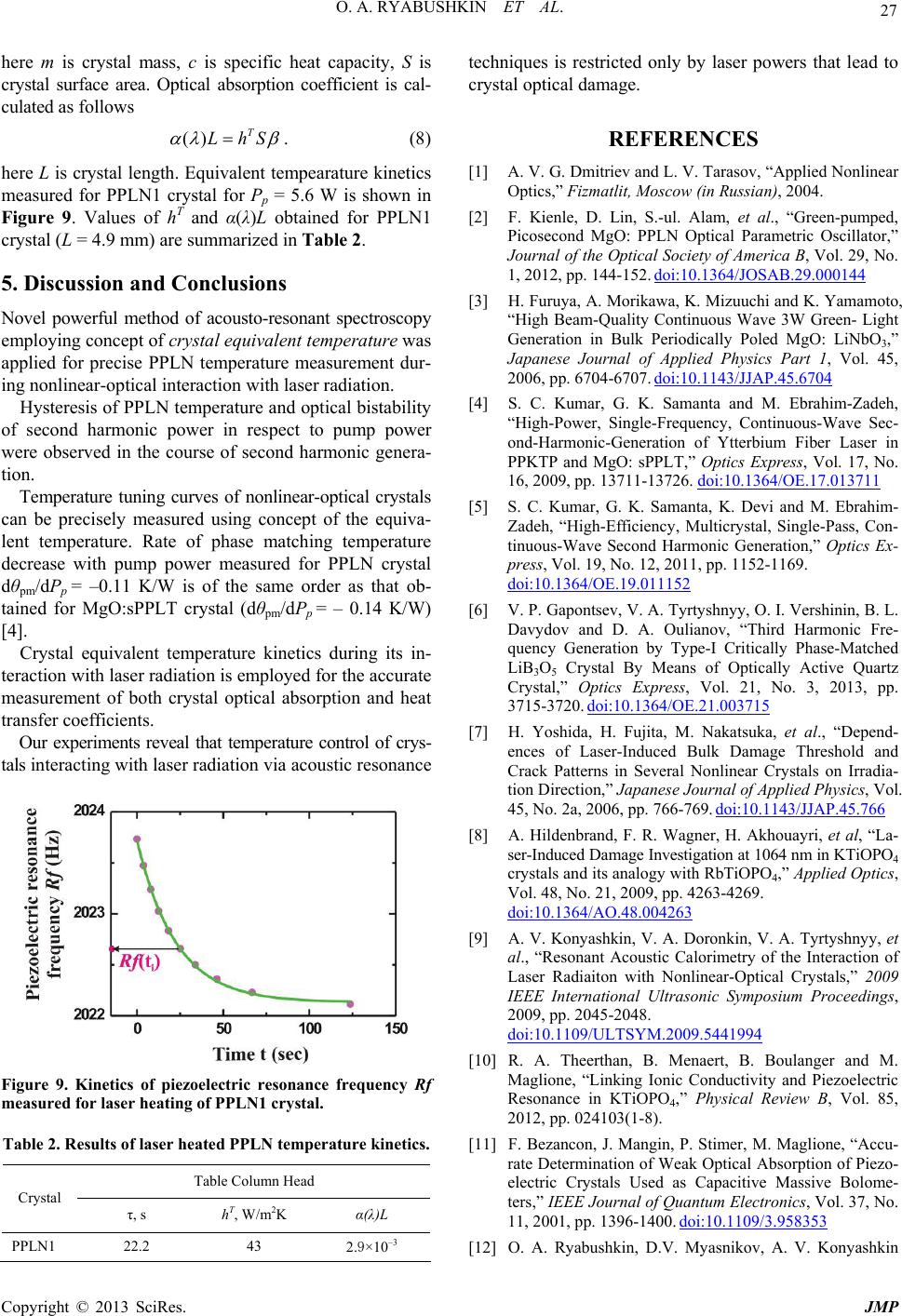 O. A. RYABUSHKIN ET AL. 27 here m is crystal mass, c is specific heat capacity, S is crystal surface area. Optical absorption coefficient is cal- culated as follows () T LhS . (8) here L is crystal length. Equivalent tempearature kinetics measured for PPLN1 crystal for Pp = 5.6 W is shown in Figure 9. Values of hT and α(λ)L obtained for PPLN1 crystal (L = 4.9 mm) are summarized in Table 2. 5. Discussion and Conclusions Novel powerful method of acousto-resonant spectroscopy employing concept of crystal equivalent temperature was applied for precise PPLN temperature measurement dur- ing nonlinear-optical interaction with laser radiation. Hysteresis of PPLN temperature and optical bistability of second harmonic power in respect to pump power were observed in the course of second harmonic genera- tion. Temperature tuning curves of nonlinear-optical crystals can be precisely measured using concept of the equiva- lent temperature. Rate of phase matching temperature decrease with pump power measured for PPLN crystal dθpm/dPp = –0.11 K/W is of the same order as that ob- tained for MgO:sPPLT crystal (dθpm/dPp = – 0.14 K/W) [4]. Crystal equivalent temperature kinetics during its in- teraction with laser radiation is employed for the accurate measurement of both crystal optical absorption and heat transfer coefficients. Our experiments reveal that temperature control of crys- tals interacting with laser radiation via acoustic resonance Figure 9. Kinetics of piezoelectric resonance frequency Rf measured for laser heating of PPLN1 crystal. Table 2. Results of laser heated PPLN temperature kinetics. Table Column Head Crystal τ, s hT, W/m2K α(λ)L PPLN1 22.2 43 2.9×10⁻³ techniques is restricted only by laser powers that lead to crystal optical damage. REFERENCES [1] A. V. G. Dmitriev and L. V. Tarasov, “Applied Nonlinear Optics,” Fizmatlit, Moscow (in Russian), 2004. [2] F. Kienle, D. Lin, S.-ul. Alam, et al., “Green-pumped, Picosecond MgO: PPLN Optical Parametric Oscillator,” Journal of the Optical Society of America B, Vol. 29, No. 1, 2012, pp. 144-152. doi:10.1364/JOSAB.29.000144 [3] H. Furuya, A. Morikawa, K. Mizuuchi and K. Yamamoto, “High Beam-Quality Continuous Wave 3W Green- Light Generation in Bulk Periodically Poled MgO: LiNbO3,” Japanese Journal of Applied Physics Part 1, Vol. 45, 2006, pp. 6704-6707. doi:10.1143/JJAP.45.6704 [4] S. C. Kumar, G. K. Samanta and M. Ebrahim-Zadeh, “High-Power, Single-Frequency, Continuous-Wave Sec- ond-Harmonic-Generation of Ytterbium Fiber Laser in PPKTP and MgO: sPPLT,” Optics Express, Vol. 17, No. 16, 2009, pp. 13711-13726. doi:10.1364/OE.17.013711 [5] S. C. Kumar, G. K. Samanta, K. Devi and M. Ebrahim- Zadeh, “High-Efficiency, Multicrystal, Single-Pass, Con- tinuous-Wave Second Harmonic Generation,” Optics Ex- press, Vol. 19, No. 12, 2011, pp. 1152-1169. doi:10.1364/OE.19.011152 [6] V. P. Gapontsev, V. A. Tyrtyshnyy, O. I. Vershinin, B. L. Davydov and D. A. Oulianov, “Third Harmonic Fre- quency Generation by Type-I Critically Phase-Matched LiB3O5 Crystal By Means of Optically Active Quartz Crystal,” Optics Express, Vol. 21, No. 3, 2013, pp. 3715-3720. doi:10.1364/OE.21.003715 [7] H. Yoshida, H. Fujita, M. Nakatsuka, et al., “Depend- ences of Laser-Induced Bulk Damage Threshold and Crack Patterns in Several Nonlinear Crystals on Irradia- tion Direction,” Japanese Journal of Applied Physics, Vol. 45, No. 2a, 2006, pp. 766-769. doi:10.1143/JJAP.45.766 [8] A. Hildenbrand, F. R. Wagner, H. Akhouayri, et al, “La- ser-Induced Damage Investigation at 1064 nm in KTiOPO4 crystals and its analogy with RbTiOPO4,” Applied Optics, Vol. 48, No. 21, 2009, pp. 4263-4269. doi:10.1364/AO.48.004263 [9] A. V. Konyashkin, V. A. Doronkin, V. A. Tyrtyshnyy, et al., “Resonant Acoustic Calorimetry of the Interaction of Laser Radiaiton with Nonlinear-Optical Crystals,” 2009 IEEE International Ultrasonic Symposium Proceedings, 2009, pp. 2045-2048. doi:10.1109/ULTSYM.2009.5441994 [10] R. A. Theerthan, B. Menaert, B. Boulanger and M. Maglione, “Linking Ionic Conductivity and Piezoelectric Resonance in KTiOPO4,” Physical Review B, Vol. 85, 2012, pp. 024103(1-8). [11] F. Bezancon, J. Mangin, P. Stimer, M. Maglione, “Accu- rate Determination of Weak Optical Absorption of Piezo- electric Crystals Used as Capacitive Massive Bolome- ters,” IEEE Journal of Quantum Electronics, Vol. 37, No. 11, 2001, pp. 1396-1400. doi:10.1109/3.958353 [12] O. A. Ryabushkin, D.V. Myasnikov, A. V. Konyashkin Copyright © 2013 SciRes. JMP  O. A. RYABUSHKIN ET AL. Copyright © 2013 SciRes. JMP 28 and V. A. Tyrtyshnyy, “Equivalent Temperature of Nonlinearoptical Crystals Interacting with Laser Radia- tion,” Journal of the European Optical Society-Rapid publications, Vol. 6, 2011, pp. 11032(1-8). [13] O. A. Ryabushkin and D. V. Myasnikov, “Experimental Determination and The Theoretical Model of An Equiva- lent Temperature of Nonlinear Optical Crystals Interact- ing With High-Power Laser Radiation,” Quantum Elec- tron, Vol. 42, No. 6, 2012, pp. 539-544. doi:10.1070/QE2012v042n06ABEH014657 [14] ISO 11551: test method for absorptance of optical laser components / International Organization for Standartiza- tion. Geneva Switzerland, 2003. |