

Paper Menu >>
Journal Menu >>
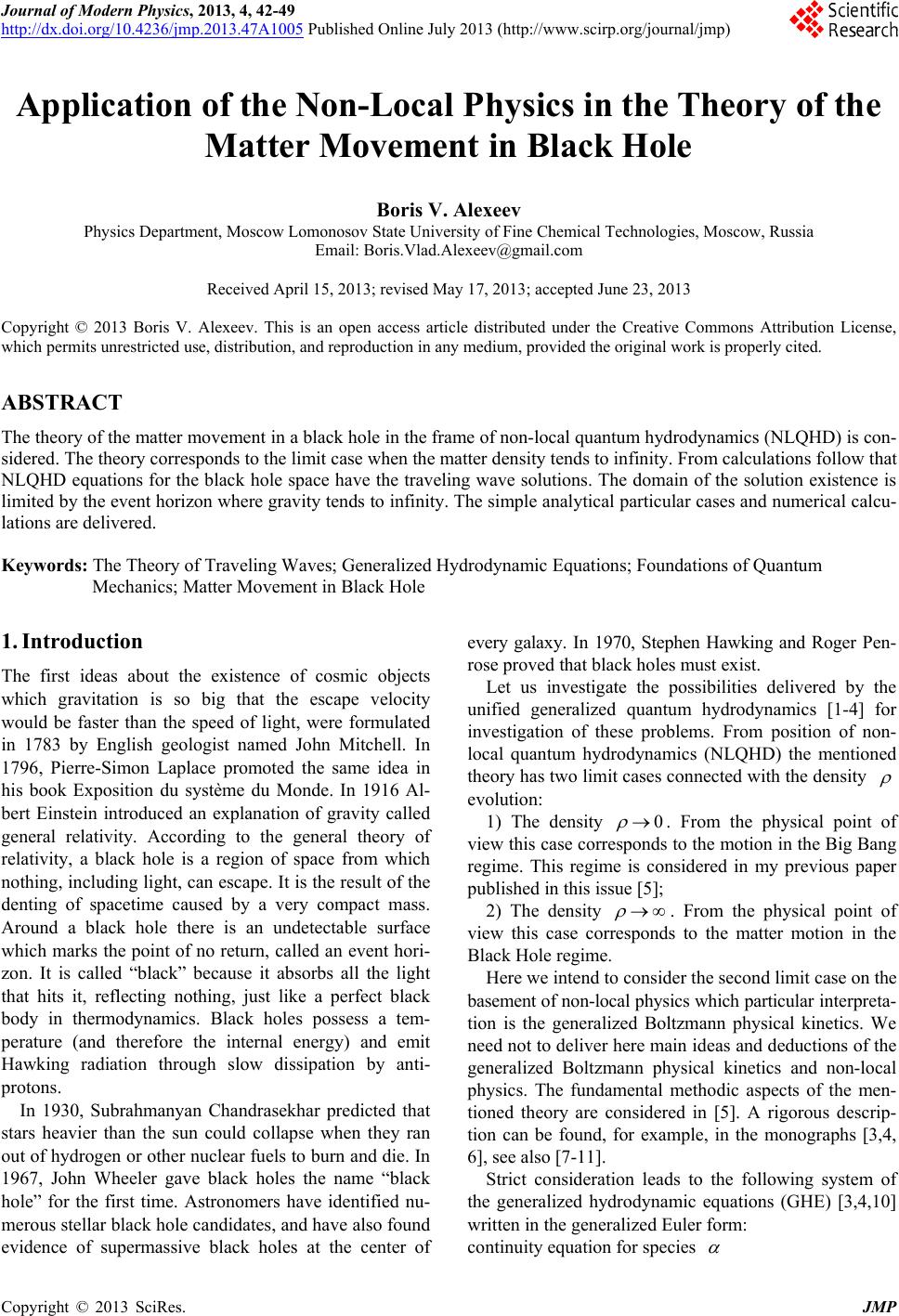 Journal of Modern Physics, 2013, 4, 42-49 http://dx.doi.org/10.4236/jmp.2013.47A1005 Published Online July 2013 (http://www.scirp.org/journal/jmp) Application of the Non-Local Physics in the Theory of the Matter Movement in Black Hole Boris V. Alexeev Physics Department, Moscow Lomonosov State University of Fine Chemical Technologies, Moscow, Russia Email: [email protected] Received April 15, 2013; revised May 17, 2013; accepted June 23, 2013 Copyright © 2013 Boris V. Alexeev. This is an open access article distributed under the Creative Commons Attribution License, which permits unrestricted use, distribution, and reproduction in any medium, provided the original work is properly cited. ABSTRACT The theory of the matter movement in a black hole in the frame of non-local quan tum hydrod ynamics (NLQHD ) is con- sidered. The theory corresponds to the limit case when the matter density tends to in finity. From calculations follow that NLQHD equations for the black hole space have the traveling wave solutions. The domain of the solution existence is limited by the event horizon where gravity tends to infinity. The simple analytical particular cases and numerical calcu- lations are delivered. Keywords: The Theory of Traveling Waves; Generalized Hydrodynamic Equations; Foundations of Quantum Mechanics; Matter Movement in Black Hole 1. Introduction The first ideas about the existence of cosmic objects which gravitation is so big that the escape velocity would be faster than the speed of light, were formulated in 1783 by English geologist named John Mitchell. In 1796, Pierre-Simon Laplace promoted the same idea in his book Exposition du système du Monde. In 1916 Al- bert Einstein introduced an explanation of gravity called general relativity. According to the general theory of relativity, a black hole is a region of space from which nothing, including light, can escape. It is the result of the denting of spacetime caused by a very compact mass. Around a black hole there is an undetectable surface which marks the point of no return, called an event hori- zon. It is called “black” because it absorbs all the light that hits it, reflecting nothing, just like a perfect black body in thermodynamics. Black holes possess a tem- perature (and therefore the internal energy) and emit Hawking radiation through slow dissipation by anti- protons. In 1930, Subrahmanyan Chandrasekhar predicted that stars heavier than the sun could collapse when they ran out of hydrogen or other nuclear fuels to burn an d die. In 1967, John Wheeler gave black holes the name “black hole” for the first time. Astronomers have identified nu- merous stellar black hole candidates, and have also found evidence of supermassive black holes at the center of every galaxy. In 1970, Stephen Hawking and Roger Pen- rose proved that black holes must exist. Let us investigate the possibilities delivered by the unified generalized quantum hydrodynamics [1-4] for investigation of these problems. From position of non- local quantum hydrodynamics (NLQHD) the mentioned theory has two limit cases con nected with the dens ity evolution: 1) The density 0 . From the physical point of view this case corresponds to the motion in the Big Bang regime. This regime is considered in my previous paper published in this issue [5]; 2) The density . From the physical point of view this case corresponds to the matter motion in the Black Hole regime. Here we intend to consider the second limit case on the basement of non-local physics which particular int er pre ta- tion is the generalized Boltzmann physical kinetics. We need not to deliver here main ideas and deductions of the generalized Boltzmann physical kinetics and non-local physics. The fundamental methodic aspects of the men- tioned theory are considered in [5]. A rigorous descrip- tion can be found, for example, in the monographs [3,4, 6], see also [7-11]. Strict consideration leads to the following system of the generalized hydrodynamic equations (GHE) [3,4,10] written in the generalized Euler form: continuity equation for species C opyright © 2013 SciRes. JMP 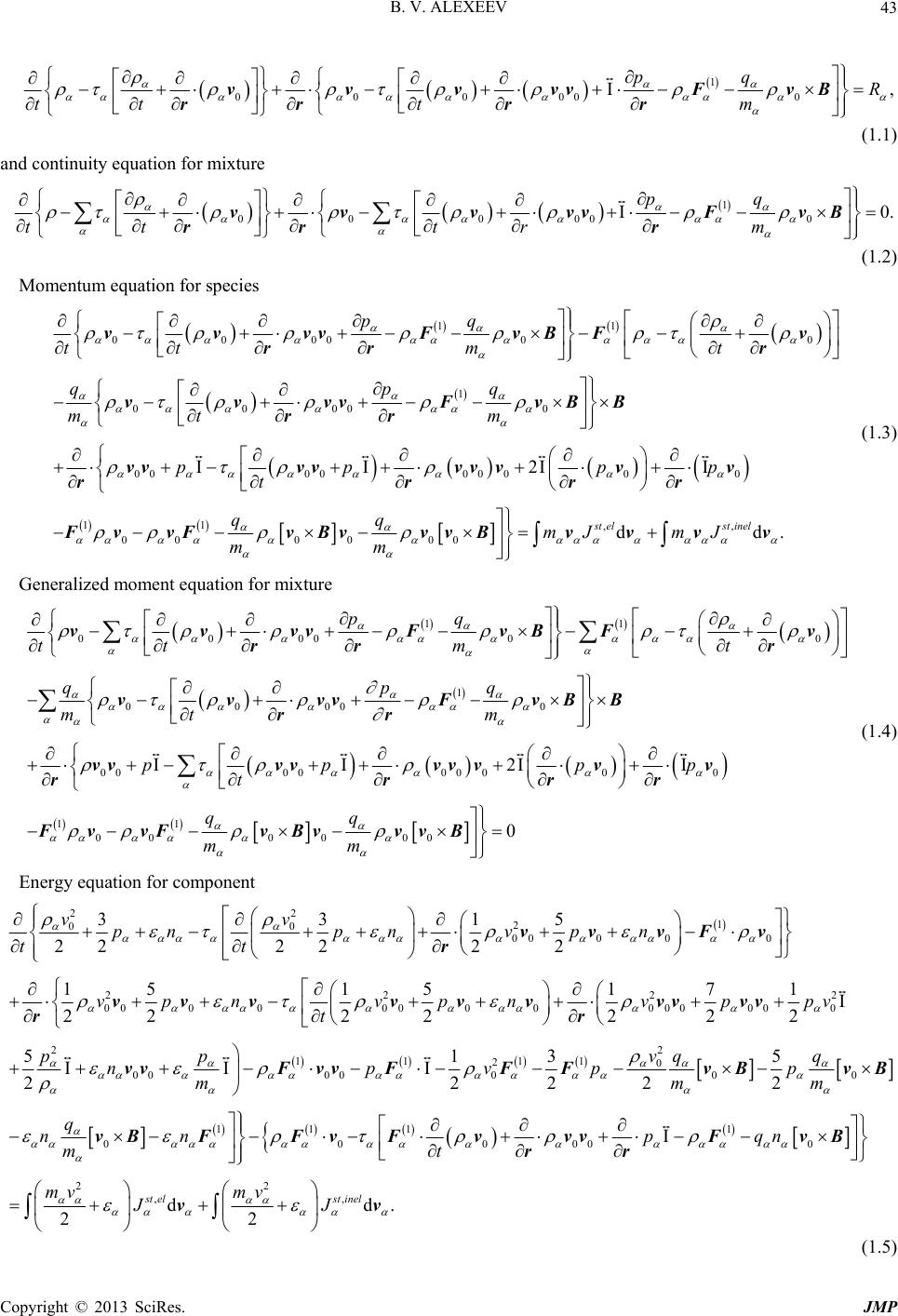 B. V. ALEXEEV 43 1 00000 pq tt t m 0 I,R vvvvv F rrr r vB (1.1) and continuity equation for mixture 1 00 000 pq tt tr vvvvv F rr r 0 I0. m vB (1.2) Momentum equation for species 11 0000 0 1 0000 0 00 00 I pq tt m qpq mt m pt 0 t v r vvvvFvBF rr vvvvFvBB rr vv vv r 00 000 11 ,, 0000 00 I2I st elst inel pp qq mJ mJ mm vv vvv rr F vvFvBvvvBvvv I dd. p r v (1.3) Generalized moment equation for mixture 11 0000 0 1 0000 0 00 0 I pq tt m qpq mt m pt 0 t v r vvvvFvBF rr vvvvFvBB rr vv vv r 00000 11 0000 00 I2I 0 pp qq mm vv vvv rrr F vvFvBvvvB 0 Ip (1.4) Energy equation for component 22 1 2 0000 0 00 222 00 0 0000000000 3315 22222 2 15151 7 22222 2 vv pnpnv pn tt vpnvpnv p t vvvFv r vvvvvv vvvv rr 2 2 11 11 20 0000 00 11 11 00000 1 2 513 222 pp vq npvp mm q nn p mt vvFvv FFFvB vBFFv FvvvF rr 2 0 0 0 5 22 pv q p m qn vB vB 22 ,, dd. 22 st elst inel mv mv JJ vv (1.5) Copyright © 2013 SciRes. JMP 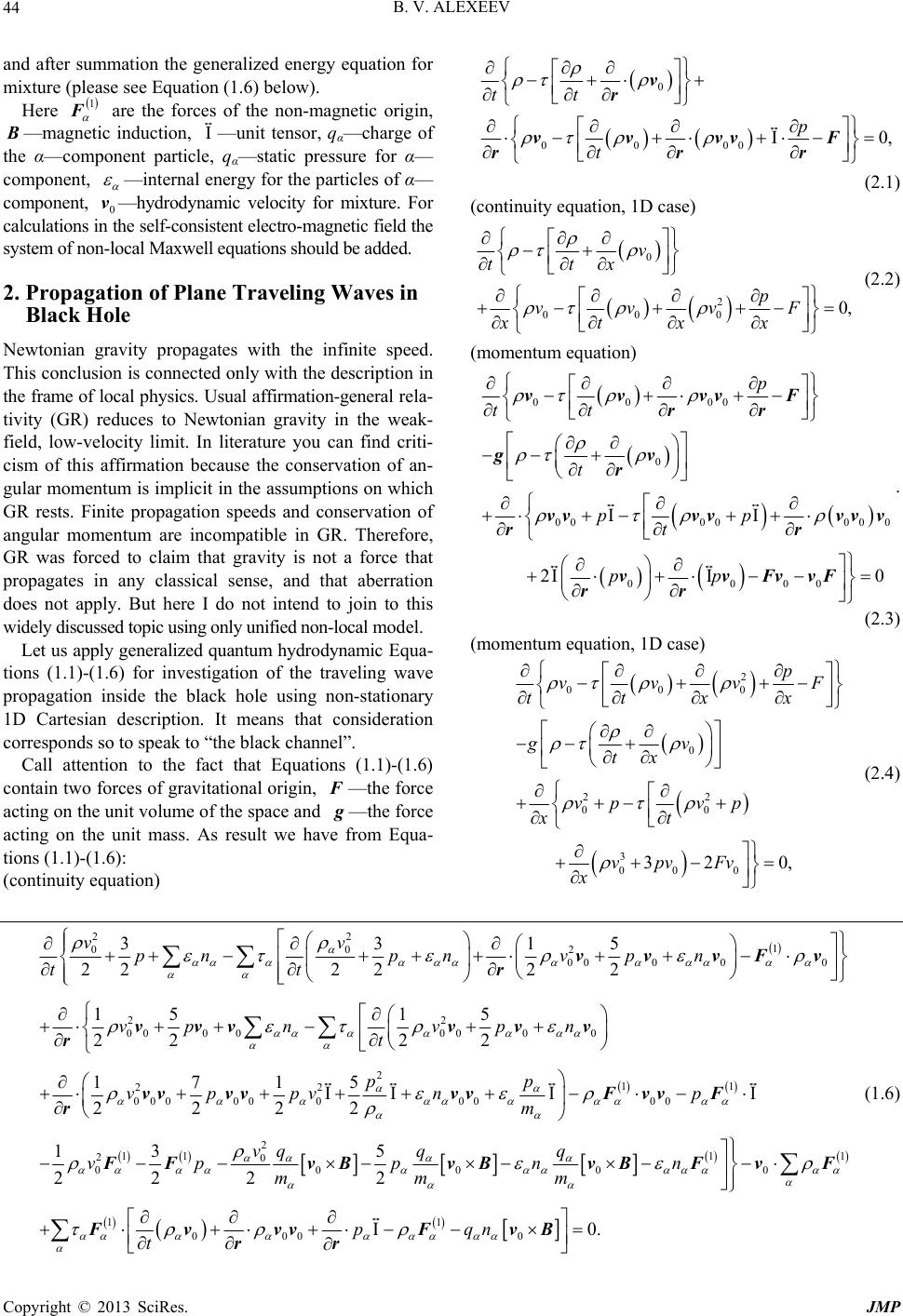 B. V. ALEXEEV 44 and after summation the generalized energy equation for mixture (please see Equation (1.6) below). Here 1 F BI are the forces of the non-magnetic origin, —magnetic induction, —unit tensor, qα—charge of the α—component particle, qα—static pressure for α— component, —internal energy for the particles of α— component, 0—hydrodynamic velocity for mixture. For calculat ions in the self- cons istent e lectro -mag netic f ield th e system of non-local Maxwell equations should be added. v 2. Propagation of Plane Traveling Waves in Black Hole Newtonian gravity propagates with the infinite speed. This conclusion is co nnected only with the description in the frame of local physics. Usual affirmation-general rela - tivity (GR) reduces to Newtonian gravity in the weak- field, low-velocity limit. In literature you can find criti- cism of this affirmation because the conservation of an- gular momentum is implicit in the assumptions on which GR rests. Finite propagation speeds and conservation of angular momentum are incompatible in GR. Therefore, GR was forced to claim that gravity is not a force that propagates in any classical sense, and that aberration does not apply. But here I do not intend to join to this widely discussed topic using only unified non-local model. Let us apply generalized quantum hydrodynamic Equ a- tions (1.1)-(1.6) for investigation of the traveling wave propagation inside the black hole using non-stationary 1D Cartesian description. It means that consideration corresponds so to speak to “the black channel”. Call attention to the fact that Equations (1.1)-(1.6) contain two forces of gravitational origin, —the force acting on the unit volume of the space and —the force acting on the unit mass. As result we have from Equa- tions (1.1 ) -(1.6): F g (continuity equation) 0 0000 I0 , tt p t v r vvvvF rrr (2.1) (continuity equation , 1D case) 0 2 000 0, v ttx p vvvF xtxx (2.2) (momentum equation) 0000 0 000000 0 0000 II 2I I0 p tt t pp t pp vvvvF rr gv r vvvvvvv rr vvFvvF rr . (2.3) (momentum equation, 1D case) 2 000 0 22 00 3 00 0 32 0, p vvvF ttxx gv tx vp vp xt vpv Fv x (2.4) 22 1 2 00 00 0 00 22 000 00000 3315 222 222 151 5 222 2 vv pnpnvp n tt vp nvpn t 2 000 17 22 vp vvvFv r vvvvvv r vv v r 211 2 00 00000 2 11 11 20 00000 11 0 15 22 13 5 222 2 pp pv np m vq q q vpp n n mmm pqn vvvFvvF F FvBvBvBFvF v Fv rr 00. B 00 t Fvv (1.6) Copyright © 2013 SciRes. JMP 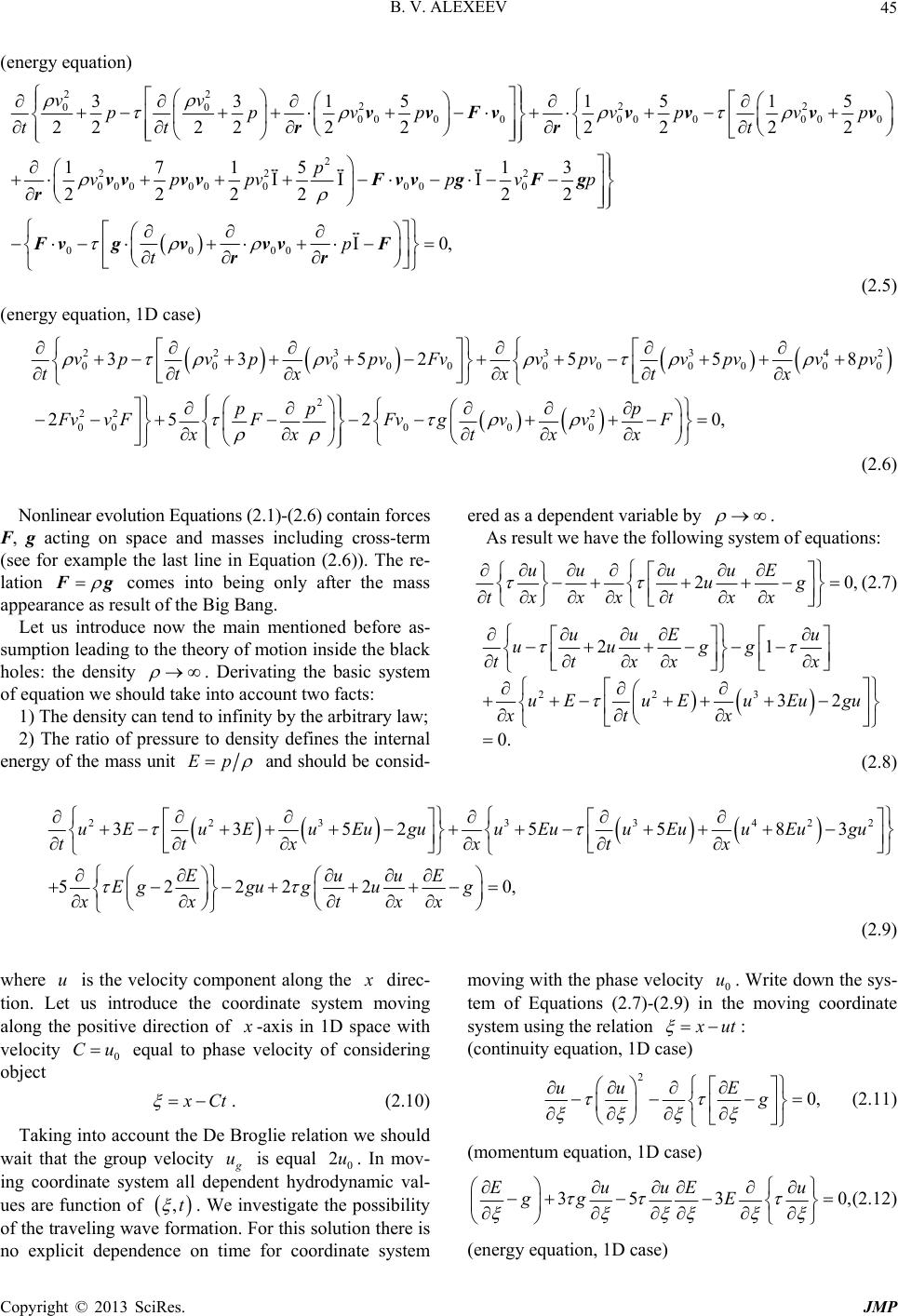 B. V. ALEXEEV 45 (energy equation) 22 22 00 00 0000 0 2 22 2 00000 0000 33 1515 2222 2222 1715 13 2222 22 vv pp vpvp tt p vppvpv vvFv vv rr vvvvFvvgFg r 2 00 0 15 22 vp t vv 0000 0, p p t Fv gvvvF rr (2.5) (energy equation, 1D case) 22333 00000000 2 22 2 00000 33525 5 25 20, vpvpvpvFvvpvvpv ttxxt pp p Fvv FFFvgvvF xx txx 42 000 8vpv x (2.6) Nonlinear evolution Equati ons (2.1)-(2.6) contain forces F, g acting on space and masses including cross-term (see for example the last line in Equation (2.6)). The re- lation Fg comes into being only after the mass appearance as result of the Big Bang. Let us introduce now the main mentioned before as- sumption leading to the theory of motion inside the black holes: the density . Derivating the basic system of equation we should take into account two facts: 1) The density can tend to infinity by the arbitrary law; 2) The ratio of pressure to density defines the internal energy of the mass unit Ep and should be consid- ered as a dependent variable by . As result we have the following system of equations: 20, uuu uE ug tx xxtxx (2.7) 223 21 32 0. uuE u uugg ttxx x uEuEu Eugu xtx (2.8) 22333422 33525 583 220, uEuEuEuguuEuuEuuEu gu ttxx tx EuuE g ug txx 52 2Eg gu xx (2.9) x where is the velocity component along the u direc- tion. Let us introduce the coordinate system moving along the positive direction of x -axis in 1D space with velocity equal to phase velocity of considering object 0 Cu x Ct . (2.10) Taking into account the De Broglie relation we should wait that the group velocity g u2u ,t is equal 0. In mov- ing coordinate system all dependent hydrodynamic val- ues are function of . We investigate the possibility of the traveling wave formation. For this solution there is no explicit dependence on time for coordinate system moving with the phase velocity 0. Write down the sys- tem of Equations (2.7)-(2.9) in the moving coordinate system using the relation u x ut : (continuity equation, 1D case) 2 0, uu E g (2.11) (momentum equation, 1D case) 35 30 EuuEu gg E , (2.12) (energy equation, 1D case) Copyright © 2013 SciRes. JMP 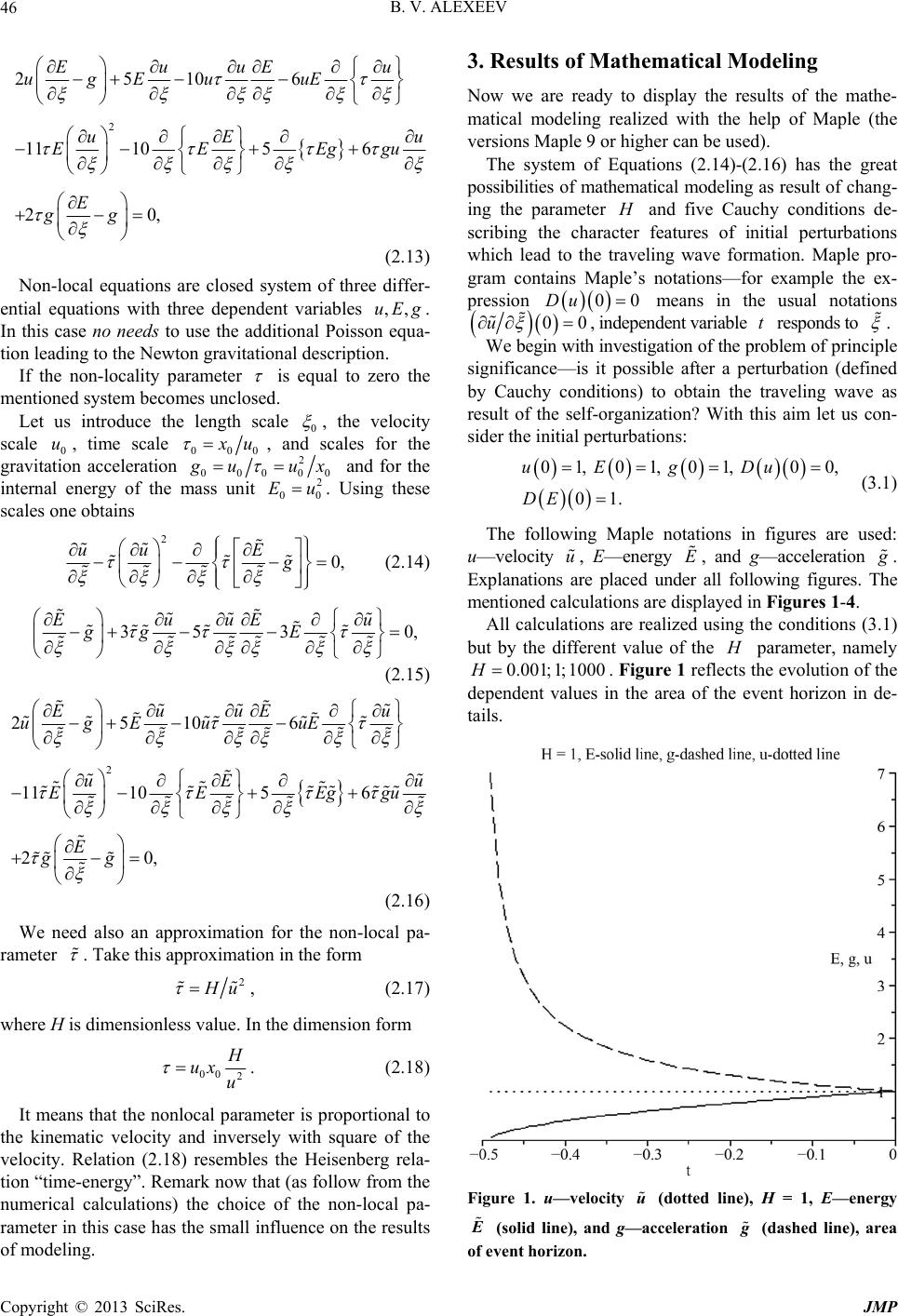 B. V. ALEXEEV 46 2 2510 11 105 20, EuuE ugE u uE EE E gg 6 6 u uE u Eggu ,, uEg (2.13) Non-local equations are closed system of three differ- ential equations with three dependent variables . In this case no needs to use the additional Poisson equa- tion leading to the Newton gravitation a l description. If the non-locality parameter is equal to zero the mentioned system becomes unclosed. Let us introduce the length scale 0 , the velocity scale 0, time scale u000 x u , and scales for the gravitation acceleration 2 0000 0 g uux 2 00 Eu and for the internal energy of the mass unit . Using these scales one obtains 2 uu 0, E g (2.14) 35 3 EuuE gg E 0, u (2.15) 2 2510 11 105 20, EuuE ugE uu uE EE E gg 6 6 u E u Eggu (2.16) We need also an approximation for the non-local pa- rameter . Take this approximation in the fo rm 2 H u , (2.17) where H is dimensionless value. In the dimension form 00 2 H ux u . (2.18) It means that the nonlocal parameter is proportional to the kinematic velocity and inversely with square of the velocity. Relation (2.18) resembles the Heisenberg rela- tion “time-energy”. Remark now that (as follow from the numerical calculations) the choice of the non-local pa- rameter in this case has the small influence on the results of modeling. 3. Results of Mathematical Modeling Now we are ready to display the results of the mathe- matical modeling realized with the help of Maple (the versions Maple 9 or hi g her can be used). The system of Equations (2.14)-(2.16) has the great possibilities of mathematical modeling as result of chang- ing the parameter H and five Cauchy conditions de- scribing the character features of initial perturbations which lead to the traveling wave formation. Maple pro- gram contains Maple’s notations—for example the ex- pression 00Du means in the usual notations 00u t, independent variable responds to . We begin with investigation of the problem of pr in ci ple significance—is it possible after a perturbation (defined by Cauchy conditions) to obtain the traveling wave as result of the self-organization? With this aim let us con- sider the initial perturbations: 0 1, 0 1, 0 1, 00, 01. uEg Du DE u E (3.1) The following Maple notations in figures are used: u—velocity , E—energy , and g—acceleration g . Explanations are placed under all following figures. The mentioned calculations are displayed in Figures 1-4. All calculations are realized using the conditions (3.1) but by the different value of the H parameter, namely 0.001;1;1000H . Figure 1 reflects the evolution of the dependent values in the area of the event horizon in de- tails. Figure 1. u—velocity (dotted line), H = 1, E—energy u E (solid line), and g—acceleration g (dashed line), area of event horizon. Copyright © 2013 SciRes. JMP 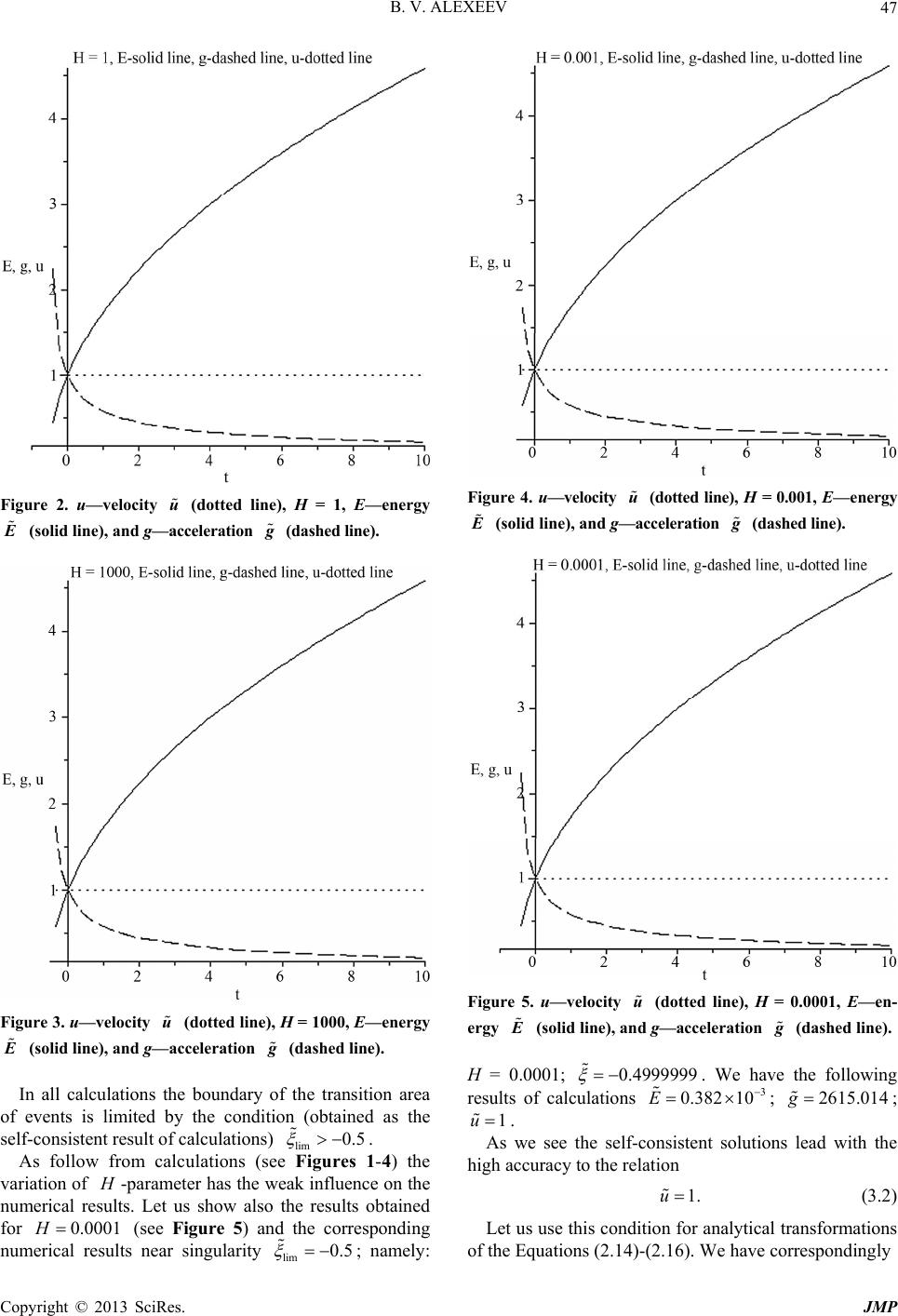 B. V. ALEXEEV 47 Figure 2. u—velocity (dotted line), H = 1, E—energy u E (solid line), and g—acceleration g (dashed line). Figure 3. u—velocity (dotted line), H = 1000, E—energy u E (solid line), and g—acceleration g 0.5 (dashed line). In all calculations the boundary of the transition area of events is limited by the condition (obtained as the self-consistent result of calculations) . lim As follow from calculations (see Figures 1-4) the variation of H -parameter has the weak influence on the numerical results. Let us show also the results obtained for (see Figure 5) and the corresponding numerical results near singularity ; namely: 0.0001H0.5 li m Figure 4. u—velocity (dotted line), H = 0.001, E—energy u E (solid line), and g—acceleration g (dashed line). Figure 5. u—velocity (dotted line), H = 0.0001, E—en- ergy u E (solid line), and g—acceleration g 0.4999999 3 0.382 10E 2615.014g 1u (dashed line). H = 0.0001; . We have the following results of calculations ; ; 1.u . As we see the self-consistent solutions lead with the high accuracy to the relation (3.2) Let us use this condition for analytical transfor mations of the Equations (2.1 4)-(2.1 6 ) . We have corresponding l y Copyright © 2013 SciRes. JMP 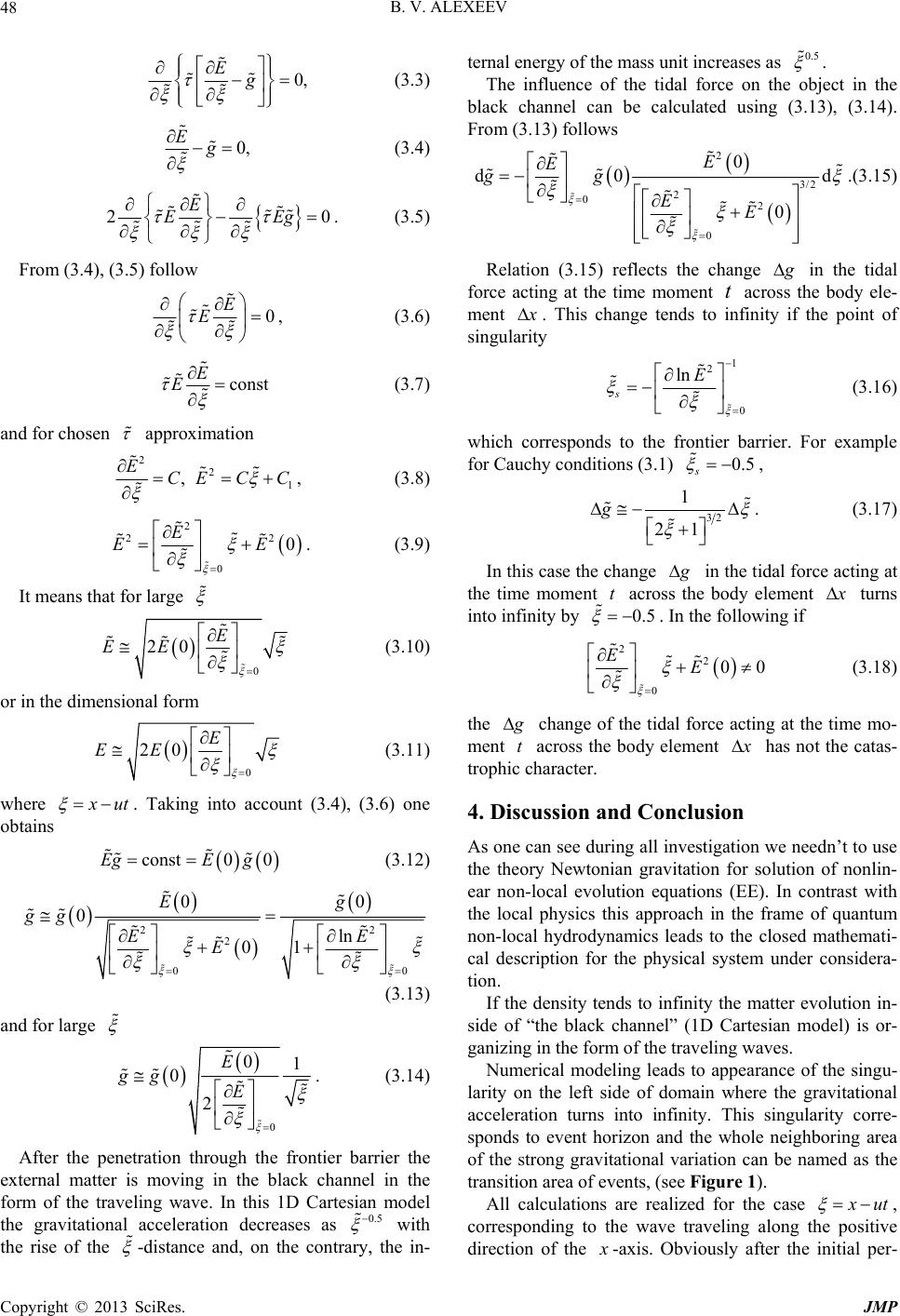 B. V. ALEXEEV 48 0, Eg (3.3) 0, Eg (3.4) 20 E g E E . (3.5) From (3.4), (3.5 ) follow 0 E E , (3.6) const E E (3.7) and for chosen approximation 221 EC C , CE , (3.8) 2 22 0 0 EE E . (3.9) It means that for large 0 E 20EE (3.10) or in the dimensional form 0 E 20EE (3.11) where x ut const00EgE g . Taking into account (3.4), (3.6) one obtains (3.12) 22 2 00 00 ln 01 Eg EE E 0gg (3.13) and for large 0 01 E E 0 2 gg 0.5 . (3.14) After the penetration through the frontier barrier the external matter is moving in the black channel in the form of the traveling wave. In this 1D Cartesian model the gravitational acceleration decreases as with the rise of the 0.5 -distance and, on the contrary, the in- ternal energy of the mass unit increases as . The influence of the tidal force on the object in the black channel can be calculated using (3.13), (3.14). From (3.13) follows 2 3/2 2 02 0 0 d0 d 0 E E gg EE .(3.15) g Relation (3.15) reflects the change t in the tidal force acting at the time moment across the body ele- ment x . This change tends to infinity if the point of singularity 1 2 0 ln s E 0.5 s (3.16) which corresponds to the frontier barrier. For example for Cauchy condition s (3.1) , 32 1 21 g . (3.17) g In this case the change in the tidal force acting at the time moment across the body element t x turns into infinity by 0.5 . In the following if 22 0 00 EE (3.18) g the change of the tidal force acting at the time mo- ment across the body element x t has not the catas- trophic character. 4. Discussion and Conclusion As one can see during all investig ation we needn’t to use the theory Newtonian gravitation for solution of nonlin- ear non-local evolution equations (EE). In contrast with the local physics this approach in the frame of quantum non-local hydrodynamics leads to the closed mathemati- cal description for the physical system under considera- tion. If the density tends to infinity the matter evolution in- side of “the black channel” (1D Cartesian model) is or- ganizing in the form of the traveling waves. Numerical modeling leads to appearance of the singu- larity on the left side of domain where the gravitational acceleration turns into infinity. This singularity corre- sponds to event horizon and the whole neighboring area of the strong gravitational variation can be named as the transition area of events, (see Figure 1). x ut All calculations are realized for the case , corresponding to the wave traveling along the positive direction of the x -axis. Obviously after the initial per- Copyright © 2013 SciRes. JMP 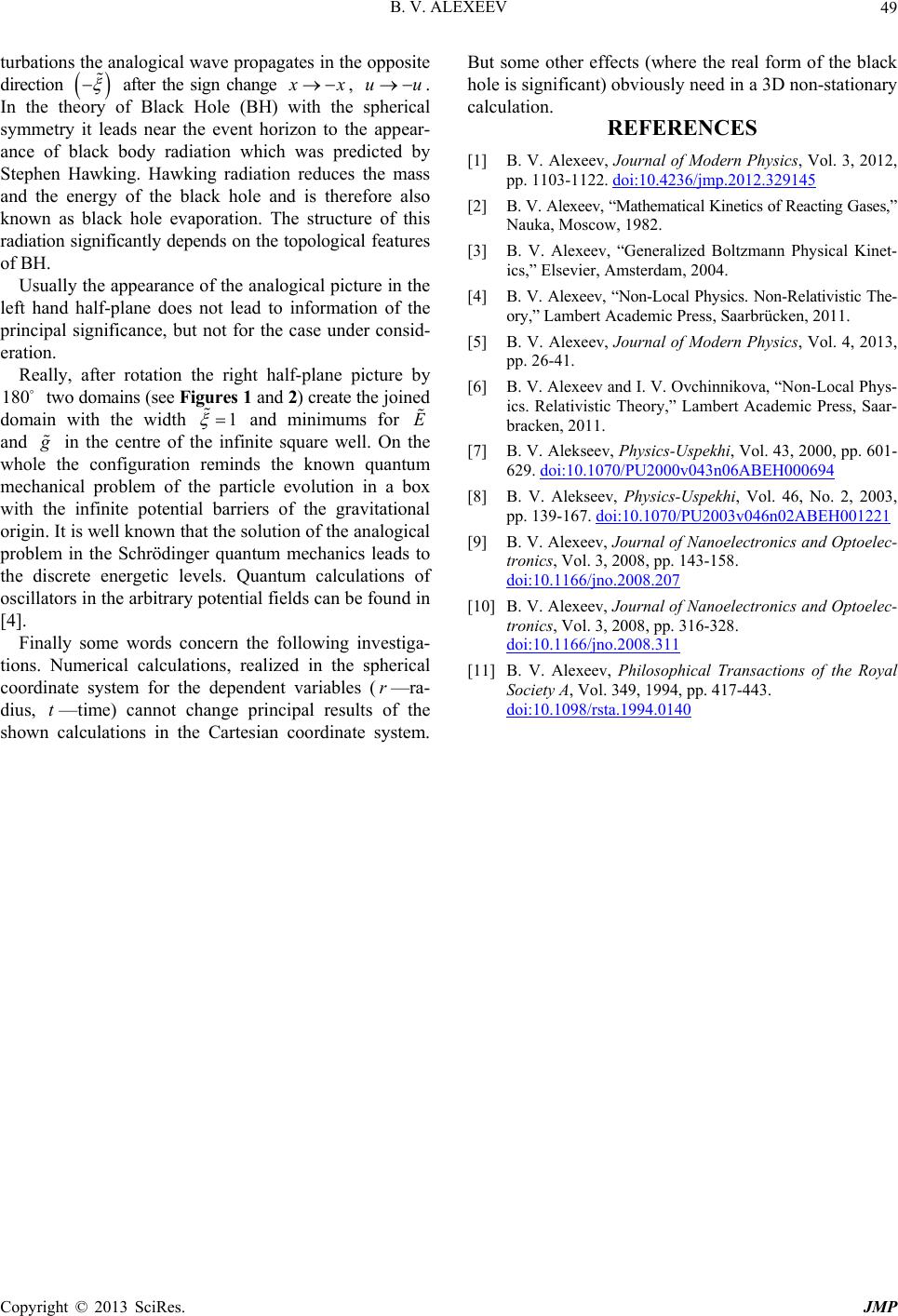 B. V. ALEXEEV opyright © 2013 SciRe JMP 49 Cs. turbations the analogical wave p ropagates in the oppo site directi on after the sign change x x uu 180 E , . In the theory of Black Hole (BH) with the spherical symmetry it leads near the event horizon to the appear- ance of black body radiation which was predicted by Stephen Hawking. Hawking radiation reduces the mass and the energy of the black hole and is therefore also known as black hole evaporation. The structure of this radiation significantly depends on the topological features of BH. Usually the appearance of the analogical picture in the left hand half-plane does not lead to information of the principal significance, but not for the case under consid- eration. Really, after rotation the right half-plane picture by two domains (see Figures 1 and 2) create the jo i n ed domain with the width and minimums for and 1 g r t in the centre of the infinite square well. On the whole the configuration reminds the known quantum mechanical problem of the particle evolution in a box with the infinite potential barriers of the gravitational origin. It is well known that the solu tion of the an alogical problem in the Schrödinger quantum mechanics leads to the discrete energetic levels. Quantum calculations of oscillators in the arbitrary potential fields can b e found in [4]. Finally some words concern the following investiga- tions. Numerical calculations, realized in the spherical coordinate system for the dependent variables (—ra- dius, —time) cannot change principal results of the shown calculations in the Cartesian coordinate system. But some other effects (where the real form of the black hole is significant) obviously need in a 3D non-stationary calculation. REFERENCES [1] B. V. Alexeev, Journal of Modern Physics, Vol. 3, 2012, pp. 1103-1122. doi:10.4236/jmp.2012.329145 [2] B. V. Alexeev, “Mathematical Kinetic s of Reacting Gases,” Nauka, Moscow, 1982. [3] B. V. Alexeev, “Generalized Boltzmann Physical Kinet- ics,” Elsevier, Amsterdam, 2004. [4] B. V. Alexeev, “Non-Local Physics. Non-Relativistic The- ory,” Lambert Academic Press, Saarbrücken, 2011. [5] B. V. Alexeev, Journal of Modern Physics, Vol. 4, 2013, pp. 26-41. [6] B. V. Alexeev and I. V. Ovchinnikova, “Non-Local Phys- ics. Relativistic Theory,” Lambert Academic Press, Saar- bracken, 2011. [7] B. V. Alekseev, Physics-Uspekhi, Vol. 43, 2000, pp. 601- 629. doi:10.1070/PU2000v043n06ABEH000694 [8] B. V. Alekseev, Physics-Uspekhi, Vol. 46, No. 2, 2003, pp. 139-167. doi:10.1070/PU2003v046n02ABEH001221 [9] B. V. Alexeev, Journal of Nanoelectronics and Optoelec- tronics, Vol. 3, 2008, pp. 143-158. doi:10.1166/jno.2008.207 [10] B. V. Alexeev, Journal of Nanoelectronics and Optoelec- tronics, Vol. 3, 2008, pp. 316-328. doi:10.1166/jno.2008.311 [11] B. V. Alexeev, Philosophical Transactions of the Royal Society A, Vol. 349, 1994, pp. 417-443. doi:10.1098/rsta.1994.0140 |