

Paper Menu >>
Journal Menu >>
 Journal of Modern Physics, 2013, 4, 20-25 http://dx.doi.org/10.4236/jmp.2013.47A1003 Published Online July 2013 (http://www.scirp.org/journal/jmp) Cosmology with Bounce by Flat Space-Time Theory of Gravitation and a New Interpretation Walter Petry Mathematisches Institut der Universitaet Duesseldorf, Duesseldorf, Germany Email: [email protected], [email protected] Received April 15, 2013; revised May 20, 2013; accepted June 25, 2013 Copyright © 2013 Walter Petry. This is an open access article distributed under the Creative Commons Attribution License, which permits unrestricted use, distribution, and reproduction in any medium, provided the original work is properly cited. ABSTRACT General relativity predicts a singularity in the beginning of the universe being called big bang. Recent developments in loop quantum cosmology avoid the singularity and the big bang is replaced by a big bounce. A classical theory of gravitation in flat space-time also avoids the singularity under natural conditions on the density parameters. The uni- verse contracts to a positiv e minimum and then it expands during all times. It is not symmetric with regard to its mini- mum implying a finite age measured with proper time of the universe. The space of the universe is flat and the total energy is conserved. Under the assumptio n that the sum of the density parameters is a little bit bigger than one the uni- verse is very hot in early times. Later on, the cosmological model agrees with the one of general relativity. A new inter- pretation of a non-expanding universe may be given by virtue of flat space -t i me theory of gravitat i on. Keywords: Gravitation; Cosmology; Big Bounce; Flat Space; No Big Bang; Non-Expanding Universe 1. Introduction Einstein’s theory of general relativity is generally ac- cepted as the most powerful theory of gravitation by vir- tue of its well-known predictions. It gives a singularity in the beginning of the universe being called big bang and which has been accepted for long times. But recent de- velopments of loop quantum cosmology avoid the singu- larity and it is replaced by a big bounce. There are many authors who have studied the big bounce by the use of loop quantum cosmology, see e.g. [1-5] and the extensive references therein. One compares also the popular book [6] on this subject. A big bounce in the beginning of the universe has already been studied by Priester (see e.g. [7]). Observational hints on a big bounce can be found in [8]. In 1981 the auth or [9] h as studied a cov ar iant th eory of gravitation in flat space-time. There exists an extensive study of this theory since that time. The energy-mome- tum of gravitation is a covariant tensor and the total en- ergy-momentum of all kinds of matter and fields includ- ing that of gravitation is the source of the gravitational field. The total energy-momentum is conserved. The the- ory gives the same results as general relativity to the ac- curacy demanded by the experiments for: gravitational redshift, light deflection, perihelion precession, radar time delay, post-Newtonian approximation, gravitational radiation, and the precession of the spin axis of a gyro- scope in the orbit of a rotating body. But there exist also differences to the results of general relativity, these are: the theorem of Birkhoff doesn’t hold and the theory gives non-singular cosmological models (no big bang). A sum- mary of flat space-time theory of gravitation with the mentioned results can be found in [10] where also refer- ences to the detailed studies are given. Non-singular cos- mological models studied by the use of flat spacetime theory of gravitation can be found e.g. in the papers [11- 15]. Subsequently, we follow along the lines of the above mentioned articles. Let us assume a hmogeneous, iso- tropic universe consisting of matter, radiation and dark energy, given by a cosmological constant. The theory of gravitation in flat space-time implies a flat space. Under the assumption that the sum of all the de nsity parameters is bigger than one, the solution describing the universe is non-singular, i.e. all the energies are finite. The universe contracts to a minimum and then it expand s for all times. The sum of all the energies of matter, radiation, dark energy, and the gravitational energy is conserved. As- suming that the sum of all the density parameters is a little bit bigger than one then the universe becomes very hot in early times. The time where the contracting uni- verse enters into the expanding one corresponds to the C opyright © 2013 SciRes. JMP 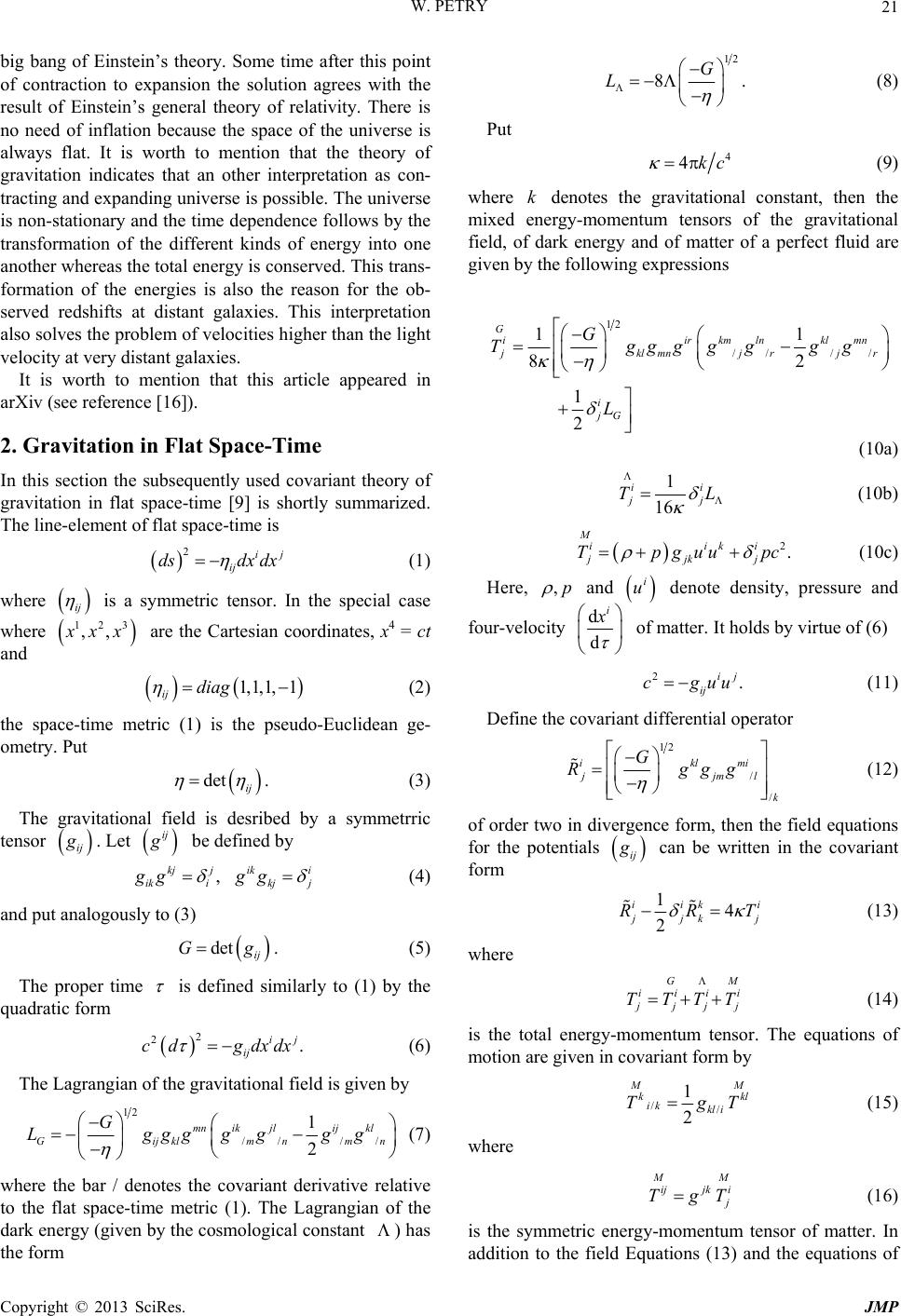 W. PETRY 21 big bang of Einstein’s theory. Some time after this point of contraction to expansion the solution agrees with the result of Einstein’s general theory of relativity. There is no need of inflation because the space of the universe is always flat. It is worth to mention that the theory of gravitation indicates that an other interpretation as con- tracting and expand ing universe is possible. The univ erse is non-stationary and the time d ependence follows by the transformation of the different kinds of energy into one another whereas the total energy is conserved. This trans- formation of the energies is also the reason for the ob- served redshifts at distant galaxies. This interpretation also solves the problem of velocities hig her than the light velocity at very distant galaxies. 12 8G L It is worth to mention that this article appeared in arXiv (see reference [16]). 2. Gravitation in Flat Space-Time In this section the subsequently used covariant theory of gravitation in flat space-time [9] is shortly summarized. The line-element of flat space-time is 2 ds ij ijdx dx ij (1) where is a symmetric tensor. In the special case where 123 ,, x xx are the Cartesian coordinates, x4 = ct and 1,1,1, 1ag ij di (2) the space-time metric (1) is the pseudo-Euclidean ge- ometry. Put det ij . (3) The gravitational field is desribed by a symmetrric tensor ij g . Let ij g be defined by ,ik i kj j gg kj j ik i gg (4) and put analogously to (3) det ij Gg. (5) The proper time is defined similarly to (1) by the quadratic form 2 2 cd . (6) ij ij gdxdx The Lagrangian of the gravitational field is given by 12 // mn ikjl Gijkl G Lgggg // 1 2 ij kl mnmn ggg (7) where the bar / denotes the covariant derivative relative to the flat space-time metric (1). The Lagrangian of the dark energy (given by the cosmological constant . (8) Put 4 4kc k (9) where denotes the gravitational constant, then the mixed energy-momentum tensors of the gravitational field, of dark energy and of matter of a perfect fluid are given by the following expres sions 12 /// / 11 82 1 2 Giirkmlnklmn j kl mnjrjr i jG G Tggggggg L (10a) ) has the form 1 16 ii jj TL 2. Miiki jjkj Tpguupc ,p (10b) (10c) i u denote density, pressure and and Here, four-velocity d d i x 2. ij ij cguu of matter. It holds by virtue of (6) (11) Define the covariant differential operator 12 / / iklmi jjml k G Rggg (12) of order two in divergence form, then the field equations for the potentials ij g can be written in the covariant form 14 2 iik i j jk j RRT GM iiii (13) where j jjj TTTT (14) is the total energy-momentum tensor. The equations of motion are given in covariant form by M // 1 2 M kkl ik kl i TgT (15) where M M ijjk i j TgT addition to the field Equations (13) and the equations of (16) is the symmetric energy-momentum tensor of matter. In Copyright © 2013 SciRes. JMP 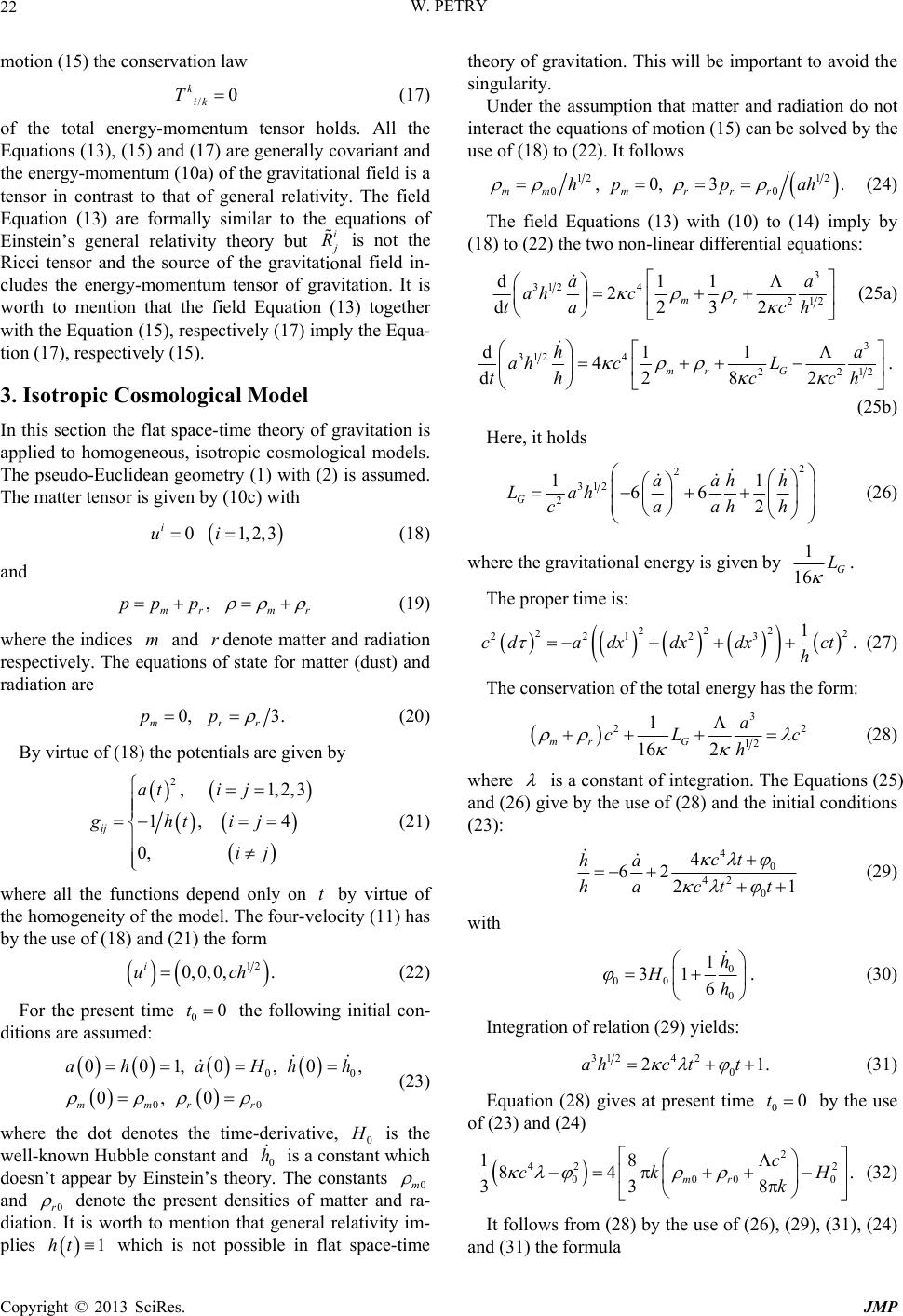 W. PETRY 22 motion (15) the conservation law 0 k T / ik (17) of the total energy-momentum tensor holds. All the Equations (13), (15) and (17) are generally covariant and the energy-momentum (10a) of the gravitational field is a tensor in contrast to that of general relativity. The field Equation (13) are formally similar to the equations of Einstein’s general relativity theory but i j R is not the Ricci tensor and the source of the gravitatnal field in- cludes the energy-momentum tensor of gravitation. It is worth to mention that the field Equation (13) together with the Equation (15), respectively (17) imply the Equa- tion (17), respec t ively (15). io 3. Isotropic Cosmological Model f gravitation is (18) and mr In this section the flat space-time theory o applied to homogeneous, isotropic cosmological models. The pseudo-Euclidean geometry (1) with (2) is assumed. The matter tensor is given by (10c) with 01,2,3 i ui , mr pp p (19) where inds m and rdenote matt qu o e thiceer and radiation respectively. The eations f state for matter (dust) and radiation are 0, 3. mrr pp (20) By virtue of (18) the potentials are given by 1, 4 0, ij gh tij ij (21) where all the functions dend only on t by virtue of l 2,1,2,3ati j pe the homogeneity of the model. The four-veocity (11) has by the use of (18) and (21) the form 12 0,0,0, . i uch (22) For thme 00t the fo di 00 ,0, r Hhh (23) where the dot denotes the tierivative, 0 e present tillowing initial con- tions are assumed: 00ah 00 1,0 0,0 mmr a me-d H is the tanwell-known Hu bble constan t and 0 h is a const which doesn’t appear by Einstein’s theo The constants 0m ry. and 0r denote the present densities of matter and ra- diatioIt is worth to mention that general relativity im- plies 1ht which is not possible in flat space-time theoryitation. This will be important to avoid the singularity. Under the n. of grav assumption that matter and radiation do not interact the equations of motion (15) can be solved by the use of (18) to (22). It follows 12,0,hp 12 00 3 . mmmrrr p ah (24) The field Equations (13) with (10) to (14) im (1 ply by 8) to (22) the two non-linear differential equ ations: 3 d11aa 31 2 4212 2 d2 32 mr ah c ta ch (25a) 3 31242212 d11 4 d282 mr G ha ah cL thc ch . (25b) Here, it holds 2 2 312 2 11 66 2 Gaahh Lah aahhc (26) where the gravitational energy is given by 1 16 G L . The proper time is: 222 2 23 1 cdadxdxdxct h . (27) The conservation of the to tal energy has the form: 2 22 1 3 1a 22 12 16 2 mr G cL c h (28) where is a constant of integration. The Equations (25) and (26) give by the use of (28) and the initial conditions (23): 40 42 0 4 62 21 ct ha ha ctt (29) with 0 00 0 1 31 6 h Hh . (30) Integration of relation (29) yields: 3124 2 21ahc tt 0. (31) Equation (28) gives at present time 0 t of0 by the use (23) and (24) 2 42 2 0000 84 . 338 mr c ck H k 18 (32) It follows from (2 8) by the use of (26), (29), (31) , (24) and (31) the formula Copyright © 2013 SciRes. JMP 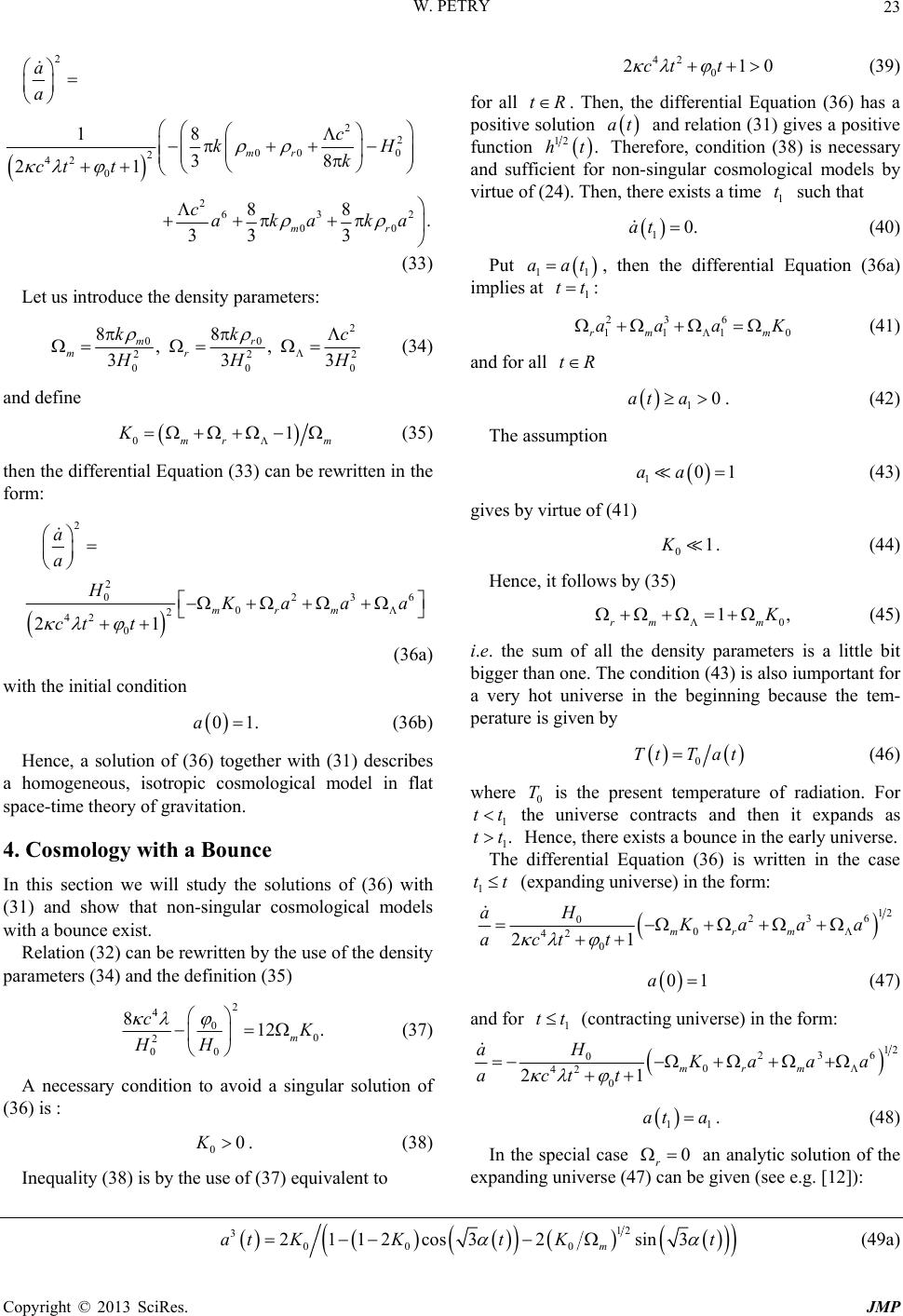 W. PETRY © 2013 SciRes. JMP 23 Copyright 2 a 22 00 0 2 42 0 2632 00 18 38 21 88 . 33 3 mr mr a c kH k ct t cakaka (33) Let us introduce the density parameters: 2 2 0 ,, 3 c 00 22 00 88 33 mr mr kk H HH (34) and define 0mr K 1m (35) then the differential Equation (33) can be rewritten in the form: 2 2 00 2 42 0 21 mr a a H236 m K aaa (36a) with the initial cond ition 01. ct t a (36b) Hence, a solution of (36) togeth a 4. Cosmology with a Bounce utions of (36) with e rewritten by the use of the density pa er with (31) describes homogeneous, isotropic cosmological model in flat space-time theory of gravitation. In this section we will study the sol (31) and show that non-singular cosmological models with a bounce exist. Relation (32) can b rameters (34) and the definition (35) 2 400 20 0 812 . m c K HH (37) A necessary condition to avoid a singular solution of (3 00K. (38) Inequality (38) is by the use of (37 42 0 210ct t tR (39) for all . Then, the differential Equation (36) has a positive solutio n at and relation (31) gives a positive function 12 .ht 1 t Therefore, condition (38) is necessary and sufficient for non-singular cosmological models by virtue of (24). Then, there exists a time such that 10.at (40) Put 1 aat 1 tt 1, then the differential Equation (36a) implies at : 236 111 0rm m aaaK tR (41) and for all 10at a 101aa 01K 0 1, rm m . (42) The assumption (43) gives by virtue of (41) . (44) Hence, it follows by (35) K (45) i.e. the sum of all the density parameters is a little bit bigger than one. The cond ition (43) is also iumportan t for a very hot universe in the beginning because the tem- perature is given by 6) is : ) equivalent to 0 TtT at T 1 tt (46) where 0 is the present temperature of radiation. For the universe contracts and then it expands as Hence, there exists a bounce in the early universe. 1 The differential Equation (36) is written in the case .tt 1 tt (expanding universe) in the form: 12 236 00 42 0 21 mrm H aKa aa actt 01a 1 tt (47) and for (contracting universe) in the form: 1 236 00 42 0 21 mrm H aKa aa actt 2 11 at a 0 . (48) In the special case r an analytic solution of the expanding univers e (47) can be gi v en (see e.g. [ 12]): 12 300 0 2112cos3 2sin3 m at KKtKt (49a) 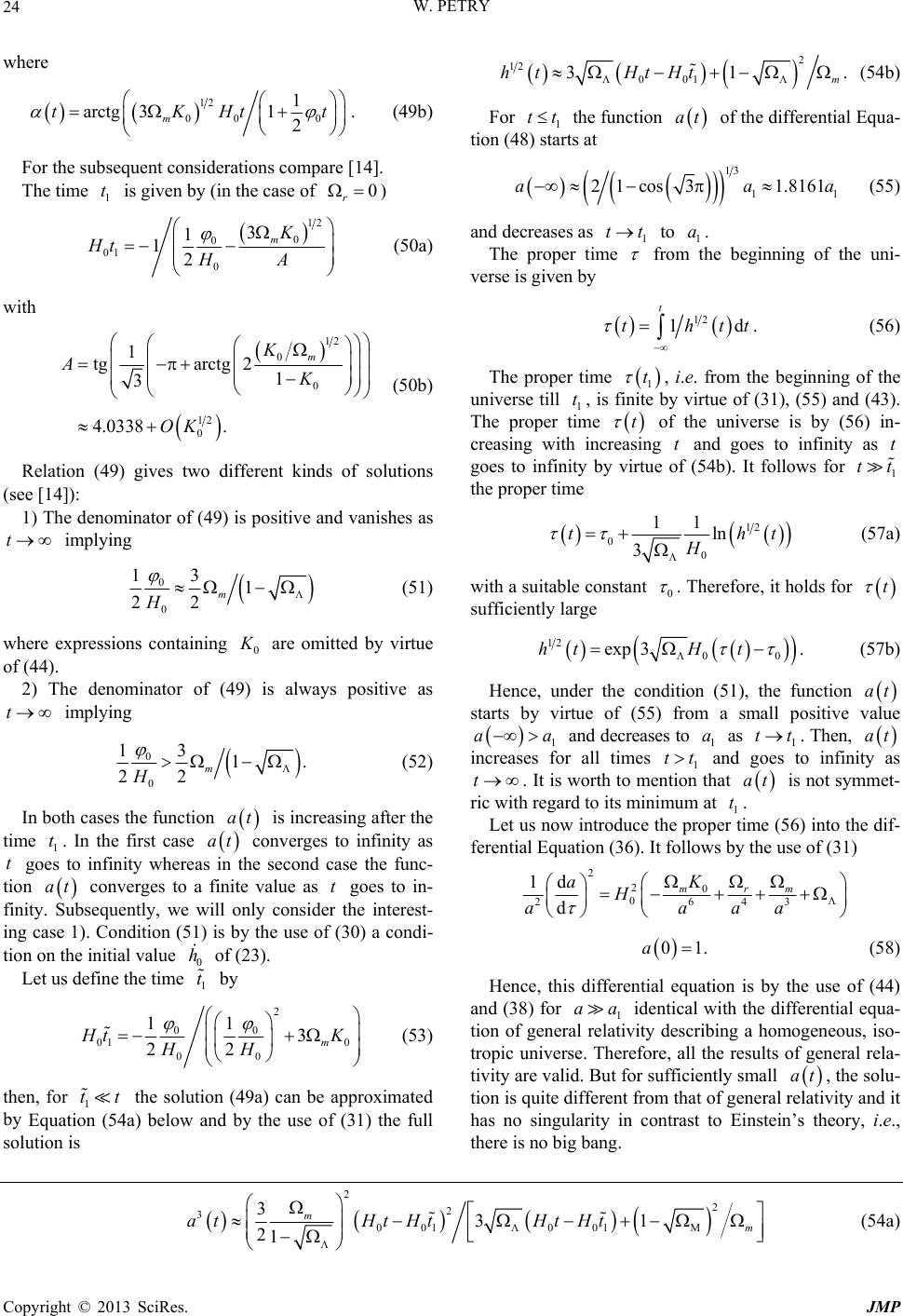 W. PETRY 24 where 12 00 arctg3 m0 1 12 Htt . (49b) For the subsequent considerations compare The time 1 t is given byof 0 r ) tK [14]. (in the ca se 12 0 0 1 3 1 1mK Ht ( 00 2HA 50a) with 12 0 1 tgarctg 2 3 4.0338 . K A OK 12 0 0 1 m K (50b) Relation (49) gives two different kinds of solutions (see [14]): ying 1) The denominator of (4 9) is positive and vanishes as t impl 0 13 2H 0 1 2 m (51) where expressintaining 0 ons co K are om of (44). ) itted by virtue 2) The denominator of (49is always positive as t implying 0 0 13 2H 1. 2 m (52) In both cases te function h at is in time 1 t. Int case at converges to infinity as tn the a creasing after the the firs goes to infinity whereas i second case the func- tion t converges to a e value as t goes to in- finity. Subsequently, we will only consider the interest- ing case 1). Condition (51) is by the use of(30) a condi- tion on the initial value 0 h of (23). Let us define the time 1 t by finit 2 0 01 1100 00 3 2 2m H t K HH (53) en, for 1 tt the solution (49a) can be app Equation (54a) below and by the use of (31) the full th by roximated solution is 2. m 12 00 1 31ht HtHt For 1 tt (54b) the function at of the differentia tion (48) starts at l Equa- 13 2a 11 1 cos31.8161aa (55) and decreases as 1 tt to 1 a. The proper time from the beginning of t he uni- verse is given by 12 t1dthtt . (56) The proper time 1 t , i.e. from t universe till 1 t, is finite by virtue of (31), (55) and (43). Th he beginning of the e proper time t rt of the universe is by (56) in- creasing with increasing t and goes to infinity as t goes to infinity by viue of (54b). It follows for 1 tt the proper time 12 11 ln tht 00 3H (57a) with a suitable con stant 0. Therefore, it holds for t sufficiently large 12 exp 3htH t 00 . () 57b Hence, under the condition (51), the function at ositive value starts by virtue of (55) from a small p 1 a a and decreases to 1 a as 1 tt. Then, at t. It ih t imet um Let ime (5 e increases for all times 1 tt and goes to infinity as s worth to mention tat as not sym- ric with regard to its minim at 1 t. us now introduce the proper t6) into the dif- ferential Equation (36). It follows by thuse of (31) 220 0 2643 1d dmm r K aH aaaa 01.a (58) Hence, this differential equa and (38) for 1 aa identical tio e. The ’s th tion is by the use of (44) with the differential equa- n of general relativity describing a homogeneous, iso- tropic universrefore, all the results of general rela- tivity are valid. But for su fficiently s mall at, th e solu - tion is qu ite differen t fro m that of g eneral relativity and it has no singularity in contrast to Einsteineory, i.e., there is no b i g b ang. 22 3001 001 331 21 mm a tHt HtHt Ht 2 (54a) Copyright © 2013 SciRes. JMP 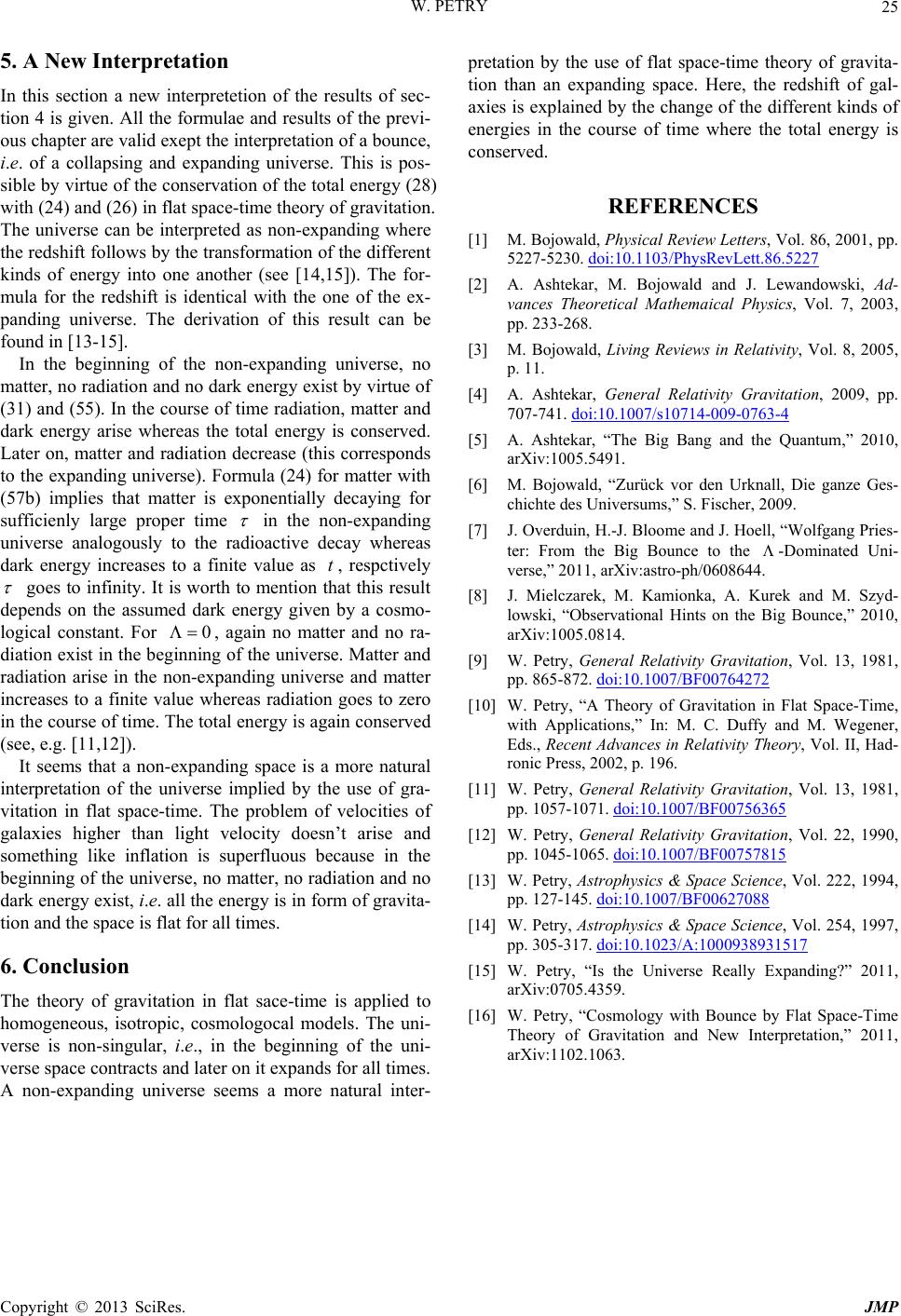 W. PETRY 25 5. A New Interpretation In this section a new interpretetion of the results of sec- on 4 is given. All the fo rmulae and results of the previ- nterpretation of a bounce, ng universe. This is pos- whereas the total energy is conse La ti ous chapter are valid ex ept the i i.e. of a collapsing and expandi sible by virtue of the conservation of the total energy (28) with (24) and (26) in flat space-ti me theory of gravitation. The universe can be interpreted as non-expanding where the redshift follows by the transformation of the different kinds of energy into one another (see [14,15]). The for- mula for the redshift is identical with the one of the ex- panding universe. The derivation of this result can be found in [13-15]. In the beginning of the non-expanding universe, no matter, no radiation and no dark energy exist by virtue of (31) and (55). In the course of time radiation, matter and dark energy arise rved. ter on, matter and radiation decrease (this corresponds to the expanding universe). Formula (24) for matter with (57b) implies that matter is exponentially decaying for sufficienly large proper time in the non-expanding universe analogously to the radioactive decay whereas dark energy increases to a finite value as t, respctively goes to infinity. It is worth to mention that this result depends on the assumed dark eergy given by a cosmo- logical constant. For 0 , again no matter and no ra- diation exist in th e beginning of the universe. Matter and diation arise in the non-expanding universe and matter increases to a finite value whereas radiation goes to zero in the course of time. Ttal energy is again conserved (see, e.g. [11,12]). It seems that a non-expanding space is a more natural interpretation of the universe implied by the use of gra- vitation in flat space-time. The problem of velocities of galaxies higher th n ra he to an light velocity doesn’t arise and so models. The u lar, i.e., in the beginning of the r on it expands for all tim pretation by the use of flat space-time theory of gravita- tion than an expanding space. Here, th axies is explained by the change of the different kinds of energies in the course of time where the total energy is wald, Physical Review Letters, Vol. 86, 2001, pp. 5227-5230. doi:10.1103/PhysRevLett.86.5227 mething like inflation is superfluous because in the beginning of the universe, no matter, no radiation and no dark energy exist, i.e. all the energy is in form of gravita- tion and the space is flat for all times. 6. Conclusion The theory of gravitation in flat sace-time is applied to homogeneous, isotropic, cosmologocalni- verse is non-singu verse space contracts and lateuni- es. A non-expanding universe seems a more natural inter- conserved. REFERENCES [1] M. Bojo e redshift of gal- [2] A. Ashtekar, wski, Ad- vances Theoresics, Vol. 7, 2003, l. 8, 2005, 0.1007/s10714-009-0763-4 M. Bojowald and J. Lewando tical Mathemaical Phy pp. 233-268. [3] M. Bojowald, Living Reviews in Relativity, Vo p. 11. [4] A. Ashtekar, General Relativity Gravitation, 2009, pp. 707-741. doi:1 005.5491. Bounce to the -Dominated Uni- nd M. Szyd- , Vol. 13, 1981, [5] A. Ashtekar, “The Big Bang and the Quantum,” 2010, arXiv:1 [6] M. Bojowald, “Zurück vor den Urknall, Die ganze Ges- chichte des Universums,” S. Fischer, 2009. [7] J. Overduin, H.-J. Bloome and J. Hoell, “Wolfgang Pries- ter: From the Big verse,” 2011, arXiv:astro-ph/0608644. [8] J. Mielczarek, M. Kamionka, A. Kurek a lowski, “Observational Hints on the Big Bounce,” 2010, arXiv:1005.0814. [9] W. Petry, General Relativity Gravitation pp. 865-872. doi:10.1007/BF00764272 [10] W. Petry, “A Theory of Gravitation in Flat Space-Time, with Applications,” In: M. C. Duffy and M. Wegener, Eds., Recent Advances in Relativity Theory, Vol. II, Had- ronic Press, 2002, p. 196. [11] W. Petry, General Relativity Gravitation, Vol. 13, 1981, pp. 1057-1071. doi:10.1007/BF00756365 [12] W. Petry, General Relativity Gravitation, Vol. 22, 1990, pp. 1045-1065. doi:10.1007/BF00757815 [13] W. Petry, Astrophysics & Space Science, Vol. 222, 1994, pp. 127-145. doi:10.1007/BF00627088 [14] W. Petry, Astrophysics & Space Science, Vol. 254, 1997, pp. 305-317. doi:10.1023/A:1000938931517 ion,” 2011, [15] W. Petry, “Is the Universe Really Expanding?” 2011, arXiv:0705.4359. [16] W. Petry, “Cosmology with Bounce by Flat Space-Time Theory of Gravitation and New Interpretat arXiv:1102.1063. Copyright © 2013 SciRes. JMP |