

Paper Menu >>
Journal Menu >>
 Journal of Modern Physics, 2013, 4, 968-973 http://dx.doi.org/10.4236/jmp.2013.47130 Published Online July 2013 (http://www.scirp.org/journal/jmp) Energy Band Analysis of MQW Structure Based on Kronig-Penny Model Yu Zhang1*, Yi Wang2 1School of Physics and Engineering, Sun Yat-sen University, Guangzhou, China 2School of Applied Physics and Materials, Wuyi University, Jiangmen, China Email: *[email protected], [email protected] Received May 1, 2013; revised June 2, 2013; accepted June 28, 2013 Copyright © 2013 Yu Zhang, Yi Wang. This is an open access article distributed under the Creative Commons Attribution License, which permits unrestricted use, distribution, and reproduction in any medium, provided the original work is properly cited. ABSTRACT The effects of different potential well depths, well widths and barrier widths on energy band of multiple quantum well (MQW) structures are discussed in detail based on Kronig-Penny model. The results show that if the well and barrier width stay unchanged, the first and second band gaps increase linearly with the well depth. When the well depth is con- stant, the first and second band gaps increase exponentially with the barrier width in a wide well. However, in narrow well one, the second band gap saturates when the barrier width is wide enough. On condition that the well and barrier have equal width, the first band gap decreases exponentially with well-barrier width while the second gap still shows an exponential increase with the width. These results are insightful for the design of MQW structure optoelectronic de- vices. Keywords: Kronig-Penny Model; MQW Structure; Potential Well; Barrier 1. Introduction Recent years have seen the rapid development of light- emitting diodes (LEDs), laser diodes (LDs) and solar cells. Particularly, LEDs have become high-performance devices widely used in display and lighting industry [1]. The core of these devices is the MQW structure. So, it is obvious that researches concerning features of MQW energy band are the foundation of further development of LED, LD devices and so on. A major obstacle for GaInN based LED to further penetrate into the general illumina- tion market is that their efficiency suffers a substantial decrease as the injection current increases, which is called “efficiency droop” [2-7]. Researches show that the decrease of the barrier height within the MQW region [1,8], such as applying p-type-doped barriers or a lightly n-type-doped GaN injection layer just below the InGaN MQWs on the n side [1,9] and the trapezoidal wells of MQW structure [10] lead to the reduction of efficiency droop at high injection levels. The GaInN/GaInN MQW structure has much lower triangular barriers in the active region which also contributes to the enhancement of LED performances [2]. The emission wavelength of In- GaN-Based MQW structure LD is the shortest one ever generated by a semiconductor laser diode [11]. InGaN/ GaN MQW can also improve the behavior of solar cells. [12,13] In this way, a profound study of different MQW structure is essential. Kronig-Penney model (K-P model) has been widely used in analyzing the energy band be- havior of crystals and super lattices [14,15]. Some re- searchers studied the spectrum, transmission and con- ductance of electrons in bilayer graphene with K-P model [16]. Further discussion concerning energy band behavior by K-P model is of great importance for under- standing the band features and electron transmission be- havior of MQW structure. However, there are few re- ports investigating comprehensively the quantum me- chanics and energy band features of different MQW structure. In this article, the energy band behavior of MQW with different potential well depths, widths and barrier widths is discussed using Kronig-Penney model. With the aid of Mathematica, the efficiency of calcula- tion and accuracy of theoretical analysis are enhanced. 2. Kronig-Penney Model Kronig-Penney model [17] is a potential field model with periodic array of rectangular potential wells. The schematic Kronig-Penney model of the crystal is shown in Figure 1. Assuming the width of potential well is a and the barrier width is b, V0 is the depth of quantum *Corresponding author. C opyright © 2013 SciRes. JMP 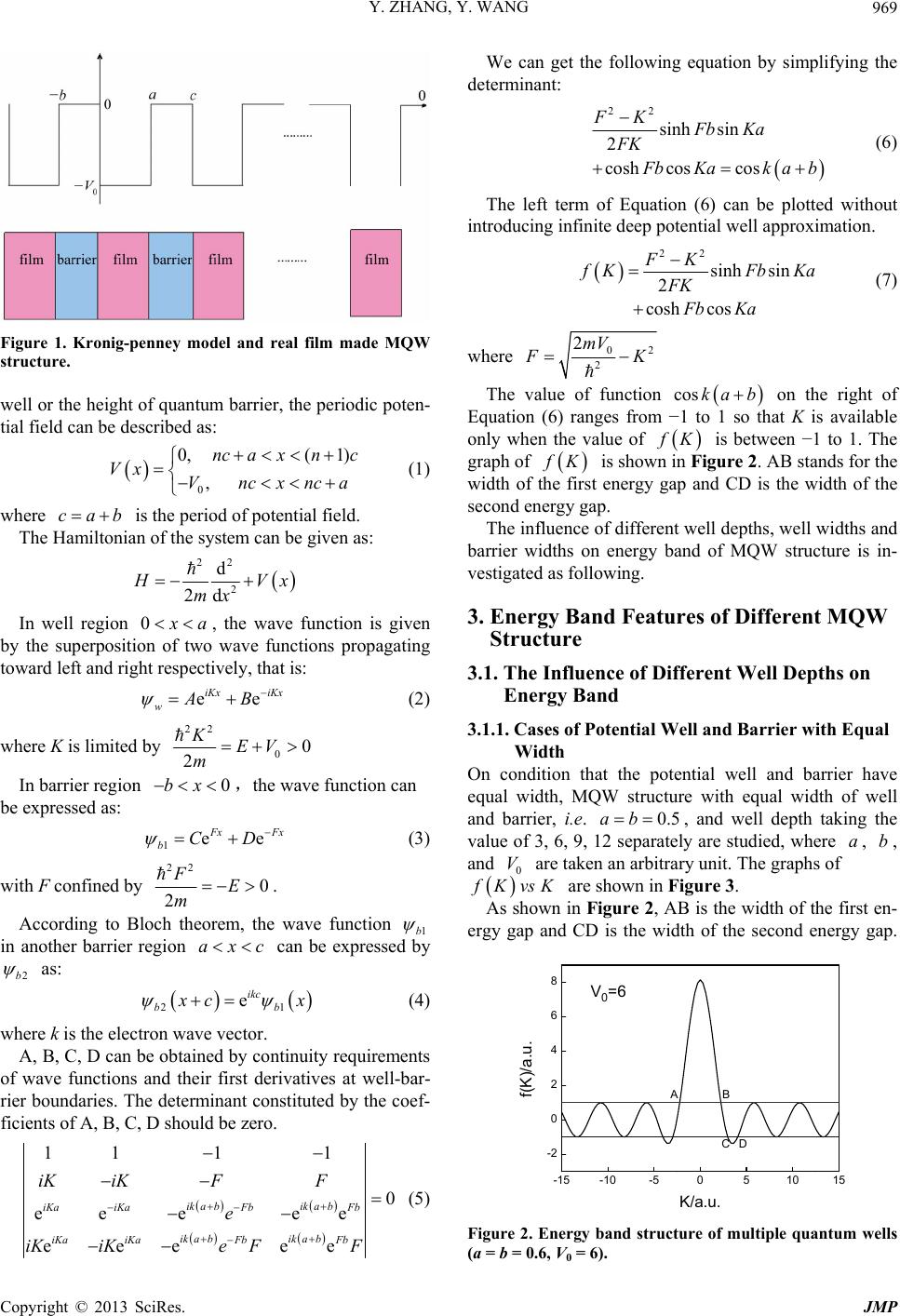 Y. ZHANG, Y. WANG 969 Figure 1. Kronig-penney model and real film made MQW structure. well or the height of quantum barrier, the periodic poten- tial field can be described as: 0 0, , nc a Vx Vn ( 1)x nc cxnca cab (1) where is the period of potential field. The Hamiltonian of the system can be given as: 22 2 d d 2 H Vx mx 0 In well region x a ee iKx iKx AB , the wave function is given by the superposition of two wave functions propagating toward left and right respectively, that is: w (2) where K is limited by 22 2 K m00EV 0bx ee In barrier region ,the wave function can be expressed as: 1 F xFx CD b (3) with F confined by 22 0 FE m 2 . According to Bloch theorem, the wave function 1b in another barrier region can be expressed by axc 2b as: b 21 eikc b x cx (4) where k is the electron wave vector. A, B, C, D can be obtained by continuity requirements of wave functions and their first derivatives at well-bar- rier boundaries. The determinant constituted by the coef- ficients of A, B, C, D should be zero. 11 1 ee e eee ik ab iKa iKaFb ik abik iKa iKaFb iK iKF e iKiKe F We can get the following equation by simplifying the determinant: 22 sinh sin 2 cosh coscos FK Fb Ka FK 1 0 ee ee ik abFb a bFb F F (5) F bKa kab (6) The left term of Equation (6) can be plotted without introducing infinite deep potential well approximation. 22 sinh sin 2 cosh cos FK KFbKa FK Fb Ka f (7) 2 0 2 2mV F K cos ka b where The value of function on the right of Equation (6) ranges from −1 to 1 so that K is available only when the value of f K is between −1 to 1. The graph of f K 0.5ab is shown in Figure 2. AB stands for the width of the first energy gap and CD is the width of the second energy gap. The influence of different well depths, well widths and barrier widths on energy band of MQW structure is in- vestigated as following. 3. Energy Band Features of Different MQW Structure 3.1. The Influence of Different Well Depths on Energy Band 3.1.1. Cases of Potential Well and Barrier with Equal Width On condition that the potential well and barrier have equal width, MQW structure with equal width of well and barrier, i.e. ab 0 V , and well depth taking the value of 3, 6, 9, 12 separately are studied, where , , and are taken an arbitrary unit. The graphs of KvsK -15 -10-5051015 -2 0 2 4 6 8 are shown in Figure 3. f As shown in Figure 2, AB is the width of the first en- ergy gap and CD is the width of the second energy gap. f(K)/a.u. K/a.u . AB CD V0=6 Figure 2. Energy band structure of multiple quantum wells (a = b = 0.6, V0 = 6). Copyright © 2013 SciRes. JMP 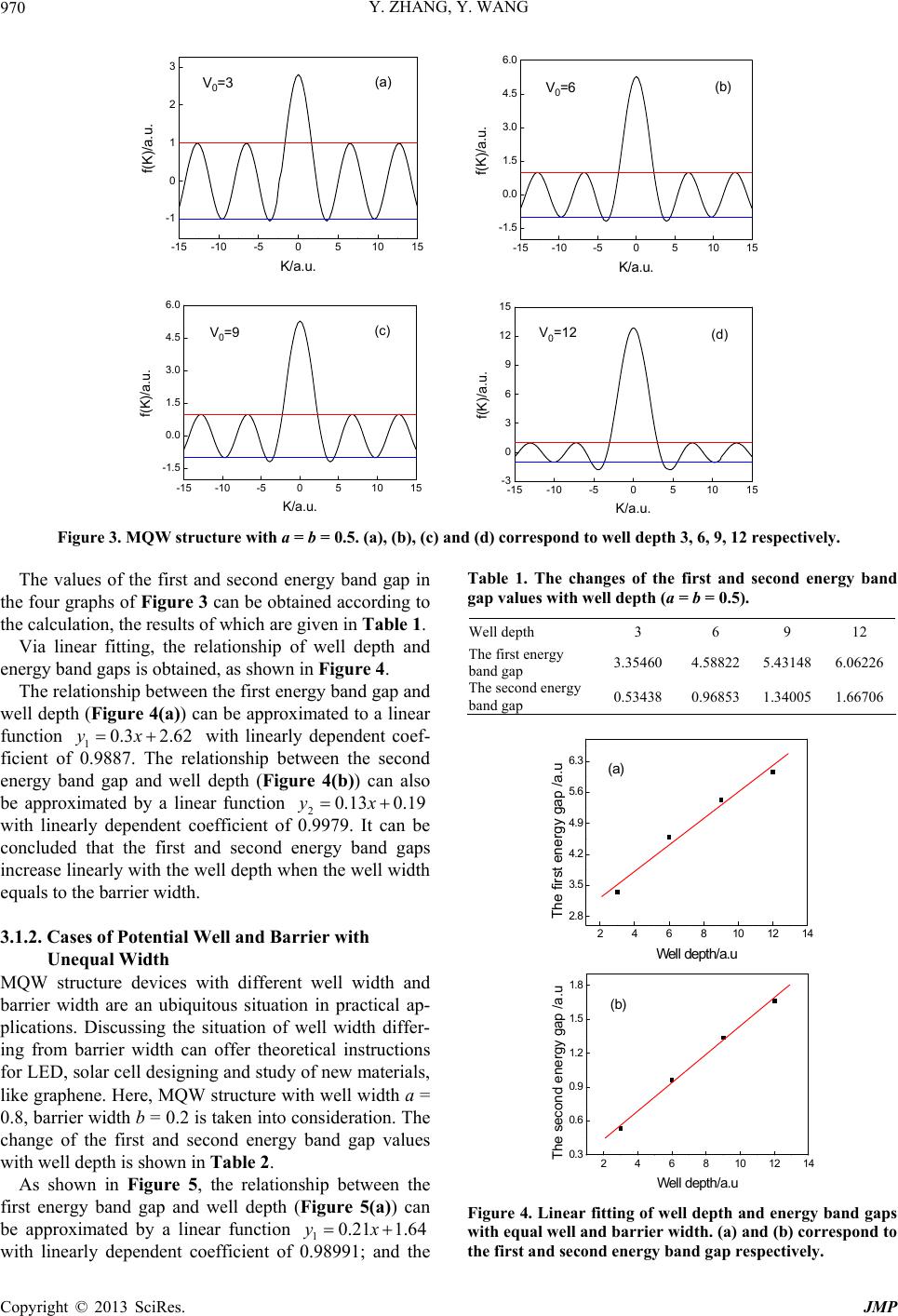 Y. ZHANG, Y. WANG Copyright © 2013 SciRes. JMP 970 5 -15 -10-50 -1 0 1 2 3 10 15 V0=3 f(K)/a.u. K/a. u. -15 -10-5051015 -1.5 0.0 1.5 3.0 4.5 6.0 (a) (b) V0=6 f(K)/a.u. K/a.u. 5 -15 -10-50 -1.5 0.0 1.5 3.0 4.5 6.0 10 15 (c) V0=9 f(K)/a.u. K/a.u. -15 -10-5051015 -3 0 3 6 9 12 15 (d) V0=12 f(K)/a.u. K/a.u. 0.3 2.62yx 0.13 0.19yx 0.21 1.64yx Figure 3. MQW structure with a = b = 0.5. (a), (b), (c) and (d) correspond to well depth 3, 6, 9, 12 respectively. Table 1. The changes of the first and second energy band gap values with well depth (a = b = 0.5). The values of the first and second energy band gap in the four graphs of Figure 3 can be obtained according to the calculation, the results of which are given in Table 1. Well depth 3 6 9 12 The first energy band gap 3.35460 4.58822 5.431486.06226 The second energy band gap 0.53438 0.96853 1.340051.66706 Via linear fitting, the relationship of well depth and energy band gaps is obtained, as shown in Figure 4. The relationship between the first energy band gap and well depth (Figure 4(a)) can be approximated to a linear function 1 with linearly dependent coef- ficient of 0.9887. The relationship between the second energy band gap and well depth (Figure 4(b)) can also be approximated by a linear function 2 with linearly dependent coefficient of 0.9979. It can be concluded that the first and second energy band gaps increase linearly with the well depth when the well width equals to the barrier width. 2 4 6 8101214 2.8 3.5 4.2 4.9 5.6 6.3 The first ene rgy g ap /a.u W ell depth/a.u (a) 2468101214 0.3 0.6 0.9 1.2 1.5 1.8 3.1.2. Cases of Potential Well and Barrier with Unequal Width MQW structure devices with different well width and barrier width are an ubiquitous situation in practical ap- plications. Discussing the situation of well width differ- ing from barrier width can offer theoretical instructions for LED, solar cell designing and study of new materials, like graphene. Here, MQW structure with well width a = 0.8, barrier width b = 0.2 is taken into consideration. The change of the first and second energy band gap values with well depth is shown in Table 2. (b) The second energy gap /a.u W ell depth/a.u As shown in Figure 5, the relationship between the first energy band gap and well depth (Figure 5(a)) can be approximated by a linear function 1 with linearly dependent coefficient of 0.98991; and the Figure 4. Linear fitting of well depth and energy band gaps with equal well and barrier width. (a) and (b) correspond to the first and second energy band gap respectively. 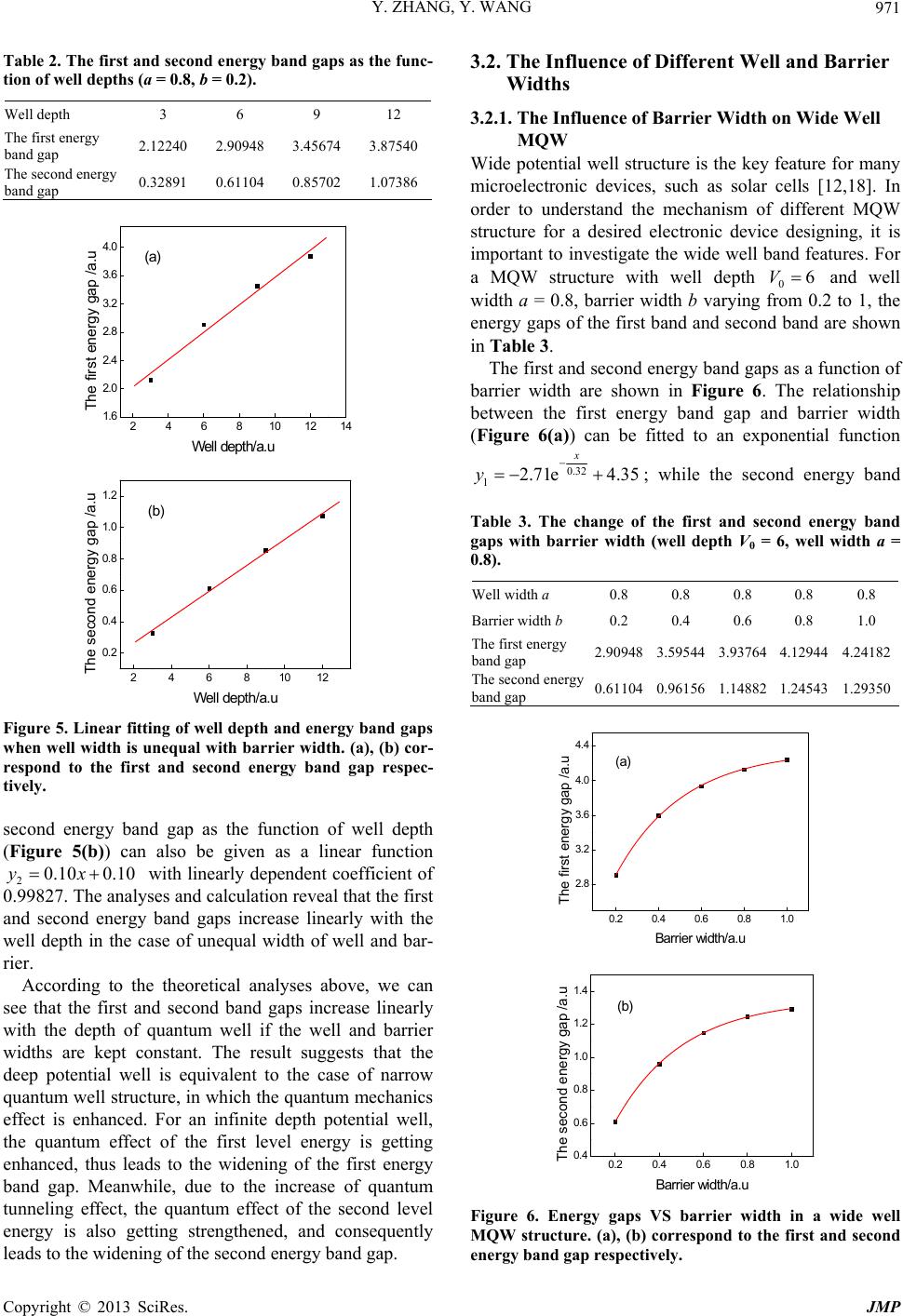 Y. ZHANG, Y. WANG 971 Table 2. The first and second e nergy band gaps as the func- tion of well depths (a = 0.8, b = 0.2). Well depth 3 6 9 12 The first energy band gap 2.12240 2.90948 3.45674 3.87540 The second energy band gap 0.32891 0.61104 0.85702 1.07386 2 468 1.6 2.0 2.4 2.8 3.2 3.6 4.0 101214 (a) The first energy g ap / a.u W ell depth/a.u 10 12 2 4 6 8 0.2 0.4 0.6 0.8 1.0 1.2 (b) The second energy gap /a.u Well depth/a.u 0.10 0.10yx Figure 5. Linear fitting of well depth and energy band gaps when well width is unequal with barrier width. (a), (b) cor- respond to the first and second energy band gap respec- tively. second energy band gap as the function of well depth (Figure 5(b)) can also be given as a linear function 2 with linearly dependent coefficient of 0.99827. The analyses and calculation reveal that the first and second energy band gaps increase linearly with the well depth in the case of unequal width of well and bar- rier. According to the theoretical analyses above, we can see that the first and second band gaps increase linearly with the depth of quantum well if the well and barrier widths are kept constant. The result suggests that the deep potential well is equivalent to the case of narrow quantum well structure, in which the quantum mechanics effect is enhanced. For an infinite depth potential well, the quantum effect of the first level energy is getting enhanced, thus leads to the widening of the first energy band gap. Meanwhile, due to the increase of quantum tunneling effect, the quantum effect of the second level energy is also getting strengthened, and consequently leads to the widening of the second energy band gap. 3.2. The Influence of Different Well and Barrier Widths 3.2.1. The Influence of Barrier Width on Wide Well MQW Wide potential well structure is the key feature for many microelectronic devices, such as solar cells [12,18]. In order to understand the mechanism of different MQW structure for a desired electronic device designing, it is important to investigate the wide well band features. For a MQW structure with well depth 0 V and well width a = 0.8, barrier width b varying from 0.2 to 1, the energy gaps of the first band and second band are shown in Table 3. 6 The first and second energy band gaps as a function of barrier width are shown in Figure 6. The relationship between the first energy band gap and barrier width (Figure 6(a)) can be fitted to an exponential function 0.32 12.71e 4.35 x y ; while the second energy band Table 3. The change of the first and second energy band gaps with barrier width (well depth V0 = 6, well width a = 0.8). Well width a 0.8 0.8 0.8 0.8 0.8 Barrier width b 0.2 0.4 0.6 0.8 1.0 The first energy band gap 2.909483.59544 3.93764 4.129444.24182 The second energy band gap 0.611040.96156 1.14882 1.245431.29350 0.20.40.60.81.0 2.8 3.2 3.6 4.0 4.4 (a) The first energ y gap /a.u Barrier width/a.u 0.2 0.4 0.6 0.8 1.0 0.4 0.6 0.8 1.0 1.2 1.4 (b) The second energy gap /a.u Barrier wi d th/a .u energy band gap respectively. Figure 6. Energy gaps VS barrier width in a wide well MQW structure. (a), (b) correspond to the first and second Copyright © 2013 SciRes. JMP 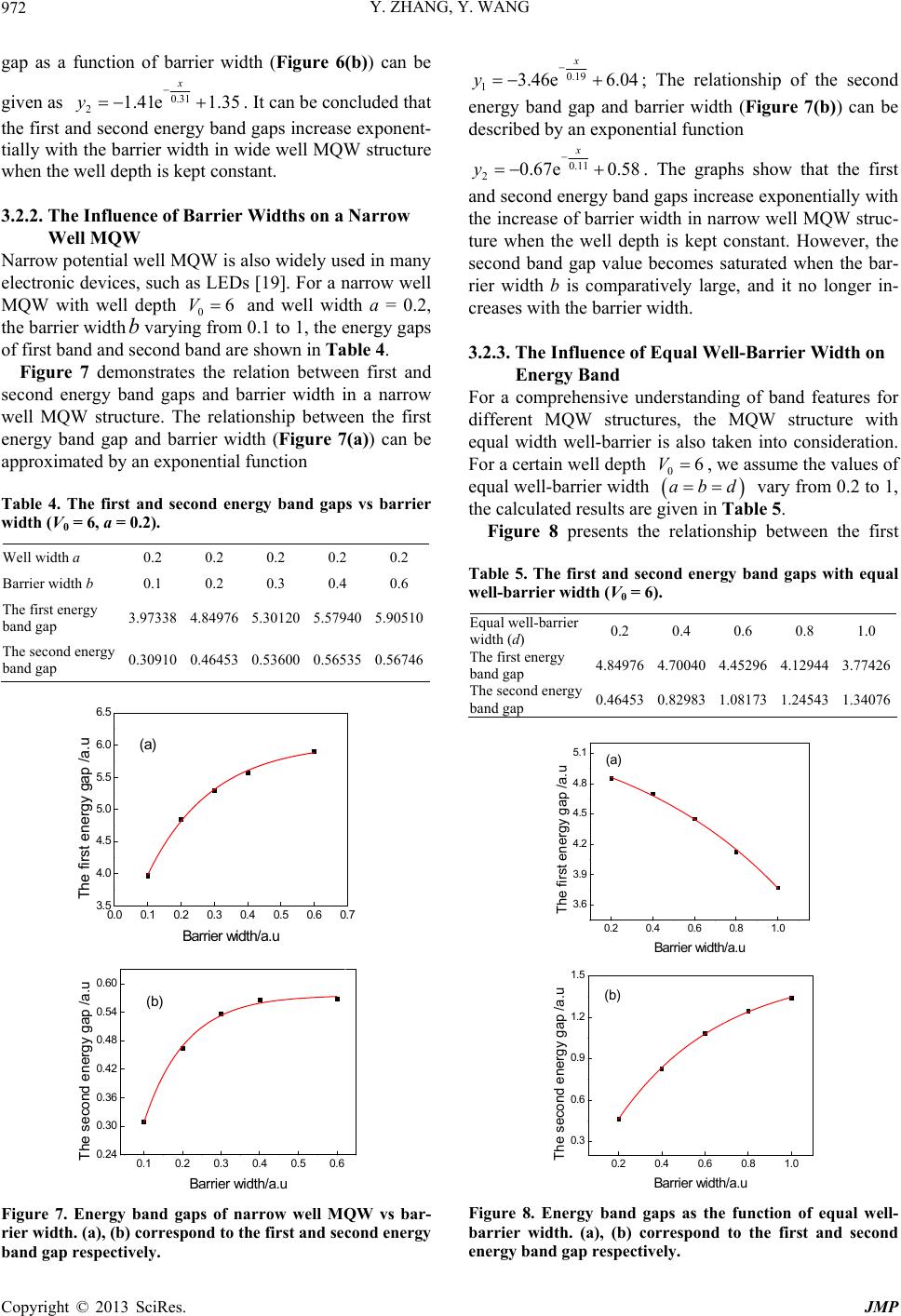 Y. ZHANG, Y. WANG 972 gap as a function of barrier width (Figure 6(b)) can be 0.19 13.46e 6.04y ; The relationship of the second energy band gap and b given as 0.31 41e 1.35. It can be concluded that nd second energy ban 3.2.2. The Influence of Barrier Widths on a Narrow Narroll MQW is also widely used in many from and se able 4. The first and second energy band gaps vs barrier 2 0.2 0.2 0.2 21.y x the first ad gaps increase exponent- tially with the barrier width in wide well MQW structure when the well depth is kept constant. Well MQW w potential we electronic devices, such as LEDs [19]. For a narrow well MQW with well depth 06V and well width a = 0.2, the barrier widthbvarying 0.1 to 1, the energy gaps of first band and second band are shown in Table 4. Figure 7 demonstrates the relation between first cond energy band gaps and barrier width in a narrow well MQW structure. The relationship between the first energy band gap and barrier width (Figure 7(a)) can be approximated by an exponential function T width (V0 = 6, a = 0.2). Well width a 0.2 0. Barrier width b 3.97338 4.849765.30120 5.57940 5.90510 d energy 0.30910 0.464530.53600 0.56535 0.56746 0.1 0.2 0.3 0.4 0.6 The first energy band gap The secon band gap 0.0 0.1 0.2 0.3 0.4 3.5 4.0 4.5 5.0 5.5 6.0 6.5 0.50.60.7 (a) The first energy gap /a.u Barrier width/a.u .4 0.5 0.60.1 0.2 0.3 0 0.24 0.30 0.36 0.42 0.48 0.54 0.60 (b) The second energy gap /a.u Barrier width/a.u Figure 7. Energy band gaps of narrow well MQW vs bar- rier width. (a), (b) correspond to the first and second energy band gap respectively . x arrier width (Figure 7(b)) can be described by an exponential function 0.11 20.67e 0.58y. The graphs show that the first and second energy ban 3.2.3. The Influence of Equal Well-Barrier Width on For a understanding of band features for x d gaps increase exponentially with the increase of barrier width in narrow well MQW struc- ture when the well depth is kept constant. However, the second band gap value becomes saturated when the bar- rier width b is comparatively large, and it no longer in- creases with the barrier width. Energy Band comprehensive different MQW structures, the MQW structure with equal width well-barrier is also taken into consideration. For a certain well depth 06V, we assume the values of equal well-barrier width d vary from 0.2 to 1, the calculated results are gble 5. ab iven in Ta Figure 8 presents the relationship between the first able 5. The first and second energy band gaps with equal 0.2 0.4 0.6 0.8 1.0 T well-barrier wi dth (V0 = 6). Equal well-barrier width (d) The first energy band gap The secon 4.84976 4.70040 4.45296 4.12944 3.77426 d energy band gap 0.46453 0.82983 1.08173 1.24543 1.34076 0.2 0.4 0.6 0.8 1.0 3.6 3.9 4.2 4.5 4.8 5.1 (a) The first energy gap /a.u Barrier width/a.u 0.2 0.4 0.6 0.8 1.0 0.3 0.6 0.9 1.2 1.5 (b) The second energy gap /a.u Barrier width/a.u Figure 8. Energy band gaps as the function of equal well- barrier width. (a), (b) correspond to the first and second energy band gap respectively. Copyright © 2013 SciRes. JMP 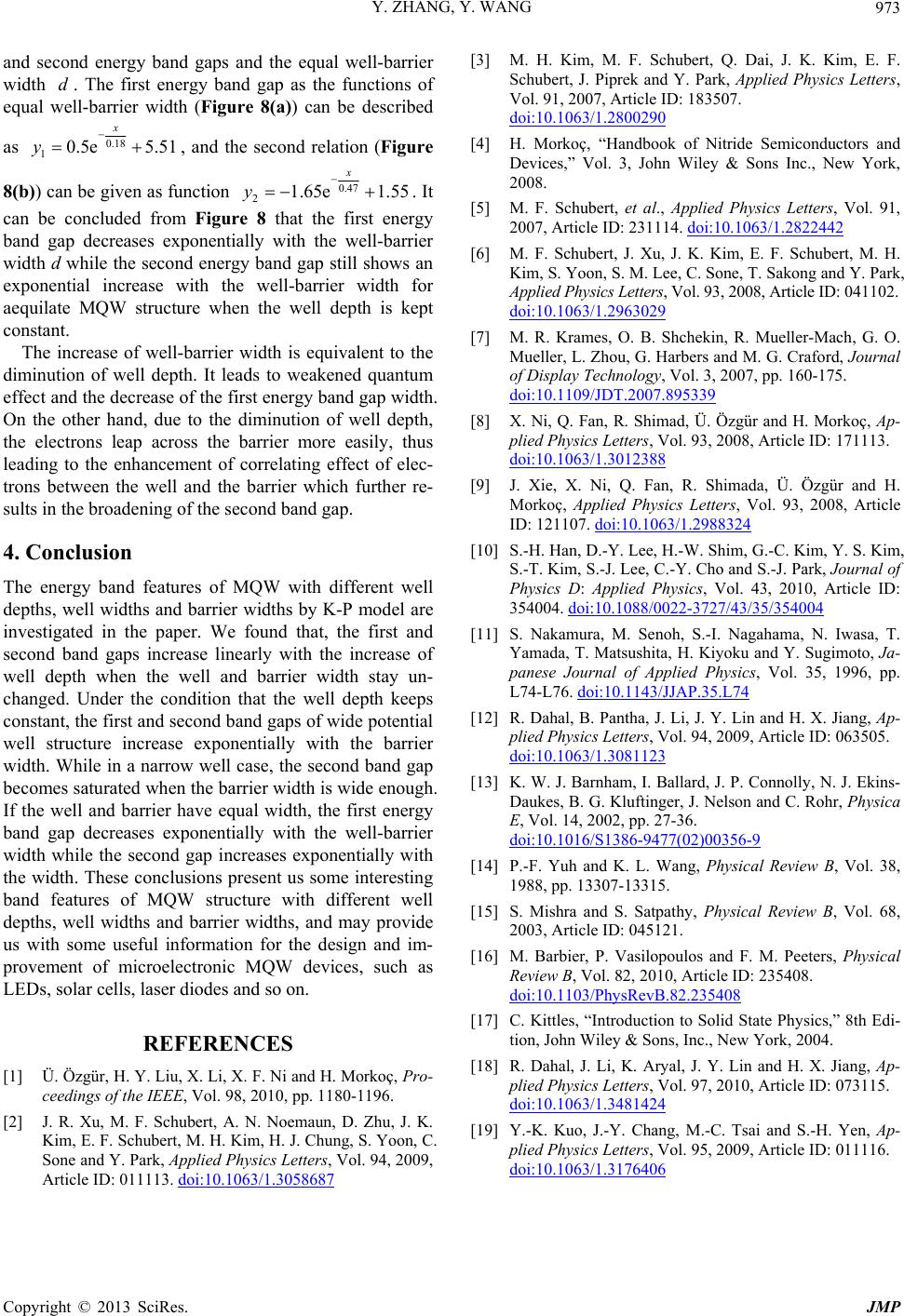 Y. ZHANG, Y. WANG Copyright © 2013 SciRes. JMP 973 [3] M . H. Kim, M. F. Schubert, Q. Dai, J. K. Kim, E. F. Schubert, J. Piprek and Y. Park, Applied Physics Letters, Vol. 91, 2007, Article ID: 183507. doi:10.1063/1.2800290 and second energy band gaps and the equal well-barrier width d. The first energy band gap as the functions of equal well-barrier width (Figure 8(a)) can be described as 0.18 10.5e 5.51y, and the second relation (Figure x [4] H. Morkoç, “Handbook of Nitride Semiconductors and Devices,” Vol. 3, John Wiley & Sons Inc., New York, 2008. 8(b)) can be given as function 0.47 65e 1.55. It 21.y x [5] M. F. Schubert, et al., Applied Physics Letters, Vol. 91, 2007, Article ID: 231114. doi:10.1063/1.2822442 can be concluded from Figur rgy e 8 that the first ene band gap decreases exponentially with the well-barrier width d while the second energy band gap still shows an exponential increase with the well-barrier width for aequilate MQW structure when the well depth is kept constant. The inc [6] M. F. Schubert, J. Xu, J. K. Kim, E. F. Schubert, M. H. Kim, S. Yoon, S. M. Lee, C. Sone, T. Sakong and Y. Park, Applied Physics Letters, Vol. 93, 2008, Article ID: 041102. doi:10.1063/1.2963029 [7] M. R. Krames, O. B. Shchekin, R. Mueller-Mach, G. O. Mueller, L. Zhou, G. Harbers and M. G. Craford, Journal of Display Technology, Vol. 3, 2007, pp. 160-175. doi:10.1109/JDT.2007.895339 rease of well-barrier width is equivalent to the diminution of well depth. It leads to weakened quantum effect and the decrease of the first energy band gap width. On the other hand, due to the diminution of well depth, the electrons leap across the barrier more easily, thus leading to the enhancement of correlating effect of elec- trons between the well and the barrier which further re- sults in the broadening of the second band gap. [8] X. Ni, Q. Fan, R. Shimad, Ü. Özgür and H. Morkoç, Ap- plied Physics Letters, Vol. 93, 2008, Article ID: 171113. doi:10.1063/1.3012388 [9] J. Xie, X. Ni, Q. Fan, R. Shimada, Ü. Özgür and H. Morkoç, Applied Physics Letters, Vol. 93, 2008, Article ID: 121107. doi:10.1063/1.2988324 4. Conclusion features of MQW with different well REFERENCES [1] Ü. Özgür, H. Yd H. Morkoç, [10] S.-H. Han, D.-Y. Lee, H.-W. Shim, G.-C. Kim, Y. S. Kim, S.-T. Kim, S.-J. Lee, C.-Y. Cho and S.-J. Park, Journal of Physics D: Applied Physics, Vol. 43, 2010, Article ID: 354004. doi:10.1088/0022-3727/43/35/354004 The energy band depths, well widths and barrier widths by K-P model are investigated in the paper. We found that, the first and second band gaps increase linearly with the increase of well depth when the well and barrier width stay un- changed. Under the condition that the well depth keeps constant, the first and second band gaps of wide potential well structure increase exponentially with the barrier width. While in a narrow well case, the second band gap becomes saturated when the barrier width is wide enough. If the well and barrier have equal width, the first energy band gap decreases exponentially with the well-barrier width while the second gap increases exponentially with the width. These conclusions present us some interesting band features of MQW structure with different well depths, well widths and barrier widths, and may provide us with some useful information for the design and im- provement of microelectronic MQW devices, such as LEDs, solar cells, laser diodes and so on. [11] S. Nakamura, M. Senoh, S.-I. Nagahama, N. Iwasa, T. Yamada, T. Matsushita, H. Kiyoku and Y. Sugimoto, Ja- panese Journal of Applied Physics, Vol. 35, 1996, pp. L74-L76. doi:10.1143/JJAP.35.L74 [12] R. Dahal, B. Pantha, J. Li, J. Y. Lin and H. X. Jiang, Ap- plied Physics Letters, Vol. 94, 2009, Article ID: 063505. doi:10.1063/1.3081123 [13] K. W. J. Barnham, I. Ballard, J. P. Connolly, N. J. Ekins- Daukes, B. G. Kluftinger, J. Nelson and C. Rohr, Physica E, Vol. 14, 2002, pp. 27-36. doi:10.1016/S1386-9477(02)00356-9 [14] P.-F. Yuh and K. L. Wang, Physical Review B, Vol. 38, 1988, pp. 13307-13315. [15] S. Mishra and S. Satpathy, Physical Review B, Vol. 68, 2003, Article ID: 045121. [16] M. Barbier, P. Vasilopoulos and F. M. Peeters, Physical Review B, Vol. 82, 2010, Article ID: 235408. doi:10.1103/PhysRevB.82.235408 [17] C. Kittles, “Introduction to Solid State Physics,” 8th Edi- tion, John Wiley & Sons, Inc., New York, 2004. [18] R. Dahal, J. Li, K. Aryal, J. Y. Lin and H. X. Jiang, Ap- plied Physics Letters, Vol. 97, 2010, Article ID: 073115. doi:10.1063/1.3481424 Pro- . Liu, X. Li, X. F. Ni an ceedings of the IEEE, Vol. 98, 2010, pp. 1180-1196. [2] J. R. Xu, M. F. Schubert, A. N. Noemaun, D. Zhu, J. K. [19] Y.-K. Kuo, J.-Y. Chang, M.-C. Tsai and S.-H. Yen, Ap- plied Physics Letters, Vol. 95, 2009, Article ID: 011116. doi:10.1063/1.3176406 Kim, E. F. Schubert, M. H. Kim, H. J. Chung, S. Yoon, C. Sone and Y. Park, Applied Physics Letters, Vol. 94, 2009, Article ID: 011113. doi:10.1063/1.3058687 |