

Paper Menu >>
Journal Menu >>
 Journal of Modern Physics, 2013, 4, 945-949 http://dx.doi.org/10.4236/jmp.2013.47127 Published Online July 2013 (http://www.scirp.org/journal/jmp) Temperature Dependent Diquark and Baryon Masses A. Chandra1, A. Bhattacharya1, B. Chakrabarti2 1Department of Physics, Jadavpur University, Kolkata, India 2Department of Physics, Jogamaya Devi College, Kolkata, India Email: [email protected], arpita1chandra@gmail.com, ballari_cha[email protected] Received March 21, 2013; revised April 22, 2013; accepted May 19, 2013 Copyright © 2013 A. Chandra et al. This is an open access article distributed under the Creative Commons Attribution License, which permits unrestricted use, distribution, and reproduction in any medium, provided the original work is properly cited. ABSTRACT Temperature dependence of diquark mass has been investigated in the frame work of the quasi particle diquark model. The effective mass of the diquark has been suggested to have a temperature dependence which shows a power law be- havior. The variation of the diquark mass with temperature has been studied. A decrease in effective mass at tempera- ture T < Tc, where Tc is the critical temperature has been observed. Some features of the phase transition have been dis- cussed. The phase transition is found to be of second order. Temperature variation of baryon masses has also been stud- ied. The results are compared and discussed with available works. Keywords: Diquark; Quasi Particle; Rushbrooke Inequality; Power Law 1. Introduction Quasi particles are particle like entities which arise in some system of interacting particles. The existence of quasi particles is mostly known in condensed matter physics. The quantum phases like superfluidity and su- perconductivity are largely described by the properties of such low lying excitations which behave like quasi parti- cle simulating many body interactions in the system. An electron in crystal lattice behaves like a quasi particle. It is well known that the behavior of electron and other particles depends upon the environment. The interaction inside can alter the collective properties which produce a new particle called quasi particle. The quantum Hall effect which is an emerging area of research also sug- gests that the collective behavior of an electron results in a new particle which may have fractional charges but seems to be the constituent of electron. Quasi particles and electrons are same entity in this picture having no distinction as expected between an elementary particle and a quasi particle. The concept of quasi particles has been widely used in describing the system of fermions, superconductivity, superfluidity. Khodel et al. [1] have investigated the properties of fermion system and corre- sponding phase transition of fermion condensate. With the advent of low temperature experimental technique the quantum critical point phenomena and quantum fluctua- tion have become area of interest and intense research. Abrahams et al. [2] have investigated critical quasi parti- cle theory and have discussed the scaling behavior asso- ciated with the quantum critical point (QCP). The effect of temperature dependent quasi particle mass which is effective on the surface impedance of a crystal has been studied by Cassinese et al. [3] in the context of two fluid model. Nawa et al. [4] have studied the BEC condensa- tion of composite diquark in the quark matter (color su- perconductivity) using a quasi chemical theory at a low density in a region near the de-confinement phase transi- tion. They have argued that the dynamical quark-pair fluctuation can be described as bosonic degrees of free- dom which are diquarks. Schneider et al. [5] have sug- gested that at very high temperature the QGP may be considered to be consisted of quasi free quarks and glu- ons. They have considered a temperature dependent quasi particle effective mass by parametrizing 0 ~1 c mT GTTT . Koh [6] has pointed out that the heavy massive quasi particle becomes superconduct- ing in heavy fermion system and has suggested that the phase transition is of second order. The study of hadrons and their masses at finite temperature is extremely im- portant for understanding the phase transition from had- ronic phase to QGP phase. It has been suggested that the nucleon mass depends substantially on the temperature variation of quark condensate and relevant interaction process. A number of works have been done on the possible variation of nucleon mass at finite temperature. In the current work we have studied the temperature dependence of effective mass of diquarks and baryons in C opyright © 2013 SciRes. JMP  A. CHANDRA ET AL. 946 quasi particle approach. Recently we have proposed a quasi particle model for diquark where diquark has been described as a quasi particle which behaves like low ly- ing excited state resembling the hypothetical phonon particle in quasi quantum systems. We have suggested relation between the temperature and the effective mass of diquark which follows a power law type of behavior. The power law is a useful tool for studying the critical behaviour near the transition point. The quasi particle critical behaviour has been studied by a number of au- thors. It would be interesting to study how does the mass of the diquark behaves which is also described as a quasi particle in the current work. The baryons are studied in the frame work of diquark-quark system and the varia- tion of masses of baryons with temperature have also been investigated. Critical exponents of different ther- modynamic co-ordinates have been studied and they are found to show Rushbrooke inequality indicating a second order phase transition for deconfinement. 2. Quasi Particle Model of Diquark and Temperature Dependence of Mass We have suggested a model [7] in which two quarks are assumed to be correlated to form a low energy configura- tion, forming a diquark and behaving like a quasi particle in an analogy with an electron behaving as a quasi parti- cle in the crystal lattice [8]. It is well known that a quasi particle is a low-lying excited state whose motion is modified by the interactions within the system. An elec- tron in a crystal is subjected to two types of forces, namely, the effect of the crystal field (grad V) and an external force (F) which accelerates the electron [8]. Under the influence of these two forces, an electron in a crystal behaves like a quasi particle having velocity v whose effective mass m* reflects the inertia of electrons which are already in a crystal field such that: d d v mF t (1) The bare electrons (with normal mass) are affected by the lattice force-grad V (where V is the periodic potential) and the external force F so that: dd dd vV mF x x m (2) Hence the ratio of the normal mass (m) to the effective mass can be expressed as: 1 1 mV F x m (3) An elementary particle in vacuum may be suggested to be in a situation exactly resembling that of an electron in a crystal. We have proposed a similar type of picture for the diquark 0 ud as a quasi particle inside a nucleon. We assume that the diquark is an independent body which is under the influence of two types of forces. One is due to the background meson cloud which is repre- sented by the potential 23 r s V, where αs being the strong coupling constant, and this potential resembles the crystal field on a crystal electron. On the other hand for the external force we have considered an average force F = −ar, where a is a suitable constant, which is of confinement type. It has been assumed that under the influence of these two types of interactions the diquark is behaving like a quasi particle, a low lying ex- cited state and its mass gets modified. The ratio of the constituent mass and the effective mass of the diquark D m can be expressed by using the same formalism as in Equation (3) and is obtained as: 3 12 qq D mm mar mm (4) Here qq represents the normal constituent mass of the diquark and mD is the effective mass of the diquark, 23 ,0.58 ss [9] and the strength parameter a = 0.003 GeV3 [10] for the light and heavy-light diquarks, V being the average value of the one gluon exchange type of potential. “r” is the radius parameter of the diquark. To calculate the effective mass of the diquark from the above expression we need the radius parameter r of the diquark. To calculate the effective mass of the diquark from the above expression we need the radius parameter “r” of the diquark. The radii parameter of the scalar diquarks have been used from existing literature [11-15] and constituent masses of quarks are taken from Karliner et al. [16]. We have estimated the masses of the diquarks in the framework of the quasi particle and the results that obtained are displayed in Table 1. The diquarks which are described as the elementary excita- tion simulating many body interactions behaves like sca- lar boson and may be regarded as separate entity. Two diquarks should be antisymmetric in color so that a total color singlet state is obtained. We presume that such a system of low lying excitations behaving like quasi par- ticles does not interact among themselves and as in an ideal gas their energies are additive [17]. Thus the mass of a baryon in a diquark-quark system can be represented as: M B Dq mm (5) We have parametrized the temperature dependent effec- tive mass of diquark by a power law such that: 01 DD c T mT mT (6) where “ϵ” is critical exponent. The critical exponent de- scribes the temperature dependence of the system near Copyright © 2013 SciRes. JMP 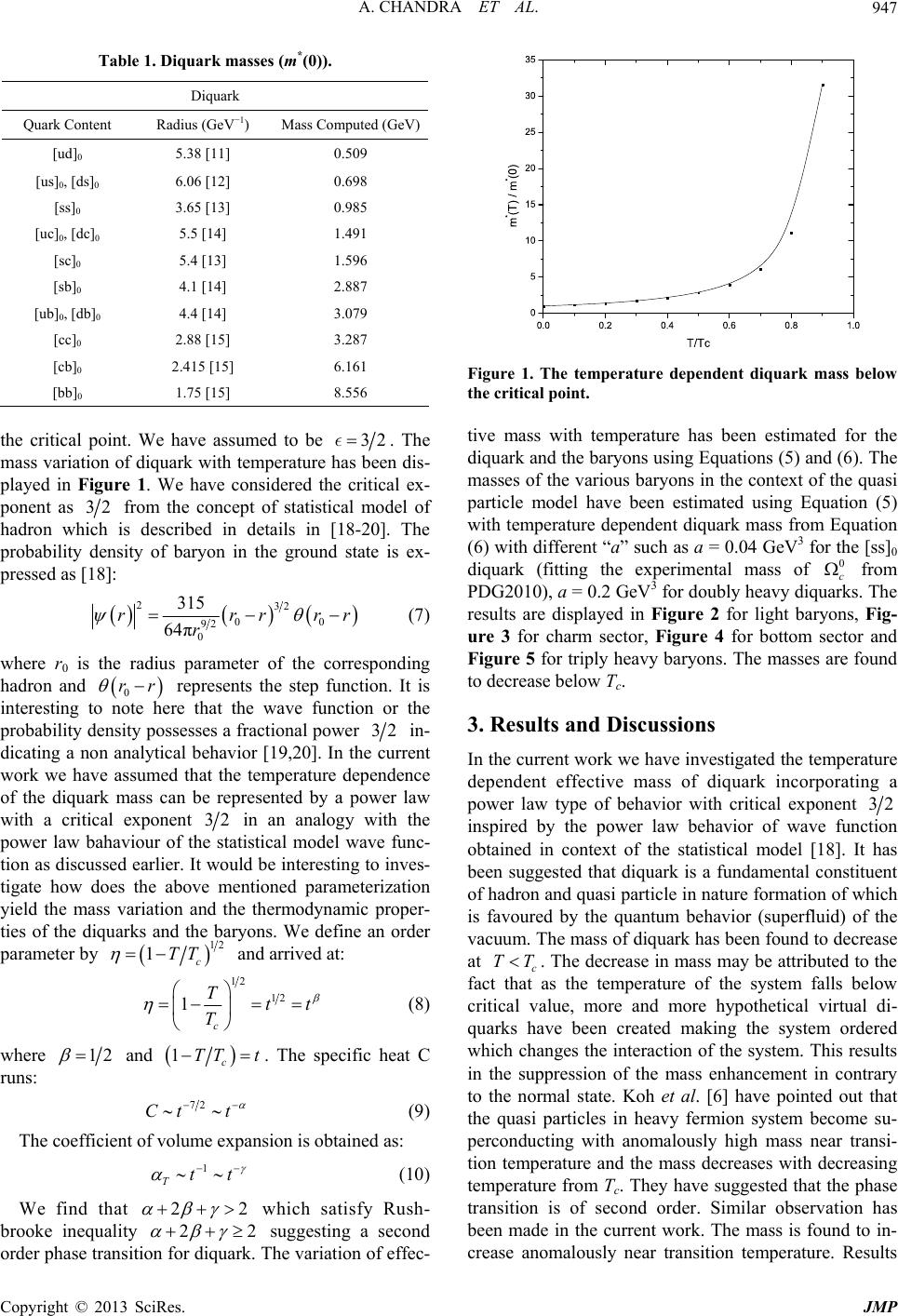 A. CHANDRA ET AL. 947 Table 1. Diquark masses (m*(0)). Diquark Quark Content Radius (GeV−1) Mass Computed (GeV) [ud]0 5.38 [11] 0.509 [us]0, [ds]0 6.06 [12] 0.698 [ss]0 3.65 [13] 0.985 [uc]0, [dc]0 5.5 [14] 1.491 [sc]0 5.4 [13] 1.596 [sb]0 4.1 [14] 2.887 [ub]0, [db]0 4.4 [14] 3.079 [cc]0 2.88 [15] 3.287 [cb]0 2.415 [15] 6.161 [bb]0 1.75 [15] 8.556 the critical point. We have assumed to be 32. The mass variation of diquark with temperature has been dis- played in Figure 1. We have considered the critical ex- ponent as 32 from the concept of statistical model of hadron which is described in details in [18-20]. The probability density of baryon in the ground state is ex- pressed as [18]: 32 00 rrr rr 2 92 0 315 64 π rr r (7) where r0 is the radius parameter of the corresponding hadron and 0 represents the step function. It is interesting to note here that the wave function or the probability density possesses a fractional power 32 in- dicating a non analytical behavior [19,20]. In the current work we have assumed that the temperature dependence of the diquark mass can be represented by a power law with a critical exponent 32 in an analogy with the power law bahaviour of the statistical model wave func- tion as discussed earlier. It would be interesting to inves- tigate how does the above mentioned parameterization yield the mass variation and the thermodynamic proper- ties of the diquarks and the baryons. We define an order parameter by 12 1c TT and arrived at: 12 12 1 c Ttt T (8) where 12 and 1c TT t. The specific heat C runs: 72 Ct t 1 Ttt (9) The coefficient of volume expansion is obtained as: 22 (10) We find that Figure 1. The temperature dependent diquark mass below the critical point. tive mass with temperature has been estimated for the diquark and the baryons using Equations (5) and (6). The masses of the various baryons in the context of the quasi particle model have been estimated using Equation (5) with temperature dependent diquark mass from Equation (6) with different “a” such as a = 0.04 GeV3 for the [ss]0 diquark (fitting the experimental mass of c 0 from PDG2010), a = 0.2 GeV3 for doubly heavy diquarks. The results are displayed in Figure 2 for light baryons, Fig- ure 3 for charm sector, Figure 4 for bottom sector and Figure 5 for triply heavy baryons. The masses are found to decrease below Tc. 3. Results and Discussions In the current work we have investigated the temperature dependent effective mass of diquark incorporating a power law type of behavior with critical exponent 32 TT inspired by the power law behavior of wave function obtained in context of the statistical model [18]. It has been suggested that diquark is a fundamental constituent of hadron and quasi particle in nature formation of which is favoured by the quantum behavior (superfluid) of the vacuum. The mass of diquark has been found to decrease at c . The decrease in mass may be attributed to the fact that as the temperature of the system falls below critical value, more and more hypothetical virtual di- quarks have been created making the system ordered which changes the interaction of the system. This results in the suppression of the mass enhancement in contrary to the normal state. Koh et al. [6] have pointed out that the quasi particles in heavy fermion system become su- perconducting with anomalously high mass near transi- tion temperature and the mass decreases with decreasing temperature from Tc. They have suggested that the phase transition is of second order. Similar observation has been made in the current work. The mass is found to in- crease anomalously near transition temperature. Results 22 which satisfy Rush- brooke inequality suggesting a second order phase transition for diquark. The variation of effec- Copyright © 2013 SciRes. JMP 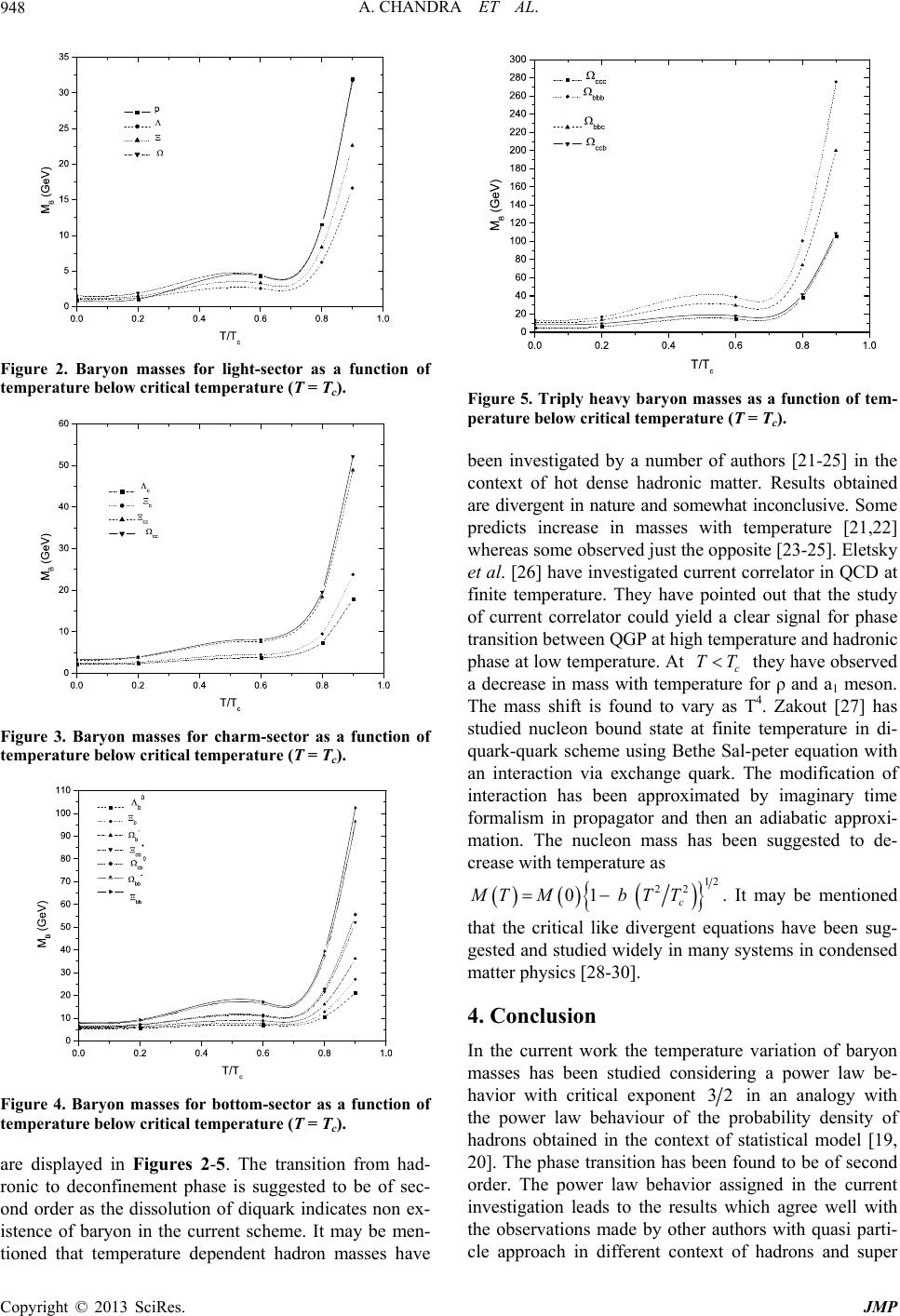 A. CHANDRA ET AL. 948 Figure 2. Baryon masses for light-sector as a function of temperature below critical temperature (T = Tc). Figure 3. Baryon masses for charm-sector as a function of temperature below critical temperature (T = Tc). Figure 4. Baryon masses for bottom-sector as a function of temperature below critical temperature (T = Tc). are displayed in Figures 2-5. The transition from had- ronic to deconfinement phase is suggested to be of sec- ond order as the dissolution of diquark indicates non ex- istence of baryon in the current scheme. It may be men- tioned that temperature dependent hadron masses have Figure 5. Triply heavy baryon masses as a function of tem- perature below critical temperature (T = Tc). been investigated by a number of authors [21-25] in the context of hot dense hadronic matter. Results obtained are divergent in nature and somewhat inconclusive. Some predicts increase in masses with temperature [21,22] whereas some observed just the opposite [23-25]. Eletsky et al. [26] have investigated current correlator in QCD at finite temperature. They have pointed out that the study of current correlator could yield a clear signal for phase transition between QGP at high temperature and hadronic phase at low temperature. At c they have observed a decrease in mass with temperature for ρ and a1 meson. The mass shift is found to vary as T4. Zakout [27] has studied nucleon bound state at finite temperature in di- quark-quark scheme using Bethe Sal-peter equation with an interaction via exchange quark. The modification of interaction has been approximated by imaginary time formalism in propagator and then an adiabatic approxi- mation. The nucleon mass has been suggested to de- crease with temperature as TT 12 22 01 c MTMb TT . It may be mentioned that the critical like divergent equations have been sug- gested and studied widely in many systems in condensed matter physics [28-30]. 4. Conclusion In the current work the temperature variation of baryon masses has been studied considering a power law be- havior with critical exponent 32 in an analogy with the power law behaviour of the probability density of hadrons obtained in the context of statistical model [19, 20]. The phase transition has been found to be of second order. The power law behavior assigned in the current investigation leads to the results which agree well with the observations made by other authors with quasi parti- cle approach in different context of hadrons and super Copyright © 2013 SciRes. JMP  A. CHANDRA ET AL. Copyright © 2013 SciRes. JMP 949 physics. It may be mentioned that the power law behav- iors are the manifestation of the dynamics of complex system whose striking feature is the showing of universal laws which are characterized by exponents in scale in- variant distribution and they are basically independent of the detailed of the microscopic dynamics [31]. Hadron itself is a complex system. It appears that it may not be far from reality to describe such a complex system by chaos, fractal which shows power law behavior. Further insight in this direction would be done in our future works. 5. Acknowledgements Authors are thankful to University Grants Commission (UGC), New Delhi, India for financial assistance. Ref No. F.No.37-217/2009 (SR). REFERENCES [1] V. A. Khodel and V. R. Shaginyan, Pis’ma Zh. Eksp. Theor. Fiz., Vol. 51, 1990, pp. 488-490. [2] E. Abrahams, P. Woelfle, Strongly Correlated Electrons, 2012. [3] A. Cassinese, M. A. Hein, S. Hensen and G. Müller, The European Physical Journal B, Vol. 14, 2000, pp. 605-610. doi:10.1007/s100510051068 [4] K. Nawa, et al., Physical Review D, Vol. 74, 2006, Arti- cle ID: 034017. doi:10.1103/PhysRevD.74.034017 [5] R. A. Schneider, T. Renk and W. Weise, “Quasiparticles in QCD Thermodynamics and Dilepton Radiation.” [6] S. I. Koh, Physical Review B, Vol. 51, 1995, pp. 669-673. doi:10.1103/PhysRevB.51.11669 [7] A. Bhattacharya, A. Chandra, B. Chakrabarti and A. Sa- gari, The European Physical Journal Plus, Vol. 126, 2011, pp. 57-61. doi:10.1140/epjp/i2011-11057-1 [8] A. Huang, “Theoretical Solid State Physics,” Pergamon Press, Oxford, 1975, p. 100. [9] W. Lucha, F. F. Schoberi and D. Gromes, Physics Re- ports, Vol. 200, 1991, pp. 127-240. doi:10.1016/0370-1573(91)90001-3 [10] R. K. Bhaduri, L. E. Cohler and Y. Nogami, Physical Re- view Letters, Vol. 44, 1980, pp. 1369-1372. doi:10.1103/PhysRevLett.44.1369 [11] B. Chakrabarti, et al., Nuclear Physics A, Vol. 782, 2007, pp. 392-395. doi:10.1016/j.nuclphysa.2006.10.021 [12] A. Bhattacharya, A. sagari, B. Chakrabarti and S. Mani, Physical Review C, Vol. 81, 2010, Article ID: 015202. doi:10.1103/PhysRevC.81.015202 [13] B. Ram and V. Kriss, Physical Review D, Vol. 35, 1987, pp. 400-402. doi:10.1103/PhysRevD.35.400 [14] B. Chakrabarti, Modern Physics Letters A, Vol. 12, 1997, pp. 2133-2140. doi:10.1142/S0217732397002181 [15] A. S. de Castro, H. F. de Carvalho and A. C. B. Antunes, Zeitschrift für Physik C Particles and Fields, Vol. 57, 1993, pp. 315-317. doi:10.1007/BF01565063 [16] M. Karliner and H. J. Lipkin, Physics Letters B, Vol. 575, 2003, pp. 249-255. doi:10.1016/j.physletb.2003.09.062 [17] L. D. Landau and E. M. Lifshitz, “Statistical Physics,” Oxford, Vol. 5, 3rd Edition, p. 216. [18] S. N. Banerjee, A. Bhattacharya, B. Chakrabarti and S. Banerjee, International Journal of Modern Physics A, Vol. 16, 2001, pp. 201-207. doi:10.1142/S0217751X01002956 [19] A. Bhattacharya, A. Raichaudhuri and S. N. Banerjee, Nuo- vo Cimento, Vol. 105, 1992, pp. 497-501. doi:10.1007/BF02730786 [20] W. W. Kolb, et al., “In the Early Universe,” Addison-Wes- ly Publishing Company, Singapore, p. 485. [21] J. Gasser and H. Leutwyler, Physics Letters B, Vol. 188, 1987, pp. 477-481. doi:10.1016/0370-2693(87)91652-2 [22] C. M. Shakin and W. D. Sun, Physical Review C, Vol. 49, 1994, pp. 1185-1189. doi:10.1103/PhysRevC.49.1185 [23] C. Song, Physical Review D, Vol. 49, 1994, pp. 1551- 1555. doi:10.1103/PhysRevD.49.1556 [24] K. Saito, T. Maruyama and K. Soutome, Physical Review C, Vol. 40, 1989, pp. 407-431. doi:10.1103/PhysRevC.40.407 [25] T. Hatsuda and T. Kunihiro, Progress of Theoretical Phy- sics, 1987, pp. 284-298. doi:10.1143/PTPS.91.284 [26] V. L. Eletsky and B. L. Ioffe, Physical Review D, Vol. 51, 1995, pp. 2371-2376. doi:10.1103/PhysRevD.51.2371 [27] I. Zakout, Nuclear Theory, 2005, 14 p. [28] P. T. Renter, et al., “Critical Exponents of Statistical Mal Fragmentation Model,” 2001. [29] H. G. Ballesteros, et al., Physics Letters B, Vol. 387, 1996, p. 125. doi:10.1016/0370-2693(96)00984-7 [30] A. Drozd-Rzoska, et al., Physical Review E, Vol. 82, 2010, Article ID: 031501. doi:10.1103/PhysRevE.82.031501 [31] S. Lehmann, A. D. Jackson and B. Lautrup, Physics and Society, 2005, 5 p. |