

Paper Menu >>
Journal Menu >>
 Communications and Network, 2013, 5, 53-59 doi:10.4236/cn.2013.52B010 Published Online May 2013 (http://www.scirp.org/journal/cn) Robustness and Accuracy Test of Particular Matter Prediction Based on Neural Networks Jiamei Deng1, Shaohua Zhong2, Andrew Ordys1 1School of Mechanical and Automotive Eng., Kingston University London, UK SW15 3DW 2School of Automotive Engineering, Wuhan University of Technology, Wuhan 430070, China Email: [email protected], [email protected], Received 2013 ABSTRACT The increasingly stringent emissions regulations require that engine manufacturers must reduce emissions of particulate matter (PM). PM is made up mainly of carbon in the form of PM and complex compound that are absorbed into the PM particles. Significant quantities PM poses a threat to health. Technologies available for PM reduction are heavily de- pendent on after-treatment systems, which are respectively active and passive. An active trap system requires a control unit to trigger and control the regeneration process (clean the trap system). The measurement of PM is crucial for the trap system to enable the fine judgment as to when to initiate the process. If the regeneration is too infrequent, the filter will block. The frequency of the regeneration and the life of the filter are compromised. Diesel engine particular matter prediction has always been a major challenge to the industry. A simple way to handle the PM estimation is to use black-box modelling as described in [J. Deng, B. Maass, R. Stobart, PM prediction in both steady state and transient operation of diesel engines, Proc IMechE, Part D: Journal of Automobile Engineering, 2011, 225, in press, DOI: 10.1177/0954407011418029]. This method is used to estimate the PM successfully in both steady and transient engine operation condition. The main question is how robust and accurate the neural networks are for a regeneration trigger signal of diesel particular filters. In order to answer such a question, the robust test of PM estimation is carried out based on different composition of bio-diesel. In this paper, regular diesel fuel will be blended with up to 20% bio-diesel to test the effect of different fuel resources on particulate matter. Bio-diesel is often added to regular diesel fuel to im- prove the burning properties and reduce carbon emissions, also is alternative source of fuels. The aim of this paper with these tests is to ensure that with a realistic change in the fuel composition the estimation of PM is still accurate. There- fore, neural networks could be used to produce a regeneration signal for diesel particular filter. In this paper a virtual sensor is proposed to measure the PM. The purpose of the proposed virtual sensor is to estimate the accumulation of PM and to trigger a regeneration cycle. The virtual sensor based on neural network is used to estimate the PM. In this pa- per, the performance, robustness and accuracy of simulated the sensor are evaluated in measuring the particulate amount for non-road transient cycle tests. Keywords: Neural Networks; Particulate Matter; Smoke; Prediction; Robustness 1. Introduction The increasingly stringent emissions regulations require that engine manufacturers must reduce emissions of par- ticulate matter (PM). PM is made up mainly of carbon in the form of PM and complex compound that are ab- sorbed into the PM particles. Significant quantities of PM pose a threat to health. Technologies available for PM reduction are heavily dependent on after-treatment sys- tems, which are respectively active and passive. Diesel Particulate Filters (DPFs) are kinds of after-treatment system and can effectively reduce the level of PM emis- sions to ambient background levels [1]. If PM accumulates on the DPF, the large amount of heat release during regeneration cannot effectively be dissipated. This could result in filter damage, for exam- ple, the formation of cracks or regions which may be locally melted. Extensive studies try to identify all mechanisms related to DPF failures and to develop strategies to avoid these failures [4]. On the other hand, if the DPF regenerates too frequently, it will also cause additional fuel penalties. Therefore, accurate knowledge of the DPF PM loading state is important for improving fuel economy and extending DPF service life. It is also very critical for the upcoming on-board diagnostics regulations [5]. A normal DPF system is very expensive (a heavy-duty catalyzed DPF unit costs about $5000) and a special de- sign one will cost much more. Therefore, controlling the Copyright © 2013 SciRes. CN  J. M. DENG ET AL. 54 DPF regeneration safely is highly critical [4]. The timing for safely and efficiently regenerating the DPF has be- come a major industrial challenge. It can be seen that a control unit to trigger and control the regeneration process is crucial for both DPF life and fuel economy. The measurement of PM is crucial for the trap system to enable the fine judgment as to when to initiate the process. The frequency of the regeneration and the life of the filter are compromised. Diesel engine PM Prediction has always been a major challenge to the industry [6, 7, 8]. The conventional method to estimate the PM loading is pressure drop measurements. But it is affected by exhaust flow varia- tions and exhibits a low degree of sensitivity to DPF PM loading and has bad dynamic response over transient operating conditions. There is study investigating the use of radio frequency (RF) to directly monitor measure DPF PM accumulation levels. However, this technique is not mature enough to be applied in commercial applications as it is not easy to be calibrated. Hence, more reliable, stable and accurate PM loading estimation or sensing method should be studied. Computational fluid dynamics (CFD) based PM models are computationally intensive and are not suitable for control purpose and real time measurement. Recently, neural networks have been used in a wide variety of automotive applications. The advan- tage of neural networks is their ability to be used as an arbitrary function approximation mechanism which has no requirement to represent the complex underlying process and is an economic way to obtain the measure- ment. Model based PM emission prediction method could be a good alternative way [9]. Neural networks have been successfully used for emissions prediction [10]. He et al. [11] built a model that considers several engine parameters such as boost pressure and exhaust gas recir- culation (EGR) and it generates several outputs including PM emissions. Maass et al. presented a smoke prediction neural network model using a three-layer autoregressive model with exogenous inputs (NLARX) model to predict PM [12]. Bose and Kumar [13] use fuzzy logic to predict the engine emissions. The simple way to handle the PM estimation is to use black-box modeling as described in [14].This method is used to estimate the PM successfully in both steady and transient engine operation condition. The disadvantage is the robustness and accuracy of the PM prediction based on neural networks while different fuels are used in the engines. The neural network model is built on training data, which has no information on fuel types. Therefore, the test of robustness and accuracy is important for the PM estimation based on neural networks. In order to carry out the robust and accurate tests, different compo- sitions of Bio-diesel with standard diesel EN590 are used. In order to improve the engine performance and emis- sions and ensure the sustainability of the fuel supplies, bio-diesel is a promising alternative for diesels. Bio- diesel leads to significant reductions in PM emissions, although the percentage reduction varied with fuel com- position and engine technology. The average PM reduc- tions are 26% compared to conventional diesel fuel [15]. In this paper, standard diesel fuel (EN590) will be blended with up to 20% bio-diesel fuel to test the effect of different fuel resources on PM. The aim with these tests is to ensure that with a realistic change in the fuel composition the estimation of PM based on neural net- works is still accurate enough to trig a regeneration cycle. The virtual sensor of PM measurement based on neural networks will be used to estimate the PM. With the simulated sensor we will evaluate its performance, ro- bustness and accuracy in predicting the PM. In this paper a virtual sensor is proposed to measure the PM. The purpose of the proposed virtual sensor is to estimate the PM and to trigger a regeneration cycle for diesel particulate filter. In Section 1 - introduction, a brief background of the research is introduced. Section 2 reviews the non-linear autoregressive model with exogenous inputs (NLARX) neural networks that can be used to predict PM. Section 3 described details of the test facility. Section 4 describes the data collection and neural network training and ro- bustness test. Section 5 provides conclusions on this work. 2. Neural Networks The field of virtual sensing has become more and more popular with growing systems complexity such as in combustion engine control. Its origin lies in the field of estimators which are specified through physical and nu- merical relations whereas virtual sensors are character- ized through black-box approaches such as neural net- works. Neural networks can be split into the following three categories: 1) single-layer feed forward networks (SLFN), 2) multi-layer feed forward networks (MLFN), 3) recurrent neural network (RNN). The chosen network structure or architecture is crucial for the output performance. Depending on the systems characteristic: linear or non-linear, static or dynamic, the network needs to be designed accordingly. Here, the pre- diction of PM is recognised as highly dynamic and non-linear that implies a recurrent network structure has to be chosen to offer sufficient predictive capability. The NLARX structure can accommodate the dynamics of the system by feeding previous network outputs back into the input layer. It also enables the user to define how many Copyright © 2013 SciRes. CN 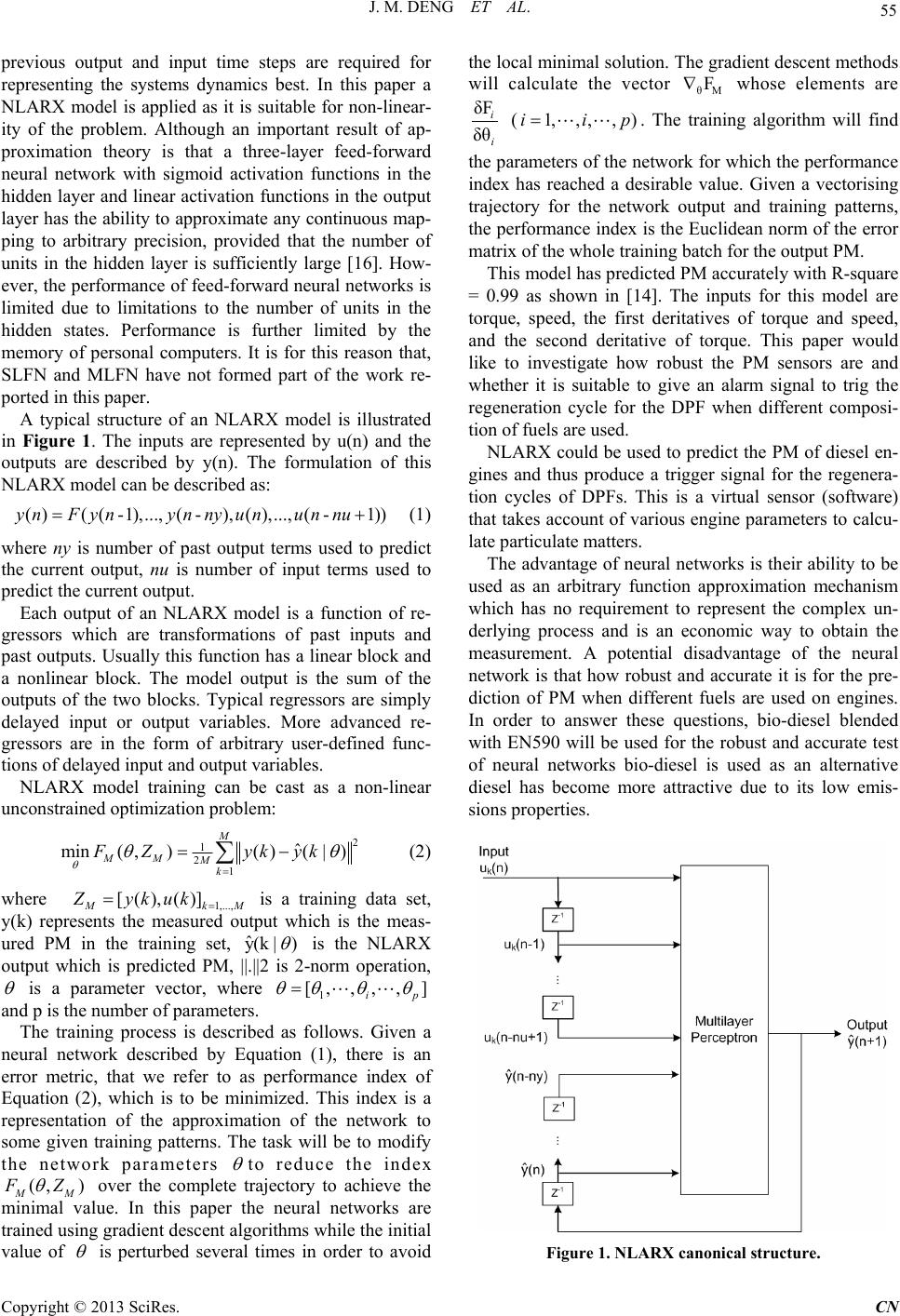 J. M. DENG ET AL. 55 previous output and input time steps are required for representing the systems dynamics best. In this paper a NLARX model is applied as it is suitable for non-linear- ity of the problem. Although an important result of ap- proximation theory is that a three-layer feed-forward neural network with sigmoid activation functions in the hidden layer and linear activation functions in the output layer has the ability to approximate any continuous map- ping to arbitrary precision, provided that the number of units in the hidden layer is sufficiently large [16]. How- ever, the performance of feed-forward neural networks is limited due to limitations to the number of units in the hidden states. Performance is further limited by the memory of personal computers. It is for this reason that, SLFN and MLFN have not formed part of the work re- ported in this paper. A typical structure of an NLARX model is illustrated in Figure 1. The inputs are represented by u(n) and the outputs are described by y(n). The formulation of this NLARX model can be described as: ( )((-1),...,(-),( ),...,(-1))ynFynyn nyunun nu (1) where ny is number of past output terms used to predict the current output, nu is number of input terms used to predict the current output. Each output of an NLARX model is a function of re- gressors which are transformations of past inputs and past outputs. Usually this function has a linear block and a nonlinear block. The model output is the sum of the outputs of the two blocks. Typical regressors are simply delayed input or output variables. More advanced re- gressors are in the form of arbitrary user-defined func- tions of delayed input and output variables. NLARX model training can be cast as a non-linear unconstrained optimization problem: 2 1 2 1 ˆ min( ,)( )(|) M MMMk FZ ykyk (2) where 1,..., [(),()] M kM Zykuk ˆ y( is a training data set, y(k) represents the measured output which is the meas- ured PM in the training set, k |) is the NLARX output which is predicted PM, ||.||2 is 2-norm operation, is a parameter vector, where 1 [, ,, ,] ip and p is the number of parameters. The training process is described as follows. Given a neural network described by Equation (1), there is an error metric, that we refer to as performance index of Equation (2), which is to be minimized. This index is a representation of the approximation of the network to some given training patterns. The task will be to modify the network parameters to reduce the index (, ) MM F Z over the complete trajectory to achieve the minimal value. In this paper the neural networks are trained using gradient descent algorithms while the initial value of is perturbed several times in order to avoid the local minimal solution. The gradient descent methods will calculate the vector whose elements are θM F δF δθ i i (1,, ,,)iip . The training algorithm will find the parameters of the network for which the performance index has reached a desirable value. Given a vectorising trajectory for the network output and training patterns, the performance index is the Euclidean norm of the error matrix of the whole training batch for the output PM. This model has predicted PM accurately with R-square = 0.99 as shown in [14]. The inputs for this model are torque, speed, the first deritatives of torque and speed, and the second deritative of torque. This paper would like to investigate how robust the PM sensors are and whether it is suitable to give an alarm signal to trig the regeneration cycle for the DPF when different composi- tion of fuels are used. NLARX could be used to predict the PM of diesel en- gines and thus produce a trigger signal for the regenera- tion cycles of DPFs. This is a virtual sensor (software) that takes account of various engine parameters to calcu- late particulate matters. The advantage of neural networks is their ability to be used as an arbitrary function approximation mechanism which has no requirement to represent the complex un- derlying process and is an economic way to obtain the measurement. A potential disadvantage of the neural network is that how robust and accurate it is for the pre- diction of PM when different fuels are used on engines. In order to answer these questions, bio-diesel blended with EN590 will be used for the robust and accurate test of neural networks bio-diesel is used as an alternative diesel has become more attractive due to its low emis- sions properties. Figure 1. NLARX canonical structure. Copyright © 2013 SciRes. CN 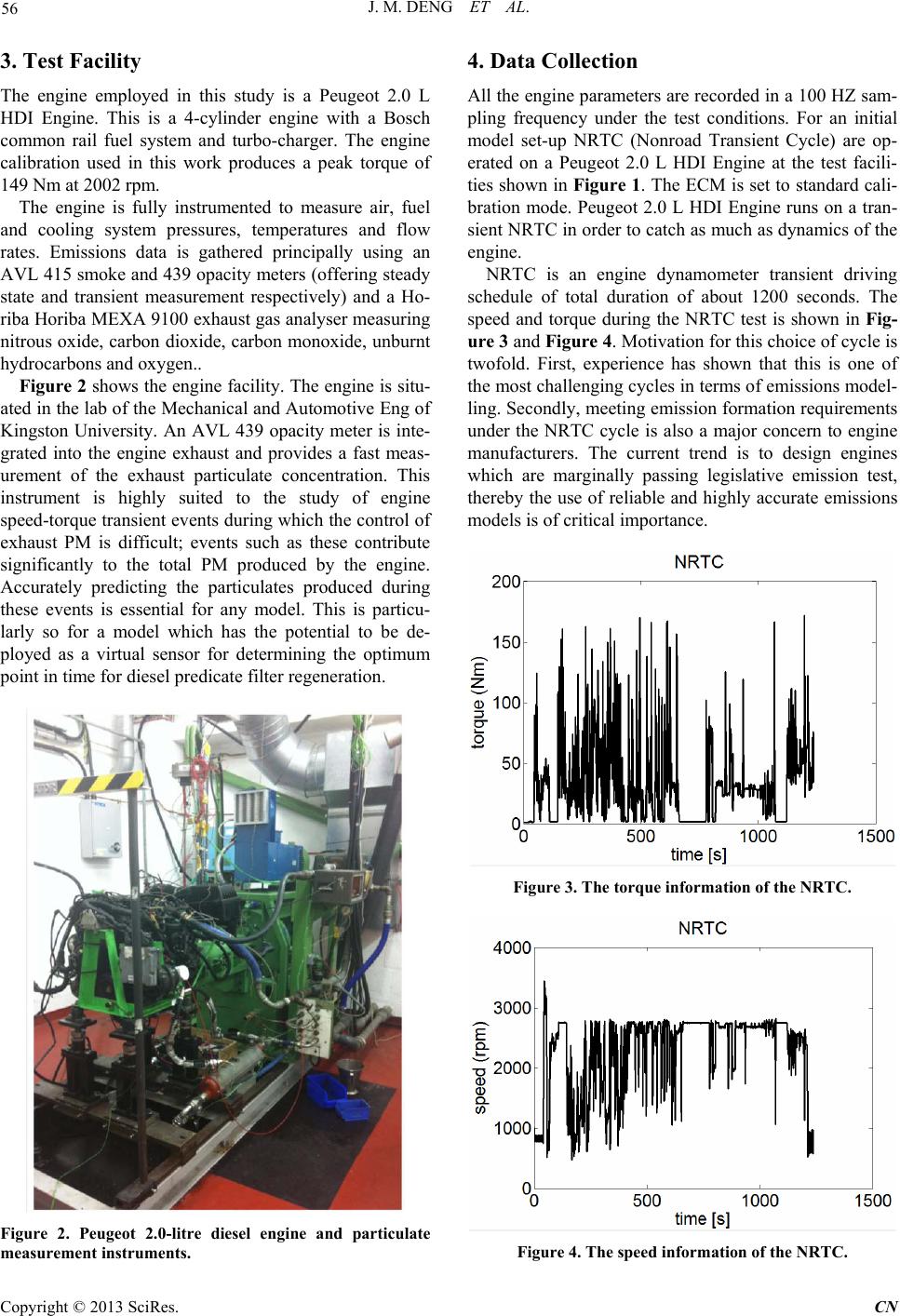 J. M. DENG ET AL. 56 3. Test Facility The engine employed in this study is a Peugeot 2.0 L HDI Engine. This is a 4-cylinder engine with a Bosch common rail fuel system and turbo-charger. The engine calibration used in this work produces a peak torque of 149 Nm at 2002 rpm. The engine is fully instrumented to measure air, fuel and cooling system pressures, temperatures and flow rates. Emissions data is gathered principally using an AVL 415 smoke and 439 opacity meters (offering steady state and transient measurement respectively) and a Ho- riba Horiba MEXA 9100 exhaust gas analyser measuring nitrous oxide, carbon dioxide, carbon monoxide, unburnt hydrocarbons and oxygen.. Figure 2 shows the engine facility. The engine is situ- ated in the lab of the Mechanical and Automotive Eng of Kingston University. An AVL 439 opacity meter is inte- grated into the engine exhaust and provides a fast meas- urement of the exhaust particulate concentration. This instrument is highly suited to the study of engine speed-torque transient events during which the control of exhaust PM is difficult; events such as these contribute significantly to the total PM produced by the engine. Accurately predicting the particulates produced during these events is essential for any model. This is particu- larly so for a model which has the potential to be de- ployed as a virtual sensor for determining the optimum point in time for diesel predicate filter regeneration. Figure 2. Peugeot 2.0-litre diesel engine and particulate measurement instruments. 4. Data Collection All the engine parameters are recorded in a 100 HZ sam- pling frequency under the test conditions. For an initial model set-up NRTC (Nonroad Transient Cycle) are op- erated on a Peugeot 2.0 L HDI Engine at the test facili- ties shown in Figure 1. The ECM is set to standard cali- bration mode. Peugeot 2.0 L HDI Engine runs on a tran- sient NRTC in order to catch as much as dynamics of the engine. NRTC is an engine dynamometer transient driving schedule of total duration of about 1200 seconds. The speed and torque during the NRTC test is shown in Fig- ure 3 and Figure 4. Motivation for this choice of cycle is twofold. First, experience has shown that this is one of the most challenging cycles in terms of emissions model- ling. Secondly, meeting emission formation requirements under the NRTC cycle is also a major concern to engine manufacturers. The current trend is to design engines which are marginally passing legislative emission test, thereby the use of reliable and highly accurate emissions models is of critical importance. Figure 3. The torque information of the NRTC. Figure 4. The speed information of the NRTC. Copyright © 2013 SciRes. CN 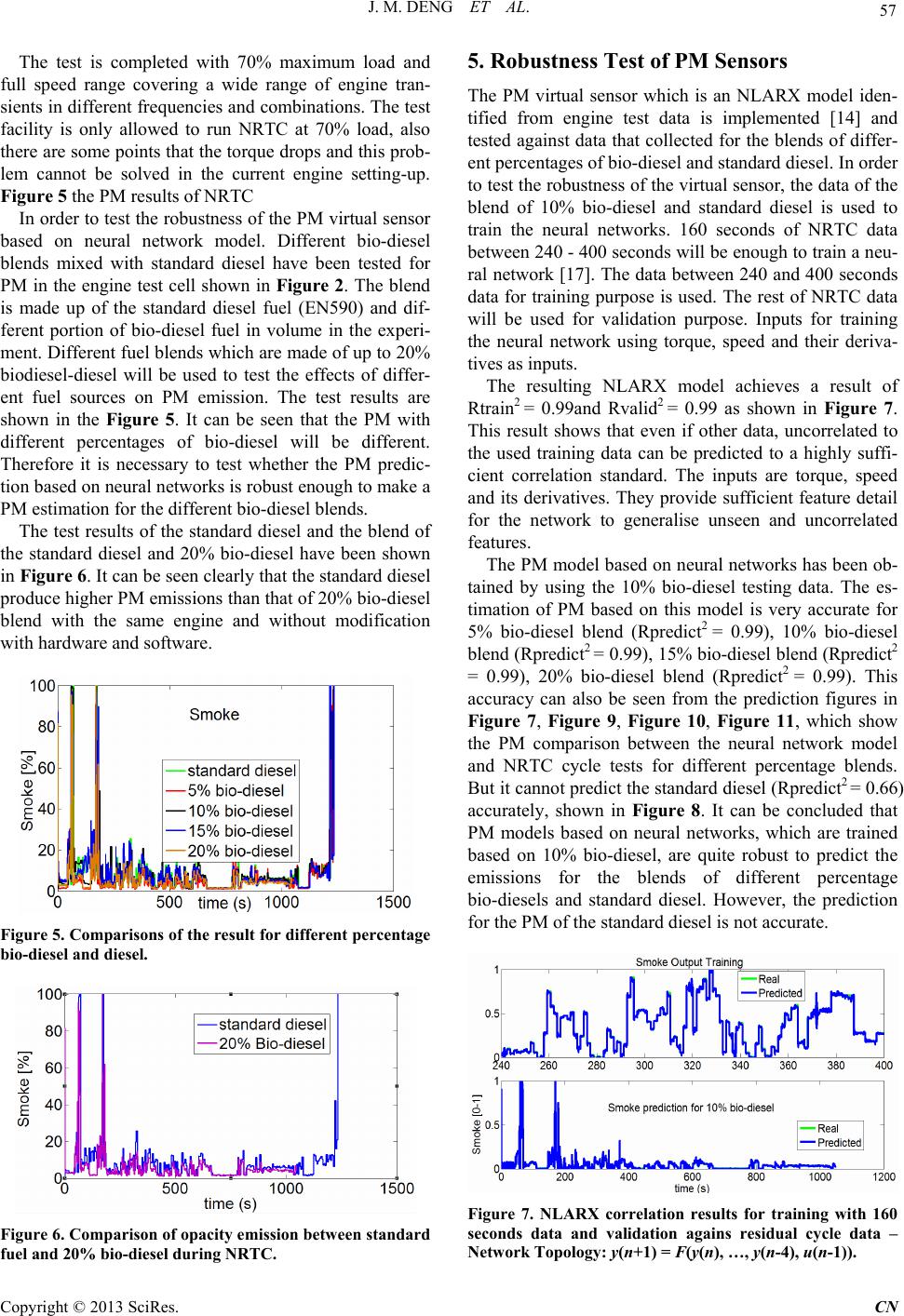 J. M. DENG ET AL. 57 The test is completed with 70% maximum load and full speed range covering a wide range of engine tran- sients in different frequencies and combinations. The test facility is only allowed to run NRTC at 70% load, also there are some points that the torque drops and this prob- lem cannot be solved in the current engine setting-up. Figure 5 the PM results of NRTC In order to test the robustness of the PM virtual sensor based on neural network model. Different bio-diesel blends mixed with standard diesel have been tested for PM in the engine test cell shown in Figure 2. The blend is made up of the standard diesel fuel (EN590) and dif- ferent portion of bio-diesel fuel in volume in the experi- ment. Different fuel blends which are made of up to 20% biodiesel-diesel will be used to test the effects of differ- ent fuel sources on PM emission. The test results are shown in the Figure 5. It can be seen that the PM with different percentages of bio-diesel will be different. Therefore it is necessary to test whether the PM predic- tion based on neural networks is robust enough to make a PM estimation for the different bio-diesel blends. The test results of the standard diesel and the blend of the standard diesel and 20% bio-diesel have been shown in Figure 6. It can be seen clearly that the standard diesel produce higher PM emissions than that of 20% bio-diesel blend with the same engine and without modification with hardware and software. Figure 5. Comparisons of the result for different percentage bio-diesel and diesel. Figure 6. Comparison of opacity emission between standard fuel and 20% bio-diesel during NRTC. 5. Robustness Test of PM Sensors The PM virtual sensor which is an NLARX model iden- tified from engine test data is implemented [14] and tested against data that collected for the blends of differ- ent percentages of bio-diesel and standard diesel. In order to test the robustness of the virtual sensor, the data of the blend of 10% bio-diesel and standard diesel is used to train the neural networks. 160 seconds of NRTC data between 240 - 400 seconds will be enough to train a neu- ral network [17]. The data between 240 and 400 seconds data for training purpose is used. The rest of NRTC data will be used for validation purpose. Inputs for training the neural network using torque, speed and their deriva- tives as inputs. The resulting NLARX model achieves a result of Rtrain2 = 0.99and Rvalid2 = 0.99 as shown in Figure 7. This result shows that even if other data, uncorrelated to the used training data can be predicted to a highly suffi- cient correlation standard. The inputs are torque, speed and its derivatives. They provide sufficient feature detail for the network to generalise unseen and uncorrelated features. The PM model based on neural networks has been ob- tained by using the 10% bio-diesel testing data. The es- timation of PM based on this model is very accurate for 5% bio-diesel blend (Rpredict2 = 0.99), 10% bio-diesel blend (Rpredict2 = 0.99), 15% bio-diesel blend (Rpredict2 = 0.99), 20% bio-diesel blend (Rpredict2 = 0.99). This accuracy can also be seen from the prediction figures in Figure 7, Figure 9, Figure 10, Figure 11, which show the PM comparison between the neural network model and NRTC cycle tests for different percentage blends. But it cannot predict the standard diesel (Rpredict2 = 0.66) accurately, shown in Figure 8. It can be concluded that PM models based on neural networks, which are trained based on 10% bio-diesel, are quite robust to predict the emissions for the blends of different percentage bio-diesels and standard diesel. However, the prediction for the PM of the standard diesel is not accurate. Figure 7. NLARX correlation results for training with 160 seconds data and validation agains residual cycle data – Network Topology: y(n+1) = F(y(n), …, y(n-4), u(n-1)). Copyright © 2013 SciRes. CN 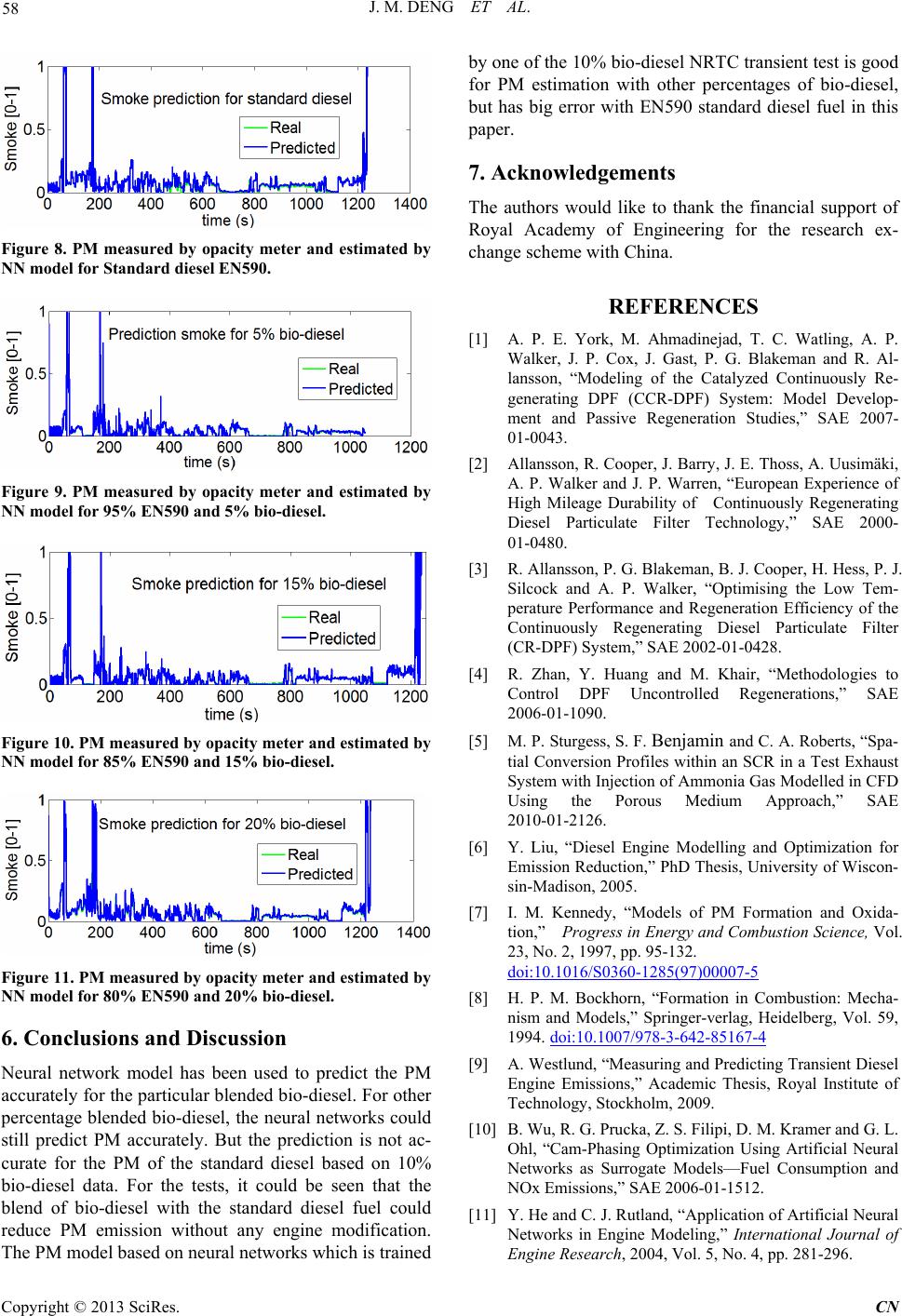 J. M. DENG ET AL. 58 Figure 8. PM measured by opacity meter and estimated by NN model for Standard diesel EN590. Figure 9. PM measured by opacity meter and estimated by NN model for 95% EN590 and 5% bio-diesel. Figure 10. PM measured by opacity meter and estimated by NN model for 85% EN590 and 15% bio-diesel. Figure 11. PM measured by opacity meter and estimated by NN model for 80% EN590 and 20% bio-diesel. 6. Conclusions and Discussion Neural network model has been used to predict the PM accurately for the particular blended bio-diesel. For other percentage blended bio-diesel, the neural networks could still predict PM accurately. But the prediction is not ac- curate for the PM of the standard diesel based on 10% bio-diesel data. For the tests, it could be seen that the blend of bio-diesel with the standard diesel fuel could reduce PM emission without any engine modification. The PM model based on neural networks which is trained by one of the 10% bio-diesel NRTC transient test is good for PM estimation with other percentages of bio-diesel, but has big error with EN590 standard diesel fuel in this paper. 7. Acknowledgements The authors would like to thank the financial support of Royal Academy of Engineering for the research ex- change scheme with China. REFERENCES [1] A. P. E. York, M. Ahmadinejad, T. C. Watling, A. P. Walker, J. P. Cox, J. Gast, P. G. Blakeman and R. Al- lansson, “Modeling of the Catalyzed Continuously Re- generating DPF (CCR-DPF) System: Model Develop- ment and Passive Regeneration Studies,” SAE 2007- 01-0043. [2] Allansson, R. Cooper, J. Barry, J. E. Thoss, A. Uusimäki, A. P. Walker and J. P. Warren, “European Experience of High Mileage Durability of Continuously Regenerating Diesel Particulate Filter Technology,” SAE 2000- 01-0480. [3] R. Allansson, P. G. Blakeman, B. J. Cooper, H. Hess, P. J. Silcock and A. P. Walker, “Optimising the Low Tem- perature Performance and Regeneration Efficiency of the Continuously Regenerating Diesel Particulate Filter (CR-DPF) System,” SAE 2002-01-0428. [4] R. Zhan, Y. Huang and M. Khair, “Methodologies to Control DPF Uncontrolled Regenerations,” SAE 2006-01-1090. [5] M. P. Sturgess, S. F. Benjamin and C. A. Roberts, “Spa- tial Conversion Profiles within an SCR in a Test Exhaust System with Injection of Ammonia Gas Modelled in CFD Using the Porous Medium Approach,” SAE 2010-01-2126. [6] Y. Liu, “Diesel Engine Modelling and Optimization for Emission Reduction,” PhD Thesis, University of Wiscon- sin-Madison, 2005. [7] I. M. Kennedy, “Models of PM Formation and Oxida- tion,” Progress in Energy and Combustion Science, Vol. 23, No. 2, 1997, pp. 95-132. doi:10.1016/S0360-1285(97)00007-5 [8] H. P. M. Bockhorn, “Formation in Combustion: Mecha- nism and Models,” Springer-verlag, Heidelberg, Vol. 59, 1994. doi:10.1007/978-3-642-85167-4 [9] A. Westlund, “Measuring and Predicting Transient Diesel Engine Emissions,” Academic Thesis, Royal Institute of Technology, Stockholm, 2009. [10] B. Wu, R. G. Prucka, Z. S. Filipi, D. M. Kramer and G. L. Ohl, “Cam-Phasing Optimization Using Artificial Neural Networks as Surrogate Models—Fuel Consumption and NOx Emissions,” SAE 2006-01-1512. [11] Y. He and C. J. Rutland, “Application of Artificial Neural Networks in Engine Modeling,” International Journal of Engine Research, 2004, Vol. 5, No. 4, pp. 281-296. Copyright © 2013 SciRes. CN  J. M. DENG ET AL. Copyright © 2013 SciRes. CN 59 doi:10.1243/146808704323224204 [12] B. Maass, R. Stobart and J. Deng, “Diesel Engine Emis- sions Prediction with Parallel Neural Networks,” Ameri- can Control Conference, 2009. [13] N. Bose and N. S. Kumar, “Prediction of Engine Emis- sions through Fuzzy Logic Modelling,” International Conference on Computational Intelligence and Multime- dia Applications, 2007. [14] J. Deng, B. Maass and R. Stobart, “PM Prediction in Both Steady State and Transient Operation of Diesel Engines,” Journal of Automobile Engineering, Vol. 226, No. 2, 2011, pp. 260-274. doi:10.1177/0954407011418029 [15] T. L. Alleman and R. L. McCormick, “Fischer-Tropsch Diesel Fuels – Properties and Exhaust Emissions: A Lit- erature Review,” SAE 2003-01-0763. [16] K. Funahashi, “On the Approximate Realization of Con- tinuous Mappings by Neural Networks,” Neural Networks, Vol. 2, No. 3, 1989, pp. 183-192. doi: /10.1016/0893-6080(89)90003-8 [17] J. Deng, M. Bastian and R. Stobart, “Minimum Data Re- quirement for Neural Networks Based on Power Density Analysis,” IEEE Transactions on Neural Networks, Vol. 23, No. 4, 2012, pp. 585-595. doi:10.1109/tnnls.2012.2183887. |