

Paper Menu >>
Journal Menu >>
 Creative Education 2013. Vol.4, No.7, 446-451 Published Online July 2013 in SciRes (http://www.scirp.org/journal/ce) http://dx.doi.org/10.4236/ce.2013.47064 Copyright © 2013 SciRe s . 446 Usefulness of Plastic Hoffman Apparatus in Chemistry Classes: A Case Study of Its Implementation with High School Teachers Muhamad Hugerat*, Ahmad Basheer, Naji Kortam SALiS Center, The Academic Arab College for Education, 22 Hachashmal St., Haifa, Israel Email: *[email protected] Received April 12th, 2013; revised May 13th, 2013; accepted May 22nd, 2013 Copyright © 2013 Muhamad Hugerat et al. This is an open access article distributed under the Creative Com- mons Attribution License, which permits unrestricted use, distribution, and reproduction in any medium, pro- vided the original work is p roperly cited. In this article we present simple and feasible idea to introduce electrolysis experiments using accessible materials in the classroom. We use plastic syringes and pipettes to build different shapes of Hoffman ap- paratus for electrolysis. This activity was introduced to a group of 20 teachers from the Arab sector in Is- rael to examine their impressions about the activity and investigate the feasibility of implementing the ac- tivity in their classrooms. Keywords: Electrolysis Workshop; Professional Development of Teachers; Case Study; Accessible Materials; Plastic Apparatus Introduction Professional development of educators at different levels is described by many researchers as a central lever leading to change and improve the capabilities and achievements of the education system (Scandholtz & Scribner, 2006). Elliote (1999) emphasizes that it is very important to carry- out local studies, and case studies to examine the interaction be- tween local and global dimensions related to the development of teachers. Teachers can act as powerful mediators in introducing change. Their decision to implement a new project depends on their satisfaction from the current situation and their expecta- tions from the contribution of the project in improving their tea- ching (Wallace & Louden, 1998; Zidani, Kortam, & Hugerat, 2003). In order to introduce a change, the teacher, himself, must go through a learning process (Wheeler et al., 1995). In this proc- ess, the teacher is an active partner in the creation of change. This involvement is a constructivist teaching model, which is essential in the introduction of such process. In a study among elementary school teachers in Israel, Ben- Chaim et al. (1994) found that training workshops encourage the implementation of approaches, attitudes and scientific— technological—and social literacy among the participating tea- chers. In this article we present simple and feasible idea to intro- duce the microscale electrolysis experiments using accessible materials in the classroom. We use plastic syringes and pipettes to build different shapes of Hoffman apparatus for electrolysis. We introduce this activity for high school teachers and we ex- amine the impact of this implementation. Starting from the last century, electrolysis of water solutions has been widely demonstrated to students in secondary schools, or in a first-year college in order to illustrate oxidation-reduc- tion reactions as well as to demonstrate the use of an external source of energy for driving non-spontaneous chemical reac- tions (Hendricks & Williams, 1982; Hugerat, 2006, 2008; Hu- gerat et al., 2009; Shakhashiri, 1992; Zhou, 1996). A Hofmann apparatus is an apparatus for electrolyzing water, invented by August Wilhelm von Hofmann. It consists of three joined upright cylinders, usually glass. The inner cylinder is open at the top to allow the addition of water and an ionic com- pound, such as a small amount of sodium sulfate, to improve conductivity. A platinum electrode is placed inside the bottom of each of the two outer cylinders, connected to the positive and negative terminals of a source of electricity. Gaseous oxygen forms at the anode and gaseous hydrogen forms at the cathode when a current runs through the Hofmann’s apparatus. Each gas displaces water and collects at the top of the two outer tubes (Hugerat, 2006, 2008; Hugerat & Schwarz, 2008; Hugerat et al., 2009; Zhou et al., 2005). Microscale chemistry is the reduction of chemicals use to the lowest level at which experiments can be effectively performed. It offers a safer way to perform chemical experiments by using smaller quan tities of chem icals. Micros cale experiments are con- ducted without compromising the quality or standard of chemi- cal applications in educational institutions and the experimental industry. The Benefits of Microscale Chemistry are: reduces chemicals use by promoting waste reduction at the source; im- proves laboratory safety (air quality, reduced exposure, and spills); saves money; decreases experiment time; teaches stu- dent s alternatives to conventi onal chemi s try (Singh et al., 1999; Zhou et al., 2005). For microscaling, the “Hoffmann Apparatus” the container, the electrodes, the electrolyte, and the power supply are replac- ed by smaller units; uses narrow 3-mL test tubes, insulated cop- per wire (for the anode they are combined with a pencil lead), diluted sodium hydroxide solution, or sodium sulfate solution *Corresponding author. 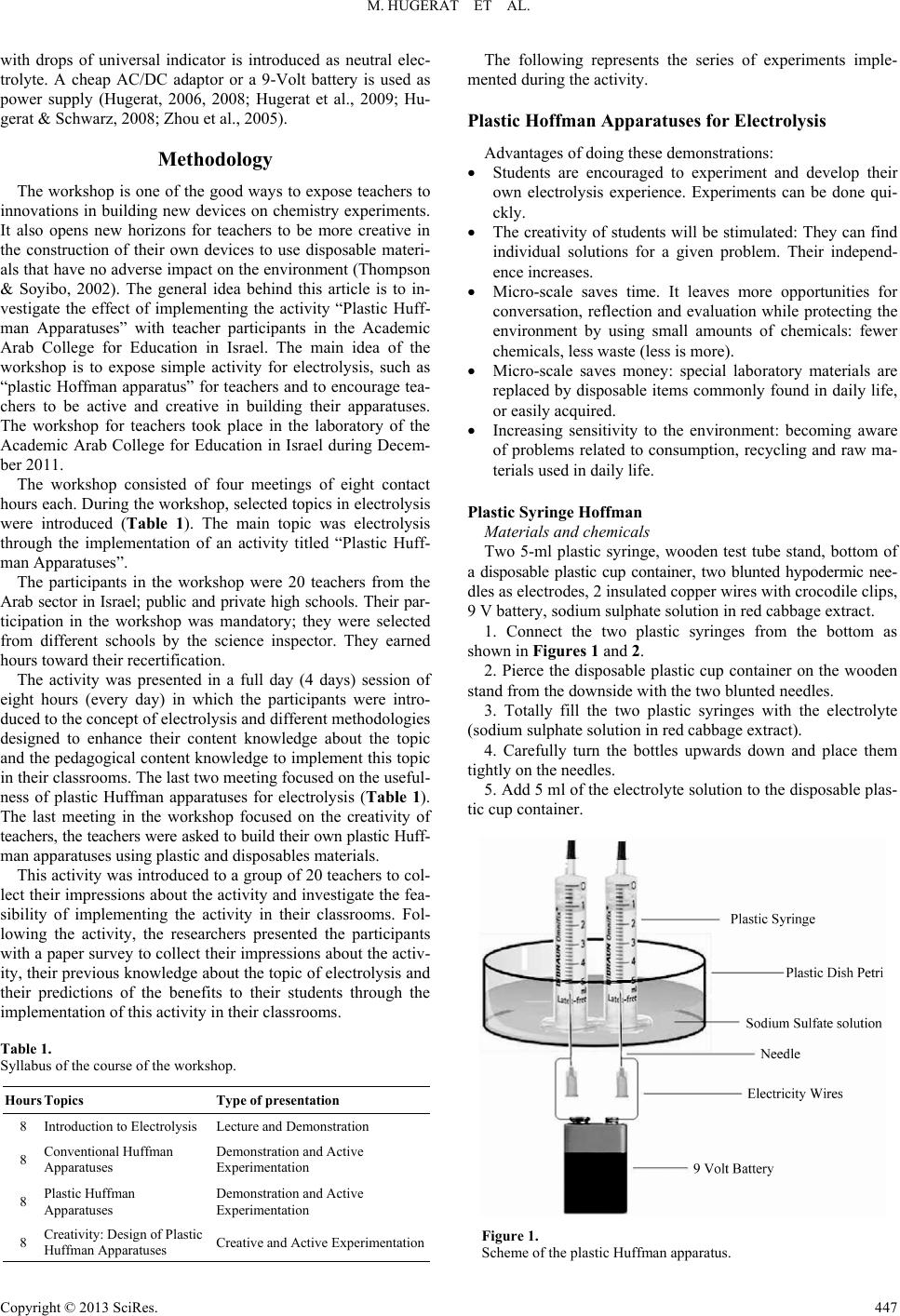 M. HUGERAT ET AL. with drops of universal indicator is introduced as neutral elec- trolyte. A cheap AC/DC adaptor or a 9-Volt battery is used as power supply (Hugerat, 2006, 2008; Hugerat et al., 2009; Hu- gerat & Schwarz, 2008; Zhou et al., 2005). Methodology The workshop is one of the good ways to expose teachers to innovations in building new devices on chemistry experiments. It also opens new horizons for teachers to be more creative in the construction of their own devices to use disposable materi- als that have no adverse impact on the environment (Thompson & Soyibo, 2002). The general idea behind this article is to in- vestigate the effect of implementing the activity “Plastic Huff- man Apparatuses” with teacher participants in the Academic Arab College for Education in Israel. The main idea of the workshop is to expose simple activity for electrolysis, such as “plastic Hoffman apparatus” for teachers and to encourage tea- chers to be active and creative in building their apparatuses. The workshop for teachers took place in the laboratory of the Academic Arab College for Education in Israel during Decem- ber 2011. The workshop consisted of four meetings of eight contact hours each. During the workshop, selected topics in electrolysis were introduced (Table 1). The main topic was electrolysis through the implementation of an activity titled “Plastic Huff- man Apparatuses”. The participants in the workshop were 20 teachers from the Arab sector in Israel; public and private high schools. Their par- ticipation in the workshop was mandatory; they were selected from different schools by the science inspector. They earned hours toward their recertification. The activity was presented in a full day (4 days) session of eight hours (every day) in which the participants were intro- duced to the concept of electrolysis and different methodologies designed to enhance their content knowledge about the topic and the pedagogical content knowledge to implement this topic in their classrooms. The last two meeting focused on the useful- ness of plastic Huffman apparatuses for electrolysis (Table 1). The last meeting in the workshop focused on the creativity of teachers, the teachers were asked to build thei r own plastic Huff- man apparatuses using plastic and disposables materials. This activity was introduced to a group of 20 teachers to col- lect their impressions about the activity and investigate the fea- sibility of implementing the activity in their classrooms. Fol- lowing the activity, the researchers presented the participants with a paper survey to collect their impressions about the activ- ity, their previous knowledge about the topic of electrolysis and their predictions of the benefits to their students through the implementation of this activity in their classrooms. Table 1. Syllabus of the course o f the workshop. Type of presentation Topics Hours Lecture and Demonstration Introduction to Electrolysis 8 Demonstration and Active Experimentation Conventional Huffman Apparatuses 8 Demonstration and Active Experimentation Plastic Huffman Apparatuses 8 Creative and Active Experimentation Creativity: Design of Plastic Huffman Appa ratuses 8 The following represents the series of experiments imple- mented during the activity. Plastic Hoffman Apparatuses for Electrolysis Advantages of doing these demonstrations: Students are encouraged to experiment and develop their own electrolysis experience. Experiments can be done qui- ckly. The creativity of students will be stimulated: They can find individual solutions for a given problem. Their independ- ence increases. Micro-scale saves time. It leaves more opportunities for conversation, reflection and evaluation while protecting the environment by using small amounts of chemicals: fewer chemicals, less waste (less is more). Micro-scale saves money: special laboratory materials are replaced by disposable items commonly found in daily life, or easily acquired. Increasing sensitivity to the environment: becoming aware of problems related to consumption, recycling and raw ma- terials used in daily life. Plastic Syringe Hoffman Materials and chemicals Two 5-ml plastic syringe, wooden test tube stand, bottom of a disposable plastic cup container, two blunted hypodermic nee- dles as electrodes, 2 insulated copper wires with crocodile clips, 9 V battery, sodium sulphate solution in red cabbage extract. 1. Connect the two plastic syringes from the bottom as shown in Figures 1 and 2. 2. Pierce the disposable plastic cup container on the wooden stand from the downside with the two blunted needles. 3. Totally fill the two plastic syringes with the electrolyte (sodium sulphate solution in red cabbage extract). 4. Carefully turn the bottles upwards down and place them tightly on the needles. 5. Add 5 ml of the electrolyte solution to the disposable plas- tic cup container. Figure 1. Scheme of the pla stic Huf fman apparatus. Copyright © 2013 SciRe s . 447  M. HUGERAT ET AL. Figure 2. Plastic Syringe Huffman apparatus experim ent. 6. Connect the needles acting as electrodes to the power sup- ply (9 V battery). Hazards Although the power source (9 V battery) used is relatively weak, electrodes should not be handled while cells are operat- ing. Care should be exercised when testing the hydrogen gas with a burning splint, be care ful of explosive hydrogen and oxy - gen mixtures. Handle the sodium sulfate with care; they can cause skin irritation. Wear gloves and goggles throughout the experiments. Be careful during your work with the sharp nee- dles, we suggest to cut the narrow part of the needle. Observations and Explanations. Electrolysis of water is a key chemical reaction, which is very often demonstrated for students. When an electrical current (DC) is passed through a water solution, oxygen gas and hydrogen ions are produced at the anode while hydrogen gas and hydroxide ions are released at the cathode side; see the equations (Hendricks & Williams, 1982; Hugerat, 2006; Shakhashiri, 1992; Zhou, 1996). Cathodic Reduction: 2aq2 g 4H O4e4OH2H 2aq2 g 2H O4HO4e Anodic Oxidation: Redox Reaction: 22g 2gaqaq The plant pigments presents in red cabbage, anthocyanin, turn to red in acidic solutions, purple in neutral solutions, and green to yellow in basic solutions. It can be clearly observed after a few minutes of electrolysis that the color of the indicator turns as the following (Figure 2): 6H O2HO4H4OH Anode: p euple red Cathode: p euplegreen The intensity of the color depends on the change in the pH of the solution near the electrodes. As a result of electrolysis of water, bubbles of hydrogen gas as well as hydroxide ions ac- cumulate in the cathode side. On the other hand, bubbles of oxygen gas and also hydrogen ions are produced in the anode side, and the volume ratio is 2:1 (H2/O2) (Figure 2). Microscale Electrolysis in Two 3-ml Plastic Pipettes In this experiment the two half-cells are two 3-ml plastic pi- pettes (Figure 3), pierced by two injection needles, which have been closed before by heating and compressing their plastic ends. The pipettes are completely filled with a concentrated so- dium sulfate solution in a red cabbage extract and placed into a 50-ml plastic cub with an electrolyte. This plastic cub acts as a salt bridge and as a stand (Figure 3). A 9-Volt battery is used as power supply. Observations and Explanations 1. The indicator changes its colour to green in the cathode pipette; and to red in the anode pipette. 2. Two gases develop in a volume ratio 2 (cathode) to 1 (an- ode). 3. A fascinateur phenomenon can be demonstrated when the DC connections between both electrodes is reversed. Due to re- versing the polarity of both electrodes. The initially anode be- come the cathode and the initially cathode is converted to anode. As a consequence of this change, acid-base neutralization oc- curs in the surrounding of each electrode due to the electrolysis of water. After changing the polarity equal volumes of gases Figure 3. Two 3-ml plastic pipettes electrolysis experiment. Copyright © 2013 SciRe s . 448  M. HUGERAT ET AL. are formed in both pipettes. 4. After piercing the pipette heads with small closed hypo- dermic needles these gases can be ignited by the spark of a piezoelectric device: Fixing the pipette during the reaction re- sults in a strong reduction of the gas volume. Water synthesis of oxyhydrogen gas in the pipette head. As the reactants disap- pear and the product is a liquid the volume is reduced very much. 22 2 gg 2HO2H O l Electrolysis in One Pipette In this experiment the cell is 3-ml plastic pipette, pierced by two injection needles, which have been closed before by heat- ing and compressing their plastic ends, the two injection nee- dles acting as electrodes. The pipette is completely filled with a concentrated sodium sulfate solution in a red cabbage extract and placed into one hole of a plastic 6-well plate; the end of the long tail of the plastic pipette dipped inside an another hole of the plastic 6-well plate which contain soap solution (Figure 4). A 9-Volt battery is used as power supply. Observations and Explanations. When an electrical current (DC) is passed through a water solution, oxygen gas is produc- ed at the anode while hydrogen gas produced at the cathode. These gases transferred through the long tail of the pipette to arrive to the soap solution and we observed bubbles over the soap solution. A simple method to check these gases (hydrogen and oxygen) is to bring a source of fire to the bubbles; immedi- ately a weak sound of explosion is heard. This is a safety ex- periment because the amount of hydrogen and oxygen which we produced during the electrolysis are very small. Educational Component 20 school teachers participated in this workshop doing this activity. Following the activity, the researchers presented the participants with a paper survey to examine their impressions about the activity, their previous knowledge about the topic of electrolysis and their predictions of the benefits to their students through the implementation of this activity in their classrooms. Figure 4. Electrolysis in one pipette in 6-well plate. Some of the results from the analysis of the survey are: 1. Regarding previous knowledge about electrolysis, the ma- jority of them stated that they gained this knowledge through formal education. And they have no idea about new develop- ments about new apparatuses from the new science education journals, especially apparatuses from disposables materials such as plastic apparatuses. 2. When the teachers were asked if they taught electrolysis in their cla ssrooms, the majority stated that they teach electrolysi s using conventional methods. Some of them wrote that they us- ed conventional Hoffman apparatus. 3. When they were asked to describe briefly whether the ex- periments presented in this workshop has helped them to un- derstand the process of electrolysis in a better way. Most of them have answered that after the activity the concept of elec- trolysis became much clearer for them and that they can explain it to audiences clearly. As an anecdotal remark, one of the tea- chers stated that at the beginning of the workshop she had a very little knowledge on the subject, and doing these experi- ments has enlightened her about the topic and how to present it to her students. Most of the participants concluded that using these electrolysis experiments would allow their students to vi- sualize what occurs during electrolysis. In the same manner, teachers commented that the experiments were presented in such a way that it is easy to implement and does not need a science laboratory. Some of them also expressed a clear gain in content knowledge using specific language to explain what occurred in the electrolysis, such as the production of acid/base in the anode/cathode and the liberation of O2 and H2. 4. When they were asked about the accessibility to dispos- able materials to implement the activity, the teachers believe that using disposable materials and a natural indicator such as red cabbage juice makes the experiments simpler, so they can think about other materials that they can use and if they do not have all the materials, they will be able to find a way to obtain them or provide alternate materials with which the experiment can be performed. Figure 5 shows an experiment which was designed by one of the teachers participating in the workshop. In the last part of the workshop, as we noted at the beginning was the important part which teachers were asked to design new equipment apparatus. As seen in the experiment (Figure 5) one the teacher built very simple experimental equipment ap- paratus for electrolysis. He took a syringe and used two needle electrodes, a battery of nine-volt current source, coffee cup as a stand and salt bridge and followed the electrolysis of tap water. As shown in this electrolysis device, he collected in the syringe oxygen and hydrogen gas. The teacher tested for oxygen and hydrogen when used with a match, the test is very safe because Figure 5. Plastic syringe apparatus for electrolysis designed by a participating teacher in the workshop. Copyright © 2013 SciRe s . 449  M. HUGERAT ET AL. of the small amount of gas generated. The teacher could also give an explanation for the product has a greenish yellow color (which is chlorine) and the solid brown is rust. More creative experiments using plastic materials were designed by other tea- chers in the workshop. 5. When they were asked about the possibility to implement this activity in the next academic year, the teachers expressed their intentions to implement some of these electrolysis activi- ties in their classroom. 6. The teachers believe that these activities will enhance the learning process in their classroom, claiming that today most of their students are visual learners and this kind of activity will motivate and engage them in the learning process of these con- cepts and wil l encourage them to do resea rch in the future. 7. When they were asked to express the main reasons that would motivate them to implement this activity in their class- room, the participants stated in general that: This activity is very simple and the materials are accessible. We can think about other accessible and disposable materi- als that were presented in this workshop by the researchers. The experiments can be carried out quickly. Our student can repeat these activities in any place, such as home, be- cause the materials are accessible, disposable, simple and it is so easy to design such appa ratus. The students will be engaged and will feel part of the dis- covery process and they can easily design their own appa- ratus. The creativity of the students will definitively be simulated. Analysis of teachers’ statements that came from a paper sur- vey to check their impressions about the activity has detected a range of professional descriptions reflecting changes in cogni- tive, pedagogical and emotional dimension, on the one hand, and various dilemmas, fears and doubts on the other. The substantial improvement in the ability of teachers shows the high skill of teachers to process appropriate activities for students while going up a “step” in their professional develop- ment. The study findings indicate that, during the course, the teachers went through an evolutionary and professional change expressed in a transition from scientific evidence of their spe- cial field of knowledge, the type of experiments and materials they used and the conceptualization of all this, to the acquisi- tion and implementation of work methods, other ways of deal- ing and thinking, in a different approach. The findings also in- dicate that there was progress in their will and ability to deal with the development and processing of materials originating in the spirit of this approach. Teachers indicated that they gained, as a result of the course, self-confidence and high skill of lo- cating and processing other topics in chemistry that can be combined during experiments with materials available and not expensive. The change that occurred in the perception of teachers as a result of the course can be attributed to two factors combined together. The first is raising teachers’ awareness of the need and importance of processing such experiments; and the second, the way teachers were exposed as learners of events during the course in the context of Hoffman apparatus for electrolysis im- proved their skills and abilities to the possibility of future de- velopment of experiments and similar activities. Some teachers are found in the midst of change process re- flected in the fact that they are implementing teaching appro- aches and content in real and not easy manner, caught between the school reality that does not always allow making real change, and the desire to change. The real “test” of change in the atti- tude of teachers will be the implementation in the coming years. Awareness of the need for change and its nature already exists, based on the teachers’ statements and the way they began to re- alize it, as reflected in the findings of this study. After the significant developmental change expressed by many teachers following their planning, implementation and evaluation, it appears that, among teachers, a rise in the motiva- tion to change was observed; in addition to recognizing the importance and profound understanding of the entire process. A possible outcome of teacher development at this stage will be the involvement of school teaching teams, where they function as agents of change to their colleagues. Continuation of the pro- cess of teacher development depends on the teacher himself, on the school support and the offered academic accompaniment. Conclusion The implementation of these activities with teachers from high school, and the analysis of the data collected from the participants corroborate the position of this paper. Although electrolysis can be a difficult subject to teach and perform ex- periments (given the common lack of resources available to teachers in high schools), teachers are motivated to experiment with and introduce these approaches in their classrooms and, with it, the content knowledge of the subject. The presented simple and familiar apparatus should make these experiments safely available at all levels in chemistry classes. Teachers that have conducted the aforementioned described experiments with plastic Hoffman apparatus have shown excitement and fun es- pecially when observing visually occurring electrolysis. We be- lieve that these workshops motivate the teachers to be more creative in designing new apparatuses in teaching and learning chemistry, and encouraging their students to be more active learning and creative in their classes. The research described in this paper, has clear implications for action at school. This action depends on several factors, where teachers constitute the central link in the success. Expec- tations to make a real and comprehensive scientific change in the education system depend largely on the ability of profes- sional development of teachers to lead real change in the class- room. REFERENCES Ben-Chaim, D., Joffe, N., & Zoller, U. (1994). Empowerment of ele- mentary school teachers to implement science curriculum reforms. School Science and Mathematics, 94, 356-366. doi:10.1111/j.1949-8594.1994.tb15694.x Elliote, J. (1999). Introduction: Global and local dimentions of reforms in teacher education. Teaching and Teacher Education, 1 5, 133-141. Hendricks, L. J., & Williams, J. T. (1982). Demonstration of electro- chemical cell properties by a simple, colorful, oxidation-reduction experiment (TD). Journal of Chemical Education, 59, 586. doi:10.1021/ed059p586 Hugerat, M. (2006). New prospects in teaching microscale electrolysis. In: M. Hugerat, P. Schwarz, & M. Livneh (Eds.), Microscale chemis- try experimentation for all ages (pp. 141-155). Nazareth: Al-Nahda Press. Hugerat, M. (2008). New inexpensive apparatus for electrolysis. Che- mical Education Journal, 11, 11-19. http://chem.sci.utsunomiya-u.ac.jp/cejrnlE.html Hugerat, M., Abu-Much, R., Basheer, A., & Basheer, S. (2009). Using inexpensive to free materials to do electrolysis with all school ages. Copyright © 2013 SciRe s . 450  M. HUGERAT ET AL. Copyright © 2013 SciRe s . 451 Chemical Education Journal, 13, 2. http://chem.sci.utsunomiya-u.ac.jp/cejrnlE.html Hugerat, M., & Schwarz, P. (2008). Microscale electrolysis with dis- posable materials. Chemical Educator, 13, 7. Scandholtz, J. H., & Scribner, S. P. (2006). The paradox of administra- tive control in fostering teacher professional development. Teaching and Teacher Education, 22, 1104-1117. doi:10.1016/j.tate.2006.07.006 Shakhashiri, B. Z. (1992). Chemical demonstrations: A handbook for teachers of chemistry. The University of Wisconsin Press. Singh, M., Szafran, Z., & Pike, R. M. (1999). Microscale chemistry and green chemistry: Complementary pedagogies. Journal of Chemical Education, 76, 1684. doi:10.1021/ed076p1684 Thompson, J., & Soyibo, K. (2002). Effects of lecture, teacher demon- stration, discussions and practical work on 10th graders’ attitudes to chemistry and understanding of electrolysis. Research in Science & Technology Education, 20, 25-37. doi:10.1080/02635140220130902 Wallace, J., & Louden, W. (1998). Curriculum change in science: Rid- ing the waves of reforms. In: B. Fraster, & K. Tobin (Eds.), Interna- tional book of science education (pp. 4 71 -485). Lon do n: Kluwer. Wheeler, C. W., Gallagher, J., & McDonough, M. (1995). Improving school community relations in Thailand: Social forestry, education and community participation. The Asian Educational Challenge. Al- bany, NY: SUNY Press. Zhou, N., Habelitz-Tkotz, W., Giesler, D., El-Marsafy, M. K., Schwarz, P., Hugerat, M., & Najdoski, M. (2005). Quantitative microscale che- mistry experimen tati on. Journal of Science Education, 6, 84. Zhou, R. E. (1996). How to offer the optimal demonstration of the elec- trolysis of water. Journal of Chemical Education, 73, 786. doi:10.1021/ed073p786 Zidani, S., Kortam, N., & Hugerat, M. (2003). Teaching science through research. Journal of Science Educ a t ion, 4, 35-38. |