

Paper Menu >>
Journal Menu >>
 Psychology 2013. Vol.4, No.7, 566-568 Published Online July 2013 in SciRes (http://www.scirp.org/journal/psych) http://dx.doi.org/10.4236/psych.2013.47081 Copyright © 2013 SciRes. 566 Music Modulates the Strength of Vection Takeharu Seno1,2,3 1Faculty of Design, Kyushu Unive rsity, Fukuoka, Japan 2Institute for Advanced Study, Kyushu University, F ukuoka, Japan 3Research Center for Appli ed Perceptual Science, Kyushu University, Fukuoka, Ja p a n Email: [email protected] Received April 20th, 2013; revised May 23rd, 2013; accepted June 20th, 2013 Copyright © 2013 Takeharu Seno. This is an open access article distributed under the Creative Commons Attri- bution License, which permits unrestricted use, distribution, and reproduction in any medium, provided the original work is properly cited. We presented four types of music (two fast tempo and two slow tempo types) during illusory self-motion perception (vection). Vection was induced by expansional dots (optic flow), and participants estimated it s strength via magnitude estimation and by pressing a button. Our purpose of this study is to examine whether music alter vection strength. Results showed that vection was facilitated by two fast tempo types and one slow tempo type of music in lieu of a no-music condition. We speculated that fast tempo, active music might induce higher arousal levels in participants compared with a no-music condition, and that higher arousal levels might induce stronger vection. We speculated that this auditory method of modulat- ing vection strength can be utilized in the virtual reality environment. Keywords: Vection; Music; Sound; Facilitation Introduction Music is known to influence human behavior (Review in Miell et al., 2005). For instance, when listening to music with a fast tempo, supermarket shoppers have been found to move more quickly around a store, restaurant patrons eat more quickly, and drinks in pubs are consumed more quickly, than when listening to music with a slow tempo (Milliman, 1982, 1986; Herrington & Capella, 1996). Additionally, listening to music with a fast tempo increases the rate and precision of mathematical computations in stock-market environments (Mayfield & Moss, 1989), and of self-paced line drawings (Nittono et al., 2000). Recent studies have revealed a relationship between music and self-motion, i.e. driving. Spinney (1997) found that music exposure during driving facilitated avoidance of driving haz- ards and increased performance, such as reaction times. In ad- dition, drivers characterized scenic countryside landscapes as having more power when listening to music with a fast tempo (Iwamiya, 1997). Another study found that music tempo con- sistently affected simulated driving speed, perceived speed, and the frequency of virtual traffic violations (Brodsky, 2002). In this study, we focused on the effect of music on illusory self-motion perception, vection. Vection refers to the pheno- menon in which a stationary observer experiences compelling illusory self-motion when exposed to a large visual field of optic flow (e.g. Seno et al., 2013). Music has been shown to have the ability to alter human arousal levels (Gabrielsson, 2001). Specifically, fast tempo music has been found to induce higher arousal levels while slow tempo music has been found to induce lower arousal lev- els (Husain et al., 2002). In our recent study, we found that vection could also alter human arousal levels; stronger vection induced higher arousal levels (Ihaya et al., submitted). We hy- pothesized that the opposite was also possible, i.e., that higher arousal levels could induce stronger vection. We further hy- pothesized that when arousal levels were increased by fast tempo music, these higher arousal levels might induce stronger vection. In this way, we predicted that fast tempo music could facilitate vection. Method Apparatus Stimuli were generated and controlled by a computer (MB 543J/A, Apple) and presented on a plasma display (3D Viera, 50-inch, Panasonic, with 1024 × 768 pixel resolution at a 60 Hz refresh rate). The experiment was conducted in a dark cham- ber. Participants Fourteen naïve volunteers participated in this experiment. Participants were graduate or undergraduate students. All par- ticipants reported normal vision and no history of vestibular system diseases. None of them was aware of the purpose of the experiment. Stimuli Vection was induced in fourteen stationary observers by pre se nt ing expanding optic flo w. Optic flow displays (72˚ × 57˚; presented for 30 s) consisted of 16,000 randomly positioned dots (Seno et al., 2010) with global dot motion to simulate for- ward self-motion (16 m/s). Procedure Participants were asked to press a button when they per- 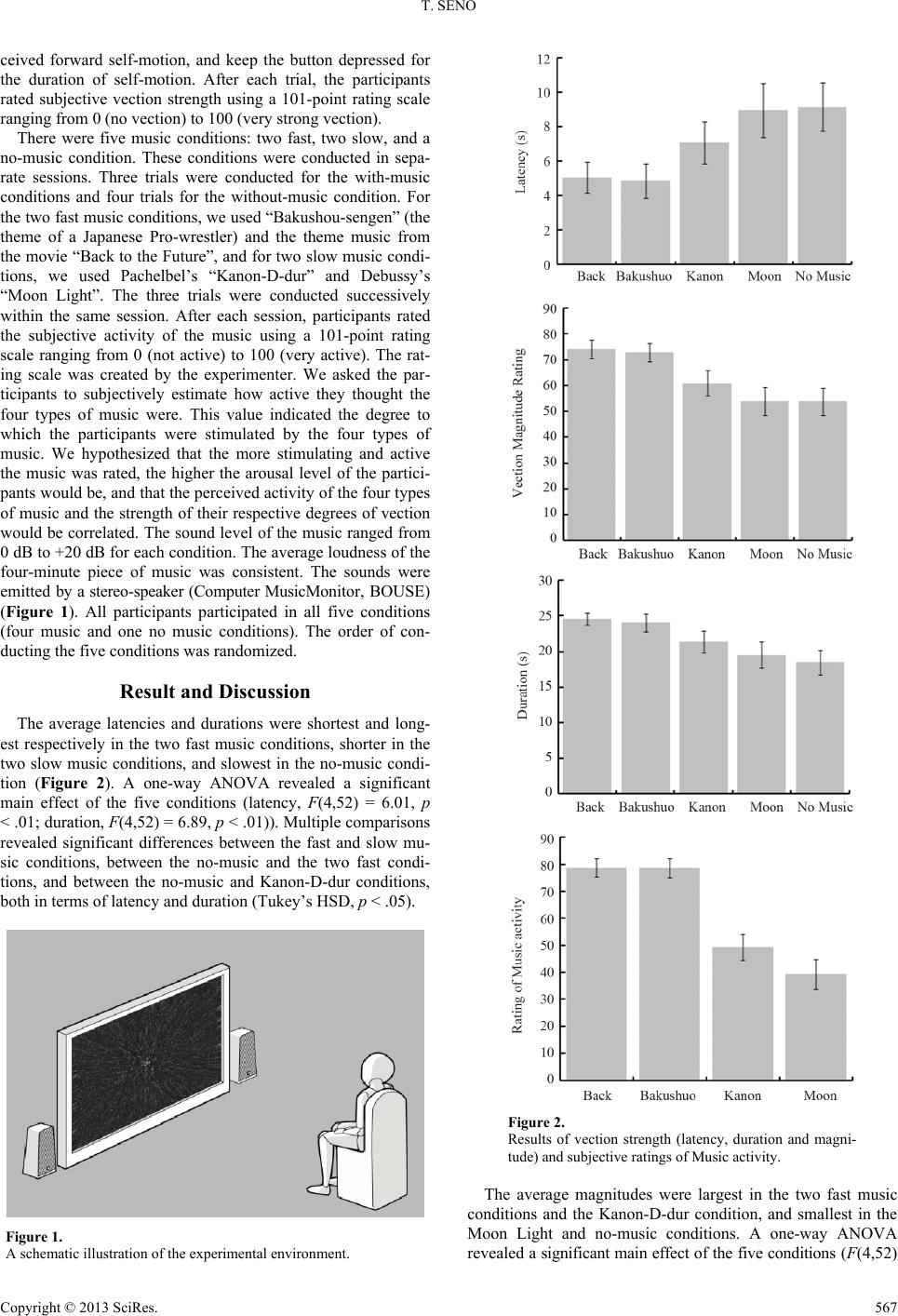 T. SENO ceived forward self-motion, and keep the button depressed for the duration of self-motion. After each trial, the participants rated subjective vection strength using a 101-point rating scale ranging from 0 (no vection) to 100 (very strong vection). There were five music conditions: two fast, two slow, and a no-music condition. These conditions were conducted in sepa- rate sessions. Three trials were conducted for the with-music conditions and four trials for the without-music condition. For the two fast music conditions, we used “Bakushou-sengen” (the theme of a Japanese Pro-wrestler) and the theme music from the movie “Back to the Future”, and for two slow music condi- tions, we used Pachelbel’s “Kanon-D-dur” and Debussy’s “Moon Light”. The three trials were conducted successively within the same session. After each session, participants rated the subjective activity of the music using a 101-point rating scale ranging from 0 (not active) to 100 (very active). The rat- ing scale was created by the experimenter. We asked the par- ticipants to subjectively estimate how active they thought the four types of music were. This value indicated the degree to which the participants were stimulated by the four types of music. We hypothesized that the more stimulating and active the music was rated, the higher the arousal level of the partici- pants would be, and that the perceived activity of the four types of music and the strength of their respective degrees of vection would be correlated. The sound level of the music ranged from 0 dB to +20 dB for each condition. The average loudness of the four-minute piece of music was consistent. The sounds were emitted by a stereo-speaker (Computer MusicMonitor, BOUSE) (Figure 1). All participants participated in all five conditions (four music and one no music conditions). The order of con- ducting the five conditions was randomized. Result and Discussion The average latencies and durations were shortest and long- est respectively in the two fast music conditions, shorter in the two slow music conditions, and slowest in the no-music condi- tion (Figure 2). A one-way ANOVA revealed a significant main effect of the five conditions (latency, F(4,52) = 6.01, p < .01; duration, F(4,52) = 6.89, p < .01)). Multiple comparisons revealed significant differences between the fast and slow mu- sic conditions, between the no-music and the two fast condi- tions, and between the no-music and Kanon-D-dur conditions, both in terms of latency and duration (Tukey’s HSD, p < .05). Figure 1. A schematic illustrat ion of the experimental environment. Figure 2. Results of vection strength (latency, duration and magni- tude) and subjectiv e ratings of Music activity. The average magnitudes were largest in the two fast music conditions and the Kanon-D-dur condition, and smallest in the Moon Light and no-music conditions. A one-way ANOVA rev eale d a significant main effect of the five conditions ( F(4,52) Copyright © 2013 SciRes. 567  T. SENO Copyright © 2013 SciRes. 568 = 11.60, p < .01). Multiple comparisons revealed significant differences between the fast and slow music conditions, be- tween the no-music and the two fast conditions, and between the no-music and Kanon-D-dur conditions (Tukey’s HSD, p < .05). The difference between the Kanon-D-dur and Moon Light conditions trended towards significance (Tukey’s HSD, p < .1). The average estimated subjective activity of the music was largest in the two fast music conditions and the Kanon-D-dur condition, and smallest in the Moon Light condition. A one- way ANOVA revealed a significant main effect of four condi- tions (F(3,39) = 56.35, p < .01). Multiple comparisons revealed significant differences between all combinations of these four conditions except between the two fast music conditions (Tukey’s HSD, p < .05). Here, we could speculate that the fast tempo music types stimulated the participants and that those music types induced higher arousal levels in the participants. The correlation be- tween the subjective activity ratings of the music and the vec- tion strength values implies that the music modulated arousal levels,which then modulated vection strength. When participants listened to more active music, they per- ceived stronger vection. This result supports our hypothesis. The estimated subjective activity ratings of the music might indicate the depth of modulation of the arousal levels in the participants. The presence of background fast tempo music had a facili- tating effect on vection. Thus, we are able to present new em- pirical data related to how music can alter human perception. Our results suggest that music can alter human visual percep- tion. Thus, visual illusions combined with musical stimuli, and the relationship between visual acuity and musical stimuli, should be examined in future work. The effects of combinations of visual and musical stimuli on human perception clearly con- stitute a new and promising topic for vision research. We speculated that our results indicated that the induced higher arousal could induce stronger vection. Thus in the future by modulating participants’ arousal level by presenting not only music but also some tactile stimuli and visual stimuli, vection strength can be m o dulated easil y as intended directions. In our study propose practical use of music to enhance visual effect, i.e. vection. In some virtual reality environment, vection should be enhanced by fast tempo music and also it can be modulated by the tempo of presence music. This can be a great advantage for the virtual reality contents developers. Acknowledgements I thank Tomomi Ogura for her beautiful figural design. The author was supported by Funds for the Development of Human Resources in Science and Technology (Japan Science and Technology Agency).This work is supported by Program to Disseminate Tenure Trac king System, MEXT, Japan. REFERENCES Brodsky, W. (2002). The effects of music tempo on simulated driving performance and vehicular control. Transportation Research, 4, 219-241. Gabrielsson, A. (2001). Emotions in strong experiences with music. In P. N. Juslin, & J. A. Sloboda (Eds.), Music and emotion: Theory and research (pp. 431- 449 ). New York: Oxford University Press. Herrington, J. D., & Capella, L. M. (1996). Effects of music in service environments: A field study. The Journal of Services Marketing, 10, 26-41. doi:10.1108/08876049610114249 Husain, G., Thompson, W. F., & Schellengerg, E. G. (2002). Effects of musical tempo and mode on arousal, mood, and spatial abilities. Mu- sic Perception, 20, 151-171. doi:10.1525/mp.2002.20.2.151 Ihaya, K., Seno, T., & Yamada, Y. (submitted) Più mosso: Fast self-motion accelerates mental tempo i n virtual reality. Iwamiya, S. (1997) Interaction between auditory and visual processing in car audio: Simulation experiment using video reproduction. Ap- plied Human Science, 16, 115-119. doi:10.2114/jpa.16.115 Miell, D. E., MacDonald, R. A. R., & Hargreaves, D. J. (2005) . Musical communication. Oxford: Oxford University Press. Mayfield, C., & Moss, S. (1989). Effect of music tempo on task per- formance. Psychological Reports, 65, 1283-1290. doi:10.2466/pr0.1989.65.3f.1283 Milliman, R. (1982). Using background music to affect the behaviour of supermarket shoppers. Journal of Marketin g, 46, 86-91. doi:10.2307/1251706 Milliman, R. (1986). The influence of background music on behaviour of restaurant patrons. Journal of Consumer Research, 13, 286-289. doi:10.1086/209068 Nittono, H., Tsuda, A., Akai, S., & Nakajima, Y. (2000). Tempo of background sound and performance speed. Perception and Motor Skills, 90, 1122. doi:10.2466/pms.2000.90.3c.1122 Seno, T., Kawabe T., Ito. H., & Sunaga, S. (2013) Vection modulates emotional valence of autobiographical episodic memories. Cognition, 126, 115-120. doi:10.1016/j.cognition.2012.08.009 Spinney, L. (1997) Pump down the volume. New Scientist, 155, 22. |