

Paper Menu >>
Journal Menu >>
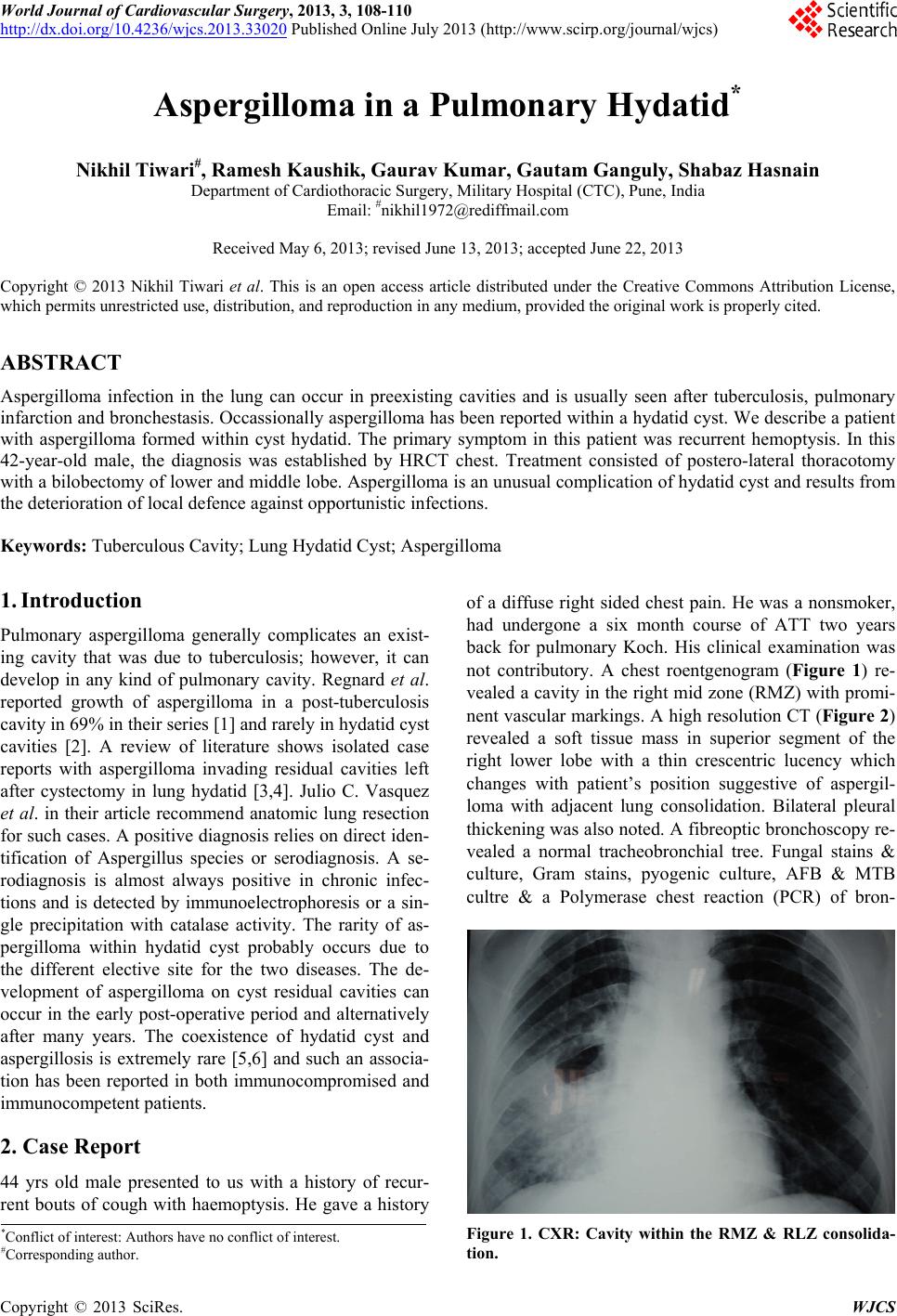 World Journal of Cardiovascular Surgery, 2013, 3, 108-110 http://dx.doi.org/10.4236/wjcs.2013.33020 Published Online July 2013 (http://www.scirp.org/journal/wjcs) Aspergilloma in a Pulmonary Hydatid* Nikhil Tiwari#, Ramesh Kaushik, Gaurav Kumar, Gautam Ganguly, Shabaz Hasnain Department of Cardiothoracic Surgery, Military Hospital (CTC), Pune, India Email: #[email protected] Received May 6, 2013; revised June 13, 2013; accepted June 22, 2013 Copyright © 2013 Nikhil Tiwari et al. This is an open access article distributed under the Creative Commons Attribution License, which permits unrestricted use, distribution, and reproduction in any medium, provided the original work is properly cited. ABSTRACT Aspergilloma infection in the lung can occur in preexisting cavities and is usually seen after tuberculosis, pulmonary infarction and bronch estasis. Occassionally aspergilloma has b een reported within a hydatid cyst. We describe a patient with aspergilloma formed within cyst hydatid. The primary symptom in this patient was recurrent hemoptysis. In this 42-year-old male, the diagnosis was established by HRCT chest. Treatment consisted of postero-lateral thoracotomy with a bilobectomy of lower and middle lobe. Aspergilloma is an unusual complication of hydatid cyst and results fro m the deterioration of local defence against opportunistic infection s . Keywords: Tuberculous Cavity; Lung Hydatid Cyst; Aspergilloma 1. Introduction Pulmonary aspergilloma generally complicates an exist- ing cavity that was due to tuberculosis; however, it can develop in any kind of pulmonary cavity. Regnard et al. reported growth of aspergilloma in a post-tuberculosis cavity in 69% in their series [1] and rarely in hydatid cyst cavities [2]. A review of literature shows isolated case reports with aspergilloma invading residual cavities left after cystectomy in lung hydatid [3,4]. Julio C. Vasquez et al. in their article recommend anatomic lung resection for such cases. A positive diagnosis relies on direct iden- tification of Aspergillus species or serodiagnosis. A se- rodiagnosis is almost always positive in chronic infec- tions and is detected by immunoelectrophoresis or a sin- gle precipitation with catalase activity. The rarity of as- pergilloma within hydatid cyst probably occurs due to the different elective site for the two diseases. The de- velopment of aspergilloma on cyst residual cavities can occur in the early post-operative period and alternatively after many years. The coexistence of hydatid cyst and aspergillosis is extremely rare [5,6] and such an associa- tion has been reported in both immunocompromised and immunocompetent patients. 2. Case Report 44 yrs old male presented to us with a history of recur- rent bouts of cough with haemoptysis. He gave a history of a diffuse right sided chest pain. He was a nonsmoker, had undergone a six month course of ATT two years back for pulmonary Koch. His clinical examination was not contributory. A chest roentgenogram (Figure 1) re- vealed a cavity in th e right mid zone (RMZ) with promi- nent vascular markings. A high resolution CT (Figure 2) revealed a soft tissue mass in superior segment of the right lower lobe with a thin crescentric lucency which changes with patient’s position suggestive of aspergil- loma with adjacent lung consolidation. Bilateral pleural thickening was also noted. A fibreoptic bronchoscopy re- vealed a normal tracheobronchial tree. Fungal stains & culture, Gram stains, pyogenic culture, AFB & MTB cultre & a Polymerase chest reaction (PCR) of bron- Figure 1. CXR: Cavity within the RMZ & RLZ consolida- tion. *Conflict of interest: Authors have no conflict of interest. #Corresponding author. C opyright © 2013 SciRes. WJCS 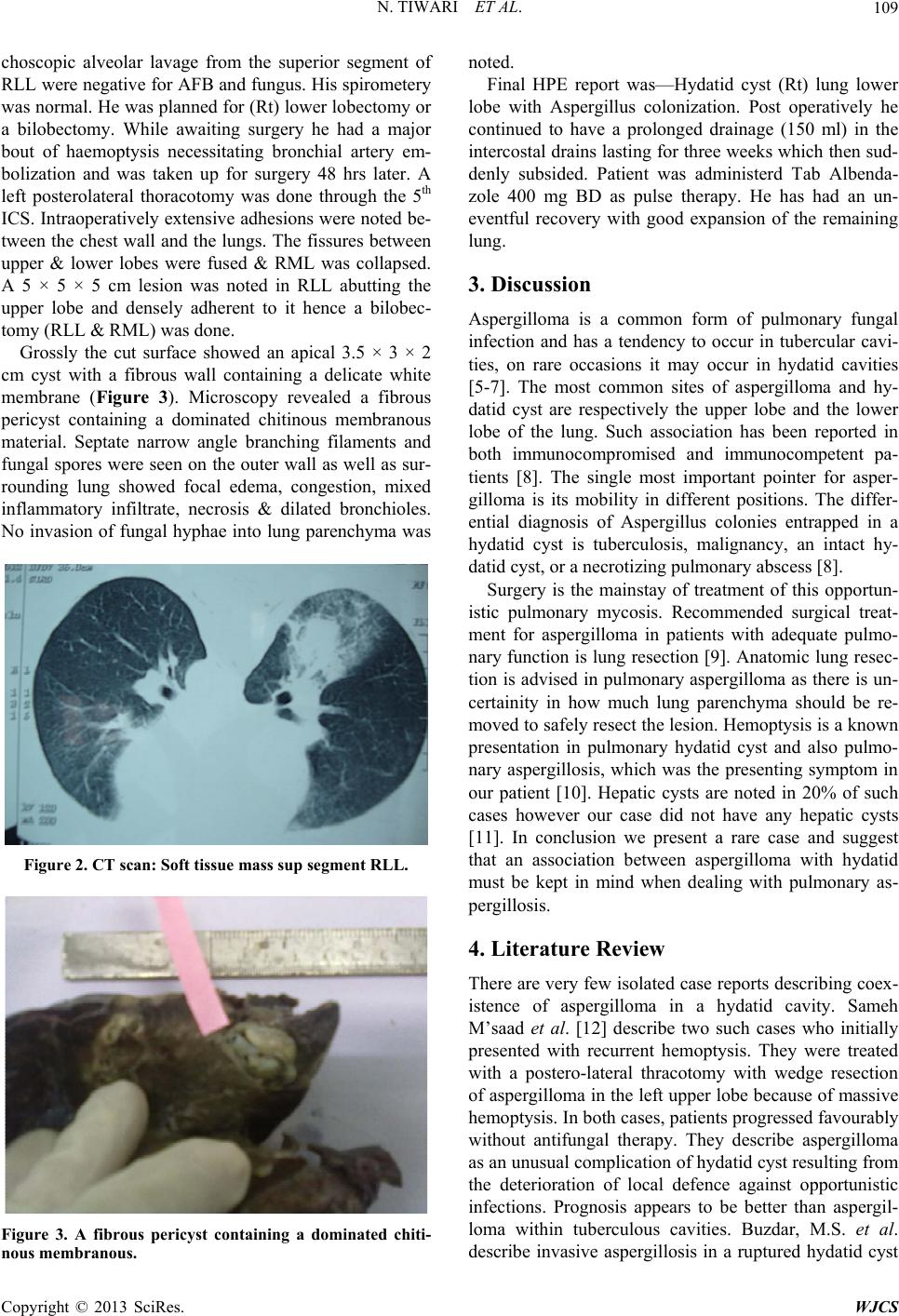 N. TIWARI ET AL. 109 choscopic alveolar lavage from the superior segment of RLL were negative for AFB and fungus. His spirometery was normal. He was planned for (Rt) lower lobectomy or a bilobectomy. While awaiting surgery he had a major bout of haemoptysis necessitating bronchial artery em- bolization and was taken up for surgery 48 hrs later. A left posterolateral thoracotomy was done through the 5th ICS. Intraoperatively extensive adhesions were noted be- tween the chest wall and the lungs. The fissures between upper & lower lobes were fused & RML was collapsed. A 5 × 5 × 5 cm lesion was noted in RLL abutting the upper lobe and densely adherent to it hence a bilobec- tomy (RLL & RML) was done. Grossly the cut surface showed an apical 3.5 × 3 × 2 cm cyst with a fibrous wall containing a delicate white membrane (Figure 3). Microscopy revealed a fibrous pericyst containing a dominated chitinous membranous material. Septate narrow angle branching filaments and fungal spores were seen on the outer wall as well as sur- rounding lung showed focal edema, congestion, mixed inflammatory infiltrate, necrosis & dilated bronchioles. No invasion of fungal hyphae into lung parenchyma was Figure 2. CT scan: Soft tissue mass sup segment RLL. Figure 3. A fibrous pericyst containing a dominated chiti- nous membranous. noted. Final HPE report was—Hydatid cyst (Rt) lung lower lobe with Aspergillus colonization. Post operatively he continued to have a prolonged drainage (150 ml) in the intercostal drains lasting for three weeks which then sud- denly subsided. Patient was administerd Tab Albenda- zole 400 mg BD as pulse therapy. He has had an un- eventful recovery with good expansion of the remaining lung. 3. Discussion Aspergilloma is a common form of pulmonary fungal infection and has a tendency to occur in tubercular cavi- ties, on rare occasions it may occur in hydatid cavities [5-7]. The most common sites of aspergilloma and hy- datid cyst are respectively the upper lobe and the lower lobe of the lung. Such association has been reported in both immunocompromised and immunocompetent pa- tients [8]. The single most important pointer for asper- gilloma is its mobility in different positions. The differ- ential diagnosis of Aspergillus colonies entrapped in a hydatid cyst is tuberculosis, malignancy, an intact hy- datid cyst, or a necrotizing pulmonary abscess [8]. Surgery is the mainstay of treatment of this opportun- istic pulmonary mycosis. Recommended surgical treat- ment for aspergilloma in patients with adequate pulmo- nary function is lung resection [9]. Anatomic lung resec- tion is advised in pulmonary aspergilloma as there is un- certainity in how much lung parenchyma should be re- moved to safely resect the lesion. Hemoptysis is a known presentation in pulmonary hydatid cyst and also pulmo- nary aspergillosis, which was the presenting symptom in our patient [10]. Hepatic cysts are noted in 20% of such cases however our case did not have any hepatic cysts [11]. In conclusion we present a rare case and suggest that an association between aspergilloma with hydatid must be kept in mind when dealing with pulmonary as- pergillosis. 4. Literature Review There are very few isolated case reports describing coex- istence of aspergilloma in a hydatid cavity. Sameh M’saad et al. [12] describe two such cases who initially presented with recurrent hemoptysis. They were treated with a postero-lateral thracotomy with wedge resection of aspergilloma in the left upper lobe because of massive hemoptysis. In both cases, patients progressed favourably without antifungal therapy. They describe aspergilloma as an unusual complication of hydatid cyst resulting from the deterioration of local defence against opportunistic infections. Prognosis appears to be better than aspergil- loma within tuberculous cavities. Buzdar, M.S. et al. describe invasive aspergillosis in a ruptured hydatid cyst Copyright © 2013 SciRes. WJCS 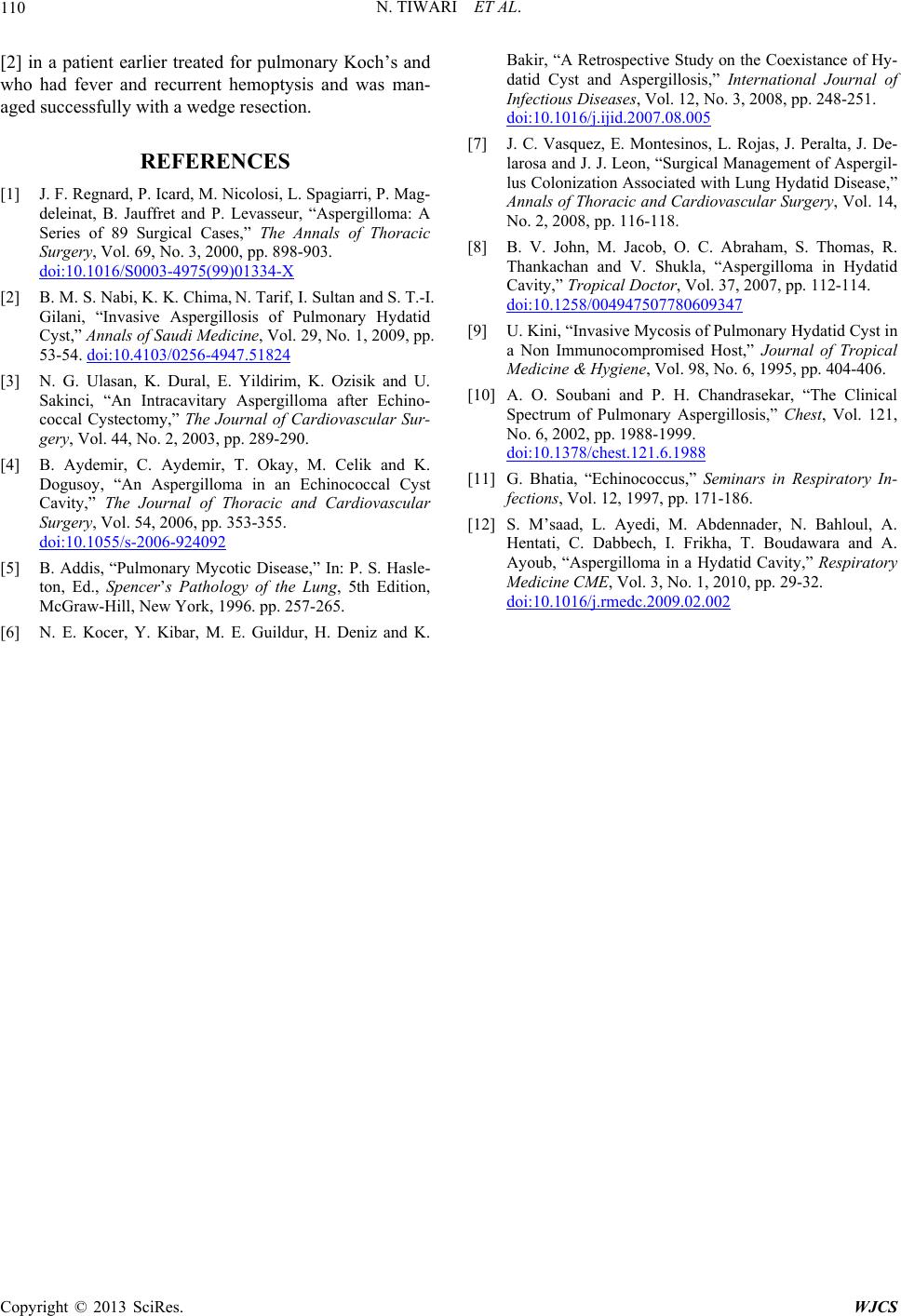 N. TIWARI ET AL. Copyright © 2013 SciRes. WJCS 110 [2] in a patient earlier treated for pulmonary Koch’s and who had fever and recurrent hemoptysis and was man- aged successfully with a wedge resection. REFERENCES [1] J. F. Regnard, P. Icard, M. Nicolosi, L. Spagiarri, P. Mag- deleinat, B. Jauffret and P. Levasseur, “Aspergilloma: A Series of 89 Surgical Cases,” The Annals of Thoracic Surgery, Vol. 69, No. 3, 2000, pp. 898-903. doi:10.1016/S0003-4975(99)01334-X [2] B. M. S. Nabi, K. K. Chima, N. Tar if, I. Su lta n and S. T.-I. Gilani, “Invasive Aspergillosis of Pulmonary Hydatid Cyst,” Annals of Saudi Medicine, Vol. 29, No. 1, 2009, pp. 53-54. doi:10.4103/0256-4947.51824 [3] N. G. Ulasan, K. Dural, E. Yildirim, K. Ozisik and U. Sakinci, “An Intracavitary Aspergilloma after Echino- coccal Cystectomy,” The Journal of Cardiovascular Sur- gery, Vol. 44, No. 2, 2003, pp. 289-290. [4] B. Aydemir, C. Aydemir, T. Okay, M. Celik and K. Dogusoy, “An Aspergilloma in an Echinococcal Cyst Cavity,” The Journal of Thoracic and Cardiovascular Surgery, Vol. 54, 2006, pp. 353-355. doi:10.1055/s-2006-924092 [5] B. Addis, “Pulmonary Mycotic Disease,” In: P. S. Hasle- ton, Ed., Spencer’s Pathology of the Lung, 5th Edition, McGraw-Hill, New York, 1996. pp. 257-265. [6] N. E. Kocer, Y. Kibar, M. E. Guildur, H. Deniz and K. Bakir, “A Retrospective Study on the Coexistance of Hy- datid Cyst and Aspergillosis,” International Journal of Infectious Diseases, Vol. 12, No. 3, 2008, pp. 248-251. doi:10.1016/j.ijid.2007.08.005 [7] J. C. Vasquez, E. Montesinos, L. Rojas, J. Peralta, J. De- larosa and J. J. Leon, “Surgical Management of Aspergil- lus Colonization Associated with Lung Hydatid Disease,” Annals of Thoracic and Cardiovascular Surgery, Vol. 14, No. 2, 2008, pp. 116-118. [8] B. V. John, M. Jacob, O. C. Abraham, S. Thomas, R. Thankachan and V. Shukla, “Aspergilloma in Hydatid Cavity,” Tropical Doctor, Vol. 37, 2007, pp. 112-114. doi:10.1258/004947507780609347 [9] U. Kini, “Invasive Mycosis of Pulmonary Hydatid Cyst in a Non Immunocompromised Host,” Journal of Tropical Medicine & Hygiene, Vol. 98, No. 6, 1995, pp. 404-406. [10] A. O. Soubani and P. H. Chandrasekar, “The Clinical Spectrum of Pulmonary Aspergillosis,” Chest, Vol. 121, No. 6, 2002, pp. 1988-1999. doi:10.1378/chest.121.6.1988 [11] G. Bhatia, “Echinococcus,” Seminars in Respiratory In- fections, Vol. 12, 1997, pp. 171-186. [12] S. M’saad, L. Ayedi, M. Abdennader, N. Bahloul, A. Hentati, C. Dabbech, I. Frikha, T. Boudawara and A. Ayoub, “Aspergilloma in a Hydatid Cavity,” Respiratory Medicine CME, Vol. 3, No. 1, 2010, pp. 29-32. doi:10.1016/j.rmedc.2009.02.002 |