

Paper Menu >>
Journal Menu >>
 Journal of Water Resource and Protection, 2013, 5, 709-714 http://dx.doi.org/10.4236/jwarp.2013.57071 Published Online July 2013 (http://www.scirp.org/journal/jwarp) Study of the Sediments of the Dam of Okpara (Benin): Physico-Chemical Characterization and Speciation of Iron and Manganese Fidele Suanon1,2*, Biaou Dimon1,3, Daouda Mama1,4, A. Lyde Tominti1,4 1Laboratoire de Chimie-Physique (LCP), Département de Chimie, Faculté des Sciences et Techniques, Cotonou, Bénin 2Laboratoire d’Hydrologie Appliquée (LHA), Département de Chimie, Faculté des Sciences et Techniques, Cotonou, Bénin 3Centre Béninois de Recherches Scientifiques et Technologiques (CBRST), Cotonou, Bénin 4Laboratoire cd chimie Inorganique et de l’Environnement (LACIE), Cotonou, Bénin Email: *[email protected] Received April 30, 2013; revised May 31, 2013; accepted June 24, 2013 Copyright © 2013 Fidele Suanon et al. This is an open access article distributed under the Creative Commons Attribution License, which permits unrestricted use, distribution, and reproduction in any medium, provided the original work is properly cited. ABSTRACT Iron and Manganese contents and parameters including pH, conductivity, and organic matter contents were determined in the sediments of the Okpara dam in Northern Benin. Fifteen samples were collected during a one-month period and analysed in laboratory using the method of sequential extraction of Tessier. The analyses indicated that sediments con- tained high concentrations in reducible fraction of Iron and relatively high contents of exchangeable fraction, acidhy- drolysable fraction and residual fraction of Manganese. The findings of this study confirmed the hypotheses that the metal contents of the sediments were relatively high and varied according to the geochemical phases. Keywords: Sediments; Iron, Manganese; Geochemical Phases; Pollution 1. Introduction The diagnostic study of the situation of the Okpara dam, led by the Coordination Team of the Local Water Part- nership of Borgou-Alibori in 2007 revealed the existence of serious threats to the safeguarding of this river and the dam, as well as to secure drinking water supplied to the population of Parakou. The major threats included con- tinuous stranding of the river, pollution by municipal solid waste, wastewater, chemical fertilizers, erosion, in- vasion by plants, land conflicts and deforestation. This situation is alarming that Okpara constitutes the single source of drinking water for the population in the region especially for the town of Parakou. Several studies [1-3] showed that the human and in- dustrial activities added to the increase of populations in African countries and particularly in Benin, generated many environmental problems; they involved a rapid increase of various pollutants such as heavy metals in lagoons, rivers, lakes which also received urban waste- water. This also applied to the river of Kpara. Indeed, the Beninese Society of Electricity and Water (SBEE), company in charge of the production and the distribution of water and electricity in Benin reported that in the early 90s, consumers of the drinking water coming from the treatment station provided by the Ok- para dam, started complaining about the organoleptic quality of the water in particular a change in color: some- times reddish, sometimes brownish. The multiple phys- icochemical analyses carried out revealed that the phe- nomenon was due to the presence of Manganese in the treated water. To look deeper into the phenomenon, the central laboratory of this company conducted several analyses at various levels: from the surface of water to- wards the bottom. The studies undertaken showed that the Iron and Manganese ions were highly concentrated down at the bottom. Elsewhere, the results of this dam’s water characterization work carried out over four years by Zogo D., Soclo H., Bawa M. and Gbaguidi M [4] be- tween the time period (2006-2010) revealed that between June and January of each year, the raw water became particularly rich in Iron and Manganese. The enrichment of the water in these metals was due to the depletion of oxygen in the water since at the closure of cofferdams, the water-atmosphere exchange surface became almost motionless. The author, in addition, noted that, the works of treatment of water currently in place at the station of *Corresponding author. C opyright © 2013 SciRes. JWARP  F. SUANON ET AL. 710 Parakou were not designed to eliminate the high concen- trations of Iron and Manganese in Okpara during low water period. The metals strongly contributed to the dete- rioration of the organoleptic quality of the water; hence the need to get rid of them before the drinking water is supplied for consumption. The speciation of a chemical element corresponded to its distribution between the various physicochemical species presented in the environment to assess their rela- tive importance. Whether in soil, sediment or aquatic systems, the fate and the bioavailability of Metal Elements Traces (ETM) are related to their speciation. The risk posed by the ETM in soils depends on their ability to migrate from the solid phase to the soil solution where they can be available for crops. The speciation of metals related to the various fixing phases of soil thus was most widely studied. Various approaches were tested in order to carry out this speciation. The most usual have long been the methods of operational and functional fractionation even if in re- cent years the physical speciation methods have rapidly developed. Operational fractionation consists of the successive use of various reagents in order to specifically extract the metals fixed to a given compartment of soil (organic matter, Iron oxides, manganese or aluminum, carbonates, sulphides etc.) and to assess its stock. However, these extractants lack of specificity [5,6] and the ETM thus are not really characterized by the elements of the soil to which they are linked but rather by the reagent used to extract them. That is why we talk of operational frac- tionation. The procedure of operational fractionation most known was developed by Tessier, A., Campbell, P.G.C., Bisson, M. [7]. Five phases are highlighted: ex- changeable, oxydable, acid-soluble, reducible and resid- ual. Since, so many other protocols of operational frac- tionation have been developed [8]. Functional fractionation consists in characterizing the trace metallic element (ETM) of the soil according to their “function” in the soil. They are made with a single extractant (dilute acids, organic complexants, salt works solutions etc.) supposed to simulate the physicochemical conditions of the soil. The most current example is the determination of the availability of the ETM for crops (bioavailability). This type of fractionation is also used to evaluate the variation of mobility and bioavailability of metals in a soil after a treatment such as, a contribution of station of purification mud. But it can also be used to assess the effectiveness of a rehabilitation of polluted soils by traces of metals [9,10]. Recently, in a harmoni- zation care, a diagram of extraction was proposed by the Community Office of Reference Community Office of Reference (BCR) [11], aiming to appreciate the fraction of bioavailable metal. The quantity of metal extracted is supposed to be representative of the quantities likely to pass in the solution of the soil and thus to be potentially bioavailable. Both types of fractionation involve reaching thermodynamic balance what limits their effectiveness. Indeed, it is generally accepted that balance is not often reached under natural conditions and that the kinetics of dissociation of complexes can be a significant parameter [12,13]. The concentration of free metal (good indicator of bioavailability according to the FIAM [14] in the soil solution, as in aquatic systems, results from a dynamic equilibrium in which the formation and dissociation of complexes in solution take place continuously. To prop- erly estimate the amount of bioavailable metals in solu- tion, it is necessary to obtain information on the kinetics of dissociation of the complex, i.e. to consider their labil- ity/unstability. But in the case of soils especially, given the stocks of metals in presence, it is important to take into account the contribution of metals fixed to the solid fixing soil compartments and transfer speed of metal fixed to the soil solution. Finally, from a kinetic point of view, there are at least two stages limiting potentially the transfer of metals from soils to crops: 1) the dissociation of the labile complexes in the solution of the soil at the solution/roots interface and 2) the extraction of metals from the solid phase of the soil towards the solution of the soil. The objective of the study is to determine within the sediments the various possible combinations of Iron and Manganese which cause the enrichment of the water in these pollutants. The study aims at testing the hypotheses that the metal contents of the sediments are relatively high and vary according to the geochemical phases. 2. Material and Methods 2.1. Study Area The town of Parakou is located between 09˚21'N and 02˚36'E (Figure 1) in the North-East of Benin, at 450 km from Cotonou, the economic capital of Benin, at an av- erage altitude of 350 m and covering an area of 441 km2 (www.villeparakou.bj). It is limited in the North by the commune of N’Dali, in the South, the East and the West by the commune of Tchaourou. It runs along a ridge that rises up to 390 m altitude and separates the Ouémé basin in the West from the one of Okpara in the East. The study area is based on a Precambrian crystalline pene- plain and cristallophylienne made of granite and gneiss that can store water reserves only after deterioration [15]. The Dam of Okpara is built on the river of the same name, which represents one of the two principal tributar- ies of the river Ouémé of Benin. It is established in the district of Kika at Tchaourou and is at a distance of 12.3 km to the water treatment company of SONEB in Para- kou. The catchment area of Okpara is composed of a Copyright © 2013 SciRes. JWARP 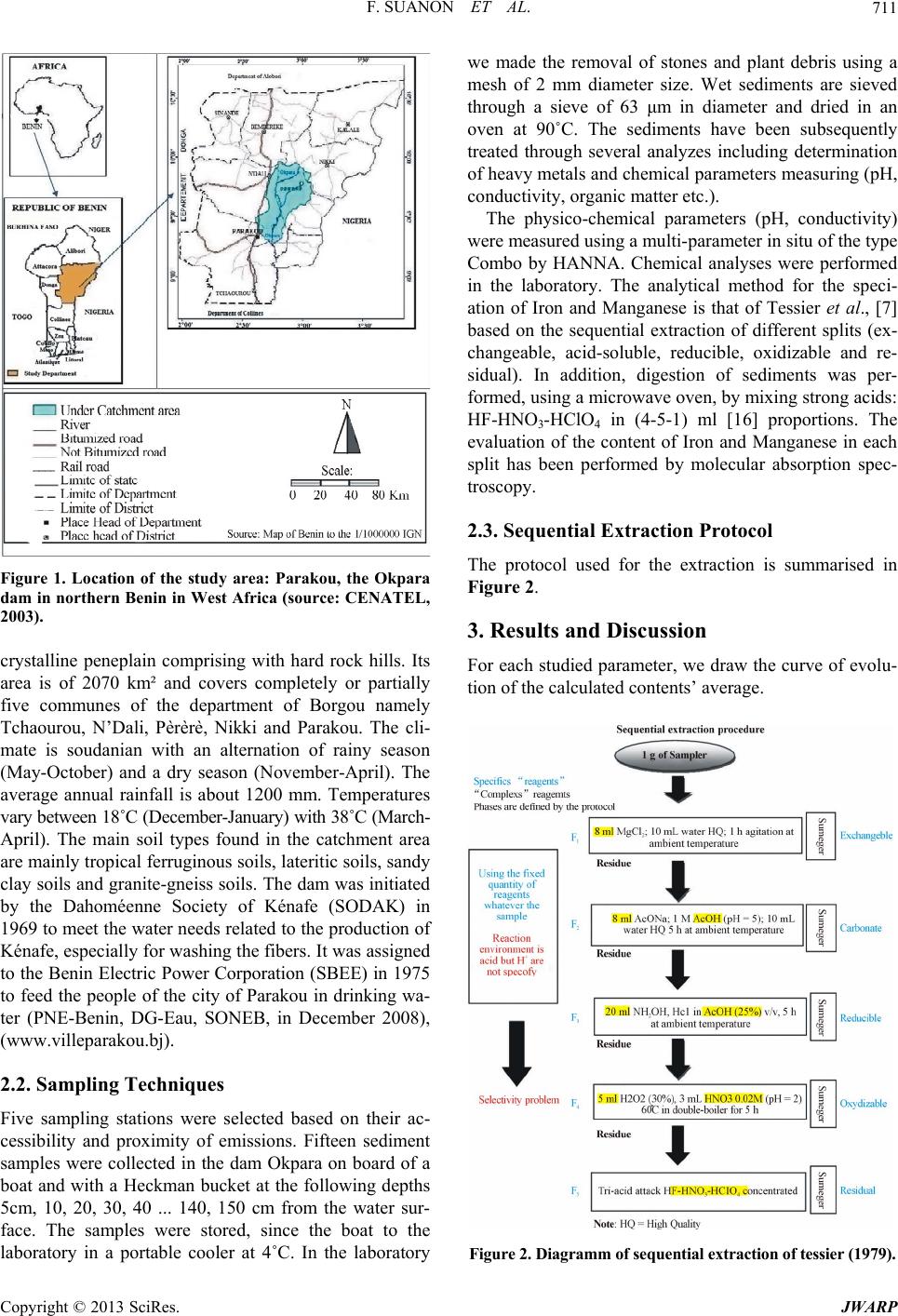 F. SUANON ET AL. 711 Figure 1. Location of the studrea: Parakou, the Okpara rystalline peneplain comprising with hard rock hills. Its 2.2. Sampling Techniques lected based on their ac- s (pH, conductivity) w 2.3. Sequential Extraction Protocol ummarised in 3. Results and Discussion w the curve of evolu- y a dam in northern Benin in West Africa (source: CENATEL, 2003). c area is of 2070 km² and covers completely or partially five communes of the department of Borgou namely Tchaourou, N’Dali, Pèrèrè, Nikki and Parakou. The cli- mate is soudanian with an alternation of rainy season (May-October) and a dry season (November-April). The average annual rainfall is about 1200 mm. Temperatures vary between 18˚C (December-January) with 38˚C (March- April). The main soil types found in the catchment area are mainly tropical ferruginous soils, lateritic soils, sandy clay soils and granite-gneiss soils. The dam was initiated by the Dahoméenne Society of Kénafe (SODAK) in 1969 to meet the water needs related to the production of Kénafe, especially for washing the fibers. It was assigned to the Benin Electric Power Corporation (SBEE) in 1975 to feed the people of the city of Parakou in drinking wa- ter (PNE-Benin, DG-Eau, SONEB, in December 2008), (www.villeparakou.bj). Five sampling stations were se cessibility and proximity of emissions. Fifteen sediment samples were collected in the dam Okpara on board of a boat and with a Heckman bucket at the following depths 5cm, 10, 20, 30, 40 ... 140, 150 cm from the water sur- face. The samples were stored, since the boat to the laboratory in a portable cooler at 4˚C. In the laboratory we made the removal of stones and plant debris using a mesh of 2 mm diameter size. Wet sediments are sieved through a sieve of 63 μm in diameter and dried in an oven at 90˚C. The sediments have been subsequently treated through several analyzes including determination of heavy metals and chemical parameters measuring (pH, conductivity, organic matter etc.). The physico-chemical parameter ere measured using a multi-parameter in situ of the type Combo by HANNA. Chemical analyses were performed in the laboratory. The analytical method for the speci- ation of Iron and Manganese is that of Tessier et al., [7] based on the sequential extraction of different splits (ex- changeable, acid-soluble, reducible, oxidizable and re- sidual). In addition, digestion of sediments was per- formed, using a microwave oven, by mixing strong acids: HF-HNO3-HClO4 in (4-5-1) ml [16] proportions. The evaluation of the content of Iron and Manganese in each split has been performed by molecular absorption spec- troscopy. The protocol used for the extraction is s Figure 2. For each studied parameter, we dra tion of the calculated contents’ average. Figure 2. Diagramm of sequential extraction of tessier (1979). Copyright © 2013 SciRes. JWARP 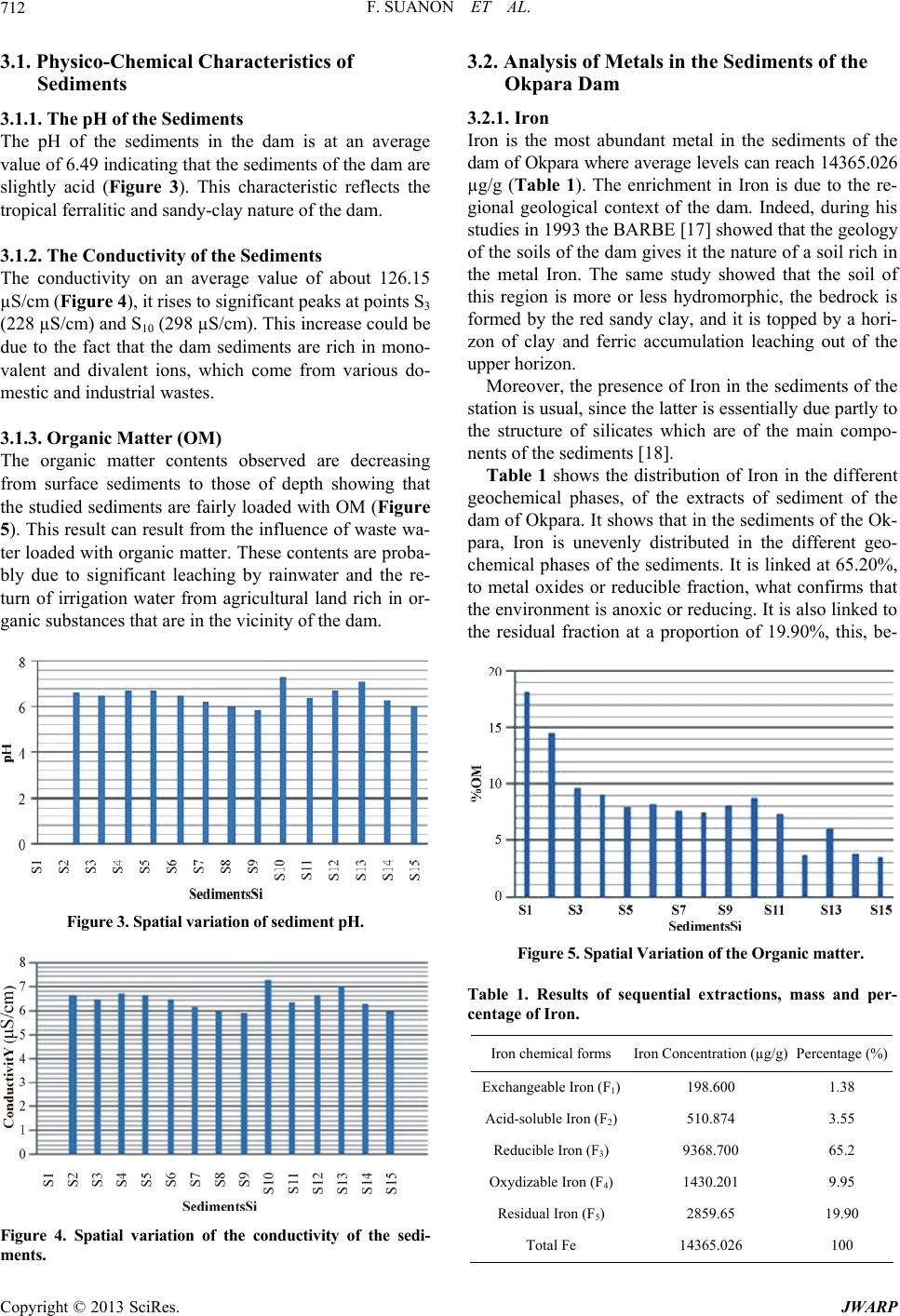 F. SUANON ET AL. 712 3.1. Physico-Chemical Characteristics of Sediments The pH of tdiments in the dam is at an average ediments of the dam are The conductivity on an average value of about 126.15 s at points S The organic matter contents observed are decreasing of depth showing that 3.1.1. The pH of the Sediments he se value of 6.49 indicating that the s slightly acid (Figure 3). This characteristic reflects the tropical ferralitic and sandy-clay nature of the dam. 3.1.2. The Conductivity of the Sediments µS/cm (Figure 4), it rises to significant peak3 (228 µS/cm) and S10 (298 µS/cm). This increase could be due to the fact that the dam sediments are rich in mono- valent and divalent ions, which come from various do- mestic and industrial wastes. 3.1.3. Or ganic Mat te r (OM) from surface sediments to those the studied sediments are fairly loaded with OM (Figure 5). This result can result from the influence of waste wa- ter loaded with organic matter. These contents are proba- bly due to significant leaching by rainwater and the re- turn of irrigation water from agricultural land rich in or- ganic substances that are in the vicinity of the dam. nt pH. Figure 3. Spatial variation of sedime ctivity of the sedi- ments. kpara Dam Irondant metal in the sediments of the evels can reach 14365.026 Figure 4. Spatial variation of the condu 3.2. Analysis of Metals in the Sediments of the O 3.2.1. Iron is the most abun dam of Okpara where average l µg/g (Table 1). The enrichment in Iron is due to the re- gional geological context of the dam. Indeed, during his studies in 1993 the BARBE [17] showed that the geology of the soils of the dam gives it the nature of a soil rich in the metal Iron. The same study showed that the soil of this region is more or less hydromorphic, the bedrock is formed by the red sandy clay, and it is topped by a hori- zon of clay and ferric accumulation leaching out of the upper horizon. Moreover, the presence of Iron in the sediments of the station is usual, since the latter is essentially due partly to the structure of silicates which are of the main compo- nents of the sediments [18]. Table 1 shows the distribution of Iron in the different geochemical phases, of the extracts of sediment of the dam of Okpara. It shows that in the sediments of the Ok- para, Iron is unevenly distributed in the different geo- chemical phases of the sediments. It is linked at 65.20%, to metal oxides or reducible fraction, what confirms that the environment is anoxic or reducing. It is also linked to the residual fraction at a proportion of 19.90%, this, be- Figure 5. Spatial Variation of the Organic matter. Table 1. Results of sequential extractions, mass and per centag - e of Iron. Iron chemical forms Iron Concentration (µg/g) Percentage (%) Exchangeable Iron (F1)198.600 1.38 Acid-soluble Iron (F2)510.874 3.55 Reducible Iron (F3) 9368.700 65.2 Oxydizable Iron (F4) 1430.201 9.95 Residual Iron (F5) 2859.65 19.90 Total Fe 14365.026 100 Copyright © 2013 SciRes. JWARP 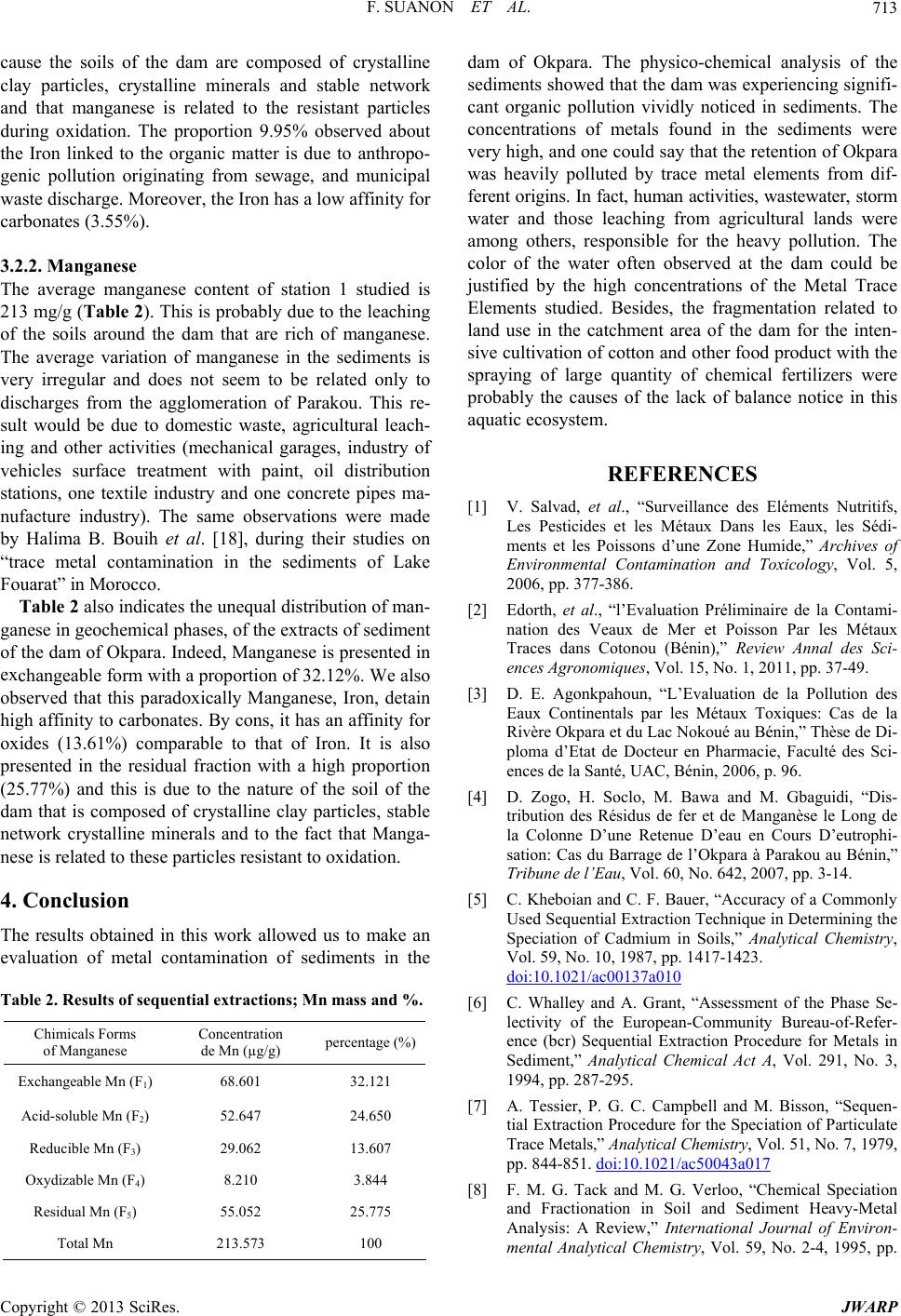 F. SUANON ET AL. 713 damhe physiical analysis of the sediments showed that the daxperiencing cant orlution vividld in sedim [1] V. Salvad, et al., “Surveillance des Eléments Nutritifs, Les Pesticideses Eaux, les Sédi- ments et les Pmide,” Archives of u (Bénin),” Review Annal des Sci- i- D’eutrophi- istry, cauthe dam posed of crystalline clay pae mind stable nwork and thanese is relaresistanticles ese content of station 1 studied is 213 mg/g (Tab le 2). This is probably due to the leaching the dam that are rich of manganese. Indeed, Manganese is presented in ex an al contamination of sediments i percentage (%) se the soils of are com rticles, crystallin t manga erals an ted to the et part during oxidation. The proportion 9.95% observed about the Iron linked to the organic matter is due to anthropo- genic pollution originating from sewage, and municipal waste discharge. Moreover, the Iron has a low affinity for carbonates (3.55%). 3.2.2. Mangan es e The average mangan of the soils around The average variation of manganese in the sediments is very irregular and does not seem to be related only to discharges from the agglomeration of Parakou. This re- sult would be due to domestic waste, agricultural leach- ing and other activities (mechanical garages, industry of vehicles surface treatment with paint, oil distribution stations, one textile industry and one concrete pipes ma- nufacture industry). The same observations were made by Halima B. Bouih et al. [18], during their studies on “trace metal contamination in the sediments of Lake Fouarat” in Morocco. Table 2 also indicates the unequal distribution of man- ganese in geochemical phases, of the extracts of sediment of the dam of Okpara. changeable form with a proportion of 32.12%. We also observed that this paradoxically Manganese, Iron, detain high affinity to carbonates. By cons, it has an affinity for oxides (13.61%) comparable to that of Iron. It is also presented in the residual fraction with a high proportion (25.77%) and this is due to the nature of the soil of the dam that is composed of crystalline clay particles, stable network crystalline minerals and to the fact that Manga- nese is related to these particles resistant to oxidation. 4. Conclusion The results obtained in this work allowed us to make evaluation of met n the Table 2. Results of sequential extractions; Mn mass and %. Chimicals Forms Concentration of Manganese de Mn (µg/g) Exchangeable Mn (F) 68.601 32.121 1 Ac 2) 2 id-soluble Mn (F52.647 24.650 Reducible Mn (F3) 29.062 13.607 Oxydizable Mn (F4) 8.210 3.844 Residual Mn (F5) 55.052 25.775 Total Mn 13.573 100 of Okpara. Tco-chem m was e y notice signifi- ents. Theganic pol concentrations of metals found in the sediments were very high, and one could say that the retention of Okpara was heavily polluted by trace metal elements from dif- ferent origins. In fact, human activities, wastewater, storm water and those leaching from agricultural lands were among others, responsible for the heavy pollution. The color of the water often observed at the dam could be justified by the high concentrations of the Metal Trace Elements studied. Besides, the fragmentation related to land use in the catchment area of the dam for the inten- sive cultivation of cotton and other food product with the spraying of large quantity of chemical fertilizers were probably the causes of the lack of balance notice in this aquatic ecosystem. REFERENCES et les Métaux Dans l oissons d’une Zone Hu Environmental Contamination and Toxicology, Vol. 5, 2006, pp. 377-386. [2] Edorth, et al., “l’Evaluation Préliminaire de la Contami- nation des Veaux de Mer et Poisson Par les Métaux Traces dans Cotono ences Agronomiques, Vol. 15, No. 1, 2011, pp. 37-49. [3] D. E. Agonkpahoun, “L’Evaluation de la Pollution des Eaux Continentals par les Métaux Toxiques: Cas de la Rivère Okpara et du Lac Nokoué au Bénin,” Thèse de D ploma d’Etat de Docteur en Pharmacie, Faculté des Sci- ences de la Santé, UAC, Bénin, 2006, p. 96. [4] D. Zogo, H. Soclo, M. Bawa and M. Gbaguidi, “Dis- tribution des Résidus de fer et de Manganèse le Long de la Colonne D’une Retenue D’eau en Cours sation: Cas du Barrage de l’Okpara à Parakou au Bénin,” Tribune de l’Eau, Vol. 60, No. 642, 2007, pp. 3-14. [5] C. Kheboian and C. F. Bauer, “Accuracy of a Commonly Used Sequential Extraction Technique in Determining the Speciation of Cadmium in Soils,” Analytical Chem Vol. 59, No. 10, 1987, pp. 1417-1423. doi:10.1021/ac00137a010 [6] C. Whalley and A. Grant, “Assessment of the Phase Se- lectivity of the European-Community ence (bcr) Sequential Extract Bureau-of-Refer- ion Procedure for Metals in tical Chemistry, Vol. 51, No. 7, 1979, Sediment,” Analytical Chemical Act A, Vol. 291, No. 3, 1994, pp. 287-295. [7] A. Tessier, P. G. C. Campbell and M. Bisson, “Sequen- tial Extraction Procedure for the Speciation of Particulate Trace Metals,” Analy pp. 844-851. doi:10.1021/ac50043a017 [8] F. M. G. Tack and M. G. Verloo, “Chemical Speciation and Fractionation in Soil and Sediment Heavy-Metal Analysis: A Review,” International Journal of Environ- mental Analytical Chemistry, Vol. 59, No. 2-4, 1995, pp. Copyright © 2013 SciRes. JWARP 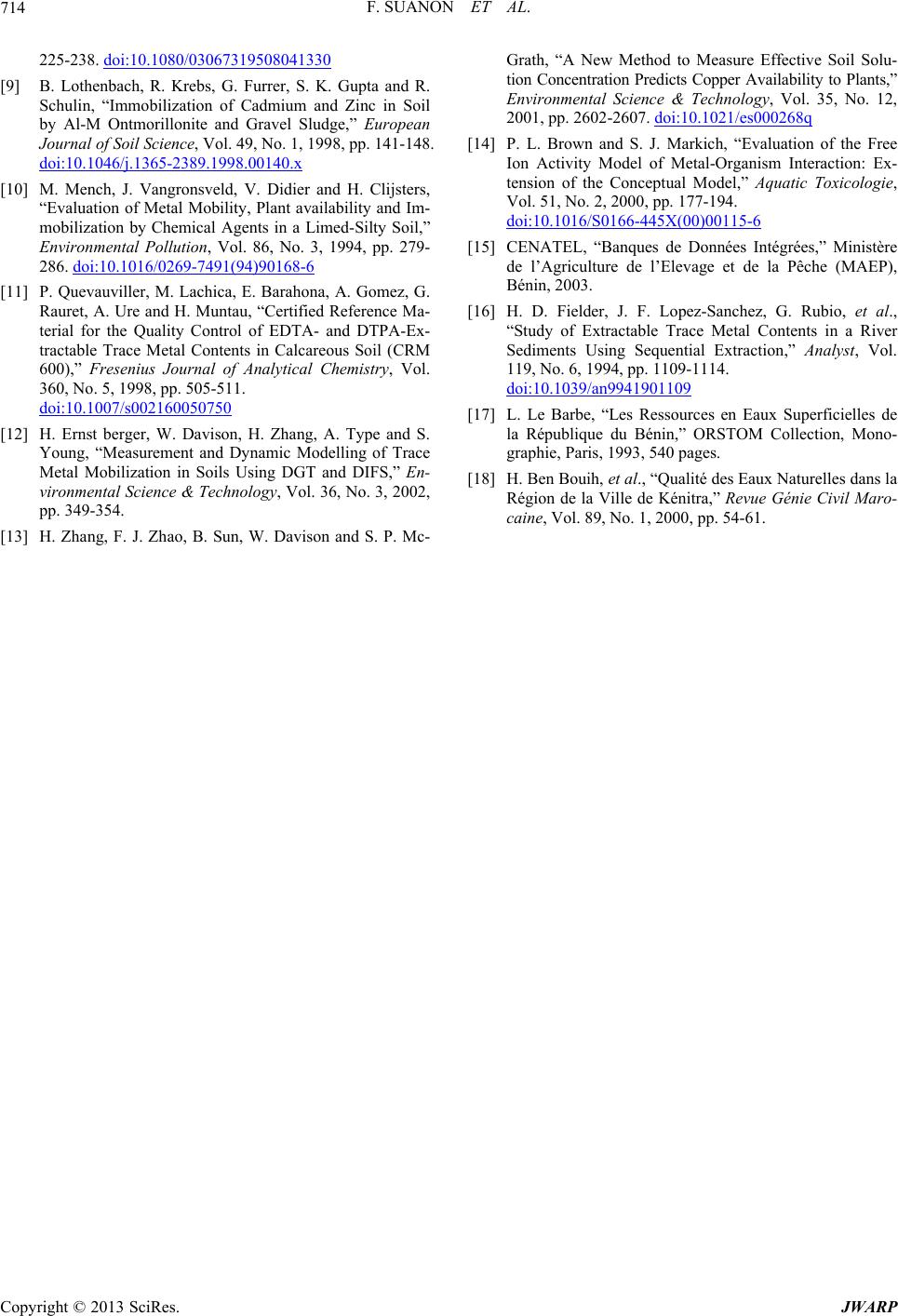 F. SUANON ET AL. Copyright © 2013 SciRes. JWARP 714 225-238. doi:10.1080/03067319508041330 [9] B. Lothenbach, R. Krebs, G. Furrer, S. K. Gupta and R. Schulin, “Immobilization of Cadmium and Zinc in Soil by Al-M Ontmorillonite and Gravel Sludge,” European Journal of Soil Science, Vol. 49, No. 1, 1998, pp. 141-148. doi:10.1046/j.1365-2389.1998.00140.x [10] M. Mench, J. Vangronsveld, V. Didier and H. Clijsters, “Evaluation of Metal Mobility, Plant availability and Im- mobilization by Chemical Agents in a Limed-Silty Soil,” Environmental Pollution, Vol. 86, No. 3, 1994, pp. 279- 286. doi:10.1016/0269-7491(94)90168-6 [11] P. Quevauviller, M. Lachica, E. Barahona, A. Gomez, G. Rauret, A. Ure and H. Muntau, “Certified Reference Ma- terial for the Quality Control of EDTA- and DTPA-Ex- tractable Trace Metal Contents in Calcareous Soil (CRM 600),” Fresenius Journal of Analytical Chemistry, Vol. 360, No. 5, 1998, pp. 505-511. doi:10.1007/s002160050750 [12] H. Ernst berger, W. Davison, H. Zhang, A. Type and S. Young, “Measurement and Dynamic Modelling of Trace Metal Mobilization in Soils Usin vironmental Science & Techng DGT and DIFS,” ology, Vol. 36, No. 3, 2002, w Method to Measure Effective Soil Solu- En- pp. 349-354. [13] H. Zhang, F. J. Zhao, B. Sun, W. Davison and S. P. Mc- Grath, “A Ne tion Concentration Predicts Copper Availability to Plants,” Environmental Science & Technology, Vol. 35, No. 12, 2001, pp. 2602-2607. doi:10.1021/es000268q [14] P. L. Brown and S. J. Markich, “Evaluation of the Free Ion Activity Model of Metal-Organism Interaction: Ex- tension of the Conceptual Model,” Aquatic Toxicologie, Vol. 51, No. 2, 2000, pp. 177-194. doi:10.1016/S0166-445X(00)00115-6 [15] CENATEL, “Banques de Données Int de l’Agriculture de l’Elevage et de l égrées,” Ministère a Pêche (MAEP), tractable Trace Metal Contents in a River Bénin, 2003. [16] H. D. Fielder, J. F. Lopez-Sanchez, G. Rubio, et al., “Study of Ex Sediments Using Sequential Extraction,” Analyst, Vol. 119, No. 6, 1994, pp. 1109-1114. doi:10.1039/an9941901109 [17] L. Le Barbe, “Les Ressources en E la République du Bénin,” ORSTOM Collection aux Superficielles de , Mono- e Génie Civil Maro- graphie, Paris, 1993, 540 pages. [18] H. Ben Bouih, et al., “Qualité des Eaux Naturelles dans la Région de la Ville de Kénitra,” Revu caine, Vol. 89, No. 1, 2000, pp. 54-61. |