

Paper Menu >>
Journal Menu >>
 Advances in Applied Sociology 2013. Vol.3, No.3, 165-171 Published Online July 2013 in SciRes (http://www.scirp.org/journal/aasoci) http://dx.doi.org/10.4236/aasoci.2013.33022 Copyright © 2013 SciR e s . 165 Paid Work & Decision Making Power of Married Women Cross Sectional Survey of Muzaffarabad Azad State of Jammu & Kashmir Sheeba Arooj1*, Wafa Hussain2, Amber Arooj3, Asif Iqbal2, Saqib Ham eed2, Atif Abbasi4 1Institute of Social & Cultural Studies, University of Punjab, Lahore, Pakistan 2Department of Sociology & Rural Development, University of Azad Jammu & Kashmir, Muzaffarabad, Pakistan 3Extension Services Management Academy, Ghari Dupatta, Muzaffarabad, Pakistan 4Department of Statistics, U n iversity of Azad Jammu & Kashmir, Muzaffarabad, Pakistan Email: *[email protected] Received March 23rd, 2013; revi s ed A pril 26th, 2013; accepted May 4th, 2013 Copyright © 2013 Sheeba Arooj et al. This is an open access article distributed under the Creative Commons Attribution License, which permits unrestricted use, distribution, and reproduction in any medium, provided the original work is properly cited. Background: Current research focuses primarily on women’s autonomy in decision making while little attention is paid to their freedom of expression. Socioeconomic & socio-demographic factors affect women’s autonomy in decision making. In the developing countries, particularly in Pakistan, although women are making significant financial contributions but they are still under collective decisions of hus- band and other family members while sometimes they are blindly relying on husband’s decision. Objec- tive of study was to find out association of women’s autonomy in decision making & socioeconomic fac- tors. Method: Cross sectional survey was conducted in Muzaffarabad Azad Kashmir on married working women (N = 500). The data consist of women’s three decisions: birth control decision, financial decision and freedom of expression. A number of socio-demographic variables were used in chi-square analysis to examine the association of these variables with the said decisions. Results: Age, residence, education, professional differences, job nature, monthly income of married women are positively associated with autonomy in decision making. 59% women of above 30 years age exercise independence in birth control decisions (p value 0.02). Urban women (96%) are more likely to be autonomous in birth control decision than women from rural areas (p value 0.00). Educational attainment effects women autonomy as profes- sionally qualified women (87.2%) are more independent in birth control decisions, independent in spend- ing income (86.5%), having freedom of expression (55.4%). Furthermore women living in nuclear fami- lies exercise more independence in birth control decisions (77.2), income spending decisions (76) and en- joy more freedom of expression (56.2). Women working in government sector have independence in birth control (71), financial decisions (70.4), and freedom of expression (52.4%) with p value 0.00. Women earning salary of above 20,000 enjoy autonomy in birth control decisions (87.5%), financial decisions (87.2%), freedom of expression (57.4) with p value 0.00. Keywords: Women; Decision; Birth Control; Financial Decision; Freedom of Expression; Chi-Square Introduction Socio-demographic factors affect women’s independence in making decisions regarding health, household, family planning etc are poorly studied in Muzaffarabad AJK. Women’s eco- nomic dependency has long been understood to be a major factor in structuring inequalities between men and women. Con- trol over financial resources is often considered a central di- mension when measuring women’s household position. Women’s role has been a priority factor not only for sustain- able development, but also in reproductive health. Autonomy is the ability to gain information and make decisions about con- cerns of one’s own (Dyson, Moore et al., 1983). Autonomy facilitates easy access to material resources such as food, land, income and other forms of wealth and social resources such as knowledge, power, prestige within the family and community (Dixon, 1978). In Muzaffarabad out of 0.632 million population 0.305 mil- lion are females (projected population 2010 census 1998). Women of working class families exert more influence in decisions of family than women of middle class. And no matter they are employed or not, wives in working-class families have more say in family decision-making than wives in middle-class families. It is also found that there is a positive association be- tween the number of chi ldren and th e influence of the husb and in decision-making (Heer & David, 1958). Situation in Pakistan *Corresponding author. In Pakistan women who met their fiance prior marriage were  S. AROOJ ET AL. one quarter and those who put into decision of choosing life partner were 11.5%. More than 5 0% women discu ssed with their partner regarding use of contraceptives and the percentage of women agreed on number of children was 44.2%. Women who have freedom in selection of spouse are more likely to make decisions regarding number of children. Adoptions of contracep- tives were more likely to be associated more with older age and higher education at marriage (Saima & Stephenson, 2011). In Pakistan the region more than the religion plays an impor- tant role in defining the autonomy of women. Autonomy of women in decision making is positively associated with em- ployment, number of living children and their ages. Women of rural areas have relatively less autonomy in decision making. Autonomy in decision making is related with education of women. Interestingly women who are rich have less independ- ence to make decisions about their health care. Women’s con- dition was also unsatisfactory with respect to access and control over economic r esources. Women who cou ld speak in househo ld spending were 59% whereas 70.4% women were those who could spend money in their homes by themselves, which means the majority of the women . But in case of bu ying valuable things, participation o f women were l imited to 16% i.e. those who could buy small jewellery, and women who could buy gifts by their own were 23.7%. Women who could own and have control on their valuable things were 61.1% and those who could speak in their dowry related decisions were 33.6%. 28.9% of women could speak in husband’s home in different matters. Women have little control over her savings by themselves (Jejeebhoy & Shireen, 2001). Increased autonomy of women in different aspects of life is related with paid work. In many village, areas mobility of women is restricted and women practice “purdah”. In the rural areas, paid work is considered undesirable because it involves working outside the home and therefore only the poorest women engage in work as farm labourers, and agricultural la- bourers are amongst the lowest paid group in the rural sector. Poverty therefore is a major determinant that drives women into low-wage work (Kazi & Shahnaz, 1999). Women had to do household tasks along with paid work because their husbands did not help them (Shaheed & Farida, 1981). Study conducted in Multan revealed that 42.9% working women were those who had to take permission from family for going outside. 36% argued that their brothers got more privilege as compared to them from their parents (Ali & Ishaque, 2010). Addressing gender inequality issues Pakistan is far from ideal however there are significant efforts made by social pro- tection projects as it provided numerous benefits to women in term of cash empowerment which has shown to improve deci- sion making power of those women. They are more likely to use reproductive health services, moreover household invest- ments shift from transportation and food to medical care, edu- cation, fuel, lighting, footwear and clothing. Employment and education have always empowered women and brought a positive impact on decision making, including reducing the inequalities among men and women. One effective method to do so is to incorporate the notion of empowerment in school curricula. Attention should also be given to those women who do not attend school, through non-formal educa- tion. A curriculum for such programmes should be developed with a clear policy framework to reduce differences in educa- tion and employment between men and women (Mumtaz & Salway, 2007). Employment of women is positively associated with delayed marriage and child birth (Jensen, 2012). Women of urban areas are more involved in working and they exercise control over their earnings and in discussion of family planning with their husbands than women of rural areas. More adoption of family planning is associated with educational level of women (Furuta, 2006). In structuring inequality between men & women, economic dependency plays an important role. For measuring household position, the important dimension is women’s control over financial resources (Standing, 1991). Married Women having paid work & education are more likely to participate in decision making (Roth, 2001). Inde- pendence of women in decision making is positively associated with employment, education, number of living children and age. Rural women with no education could not exercise autonomy in decision making (Ahmmed & Chakraborty, 2012). Women with completed higher education are considered for consent of mar- riage (93.3%), enjoy higher purchasing power (46.7%), auto- nomous in decisions regarding politics (86.7%) whereas illiter- ate women have no say in marriage related decision, having no purchasing power (0.0%) and political decision making (77.8%) (Sanjoy, 2012). Contraceptive use is significantly associated with decision autonomy than autonomy of movement (Saleem & Bobak, 2005). Methodology A cross sectional descriptive study was conducted in district Muzaffarabad. A sample of 500 married working women was taken as per judgement of researcher because number of work- ing women was limited (purposive sampling). Data Collection A close ended structured questionnaire was used to collect data of participants regarding decision making power with re- gard to birth control, independence in income spending and freedom of expression. The level of the questionnaire was that of layman understanding. Inclusion & Exclusion Criteria Present study excluded unmarried and non-working women as primary interest of researcher was to find out changing role of married working women. Analysis Data were entered and analy sed using SPSS software version 20. Both descriptive (percentage) and inferential (chi-square) statistics were used for data analysis. Results on the variables were presented with cross tabulation. Measures Independent variables which were chosen to represent deci- sion making in above said areas were age, residence, education (primary and secondary were recorded into secondary), job title, job nature, family type, monthly income and expenses afforded by women. Bivariate analysis was performed to check out the association between variables. Results Table 1 describes that Working married women between age Copyright © 2013 SciRe s. 166 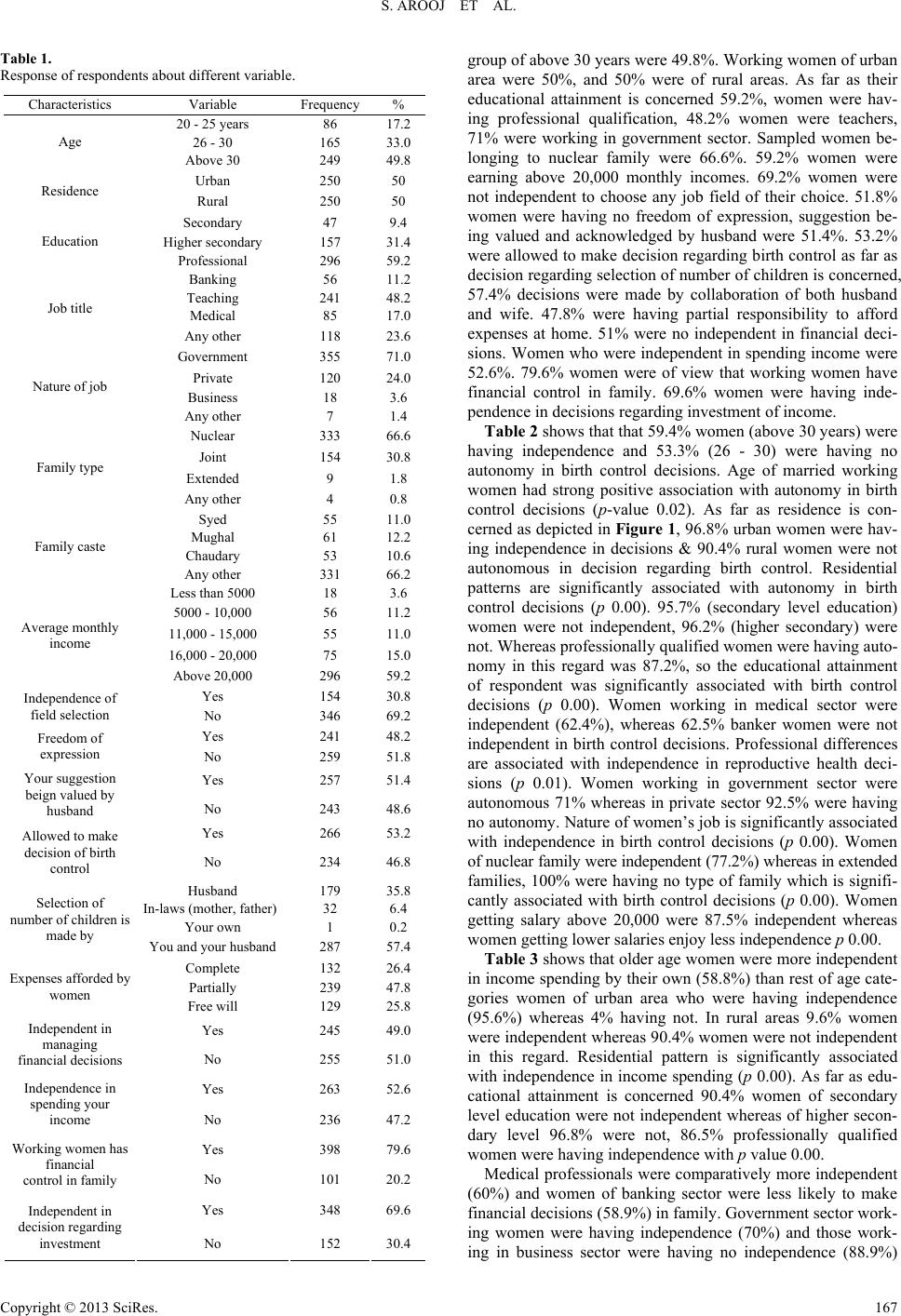 S. AROOJ ET AL. Table 1. Response of respondents about different variable. Characteristics Variable Frequency% 20 - 25 years 86 17.2 26 - 30 165 33.0 Age Above 30 249 49.8 Urban 250 50 Residence Rural 250 50 Secondary 47 9.4 Higher secondary 157 31.4 Education Professional 296 59.2 Banking 56 11.2 Teaching 241 48.2 Medical 85 17.0 Job title Any other 118 23.6 Government 355 71.0 Private 120 24.0 Business 18 3.6 Nature of job Any other 7 1.4 Nuclear 333 66.6 Joint 154 30.8 Extended 9 1.8 Family type Any other 4 0.8 Syed 55 11.0 Mughal 61 12.2 Chaudary 53 10.6 Family caste Any other 331 66.2 Less than 5000 18 3.6 5000 - 10,000 56 11.2 11,000 - 15,000 55 11.0 16,000 - 20,000 75 15.0 Average mont h l y income Above 20,000 296 59.2 Yes 154 30.8 Independe nce of field selection No 346 69.2 Yes 241 48.2 Freedom of expression No 259 51.8 Yes 257 51.4 Your suggestion beign valued by husband No 243 48.6 Yes 266 53.2 Allowed to make decision of birt h control No 234 46.8 Husband 179 35.8 In-laws (mother, father) 32 6.4 Your own 1 0.2 Selection of number of children is made by You and your husband 287 57.4 Complete 132 26.4 Partially 239 47.8 Expenses a fforded b y women Free will 129 25.8 Yes 245 49.0 Independent i n managing financial dec i sions No 255 51.0 Yes 263 52.6 Independence in spending your income No 236 47.2 Yes 398 79.6 Working women has financial control in family No 101 20.2 Yes 348 69.6 Independent i n decision rega rdi ng investment No 152 30.4 group of above 30 years were 49.8%. Working women of urban area were 50%, and 50% were of rural areas. As far as their educational attainment is concerned 59.2%, women were hav- ing professional qualification, 48.2% women were teachers, 71% were working in government sector. Sampled women be- longing to nuclear family were 66.6%. 59.2% women were earning above 20,000 monthly incomes. 69.2% women were not independent to choose any job field of their choice. 51.8% women were having no freedom of expression, suggestion be- ing valued and acknowledged by husband were 51.4%. 53.2% were allowed to make decision regarding birth control as far as decision regarding selection of number of children is concerned, 57.4% decisions were made by collaboration of both husband and wife. 47.8% were having partial responsibility to afford expenses at home. 51% were no independent in financial deci- sions. Women who were independent in spending income were 52.6%. 79.6% women were of view that working women have financial control in family. 69.6% women were having inde- pendence in decisions regarding investment of income. Table 2 shows that that 59.4% women (above 30 years) were having independence and 53.3% (26 - 30) were having no autonomy in birth control decisions. Age of married working women had strong positive association with autonomy in birth control decisions (p-value 0.02). As far as residence is con- cerned as depicted in Figure 1, 96.8% urban women were hav- ing independence in decisions & 90.4% rural women were not autonomous in decision regarding birth control. Residential patterns are significantly associated with autonomy in birth control decisions (p 0.00). 95.7% (secondary level education) women were not independent, 96.2% (higher secondary) were not. Whereas professionally qualified women were having auto- nomy in this regard was 87.2%, so the educational attainment of respondent was significantly associated with birth control decisions (p 0.00). Women working in medical sector were independent (62.4%), whereas 62.5% banker women were not independent in birth control decisions. Professional differences are associated with independence in reproductive health deci- sions (p 0.01). Women working in government sector were autonomous 71% whereas in private sector 92.5% were having no autonomy. Nature of women’s job is significantly associated with independence in birth control decisions (p 0.00). Women of nuclear family were independe nt (77.2%) whereas in extended families, 100% were having no type of family which is signifi- cantly associated with birth control decisions (p 0.00). Women getting salary above 20,000 were 87.5% independent whereas women getting lower salaries enjoy less independence p 0.00. Table 3 shows that older age women were more independent in income spending by their own (58.8%) than rest of age cate- gories women of urban area who were having independence (95.6%) whereas 4% having not. In rural areas 9.6% women were independent whereas 90.4% women were not independent in this regard. Residential pattern is significantly associated with independence in income spending (p 0.00). As far as edu- cational attainment is concerned 90.4% women of secondary level education were not independent whereas of higher secon- dary level 96.8% were not, 86.5% professionally qualified women were having independence with p value 0.00. Medical professionals were comparatively more independent (60%) and women of banking sector were less likely to make financial decisions (58.9%) in family. Government sector work- ing women were having independence (70%) and those work- ing in business sector were havng no independence (88.9%) i Copyright © 2013 SciRe s . 167 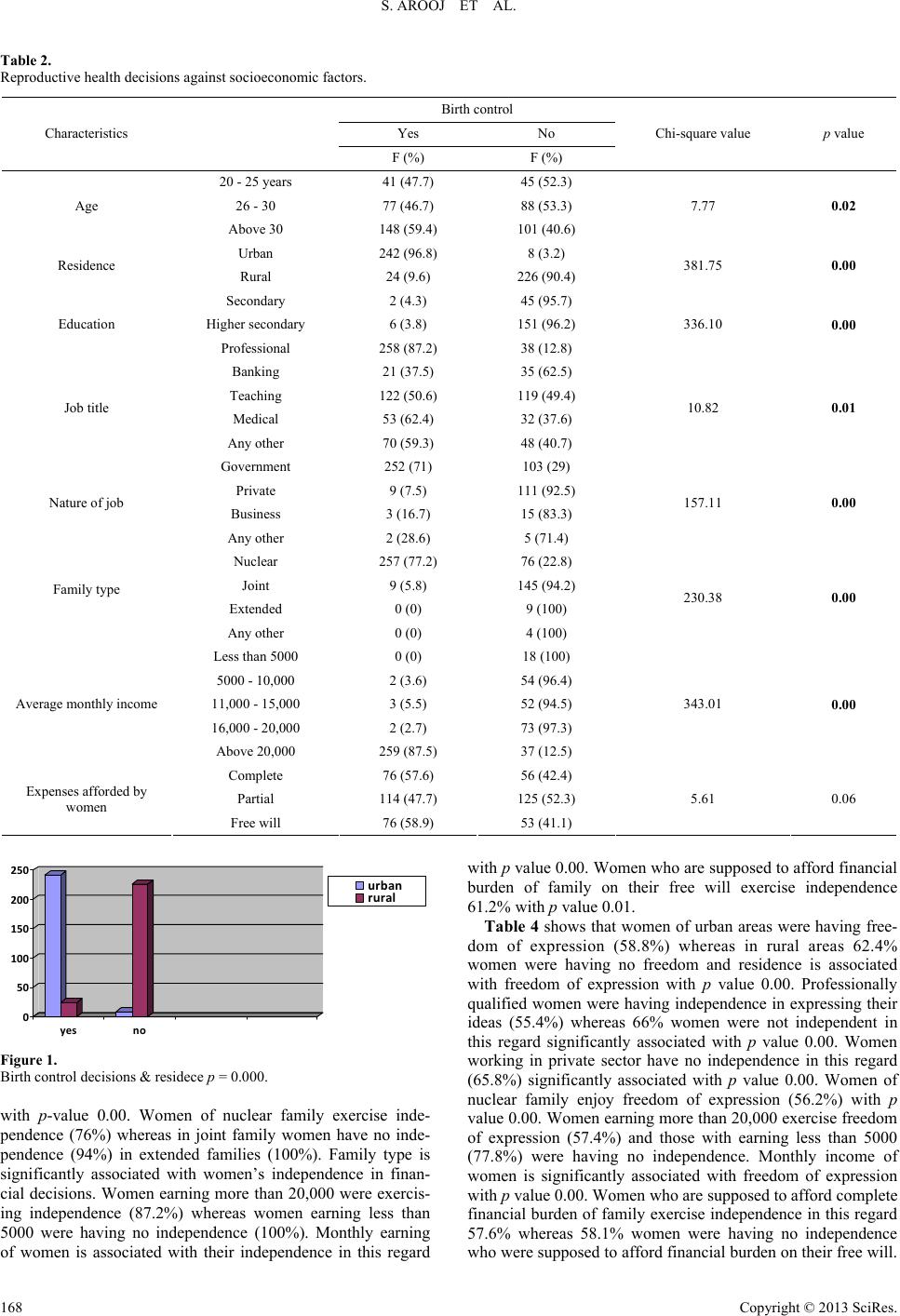 S. AROOJ ET AL. Copyright © 2013 SciRe s . 168 Table 2. Reproductive health decisions against socioeconomic factors. Birth control Yes No Characteristics F (%) F (%) Chi-square value p value 20 - 25 yea r s 41 (47.7) 4 5 (52.3) 26 - 30 77 (46.7) 88 (53.3) Age Above 30 148 (59.4) 101 (40.6) 7.77 0.02 Urban 242 (96.8) 8 (3.2) Residence Rural 24 (9.6) 22 6 (90.4) 381.75 0.00 Secondary 2 (4.3) 45 (95.7) Higher secondary 6 (3.8) 151 (96.2) Education Professional 258 (87.2) 38 (12.8) 336.10 0.00 Banking 21 (37.5) 35 (62.5) Teaching 122 (50.6) 119 (49.4) Medical 53 (62.4) 32 (37.6 ) Job title Any other 70 (59.3) 48 (40.7) 10.82 0.01 Government 252 (71) 103 (29) Private 9 (7.5) 111 (92.5) Business 3 (16.7) 15 ( 83 .3) Nature of job Any other 2 (28.6) 5 (71.4) 157.11 0.00 Nuclea r 257 (77.2) 76 (22.8) Joint 9 (5.8) 145 (94.2) Extended 0 (0) 9 (100) Family type Any other 0 (0) 4 (100) 230.38 0.00 Less than 50 0 0 0 (0) 18 (100) 5000 - 10,000 2 (3.6) 54 (96.4) 11,000 - 15,000 3 (5.5) 52 (94.5) 16,000 - 20,000 2 (2.7) 73 (97.3) Average mont h l y income Above 20,000 25 9 (87.5) 37 (12.5) 343.01 0.00 Complete 76 (57.6) 56 (42.4) Partial 114 (47.7) 125 (52.3) Expenses a fforded b y women Free will 76 (58.9) 53 (41.1 ) 5.61 0.06 0 50 100 150 200 250 yes no urban rural Figure 1. Birth control decisions & residece p = 0.000. with p-value 0.00. Women of nuclear family exercise inde- pendence (76%) whereas in joint family women have no inde- pendence (94%) in extended families (100%). Family type is significantly associated with women’s independence in finan- cial decisions. Women earning more than 20,000 were exercis- ing independence (87.2%) whereas women earning less than 5000 were having no independence (100%). Monthly earning of women is associated with their independence in this regard with p value 0.00. Women who are supposed to afford financial burden of family on their free will exercise independence 61.2% with p value 0.01. Table 4 shows that women of urban areas were having free- dom of expression (58.8%) whereas in rural areas 62.4% women were having no freedom and residence is associated with freedom of expression with p value 0.00. Professionally qualified women were having independence in expressing their ideas (55.4%) whereas 66% women were not independent in this regard significantly associated with p value 0.00. Women working in private sector have no independence in this regard (65.8%) significantly associated with p value 0.00. Women of nuclear family enjoy freedom of expression (56.2%) with p value 0.00. Women earning more than 20,000 exercise freedom of expression (57.4%) and those with earning less than 5000 (77.8%) were having no independence. Monthly income of women is significantly associated with freedom of expression with p value 0.00. Women who are supposed to afford complete financial burden of family exercise independence in this regard 57.6% whereas 58.1% women were having no independence who were supposed to afford financial burden on their free will. 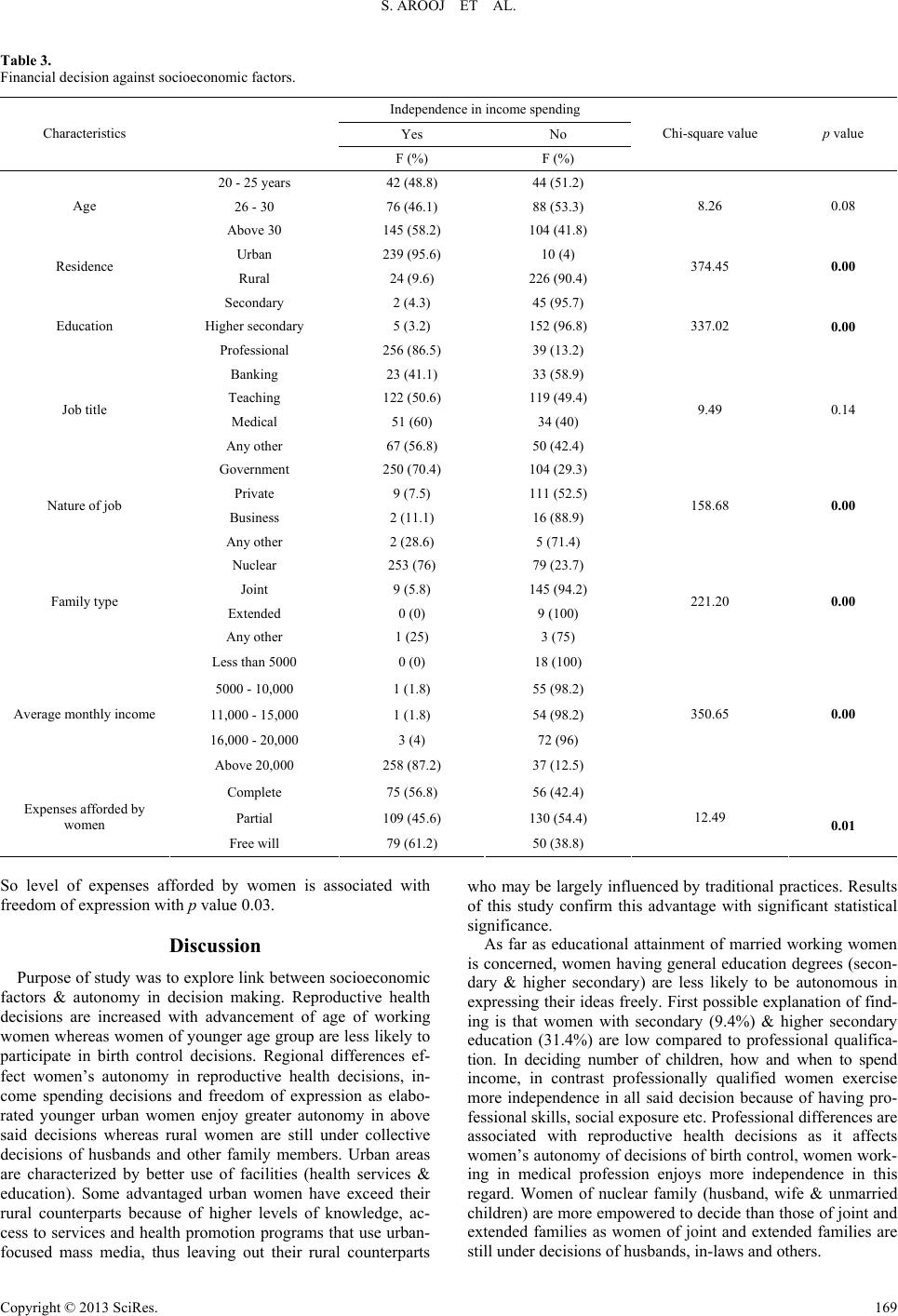 S. AROOJ ET AL. Table 3. Financial decision against socioeconomic factors. Independen ce in income spending Yes No Characteristics F (%) F (%) Chi-square value p value 20 - 25 yea r s 42 (48 .8) 44 (51.2) 26 - 30 76 (46.1) 88 (53.3) Age Above 30 145 (58.2) 104 (41.8) 8.26 0.08 Urban 239 (95.6) 10 (4) Residence Rural 24 (9.6) 226 (90.4) 374.45 0.00 Secondary 2 (4.3) 45 (95.7) Higher secondary 5 (3.2) 152 (96.8) Education Professional 2 56 (86.5) 39 (13.2) 337.02 0.00 Banking 23 (41.1) 33 (58.9) Teaching 122 (50.6) 119 (49.4) Medical 51 (60) 34 (40) Job title Any other 67 ( 56.8) 50 (42.4) 9.49 0.14 Government 250 (70.4) 104 (29.3) Private 9 (7.5) 11 1 (52.5) Business 2 (11.1) 16 (88.9) Nature of job Any other 2 (28.6) 5 (71.4) 158.68 0.00 Nuclear 253 (76) 79 (23.7) Joint 9 (5.8) 145 (94.2) Extended 0 (0) 9 (100) Family type Any other 1 (25) 3 (75) 221.20 0.00 Less than 50 0 0 0 ( 0) 18 (100) 5000 - 10,000 1 (1. 8) 55 (98.2) 11,000 - 15,000 1 (1.8) 54 (98.2) 16,000 - 20,000 3 (4) 72 (96) Average mont h l y income Above 20,000 258 (87.2) 37 (12.5) 350.65 0.00 Complete 75 (56.8) 56 (42.4) Partial 109 (45.6) 130 (54.4) Expenses a fforded b y women Free will 79 (61.2) 50 (38.8) 12.49 0.01 So level of expenses afforded by women is associated with freedom of expression with p value 0.03. Discussion Purpose of study was to explore link between socioeconomic factors & autonomy in decision making. Reproductive health decisions are increased with advancement of age of working women whereas women of younger age group are less likely to participate in birth control decisions. Regional differences ef- fect women’s autonomy in reproductive health decisions, in- come spending decisions and freedom of expression as elabo- rated younger urban women enjoy greater autonomy in above said decisions whereas rural women are still under collective decisions of husbands and other family members. Urban areas are characterized by better use of facilities (health services & education). Some advantaged urban women have exceed their rural counterparts because of higher levels of knowledge, ac- cess to services and health promotion programs that use urban- focused mass media, thus leaving out their rural counterparts who may be largely influenced by traditional practices. Results of this study confirm this advantage with significant statistical significance. As far as educational attainment of married working women is concerned, women having general education degrees (secon- dary & higher secondary) are less likely to be autonomous in expressing their ideas freely. First possible explanation of find- ing is that women with secondary (9.4%) & higher secondary education (31.4%) are low compared to professional qualifica- tion. In deciding number of children, how and when to spend income, in contrast professionally qualified women exercise more independence in all said decision because of having pro- fessional skills, social exposure etc. Professional differences are associated with reproductive health decisions as it affects women’s autonomy of decisions of birth control, women work- ing in medical profession enjoys more independence in this regard. Women of nuclear family (husband, wife & unmarried children) are more empowered to decide than those of joint and extended families as women of joint and extended families are till under decisions of husbands, in-laws and others. s Copyright © 2013 SciRe s . 169 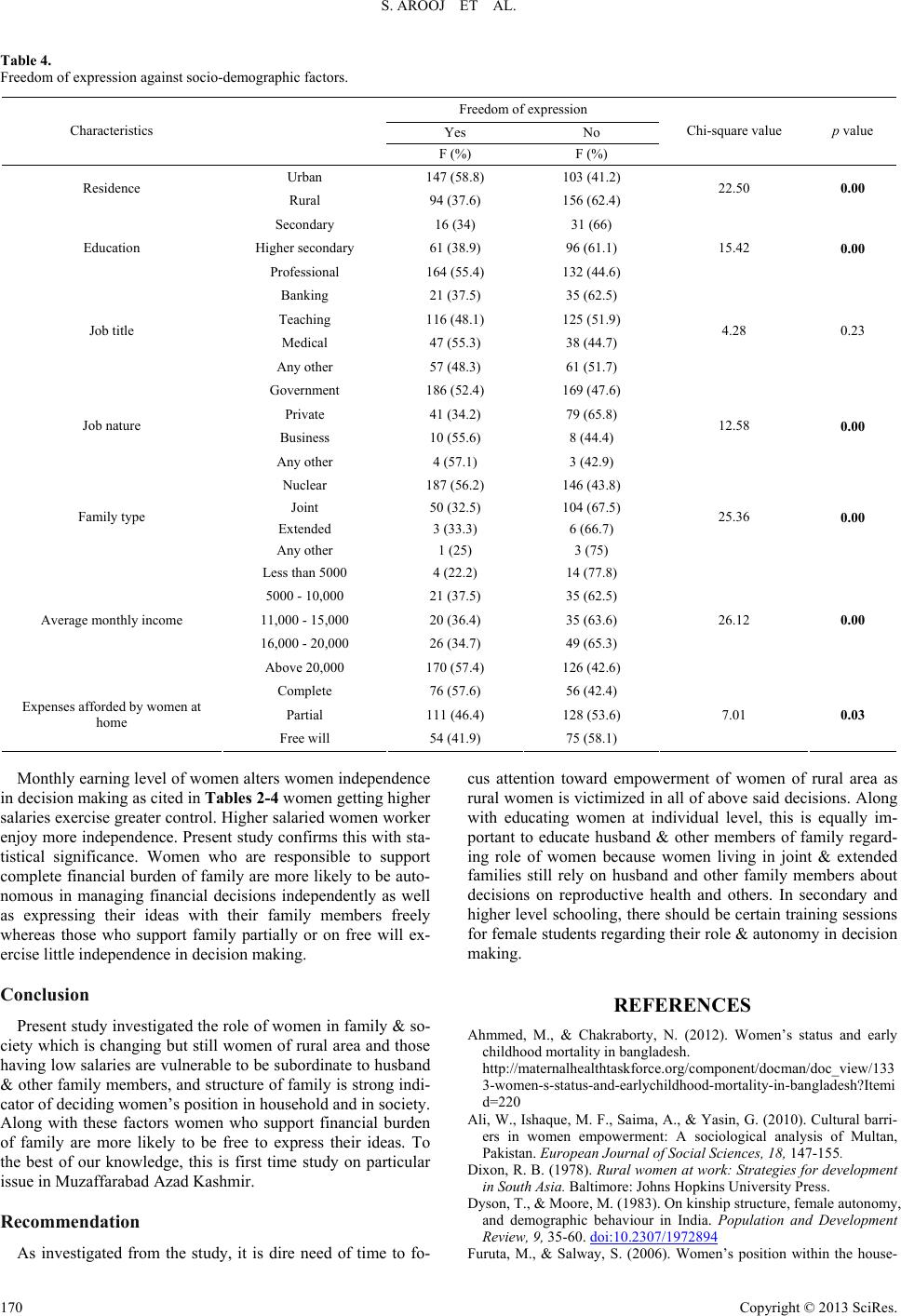 S. AROOJ ET AL. Table 4. Freedom of expression ag a i nst socio-demographic fac tors. Freedom of expression Yes No Characteristics F (%) F (%) Chi-square value p value Urban 147 (58.8) 103 (41.2) Residence Rural 94 (37.6) 156 (62.4) 22.50 0.00 Secondary 16 (34) 31 (66) Higher secondary 61 (38.9) 96 (61.1) Education Professional 164 (55.4) 132 (44.6) 15.42 0.00 Banking 21 (37.5) 35 (62.5) Teaching 11 6 (48.1) 125 (51.9) Medical 47 (55.3) 38 (44.7) Job title Any other 57 (48.3) 61 (51.7) 4.28 0.23 Government 186 (52.4) 169 (47.6) Private 41 (34.2) 79 (65.8) Business 10 (55.6) 8 (44.4) Job nature Any other 4 (57.1) 3 (42.9) 12.58 0.00 Nuclea r 187 (56.2) 146 (43.8) Joint 50 (32.5) 104 (67.5) Extended 3 (33.3) 6 (66.7) Family type Any other 1 (25) 3 (75) 25.36 0.00 Less than 5000 4 (22.2) 14 (77.8) 5000 - 10,000 21 (37.5) 35 (62.5) 11,000 - 15,000 20 (36.4) 35 (63.6) 16,000 - 20,000 26 (34.7) 49 (65.3) Average mont h l y income Above 20,000 170 (57.4) 126 (42.6) 26.12 0.00 Complete 76 (57.6) 56 (42.4) Partial 111 (46.4) 128 (53.6) Expenses afforded by women at home Free will 54 ( 41 .9) 75 (58.1) 7.01 0.03 Monthly earning level of women alters women independence in decision making as cited in Tables 2-4 women getting higher salaries exercise greater control. Higher salaried women worker enjoy more independence. Present study confirms this with sta- tistical significance. Women who are responsible to support complete fi nancial burden of family are more li kely to be auto- nomous in managing financial decisions independently as well as expressing their ideas with their family members freely whereas those who support family partially or on free will ex- ercise little independence in decision making. Conclusion Present study investigated the role of women in family & so- ciety which is changing but still women of rural area and those having low salaries are vulnerable to be subordinate to husband & other family members, and structure of family is strong indi- cator of deciding women’s position in household and in society. Along with these factors women who support financial burden of family are more likely to be free to express their ideas. To the best of our knowledge, this is first time study on particular issue in Muzaffarabad Azad Kashmir. Recommendation As investigated from the study, it is dire need of time to fo- cus attention toward empowerment of women of rural area as rural women is victimized in all of above said decisions. Along with educating women at individual level, this is equally im- portant to educate husband & other members of family regard- ing role of women because women living in joint & extended families still rely on husband and other family members about decisions on reproductive health and others. In secondary and higher level schooling, there should be certain training sessions for female students regarding their role & autonomy in decision making. REFERENCES Ahmmed, M., & Chakraborty, N. (2012). Women’s status and early childhood mortality in bangladesh. http://maternalhealthtaskforce.org/component/docman/doc_view/133 3-women-s-status-and-earlychildhood-mortality-in-bangladesh?Itemi d=220 Ali, W., Ishaque, M. F., Saima, A., & Yasin, G. (2010). Cultural barri- ers in women empowerment: A sociological analysis of Multan, Pakistan. European Journal of Social Sciences, 18, 147-155. Dixon, R. B. (1978). Rural women at work: Strategies for development in South Asia. Baltimore: Johns Hopkins Un i v e rsity Press. Dyson, T., & Moore, M. (1983). On kinship structure, female autonomy, and demographic behaviour in India. Population and Development Review, 9, 35-60. doi:10.2307/1972894 Furuta, M., & Salway, S. (2006). Women’s position within the house- Copyright © 2013 SciRe s. 170 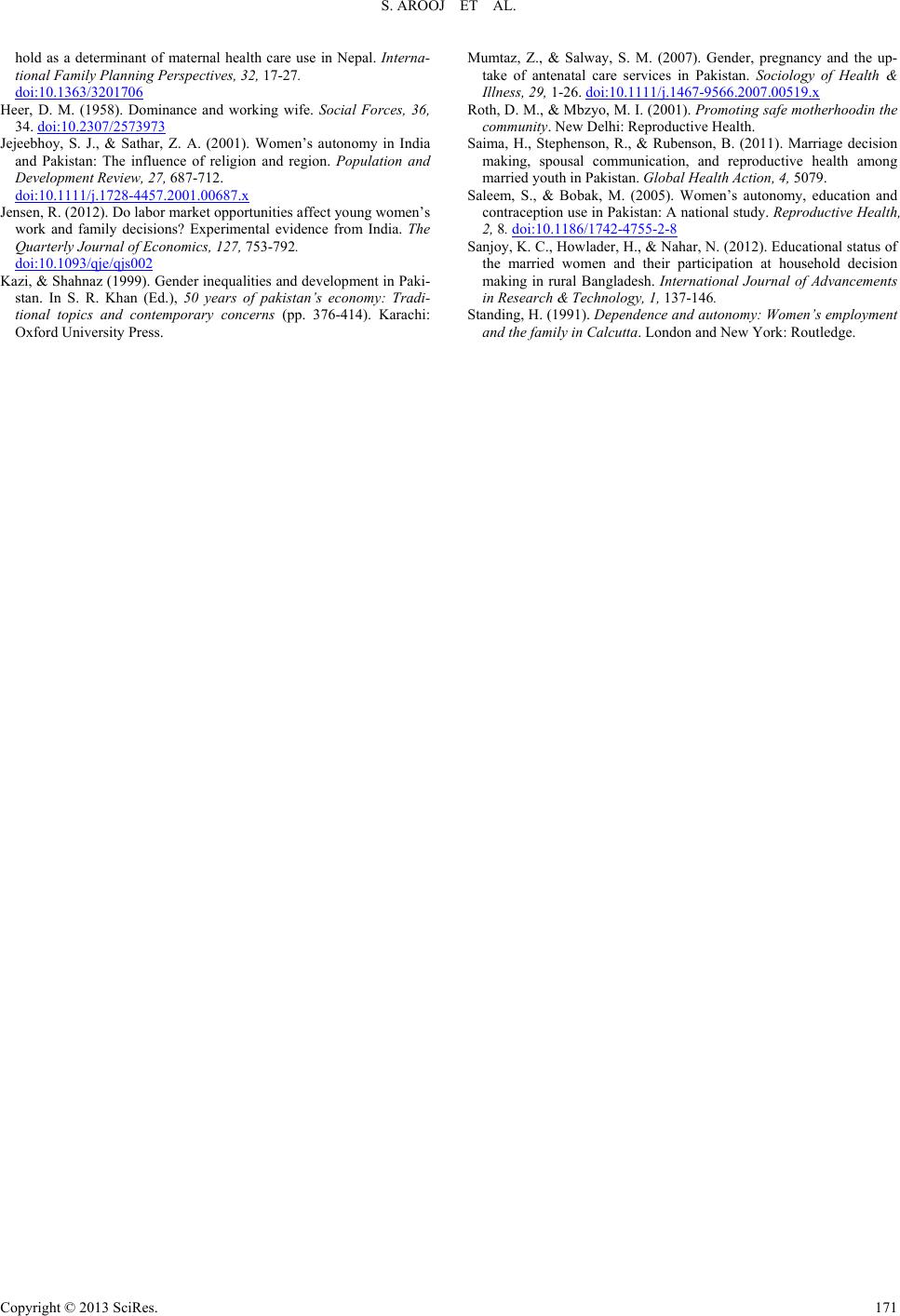 S. AROOJ ET AL. hold as a determinant of maternal health care use in Nepal. Interna- tional Family Planning Perspectives, 32, 17-27. doi:10.1363/3201706 Heer, D. M. (1958). Dominance and working wife. Social Forces, 36, 34. doi:10.2307/2573973 Jejeebhoy, S. J., & Sathar, Z. A. (2001). Women’s autonomy in India and Pakistan: The influence of religion and region. Population and Development Review, 27, 687-712. doi:10.1111/j.1728-4457.2001.00687.x Jensen, R. (2012). Do labor market opportunities affect young women’s work and family decisions? Experimental evidence from India. The Quarterly Journal of Economics, 127, 753-792. doi:10.1093/qje/qjs002 Kazi, & Shahnaz (1999). Gender inequalities and development in Paki- stan. In S. R. Khan (Ed.), 50 years of pakistan’s economy: Tradi- tional topics and contemporary concerns (pp. 376-414). Karachi: Oxford University Press. Mumtaz, Z., & Salway, S. M. (2007). Gender, pregnancy and the up- take of antenatal care services in Pakistan. Sociology of Health & Illness, 29, 1-26. doi:10.1111/j.1467-9566.2007.00519.x Roth, D. M., & Mbzyo, M. I. (2001). Promoting safe motherhoodin the community. New Delhi: Reproductive Health. Saima, H., Stephenson, R., & Rubenson, B. (2011). Marriage decision making, spousal communication, and reproductive health among married youth in Pakistan . Global Health A ction, 4, 5079. Saleem, S., & Bobak, M. (2005). Women’s autonomy, education and contraception use in Pakistan: A national study. Reproductive Health, 2, 8. doi:10.1186/1742-4755-2-8 Sanjoy, K. C., Howlader, H., & Nahar, N. (2012). Educational status of the married women and their participation at household decision making in rural Bangladesh. International Journal of Advancements in Research & Technology, 1, 137-146. Standing, H. (1991). Dependence and autonomy: Women’s employment and the family in Calcutta. London and N e w Y o rk: Routledge. Copyright © 2013 SciRe s . 171 |