

Paper Menu >>
Journal Menu >>
 Food and Nutrition Sciences, 2013, 4, 28-30 http://dx.doi.org/10.4236/fns.2013.47A004 Published Online July 2013 (http://www.scirp.org/journal/fns) Qualitative Evaluation of the Capacity of Lactobacillus Strains to Degrade Mycotoxins Developed and Accumulated by Strains of the Genus Alternaria L. Pérez, G. Girmé, E. L. Arosemena, M. A. Calvo Torras Grupo de Investigación en Microbiología Aplicada y Medio-Ambiental, Departamento de Sanidad y de Anatomia Animales, Fa- cultad de Veterinaria, Universidad Autónoma de Barcelona, Bellaterra, Spain. Email: mariange[email protected] Received March 27th, 2013; revised April 30th, 2013; accepted May 7th, 2013 Copyright © 2013 L. Pérez et al. This is an open access article distributed under the Creative Commons Attribution License, which permits unrestricted use, distribution, and reproduction in any medium, provided the original work is properly cited. ABSTRACT Mycotoxins are secondary metabolites produced and accumulated by mould. This study assessed the ability of 89 lactic acid bacteria, isolated from different sources, to degrade two mycotoxins by Alternaria: alternariol and altenuene. The mehodology employed was the thin layer chromatography. The results obtained allow us to demonstrate that a 16.85% of the strains (15/89 strains) are capable of decreasing the intensity of the band related at the alternariol and 14.60% (13/89 strains) is capable of decrease the intensity of the band that manifests the altenuane in Alufolium. All tests have been observed under wavelengths of 360 nm and 255 nm. The results obtained allow carrying out a selection of lactic acid strains capable of degrading or decreasing the concentration of mycotoxins selected for this. Keywords: Lactic Acid Bacteria; Mycotoxins; Alternaria; Thin Layer Chromatography 1. Introduction Mycotoxins are compounds resulting from the condensa- tion reactions which take place under certain physical, chemical and biological conditions when the reduction of ketone groups in the biosynthesis of fatty acids made by the moulds is interrupted. These acids are primary me- tabolites by the fungus used as energy source. Mycotox- ins are often formed at the end of the exponential phase or early stationary growth phase of the microorganism. These are pollutants of various food and feed, corre- lating with various diseases of animals and humans [1,2]. Exposure to mycotoxins can cause acute or chronic tox- icity, and adverse effects on the central nervous system, on the cardiovascular, respiratory and digestive system and can also cause death. Agents may also be carcino- genic, mutagenic, teratogenic and immunosuppressive. At present it is mentioned as one of the most important effects, the ability of some mycotoxin compromise the immune response thus reduce the resistance to infectious diseases. Moreover mycotoxins are of global concern due to major economic losses because of its effects at the level of human health, animal productivity and national and international trade. Miller [3] in a statement staff esti- mate that in the United States of America and Canada, the annual losses due to the effects of mycotoxins in feed and livestock industries are of the order of 5000 million. For prevention, decontamination, inactivation and detoxi- fication have studied different methods: physical, chemi- cal, fungistatic utilization, use of additives and enzymes mycotoxin absorbents. The latter method is applicable to the degradation and/ or inactivation of mycotoxins, which can include: natural extracts and/or essential oils from plants and pathogenic microorganisms. Various tests have been conducted to study pathogenic microorganisms capable of degrading specific conditions certain mycotoxins. Such microorganisms are: Saccharo- myces cerevisiae, Flavobacterium aurantiacum, Rhizopus spp. Neurospora sitophila and rumen microorganisms. Some of these studies have provided effective results in the degradation of mycotoxins such as Aflatoxins, Pa- tulin, Ochratoxin A, Zearalenone, T-2, Rubratoxin or Dia- cetoxyscirpenol A. These studies have been performed in the laboratory, but the practical application of these sys- tems is under study and development [4]. Lactic acid bacteria (LAB) may be a possible alterna- tive. This group of microorganisms is considered GRAS Copyright © 2013 SciRes. FNS 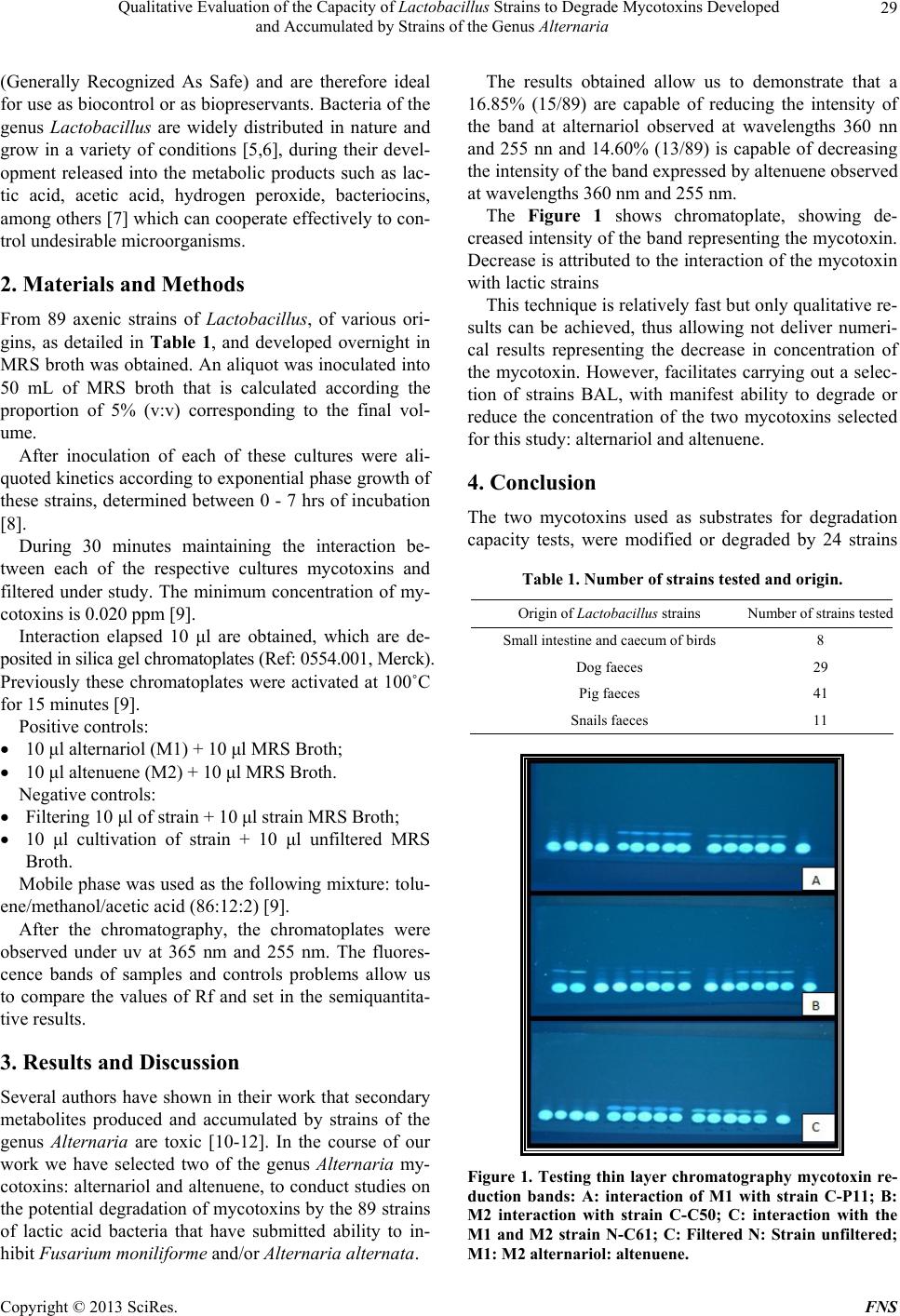 Qualitative Evaluation of the Capacity of Lactobacillus Strains to Degrade Mycotoxins Developed and Accumulated by Strains of the Genus Alternaria 29 (Generally Recognized As Safe) and are therefore ideal for use as biocontrol or as biopreservants. Bacteria of the genus Lactobacillus are widely distributed in nature and grow in a variety of conditions [5,6], during their devel- opment released into the metabolic products such as lac- tic acid, acetic acid, hydrogen peroxide, bacteriocins, among others [7] which can cooperate effectively to con- trol undesirable microorganisms. 2. Materials and Methods From 89 axenic strains of Lactobacillus, of various ori- gins, as detailed in Table 1, and developed overnight in MRS broth was obtained. An aliquot was inoculated into 50 mL of MRS broth that is calculated according the proportion of 5% (v:v) corresponding to the final vol- ume. After inoculation of each of these cultures were ali- quoted kinetics according to exponential phase growth of these strains, determined between 0 - 7 hrs of incubation [8]. During 30 minutes maintaining the interaction be- tween each of the respective cultures mycotoxins and filtered under study. The minimum concentration of my- cotoxins is 0.020 ppm [9]. Interaction elapsed 10 μl are obtained, which are de- posited in silica gel chromatoplates (Ref: 0554.001, Merck). Previously these chromatoplates were activated at 100˚C for 15 minutes [9]. Positive controls: 10 μl alternariol (M1) + 10 μl MRS Broth; 10 μl altenuene (M2) + 10 μl MRS Broth. Negative controls: Filtering 10 μl of strain + 10 μl strain MRS Broth; 10 μl cultivation of strain + 10 μl unfiltered MRS Broth. Mobile phase was used as the following mixture: tolu- ene/methanol/acetic acid (86:12:2) [9]. After the chromatography, the chromatoplates were observed under uv at 365 nm and 255 nm. The fluores- cence bands of samples and controls problems allow us to compare the values of Rf and set in the semiquantita- tive results. 3. Results and Discussion Several authors have shown in their work that secondary metabolites produced and accumulated by strains of the genus Alternaria are toxic [10-12]. In the course of our work we have selected two of the genus Alternaria my- cotoxins: alternariol and altenuene, to conduct studies on the potential degradation of mycotoxins by the 89 strains of lactic acid bacteria that have submitted ability to in- hibit Fusarium moniliforme and/or Alternaria alternata. The results obtained allow us to demonstrate that a 16.85% (15/89) are capable of reducing the intensity of the band at alternariol observed at wavelengths 360 nn and 255 nn and 14.60% (13/89) is capable of decreasing the intensity of the band expressed by altenuene observed at wavelengths 360 nm and 255 nm. The Figure 1 shows chromatoplate, showing de- creased intensity of the band representing the mycotoxin. Decrease is attributed to the interaction of the mycotoxin with lactic strains This technique is relatively fast but only qualitative re- sults can be achieved, thus allowing not deliver numeri- cal results representing the decrease in concentration of the mycotoxin. However, facilitates carrying out a selec- tion of strains BAL, with manifest ability to degrade or reduce the concentration of the two mycotoxins selected for this study: alternariol and altenuene. 4. Conclusion The two mycotoxins used as substrates for degradation capacity tests, were modified or degraded by 24 strains Table 1. Number of strains tested and origin. Origin of Lactobacillus strains Number of strains tested Small intestine and caecum of birds 8 Dog faeces 29 Pig faeces 41 Snails faeces 11 Figure 1. Testing thin layer chromatography mycotoxin re- duction bands: A: interaction of M1 with strain C-P11; B: M2 interaction with strain C-C50; C: interaction with the M1 and M2 strain N-C61; C: Filtered N: Strain unfiltered; M1: M2 alternariol: altenuene. Copyright © 2013 SciRes. FNS  Qualitative Evaluation of the Capacity of Lactobacillus Strains to Degrade Mycotoxins Developed and Accumulated by Strains of the Genus Alternaria Copyright © 2013 SciRes. FNS 30 of lactic acid bacteria, of which, fifteen strains showed activity on alternariol and thirteen on altenuene. REFERENCES [1] C. F. Mayer, “Endemic Panmyelotoxicoses in the Russian Grain Belt. Part One: The Clinical Aspects of Alimentary Toxic Aleukia (ATA). A Comprehensive Review,” Mili- tary Sergeon, Vol. 113, No. 3, 1953, pp. 173-189. [2] R. D. Coker, “Mycotoxins and Their Control: Constraints and Opportunities,” NRI Bulletin 73, Natural Resources Institute, Chatham, 1997. [3] J. D. Miller, “Conference Report: 6th International Work- ing Conference on Stored Product Protection,” Australian Mycotoxin Newsletter, Vol. 5, No. 2, 1994, pp. 1-8. [4] E. Smith, G. L. Solomons, C. W. Lewis and J. G. Ander- son, “Mycotoxins in Human Nutrition and Health,” Di- rectorate-General XII Science, Research and Develop- ment, European Commision, 1994. [5] K. H. Schleifer and E. Stackenbrandt, “Molecular Sys- tematic of Prokaryotes,” Annual Review of Microbiology, Vol. 37, 1983, pp. 143-187. doi:10.1146/annurev.mi.37.100183.001043 [6] W. P. Hammes and R. F. Vogel, “The Genus Lactobacil- lus,” In: The Genera of Lactic Acid Bacteria, Chapman & Hall, London, 1995, pp. 19-54. doi:10.1007/978-1-4615-5817-0_3 [7] E. Ringo and F. Gatesoupe, “Lactic Acid Bacteria in Fish: A Review,” Aquaculture, Vol. 160, No. 3-4, 1998, pp. 177-179. doi:10.1016/S0044-8486(97)00299-8 [8] A. Fábrega, “Estudio de la Variabilidad Morfológica y Producción de Metabolitos Secundarios en Cepas del Gé- nero Alternaria,” Ph.D. Dissertation, Universidad de Bar- celona, Spain, 2001. [9] G. E. Templeton, “Alternaria Toxins Related to Patho- genesis in Plants,” In S. Kadis, A. Ciegler and S. J. Ajl, Eds., Microbial Toxins, Vol. VII, Academic Press, Inc., New York, 1972. [10] M. Kostecki, S. Crabarkiewicz and J. Szczesna, “Biosyn- thesis and Preparation of Five Alternaria Metabolites,” Mycotoxin Research, Vol. 7, No. 1, 1991, pp. 3-7. [11] R. W. Pero, H. Posner, M. Blois, D. Harvan and J. W. Spalding, “Toxicity of Metabolites Produced by the Al- ternaria,” Environmental Health Perspectives, Vol. 4, 1973, pp. 87-94. [12] M. Rodríguez, “Aislamiento y Selección de Cepas del Género Lactobacillus con Capacidad Probiótica e Inmu- nomoduladora,” Ph.D. Dissertation, Universidad Autóno- ma de Barcelona, Spain, 2009. |