

Paper Menu >>
Journal Menu >>
 American Journal of Plant Sciences, 2013, 4, 1285-1290 http://dx.doi.org/10.4236/ajps.2013.46159 Published Online June 2013 (http://www.scirp.org/journal/ajps) Effects of Exogenous Nitric Oxide on Wheat Exposed to Enhanced Ultraviolet-B Radiation Liyan Yang1, Rong Han1, Yi Sun2,3* 1Shanxi Normal University, Linfen, China; 2Biotechnology Research Centre, Shanxi Academy of Agricultural Sciences, Taiyuan, China; 3Key Laboratory of Crop Gene Resources and Germplasm Enhancement on Loess Plateau, Ministry of Agriculture, Taiyuan, China. Email: *[email protected] Received April 20th, 2013; revised May 20th, 2013; accepted June 10th, 2013 Copyright © 2013 Liyan Yang et al. This is an open access article distributed under the Creative Commons Attribution License, which permits unrestricted use, distribution, and reproduction in any medium, provided the original work is properly cited. ABSTRACT We explored the use of exogenous nitric oxide (NO) on alleviating effects of UV-B light on winter wheat development. Triticum aestivum L. cv. Linyou 7287 seeds were irradiated with UV-B (10.08 kJ·m–2·d–1) (enhanced UV-B) and wa- tered with either water or 100 µmol·L–1 SNP solution. Plants were also watered with the SNP alone. The results showed that enhanced UV-B produced negative effects on seedling development. Leaf length decreased and seedling biomass dropped significantly compared with the control. Photochemical efficiency (Fv/Fm) dropped, and chlorophyll and caro- tenoid content as well as the ATPase activity declined. Content of UV-absorbing compounds and activity of the POD increased compared to the control. Application of the SNP, a NO donor partially protected wheat seedlings exposed to elevated UV-B radiation in that their leaf lengths and biomass accumulation were enhanced compared to the UV-B treatment alone. SNP also improved the contents of chlorophyll, carotenoid and UV-absorbing compounds in leaves. ATPase activity was enhanced but no influence on POD activity. Furthermore, the application of SNP alone showed a favorable ef fect on seedling growth compared with the control. Keywords: Nitric Oxide; Seedling Development; UV-B Radiation; Wheat 1. Introduction Plants are sessile photoautotrophic organisms and thus must constantly adapt to surrounding environmental fac- tors for optimal growth and development. Ultraviolet-B (UV-B) radiation (wavelengths from 280 to 320 nm) is an intrinsic part of the sunlight. There is evidence of ad- verse effects of UV-B on plants including DNA damage and biomass reduction [1-3], and enhanced UV-B radia- tion has potentially harmful or even detrimental effects. Chloroplast is th e photosynthesis organelle wh ich is very sensitive to UV-B radiation, upon high dosage of UV-B radiation, yellow spots or streaks appeared on the treated leaf surfaces, which are attributed to decreased chloro- phyll content and the possible injury on chloroplast [4]. Excessive radiation may lead to over-saturation of the photosynthetic light reactions, which eventually cause photo inhibitory damage to the photosynthetic apparatus [5]. Photosystem II (PSII) and ATP synthase are two kinds of proteins complex in thylakoid membrane, and the later are abundantly located on plasma membrane, inner mitochondrial membrane and thylakoid membrane and play an important role in photosynthesis reaction. The target of UV-B rad iation is the membrane [6] which can be damaged by increased reactive oxygen species (ROS) in the plant cell. UV-B exposure has shown to increase ROS [7]. Higher plants have evolved different mechanisms to resist the harm of ROS. These mecha- nisms are based on metabolic compounds and enzymes, including UV-absorbing substances and reactive oxygen species. Nitric oxide (NO) acts as a signaling molecule and mediates multiple physiological processes in plants [8]. NO confers protection ag ainst the h erbicide diquat, drough t, and salt stress [9-11]. When Arabidopsis thaliana were exposed to UV-B irradiation, endogenous NO is gener- ated, which indicated the involvement of NO in UV-B stress [7] (Mackerness et al., 2001); flavonoid biosyn- thetic pathway was systemically induced by UV-B in a NO dependent way [12]; the NO is able to protect cells from the deleterious effects of oxidative stress contribut- *Corresponding a uthor. Copyright © 2013 SciRes. AJPS 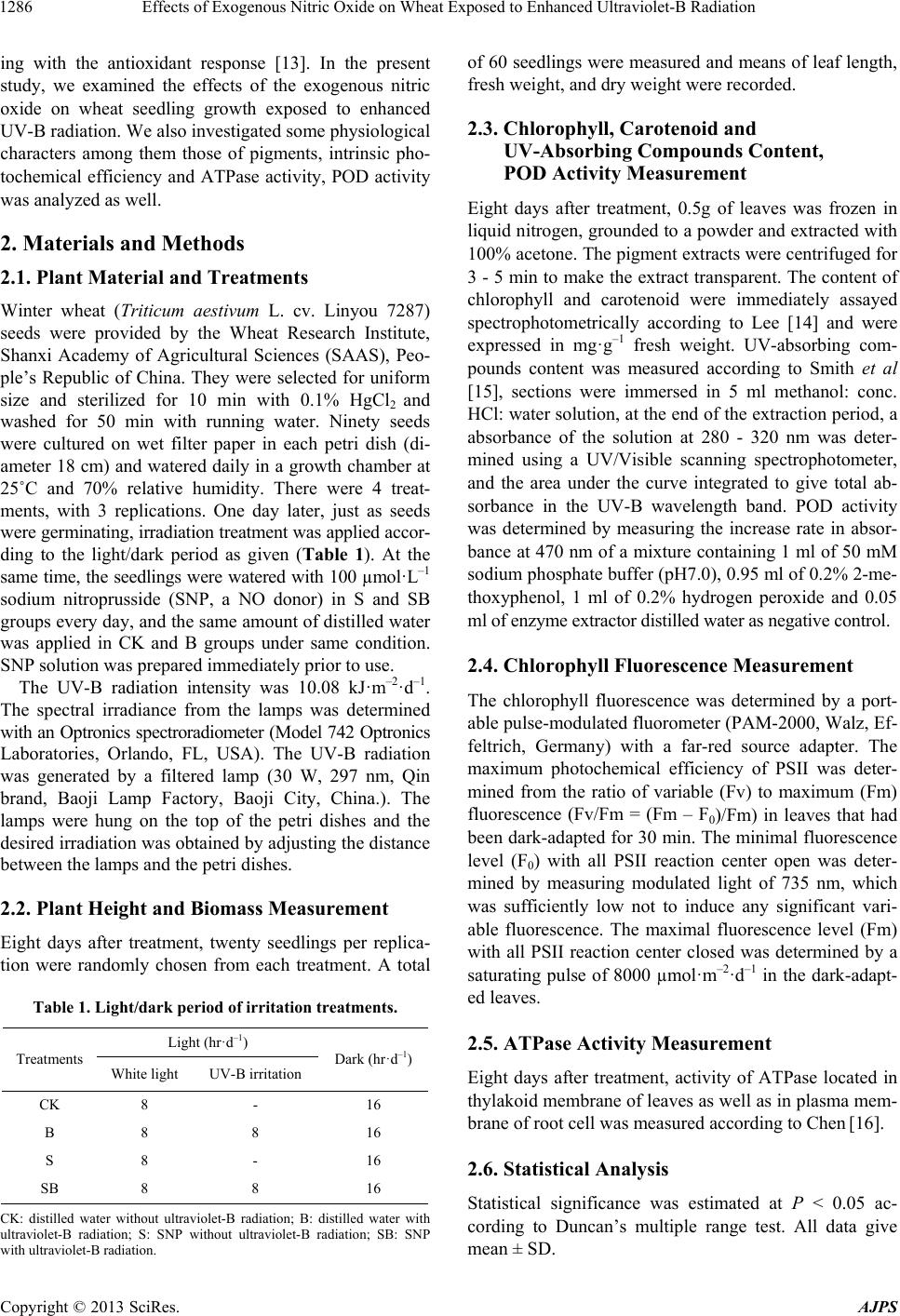 Effects of Exogenous Nitric Oxide on Wheat Exposed to Enhanced Ultraviolet-B Radiation 1286 ing with the antioxidant response [13]. In the present study, we examined the effects of the exogenous nitric oxide on wheat seedling growth exposed to enhanced UV-B radiation. We also investigated some physiological characters among them those of pigments, intrinsic pho- tochemical efficiency and ATPase activity, POD activity was analyzed as well. 2. Materials and Methods 2.1. Plant Material and Treatments Winter wheat (Triticum aestivum L. cv. Linyou 7287) seeds were provided by the Wheat Research Institute, Shanxi Academy of Agricultural Sciences (SAAS), Peo- ple’s Republic of China. They were selected for uniform size and sterilized for 10 min with 0.1% HgCl2 and washed for 50 min with running water. Ninety seeds were cultured on wet filter paper in each petri dish (di- ameter 18 cm) and watered daily in a growth chamber at 25˚C and 70% relative humidity. There were 4 treat- ments, with 3 replications. One day later, just as seeds were germinating, irradiation treatment was applied accor- ding to the light/dark period as given (Table 1). At the same time, the seedlings were watered with 100 µmol·L–1 sodium nitroprusside (SNP, a NO donor) in S and SB groups every day, and the same amount of distilled water was applied in CK and B groups under same condition. SNP solution was prepared immediately prior to use. The UV-B radiation intensity was 10.08 kJ·m–2·d–1. The spectral irradiance from the lamps was determined with an Optronics spectroradiometer (Model 742 Op tronics Laboratories, Orlando, FL, USA). The UV-B radiation was generated by a filtered lamp (30 W, 297 nm, Qin brand, Baoji Lamp Factory, Baoji City, China.). The lamps were hung on the top of the petri dishes and the desired irradiation was obtained by adjusting the distance between the lamps and the petri dishes. 2.2. Plant Height and Biomass Measurement Eight days after treatment, twenty seedlings per replica- tion were randomly chosen from each treatment. A total Table 1. Light/dark period of irritation treatments. Light (hr·d–1) Treatments White light UV-B irritation Dark (hr·d–1) CK 8 - 16 B 8 8 16 S 8 - 16 SB 8 8 16 CK: distilled water without ultraviolet-B radiation; B: distilled water with ultraviolet-B radiation; S: SNP without ultraviolet-B radiation; SB: SNP with ultraviolet-B radiation. of 60 seedlings were measured and means of leaf length, fresh weight, and dry weight were recorded. 2.3. Chlorophyll, Carotenoid and UV-Absorbing Compounds Content, POD Activity Measurement Eight days after treatment, 0.5g of leaves was frozen in liquid nitrogen, grounded to a powder and extracted with 100% acetone. The pigment extracts were centrifuged for 3 - 5 min to make the extract transparent. The content of chlorophyll and carotenoid were immediately assayed spectrophotometrically according to Lee [14] and were expressed in mg·g–1 fresh weight. UV-absorbing com- pounds content was measured according to Smith et al [15], sections were immersed in 5 ml methanol: conc. HCl: water solution, at the end of the extractio n period, a absorbance of the solution at 280 - 320 nm was deter- mined using a UV/Visible scanning spectrophotometer, and the area under the curve integrated to give total ab- sorbance in the UV-B wavelength band. POD activity was determined by measuring the increase rate in absor- bance at 470 nm of a mixture containing 1 ml of 50 mM sodium phosphate buffer (pH7.0), 0.95 ml of 0.2% 2-me- thoxyphenol, 1 ml of 0.2% hydrogen peroxide and 0.05 ml of enzyme extract or disti lled water as negat ive control. 2.4. Chlorophyll Fluorescence Measurement The chlorophyll fluorescence was determined by a port- able pulse-modulated fluorometer (PAM-2000, Walz, Ef- feltrich, Germany) with a far-red source adapter. The maximum photochemical efficiency of PSII was deter- mined from the ratio of variable (Fv) to maximum (Fm) fluorescence (Fv/Fm = (Fm – F0)/Fm) in leaves that had been dark-adapted for 30 min. The minimal fluorescence level (F0) with all PSII reaction center open was deter- mined by measuring modulated light of 735 nm, which was sufficiently low not to induce any significant vari- able fluorescence. The maximal fluorescence level (Fm) with all PSII reaction center closed was determined by a saturating pulse of 8000 µmol·m–2·d–1 in the dark-adapt- ed leaves. 2.5. ATPase Activity Measurement Eight days after treatment, activity of ATPase located in thylakoid membrane of leaves as well as in plasma mem- brane of root cell was measured according to Chen [16]. 2.6. Statistical Analysis Statistical significance was estimated at P < 0.05 ac- cording to Duncan’s multiple range test. All data give mean ± SD. Copyright © 2013 SciRes. AJPS 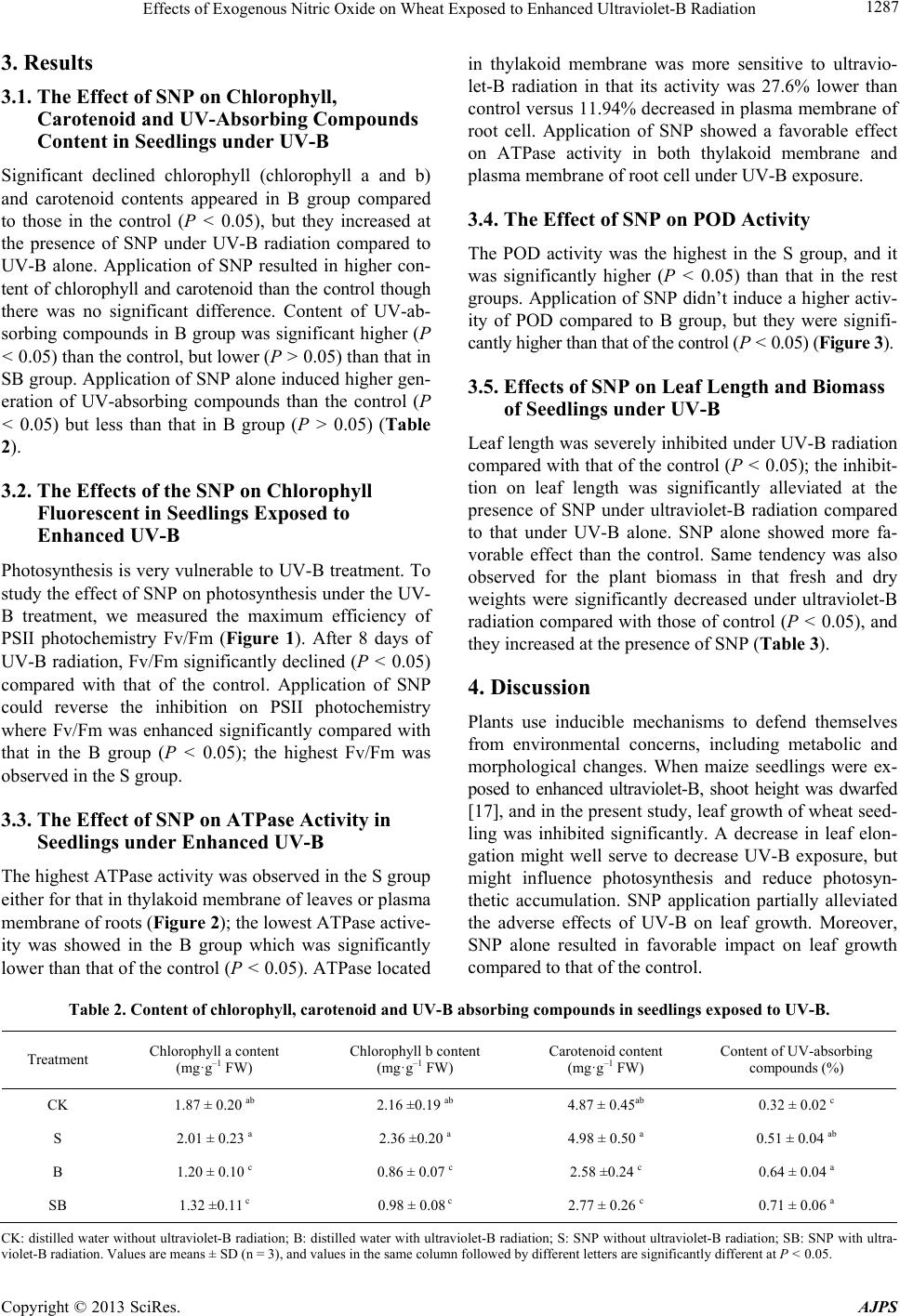 Effects of Exogenous Nitric Oxide on Wheat Exposed to Enhanced Ultraviolet-B Radiation Copyright © 2013 SciRes. AJPS 1287 3. Results 3.1. The Effect of SNP on Chlorophyll, Carotenoid and UV-Absorbing Compounds Content in Seedlings under UV-B Significant declined chlorophyll (chlorophyll a and b) and carotenoid contents appeared in B group compared to those in the control (P < 0.05), but they increased at the presence of SNP under UV-B radiation compared to UV-B alone. Application of SNP resulted in higher con- tent of chlorophyll and carotenoid than the control though there was no significant difference. Content of UV-ab- sorbing compounds in B group was significant higher (P < 0.05) than the contro l, but lower (P > 0.05) than th at in SB group. Application of SNP alon e induced higher gen- eration of UV-absorbing compounds than the control (P < 0.05) but less than that in B group (P > 0.05) (Table 2). 3.2. The Effects of the SNP on Chlorophyll Fluorescent in Seedlings Exposed to Enhanced UV-B Photosynthesis is very vulnerable to UV-B treatment. To study the effect of SNP on photosynthesis under the UV- B treatment, we measured the maximum efficiency of PSII photochemistry Fv/Fm (Figure 1). After 8 days of UV-B radiation, Fv/Fm significantly declined (P < 0.05) compared with that of the control. Application of SNP could reverse the inhibition on PSII photochemistry where Fv/Fm was enhanced significantly compared with that in the B group (P < 0.05); the highest Fv/Fm was observed in the S group. 3.3. The Effect of SNP on ATPase Activity in Seedlings under Enhanced UV-B The highest ATPase activity was observed in the S group either for that in thylakoid membrane of leaves or plasma membrane of roots (Figure 2); the lowest ATPase active- ity was showed in the B group which was significantly lower than that of th e control (P < 0.05). ATPase located in thylakoid membrane was more sensitive to ultravio- let-B radiation in that its activity was 27.6% lower than control versus 11.94% decreased in plasma membrane of root cell. Application of SNP showed a favorable effect on ATPase activity in both thylakoid membrane and plasma membrane of root cell under UV-B exposure. 3.4. The Effect of SNP on POD Activity The POD activity was the highest in the S group, and it was significantly higher (P < 0.05) than that in the rest groups. Application of SNP didn’t induce a higher activ- ity of POD compared to B group, but they were signifi- cantly higher than that of the control (P < 0.05) (Figure 3). 3.5. Effects of SNP on Leaf Length and Biomass of Seedlings under UV-B Leaf length was severely inhibited under UV-B radiation compared with that of the control (P < 0.05); the inhibit- tion on leaf length was significantly alleviated at the presence of SNP under ultraviolet-B radiation compared to that under UV-B alone. SNP alone showed more fa- vorable effect than the control. Same tendency was also observed for the plant biomass in that fresh and dry weights were significantly decreased under ultraviolet-B radiation compared with those of control (P < 0.05), and they increased at the presence of SNP (Table 3). 4. Discussion Plants use inducible mechanisms to defend themselves from environmental concerns, including metabolic and morphological changes. When maize seedlings were ex- posed to enhanced ultraviolet-B, shoot height was dwarfed [17], and in the present study, leaf growth of wheat seed- ling was inhibited significantly. A decrease in leaf elon- gation might well serve to decrease UV-B exposure, but might influence photosynthesis and reduce photosyn- thetic accumulation. SNP application partially alleviated the adverse effects of UV-B on leaf growth. Moreover, SNP alone resulted in favorable impact on leaf growth compared to that of the control. Table 2. Content of chlorophyll, caro te noid and UV-B absorbing compounds in seedlings exposed to UV-B. Treatment Chlorophyll a content (mg·g–1 FW) Chlorophyll b c ontent (mg·g–1 FW) Carotenoid content (mg·g–1 FW) Content of UV-absorbing compounds (% ) CK 1.87 ± 0.20 ab 2.16 ±0.19 ab 4.87 ± 0.45ab 0.32 ± 0.02 c S 2.01 ± 0.23 a 2.36 ±0.20 a 4.98 ± 0.50 a 0.51 ± 0.04 ab B 1. 2 0 ± 0 .10 c 0.86 ± 0.07 c 2.58 ±0.24 c 0.64 ± 0.04 a SB 1.32 ±0.11 c 0.98 ± 0.08 c 2.77 ± 0.26 c 0.71 ± 0.06 a CK: distilled water without ultraviolet-B radiation; B: distilled water with ultraviolet-B radiation; S: SNP without ultraviolet-B radiation; SB: SNP with ultra- violet-B radiation. Values are means ± SD (n = 3), and values in the same column followed by different letters are significantly different at P < 0.05. 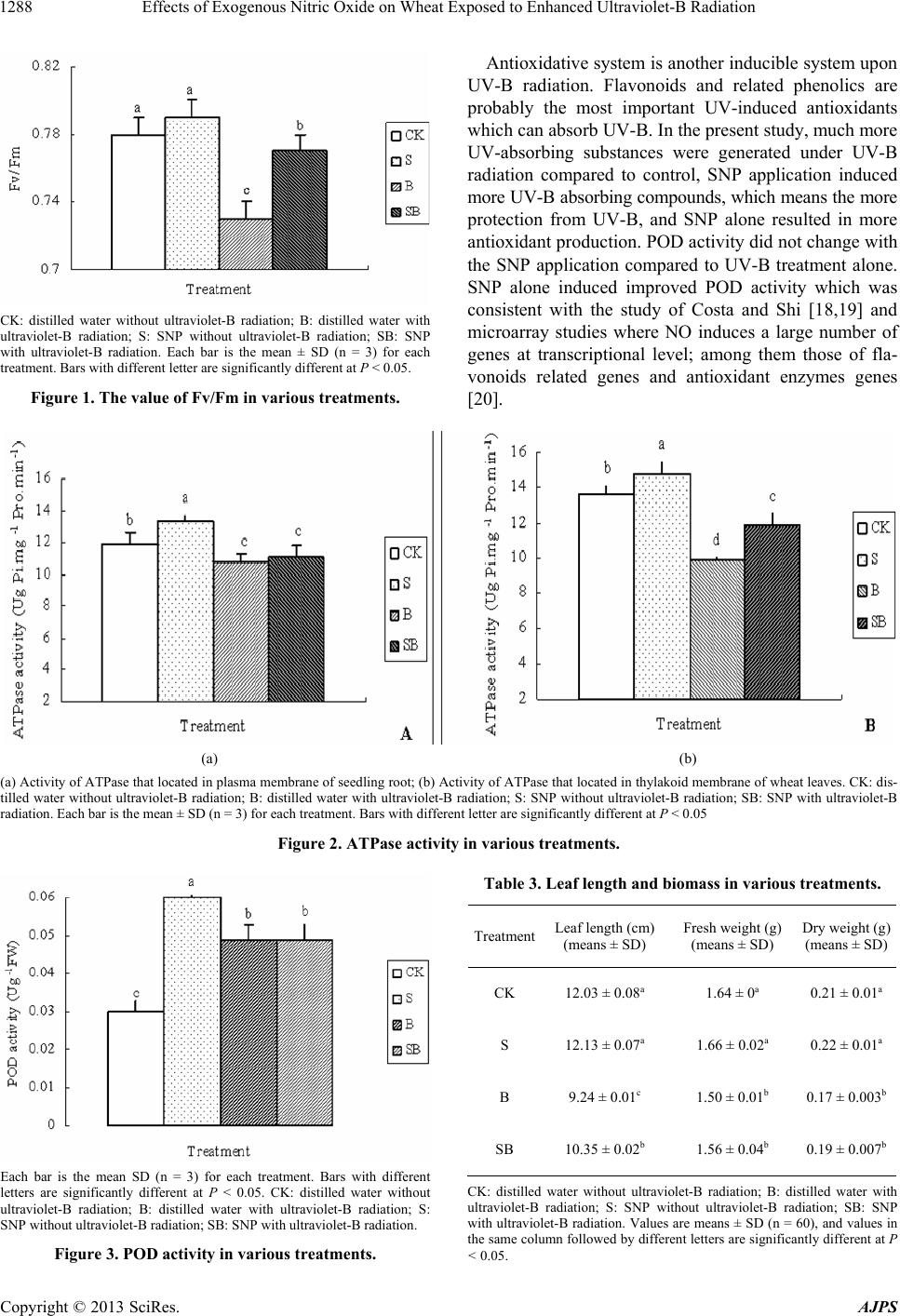 Effects of Exogenous Nitric Oxide on Wheat Exposed to Enhanced Ultraviolet-B Radiation 1288 CK: distilled water without ultraviolet-B radiation; B: distilled water with ultraviolet-B radiation; S: SNP without ultraviolet-B radiation; SB: SNP with ultraviolet-B radiation. Each bar is the mean ± SD (n = 3) for each treatment. Bars with different letter are significantly different at P < 0.05. Figure 1. The value of Fv/Fm in various treatments. Antioxidative system is another inducible system upon UV-B radiation. Flavonoids and related phenolics are probably the most important UV-induced antioxidants which can ab sorb UV-B. In the present study, much mor e UV-absorbing substances were generated under UV-B radiation compared to control, SNP application induced more UV-B absorbing compounds, which means the more protection from UV-B, and SNP alone resulted in more antioxidant production. POD activity did not change with the SNP application compared to UV-B treatment alone. SNP alone induced improved POD activity which was consistent with the study of Costa and Shi [18,19] and microarray studies where NO induces a large number of genes at transcriptional level; among them those of fla- vonoids related genes and antioxidant enzymes genes [20]. (a) (b) (a) Activity of ATPase that located in plasma membrane of seedling root; (b) Activity of ATPase that located in thylakoid membrane of wheat l eaves. CK: d is- tilled water without ultraviolet-B radiation; B: distilled water with ultraviolet-B radiation; S: SNP without ultraviolet-B radiation; SB: SNP with ultraviolet-B radiation. Each bar is the mean ± SD (n = 3) for each treatment. Bars with different letter are significantly different at P < 0.05 Figure 2. ATPase activity in various treatments. Each bar is the mean SD (n = 3) for each treatment. Bars with different letters are significantly different at P < 0.05. CK: distilled water without ultraviolet-B radiation; B: distilled water with ultraviolet-B radiation; S: SNP without ultraviolet -B radiation; SB: SNP with ultraviolet-B radiation. Figure 3. POD activity in various treatments. Table 3. Leaf length and biomass in various treatments. Treatment Leaf length ( cm) (means ± SD) Fresh weight (g) (means ± SD) Dry weight (g) (means ± SD) CK 12.03 ± 0.08a 1.64 ± 0a 0.21 ± 0.01a S 12.13 ± 0.07a 1.66 ± 0.02a 0.22 ± 0.01a B 9.24 ± 0.01c 1.50 ± 0.01b 0.17 ± 0.003b SB 10.35 ± 0.02b 1.56 ± 0.04b 0.19 ± 0.007b CK: distilled water without ultraviolet-B radiation; B: distilled water with ultraviolet-B radiation; S: SNP without ultraviolet-B radiation; SB: SNP with ultraviolet-B radiation. Values are means ± SD (n = 60), and values in the same column followed by different letters are significantly different at P < 0.05. Copyright © 2013 SciRes. AJPS  Effects of Exogenous Nitric Oxide on Wheat Exposed to Enhanced Ultraviolet-B Radiation 1289 Enhanced ultraviolet-B caused reduction of chlorophyll content and resulted in adaptive changes on photosynthetic apparatus such as thylakoid membrane, PSII system [4, 12]. In the present study, we found not only chlorophyll but also carotenoid content decreased under UV-B radia- tion. Carotenoid plays a vital role in the photosynthetic reaction centre where, it provides a mechanism for photo protection against auto-oxidation and they also participate in the energy-transfer process. The loss of carotenoid might negatively influence the photosynthesis. Measure- ment of the maximum efficiency of PSII photochemistry (Fv/Fm) revealed that it decreased under UV-B radiation. The ATP synthase of chloroplasts is an anabolic enzyme which is the prime producer of ATP, using the proton gradient generated by photosynthesis. ATP synthase activity of chloroplasts was significantly inhibited under UV-B radiation compared to that of the control, which implied that the ATP generation might be hampered accordingly. At the presence of SNP, the values of Fv/Fm were higher than that of UV-B treatment alone, so were the contents of chlorophyll and carotenoid, as well as ATPase activity. We attribute those favorable effects of SNP to following: NO, an important signaling molecule, involved in UV-B transduction pathway and plants may use exogenous NO as a protection strategy against ele- vated doses of UV-B. NO may fulfill this function by inducing more antioxidant to absorb UV-B. Decreased UV-B irradiation and peroxidant damage on photosyn- thetic apparatus as PSII and ATPase partially alleviated the inhibition on them caused by UV-B. We also con- clude ATPases of root cell membrane was less sensitive to UV-B, but their activity was declined too, SNP alone showed a more favorable effects compared to the control. 5. Acknowledgements This research project was supported by the Shanxi Scho- larship Council of the People’s Republic of China (2011- 061) and the National Nature Science Foundation of Shanxi Normal University (SMYKZ-18). REFERENCES [1] C. M. Rousseaux, S. D. Flint, P. S. Searles and M. M. Caldwell, “Plant Responses to Current Solar Ultraviolet- B Radiation and Supplemented Solar Ultraviolet-B Ra- diation Simulating Ozone Depletion: An Experimental Comparison,” Photochemistry and Photobiology, Vol. 80, No. 2, 2004, pp. 224-230. [2] P. Majer and É. Hideg, “Developmental Stage Is an Im- portant Factor T hat Determines the Antioxidant Response s of Young and Old Grapevine Leaves under UV Irradia- tion in a Greenhouse,” Plant Physiology and Biochemis- try, Vol. 50, 2011, pp. 15-23. doi:10.1016/j.plaphy.2011.09.018 [3] G. Fabón, L. Monforte, R. Tomás-Las-Heras, E. Núñez- Olivera and J. Martínez-Abaigar, “Dynamic Response of UV-Absorbing Compounds, Quantum Yield and the Xan- thophyll Cycle to Diel Changes in UV-B and Photosyn- thetic Radiations in an Aquatic Liverwort, ” Journal of Plant Physiology, Vol. 169, No. 1, 2012, pp. 20-26. doi:10.1016/j.jplph.2011.08.010 [4] L. Y. Yang, R. Han and Y. Sun, “Damage Repair Effect of He-Ne Laser on Wheat Exposed to Enhanced Ultravio- let-B Radiation,” Plant Physiology and Biochemistry, Vol. 57, 2012, pp. 218-221. doi:10.1016/j.plaphy.2012.06.003 [5] E. M. Aro, I. Virgin and B. Anersson, “Photoinhibition of Photosystem II: Inactivation, Protein Damage and Turn- over,” Biochimica et Biophysica Acta, Vol. 1143, No. 2, 1993, pp. 113-134. doi:10.1016/0005-2728(93)90134-2 [6] A. K. Jansen, V. Gaba and B. Greenberg, “Higher Plants and UV Radiation: Balancing Damage, Repair and Accli- mation,” Trends in Plant Science, Vol. 3, No. 4, 1998, pp. 131-135. doi:10.1016/S1360-1385(98)01215-1 [7] S. A. H. Mackerness, C. F. John, B. Jordan and B. Tho- mas, “Early Signaling Components in Ultraviolet-B Re- sponses: Distinct Roles for Different Reactive Oxygen Species and Nitric Oxide,” FEBS Letters, Vol. 489, No. 2-3, 2001, pp. 237-242. doi:10.1016/S0014-5793(01)02103-2 [8] M. Leitner, E. Vandelle, F. Gaupels, D. Bellin and M. Delledonne, “NO Signals in the Haze: Nitric Oxide Sig- nalling in Plant Defence,” Current Opinion in Plant Bi- ology, Vol. 12, No. 4, 2009, pp. 451-458. doi:10.1016/j.pbi.2009.05.012 [9] M. V. Beligni, and L. Lamattina, “Nitric Oxide Counter- acts Cytotoxic Processes Mediated by Reactive Oxygen Species in Plant Tissues,” Planta, Vol. 208, No. 3, 1999, pp. 337-344. doi:10.1007/s004250050567 [10] C. Garcia-Mata and L. Lamattina, “Nitric Oxide Induces Stomatal Closure and Enhances the Adaptive Plant Re- sponses against Drought Stress,” Plant Physiology, Vol. 126, No. 3, 2001, pp. 1196-1204. doi:10.1104/pp.126.3.1196 [11] C. L. Zeng, L. Liu, B. R. Wang, X. M. Wu and Y. Zhou, “Physiological Effects of Exogenous Nitric Oxide on Brassica juncea Seedlings under NaCl Stress,” Biologia Plantarum, Vol. 55, No. 2, 2011, pp. 345-348. doi:10.1007/s10535-011-0051-5 [12] V. Tossi, C. Lombardo, R. Cassia and L. Lamattina, “Ni- tric Oxide and Flavonoids Are Systemically Induced by UV-B in Maize Leaves,” Plant Science, Vol. 193-194, 2012, pp.103-109. doi:10.1016/j.plantsci.2012.05.012 [13] A. D. Boveris, A. Galatro and S. Puntarulo, “Effect of Nitric Oxide and Plant Antioxidants on Microsomal Con- tent of Lipid Radicals,” Biological Research, Vol. 33, No. 2, 2000, pp. 159-165. doi:10.4067/S0716-97602000000200016 [14] H. S. Lee, “Principles and Experimental Techniques of Plant Physiology and Biochemistry,” Higher Education Press, Beijing, 2000. (in Chinese) [15] J. L. Smith, D. J. Burritt and P. Bannister, “Shoot Dry Weight, Chlorophyll and UV-B-Absorbing Compounds as Indicators of a Plant’s Sensitivity to UV-B Radiation,” Annals of Botany, Vol. 86, No. 6, 2000, pp. 1057-1063. Copyright © 2013 SciRes. AJPS  Effects of Exogenous Nitric Oxide on Wheat Exposed to Enhanced Ultraviolet-B Radiation Copyright © 2013 SciRes. AJPS 1290 doi:10.1006/anbo.2000.1270 [16] H. D. Chen, H. Xu and Y. W. Lian, “Experimental Tech- niques of Modern Plant Physiology,” Science Press, Bei- jing, 2005. (in Chinese) [17] M. Zhang, L. An, H. Feng, T. Chen, K. Chen, Y. H. Liu, H. G. Tang, J. F. Chang and X. L. Wang, “The Cascade Mechanisms of Nitric Oxide as a Second Messenger of Ultraviolet B in Inhibiting Mesocotyl Elongations,” Pho- tochemistry and Photobiology, Vol. 77, No. 2, 2003, pp. 219-225. doi:10.1562/0031-8655(2003)077<0219:TCMONO>2.0. CO;2 [18] H. Costa, S. M. Gallego and M. L .Tomaro, “Effect of UV-B Radiation on Antioxidant Defense System in Sun- flower Cotyledons,” Plant Science, Vol. 162, No. 6, 2001, pp. 939-945. doi:10.1016/S0168-9452(02)00051-1 [19] S. Shi, G. Wang, Y. Wang, L. Zhang and L. Zhang, “Pro- tective Effect of Nitric Oxide against Oxidative Stress under Ultraviolet-B Radiation,” Nitric Oxi de , Vol. 13, No. 1, 2005, pp. 1-9. doi:10.1016/j.niox.2005.04.006 [20] M. Parani, S. Rudrabhatla, R. Myers, H. Weirich, B. Smith, D. W. Leaman and S. Goldman, “Microarray Ana- lysis of Nitric Oxide Responsive Transcripts in Arabidop- sis,” Pl ant Biotechnology Journal, Vol. 2, No. 4, 2004 , p p . 359-366. doi:10.1111/j.1467-7652.2004.00085.x Abbreviation NO: nitric oxide; UV-B: Ultraviolet B; POD: peroxidase; SNP: sodium nitroprusside; ROS: reactive oxygen species; PSII: Photosystem II; ATPase: ATP synthase. |