

Paper Menu >>
Journal Menu >>
 Creative Education 2010. Vol.1, No.3, 135-137 Copyright © 2010 SciRes. DOI:10.4236/ce.2010.13021 Using Integrating Method to Teach Biochemical Pharmacy Technology Chunchao Han School of Pharmacy, Shandong University of Traditional Chinese Medicine, Jinan, P.R China. Email: [email protected] Received December 20th, 2009; revised February 7th, 2010; accepted September 16th, 2010. An integrating method to teach Biochemical Pharmacy Technology was developed to help students understand the technology to produce biochemical pharmacy well in this paper. By the integrating method, students can compare the main content of the biochemical pharmacy and the technology to produce them. Students were en- couraged to demonstrate the connection and difference of the various biochemical pharmacies. The results showed that the performance of students with integrating method is significantly better than that of students without integrating method (p < 0.05). In conclusion, integrating method can enhance students’ performance on Biochemical Pharmacy Technology. Keywords: Curricular Innovations, BPT, BP, Integrating Method Intr od uc t ion Biochemical Pharmacy Technology (BP T) is the major cur- riculum at the School of Pharmacy, Shandong University of Traditional Chinese Medicine in the fourth -professional year of pharmacy students. At this stage of their education, students typically have difficulty grasping all kinds of Biochemical Pharmaceutics (BP). Many students have learned to rely on rote memorization about course material. However, the performance of them is very poor. Approaches reported to facilitate student learning include intermeshing different teaching modes/strate- gies, changing the pace of lectures and active learning, all of which are intended to stimulate student thinking and reflection on the subject matter (Matthews, 1997; Ruhl, Hughes, & Schloss, 1987). Active learning can be approached in numerous ways and, classically, is thought to involve student discussions in small groups (McKeachie, 1999). New method is interac- tive-learning techniques, such as WebCT quizzes (D uska , 2004). However, none of these methods is about how to learn BPT wel l. Integrating method (IM) was selected as a learning process at the School of Pharmacy, Shandong University of Traditional Chinese Medicine si nce 2004. It involves students in meaning- ful learning because the process engages possible affiliation of all kinds of Biochemical Pharmaceutics (BP) to students. The learning tends to be long lasting because the new knowledge is related to and integrated within a person’s existing knowledge. According to the cognitive learning theory, the brain learns most effectively by relating new experiences and knowledge to prior knowledge, and that meaningful learning requires delibe- rate effort to link new knowledge with higher-order, more in- clusive concepts in a person’s cognitive structure (Roth & Roychoudhury, 1993). The interactive compensatory model for learning (ICML) also suggests that prior knowledge is the most important component when predicting whether new learning will be successful. There is widespread agreement that prior knowledge is the largest factor in successful new learning (Shapiro, 2004). Design Learning Objectives Biochemical Pharmacy Technology (BPT) is designed to provide a preparation and analysis of the Biochemical Pharma- ceutics (BP) with an emphasis on the methods to manufacture them. With the approval of the School of Pharmacy, Shandong University of Traditional Chinese Medicine, a primary objec- tive of the IM was first set. It was to help students acquire and retain a sound biochemical pharmaceutical knowledge base, to learn to use indexing and pharmacy literature resources, to know how to prepare the BP and how to control the quality of them. Integrating Method (IM) Steps The students had learned organic chemistry, biochemistry and pharmacology in the former thre e -professional years. It was the prior knowledge to the students. Also, the BP grasped by the students was the prior knowledge, the BP will be learnt is the new experiences. One BP by one BP,all the BPS will be grasped by the students eventually (Figure 1). The main Biochemical Pharmaceutics (BP ) may be included in the Table 1. Firstly, from the Table 1, the students can grasp the main BP according to their chara ct eristic. Secondly, the affiliation and diffe r ence of different Bio- chemical Pharmaceutics (BP) were set up. The affiliation be- tween BPT and the former three subjects was also set up. Fig- ure 2 was the example of Polypeptides. From 2004, the integrating metho d was used in teaching of Biochemical Pharmacy Technology. It was taught by one in- s truc tor. I compared the performance of students taught using an integrating method or a traditional lecture format on tradi- tional exams. 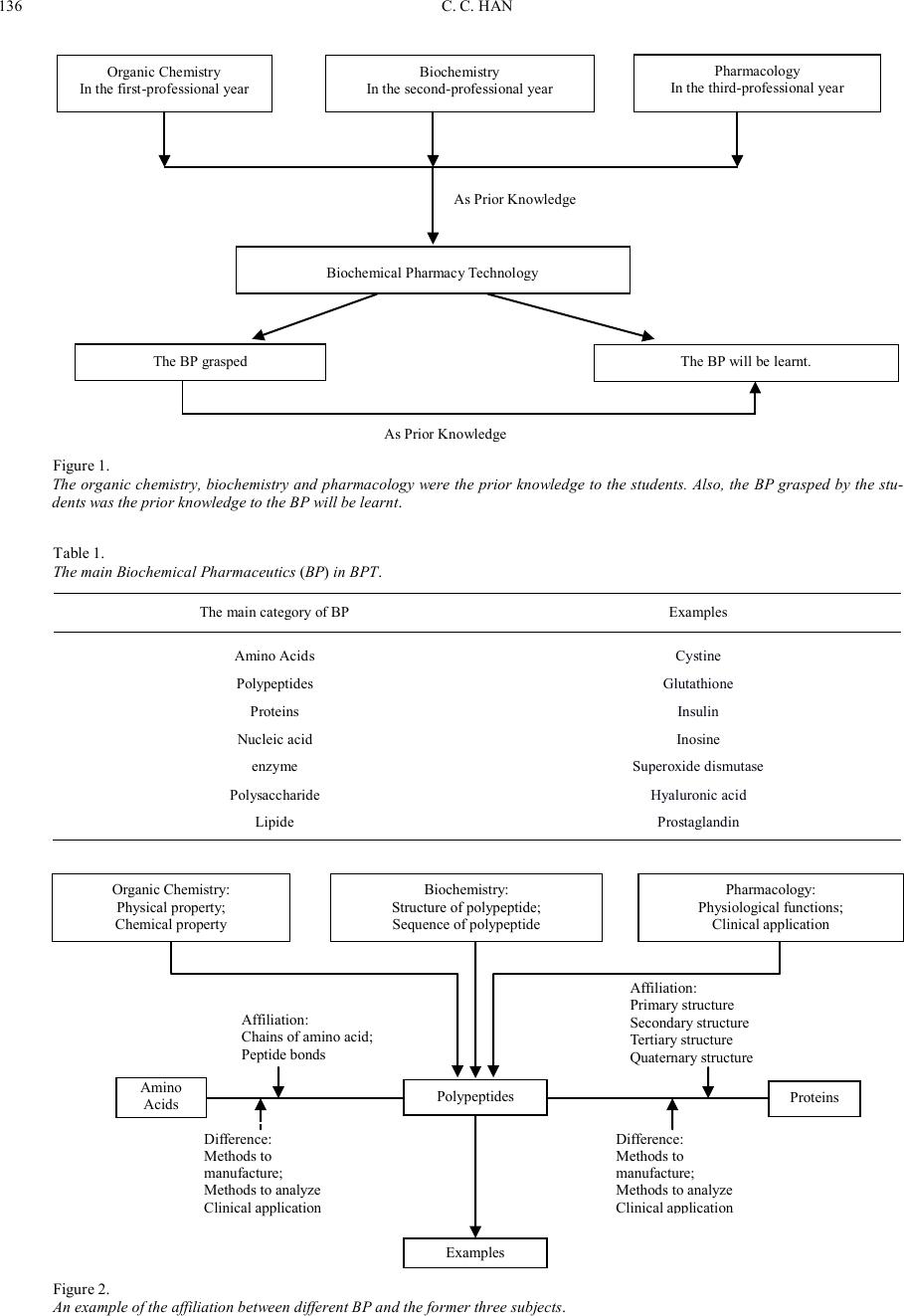 C. C. HAN 136 Organic Chemistry In the first-professional year Biochemistry In the second-professional year Pharmacology In the third-professional year Biochemical Pharmacy Technology As Prior Knowledge The BP grasped The BP will be learnt. As Prior Knowledge Figure 1. The organic chemistry, biochemistry and pharmacology were the prior knowledge to the students. Also, the BP grasped by the stu- dents was the prior knowledge to the BP will be learnt. Table 1. The main Biochemical Pharmaceutics (BP) in BPT. The main category of BP Examples Amino Acids Polypeptides Proteins Nucleic acid enzyme Polysaccharide Lipide Cystine Glutathione Insulin Inosine Superoxide dismutase Hyaluronic acid Prostaglandin Organic Chemistry: Physical property; Chemical property Biochemistry: Structure of polypeptide; Sequence of polypeptide Pharmacology: Physiological functions; Clinical application Amino Acids Proteins Difference: Methods to manufacture; Methods to analyze Clinical application Affiliation: Chains of amino acid; Peptide bonds Difference: Methods to manufacture; Methods to analyze Clinical application Affiliation: Primary structure Secondary structure Tertiary structure Quaternary structure Examples Polypeptides Figure 2. An example of the affiliation between different BP and the former three subjects. 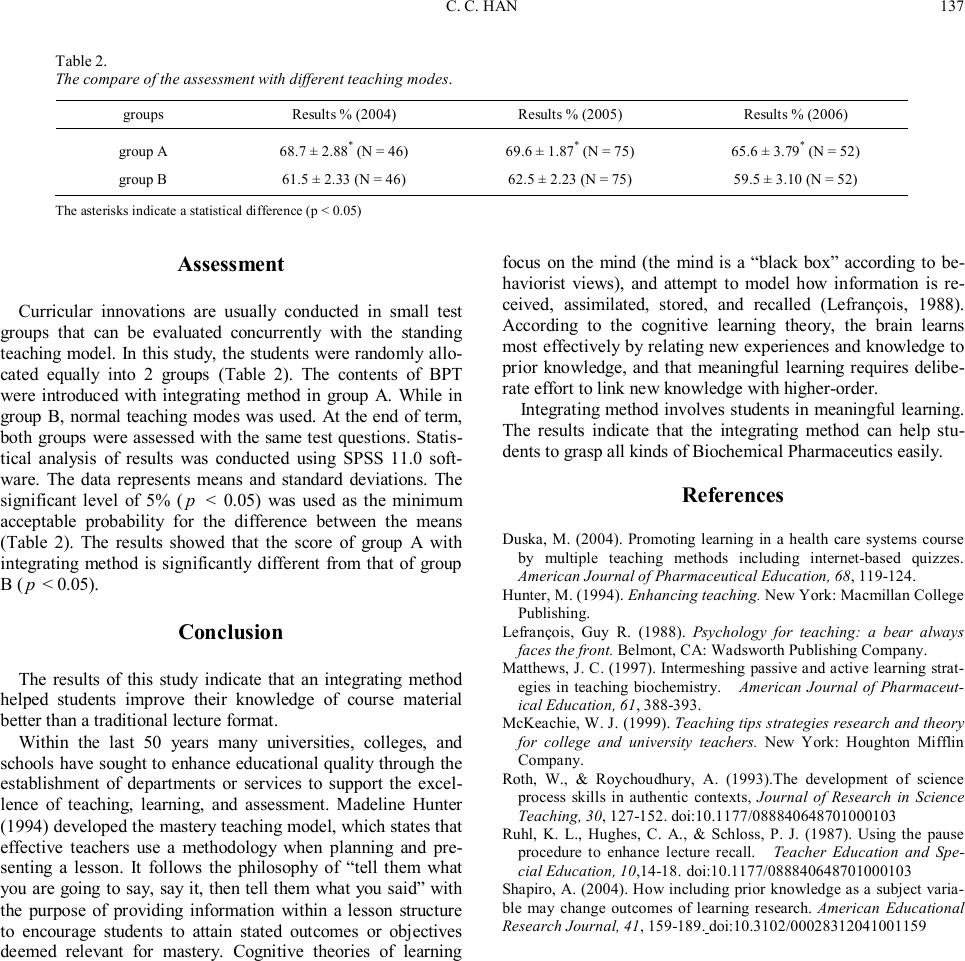 C. C. HAN 137 Table 2. The compare of the assessment with different teaching modes. groups Results % (2004) Results % (2005) Results % (2006) group A group B 68.7 ± 2.88* (N = 46) 61.5 ± 2.33 (N = 46) 69.6 ± 1.87* (N = 75) 62.5 ± 2.23 (N = 75) 65.6 ± 3.79* (N = 52) 59.5 ± 3.10 (N = 52) The asterisks indicate a statistical difference (p < 0. 05) Assessment Curricular innovations are usually conducted in small test groups that can be evaluated concurrently with the standing teaching model. In this study, the students were randomly allo- cated equally into 2 groups (Table 2). The contents of BPT were introduced with integrating method in group A. While in group B, normal teaching modes was used. At the end of term, both groups were assessed with the same test questions. Statis- tical analysis of results was conducted using SPSS 11.0 soft- ware. The data represents means and standard deviations. The significant level of 5% (p < 0.05) was used as the minimum acceptable probability for the difference between the means (Table 2). The results showed that the score of group A with integrating metho d is significantly different from that of group B (p < 0.05 ) . C oncl usi on The results of this study indicate that an integrating method helped students improve their knowledge of course material better than a traditional lecture format. Within the last 50 years many universities, colleges, and schools have sought to enhance educational quality through the establishment of departments or services to support the excel- l ence of teaching, learning, and assessment. Madeline Hunter (1994) developed the mastery teaching model, which states that effective teachers use a methodology when planning and pre- senting a lesson. It follows the philosophy of “tell them what you are going to say, say it, then tell them what you said” with the purpose of providing information within a lesson structure to encourage students to attain stated outcomes or objectives deemed relevant for mastery. Cognitive theories of learning focus on the mind (the mind is a “black box” according to be- haviorist views), and attempt to model how information is re- ceived, assimilated, stored, and recalled (Lefrançois, 1988). According to the cognitive learning theory, the brain learns most effectively by relating new experiences and knowledge to prior knowledge, and that meaningful learning requires delibe- rate effort to link new knowledge with higher -order. Integrating method involves students in meaningful learning. The results indicate that the integrating method can help stu- dents to grasp all kinds of Biochemical Pharmaceutics easi ly. References Duska, M. (2004). Promoting learning in a health care systems course by multiple teaching methods including internet-based quizzes. American Journal of Pharmaceutical Education, 68, 119-124. Hunter, M. (1994). Enhancing teaching. New York: Macmillan College Publishi ng. Lefra nçois, Guy R. (1988). Psychology for teaching: a bear always faces the front. Belmont, CA: Wadsworth Publishing Company. Matt hews, J. C. (1997). Intermeshing passive and active learning strat- egies in teaching biochemistry. American Journal of Pharmaceut- ical Education, 61, 388-393. McKea chie, W. J. (1999). Teaching tips strategies research and theory for college and university teachers. New York: Houghton Mifflin Company. Roth, W., & Roychoudhury, A. (1993).The development of science process skills in authentic contexts, Journal of Research in Science Teaching, 30, 127-152. doi:10.1177/088840648701000103 Ruhl, K. L., Hug hes, C. A., & Schloss, P. J. (1987). Using the pause procedure to enhance lecture recall. Teacher Education and Spe- cial Education, 10,1 4-18. doi:10.1177/088840648701000103 Shapiro, A. (2004). How including prior knowledge as a subject varia- ble may change outcomes of learning research. American Educational Research Journal, 41, 159-189. doi:10.3102/00028312041001159 |