

Paper Menu >>
Journal Menu >>
 Creative Education 2013. Vol.4, No.6A, 23-28 Published Online June 2013 in SciRes (http://www.scirp.org/journal/ce) http://dx.doi.org/10.4236/ce.2013.46A005 Copyright © 2013 SciRes. 23 Investigating the Reliability and Validity of Self and Peer Assessment to Measure Medical Students’ Professional Competencies Tyrone Donnon1, Joann McIlwrick2, Wayne Woloschuk2 1Office of Health Medical Education Scholarship, Faculty of Medicine, University of Calgary, Calgary, Canada 2Office of Undergraduate Medical Education, Faculty of Medicine, University of Calgary, Calgary, Canada Email: [email protected] Received April 10th, 2013; revised May 12th, 2013; accepted May 20th, 2013 Copyright © 2013 Tyrone Donnon et al. This is an open access article distributed under the Creative Commons Attribution License, which permits unrestricted use, distribution, and reproduction in any medium, provided the original work is properly cited. The use of peer assessment through a multisource feedback process has gained recognition as a reliable and valid method to assess the characteristics of professionals and trainees. A total of 168 first-year medical students completed a 15-item questionnaire to self-assess their professional work habits and in- terpersonal abilities. Each student was expected to identify 8 first-year classmates to complete a corre- sponding 15-item peer assessment. Although the self and peer assessment questionnaires had strong reli- ability (Cronbach’s α = 0.85 and 0.91, respectively), an exploratory factor analysis resulted in a 3- and 2- factor solution, respectively. The third factor was associated with items related to students’ personal at- tributes. Significantly lower mean score differences for the self-report assessment were found for all 15 items (Cohen’s d = 0.27 to 1.39, p < 0.001). A decision study analysis found that 7 peer assessors were needed to achieve a generalizability coefficient of 0.70. The findings suggest some inconsistencies in re- gards to the construct validity and stability of measures between self and peer assessment measures. The need for self-awareness of students’ strengths and limitations, however, is recommended as part of their development in a profession that emphasizes self-regulation. Keywords: Self Assessment; Peer Assessment; Multisource Feedback; Medical Students Introduction Professionalism is a cornerstone of medical practice, reflect- ing the qualities we demand of our practitioners and the expec- tations we have for the medical students we accept into the profession (Papadakis et al., 2005). Although there are various approaches that can be used to assess professionalism, the use of direct observation compiled through a 360 degree evaluation or multi-source feedback (MSF) format has been recognized as one of the most effective methods for the assessment of profes- sionalism (Arnold, 2002; Bandiera et al., 2006; ACGME, 2013). Although professionalism is a multi-faceted construct that in- cludes a range of measures from the personal (e.g., ability to self-reflect and regulate), attitudinal (e.g., altruistic, honesty, integrity) and behavioral (e.g., dutifulness, collegiality), the use of MSF has the potential to be used as a formative or summa- tive feedback process for evaluating specific components of professionalism. For example, within the context of medical practice MSF has been shown to be successful in evaluating physicians’ professional attitudes and behaviors from a range of stakeholder perspectives that include other physicians, cowork- ers and the patients’ themselves (Violato & Lockyer, 2006; Allerup et al., 2007; Brinkman et al., 2007; Lockyer & Clyman, 2008). The introduction of MSF at the medical school level to as- sess professional attitudes and behaviours reflects a progressive move towards acknowledging the importance the profession places on this role or core set of competencies (Epstein et al., 2004; ACGME, 2013). There are constrains, however, to in- troducing a MSF process at medical schools in that as students the assessment is restricted to other peers as they are the only other persons that will have observed and know each other well enough. In addition, the peer assessment is constrained by what other students can realistically observe and assess about each other as it relates to the professional attributes displayed through education activities shared mutually. In particular, the peer assessment protocol has shown promise as a reliable and valid method to assess the professional competence of medical students (Epstein et al., 2004; Dannefer et al., 2005). Used in part to assess the domains of competence such as interpersonal, humanistic, and teamwork skills, the 15 item peer assessment form was shown to distinguish between two domains of stu- dents’ professional competence: consistency in their work re- lated habits and interpersonal habits. The subsequent research on the use of the peer assessment protocol with undergraduate medical students has expanded to explore the effects of rater selection (Lurie et al., 2006a), changes in self-perceived abilities among man and women (Lurie et al., 2007a), the relationship between peer assessments and other measures (e.g, Dean’s letter rankings and ratings by internship directors) (Lurie et al., 2007b), and temporal and  T. DONNON ET AL. group-related trends (Lurie et al., 2006b). In each case, the structure of the peer assessment form is premised on the meas- ure of two identified dimensions referred to as work habits and interpersonal abilities. In a qualitative study of the impact that the peer assessment protocol had at the University of Rochester School of Medicine and Dentistry, medical students reported that they found the process transformative and a useful source of feedback that contributed to their own professional devel- opment (Nofziger et al., 2010). In this study, we describe the implementation and results of a formative self and peer assessment protocol as a measure of medical students’ professional competence in their first and second years at a medical school in Canada. The responses were analyzed to determine the reliability (i.e., internal consis- tency, test-retest, and generalizability coefficients) and con- struct validity (i.e., factor analysis) of the self and peer ques- tionnaires and to explore relationships between self and peer assessment ratings. Method Participants As a component of the student feedback process in the un- dergraduate medical education program, a total of 168, first year medical students from the University of Calgary com- pleted an online 15 item, self assessment form during the mid- dle of their first year and, then again, at the middle of their second year. All of the participants were asked to identified 8 classmates to complete a peer assessment version of the ques- tionnaire in their first year using the same 15 items. This study was approved by the Conjoint Health Research Ethics Board of the University of Calgary and signed consent was obtained by all participants. Questionnaire The 15 item Likert form was developed through initial re- search by Dannefer et al. (2005) on a peer assessment protocol to measure medical students’ professional competencies as a function of observable behaviors (Appendix). In particular, their findings supported a two factor or subscale measure with high internal reliability (Cronbach’s alpha greater than 0.80 for each subscale) that assesses students’ professional work habits (WH) and interpersonal abilities (IA). The 15th item is not con- sidered to be connected to either factor or subscale and is treated as an overall assessment of the individual’s potential for professional competency; reflecting on whether or not the as- sessor is concerned about this person’s future patients. The scoring of each item is based on a 5-point scale anchored by descriptors at each end and the option to circle UA for “unable to assess”. For example a score of 1 or 2 for item number 13 states that the person’s “behavior is frequently inappropriate” to options 4 or 5 for “behavior is always appropriate”. Statistical Analysis The construct validity of the self and peer assessment ques- tionnaires were investigated with exploratory factor analysis using principal components and varimax rotated solutions. The internal reliability (Cronbach’s alpha), and generalizability coefficients were calculated in a decision study analysis to de- termine the optimal number of peer assessors required to obtain a generalizability coefficient of greater than 0.70 (Brennan, 2001). A comparison of mean differences between self and peer as- sessment ratings on each of the 15 items was conducted using independent samples t-tests with an effect size difference (Cohen’s d) analysis. The interpretation of the magnitude of the effect size for mean differences is based on Cohen’s (1988) suggestions of d of 0.30 as “small”, d of 0.50 as “medium”, and d of 0.80 as “large”. In addition, for the independent variable sex (men vs. women) mean differences in the self and peer assessments were also investigated using independent samples t-tests and effect size difference analyses. As there have been found to be discrepancies between self and peer assessment on other measures of professional compe- tencies using multisource feedback, medical students’ self as- sessments were classified into quartile categories (i.e., < 25th percentile, 26th to 50th percentile, 51st to 75th percentile, and > 76th percentile) based on their mean total scores across all 15 items on the questionnaire and compared with their corre- sponding peer assessments. Results The Cronbach’s alpha coefficients for the self and peer as- sessments questionnaires were α = 0.85 and 0.91, respectively. An average of 7.5 peer assessment questionnaires were com- pleted for each medical student self assessment. On all 15 of the items shown in Table 1, the mean ratings of the medical stu- dents on the self assessment questionnaire were significantly lower than those on the students’ corresponding peer assess- ment ratings (p < 0.001). Overall, the medical students consis- tently score themselves lower than their peers with a mean ef- fect size difference of d = 0.69 across all 15 items (range from d = 0.27 to 1.39). A large effect size difference (d = 1.17, p < 0.001) was found across a total score comparison between the self and peer assessment groups. On the self assessment questionnaire items women (n = 88, 52%) were significantly more likely to report themselves as having higher “respect, compassion and empathy” [Item #4: M = 4.64 (SD = 0.50), p < 0.01, d = 0.43], “seeks to understand others/sensitivity” [Item #5: M = 4.50 (SD = 0.60), p < 0.05, d = 0.36], “seeks responsibility” [Item #8: M = 4.13 (0.57), p < 0.001, d = 0.53], and “behavior is always appropriate” [Item #13: M = 4.63 (.49), p < 0.01, d = 0.42] than did men (n = 80, 48%). Peer assessors also rated women significantly higher than men on three of these four items but the effect size differ- ences were minimal in comparison: [Item #4: M = 4.73 (SD = 0.52), p < 0.001, d = 0.22], [Item #8: M = 4.60 (.54), p < 0.001, d = 0.18], and [Item #13: M = 4.79 (0.44), p < 0.001, d = 0.21]. In addition, women were rated significant higher than men by their peer assessors on being “consistently well prepared” [Item #1: M = 4.48 (SD = 0.58), p < 0.01, d = 0.16] and that their “dress and appearance was always appropriate for the situation” [Item #12: M = 4.83 (SD = 0.44), p < 0.01, d = 0.15]. On Item #3, however, men students were rated by their peer assessors to be significantly higher on their ability to “explain clearly their reasoning process” [M = 4.58 (SD = 0.58), p < 0.01, d = 0.17] than women. As shown in Figure 1, when students’ self assessment scores were compared with their corresponding peer assessments by quartile groupings, medical students’ in the lowest three quartiles score themselves significantly l wer that their peer assessors o Copyright © 2013 SciRes. 24 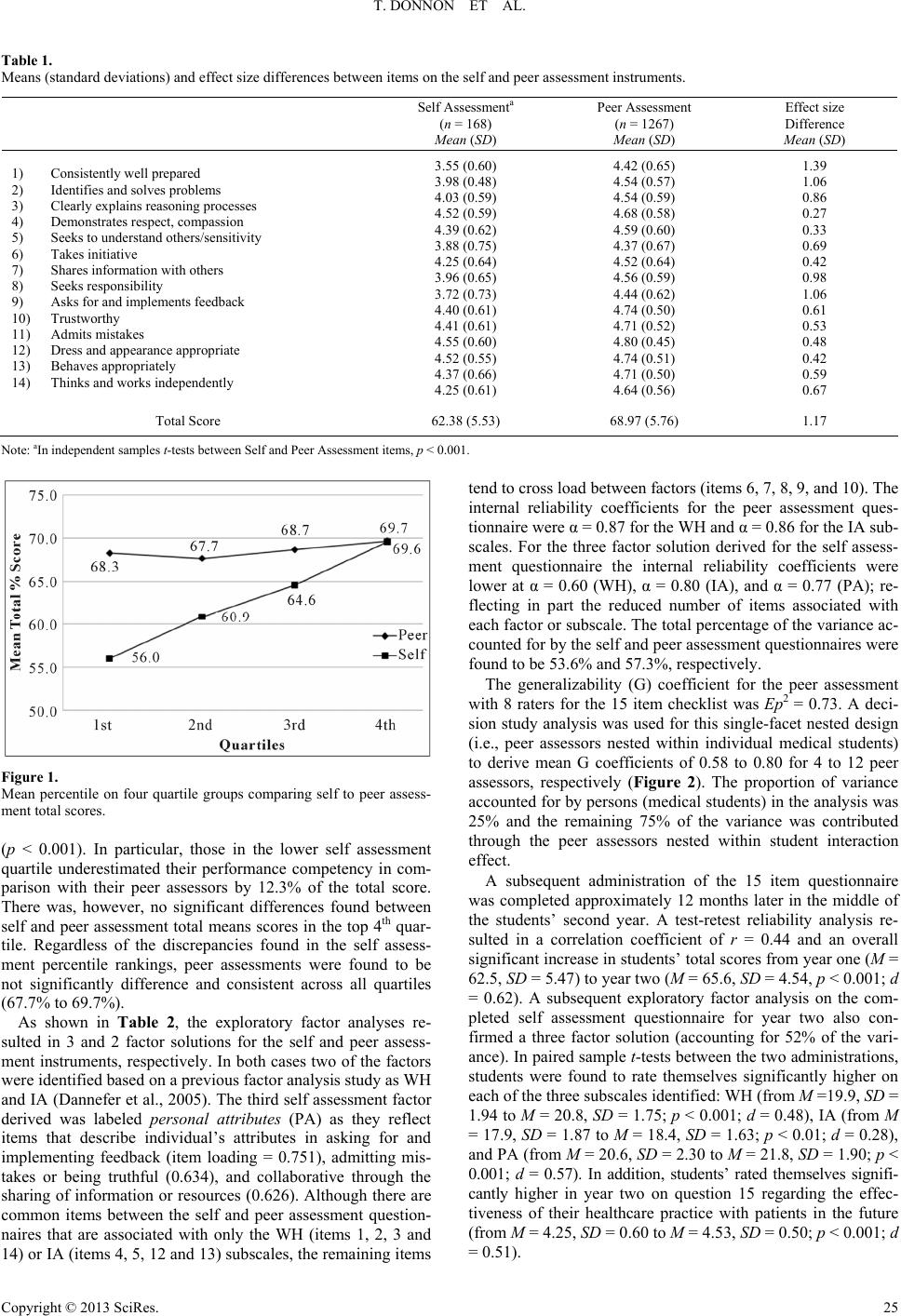 T. DONNON ET AL. Copyright © 2013 SciRes. 25 Table 1. Means (standard deviations) and effect size differences between items on the self and peer assessment instruments. Self Assessmenta (n = 168) Mean (SD) Peer Assessment (n = 1267) Mean (SD) Effect size Difference Mean (SD) 1) Consistently well prepared 2) Identifies and solves problems 3) Clearly explains reasoning processes 4) Demonstrates respect, compassion 5) Seeks to understand others/sensitivity 6) Takes initiative 7) Shares information with others 8) Seeks responsibility 9) Asks for and implements feedback 10) Trustworthy 11) Admits mistakes 12) Dress and appearance appropriate 13) Behaves appropriately 14) Thinks and works independently 3.55 (0.60) 3.98 (0.48) 4.03 (0.59) 4.52 (0.59) 4.39 (0.62) 3.88 (0.75) 4.25 (0.64) 3.96 (0.65) 3.72 (0.73) 4.40 (0.61) 4.41 (0.61) 4.55 (0.60) 4.52 (0.55) 4.37 (0.66) 4.25 (0.61) 4.42 (0.65) 4.54 (0.57) 4.54 (0.59) 4.68 (0.58) 4.59 (0.60) 4.37 (0.67) 4.52 (0.64) 4.56 (0.59) 4.44 (0.62) 4.74 (0.50) 4.71 (0.52) 4.80 (0.45) 4.74 (0.51) 4.71 (0.50) 4.64 (0.56) 1.39 1.06 0.86 0.27 0.33 0.69 0.42 0.98 1.06 0.61 0.53 0.48 0.42 0.59 0.67 Total Score 62.38 (5.53) 68.97 (5.76) 1.17 Note: aIn independent samples t-tests between Self and Peer Assessment items, p < 0.001. tend to cross load between factors (items 6, 7, 8, 9, and 10). The internal reliability coefficients for the peer assessment ques- tionnaire were α = 0.87 for the WH and α = 0.86 for the IA sub- scales. For the three factor solution derived for the self assess- ment questionnaire the internal reliability coefficients were lower at α = 0.60 (WH), α = 0.80 (IA), and α = 0.77 (PA); re- flecting in part the reduced number of items associated with each factor or subscale. The total percentage of the variance ac- counted for by the self and peer assessment questionnaires were found to be 53.6% and 57.3%, respectively. The generalizability (G) coefficient for the peer assessment with 8 raters for the 15 item checklist was Ep2 = 0.73. A deci- sion study analysis was used for this single-facet nested design (i.e., peer assessors nested within individual medical students) to derive mean G coefficients of 0.58 to 0.80 for 4 to 12 peer assessors, respectively (Figure 2). The proportion of variance accounted for by persons (medical students) in the analysis was 25% and the remaining 75% of the variance was contributed through the peer assessors nested within student interaction effect. Figure 1. Mean percentile on four quartile groups comparing self to peer assess- ment total scores. (p < 0.001). In particular, those in the lower self assessment quartile underestimated their performance competency in com- parison with their peer assessors by 12.3% of the total score. There was, however, no significant differences found between self and peer assessment total means scores in the top 4th quar- tile. Regardless of the discrepancies found in the self assess- ment percentile rankings, peer assessments were found to be not significantly difference and consistent across all quartiles (67.7% to 69.7%). A subsequent administration of the 15 item questionnaire was completed approximately 12 months later in the middle of the students’ second year. A test-retest reliability analysis re- sulted in a correlation coefficient of r = 0.44 and an overall significant increase in students’ total scores from year one (M = 62.5, SD = 5.47) to year two (M = 65.6, SD = 4.54, p < 0.001; d = 0.62). A subsequent exploratory factor analysis on the com- pleted self assessment questionnaire for year two also con- firmed a three factor solution (accounting for 52% of the vari- ance). In paired sample t-tests between the two administrations, students were found to rate themselves significantly higher on each of the three subscales identified: WH (from M =19.9, SD = 1.94 to M = 20.8, SD = 1.75; p < 0.001; d = 0.48), IA (from M = 17.9, SD = 1.87 to M = 18.4, SD = 1.63; p < 0.01; d = 0.28), and PA (from M = 20.6, SD = 2.30 to M = 21.8, SD = 1.90; p < 0.001; d = 0.57). In addition, students’ rated themselves signifi- cantly higher in year two on question 15 regarding the effec- tiveness of their healthcare practice with patients in the future (from M = 4.25, SD = 0.60 to M = 4.53, SD = 0.50; p < 0.001; d 0.51). As shown in Table 2, the exploratory factor analyses re- sulted in 3 and 2 factor solutions for the self and peer assess- ment instruments, respectively. In both cases two of the factors were identified based on a previous factor analysis study as WH and IA (Dannefer et al., 2005). The third self assessment factor derived was labeled personal attributes (PA) as they reflect items that describe individual’s attributes in asking for and implementing feedback (item loading = 0.751), admitting mis- takes or being truthful (0.634), and collaborative through the sharing of information or resources (0.626). Although there are common items between the self and peer assessment question- naires that are associated with only the WH (items 1, 2, 3 and 14) or IA (items 4, 5, 12 and 13) subscales, the remaining items = 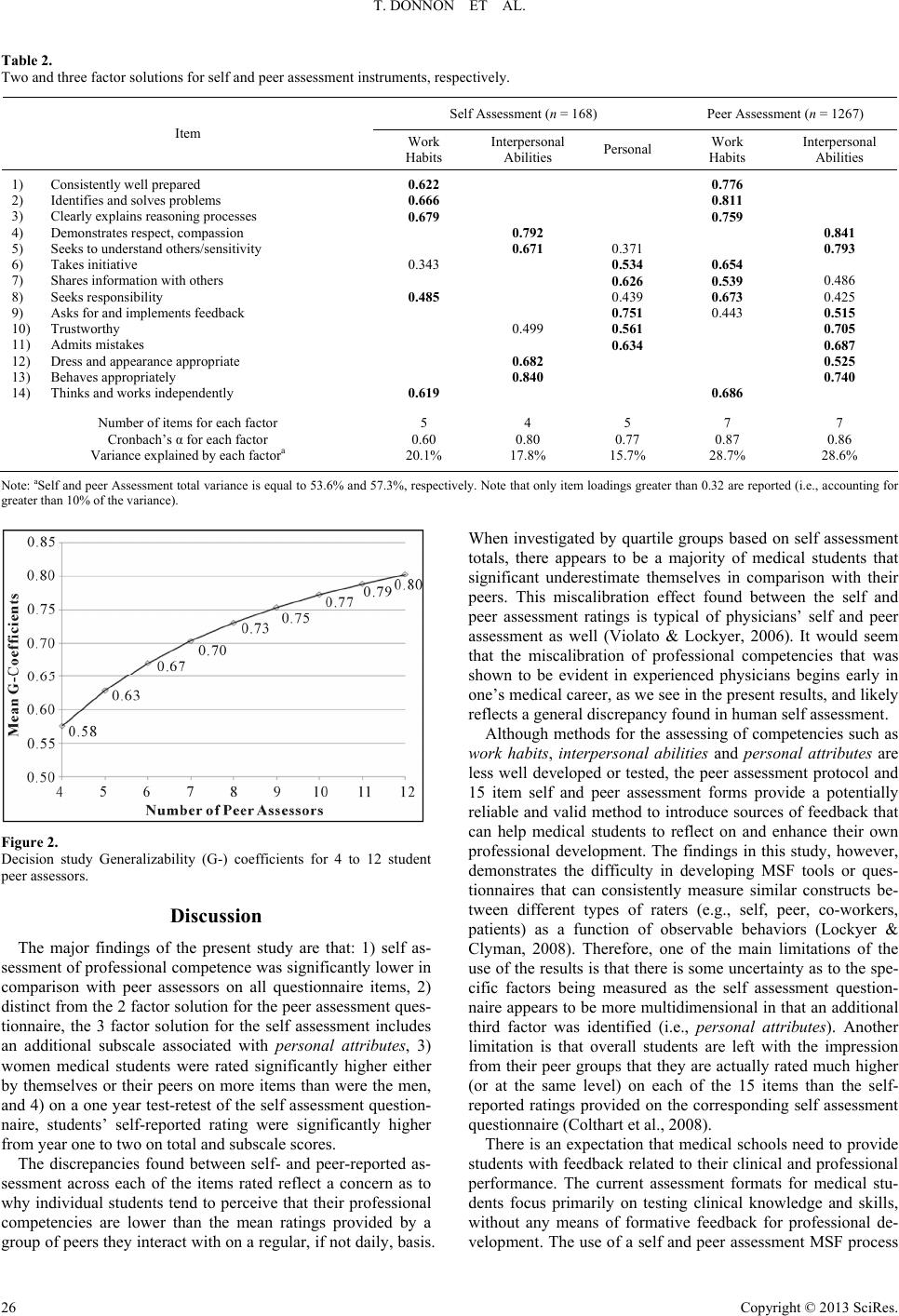 T. DONNON ET AL. Table 2. Two and three factor solutions for self and peer assessment instruments, respectively. Self Assessment (n = 168) Peer Assessment (n = 1267) Item Work Habits Interpersonal Abilities Personal Work Habits Interpersonal Abilities 1) Consistently well prepared 2) Identifies and solves problems 3) Clearly explains reasoning processes 4) Demonstrates respect, compassion 5) Seeks to understand others/sensitivity 6) Takes initiative 7) Shares information with others 8) Seeks responsibility 9) Asks for and implements feedback 10) Trustworthy 11) Admits mistakes 12) Dress and appearance appropriate 13) Behaves appropriately 14) Thinks and works independently 0.622 0.666 0.679 0.343 0.485 0.619 0.792 0.671 0.499 0.682 0.840 0.371 0.534 0.626 0.439 0.751 0.561 0.634 0.776 0.811 0.759 0.654 0.539 0.673 0.443 0.686 0.841 0.793 0.486 0.425 0.515 0.705 0.687 0.525 0.740 Number of items for each factor Cronbach’s α for each factor Variance explained by each factora 5 0.60 20.1% 4 0.80 17.8% 5 0.77 15.7% 7 0.87 28.7% 7 0.86 28.6% Note: aSelf and peer Assessment total variance is equal to 53.6% and 57.3%, respectively. Note that only item loadings greater than 0.32 are reported (i.e., accounting for greater than 10% of the variance). Figure 2. Decision study Generalizability (G-) coefficients for 4 to 12 student peer assessors. Discussion The major findings of the present study are that: 1) self as- sessment of professional competence was significantly lower in comparison with peer assessors on all questionnaire items, 2) distinct from the 2 factor solution for the peer assessment ques- tionnaire, the 3 factor solution for the self assessment includes an additional subscale associated with personal attributes, 3) women medical students were rated significantly higher either by themselves or their peers on more items than were the men, and 4) on a one year test-retest of the self assessment question- naire, students’ self-reported rating were significantly higher from year one to two on total and subscale scores. The discrepancies found between self- and peer-reported as- sessment across each of the items rated reflect a concern as to why individual students tend to perceive that their professional competencies are lower than the mean ratings provided by a group of peers they interact with on a regular, if not daily, basis. When investigated by quartile groups based on self assessment totals, there appears to be a majority of medical students that significant underestimate themselves in comparison with their peers. This miscalibration effect found between the self and peer assessment ratings is typical of physicians’ self and peer assessment as well (Violato & Lockyer, 2006). It would seem that the miscalibration of professional competencies that was shown to be evident in experienced physicians begins early in one’s medical career, as we see in the present results, and likely reflects a general discrepancy found in human self assessment. Although methods for the assessing of competencies such as work habits, interpersonal abilities and personal attributes are less well developed or tested, the peer assessment protocol and 15 item self and peer assessment forms provide a potentially reliable and valid method to introduce sources of feedback that can help medical students to reflect on and enhance their own professional development. The findings in this study, however, demonstrates the difficulty in developing MSF tools or ques- tionnaires that can consistently measure similar constructs be- tween different types of raters (e.g., self, peer, co-workers, patients) as a function of observable behaviors (Lockyer & Clyman, 2008). Therefore, one of the main limitations of the use of the results is that there is some uncertainty as to the spe- cific factors being measured as the self assessment question- naire appears to be more multidimensional in that an additional third factor was identified (i.e., personal attributes). Another limitation is that overall students are left with the impression from their peer groups that they are actually rated much higher (or at the same level) on each of the 15 items than the self- reported ratings provided on the corresponding self assessment questionnaire (Colthart et al., 2008). There is an expectation that medical schools need to provide students with feedback related to their clinical and professional performance. The current assessment formats for medical stu- dents focus primarily on testing clinical knowledge and skills, without any means of formative feedback for professional de- velopment. The use of a self and peer assessment MSF process Copyright © 2013 SciRes. 26 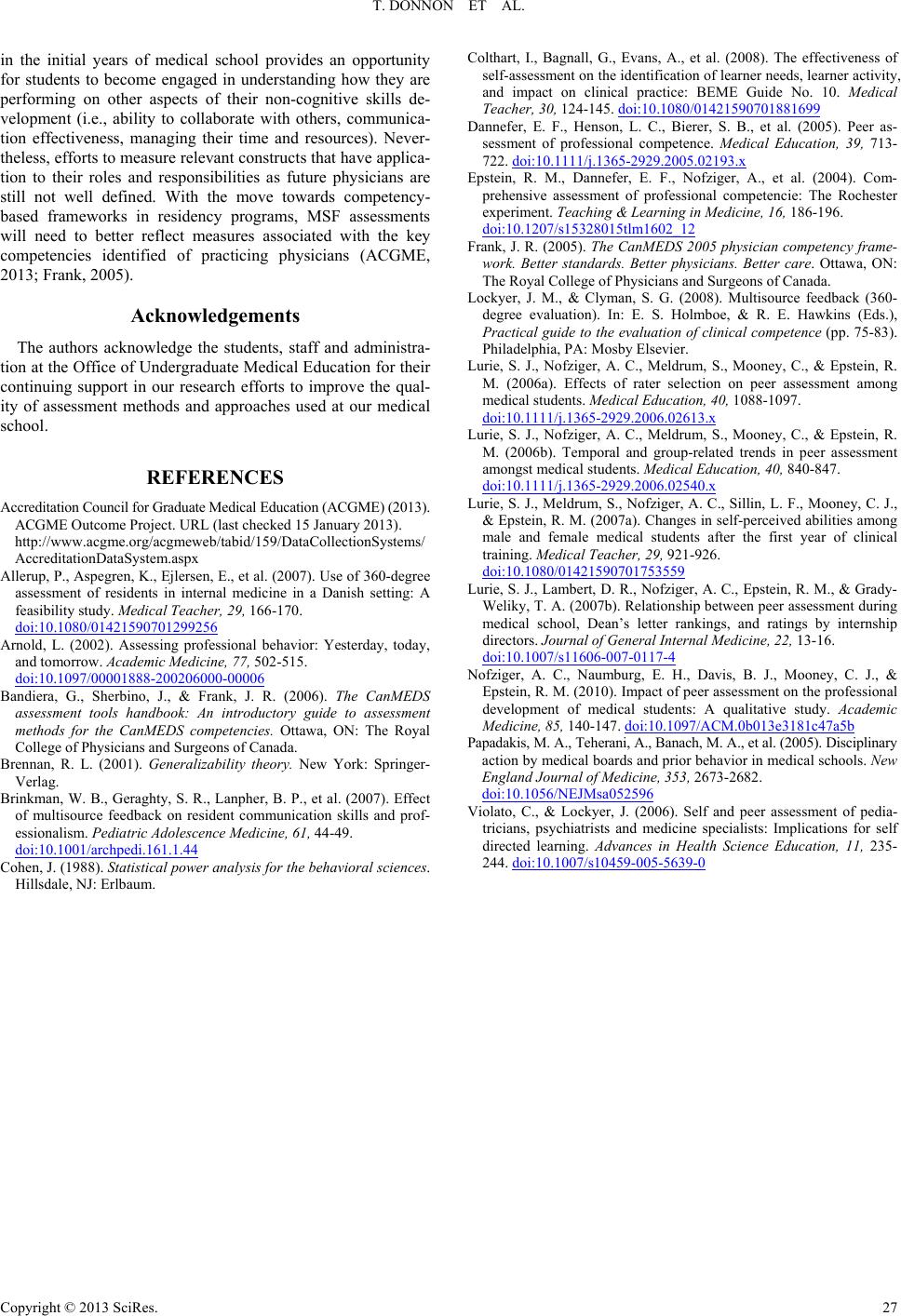 T. DONNON ET AL. in the initial years of medical school provides an opportunity for students to become engaged in understanding how they are performing on other aspects of their non-cognitive skills de- velopment (i.e., ability to collaborate with others, communica- tion effectiveness, managing their time and resources). Never- theless, efforts to measure relevant constructs that have applica- tion to their roles and responsibilities as future physicians are still not well defined. With the move towards competency- based frameworks in residency programs, MSF assessments will need to better reflect measures associated with the key competencies identified of practicing physicians (ACGME, 2013; Frank, 2005). Acknowledgements The authors acknowledge the students, staff and administra- tion at the Office of Undergraduate Medical Education for their continuing support in our research efforts to improve the qual- ity of assessment methods and approaches used at our medical school. REFERENCES Accreditation Council for Graduate Medical Education (ACGME) (2013). ACGME Outcome Project. URL (last checked 15 January 2013). http://www.acgme.org/acgmeweb/tabid/159/DataCollectionSystems/ AccreditationDataSystem.aspx Allerup, P., Aspegren, K., Ejlersen, E., et al. (2007). Use of 360-degree assessment of residents in internal medicine in a Danish setting: A feasibility study. Medical Teacher, 29, 166-170. doi:10.1080/01421590701299256 Arnold, L. (2002). Assessing professional behavior: Yesterday, today, and tomorrow. Academic Medici ne, 77, 502-515. doi:10.1097/00001888-200206000-00006 Bandiera, G., Sherbino, J., & Frank, J. R. (2006). The CanMEDS assessment tools handbook: An introductory guide to assessment methods for the CanMEDS competencies. Ottawa, ON: The Royal College of Physicians and Surgeons of Canada. Brennan, R. L. (2001). Generalizability theory. New York: Springer- Verlag. Brinkman, W. B., Geraghty, S. R., Lanpher, B. P., et al. (2007). Effect of multisource feedback on resident communication skills and prof- essionalism. Pediatric Adolescence Medicine, 61, 44-49. doi:10.1001/archpedi.161.1.44 Cohen, J. (1988). Statistical power analysis for the behavioral sciences. Hillsdale, NJ: Erlbaum. Colthart, I., Bagnall, G., Evans, A., et al. (2008). The effectiveness of self-assessment on the identification of learner needs, learner activity, and impact on clinical practice: BEME Guide No. 10. Medical Teacher, 30, 124-145. doi:10.1080/01421590701881699 Dannefer, E. F., Henson, L. C., Bierer, S. B., et al. (2005). Peer as- sessment of professional competence. Medical Education, 39, 713- 722. doi:10.1111/j.1365-2929.2005.02193.x Epstein, R. M., Dannefer, E. F., Nofziger, A., et al. (2004). Com- prehensive assessment of professional competencie: The Rochester experiment. Teaching & Learning in Medicine, 16, 186-196. doi:10.1207/s15328015tlm1602_12 Frank, J. R. (2005). The CanMEDS 2005 physician competency frame- work. Better standards. Better physicians. Better care. Ottawa, ON: The Royal College of Physicians and Surgeons of Canada. Lockyer, J. M., & Clyman, S. G. (2008). Multisource feedback (360- degree evaluation). In: E. S. Holmboe, & R. E. Hawkins (Eds.), Practical guide to the evaluation of clinical competence (pp. 75-83). Philadelphia, PA: Mosby Elsevier. Lurie, S. J., Nofziger, A. C., Meldrum, S., Mooney, C., & Epstein, R. M. (2006a). Effects of rater selection on peer assessment among medical students. Medical Education, 40, 1088-1097. doi:10.1111/j.1365-2929.2006.02613.x Lurie, S. J., Nofziger, A. C., Meldrum, S., Mooney, C., & Epstein, R. M. (2006b). Temporal and group-related trends in peer assessment amongst medical students. Medical E du ca tio n, 40, 840-847. doi:10.1111/j.1365-2929.2006.02540.x Lurie, S. J., Meldrum, S., Nofziger, A. C., Sillin, L. F., Mooney, C. J., & Epstein, R. M. (2007a). Changes in self-perceived abilities among male and female medical students after the first year of clinical training. Medical Teacher, 29, 921-926. doi:10.1080/01421590701753559 Lurie, S. J., Lambert, D. R., Nofziger, A. C., Epstein, R. M., & Grady- Weliky, T. A. (2007b). Relationship between peer assessment during medical school, Dean’s letter rankings, and ratings by internship directors. Jou r n a l o f G e n e r a l Internal Medicine, 22, 13-16. doi:10.1007/s11606-007-0117-4 Nofziger, A. C., Naumburg, E. H., Davis, B. J., Mooney, C. J., & Epstein, R. M. (2010). Impact of peer assessment on the professional development of medical students: A qualitative study. Academic Medicine, 85, 140-147. doi:10.1097/ACM.0b013e3181c47a5b Papadakis, M. A., Teherani, A., Banach, M. A., et al. (2005). Disciplinary action by medical boards and prior behavior in medical schools. New England Journal of Medicine, 353, 2673-2682. doi:10.1056/NEJMsa052596 Violato, C., & Lockyer, J. (2006). Self and peer assessment of pedia- tricians, psychiatrists and medicine specialists: Implications for self directed learning. Advances in Health Science Education, 11, 235- 244. doi:10.1007/s10459-005-5639-0 Copyright © 2013 SciRes. 27 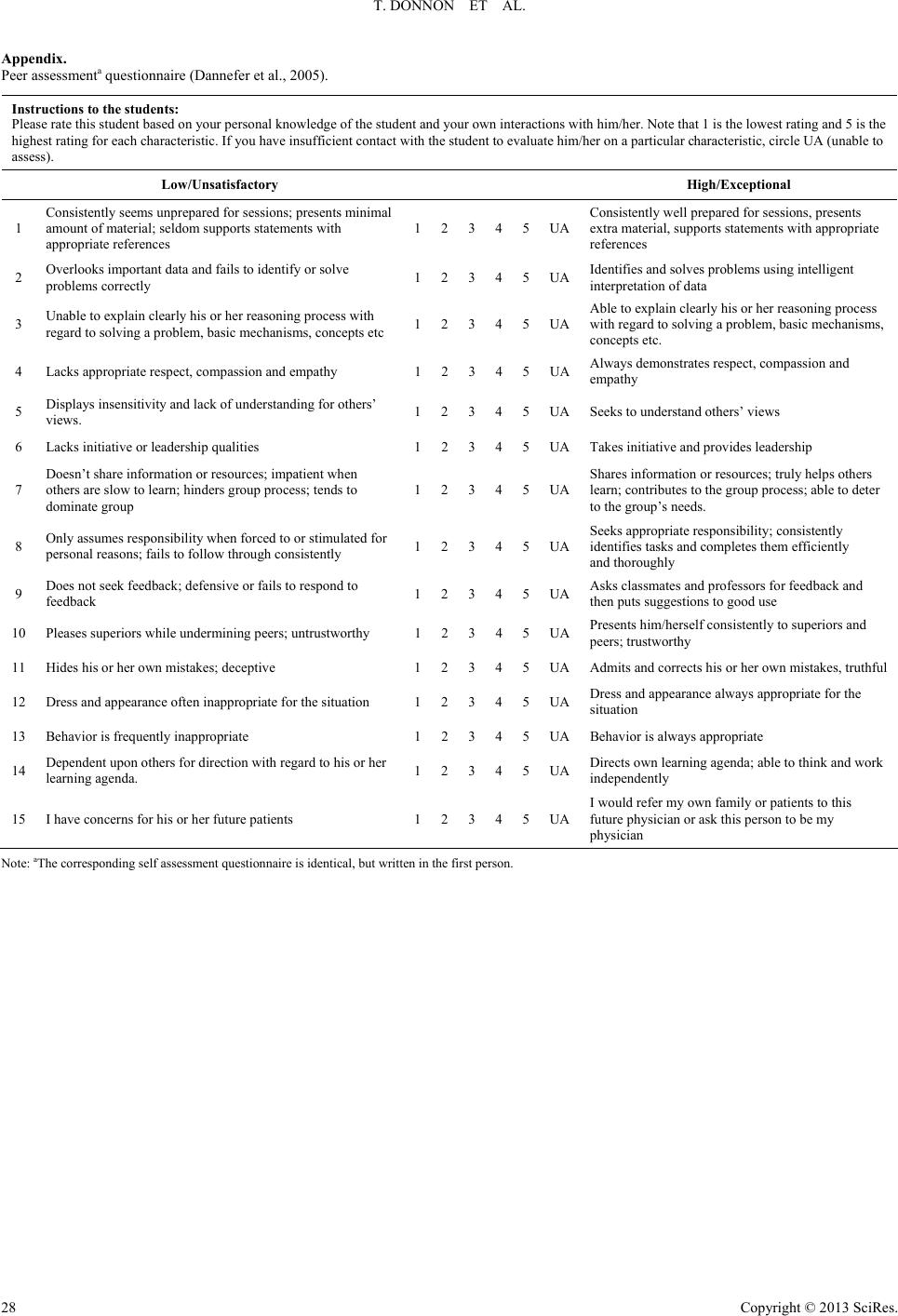 T. DONNON ET AL. Appendix. Peer assessmenta questionnaire (Dannefer et al., 2005). Instructions to the students: Please rate this student based on your personal knowledge of the student and your own interactions with him/her. Note that 1 is the lowest rating and 5 is the highest rating for each characteristic. If you have insufficient contact with the student to evaluate him/her on a particular characteristic, circle UA (unable to assess). Low/Unsatisfactory High/Exceptional 1 Consistently seems unprepared for sessions; presents minimal amount of material; seldom supports statements with appropriate references 12345UA Consistently well prepared for sessions, presents extra material, supports statements with appropriate references 2 Overlooks important data and fails to identify or solve problems correctly 12345UAIdentifies and solves problems using intelligent interpretation of data 3 Unable to explain clearly his or her reasoning process with regard to solving a problem, basic mechanisms, concepts etc 12345UA Able to explain clearly his or her reasoning process with regard to solving a problem, basic mechanisms, concepts etc. 4 Lacks appropriate respect, compassion and empathy 12345UAAlways demonstrates respect, compassion and empathy 5 Displays insensitivity and lack of understanding for others’ views. 12345UASeeks to understand others’ views 6 Lacks initiative or leadership qualities 12345UATakes initiative and provides leadership 7 Doesn’t share information or resources; impatient when others are slow to learn; hinders group process; tends to dominate group 12345UA Shares information or resources; truly helps others learn; contributes to the group process; able to deter to the group’s needs. 8 Only assumes responsibility when forced to or stimulated for personal reasons; fails to follow through consistently 12345UA Seeks appropriate responsibility; consistently identifies tasks and completes them efficiently and thoroughly 9 Does not seek feedback; defensive or fails to respond to feedback 12345UAAsks classmates and professors for feedback and then puts suggestions to good use 10 Pleases superiors while undermining peers; untrustworthy 12345UAPresents him/herself consistently to superiors and peers; trustworthy 11 Hides his or her own mistakes; deceptive 12345UAAdmits and corrects his or her own mistakes, truthful 12 Dress and appearance often inappropriate for the situation 12345UADress and appearance always appropriate for the situation 13 Behavior is frequently inappropriate 12345UABehavior is always appropriate 14 Dependent upon others for direction with regard to his or her learning agenda. 12345UADirects own learning agenda; able to think and work independently 15 I have concerns for his or her future patients 12345UA I would refer my own family or patients to this future physician or ask this person to be my physician Note: aThe corresponding self assessment questionnaire is identical, but written in the first person. Copyright © 2013 SciRes. 28 |