

Paper Menu >>
Journal Menu >>
 Creative Education 2013. Vol.4, No.6A, 1-8 Published Online June 2013 in SciRes (http://www.scirp.org/journal/ce) http://dx.doi.org/10.4236/ce.2013.46A001 Copyright © 2013 SciRes. 1 Mechanism of Discerning Similarities in Psychiatric Diagnoses Haim Eshach Ben Gurion University of t he Ne ge v , Beer Sheva, Israel Email: [email protected] Received April 23rd, 20 1 3; revised May 23rd, 2013; accepted May 3 1st, 2013 Copyright © 2013 Haim Eshach. This is an open access article distributed under the Creative Commons Attribu- tion License, which permits unrestr ic ted u se, distribution, and r eproduction in any medium, provided the original work is properly cited. Psychiatrists use similarities to make diagnoses in situations where rules are insufficient. The purpose of this study was to examine the criteria psychiatrists use to determine similarity between cases of personal- ity disorder. Psychiatrists were provided with cases and were interviewed according to Kelly’s method. Cognitive science theories were used to explain the criteria identified. Results indicated that similarity de- cisions include idiosyncratic criteria. These results add to the current understanding of medical prob- lem-solving processes and have implications for medical education. Keywords: Similarity; Psychiatric Diagnoses; Medical Education Introduction Clinical reasoning, a highly complex phenomenon (Higgs & Jones, 1995), is defined as the thinking processes occurring while dealing with a clinical case (Boshuizen & Schmidt, 1995). The problems that patients present can be confusing and con- tradictory, characterized by imperfect, inconsistent, or even inaccurate information (Kassirer & Kopelman, 1991; Eshach & Bitterman, 2002). In addition, medical problems are often poorly defined (Barrows & Feltovich, 1987). Not only is much irrelevant information present, but relevant information about the case is often missing and does not become apparent until after problem solving has begun (Voss & Post, 1988). In such cases, it is difficult to specify the state from which one can start, to identify the medical interventions that might be applicable, or even to recognize when the goal has been achieved. In other words, many medical problems are ill-defined. Moreover, in many situations, the deterministic mechanisms that account for the medical problems are not completely understood (Williams, 1992). In other words, many medical domains are “ill-domain theories”. Despite the uncertainty and variation that character- ize physicians’ work they have to diagnose and treat such ill- nesses. In order to do this, physicians use different types of reasoning e.g. rule-based reasoning and similarity-based rea- soning. In the following paragraphs I first explain why person- ality disorder realm was chosen for the purpose of this study. Secondly I explain why rule-based reasoning cannot alone ex- plain the variety of medical decision making processes. Third, I argue that similarity decisions may be effective to solve ill-defined problems in ill domains. I then suggest to study the factors according which similarities are made. Personality Disorders as the Focus of the Study The etiology and pathogenesis of most personality disorders are not known; psychiatrists therefore tend to resort to phe- nomenological, descriptive criteria in the diagnosis of these conditions. Many of the definitions provided in the Diagnostic and Statistical Manual of Mental Disorders (DSM-IV) (Ameri- can Psychiatric Association, 1994) are set up in a format whereby an individual must have a subset of several features in order to be diagnosed. Thus, for the nine DSM-IV diagnostic features of borderline personality, for instance, at least five of which are required for diagnosis, there are 256 different criteria combinations that can result in this diagnosis (Morey, 1998). In addition, the study of personality disorder leads into areas in which the distinction between health and sickness is inherently ambiguous and is potentially biased by societal norms and per- sonal values. To a large extent, whether persons are considered to have a personality disorder depends on whether their person- ality traits are noxious to the society in which they live and, in particular, to the persons with whom they most frequently in- teract (Kaplan & Sadock, 1996). This means that formal diag- nostic systems such as the DSM-IV, which define rules to cate- gorize discrete pathological entities, are not sufficient and can- not always lead to the diagnosis of the personality disorder. Despite the uncertainty and variation that characterize personal- ity disorders, psychiatrists have to diagnose and treat them. It is my assumption that perceiving similarities, an ability that is one of the most fundamental aspects of human cognition (Vos- niadou & Ortony, 1989), is used by psychiatrists in the diag- nostic and treating of personality disorders. Domain Rule -Based Rea soning In order to better understand this phenomenon one should first distinguish between domain rule-based reasoning (RBR) and the use of a rule or rules in problem solving. The former is identified as the process of drawing conclusions by chaining together generalized rules, starting from scratch (Leake, 1996). The latter, on the other hand does not require starting from scratch nor does it require chaining together rules. For the pur- pose of this study I will focus on RBR processes. RBR models are rooted in the philosophical belief that humans are rational  H. ESHACH beings and that the laws of logic are the laws of thoughts (Ey- senck & Keane, 1995). According to Kolodner (1993), although some rules are very specific, the goal is to formulate rules that are generally applicable. An important advantage of rules is the economy of storage they allow. But general knowledge has the problem of applicability (Mostow, 1983), i.e., the bringing of some general piece of knowledge to a particular situation. When rules are expressed too abstractly, the terms tend to be unintelligible to the novice and to mean a variety of specific things to the expert. Also, in ill-defined domains, the rules do not encompass all the situations they are asked or assumed to cover, admit tacit exceptions, or can be contradicted and an- nulled by other rules (Rissland & Skalak, 1991). Limited mental capacity is another reason why RBR alone cannot explain the human problem-solving processes. RBR, which requires that the problem solver take into account all the domain rules, is not capable of doing that in real-life situations (BarOn, 1993), as the number of rules required for solving a problem may be unmanageably large (Leake, 1996). Similarity based reasoning offers an attractive way out of these difficulties. Rather than having to patch up abstract rules with endless sub-rules, according to similarity-based models of reasoning, problem solving depend, especially while working in ill-do- mains theories and ill problems, on the ability to identify the most relevant bodies of knowledge that already exist in mem- ory so that this knowledge can be used as a starting point for encounter the novel situation. I do not focus on a particular model such as the prototype models, the exampler models, connectionist models and the probabilistic models, but rather relate to the similarities underlying all these kinds of models. Similarity Rumelhart (1989) claims that most everyday reasoning probably involves assimilating the novel problem to other situations in which the solutions are known—that is, reasoning by similarity. He further suggests that the reason for the impor- tant role of reasoning by similarity is the essential human abil- ity for pattern matching. “We seem to be able to ‘settle’ quickly on interpretation of an input pattern. This is an ability that is central to perceiving, remembering, comprehending, and rea- soning by similarity. Our ability to pattern—much is probably not something that sets humans apart from other animals but is probably the essential component to most cognitive behavior” (Rumelhart, 1989: p. 300). Support for similarity processes can be found in cognitive neurosciences research. This indicates that different neural circuits are involved when people catego- rize items on the basis of a rule, as compared with when they categorize the same items on the basis of similarity (Kolodny, 1994). The term “similarity”, which typically refers to the outcome of comparison among entities, can be regarded as a form of judgment—what people say when asked to compare different entities (Sloman & Rips, 1998). Goodman (1972) argues that claiming that two things are similar is uninformative until we specify in what respect they are similar. According to Gold- stone (1994) people do not usually compare objects only in a single respect such as “size” but along multiple dimensions such as size, color, shape, etc. Kelly (1955a) claims that two things are “similar”, “alike”, or “identical” obviously means that they are alike in some particular way or ways, but, of course, never in every way. Their alikeness makes no sense unless it also serves to distinguish them from certain other things. Thus, according to Kelly, likeness always implies a difference. At the same time, the way in which two things are different must, if it is to make any sense at all, be the way in which at least one of them is like a third thing. Aims This study focused on understanding the process of how pro- fessionals find similarities between cases. The following ques- tions are therefore addressed: 1) What are the differences between the various diagnoses given by psychiatrists to given cases? 2) What are the criteria that psychiatrists use to decide on similarities between cases? Method Participants Nine psychiatrists at different levels of medical experience were chosen for this study. Participant 1: 20 years’ experience; Participant 2: 6 years’ experience; Participant 3: 7 years’ experience; Participant 4: 10 years’ experience; Participant 5: 5 years’ experience; Par- ticipant 6: 2 years’ experience; Participant 7: 4 years’ experi- ence; Participant 8: 5 years’ experience; Participant 9: 5 years’ experience. Procedure 1) Nine patients diagnosed as suffering from personality dis- orders according to DSM-IV criteria who agreed to participate in the study were identified. The following list describes the diagnosis given by the department in which the patients were treated: a) Narcissistic personality disorder with dependent traits; b) Borderline personality disorder with narcissistic traits; c) Narcissistic personality disorder; d) Borderline personality disorder; e) Narcissistic personality disorder; f) Dependent personality disorder; g) Narcissistic personality with obsessive traits; h) Obsessive-compulsive disorder; i) Borderline personality with narcissistic traits. A psychiatrist who was very familiar with all the cases con- ducted an introductory interview with each one of the patients. This enabled him to extract the maximum and most pertinent information from each case. The interviews lasted between 20 and 25 minutes. The interviews were videotaped and tran- scribed. Transcripts of each interview were used as cases in- troduced to the participants. 2) The transcripts of the nine cases were presented to each of the participants, all of whom were unfamiliar with the nine patients. The participants were each instructed to do the fol- lowing1: a) Diagnose each case. The participants were asked to think aloud while diagnosing the cases. These sessions were tape- recorded, and verbatim transcripts were produced. b) Group cases according to important similarities of their own choice. 1This idea is the basis for Kelly’s (1955) repertory test, from which we have drawn the interviews described in the method for the current research. Copyright © 2013 SciRes. 2 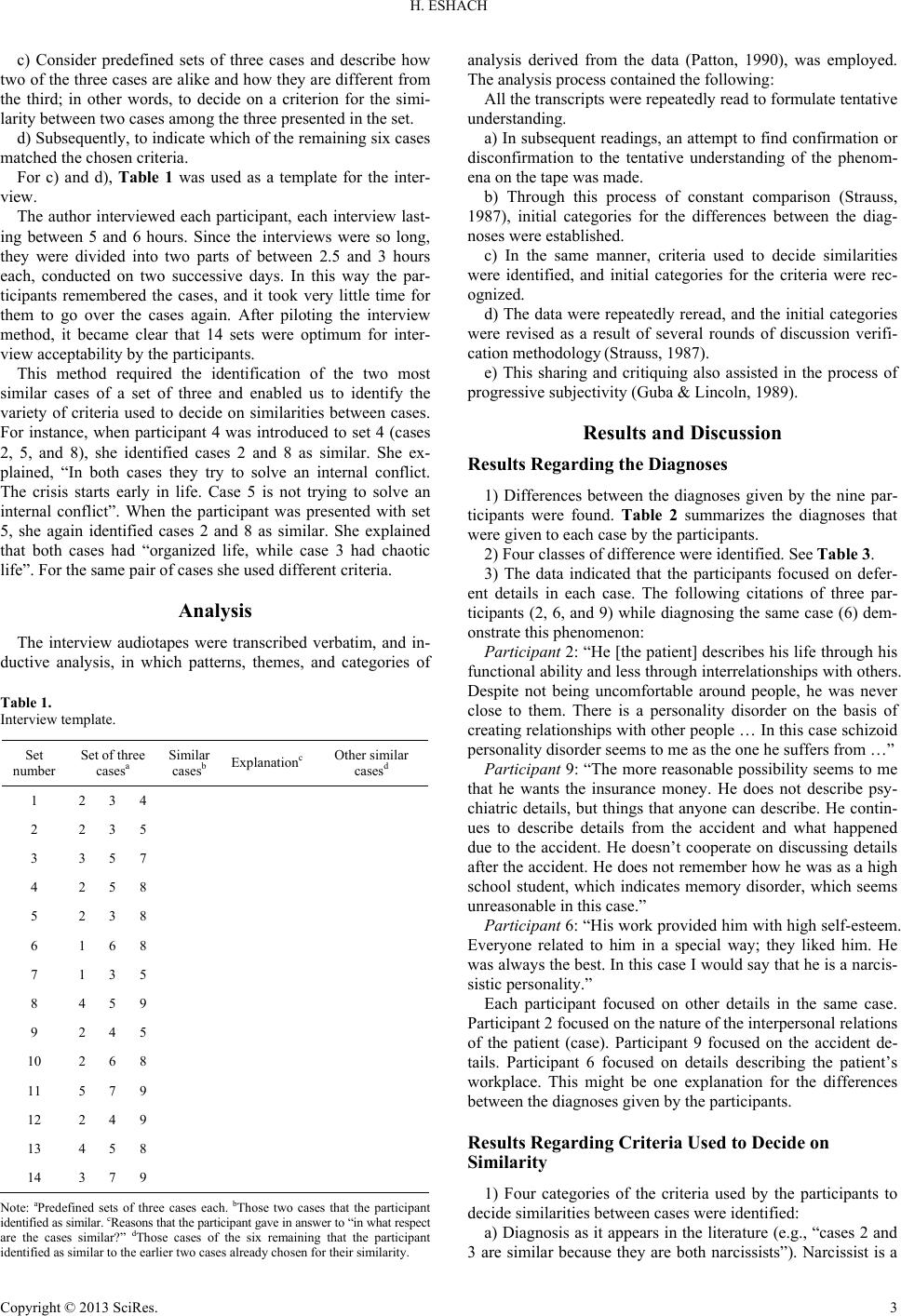 H. ESHACH c) Consider predefined sets of three cases and describe how two of the three cases are alike and how they are different from the third; in other words, to decide on a criterion for the simi- larity between two cases among the three presented in the set. d) Subsequently, to indicate which of the remaining six cases matched the chosen criteria. For c) and d), Table 1 was used as a template for the inter- view. The author interviewed each participant, each interview last- ing between 5 and 6 hours. Since the interviews were so long, they were divided into two parts of between 2.5 and 3 hours each, conducted on two successive days. In this way the par- ticipants remembered the cases, and it took very little time for them to go over the cases again. After piloting the interview method, it became clear that 14 sets were optimum for inter- view acceptability by the participants. This method required the identification of the two most similar cases of a set of three and enabled us to identify the variety of criteria used to decide on similarities between cases. For instance, when participant 4 was introduced to set 4 (cases 2, 5, and 8), she identified cases 2 and 8 as similar. She ex- plained, “In both cases they try to solve an internal conflict. The crisis starts early in life. Case 5 is not trying to solve an internal conflict”. When the participant was presented with set 5, she again identified cases 2 and 8 as similar. She explained that both cases had “organized life, while case 3 had chaotic life”. For the same pair of cases she used different criteria. Analysis The interview audiotapes were transcribed verbatim, and in- ductive analysis, in which patterns, themes, and categories of Table 1. Interview template. Set number Set of three casesa Similar casesb Expl an atio n c Other similar casesd 1 2 3 4 2 2 3 5 3 3 5 7 4 2 5 8 5 2 3 8 6 1 6 8 7 1 3 5 8 4 5 9 9 2 4 5 10 2 6 8 11 5 7 9 12 2 4 9 13 4 5 8 14 3 7 9 Note: aPredefined sets of three cases each. bThose two cases that the participant identified as similar. cReasons that the participant gave in answer to “in what respect are the cases similar?” dThose cases of the six remaining that the participant identified as similar to the earlier two cases already chosen for their similarity. analysis derived from the data (Patton, 1990), was employed. The analysis process contained the following: All the transcripts were repeatedly read to formulate tentative understanding. a) In subsequent readings, an attempt to find confirmation or disconfirmation to the tentative understanding of the phenom- ena on the tape was made. b) Through this process of constant comparison (Strauss, 1987), initial categories for the differences between the diag- noses were established. c) In the same manner, criteria used to decide similarities were identified, and initial categories for the criteria were rec- ognized. d) The data were repeatedly reread, and the initial categories were revised as a result of several rounds of discussion verifi- cation methodology (Strauss, 1987). e) This sharing and critiquing also assisted in the process of progressive subjectivity (Guba & Lincoln, 1989). Results and Discussion Results Regarding the Diagnoses 1) Differences between the diagnoses given by the nine par- ticipants were found. Table 2 summarizes the diagnoses that were given to each case by the participants. 2) Four classes of difference were identified. See Table 3. 3) The data indicated that the participants focused on defer- ent details in each case. The following citations of three par- ticipants (2, 6, and 9) while diagnosing the same case (6) dem- onstrate this phenomenon: Participant 2: “He [the patient] describes his life through his functional ability and less through interrelationships with others. Despite not being uncomfortable around people, he was never close to them. There is a personality disorder on the basis of creating relationships with other people … In this case schizoid personality disorder seems to me as the one he suffers from …” Participant 9: “The more reasonable possibility seems to me that he wants the insurance money. He does not describe psy- chiatric details, but things that anyone can describe. He contin- ues to describe details from the accident and what happened due to the accident. He doesn’t cooperate on discussing details after the accident. He does not remember how he was as a high school student, which indicates memory disorder, which seems unreasonable in this case.” Participant 6: “His work provided him with high self-esteem. Everyone related to him in a special way; they liked him. He was always the best. In this case I would say that he is a narcis- sistic personality.” Each participant focused on other details in the same case. Participant 2 focused on the nature of the interpersonal relations of the patient (case). Participant 9 focused on the accident de- tails. Participant 6 focused on details describing the patient’s workplace. This might be one explanation for the differences between the diagnoses given by the participants. Results Reg arding Criteria Used to Dec ide on Similarity 1) Four categories of the criteria used by the participants to decide similarities between cases were identified: a) Diagnosis as it appears in the literature (e.g., “cases 2 and 3 are similar because they are bonarcissists”). Narcissist is a th Copyright © 2013 SciRes. 3 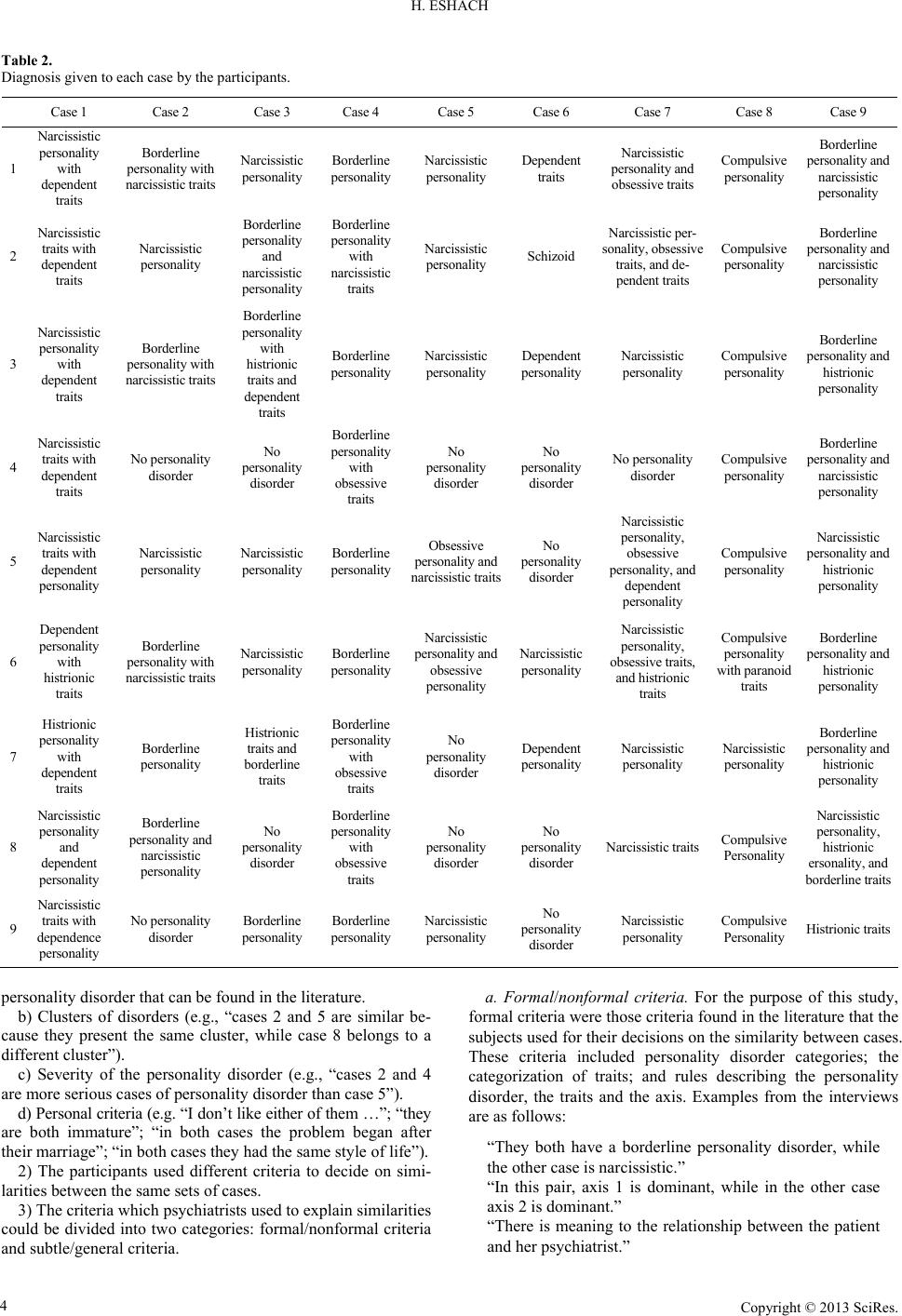 H. ESHACH Copyright © 2013 SciRes. 4 Table 2. Diagnosis given to each case by the participants. Case 1 Case 2 Case 3 Case 4 Case 5 Case 6 Case 7 Case 8 Case 9 1 Narcissistic personality with dependent traits Borderline personality with narcissistic traits Narcissistic personality Borderline personality Narcissistic personality Dependent traits Narcissistic personality and obsessive traits Compulsive personality Borderline personality and narcissistic personality 2 Narcissistic traits with dependent traits Narcissistic personality Borderline personality and narcissistic personality Borderline personality with narcissistic traits Narcissistic personality Schizoid Narcissistic per- sonality, obsessive traits, and de- pendent traits Compulsive personality Borderline personality and narcissistic personality 3 Narcissistic personality with dependent traits Borderline personality with narcissistic traits Borderline personality with histrionic traits and dependent traits Borderline personality Narcissistic personality Dependent personality Narcissistic personality Compulsive personality Borderline personality and histrionic personality 4 Narcissistic traits with dependent traits No personality disorder No personality disorder Borderline personality with obsessive traits No personality disorder No personality disorder No personality disorder Compulsive personality Borderline personality and narcissistic personality 5 Narcissistic traits with dependent personality Narcissistic personality Narcissistic personality Borderline personality Obsessive personality and narcissistic traits No personality disorder Narcissistic personality, obsessive personality, and dependent personality Compulsive personality Narcissistic personality and histrionic personality 6 Dependent personality with histrionic traits Borderline personality with narcissistic traits Narcissistic personality Borderline personality Narcissistic personality and obsessive personality Narcissistic personality Narcissistic personality, obsessive traits, and histrionic traits Compulsive personality with paranoid traits Borderline personality and histrionic personality 7 Histrionic personality with dependent traits Borderline personality Histrionic traits and borderline traits Borderline personality with obsessive traits No personality disorder Dependent personality Narcissistic personality Narcissistic personality Borderline personality and histrionic personality 8 Narcissistic personality and dependent personality Borderline personality and narcissistic personality No personality disorder Borderline personality with obsessive traits No personality disorder No personality disorder Narcissistic traits Compulsive Personality Narcissistic personality, histrionic ersonality, and borderline traits 9 Narcissistic traits with dependence personality No personality disorder Borderline personality Borderline personality Narcissistic personality No personality disorder Narcissistic personality Compulsive Personality Histrionic traits personality disorder that can be found in the literature. b) Clusters of disorders (e.g., “cases 2 and 5 are similar be- cause they present the same cluster, while case 8 belongs to a different cluste r”). c) Severity of the personality disorder (e.g., “cases 2 and 4 are more serious cases of personality disorder than case 5”). d) Personal criteria (e.g. “I don’t l ike either of them …”; “they are both immature”; “in both cases the problem began after their marriage”; “in both cases they had the same style of life”). 2) The participants used different criteria to decide on simi- larities between the same sets of cases. 3) The criteria which psychiatrists used to explain similarities could be divided into two categories: formal/nonformal criteria and subtle/general criteria. a. Formal/nonformal criteria. For the purpose of this study, formal criteria were those criteria found in the literature that the subjects used for their decisions on the similarity between cases. These criteria included personality disorder categories; the categorization of traits; and rules describing the personality disorder, the traits and the axis. Examples from the interviews are as follows: “They both have a borderline personality disorder, while the other case is narcissistic.” “In this pair, axis 1 is dominant, while in the other case axis 2 is dominant.” “There is meaning to the relationship between the patient and her psychiatrist.” 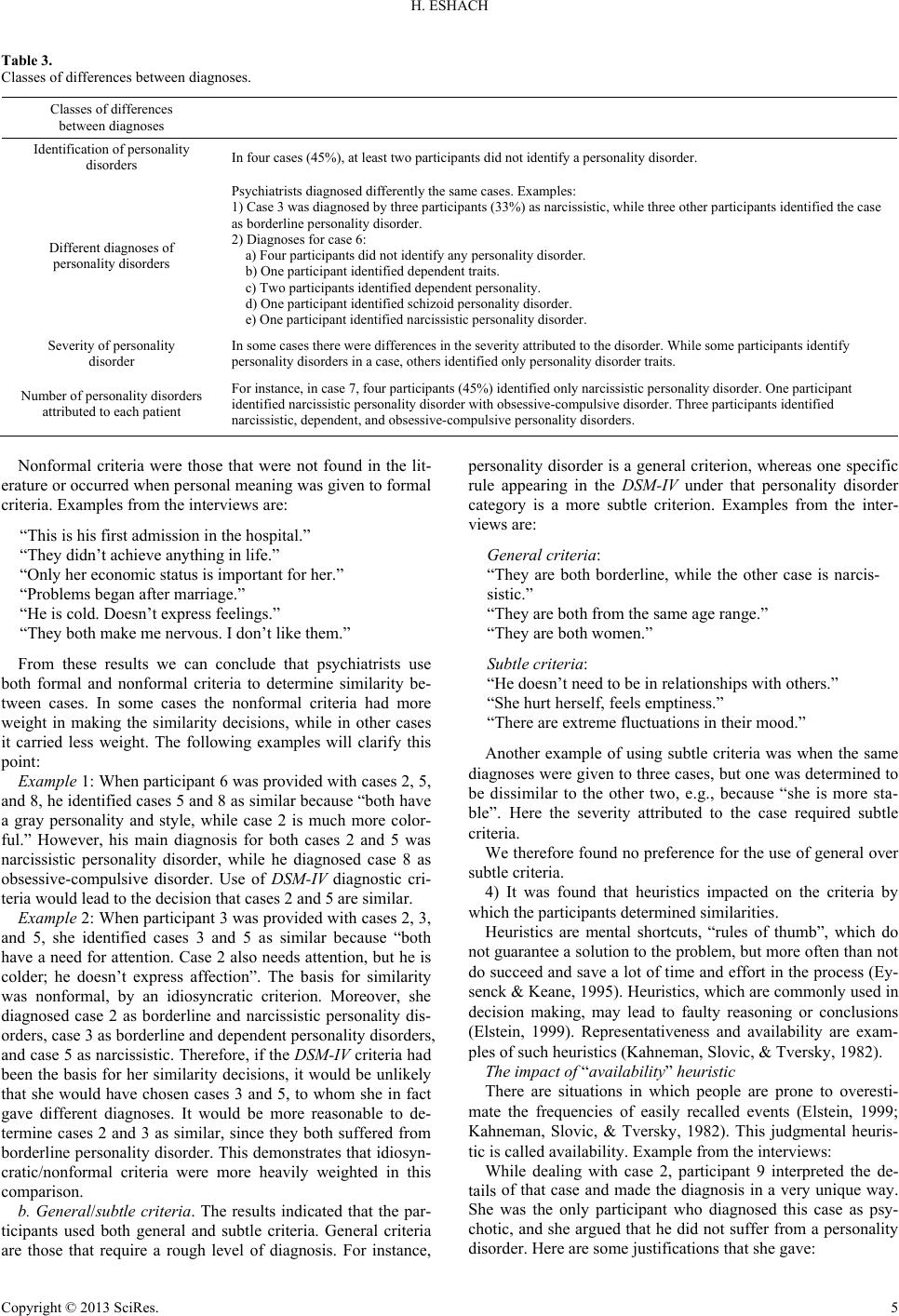 H. ESHACH Table 3. Classes of differences be t w een diagnoses. Classes of d ifferences between diagnoses Identification of personality disorders In four cases (45%), at le ast two participants did not identify a personal ity disorder. Different diagnoses of personality disorders Psychiatrists diagnosed differently the same cases. Examples: 1) Case 3 was diagnosed by three participants (33%) as narcissistic, whil e three other participants id entified the case as borderline personality d isorder. 2) Diagnoses for case 6: a) Four participa nts did not identify any personality dis order. b) One participant identified dependent traits. c) Two participants identified dependent personality. d) One participant identified schizoid personality disorder. e) One participant identified narcissistic personality disorder. Severity of personality disorder In some cases there were differences in the severity attributed to the disorder. While some particip ants identify personality disorders in a case, others identified only personality disorder traits. Number of personality disorders attributed to each patient For instance, in case 7, four participants (45%) identifie d only narcissistic personality disorder. One participant identified narc issistic personality disorder with obsessive-compul sive disorder. Three participants identified narcissistic, dependent, and obsessive-compulsi v e personal ity disorders. Nonformal criteria were those that were not found in the lit- erature or occurred when personal meaning was given to formal criteria. Examples from the interviews are: “This is his first admission in the hospital.” “They didn’t achieve anything in life.” “Only her economic status is important for her.” “Problems began after marriage.” “He is cold. Doesn’t express feelings.” “They both make me nervous. I don’t like them.” From these results we can conclude that psychiatrists use both formal and nonformal criteria to determine similarity be- tween cases. In some cases the nonformal criteria had more weight in making the similarity decisions, while in other cases it carried less weight. The following examples will clarify this point: Example 1: When participant 6 was provided with cases 2, 5, and 8, he identified cases 5 and 8 as similar because “both have a gray personality and style, while case 2 is much more color- ful.” However, his main diagnosis for both cases 2 and 5 was narcissistic personality disorder, while he diagnosed case 8 as obsessive-compulsive disorder. Use of DSM-IV diagnostic cri- teria would lead to the decision that cases 2 and 5 are similar. Example 2: When participant 3 was provided with cases 2, 3, and 5, she identified cases 3 and 5 as similar because “both have a need for attention. Case 2 also needs attention, but he is colder; he doesn’t express affection”. The basis for similarity was nonformal, by an idiosyncratic criterion. Moreover, she diagnosed case 2 as borderline and narcissistic personality dis- orders, case 3 as borderline and dependent personality disorders, and case 5 as narcissistic. Therefore, if the DSM-IV criteria had been the basis for her similarity decisions, it would be unlikely that she would have chosen cases 3 and 5, to whom she in fact gave different diagnoses. It would be more reasonable to de- termine cases 2 and 3 as similar, since they both suffered from borderline personality disorder. This demonstrates that idiosyn- cratic/nonformal criteria were more heavily weighted in this comparison. b. General/subtle criteria. The results indicated that the par- ticipants used both general and subtle criteria. General criteria are those that require a rough level of diagnosis. For instance, personality disorder is a general criterion, whereas one specific rule appearing in the DSM-IV under that personality disorder category is a more subtle criterion. Examples from the inter- views are: General criteria: “They are both borderline, while the other case is narcis- sistic.” “They are both from the same age range.” “They are both women.” Subtle criteria: “He doesn’t need to be in relationships with others.” “She hurt herself, feels emptiness.” “There are extreme fluctuations in their mood.” Another example of using subtle criteria was when the same diagnoses were given to three cases, but one was determined to be dissimilar to the other two, e.g., because “she is more sta- ble”. Here the severity attributed to the case required subtle criteria. We therefore found no preference for the use of general over subtle criteria. 4) It was found that heuristics impacted on the criteria by which the participants determined similarities. Heuristics are mental shortcuts, “rules of thumb”, which do not guarantee a solution to the problem, but more often than not do succeed and save a lot of time and effort in the process (Ey- senck & Keane, 1995). Heuristics, which are commonly used in decision making, may lead to faulty reasoning or conclusions (Elstein, 1999). Representativeness and availability are exam- ples of such heuristics (Kahneman, Slovic, & Tversky, 1982). The impact of “availability” heuristic There are situations in which people are prone to overesti- mate the frequencies of easily recalled events (Elstein, 1999; Kahneman, Slovic, & Tversky, 1982). This judgmental heuris- tic is calle d av ailability . E xa mpl e from t h e interviews: While dealing with case 2, participant 9 interpreted the de- tails of that case and made the diagnosis in a very unique way. She was the only participant who diagnosed this case as psy- chotic, and she argued that he did not suffer from a personality disorder. Here are some justifications that she gave: Copyright © 2013 SciRes. 5 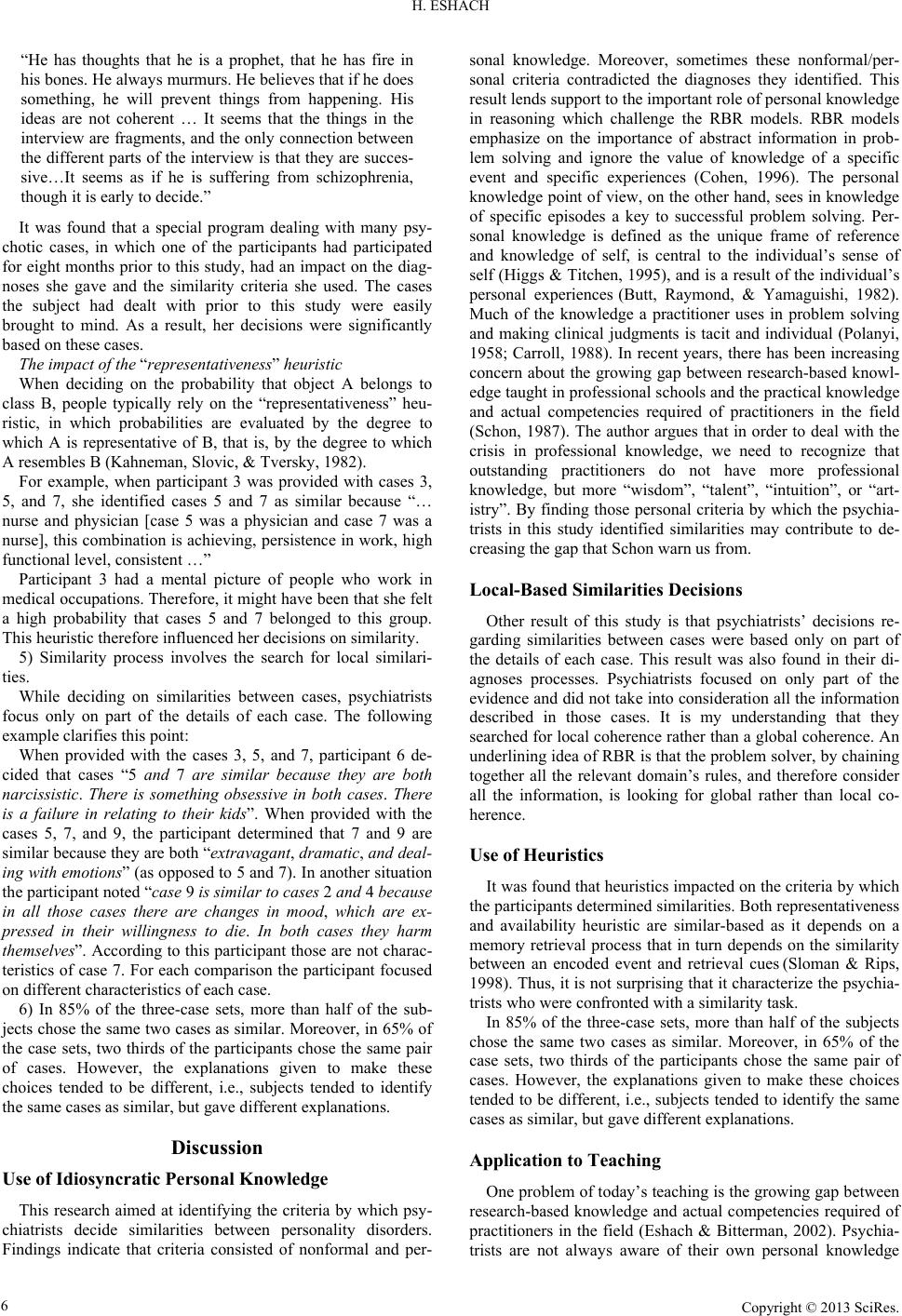 H. ESHACH “He has thoughts that he is a prophet, that he has fire in his bones. He always murmurs. He believes that if he does something, he will prevent things from happening. His ideas are not coherent … It seems that the things in the interview are fragments, and the only connection between the different parts of the interview is that they are succes- sive…It seems as if he is suffering from schizophrenia, though it is early to decide.” It was found that a special program dealing with many psy- chotic cases, in which one of the participants had participated for eight months prior to this study, had an impact on the diag- noses she gave and the similarity criteria she used. The cases the subject had dealt with prior to this study were easily brought to mind. As a result, her decisions were significantly based on these cases. The impact of the “representativeness” heuristic When deciding on the probability that object A belongs to class B, people typically rely on the “representativeness” heu- ristic, in which probabilities are evaluated by the degree to which A is representative of B, that is, by the degree to which A resembles B (Kahneman, Slovic, & Tversky, 1982). For example, when participant 3 was provided with cases 3, 5, and 7, she identified cases 5 and 7 as similar because “… nurse and physician [case 5 was a physician and case 7 was a nurse], this combination is achieving, persistence in work, high functional lev el, consistent …” Participant 3 had a mental picture of people who work in medical occupations. Therefore, it might have been that she felt a high probability that cases 5 and 7 belonged to this group. This heuristic therefore influenced her decisions on similarity. 5) Similarity process involves the search for local similari- ties. While deciding on similarities between cases, psychiatrists focus only on part of the details of each case. The following example clarifies this point: When provided with the cases 3, 5, and 7, participant 6 de- cided that cases “5 and 7 are similar because they are both narcissistic. There is something obsessive in both cases. The re is a failure in relating to their kids”. When provided with the cases 5, 7, and 9, the participant determined that 7 and 9 are similar because they are both “extravagant, dramatic, and deal- ing with emotions” (as opposed to 5 and 7). In another situation the participant noted “case 9 is similar to cases 2 and 4 because in all those cases there are changes in mood, which are ex- pressed in their willingness to die. In both cases they harm themselves”. According to this participant those are not charac- teristics of case 7. For each comparison the participant focused on different characteristics of each case. 6) In 85% of the three-case sets, more than half of the sub- jects chose the same two cases as similar. Moreove r, in 65% of the case sets, two thirds of the participants chose the same pair of cases. However, the explanations given to make these choices tended to be different, i.e., subjects tended to identify the same cases as similar, but gave different explanations. Discussion Use of Idiosyncratic Personal Knowledge This research aimed at identifying the criteria by which psy- chiatrists decide similarities between personality disorders. Findings indicate that criteria consisted of nonformal and per- sonal knowledge. Moreover, sometimes these nonformal/per- sonal criteria contradicted the diagnoses they identified. This result lends support to the important role of personal knowledge in reasoning which challenge the RBR models. RBR models emphasize on the importance of abstract information in prob- lem solving and ignore the value of knowledge of a specific event and specific experiences (Cohen, 1996). The personal knowledge point of view, on the other hand, sees in knowledge of specific episodes a key to successful problem solving. Per- sonal knowledge is defined as the unique frame of reference and knowledge of self, is central to the individual’s sense of self (Higgs & Titchen, 1995), and is a result of the individual’s personal experiences (Butt, Raymond, & Yamaguishi, 1982). Much of the knowledge a practitioner uses in problem solving and making clinical judgments is tacit and individual (Polanyi, 1958; Carroll, 1988). In recent years, there has been increasing concern about the growing gap between research-based knowl- edge taught in professional schools and the practical knowledge and actual competencies required of practitioners in the field (Schon, 1987). The author argues that in order to deal with the crisis in professional knowledge, we need to recognize that outstanding practitioners do not have more professional knowledge, but more “wisdom”, “talent”, “intuition”, or “art- istry”. By finding those personal criteria by which the psychia- trists in this study identified similarities may contribute to de- creasing the gap that Schon warn us from. Local-Based Similarities Decisions Other result of this study is that psychiatrists’ decisions re- garding similarities between cases were based only on part of the details of each case. This result was also found in their di- agnoses processes. Psychiatrists focused on only part of the evidence and did not take into consideration all the information described in those cases. It is my understanding that they searched for local coherence rather than a global coherence. An underlining idea of RBR is that the problem solver, by chaining together all the relevant domain’s rules, and therefore consider all the information, is looking for global rather than local co- herence. Use of Heuristics It was found that heuristics impacted on the criteria by which the participants determined similarities. Both representativeness and availability heuristic are similar-based as it depends on a memory retrieval process that in turn depends on the similarity between an encoded event and retrieval cues (Sloman & Rips, 1998). Thus, it is not surprising that it characterize the psychia- trists who were confronted with a similarity task. In 85% of the three-case sets, more than half of the subjects chose the same two cases as similar. Moreover, in 65% of the case sets, two thirds of the participants chose the same pair of cases. However, the explanations given to make these choices tended to be different, i.e., subjects tended to identify the same cases as similar, but gave different explanations. Application to Teaching One problem of today’s teaching is the growing gap between research-based knowledge and actual competencies required of practitioners in the field (Eshach & Bitterman, 2002). Psychia- trists are not always aware of their own personal knowledge Copyright © 2013 SciRes. 6 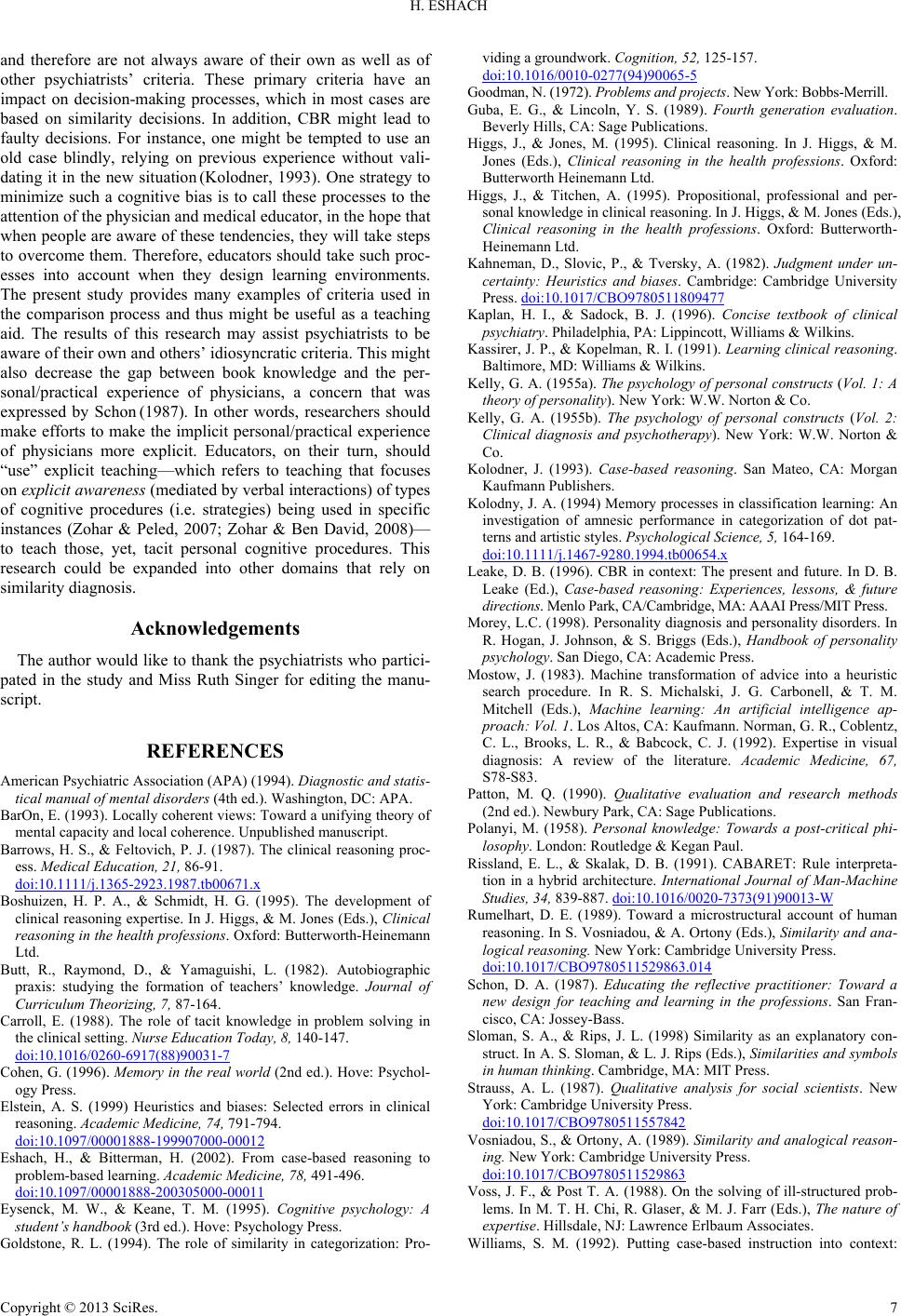 H. ESHACH and therefore are not always aware of their own as well as of other psychiatrists’ criteria. These primary criteria have an impact on decision-making processes, which in most cases are based on similarity decisions. In addition, CBR might lead to faulty decisions. For instance, one might be tempted to use an old case blindly, relying on previous experience without vali- dating it in the new situation (Kolodner, 1993). One strategy to minimize such a cognitive bias is to call these processes to the attention of the physician and medical educator, in the hope that when people are aware of these tendencies, they will take steps to overcome them. Therefore, educators should take such proc- esses into account when they design learning environments. The present study provides many examples of criteria used in the comparison process and thus might be useful as a teaching aid. The results of this research may assist psychiatrists to be aware of their own and others’ idiosyncratic c r iteria. Thi s might also decrease the gap between book knowledge and the per- sonal/practical experience of physicians, a concern that was expressed by Schon (1987). In other words, researchers should make efforts to make the implicit personal/practical experience of physicians more explicit. Educators, on their turn, should “use” explicit teaching—which refers to teaching that focuses on explicit awareness (mediated by verbal interactions) of types of cognitive procedures (i.e. strategies) being used in specific instances (Zohar & Peled, 2007; Zohar & Ben David, 2008)— to teach those, yet, tacit personal cognitive procedures. This research could be expanded into other domains that rely on similarity diagnosis. Acknowledgements The author would like to thank the psychiatrists who partici- pated in the study and Miss Ruth Singer for editing the manu- script. REFERENCES American Psychiatric Association (APA) (1994). Diagnostic and statis- tical manual of mental disorders ( 4th ed.). Washington, DC: APA. BarOn, E. (1993). Locally coherent views: Toward a unifying theory of mental capacity and local coherence. Unpublished manuscript. Barrows, H. S., & Feltovich, P. J. (1987). The clinical reasoning proc- ess. Medical Education, 21, 86-91. doi:10.1111/j.1365-2923.1987.tb00671.x Boshuizen, H. P. A., & Schmidt, H. G. (1995). The development of clinical reasoning expertise. In J. Higgs, & M. Jones (Eds.), Clinical reasoning in the health professions. Oxford: Butterworth-Heinemann Ltd. Butt, R., Raymond, D., & Yamaguishi, L. (1982). Autobiographic praxis: studying the formation of teachers’ knowledge. Journal of Curriculum Theorizing, 7, 87-164. Carroll, E. (1988). The role of tacit knowledge in problem solving in the clinical setting. Nurse Education Today, 8, 140-147. doi:10.1016/0260-6917(88)90031-7 Cohen, G. (1996). Memory in the real world (2nd ed.). Hove: Psychol- ogy Press. Elstein, A. S. (1999) Heuristics and biases: Selected errors in clinical reasoning. Academic M edicine, 74, 791-794. doi:10.1097/00001888-199907000-00012 Eshach, H., & Bitterman, H. (2002). From case-based reasoning to problem-bas ed lea rning. Academic Medicine, 78, 491- 496. doi:10.1097/00001888-200305000-00011 Eysenck, M. W., & Keane, T. M. (1995). Cognitive psychology: A student’s handbook (3rd ed.). Hove: Psychology Press. Goldstone, R. L. (1994). The role of similarity in categorization: Pro- viding a groundwork. Cognition, 52, 125-157. doi:10.1016/0010-0277(94)90065-5 Goodman, N. (1972). Problems and projects. New York: Bobbs-Merrill. Guba, E. G., & Lincoln, Y. S. (1989). Fourth generation evaluation. Beverly Hills, CA: Sage Publications. Higgs, J., & Jones, M. (1995). Clinical reasoning. In J. Higgs, & M. Jones (Eds.), Clinical reasoning in the health professions. Oxford: Butterworth Heinemann Ltd. Higgs, J., & Titchen, A. (1995). Propositional, professional and per- sonal knowledge in clinical reasoning. In J. Higgs, & M. Jones (Eds.), Clinical reasoning in the health professions. Oxford: Butterworth- Heinemann Ltd. Kahneman, D., Slovic, P., & Tversky, A. (1982). Judgment under un- certainty: Heuristics and biases. Cambridge: Cambridge University Press. doi:10.1017/CBO9780511809477 Kaplan, H. I., & Sadock, B. J. (1996). Concise textbook of clinical psychiatry. Philadelphia, PA: Lippincott, Williams & Wilkins. Kassirer, J. P., & Kopelman, R. I. (1991). Learning clinical reasoning. Baltimore, MD: Williams & Wilkins. Kelly, G. A. (1955a). The psychology of personal constructs (Vol. 1: A theory of personality). New York: W.W. Norton & Co. Kelly, G. A. (1955b). The psychology of personal constructs (Vol. 2: Clinical diagnosis and psychotherapy). New York: W.W. Norton & Co. Kolodner, J. (1993). Case-based reasoning. San Mateo, CA: Morgan Kaufmann Publishers. Kolodny, J. A. (1994) Memory processes in classification learning: An investigation of amnesic performance in categorization of dot pat- terns and artistic styles. Psychological Science, 5, 164-169. doi:10.1111/j.1467-9280.1994.tb00654.x Leake, D. B. (1996). CBR in context: The present and future. In D. B. Leake (Ed.), Case-based reasoning: Experiences, lessons, & future directions. Menlo Park, CA/Cam bri dge, M A: AA AI Pr ess/M IT Pres s. Morey, L.C. (1998). Personality diagnosis and personality disorders. In R. Hogan, J. Johnson, & S. Briggs (Eds.), Handbook of personality psychology. San Diego, C A: Academic Press. Mostow, J. (1983). Machine transformation of advice into a heuristic search procedure. In R. S. Michalski, J. G. Carbonell, & T. M. Mitchell (Eds.), Machine learning: An artificial intelligence ap- proach: Vol. 1. Los Altos, CA: Kaufmann. Norman, G. R., Coblentz, C. L., Brooks, L. R., & Babcock, C. J. (1992). Expertise in visual diagnosis: A review of the literature. Academic Medicine, 67, S78-S83. Patton, M. Q. (1990). Qualitative evaluation and research methods (2nd ed.). Newbury Park, CA: Sage Publications. Polanyi, M. (1958). Personal knowledge: Towards a post-critical phi- losophy. London: Routledge & Kegan Paul. Rissland, E. L., & Skalak, D. B. (1991). CABARET: Rule interpreta- tion in a hybrid architecture. International Journal of Man-Machine Studies, 34, 839-887. doi:10.1016/0020-7373(91)90013-W Rumelhart, D. E. (1989). Toward a microstructural account of human reasoning. In S. Vosniadou, & A. Ortony (Eds.), Similarity and ana- logical reasoning. New York: Cambridge University Press. doi:10.1017/CBO9780511529863.014 Schon, D. A. (1987). Educating the reflective practitioner: Toward a new design for teaching and learning in the professions. San Fran- cisco, CA: Jossey-Bas s. Sloman, S. A., & Rips, J. L. (1998) Similarity as an explanatory con- struct. In A. S. Sloman, & L. J. Rips (Eds.), Similarities and symbols in human thinking. Cambridge, MA: MIT Press. Strauss, A. L. (1987). Qualitative analysis for social scientists. New York: Cambridge University Press. doi:10.1017/CBO9780511557842 Vosniadou, S., & Ortony, A. (1989). Similarity and analogical reason- ing. New York: Cambridge University Press. doi:10.1017/CBO9780511529863 Voss, J. F., & Post T. A. (1988). On the solving of ill-structured prob- lems. In M. T. H . Chi, R. Glaser, & M. J . Farr (Eds.), The nature of expertise. Hillsdale, NJ: Lawrence Erlbaum Associates. Williams, S. M. (1992). Putting case-based instruction into context: Copyright © 2013 SciRes. 7  H. ESHACH Copyright © 2013 SciRes. 8 Examples from legal and medical education. Journal of the Learning Sciences, 2, 367-427. doi:10.1207/s15327809jls0204_2 Zohar, A., & Peled, B. (2008). The effects of explicit teaching of me- tastrategic knowledge on low- and high-achieving students. Learning and Instruction, 18, 337-353. doi:10.1016/j.learninstruc.2007.07.001 Zohar, A., & Ben David, A. (2008). Explicit teaching of meta-strategic knowledge in authentic classroom situations. Metacognitive Lea r n in g , 4, 59-82. doi:10.1007/s11409-007-9019-4 |