

Paper Menu >>
Journal Menu >>
 Creative Education 2013. Vol.4, No.6, 411-414 Published Online June 2013 in SciRes (http://www.scirp.org/journal/ce) http://dx.doi.org/10.4236/ce.2013.46058 Copyright © 2013 SciR e s . 411 Comparative Study between Teaching Football with Oral and Oral/Graphic Verbalization Makram Zghibi1*, Mohamed Jabri2, Najmeddine Ouesleti3, Chamseddine Guinoubi4, Samira Welhezi2, Moez Hamdi2 1LASELDI, University of Franche-Comté, Besançon, France 2Higher Institute of Sports and Physical Education, Kef, Tunisia 3Higher Institute of Education and Training Contained, Tunis, Tunisia 4Research Laboratory, “Sports Performance Optimiza tion” National Center of Medicine and Science in Sports (CNMSS), Tunis, Tunisia Email: *[email protected] Received April 10th, 2013; revised May 15th, 2013; accepted May 28th, 2013 Copyright © 2013 Makram Zghibi et al. This is an open access article distributed under the Creative Commons Attribution License, which permits unrestricted use, distribution, and reproduction in any medium, provided the original work is properly cited. The aim of this study was to compare two methods of teaching using two different modalities of verbali- zation: oral and oral/graphic. We opted for a quantitative-comparative analysis of the pupils’ language typologies taken from oral and written productions of third secondary grade pupils who play football in a professional club (juniors of Olympic Kef, IInd league, 18 years old on average). The comparisons be- tween the group proceeding to an oral verbalization versus the group using an oral/graphic one as well as intra-groups’ comparisons did not show clear significant differences. Despite of a statistical signification absence, we note that the two teams made a progress (increase in the number of played and conquered balls and the shots on target) especially during the last three sessions. Indeed, the debate of ideas is a process. It is relevant that the interaction between learning oral and graphic verbalization is more dynamic, whenever pupils verbalize orally and graphically, they are more motivated to learn. Keywords: Teaching; Oral/Graphic Verbalization; Football; Game Introduction Comparative education collects data about educational sys- tems; it offers an explanation about the links between education and culture (Lê Thành Khôi, 1995). It initiates researches ori- ented to decisions (international organizations) and also to con- clusions: studies on the relationship between education, culture and society (De Landsheere, 1992). Comparative education aims to contribute to a better comprehension (Zerai, 2011). In- deed, by comparing educational facts belonging to different contexts, we are guided to explore other cultures (De Land- sheere, 1972). It then passes to a better understanding of our own culture, and discovering relativism but it is necessary to define the field of comparative education previously (Zerai, 2011). It is in this comparative perspective that this work aimed to compare two methods of teaching using two different modali- ties of verbalization: oral and oral/graphic. Methodology This study opts for a quantitative analysis of oral and written productions of third secondary grade pupils who play football in a professional club (juniors of Olympic Kef, IInd league, 18 years old on average). The research protocol proposed in this study lies in the or- ganization of a cycle of ten “one effective-hour” sessions of football (eight hours and a half of motor and verbal practice were observed and recorded). Learning during these sessions will offer an opportunity in which pupils can exchange ideas freely to build action projects. This creates among pupils/play- ers the search for answers to the problems encountered during the game. The proposed sessions are all based on game situa- tions on a handball pitch (40 m × 20 m). Each session (ses- sion’s body) consists in two game situations (two matches) controlled by the teacher and separated by a five minutes se- quence of debate of ideas (Gréhaigne et al., 1998) provided by two specialist teachers. Therefore, it is a comparative analysis aiming to convey the pupils’ language typologies through analytical models of ana- lyze taken from the sciences of language (Roulet, 1987). The aims of this experiment are to allow to all the pupils to partici- pate in the process of knowledge building via the lived game situations. They are called to analyze and understand what is happening during the play situation in order to build an action project and check whether it is actually applied on the pitch. The Figure 1 shows the experiment steps: pupils play for ten minutes, and then verbalize during five minutes before to return to play again (another 10 min) to implement the action project set by each team. During the verbalization sequences, pupils discuss their action project to solve the problems experienced in the first situation of the game. The debate of ideas is a space for dialogue that allows to learners to negotiate the meaning of *Corresponding author. 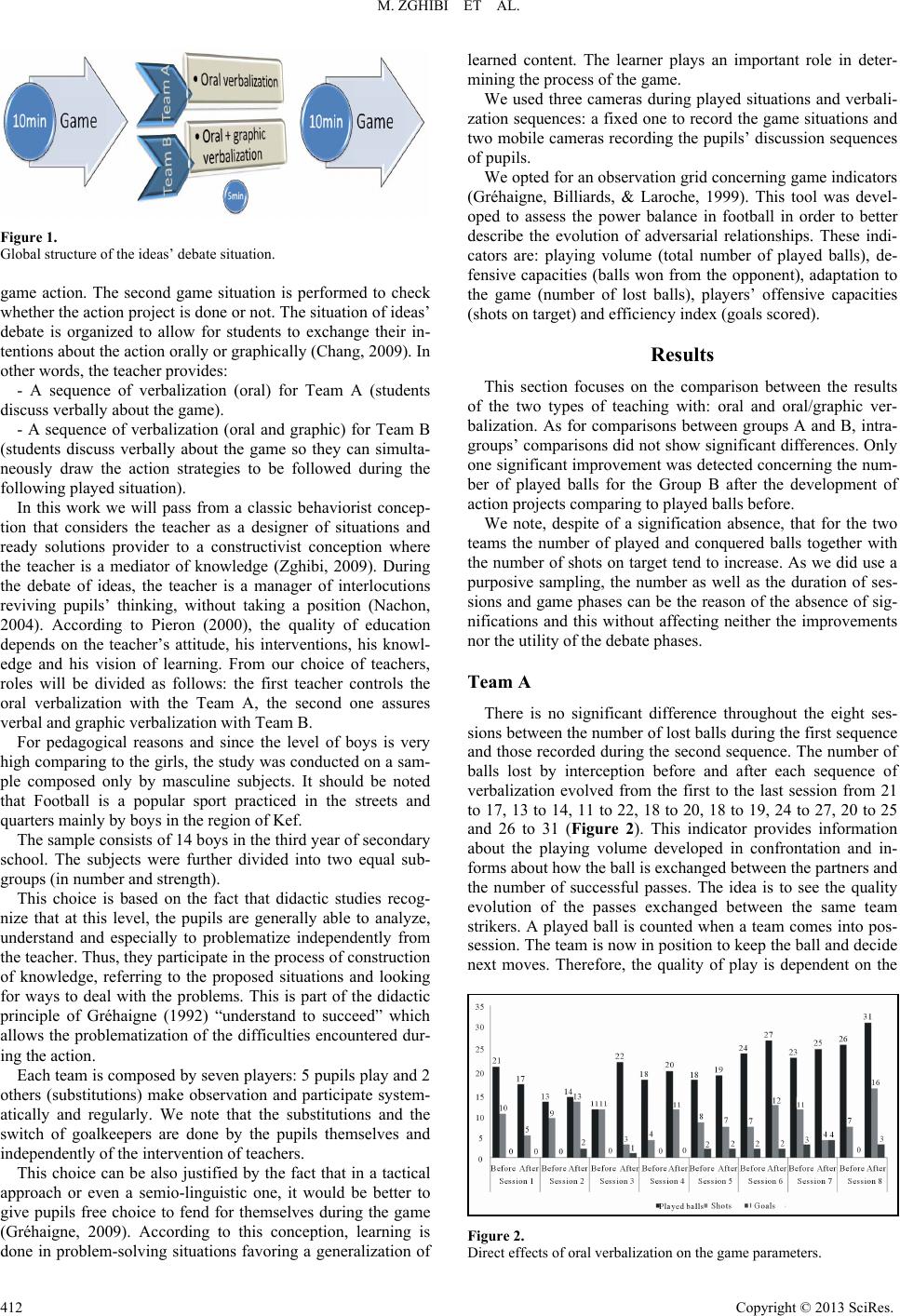 M. ZGHIBI ET AL. Figure 1. Global structure of the ideas’ debate situation. game action. The second game situation is performed to check whether the action project is done or not. The situation of ideas’ debate is organized to allow for students to exchange their in- tentions about the action orally or graphically (Chang, 2009). In other words, the teacher provides: - A sequence of verbalization (oral) for Team A (students discuss verbally about the game). - A sequence of verbalization (oral and graphic) for Team B (students discuss verbally about the game so they can simulta- neously draw the action strategies to be followed during the following played situation). In this work we will pass from a classic behaviorist concep- tion that considers the teacher as a designer of situations and ready solutions provider to a constructivist conception where the teacher is a mediator of knowledge (Zghibi, 2009). During the debate of ideas, the teacher is a manager of interlocutions reviving pupils’ thinking, without taking a position (Nachon, 2004). According to Pieron (2000), the quality of education depends on the teacher’s attitude, his interventions, his knowl- edge and his vision of learning. From our choice of teachers, roles will be divided as follows: the first teacher controls the oral verbalization with the Team A, the second one assures verbal and graphic verbalization with Team B. For pedagogical reasons and since the level of boys is very high comparing to the girls, the study was conducted on a sam- ple composed only by masculine subjects. It should be noted that Football is a popular sport practiced in the streets and quarters mainly by boys in the region of Kef. The sample consists of 14 boys in the third year of secondary school. The subjects were further divided into two equal sub- groups (in number and strength). This choice is based on the fact that didactic studies recog- nize that at this level, the pupils are generally able to analyze, understand and especially to problematize independently from the teacher. Thus, they participate in the process of construction of knowledge, referring to the proposed situations and looking for ways to deal with the problems. This is part of the didactic principle of Gréhaigne (1992) “understand to succeed” which allows the problematization of the difficulties encountered dur- ing the action. Each team is composed by seven players: 5 pupils play and 2 others (substitutions) make observation and participate system- atically and regularly. We note that the substitutions and the switch of goalkeepers are done by the pupils themselves and independently of the intervention of teachers. This choice can be also justified by the fact that in a tactical approach or even a semio-linguistic one, it would be better to give pupils free choice to fend for themselves during the game (Gréhaigne, 2009). According to this conception, learning is done in problem-solving situations favoring a generalization of learned content. The learner plays an important role in deter- mining the process of the game. We used three cameras during played situations and verbali- zation sequences: a fixed one to record the game situations and two mobile cameras recording the pupils’ discussion sequences of pupils. We opted for an observation grid concerning game indicators (Gréhaigne, Billiards, & Laroche, 1999). This tool was devel- oped to assess the power balance in football in order to better describe the evolution of adversarial relationships. These indi- cators are: playing volume (total number of played balls), de- fensive capacities (balls won from the opponent), adaptation to the game (number of lost balls), players’ offensive capacities (shots on target) and efficiency index (goals scored). Results This section focuses on the comparison between the results of the two types of teaching with: oral and oral/graphic ver- balization. As for comparisons between groups A and B, intra- groups’ comparisons did not show significant differences. Only one significant improvement was detected concerning the num- ber of played balls for the Group B after the development of action projects comparing to played balls before. We note, despite of a signification absence, that for the two teams the number of played and conquered balls together with the number of shots on target tend to increase. As we did use a purposive sampling, the number as well as the duration of ses- sions and game phases can be the reason of the absence of sig- nifications and this without affecting neither the improvements nor the utility of the debate phases. Team A There is no significant difference throughout the eight ses- sions between the number of lost balls during the first sequence and those recorded during the second sequence. The number of balls lost by interception before and after each sequence of verbalization evolved from the first to the last session from 21 to 17, 13 to 14, 11 to 22, 18 to 20, 18 to 19, 24 to 27, 20 to 25 and 26 to 31 (Figure 2). This indicator provides information about the playing volume developed in confrontation and in- forms about how the ball is exchanged between the partners and the number of successful passes. The idea is to see the quality evolution of the passes exchanged between the same team strikers. A played ball is counted when a team comes into pos- session. The team is now in position to keep the ball and decide next moves. Therefore, the quality of play is dependent on the Figure 2. Direct effects of oral verbalization on the game paramete rs. Copyright © 2013 SciRe s . 412 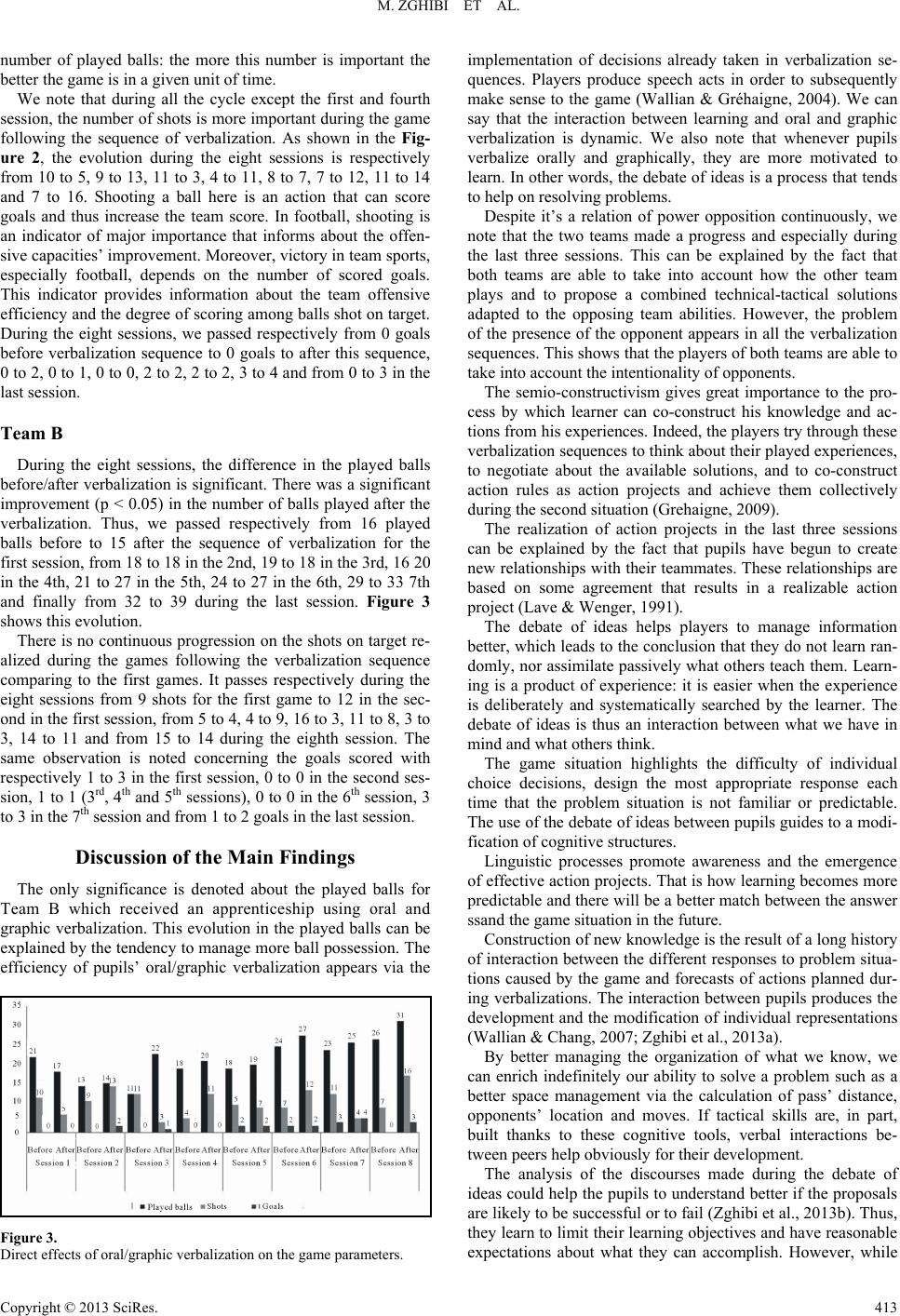 M. ZGHIBI ET AL. number of played balls: the more this number is important the better the game is in a given unit of time. We note that during all the cycle except the first and fourth session, the number of shots is more important during the game following the sequence of verbalization. As shown in the Fig- ure 2, the evolution during the eight sessions is respectively from 10 to 5, 9 to 13, 11 to 3, 4 to 11, 8 to 7, 7 to 12, 11 to 14 and 7 to 16. Shooting a ball here is an action that can score goals and thus increase the team score. In football, shooting is an indicator of major importance that informs about the offen- sive capacities’ improvement. Moreover, victory in team sports, especially football, depends on the number of scored goals. This indicator provides information about the team offensive efficiency and the degree of scoring among balls shot on target. During the eight sessions, we passed respectively from 0 goals before verbalization sequence to 0 goals to after this sequence, 0 to 2, 0 to 1 , 0 to 0, 2 to 2, 2 t o 2, 3 to 4 and f rom 0 to 3 in th e last session. Team B During the eight sessions, the difference in the played balls before/after verbalization is significant. There was a significant improvement (p < 0.05) in the number of balls played after the verbalization. Thus, we passed respectively from 16 played balls before to 15 after the sequence of verbalization for the first session, from 18 to 18 in the 2nd, 19 to 18 in the 3rd, 16 20 in the 4th, 21 to 27 in the 5th, 24 to 27 in the 6th, 29 to 33 7th and finally from 32 to 39 during the last session. Figure 3 shows this evolution. There is no continuous progression on the shots on target re- alized during the games following the verbalization sequence comparing to the first games. It passes respectively during the eight sessions from 9 shots for the first game to 12 in the sec- ond in the first session, from 5 to 4, 4 to 9, 16 to 3, 11 to 8, 3 to 3, 14 to 11 and from 15 to 14 during the eighth session. The same observation is noted concerning the goals scored with respectively 1 to 3 in the first session, 0 to 0 in the second ses- sion, 1 to 1 (3rd, 4th and 5th sessions), 0 to 0 in the 6th session, 3 to 3 in the 7th session and from 1 to 2 goals in the last session. Discussion of the Main Findings The only significance is denoted about the played balls for Team B which received an apprenticeship using oral and graphic verbalization. This evolution in the played balls can be explained by the tendency to manage more ball possession. The efficiency of pupils’ oral/graphic verbalization appears via the Figure 3. Direct effects of oral/graphic verbalization on the game parameters. implementation of decisions already taken in verbalization se- quences. Players produce speech acts in order to subsequently make sense to the game (Wallian & Gréhaigne, 2004). We can say that the interaction between learning and oral and graphic verbalization is dynamic. We also note that whenever pupils verbalize orally and graphically, they are more motivated to learn. In other words, the debate of ideas is a process that tends to help on resolving problems. Despite it’s a relation of power opposition continuously, we note that the two teams made a progress and especially during the last three sessions. This can be explained by the fact that both teams are able to take into account how the other team plays and to propose a combined technical-tactical solutions adapted to the opposing team abilities. However, the problem of the presence of the opponent appears in all the verbalization sequences. This shows that the players of both te ams are a ble to take into account the intentionality of opponents. The semio-constructivism gives great importance to the pro- cess by which learner can co-construct his knowledge and ac- tions from his experiences. Indeed, the players try through these verbalization sequences to think about their played experiences, to negotiate about the available solutions, and to co-construct action rules as action projects and achieve them collectively during the second situation (Grehaigne, 2009). The realization of action projects in the last three sessions can be explained by the fact that pupils have begun to create new relationships with their teammates. These relationships are based on some agreement that results in a realizable action project (Lave & Wenger, 1991). The debate of ideas helps players to manage information better, which leads to the conclusion that they do not learn ran- domly, nor assimilate passively what others teach them. Learn- ing is a product of experience: it is easier when the experience is deliberately and systematically searched by the learner. The debate of ideas is thus an interaction between what we have in mind and what others think. The game situation highlights the difficulty of individual choice decisions, design the most appropriate response each time that the problem situation is not familiar or predictable. The use of the debate of ideas between pupils guides to a modi- fication of cognitive structures. Linguistic processes promote awareness and the emergence of effective action projects. That is how learning becomes more predictable and there will be a better match between the answer ssand the game situation in the future. Construction of new knowledge is the result of a long history of interaction between the different responses to problem situa- tions caused by the game and forecasts of actions planned dur- ing verbalizations. The interaction between pupils produces the development and the modification of individual representations (Wallian & Chang, 2007; Zghibi et al., 2013a). By better managing the organization of what we know, we can enrich indefinitely our ability to solve a problem such as a better space management via the calculation of pass’ distance, opponents’ location and moves. If tactical skills are, in part, built thanks to these cognitive tools, verbal interactions be- tween peers help obviously for their development. The analysis of the discourses made during the debate of ideas could help the pupils to understand better if the proposals are likely to be successful or to fail (Zghibi et al., 2013b). Thus, they learn to limit their learning objectives and have reasonable expectations about what they can accomplish. However, while Copyright © 2013 SciRe s . 413 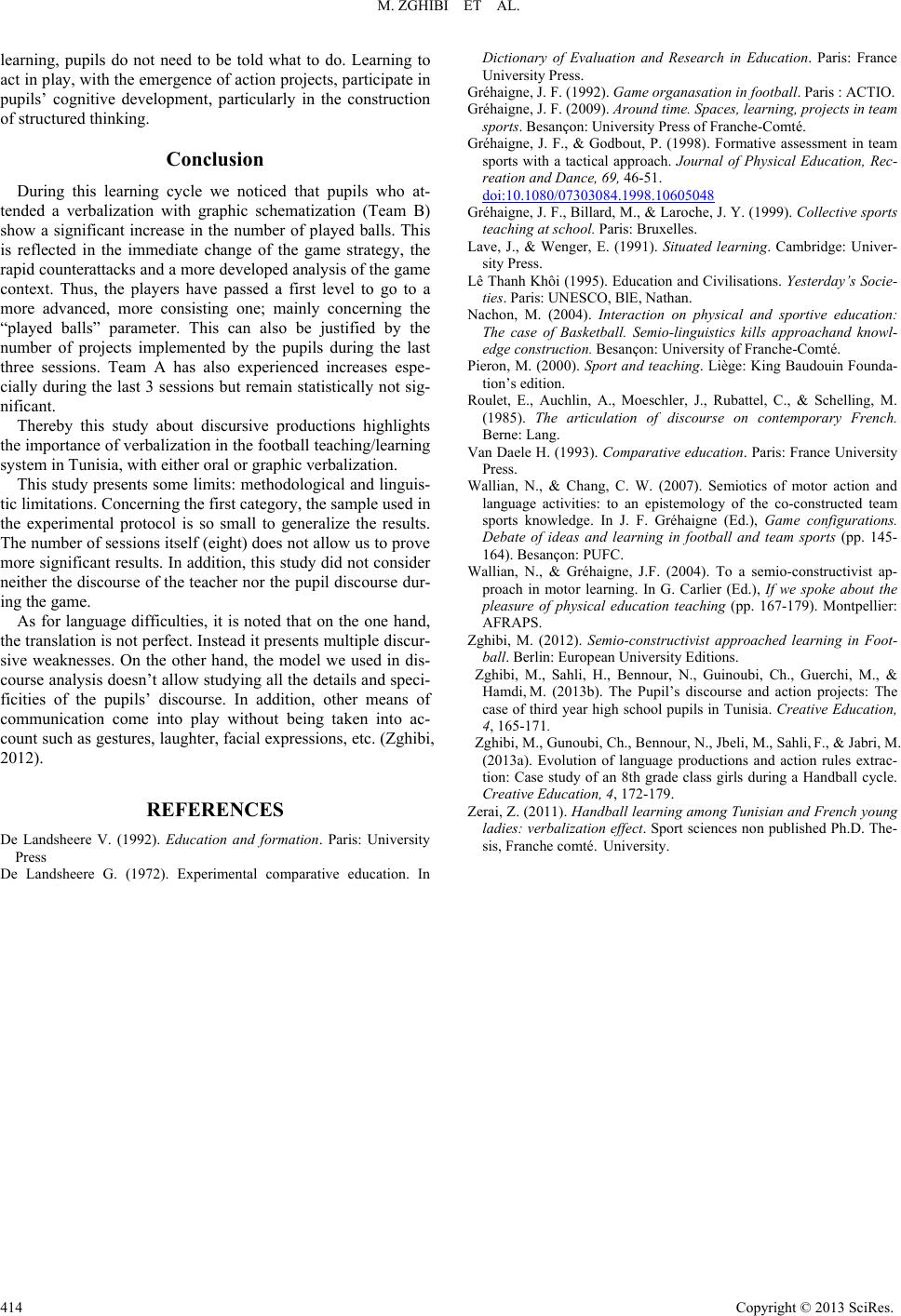 M. ZGHIBI ET AL. Copyright © 2013 SciRe s . 414 learning, pupils do not need to be told what to do. Learning to act in play, with the emergence of action projects, participate in pupils’ cognitive development, particularly in the construction of structured thinking. Conclusion During this learning cycle we noticed that pupils who at- tended a verbalization with graphic schematization (Team B) show a significant increase in the number of played balls. This is reflected in the immediate change of the game strategy, the rapid counterattacks and a more developed analysis of the game context. Thus, the players have passed a first level to go to a more advanced, more consisting one; mainly concerning the “played balls” parameter. This can also be justified by the number of projects implemented by the pupils during the last three sessions. Team A has also experienced increases espe- cially during the last 3 sessions but remain statistically not sig- nificant. Thereby this study about discursive productions highlights the importance of verbalization in the football teaching/learning system in Tunisia, with either oral or graphic verbalization. This study presents some limits: methodological and linguis- tic limitations. Concerning the first category, the sample used in the experimental protocol is so small to generalize the results. The number of sessions itself (eight) does not allow us to prove more significant results. In addition, this study did not consider neither the discourse of the teacher nor the pupil discourse dur- ing the game. As for language difficulties, it is noted that on the one hand, the translation is not perfect. Instead it presents multiple discur- sive weaknesses. On the other hand, the model we used in dis- course analysis doesn’t allow studying all the details and speci- ficities of the pupils’ discourse. In addition, other means of communication come into play without being taken into ac- count such as gestures, laughter, facial expressions, etc. (Zghibi, 2012). REFERENCES De Landsheere V. (1992). Education and formation. Paris: University Press De Landsheere G. (1972). Experimental comparative education. In Dictionary of Evaluation and Research in Education. Paris: France University Press. Gréhaigne, J. F. (1992). Game organasation in football. Paris : ACTIO. Gréhaigne, J. F. (2009). Around time. Spaces, lea rning, projects in team sports. Besançon: University Press of Franche-Comté. Gréhaigne, J. F., & Godbout, P. (1998). Formative assessment in team sports with a tactical approach. Journal of Physical Education, Rec- reation and Dance, 69, 46-51. doi:10.1080/07303084.1998.10605048 Gréhaigne, J. F., Billard, M., & Laroche, J. Y. (1999). Collective sports teaching at school. Paris: Bruxelles. Lave, J., & Wenger, E. (1991). Situated learning. Cambridge: Univer- sity Press. Lê Thanh Khôi (1995). Education and Civilisations. Yesterday’s Socie- ties. Paris: UNESCO, BlE, Nathan. Nachon, M. (2004). Interaction on physical and sportive education: The case of Basketball. Semio-linguistics kills approachand knowl- edge construction. Besançon: University of Franche-Comté. Pieron, M. (2000). Sport and teaching. Liège: King Baudouin Founda- tion’s edition. Roulet, E., Auchlin, A., Moeschler, J., Rubattel, C., & Schelling, M. (1985). The articulation of discourse on contemporary French. Berne: Lang. Van Daele H. (1993). Comparative education. Paris: France University Press. Wallian, N., & Chang, C. W. (2007). Semiotics of motor action and language activities: to an epistemology of the co-constructed team sports knowledge. In J. F. Gréhaigne (Ed.), Game configurations. Debate of ideas and learning in football and team sports (pp. 145- 164). Besançon: PUFC . Wallian, N., & Gréhaigne, J.F. (2004). To a semio-constructivist ap- proach in motor learning. In G. Carlier (Ed.), If we spoke about the pleasure of physical education teaching (pp. 167-179). Montpellier: AFRAPS. Zghibi, M. (2012). Semio-constructivist approached learning in Foot- ball. Berlin: European University Editions. Zghibi, M., Sahli, H., Bennour, N., Guinoubi, Ch., Guerchi, M., & Hamdi, M. (2013b). The Pupil’s discourse and action projects: The case of third year high school pupils in Tunisia. Creative Education, 4, 165-171. Zghibi, M., Gunoubi, Ch., Bennour, N., Jbeli, M., Sahli, F., & Jabri, M. (2013a). Evolution of language productions and action rules extrac- tion: Case study of an 8th grade class girls during a Handball cycle. Creative Education, 4, 172-179. Zerai, Z. (2011). Handball learning among Tunisian and French young ladies: verbalization effect. Sport sciences non published Ph.D. The- sis, Franche comté. University. |