

Paper Menu >>
Journal Menu >>
 Open Journal of Leadership 2013. Vol.2, No.2, 21-26 Published Online June 2013 in SciRes (http://www.scirp.org/journal/ojl) http://dx.doi.org/10.4236/ojl.2013.22003 Copyright © 2013 SciRes. 21 The Efficacy of the Adaptive Mentorship© Model Edwin G. Ralph1*, Keith D. Walker2 1Department of Curriculum Studies, College of Education, University of Saskatchewan, Saskatoon, Canada 2Deparment of Educational Administration and Johnson Shoyama Graduate School of Public Policy, University of Saskatchewan, Saskatoon, Canada Email: *[email protected] Received March 14th, 2013; revis ed Apri l 1 4th, 2013; accepted April 22nd, 2013 Copyright © 2013 Edwin G. Ralph, Keith D. Walker. This is an open access article distributed under the Crea- tive Commons Attribution License, which permits unrestricted use, distribution, and reproduction in any me- dium, provided the original work is properl y cited. In this article the authors describe the Adaptive Mentorship© (AM) model that they designed, applied, and refined during the past two decades. They developed AM to be used within a variety of management, mentorship, coaching, supervisory, or training programs. After employing and researching it within edu- cational settings, they received a federal grant to disseminate the model to a wider audience across the professional and occupational landscape and to investigate its effects. The researchers summarize the re- sults of that experience, including their recent analysis of the judgments of several panels of experts re- garding the efficacy of AM model. The authors present these findings for the consideration of practitio- ners, scholars, and researchers in any field interested in improving the mentorship offered in their own organizations. Keywords: Mentorship; Leadership; Management; Professional Coaching; Expert Panels Introduction Interest in the study of mentorship has increased in all fields (Steers, Sanchez-Runde, & Nardon, 2010), from the business and commerce sectors (Bauer & Erdogan, 2009) to the health- and social sciences, applied sciences, and humanities (Allen & Eby, 2007; Carnegie, 2011). The personal life experiences of most individuals have con- firmed that one of the best ways to help novices internalize the main functions of any profession or occupation is through mentoring them (Ellsum & Pedersen, 2005; Ralph & Walker, 2013). The literature has also shown that no single definition of mentorship applies to all settings, but that every discipline em- ploys unique terms to describe this helping-developmental process within its own field (Rose, Ragins, & Kram, 2007). Furthermore, mentorship programs have varied in terms of their degree of effectiveness, because participants have not always been adequately prepared to implement and/or sustain an effec- tive mentorship approach (Schoonover, 2002). This fact pro- vides further impetus for seeking ways to employ and/or en- hance efficacious mentorship practices in every educational, training, or preparation setting. We provide evidence in this paper that Adaptive Mentorship is an effective model that men- toring partners could adopt or adapt to enhance the quality of the mentoring process. Purpose of the Article In this paper we briefly describe the Adaptive Mentorship model, its rationale, and its implementation; and we synthesize the results of the growing body of research that we and others have conducted within various professions in several countries regarding its potential to improve the mentoring process. Literature Review Although definitions of mentorship, coaching, supervising, and training—both in the literature and across profession fields- have varied considerably (Bozeman & Feeney, 2007; Rose & Best, 2005), there is almost universal agreement that the proc- ess of mentorship has certain characteristics (Brock, 2011; Chu, 2009). These commonalities are that: 1) it involves providing support to help protégés develop personally and socially/pro- fessionally; 2) it has functioned in family, community, and organizational settings since ancient times; 3) it is practiced both formally and informally in a variety of forms; 4) it can yield potential benefits and drawbacks for mentors, protégés, and the groups in which they participate; and 5) it is influenced by a variety of contextual factors and conditions, not the least of which is the quality of interpersonal relationships between/ among the participants (Yoo, 2004). Some of the mentorship research has indicated that although the relationship between mentors and protégés is typically posi- tive (Chun, Sosik, & Yun, 2012), there is in many cases a defi- ciency that arises within the mentorship transaction. The prob- lem may emerge from inadequate/inappropriate guidance, un- acceptable supervisory interventions, unproductive mentoring responses, or poor leader communication (Taherian & Shekar- chian, 2008). There has thus been a subsequent call for better mentorship training and enhanced developmental relationships (Asare, 2008; Myall, T. Levett-Jones, & J. Lathlean, 2008). Our own research has confirmed that these mentorship diffi- culties (Ralph, 1994; Ralph & Walker, 2010) could be reduced *Corresponding author. 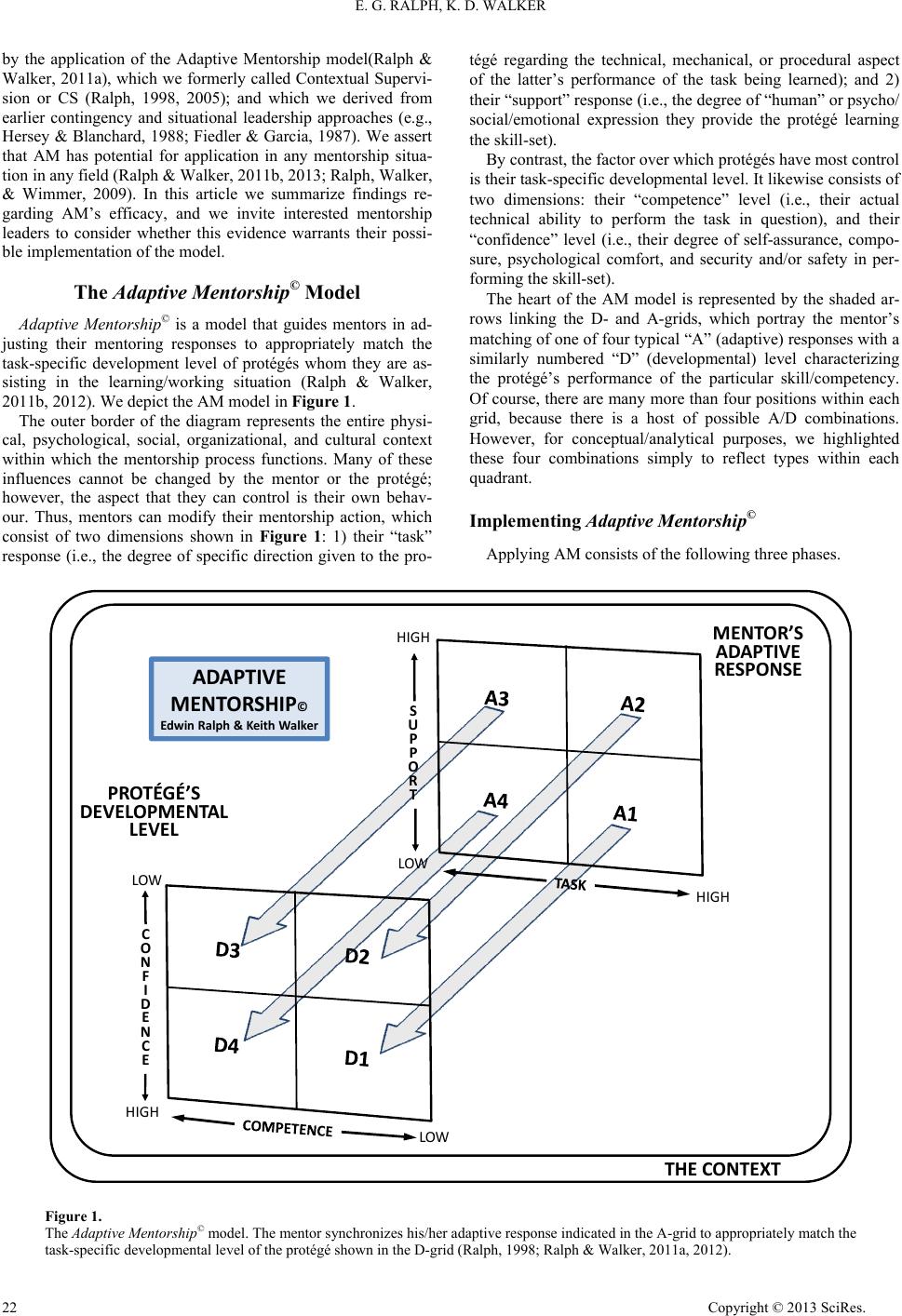 E. G. RALPH, K. D. WALKER by the application of the Adaptive Mentorship model(Ralph & Walker, 2011a), which we formerly called Contextual Supervi- sion or CS (Ralph, 1998, 2005); and which we derived from earlier contingency and situational leadership approaches (e.g., Hersey & Blanchard, 1988; Fiedler & Garcia, 1987). We assert that AM has potential for application in any mentorship situa- tion in any field (Ralph & Walker, 2011b, 2013; Ralph, Walker, & Wimmer, 2009). In this article we summarize findings re- garding AM’s efficacy, and we invite interested mentorship leaders to consider whether this evidence warrants their possi- ble implementation of the model. The Adaptive Mentorship© Model Adaptive Mentorship© is a model that guides mentors in ad- justing their mentoring responses to appropriately match the task-specific development level of protégés whom they are as- sisting in the learning/working situation (Ralph & Walker, 2011b, 2012). We depict the AM model in Figure 1. The outer border of the diagram represents the entire physi- cal, psychological, social, organizational, and cultural context within which the mentorship process functions. Many of these influences cannot be changed by the mentor or the protégé; however, the aspect that they can control is their own behav- our. Thus, mentors can modify their mentorship action, which consist of two dimensions shown in Figure 1: 1) their “task” response (i.e., the degree of specific direction given to the pro- tégé regarding the technical, mechanical, or procedural aspect of the latter’s performance of the task being learned); and 2) their “support” response (i.e., the degree of “human” or psycho/ social/emotional expression they provide the protégé learning the skill-set). By contrast, the factor over which protégés have most control is their task-specific developmental level. It likewise consists of two dimensions: their “competence” level (i.e., their actual technical ability to perform the task in question), and their “confidence” level (i.e., their degree of self-assurance, compo- sure, psychological comfort, and security and/or safety in per- forming the skill-set). The heart of the AM model is represented by the shaded ar- rows linking the D- and A-grids, which portray the mentor’s matching of one of four typical “A” (adaptive) responses with a similarly numbered “D” (developmental) level characterizing the protégé’s performance of the particular skill/competency. Of course, there are many more than four positions within each grid, because there is a host of possible A/D combinations. However, for conceptual/analytical purposes, we highlighted these four combinations simply to reflect types within each quadrant. Implementing Adaptive Mentorship© Applying AM consists of the following three phases. HIGH HIGH HIGH LOW LOW LOW THE CONTEXT MENTOR’S ADAPTIVE RESPONSE PROTÉGÉ’S DEVELOPM ENTAL LEVEL C O N F I D E N C E S U P P O R T ADAPTIVE MENTORSHIP © Edwin Ralph & Keith Walker Figure 1. The Adaptive Mentorship© model. The mentor synchronizes his/her adaptive re sponse indicated in the A-grid to appropr iat ely match the ask-specific developmental level of the protégé sho w n i n t he D-grid (Ralph, 1998; Ralph & Walker, 2011a, 2012) . t Copyright © 2013 SciRes. 22  E. G. RALPH, K. D. WALKER Determining the Protégé’s Development First, the protégé/mentor pair ascertains the existing devel- opment level of the protégé to perform a specific skill-set being learned at the time. As illustrated in the “D-grid”, a protégé’s task-specific level of development consists of both his/her com- petence and his/her confidence levels to perform the task. The D1 quadrant reflects an individual with “low competence” and “high confidence” to accomplish the task (i.e., he/she does not know exactly how to perform it, but is confident, willing, and eager to try). A protégé at D2 is low on both competence and confidence; a protégé at D3 shows higher competence and lower confidence; while a protégé at D4 is high on both dimen- sions for the particular skill-set. A protégé’s developmental level may be identified: 1) by the mentor’s formal and informal observations of the protégé’s actual performance of the skill/task; 2) by the pairs’ informal conversations about the protégé’s D-level; and 3) by the pro- tégé’s answers to the mentor’s direct questions about his/her progress. D-levels are: task-specific; changeable over-time; dif- ferent for different skill-sets; and temporary indicators of a pro- tégé’s stage at a specific point in time (Ralph, 1998, 2000a, 2005; Ralph & Walker, 2011a, 2011b). Synchronizing the Mentor’s Response Next, the mentor appropriately adjusts his/her mentorship response to match the existing D-level of the protégé regarding the particular competency: A1 matches D1, A2 matches D2, and so on. The mentor’s “A” adaptive-response also has two dimensions: the degree of support the mentor provides (i.e., the psycho-emotional aspects of encouragement, reinforcement, and praise to bolster the protégé as he/she attempts to develop the particular skill-set). Support consists of genuinely positive words and/or actions, and varies along a continuum. The other A-element is task (i.e., how directive the mentor is toward the protégé regarding his/her technical or mechanical prowess in the task), which also varies along a continuum, ranging for example, from telling, to demonstrating, to sug- gesting, to questioning, or to delegating with respect to the protégé’s skill-specific technique. The key principle for the mentor to correctly match the A and D quadrants is that his/her task response must be inverse in magnitude to the extent of the protégé’s competence level; and simultaneously, the extent of the mentor’s support is similarly inversely proportional to the novice’s level of confidence for particular task. Monitoring the Protégé’s Development Then, the mentorship pair continually and mutually monitors the protégé’s ongoing level of development, which necessitates that the mentor simultaneously adjusts his/her adaptive re- sponse to match, in inverse proportions, the protégé’s changing development level(s). Research Results During the past 23 years we and other mentorship scholars and practitioners have conducted research investigating the effectiveness of the AM model in a variety of mentorship set- tings. We summarize this research in two categories: early and recent phases. Early Research From 1990 to 2005, we conducted research on the model, which we first called Contextual Supervision (CS) within ex- tended-practicum (internship) programs of teacher education (Ralph, 1991, 1993a, 1998, 2004, 2005). Our several reports have documented the model’s application, the research results, the subsequent refinements, and the caveats for implementing the model (Ralph, 1992, 1994, 1996, 2000, 2002b). We gath- ered data from mentors and protégés who used the model re- garding their respective readings of self- and partner-locations on the two A and D grids of the model, as they progressed through the mentorship cycle. By recording these respective plottings at different times during the learning period, we were able to determine the developmental changes/adaptations of each partner throughout the practicum. That research presented the following findings: 1) AM helped mentors clarify their con- ceptualization of the whole mentoring process; 2) it replaced a “one-size-fits-all” approach by allowing mentors to vary their adaptive behaviour according to the developmental needs of their protégés; 3) it was intuitively appealing and relatively easy to learn; 4) it offered mentors a tool to help analyze and alleviate mentoring conflicts; and 5) it revealed that such rela- tionship problems were often the result of mentors mismatching their adaptive responses with protégés’ task-specific develop- mental levels (Ralph, 1993b, 1996, 1998, 2000, 2002a). At the same time, however, we also found that there was a small but persistent degree of mismatching between mentor response and protégé developmental level. Ideally, if the AM model functioned perfectly there would be a 100% agreement of matching of D and A quadrants; yet, some of our previous research (Ralph, 2004, 2005) showed that the mismatching phenomenon could be reduced if the program provided partici- pants with more workshop time to become acquainted with the model, and if the college-based advisor made more deliberate reference to the model during mentoring seminars and site- visits. Recent Research We continued to apply the AM model in our teacher-educa- tion internships (Ralph, Walker, & Wimmer, 2007, 2009, 2010), but we also sought to broaden its application in other profes- sional disciplines (Posner, 2004; Watt, 1998). In 2007, as a conesquence of our receipt of a public-outreach grant from the Social Sciences and Humanities research Council of Canada we were able to disseminate the AM model both by means of workshop presentations and publications describing the model and its research results. Results from a Variety of Professions From 2007 to the present we have continued to apply the model in our own mentorship of novice teachers during their extended-practicum programs, and we have also been more widely distributing the model through public presentations and scholarly publications (Ralph & Walker, 2011a, 2012). As a result of these dissemination efforts, leaders from several other professional disciplines have implemented the AM model. Re- cent reports documenting these experiences were: 1) applying it in undergraduate advisory programs (Chrosniak, Ralph, & Walker, 2013); using it to mentor university students in EAL programs (Khoii, 2011); adapting it for teacher-candidates com- pleting their extended-practicum (Chin & Kutsyuruba, 2011); adapting it to guide young adults through developmental life stages (Pullman, 2011); mentoring student nurses (Jennings & Copyright © 2013 SciRes. 23  E. G. RALPH, K. D. WALKER Couture, 2011); implementing it within a medicine/nurse-prac- titioner mentorship program (Ralph & Shaw, 2011); adapting it for undergraduate pharmacy students (Hawrysh, 2011); em- ploying it to enhance the mentorship of business students (Pos- ner, 2004); adapting it to enhance a dietetic preceptors’ men- torship program (Haskey, Floer, Walker, & Ralph, in press); and adapting it to fit mentorship conducted in cross-cultural settings (Johansson-Fua, Ruru, Sanga, Walker, & Ralph, 2013; Johansson-Fua, Sanga, Walker, & Ralph, 2011; Ruru, Sanga, Walker, & Ralph, in press). The results of these research reports confirmed many of our earlier findings, one of which was that the AM model offers mentoring partners a sensible and sensitive frame work to con- ceptualize mentorship as a developmental process. A second point of agreement among most AM users was that this process proved most effective when mentors adapted the degree of support and guidance they offered to meet the variable learning needs of their protégés. By contrast, the quality of mentorship was shown to be less effective when there was a mismatch between these elements. A third finding was that although most AM participants acknowledged the clarity provided for their overall understanding of the mentoring process, they still wan- ted freedom to adapt and/or modify the model as needed in order to fit the unique contexts and idiosyncratic conditions connected to their particular work settings and/or cultures. They expressed reluctance at being unnecessarily tied to rigid proce- dures or structures that did not reflect their organizational back- grounds (Johansson-Fua, Sanga, Walker, & Ralph, 2011; Ruru, Sanga, Walker, & Ralph, in press). Results from Panels of Experts At the time of writing this article, we had conducted 48 Adaptive Mentorship dissemination forums, workshops, or presentations at scholarly conferences, professional seminars, practitioner meetings, or academic conventions in eight coun- tries. At these gatherings that ranged from one hour to two days in length, we typically described the AM model, its rationale, its application, and its research record. Also at these sessions, we collected feedback from a total of 573 respondents con- cerning the AM model, who represented a wide range of pro- fessions and occupations from the educational, industrial, and governmental sectors. Those respondents were workshop at- tendees, and who accepted our invitation to serve as members of “panels of experts” (Srinivasan, Straus, & Adams, 2011; Wiersma & Jurs, 2008), by virtue of the fact that they were all scholars, researchers, or practitioners experienced in the proc- ess of mentoring within their respective fields. As panel mem- bers, they responded to two questions on a survey we circulated at the conclusion of each workshop: 1) What to you are the positive aspects of AM, and 2) What are the challenging as- pects? The findings we derived from our analysis of these ex- pert panels’ responses (Ralph & Walker, 2013) again confirmed many of the previous AM results cited above. We noted in these data that all pane lists identified one or more positive fea- tures of the model; and that, overall, they provided twice as many positive elements as they did challenging ones. We sum- marize the main response-categories that emerged from this study, below, and we also include sample comments in paren- theses, which illustrate typical perspectives. The three categories having the largest numbers of positive aspects that panels identified were that the AM model: 1) pro- vided a logical conceptual map of the entire mentorship enter- prise (“It gives a simple and clear identification of where pairs are at and how to generate discussion to address action”); 2) helped mentors guide protégés’ learning (“It shows how the mentor should adapt her style to match the learner’s stage”); and 3) promoted the growth of both partners (“I like the idea of open conversation between both the protégé and mentor, as to where each is at and what they need from one another”). The three largest categories of challenge that panel lists iden- tified regarding the AM model were that AM leaders must be careful to: 1) provide adequate time for partners to become familiar with using the model (“To me, both the mentor and protégé would need training to understand the model and to effectively implement it”); 2) recognize that some partners may resist the model (“The hierarchy relationship may cause diffi- culty for the mentor or protégé to be honest”); and 3) acknowl- edge the existence of unforeseen barriers or conditions that might reduce the model’s efficacy (“I think AM may be seen by some as too simplistic, because there are more factors at play than just the protégé’s confidence and competence, i.e., you might have to expand it beyond the 2 windows you show”). Conclusion To this point in our research into Adaptive Mentorship, the accumulated evidence suggests that it is a viable model that can clarify understanding and provide guidance to individuals using it in their mentoring practice. Like any conceptual model in the social sciences, however (Zais, 1975), it is imperfect and it has advantages and disadvantages. Nevertheless, the results tend to confirm that its benefits outweigh its limitations. In this light, we believe that the following comment submitted by a member of one of the expert panels in New Zealand aptly described the efficacy of the AM model: “It is situational and contextual, providing mentors with a framework for thinking about their approach to their protégés. It is very “protégé-centric” and lets mentors adapt/tailor their style to meet the needs of their men- tees.” We conclude by inviting interested mentorship leaders to examine these results as they consider whether to adapt AM to enhance their respective mentorship programs. REFERENCES Allen, T., & Eby, L. (2007). The Blackwell handbook of mentoring: A multiple perspective approach. Malden, MA: Blackwell. doi:10.1111/b.9781405133739.2007.x Asare, A. (2008). A few good faculty: Inspiring and preparing contem- porary dental educators. New York Sta t e D e nt a l J o ur n a l, 74, 23-27. Bauer, T., & Erdogan, B. (2009). Organizational behavior. http://www.flatworldknowledge.com/pub/1.0/organizational-behavior/2 8789#web-28789 Bozeman, B., & Feeney, M. (2007). Toward a useful theory of mentor- in g: A conceptual analysis and cr itique. Administration & Society, 39, 719-739. doi:10.1177/0095399707304119 http://aas.sagepub.com/content/39/6/719 Brock, V. (2011). Secret history of coaching. International Journal of Mentoring and Coaching, 9. ht t p: // w ww .em cc ou n ci l. or g /e u/ e n/ 40 Carnegie Foundation for the Advancement of Teaching (2011). Profes- sional and graduate education: Preparation for the professions pro- gram (PPP: Clergy study, engineering study, law study, medical edu- cation study, nursing study, teacher education study. http://www.carnegiefoundation.org/previous-work/professional-grad uate-education Chin, P., & Kutsyuruba, B. (2011). The potential of the Adaptive Men- torship© model in teacher education practicum settings. In E. Ralph, Copyright © 2013 SciRes. 24  E. G. RALPH, K. D. WALKER & K. Walker (Eds.), Adapting mentorship across the professions: Fresh insights & perspectives (pp. 361-378). Calgary, Alberta: Te- meron/Detselig/Brush. Chrosniak, P., Ralph, E., & Walker, K. (2013). What role can question- ing play in mentorship ? http://dus.psu.edu/mentor/2013/02/role-questioning-play-mentorship/ Chu, C. (2009). Mentoring for leadership in Pacific education. Doc- toral Dissertation, Wellington, NZ: Victoria University of Wellington. http://researcharchive.vuw.ac.nz/bitstream/handle/10063/1103/thesis. pdf Chun, J., Sosik, J., & Yun, N. (2012, January 13). A longitudinal study of mentor and protégé outcomes in formal mentoring relationships. Journal of Organizational Behavior, 33, 1071-1094. doi:10.1002/job.1781 http://onlinelibrary.wiley.com/doi/10.1002/job.1781/pdf Ellsum, W., & Pedersen, C. (2005). Does coaching work without men- torship in management development? Paper at ANZAM 2005: En- gaging the multiple contexts of management convergence and diver- gence of management theory and practice, 7-10 December 2005, Canberra, Australia. http://eprints.usq.edu.au/1760/ Fiedler, F., & Garcia, J. (1987) New Approaches to leadership, cogni- tive resources and organizational performance. New York: John Wiley and Sons. Haskey, N., Floer, S., Walker, K., & Ralph, E. (2013). Adapting the Adaptive Mentorship© model in the dietetic internship: A preceptor handbook. Saskatoon: T ur ning P oint Global. Hawrysh, D. (2011). Towards a mentorship model for pharmacy stu- dents. In E. Ralph, & K. Walker (Eds.), Adapting mentorship across the professions: Fresh insights & perspectives (pp. 345-360). Cal- gary: Temeron/Detselig/Brush. Hersey, P., & Blanchard, K. (1988). Management of organizational behavior: Utilizing human resources (5th ed.). Englewood Cliffs, NJ: Prentice-Hall. Jennings, A., & Couture, B. (2011). Supervision in nursing education: A Canadian perspective. In E. Ralph, & K. Walker (Eds.), Adapting men tor ship acr oss th e professions: Fresh insights & perspectives (pp. 329-344). Calga r y: Temeron/Detselig/Brush. Johansson-Fua, S., Sanga, K., Walker, K., & Ralph, E. (2011). Men- torship in the professions: A perspective from Tonga. The Interna- tional Journal of Mentoring and Coaching, 9, 19-37. Johansson-Fua, S. Ruru, D., Sanga, K., Walker, K., & Ralph, E. (2013). Creating mentorship metaphors: Pacific Island perspectives. Learn- ing Landscapes, 6, 241- 259. http://www.learninglandscapes.ca/images/documents/ll-no11.pdf Khoii, R. (2011). The effect of Adaptive Mentorship© on EAL students’ writing development. In E. Ralph, & K. Walker (Eds.), Adapting Men tor ship across the profes sions: Fresh insights & perspectives (pp. 307-327). Calga r y: Temeron/Detselig/Brush. Myall, M., Levett-Jones, T., & Lathlean, J. (2008). Issues in under- graduate education: Mentorship in contemporary practice: The ex- periences of nursing students and practice mentors. Journal of Clini- cal Nursing, 17, 1834-1842. doi:10.1111/j.1365-2702.2007.02233.x Posner, B. (2004). Reflections on experience: Editor’s introduction. Journal of Management Inquiry, 13, 151. doi:10.1177/1056492604265539 Pullman, E. (2011). Integrating a developmental perspective with the Adaptive Mentorship© model. In E. Ralph, & K. Walker (Eds.), Adapting mentorship across the professions: Fresh insights & per- spective (pp. 379-394). Calgary: T emeron/Detselig/Brush. Ralph, E. (1991). Aboriginal student teachers in the extended practicum: Contextual Supervision. Teaching Education, 4, 113-121. doi:10.1080/1047621910040116 Ralph, E. (1992). Improving practicum supervision: A Canadian ex- perience. Action in Teacher Education, 14, 30-38. doi:10.1080/01626620.1993.10463139 Ralph, E. (1993a). Enhancing Aboriginal teacher education: One prom- ising approach. Can a di an Journal of Native Educa t io n , 20, 44-62. Ralph, E. (1993b). Sensitive, sensible practicum supervision: A con- textual application in Saskatchewan. The Alberta Journal of Educa- tional Research, 39, 283-296. Ralph, E. (1994). Helping beginning teachers improve via Contextual Supervision. Journal of Teacher Education, 45 , 354 -363. doi:10.1177/0022487194045005008 Ralph, E. (1996). Contextual supervision: Matching supervisory styles with learners’ needs. The Canadian Administrator, 35, 1-11. Ralph, E. (1998). Developing practitioners: A handbook of contextual supervision. Stillwater, OK: New Forums Press. Ralph, E. (2000). Aligning mentorship style with beginning teachers’ development: Contextual supervision. The Alberta Journal of Educa- tional Research, 46, 311-326. Ralph, E. (2002a). Improving the application of contextual supervision: An ongoing initiative. In R. Nata (Ed.), Progress in education: Vol- ume 9 (pp. 1-12). New York: Nova Science Publishers. Ralph, E. (2002b). Mentoring beginning teachers: Findings from con- textual supervision. Journal of Personnel Evaluation in Education, 16, 191-210. doi:10.1023/A:1020809206376 Ralph, E. (2004). Developing managers’ effectiveness: A model with potential. Journal of Manag em en t Inquiry, 13, 151-163, doi:10.1177/1056492604265222 Ralph, E. (2005). Enhancing managers’ supervisory effectiveness: A promising model. The Journal of Management Development, 24, 267-284. doi:10.1108/02621710510584071 Ralph, E., & Walker, K. (2010). Enhancing mentors’ effectiveness: The promise of the Adaptive Mentorship© model. McGill Journal of Education, 45, 205- 218. doi:10.7202/045604ar Ralph, E., & Walker, K. (Eds.). (2011a). Adapting mentorship across the professions: Fresh insights and perspectives. Calgary, Alberta: Brush Education. Ralph, E., & Walker, K. (2011b). Helping novices develop in the hu- manities via Adaptive Mentorship©. The International Journal of the Humanities, 9,121-132. Ralph, E., & Walker, K. (2012). Enhancing mentoring across the disci- plines: Via the Adaptive Mentorship© model. Bridges: Reflecting the scholarship of teaching & learning at the University of Saskatche- wan, 10, 9-11. http://www.usask.ca/gmcte/sites/default/files/Bridges%20May%202 012%20WEB.pdf Ralph, E., & Walker, K. (2013). The potential of Adaptive Mentorship©: Expert panels’ views. Manuscript submitted for publicatio n. Ralph, R., & Shaw, S. (2011). Dismantling barriers: Mentorship in emerging nurse-practitioner roles. In E. Ralph, & K. Walker (Eds.), Adapting mentorship across the professions: Fresh insights & per- spectives (pp. 413-431). Calgary, Alberta: Brush Education. Ralph, E., Walker, K., & Wimmer, R. (2008). The clinical/practicum experience in professional preparation: Preliminary findings. McGill Journal of Education, 43, 157-172. doi:10.7202/019580ar Ralph, E., Walker, K., & Wimmer, R. (2009). Practicum-education ex- periences: Post-interns’ views. International Journal of Engineering Education, 25, 122-130. Ralph, E., Walker, K., & Wimmer, R. (Eds.). (2010). The practicum in professional education: Canadian perspectives. Calgary, Alberta, Brush Education. Rose, M., & Best, D. (Eds.). (2005). Transforming practice through clinical education, professional supervision and mentoring. New York: Elsevier. Ragins, R. B., & Kram, K. (Eds.). (2007). The handbook of mentoring at work: Theory, research, and practice. Los Angeles, CA: Sage. Ruru, D., Sanga, K., Walker, K., & Ralph, E. (in Press). Adapting men- torship across the professions: A Fijian view. International Journal of Evidence Based Coaching and M e ntoring. Schoonover, S. (2002). Six sigma leadership: The key to sustaining contemporary qualit y p r o g r am s . http://www.slideshare.net/Sixsigmacentral/six-sigma-leadership-the- key-to-sustaining-contemporary Srinivasan, R., Straus, S., & Adams, J. (2011). New research system uses social media and other tools to gather, analyze expert opinions. Science Daily: Your Source for the Latest Research News. http://www.sciencedaily.com/releases/2011/06/110614115642.htm Steers, R., Sanchez-Runde, C., & Nardon, L. (2010). Management across cultures: Challenges and strategies. New York: Cambridge University Press. doi:10.1017/CBO9780511810510 Copyright © 2013 SciRes. 25  E. G. RALPH, K. D. WALKER Copyright © 2013 SciRes. 26 Taherian, K., & Shekarchian, M. (2008). Mentoring for doctors: Do its benefits outweigh its disadvantages? Medical Teacher , 30, pp. 95-99. doi:10.1080/01421590801929968 Watt, S. (1998). An examination of contextual supervision in a pre- school practicum setting. M. Ed. Thesis. Burnaby: Simon Fraser University. Wiersma, W., & Jurs, S. (2008). Research methods in education (9th ed.). New York: Pearson. Yoo, In-Sung. (2004). Education: Mentoring swells into “a movement.” USA Today. http://www.usatoday.com/news/education/2004-01-26-mentoring_x. htm Zais, R. (1976). Curriculum: Principles and foundations. New York: Crowell. |