

Paper Menu >>
Journal Menu >>
 Psychology 2013. Vol.4, No.5, 483-487 Published Online May 2013 in SciRes (http://www.scirp.org/journal/psych) http://dx.doi.org/10.4236/psych.2013.45068 Copyright © 2013 SciRes. 483 The Effect of a Mother’s Level of Attachment and Her Emotional Intelligence on a Child’s Health during Its First Year of Life Elena Nikolaeva, Vera Merenkova Herzen State Pedagogical University, Saint Petersburg, Russia Email: [email protected] Received January 3rd, 2013; revised February 6th, 2013; accepted March 23rd, 2013 Copyright © 2013 Elena Nikolaeva, Vera Merenkova. This is an open access article distributed under the Crea- tive Commons Attribution License, which permits unrestricted use, distribution, and reproduction in any me- dium, provided the original work is properly cited. The aim of this study was to investigate the possibility of predicting the health of a child during its first year by using the mother’s emotional intelligence and the level of her attachment to the child. Serving as test subjects were 50 mother-child pairs during the first year of life and 50 mother-child pairs during the second year of life (altogether 200 individuals). It was shown that the likelihood of dismissing a diagnosis given to a child at a maternity clinic depends on the level of the mother’s acceptance of the child and not on her emotional intelligence and anxiety. Keywords: Health; Emotional Intelligence; Attachment; A Child in Its First Year of Life Introduction Being able to forecast healthy changes of behavior in a sub- ject is among the typical concerns of health psychology (e.g. Balmford, Borland, & Burney, 2010; Murnaghan et al., 2010; Lyons, 2011). Such behavior is clearly determined to a signifi- cant degree by the subject’s motivation to lead a healthy life- style. There are considerably fewer studies devoted to changes in behavior attributable not to internal needs but to the desire not to harm the health of another person, for example when parents give up smoking so as not to harm the health of their child (Moan, Rise, & Andersen, 2005). But there is a vast field, virtually untouched by research, in which the behavior of adults determines the health of a child. Such an influence is very like- ly during the first year of a child’s life, when the number of external factors affecting their health is restricted primarily by interaction with the few members of the family into which it was born. After birth, most children (about 95% - 99% of them) in Russia are given one or another diagnosis while they are still at a maternity clinic, where neurologist examines each child (Ba- ranov, 1999). It may later be expanded or dismissed after a visit from a polyclinic doctor. The most typical ones are perinatal encephalopathy and motor disturbance syndrome. Such illnes- ses in children are caused by chronic intrauterine fetal hypoxia as a result of various diseases contracted by the mother during pregnancy (Kulakov & Frolova, 2004). However, by the end of the child’s first year of life, and, very often, by the end of the second year, these earlier diagnoses are dismissed by specialists (Baranov, 1999). To a considerable extent, improvement in a child’s condition after birth is predetermined by the effective actions of those who are taking care of it, mainly the mother (In Russia, it is primarily the mother who cares for a child until the age of two). In most families, it is the mother who takes a child to the doctor and carries out the instructions necessary for rehabilitation. In this case, her involvement in the process of restoring the child’s health will substantially affect whether or not the prognosis for recovery is favorable in those instances when the illness is not hereditary but is determined by particular features of intrauter- ine development and birth. And so the question arises: Having evaluated different psy- chological features of the mother, is it possible to predict how effective a child’s recovery is likely to be? Among the psycho- logical factors that are very likely to speed up a child’s reha- bilitation, it is the mother’s emotional features that stand out. There are a considerable number of studies that attest to the ne- gative influence of a mother’s postnatal depression on her child’s intellect. It has been proven that the earlier this pathology arises in the mother, the more pronounced the negative effects on the child (Petterson & Albers, 2001), especially a boy (Offord, 1989). There are, however, no studies about the positive influence on a child’s recovery of other emotional manifestations of the mo- ther, for example the level of her emotional intelligence and at- tachment to the child. For this reason, the aim of this study was to examine the in- fluence of a mother’s emotional intelligence and her attachment to a child on the likelihood of dismissing the child’s diagnosed illness due to perinatal problems experienced by the mother du- ring pregnancy. Methods Participants and Procedure Overall 200 test subjects were examined, 50 mother-child pairs with the child in the first year of life (the mean age of the mothers was 24.46 (SD = 5.57) years and 50 mother-child pairs with the child in the second year of life (the mean age of the mothers was 25.54 (SD = 4.9 years). Of the 50 children in the first year of life, 23 were girls and 27 were boys; of the 50 child- ren in the second year of life, 24 were girls and 26 were boys.  E. NIKOLAEVA, V. MERENKOVA The gender breakdown of the sample groups did not differ from each other and conformed to the known statistics, which show a slight predominance among newborn males (Golubeva, Les- henko, & Pechora, 2002). The study was conducted in a children’s clinic in one of the districts of Yeletz, a city in west-central Russia. The following two sets of procedures were used to carry out the aim of the study. The first set of procedures involved de- scribing the distinct features concerning the health of the chil- dren in their first or second year of life. A comprehensive ap- praisal of the children’s health was conducted based on health criteria (Golubeva, Leshenko, & Pechora, 2002), information about which was received from the individual medical records of the children, aged up to two years. Permission to use this in- formation was obtained from the children’s parents. The second set of procedures was aimed at examining the psychological features of the mothers with children up to two years old and included the following procedures: 1) A questionnaire evaluating the attitude of a mother toward a child during its first two years of life (Vereshagina & Niko- laeva, 2009). The questionnaire included four scales: a) Sensitivity—insensitivity to the needs of the baby. This parameter establishes the extent to which the mother is capable of understanding the child’s needs and seeing a situation from its point of view. b) Acceptance—rejection. This scale determines the degree to which the parents accept the child, i.e., it evaluates how much the child corresponds to their expectations. c) Responsiveness—intrusion. This parameter establishes the mother’s respect for the independence and individuality of the child and shows how prepared she is to support its initiative, develop its abilities and, not suppressing them, press for the re- alization of its own wishes. d) Encouragement—neglect. This scale establishes that as- pect of the mother’s behavior which reveals the degree of her emotional fitness. This parameter evaluates her ability to sup- port the tot when it is experiencing difficulties. Such is a qualitative description of a mother’s level of at- tachment to her child. A high level of healthy attachment cor- responds to high scores that the mother’s answers receive ac- cording to all four scales. This means that she is extremely sensitive to the needs of her child, accepts it as it is and does not try to follow the socially accepted notions of child devel- opment. She always responds promptly to the child’s appeals, providing support for its undertakings and granting sufficient freedom for its own actions. A mean level of healthy attachment is assigned when either mean scores are given for all scales or very high scores for the majority of scales are combined with low marks for one of them. In this case, we did not take into account the contribution of each scale to the final result since we had set ourselves the task of evaluating the types of interaction in the mother-child pair. Accordingly, with a mean level of healthy attachment, a mother shows sensitivity to her child’s needs in most cases and tries to develop socially desirable forms of behavior beginning in early childhood. Depending on the situation, she responds to the child’s appeals and provides support for its initiatives but often excessively controls its behavior or, being extremely busy, fails to respond in certain instances to the child’s appeals for help. A low level of healthy attachment corresponds to low scores on all scales or average scores on two and very low marks on some of the other scales. In practice, the mother shows interest in the child in socially acceptable situations, and when wit- nesses are present, and tends to impose her own stereotypes of behavior on the child regardless of its needs. In most cases, she ignores the child’s interests and rejects its requests for support or independent investigation. Unhealthy attachment is characterized by a mother pursuing her own line of behavior in interaction without considering the wishes of her child and the particularities of its development, essentially impeding the independence and initiative of the child and not striving to support it in difficult situations (re- strictiveness or neglect prevail). Thus, it is obvious that we can separate out anxious unhealthy attachment from the responses, but no mother would write about the ambivalence of her be- havior in relation to her child. For the time being, it is possible that this type of interaction falls into the category of healthy attachment since many mothers, in their responses, are guided not by their own behavior but by what they consider to be the societal standards. 2) The questionnaire to evaluate emotional intelligence (Ly- usin, 2004) is a standardized methodology for measuring the level of emotional intelligence. The questionnaire is based on an interpretation of emotional intelligence as the ability to un- derstand one’s own and others’ emotions and to control them. In its final form, the questionnaire consists of 46 statements in relation to which the test subject must express the extent of their agreement, using a four-point scale (strongly disagree, tend to disagree, tend to agree, strongly agree). These statements are combined into five sub-scales, which, in turn, are combined into four scales of a more general nature. The questionnaire included the following scales: a) A scale of interpersonal emotional intelligence, which is aimed at evaluating the ability to understand the emotions of other people and to control them. b) A scale of intrapersonal emotional intelligence, which de- scribes the ability to understand one’s own emotions and to control them. c) A scale of emotional understanding, which delineates the ability to understand one’s own and others’ emotions. d) A scale of emotional control, which defines the ability to control one’s own and others’ emotions. A sub-scale of understanding others’ emotions, which de- scribes the ability to understand a person’s emotional state ba- sed on external manifestations of emotions (facial expressions, gestures, tone of voice) and/or one’s own intuition; sensitivity to the inner state of other people. A sub-scale of controlling others’ emotions, which delineates the ability to evoke various emotions in other people, to reduce the intensity of undesirable emotions and, possibly, the inclina- tion to manipulate people. A sub-scale of understanding one’s own emotions, which de- fines the ability to perceive one’s emotions, to recognize and identify them, to understand their source and to verbalize them. A sub-scale of controlling one’s own emotions, which de- scribes the ability and need to control one’s emotions, to evoke and encourage desirable emotions and to keep those that are un- desirable under control. A sub-scale of controlling expression, which describes the ability to control the display of one’s emotions. 3) A Russian version of the Spielberger questionnaire, ad- apted for Russian-speaking test subjects by Khanin (Shapar, 2006). This allowed us to determine the level of situational and Copyright © 2013 SciRes. 484 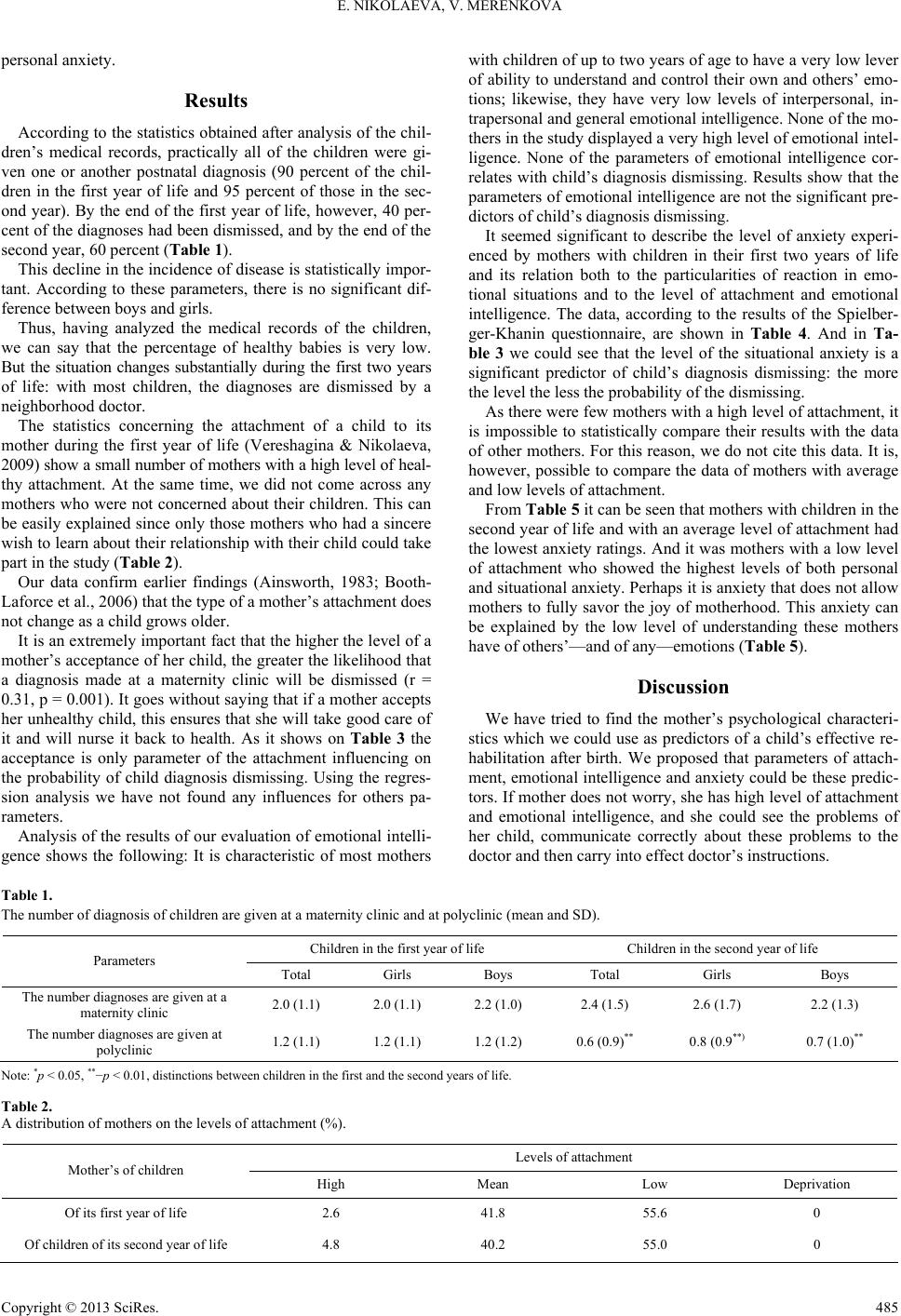 E. NIKOLAEVA, V. MERENKOVA Copyright © 2013 SciRes. 485 personal anxiety. Results According to the statistics obtained after analysis of the chil- dren’s medical records, practically all of the children were gi- ven one or another postnatal diagnosis (90 percent of the chil- dren in the first year of life and 95 percent of those in the sec- ond year). By the end of the first year of life, however, 40 per- cent of the diagnoses had been dismissed, and by the end of the second year, 60 percent (Table 1). This decline in the incidence of disease is statistically impor- tant. According to these parameters, there is no significant dif- ference between boys and girls. Thus, having analyzed the medical records of the children, we can say that the percentage of healthy babies is very low. But the situation changes substantially during the first two years of life: with most children, the diagnoses are dismissed by a neighborhood doctor. The statistics concerning the attachment of a child to its mother during the first year of life (Vereshagina & Nikolaeva, 2009) show a small number of mothers with a high level of heal- thy attachment. At the same time, we did not come across any mothers who were not concerned about their children. This can be easily explained since only those mothers who had a sincere wish to learn about their relationship with their child could take part in the study (Table 2). Our data confirm earlier findings (Ainsworth, 1983; Booth- Laforce et al., 2006) that the type of a mother’s attachment does not change as a child grows older. It is an extremely important fact that the higher the level of a mother’s acceptance of her child, the greater the likelihood that a diagnosis made at a maternity clinic will be dismissed (r = 0.31, p = 0.001). It goes without saying that if a mother accepts her unhealthy child, this ensures that she will take good care of it and will nurse it back to health. As it shows on Table 3 the acceptance is only parameter of the attachment influencing on the probability of child diagnosis dismissing. Using the regres- sion analysis we have not found any influences for others pa- rameters. Analysis of the results of our evaluation of emotional intelli- gence shows the following: It is characteristic of most mothers with children of up to two years of age to have a very low lever of ability to understand and control their own and others’ emo- tions; likewise, they have very low levels of interpersonal, in- trapersonal and general emotional intelligence. None of the mo- thers in the study displayed a very high level of emotional intel- ligence. None of the parameters of emotional intelligence cor- relates with child’s diagnosis dismissing. Results show that the parameters of emotional intelligence are not the significant pre- dictors of child’s diagnosis dismissing. It seemed significant to describe the level of anxiety experi- enced by mothers with children in their first two years of life and its relation both to the particularities of reaction in emo- tional situations and to the level of attachment and emotional intelligence. The data, according to the results of the Spielber- ger-Khanin questionnaire, are shown in Table 4. And in Ta- ble 3 we could see that the level of the situational anxiety is a significant predictor of child’s diagnosis dismissing: the more the level the less the probability of the dismissing. As there were few mothers with a high level of attachment, it is impossible to statistically compare their results with the data of other mothers. For this reason, we do not cite this data. It is, however, possible to compare the data of mothers with average and low levels of attachment. From Table 5 it can be seen that mothers with children in the second year of life and with an average level of attachment had the lowest anxiety ratings. And it was mothers with a low level of attachment who showed the highest levels of both personal and situational anxiety. Perhaps it is anxiety that does not allow mothers to fully savor the joy of motherhood. This anxiety can be explained by the low level of understanding these mothers have of others’—and of any—emotions (Table 5 ). Discussion We have tried to find the mother’s psychological characteri- stics which we could use as predictors of a child’s effective re- habilitation after birth. We proposed that parameters of attach- ment, emotional intelligence and anxiety could be these predic- tors. If mother does not worry, she has high level of attachment and emotional intelligence, and she could see the problems of her child, communicate correctly about these problems to the doctor and then carry into effect doctor’s instructions. Table 1. The number of diagnosis of children are given at a maternity clinic and at polyclinic (mean and SD). Children in the first year of life Children in the second year of life Parameters Total Girls Boys Total Girls Boys The number diagnoses are given at a maternity clinic 2.0 (1.1) 2.0 (1.1) 2.2 (1.0) 2.4 (1.5) 2.6 (1.7) 2.2 (1.3) The number diagnoses are given at polyclinic 1.2 (1.1) 1.2 (1.1) 1.2 (1.2) 0.6 (0.9)** 0.8 (0.9**) 0.7 (1.0)** Note: *р < 0.05, **−р < 0.01, distinctions between children in the first and the second years of life. Table 2. A distribution of mothers on the levels of attachment (%). Levels of attachment Mother’s of children High Mean Low Deprivation Of its first year of life 2.6 41.8 55.6 0 Of children of its second year of life 4.8 40.2 55.0 0 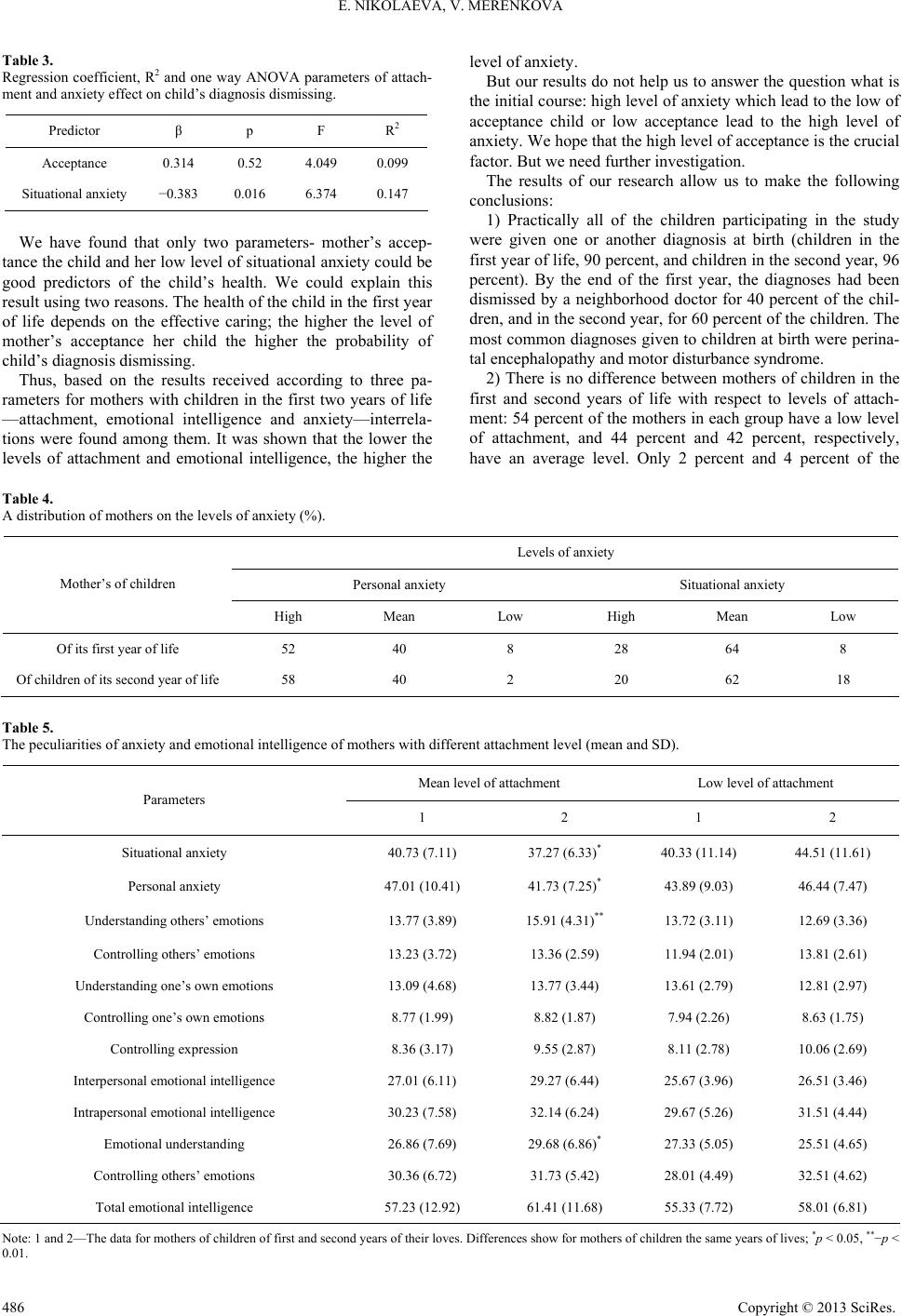 E. NIKOLAEVA, V. MERENKOVA Table 3. Regression coefficient, R2 and one way ANOVA parameters of attach- ment and anxiety effect on child’s diagnosis dismissing. Predictor β p F R2 Acceptance 0.314 0.52 4.049 0.099 Situational anxiety −0.383 0.016 6.374 0.147 We have found that only two parameters- mother’s accep- tance the child and her low level of situational anxiety could be good predictors of the child’s health. We could explain this result using two reasons. The health of the child in the first year of life depends on the effective caring; the higher the level of mother’s acceptance her child the higher the probability of child’s diagnosis dismissing. Thus, based on the results received according to three pa- rameters for mothers with children in the first two years of life —attachment, emotional intelligence and anxiety—interrela- tions were found among them. It was shown that the lower the levels of attachment and emotional intelligence, the higher the level of anxiety. But our results do not help us to answer the question what is the initial course: high level of anxiety which lead to the low of acceptance child or low acceptance lead to the high level of anxiety. We hope that the high level of acceptance is the crucial factor. But we need further investigation. The results of our research allow us to make the following conclusions: 1) Practically all of the children participating in the study were given one or another diagnosis at birth (children in the first year of life, 90 percent, and children in the second year, 96 percent). By the end of the first year, the diagnoses had been dismissed by a neighborhood doctor for 40 percent of the chil- dren, and in the second year, for 60 percent of the children. The most common diagnoses given to children at birth were perina- tal encephalopathy and motor disturbance syndrome. 2) There is no difference between mothers of children in the first and second years of life with respect to levels of attach- ment: 54 percent of the mothers in each group have a low level of attachment, and 44 percent and 42 percent, respectively, have an average level. Only 2 percent and 4 percent of the Table 4. A distribution of mothers on the levels of anxiety (%). Levels of anxiety Personal anxiety Situational anxiety Mother’s of children High Mean Low High Mean Low Of its first year of life 52 40 8 28 64 8 Of children of its second year of life 58 40 2 20 62 18 Table 5. The peculiarities of anxiety and emotional intelligence of mothers with different attachment level (mean and SD). Mean level of attachment Low level of attachment Parameters 1 2 1 2 Situational anxiety 40.73 (7.11) 37.27 (6.33)* 40.33 (11.14) 44.51 (11.61) Personal anxiety 47.01 (10.41) 41.73 (7.25)* 43.89 (9.03) 46.44 (7.47) Understanding others’ emotions 13.77 (3.89) 15.91 (4.31)** 13.72 (3.11) 12.69 (3.36) Controlling others’ emotions 13.23 (3.72) 13.36 (2.59) 11.94 (2.01) 13.81 (2.61) Understanding one’s own emotions 13.09 (4.68) 13.77 (3.44) 13.61 (2.79) 12.81 (2.97) Controlling one’s own emotions 8.77 (1.99) 8.82 (1.87) 7.94 (2.26) 8.63 (1.75) Controlling expression 8.36 (3.17) 9.55 (2.87) 8.11 (2.78) 10.06 (2.69) Interpersonal emotional intelligence 27.01 (6.11) 29.27 (6.44) 25.67 (3.96) 26.51 (3.46) Intrapersonal emotional intelligence 30.23 (7.58) 32.14 (6.24) 29.67 (5.26) 31.51 (4.44) Emotional understanding 26.86 (7.69) 29.68 (6.86)* 27.33 (5.05) 25.51 (4.65) Controlling others’ emotions 30.36 (6.72) 31.73 (5.42) 28.01 (4.49) 32.51 (4.62) Total emotional intelligence 57.23 (12.92) 61.41 (11.68) 55.33 (7.72) 58.01 (6.81) Note: 1 and 2—The data for mothers of children of first and second years of their loves. Differences show for mothers of children the same years of lives; *р < 0.05, **−р < 0.01. Copyright © 2013 SciRes. 486 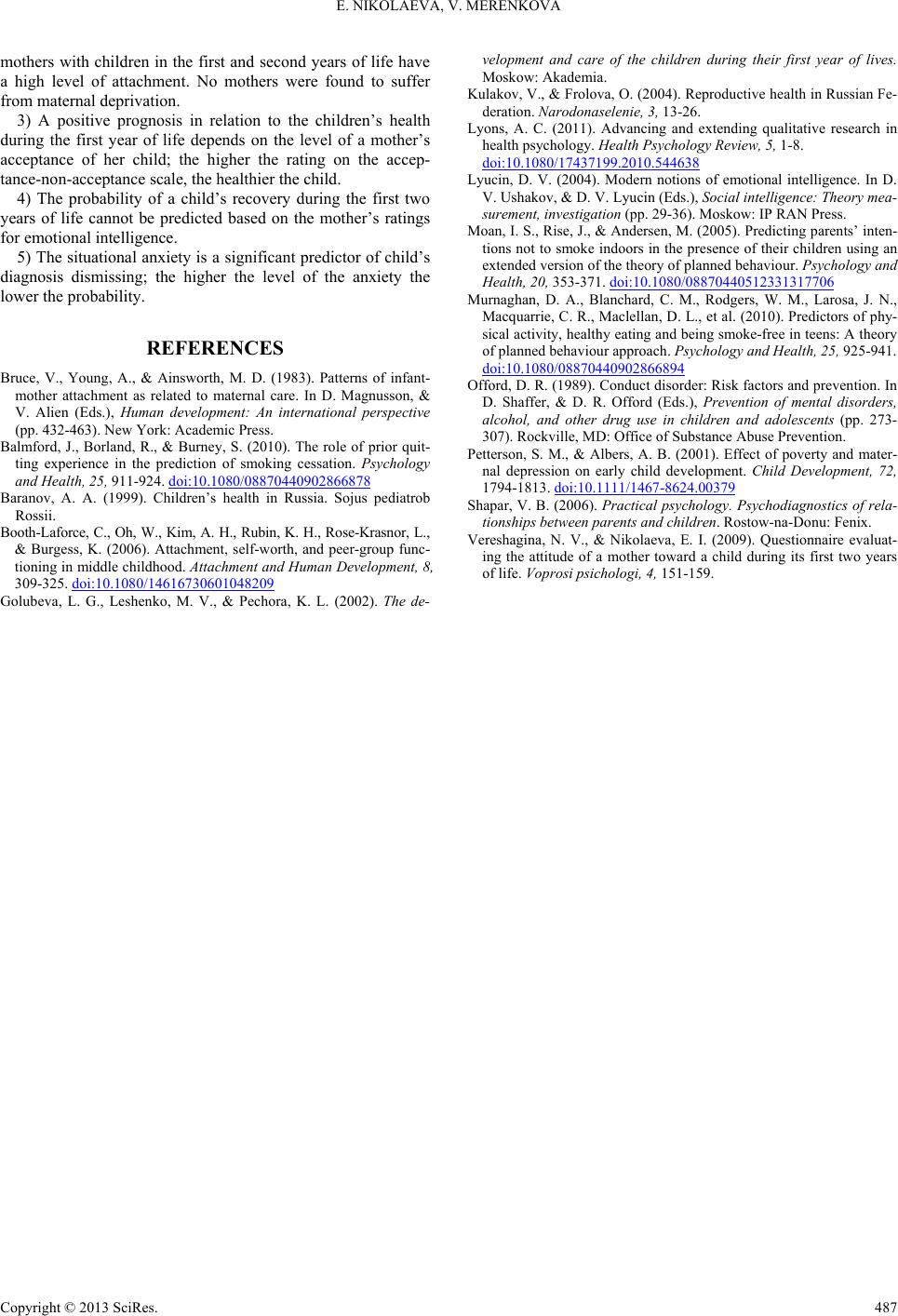 E. NIKOLAEVA, V. MERENKOVA mothers with children in the first and second years of life have a high level of attachment. No mothers were found to suffer from maternal deprivation. 3) A positive prognosis in relation to the children’s health during the first year of life depends on the level of a mother’s acceptance of her child; the higher the rating on the accep- tance-non-acceptance scale, the healthier the child. 4) The probability of a child’s recovery during the first two years of life cannot be predicted based on the mother’s ratings for emotional intelligence. 5) The situational anxiety is a significant predictor of child’s diagnosis dismissing; the higher the level of the anxiety the lower the probability. REFERENCES Bruce, V., Young, A., & Ainsworth, M. D. (1983). Patterns of infant- mother attachment as related to maternal care. In D. Magnusson, & V. Alien (Eds.), Human development: An international perspective (pp. 432-463). New York: Academic Press. Balmford, J., Borland, R., & Burney, S. (2010). The role of prior quit- ting experience in the prediction of smoking cessation. Psychology and Health, 25, 911-924. doi:10.1080/08870440902866878 Baranov, A. A. (1999). Children’s health in Russia. Sojus pediatrob Rossii. Booth-Laforce, C., Oh, W., Kim, A. H., Rubin, K. H., Rose-Krasnor, L., & Burgess, K. (2006). Attachment, self-worth, and peer-group func- tioning in middle childhood. Attachment and Human Development, 8, 309-325. doi:10.1080/14616730601048209 Golubeva, L. G., Leshenko, M. V., & Pechora, K. L. (2002). The de- velopment and care of the children during their first year of lives. Мoskow: Akademia. Kulakov, V., & Frolova, O. (2004). Reproductive health in Russian Fe- deration. Narodonaselenie, 3, 13-26. Lyons, A. C. (2011). Advancing and extending qualitative research in health psychology. Health Psychology Review, 5, 1-8. doi:10.1080/17437199.2010.544638 Lyucin, D. V. (2004). Modern notions of emotional intelligence. In D. V. Ushakov, & D. V. Lyucin (Eds.), Social intelligence: Theory mea- surement, investigation (pp. 29-36). Moskow: IP RAN Press. Moan, I. S., Rise, J., & Andersen, M. (2005). Predicting parents’ inten- tions not to smoke indoors in the presence of their children using an extended version of the theory of planned behaviour. Psychology and Health, 20, 353-371. doi:10.1080/08870440512331317706 Murnaghan, D. A., Blanchard, C. M., Rodgers, W. M., Larosa, J. N., Macquarrie, C. R., Maclellan, D. L., et al. (2010). Predictors of phy- sical activity, healthy eating and being smoke-free in teens: A theory of planned behaviour approach. Psychology and Health, 25, 925-941. doi:10.1080/08870440902866894 Offord, D. R. (1989). Conduct disorder: Risk factors and prevention. In D. Shaffer, & D. R. Offord (Eds.), Prevention of mental disorders, alcohol, and other drug use in children and adolescents (pp. 273- 307). Rockville, MD: Office of Substance Abuse Prevention. Petterson, S. M., & Albers, A. B. (2001). Effect of poverty and mater- nal depression on early child development. Child Development, 72, 1794-1813. doi:10.1111/1467-8624.00379 Shapar, V. B. (2006). Practical psychology. Psychodiagnostics of rela- tionships between parents and children. Rostow-na-Donu: Fenix. Vereshagina, N. V., & Nikolaeva, E. I. (2009). Questionnaire evaluat- ing the attitude of a mother toward a child during its first two years of life. Voprosi psichologi, 4, 151-159. Copyright © 2013 SciRes. 487 |