

Paper Menu >>
Journal Menu >>
 Vol.2, No.11, 1316-1319 (2010) doi:10.4236/health.2010.211196 Copyright © 2010 SciRes. Openly accessible at http://www.scirp.org/journal/HEALTH/ Health The frequency of intestinal parasites in puppies from Mexican kennels Enedina Jiménez-Cardoso1*, Leticia Eligio-García1, Adrián Cortés-Campos1, Apolinar Cano Estrada1, Margarita Pinto-Sagahón2, Cynthia Noguera-Estrada2 1Laboratorio de Investigación en Parasitología, Hospital Infantil de México FG, Dr. Márquez No. 162. Col. Doctores, D.F. 6720, México; *Corresponding Author: [email protected]; 2Fort Dodge Animal Health, Fort Dodge, USA. Received 7 August 2010; revised 18 August 2010; accepted 30 August 2010. ABSTRACT The purpose of this investigation was to deter- mine the intestinal parasite prevalence in pup- pies from six different kennels; four kennels were in Guadalajara and Zapopan cities (Jalisco State) and two kennels were in Mexico City. From October 2006 to November 2007, we col- lected 441 fecal samples from 147 puppies, both male and female, ranging from 1 to 36 months of age. Three samples from every puppy were ana- lyzed by using the Faust technique. The preva- lence found were as follows: Giardia intestinalis (genotype A and B) 6.8%; Cystoisospora 21.08%; Uncinaria 7.48%; Toxocara canis 12.29% and multiparasitism (Giardia, Toxocara and Unci- naria) 4.76%. The highest prevalence for both Giardia and Cystoisospora were found in 2-3- month-old puppies; the highest prevalence for Toxocara canis was found in 3-4-month-old pu- ppies. In the kennels of Mexico City we found mainly Giardia intestinalis, Cystoisospora to be most prevalent in Zapopan and Toxocara canis in Guadalajara. The high prevalence of intestinal parasites found in this study demonstrates an increased risk for infection in humans, as these animals are usually a common pet in many homes. This zoonotic phenomenon represents an important health problem for any community. Keywords: Parasites; Giardia; Cystoisospora; Dogs 1. INTRODUCTION The prevalence of intestinal parasites in dogs from kennels depends on several variables, including the ken- nels’ geographic area, number of animals sharing space, and, most importantly, the sanitary conditions in which the dogs live. Epidemiological studies of intestinal para- sites give us an idea of the zoonotic risk for dogs living in kennels as well as dogs living with a family as a do- mesticated pet. Several studies from kennels in Australia showed a parasitic prevalence of 23.9%, with 9.3% of the cases testing positive for Giardia intestinalis [1]. In Spain, a study showed a prevalence of parasites in 25% of those tested, with 6.0% of the cases testing positive for Toxo- cara canis and 10.0% testing positive for Cystoisospora [2]. In Greece, studies found a 26% parasitic prevalence, with 12.8% of the cases testing positive for Toxocara canis, 4.3% testing positive for Giardia duodenalis and Cystoisospora, and 2.8% testing positive for Uncinaria [3]. These statistics are important, as multiple parasites are being found in puppies as young as six months; therefore, kennel owners should treat all of their animals for parasites to prevent the continued spread of gastroin- testinal diseases [4]. For example, there is a high inci- dence of Giardia in children; this could be explained if the children are living in homes with a contaminated pet [5]. Deworming and treating all kennel animals for para- sites would reduce the cases of infection in humans. When puppies lived in a small, confined area in groups of 12 to 15, especially in cases when they lived together with their mother, tests showed a high preva- lence for Toxocara canis and Cystoisospora (36.4%). In contrast, when puppies were kept in clean, spacious ar- eas, these parasites were found in only 10% of those tested. Finally, some reports show that the prevalence of intestinal parasitism in dogs ranges from 35.5% to 100% [6]. For dogs kept in private kennels, the prevalence range is between 54% and 68% [7]. Intestinal parasitism can be an asymptomatic disease; moreover, there is no a specific symptom that can iden- tify a parasite. Therefore, all puppies kept in a kennel or stored in similar places could receive a prophylactic treatment to prevent intestinal parasitic from spreading 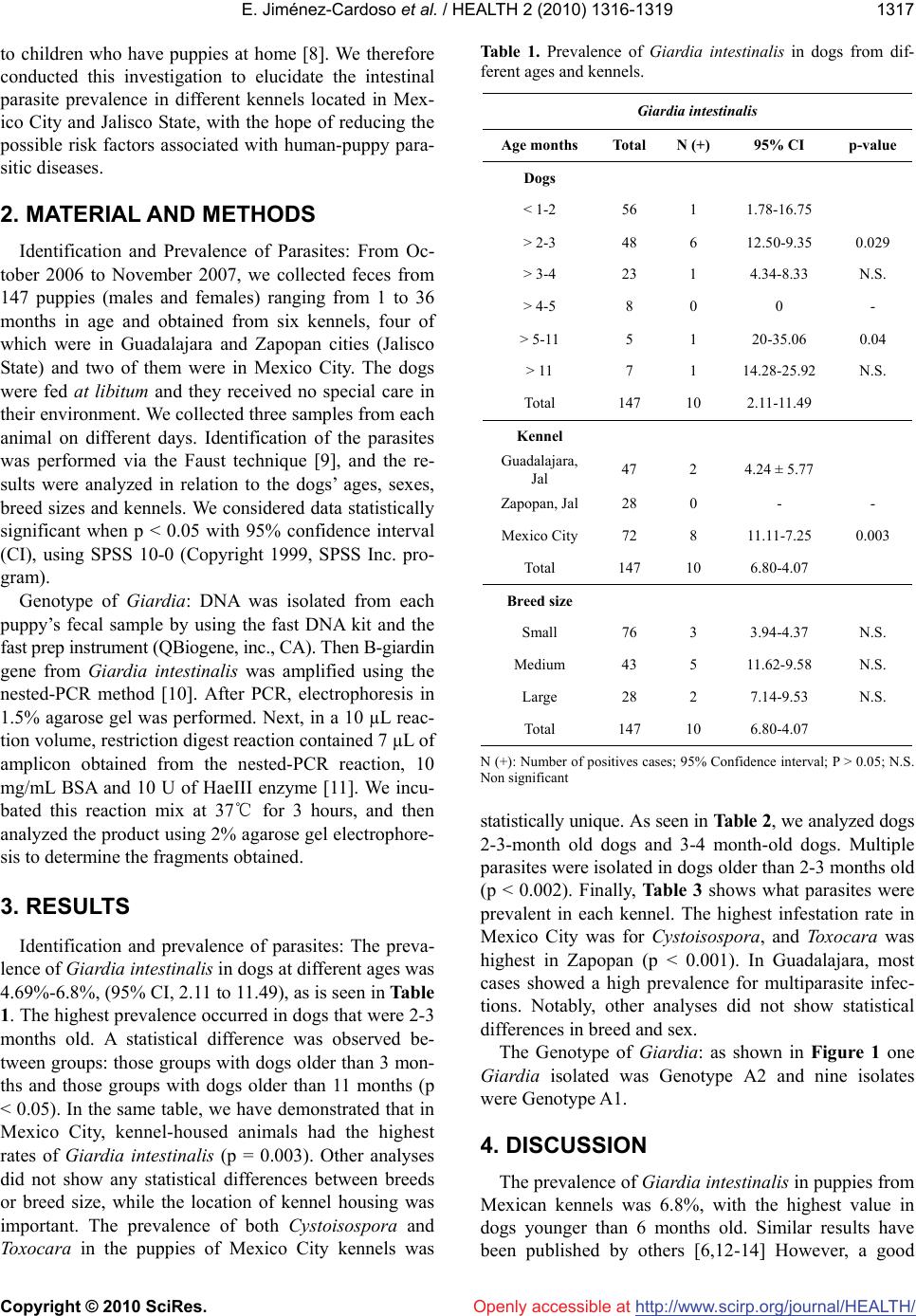 E. Jiménez-Cardoso et al. / HEALTH 2 (2010) 1316-1319 Copyright © 2010 SciRes. http://www.scirp.org/journal/HEALTH/Openly accessible at 1317 to children who have puppies at home [8]. We therefore conducted this investigation to elucidate the intestinal parasite prevalence in different kennels located in Mex- ico City and Jalisco State, with the hope of reducing the possible risk factors associated with human-puppy para- sitic diseases. 2. MATERIAL AND METHODS Identification and Prevalence of Parasites: From Oc- tober 2006 to November 2007, we collected feces from 147 puppies (males and females) ranging from 1 to 36 months in age and obtained from six kennels, four of which were in Guadalajara and Zapopan cities (Jalisco State) and two of them were in Mexico City. The dogs were fed at libitum and they received no special care in their environment. We collected three samples from each animal on different days. Identification of the parasites was performed via the Faust technique [9], and the re- sults were analyzed in relation to the dogs’ ages, sexes, breed sizes and kennels. We considered data statistically significant when p < 0.05 with 95% confidence interval (CI), using SPSS 10-0 (Copyright 1999, SPSS Inc. pro- gram). Genotype of Giardia: DNA was isolated from each puppy’s fecal sample by using the fast DNA kit and the fast prep instrument (QBiogene, inc., CA). Then B-giardin gene from Giardia intestinalis was amplified using the nested-PCR method [10]. After PCR, electrophoresis in 1.5% agarose gel was performed. Next, in a 10 µL reac- tion volume, restriction digest reaction contained 7 µL of amplicon obtained from the nested-PCR reaction, 10 mg/mL BSA and 10 U of HaeIII enzyme [11]. We incu- bated this reaction mix at 37℃ for 3 hours, and then analyzed the product using 2% agarose gel electrophore- sis to determine the fragments obtained. 3. RESULTS Identification and prevalence of parasites: The preva- lence of Giardia intestinalis in dogs at different ages was 4.69%-6.8%, (95% CI, 2.11 to 11.49), as is seen in Table 1. The highest prevalence occurred in dogs that were 2-3 months old. A statistical difference was observed be- tween groups: those groups with dogs older than 3 mon- ths and those groups with dogs older than 11 months (p < 0.05). In the same table, we have demonstrated that in Mexico City, kennel-housed animals had the highest rates of Giardia intestinalis (p = 0.003). Other analyses did not show any statistical differences between breeds or breed size, while the location of kennel housing was important. The prevalence of both Cystoisospora and Toxocar a in the puppies of Mexico City kennels was Table 1. Prevalence of Giardia intestinalis in dogs from dif- ferent ages and kennels. Giardia intestinalis Age months Total N (+) 95% CI p-value Dogs < 1-2 56 1 1.78-16.75 > 2-3 48 6 12.50-9.35 0.029 > 3-4 23 1 4.34-8.33 N.S. > 4-5 8 0 0 - > 5-11 5 1 20-35.06 0.04 > 11 7 1 14.28-25.92 N.S. Total 147 10 2.11-11.49 Kennel Guadalajara, Jal 47 2 4.24 ± 5.77 Zapopan, Jal 28 0 - - Mexico City 72 8 11.11-7.25 0.003 Total 147 10 6.80-4.07 Breed size Small 76 3 3.94-4.37 N.S. Medium 43 5 11.62-9.58 N.S. Large 28 2 7.14-9.53 N.S. Total 147 10 6.80-4.07 N (+): Number of positives cases; 95% Confidence interval; P > 0.05; N.S. Non significant statistically unique. As seen in Table 2, we analyzed dogs 2-3-month old dogs and 3-4 month-old dogs. Multiple parasites were isolated in dogs older than 2-3 months old (p < 0.002). Finally, Table 3 shows what parasites were prevalent in each kennel. The highest infestation rate in Mexico City was for Cystoisospora, and Toxocara was highest in Zapopan (p < 0.001). In Guadalajara, most cases showed a high prevalence for multiparasite infec- tions. Notably, other analyses did not show statistical differences in breed and sex. The Genotype of Giardia: as shown in Figure 1 one Giardia isolated was Genotype A2 and nine isolates were Genotype A1. 4. DISCUSSION The prevalence of Giardia intestinalis in puppies from Mexican kennels was 6.8%, with the highest value in dogs younger than 6 months old. Similar results have een published by others [6,12-14] However, a good b 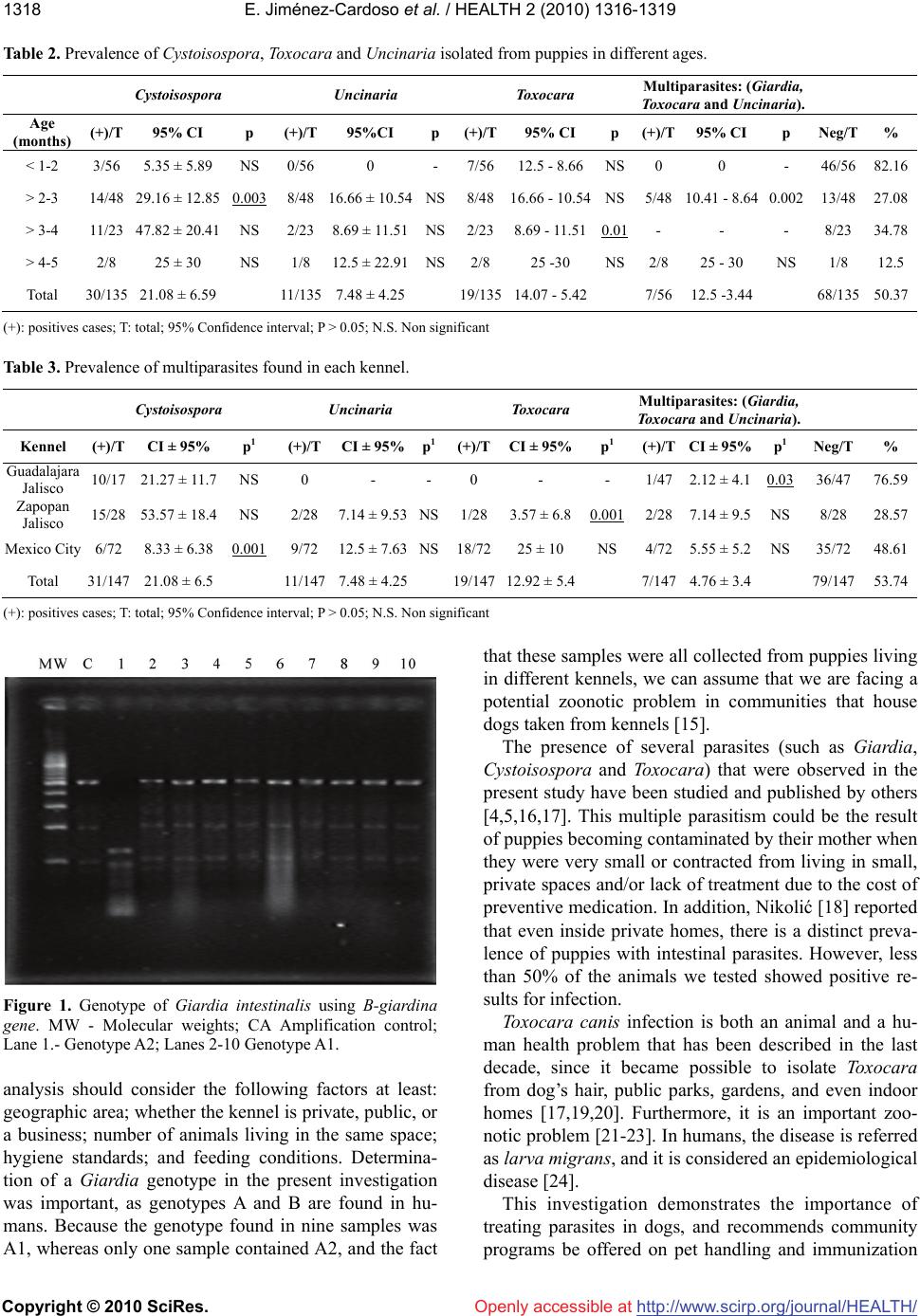 E. Jiménez-Cardoso et al. / HEALTH 2 (2010) 1316-1319 Copyright © 2010 SciRes. http://www.scirp.org/journal/HEALTH/ 1318 Table 2. Prevalence of Cystoisospora, Toxocara and Uncinaria isolated from puppies in different ages. Cystoisospora Uncinaria Toxocara Multiparasites: (Giardia, Toxocara and Uncinaria). Age (months) (+)/T 95% CI p (+)/T 95%CI p (+)/T95% CI p(+)/T95% CI p Neg/T% < 1-2 3/56 5.35 ± 5.89 NS 0/56 0 - 7/5612.5 - 8.66NS0 0 - 46/5682.16 > 2-3 14/48 29.16 ± 12.85 0.003 8/48 16.66 ± 10.54NS8/4816.66 - 10.54NS5/4810.41 - 8.64 0.002 13/4827.08 > 3-4 11/23 47.82 ± 20.41 NS 2/23 8.69 ± 11.51NS2/238.69 - 11.510.01 - - - 8/2334.78 > 4-5 2/8 25 ± 30 NS 1/8 12.5 ± 22.91NS2/825 -30 NS2/825 - 30 NS 1/8 12.5 Total 30/135 21.08 ± 6.59 11/135 7.48 ± 4.25 19/13514.07 - 5.42 7/5612.5 -3.44 68/13550.37 (+): positives cases; T: total; 95% Confidence interval; P > 0.05; N.S. Non significant Table 3. Prevalence of multiparasites found in each kennel. Cystoisospora Uncinaria Toxocara Multiparasites: (Giardia, Toxocara and Uncinaria). Kennel (+)/T CI ± 95% p1 (+)/T CI ± 95%p1(+)/TCI ± 95%p1 (+)/TCI ± 95% p1 Neg/T% Guadalajara Jalisco 10/17 21.27 ± 11.7 NS 0 - -0 - - 1/472.12 ± 4.1 0.03 36/47 76.59 Zapopan Jalisco 15/28 53.57 ± 18.4 NS 2/28 7.14 ± 9.53NS1/283.57 ± 6.80.001 2/287.14 ± 9.5 NS 8/28 28.57 Mexico City 6/72 8.33 ± 6.38 0.001 9/72 12.5 ± 7.63NS18/7225 ± 10 NS 4/725.55 ± 5.2 NS 35/7248.61 Total 31/147 21.08 ± 6.5 11/147 7.48 ± 4.25 19/14712.92 ± 5.4 7/1474.76 ± 3.4 79/14753.74 (+): positives cases; T: total; 95% Confidence interval; P > 0.05; N.S. Non significant Openly accessible at Figure 1. Genotype of Giardia intestinalis using B-giardina gene. MW - Molecular weights; CA Amplification control; Lane 1.- Genotype A2; Lanes 2-10 Genotype A1. analysis should consider the following factors at least: geographic area; whether the kennel is private, public, or a business; number of animals living in the same space; hygiene standards; and feeding conditions. Determina- tion of a Giardia genotype in the present investigation was important, as genotypes A and B are found in hu- mans. Because the genotype found in nine samples was A1, whereas only one sample contained A2, and the fact that these samples were all collected from puppies living in different kennels, we can assume that we are facing a potential zoonotic problem in communities that house dogs taken from kennels [15]. The presence of several parasites (such as Giardia, Cystoisospora and Toxocara) that were observed in the present study have been studied and published by others [4,5,16,17]. This multiple parasitism could be the result of puppies becoming contaminated by their mother when they were very small or contracted from living in small, private spaces and/or lack of treatment due to the cost of preventive medication. In addition, Nikolić [18] reported that even inside private homes, there is a distinct preva- lence of puppies with intestinal parasites. However, less than 50% of the animals we tested showed positive re- sults for infection. Toxocara canis infection is both an animal and a hu- man health problem that has been described in the last decade, since it became possible to isolate Toxocara from dog’s hair, public parks, gardens, and even indoor homes [17,19,20]. Furthermore, it is an important zoo- notic problem [21-23]. In humans, the disease is referred as larva migrans, and it is considered an epidemiological disease [24]. This investigation demonstrates the importance of treating parasites in dogs, and recommends community programs be offered on pet handling and immunization 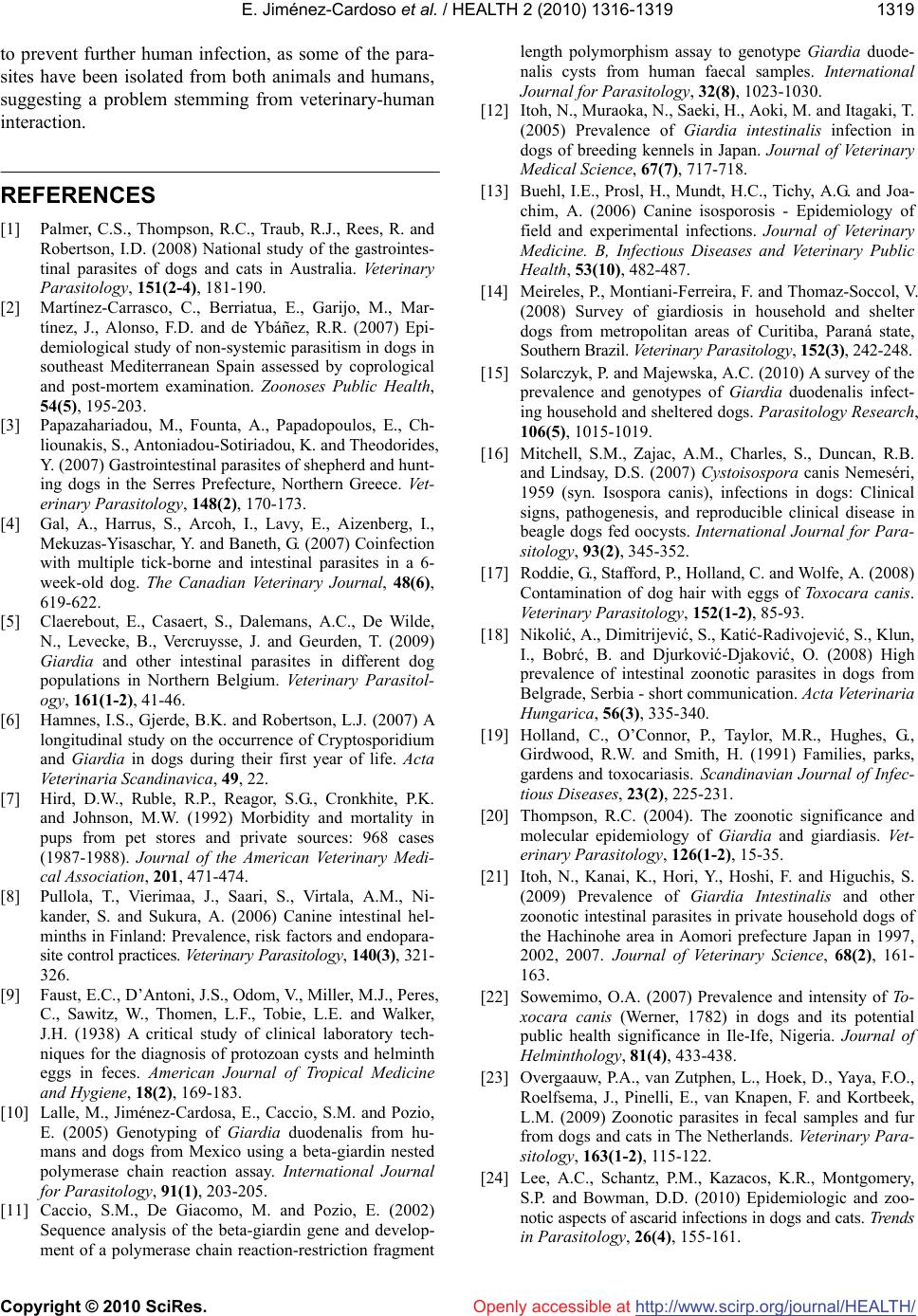 E. Jiménez-Cardoso et al. / HEALTH 2 (2010) 1316-1319 Copyright © 2010 SciRes. http://www.scirp.org/journal/HEALTH/ 1319 Openly accessible at to prevent further human infection, as some of the para- sites have been isolated from both animals and humans, suggesting a problem stemming from veterinary-human interaction. REFERENCES [1] Palmer, C.S., Thompson, R.C., Traub, R.J., Rees, R. and Robertson, I.D. (2008) National study of the gastrointes- tinal parasites of dogs and cats in Australia. Veterinary Parasitology, 151(2-4), 181-190. [2] Martínez-Carrasco, C., Berriatua, E., Garijo, M., Mar- tínez, J., Alonso, F.D. and de Ybáñez, R.R. (2007) Epi- demiological study of non-systemic parasitism in dogs in southeast Mediterranean Spain assessed by coprological and post-mortem examination. Zoonoses Public Health, 54(5), 195-203. [3] Papazahariadou, M., Founta, A., Papadopoulos, E., Ch- liounakis, S., Antoniadou-Sotiriadou, K. and Theodorides, Y. (2007) Gastrointestinal parasites of shepherd and hunt- ing dogs in the Serres Prefecture, Northern Greece. Vet- erinary Parasitology, 148(2), 170-173. [4] Gal, A., Harrus, S., Arcoh, I., Lavy, E., Aizenberg, I., Mekuzas-Yisaschar, Y. and Baneth, G. (2007) Coinfection with multiple tick-borne and intestinal parasites in a 6- week-old dog. The Canadian Veterinary Journal, 48(6), 619-622. [5] Claerebout, E., Casaert, S., Dalemans, A.C., De Wilde, N., Levecke, B., Vercruysse, J. and Geurden, T. (2009) Giardia and other intestinal parasites in different dog populations in Northern Belgium. Veterinary Parasitol- ogy, 161(1-2), 41-46. [6] Hamnes, I.S., Gjerde, B.K. and Robertson, L.J. (2007) A longitudinal study on the occurrence of Cryptosporidium and Giardia in dogs during their first year of life. Acta Veterinaria Scandinavica, 49, 22. [7] Hird, D.W., Ruble, R.P., Reagor, S.G., Cronkhite, P.K. and Johnson, M.W. (1992) Morbidity and mortality in pups from pet stores and private sources: 968 cases (1987-1988). Journal of the American Veterinary Medi- cal Association, 201, 471-474. [8] Pullola, T., Vierimaa, J., Saari, S., Virtala, A.M., Ni- kander, S. and Sukura, A. (2006) Canine intestinal hel- minths in Finland: Prevalence, risk factors and endopara- site control practices. Veterinary Parasitology, 140(3), 321- 326. [9] Faust, E.C., D’Antoni, J.S., Odom, V., Miller, M.J., Peres, C., Sawitz, W., Thomen, L.F., Tobie, L.E. and Walker, J.H. (1938) A critical study of clinical laboratory tech- niques for the diagnosis of protozoan cysts and helminth eggs in feces. American Journal of Tropical Medicine and Hygiene, 18(2), 169-183. [10] Lalle, M., Jiménez-Cardosa, E., Caccio, S.M. and Pozio, E. (2005) Genotyping of Giardia duodenalis from hu- mans and dogs from Mexico using a beta-giardin nested polymerase chain reaction assay. International Journal for Parasitology, 91(1), 203-205. [11] Caccio, S.M., De Giacomo, M. and Pozio, E. (2002) Sequence analysis of the beta-giardin gene and develop- ment of a polymerase chain reaction-restriction fragment length polymorphism assay to genotype Giardia duode- nalis cysts from human faecal samples. International Journal for Parasitology, 32(8), 1023-1030. [12] Itoh, N., Muraoka, N., Saeki, H., Aoki, M. and Itagaki, T. (2005) Prevalence of Giardia intestinalis infection in dogs of breeding kennels in Japan. Journal of Veterinary Medical Science, 67(7), 717-718. [13] Buehl, I.E., Prosl, H., Mundt, H.C., Tichy, A.G. and Joa- chim, A. (2006) Canine isosporosis - Epidemiology of field and experimental infections. Journal of Veterinary Medicine. B, Infectious Diseases and Veterinary Public Health, 53(10), 482-487. [14] Meireles, P., Montiani-Ferreira, F. and Thomaz-Soccol, V. (2008) Survey of giardiosis in household and shelter dogs from metropolitan areas of Curitiba, Paraná state, Southern Brazil. Veterinary Parasitology, 152(3), 242-248. [15] Solarczyk, P. and Majewska, A.C. (2010) A survey of the prevalence and genotypes of Giardia duodenalis infect- ing household and sheltered dogs. Parasitology Research, 106(5), 1015-1019. [16] Mitchell, S.M., Zajac, A.M., Charles, S., Duncan, R.B. and Lindsay, D.S. (2007) Cystoisospora canis Nemeséri, 1959 (syn. Isospora canis), infections in dogs: Clinical signs, pathogenesis, and reproducible clinical disease in beagle dogs fed oocysts. International Journal for Para- sitology, 93(2), 345-352. [17] Roddie, G ., Stafford, P., Holland, C. and Wolfe, A. (2008) Contamination of dog hair with eggs of Toxocara canis. Veterinary Parasitology, 152(1-2), 85-93. [18] Nikolić, A., Dimitrijević, S., Katić-Radivojević, S., Klun, I., Bobrć, B. and Djurković-Djaković, O. (2008) High prevalence of intestinal zoonotic parasites in dogs from Belgrade, Serbia - short communication. Acta Veterinaria Hungarica, 56(3), 335-340. [19] Holland, C., O’Connor, P., Taylor, M.R., Hughes, G., Girdwood, R.W. and Smith, H. (1991) Families, parks, gardens and toxocariasis. Scandinavian Journal of Infec- tious Diseases, 23(2), 225-231. [20] Thompson, R.C. (2004). The zoonotic significance and molecular epidemiology of Giardia and giardiasis. Vet - erinary Parasitology, 126(1-2), 15-35. [21] Itoh, N., Kanai, K., Hori, Y., Hoshi, F. and Higuchis, S. (2009) Prevalence of Giardia Intestinalis and other zoonotic intestinal parasites in private household dogs of the Hachinohe area in Aomori prefecture Japan in 1997, 2002, 2007. Journal of Veterinary Science, 68(2), 161- 163. [22] Sowemimo, O.A. (2007) Prevalence and intensity of To- xocara canis (Werner, 1782) in dogs and its potential public health significance in Ile-Ife, Nigeria. Journal of Helminthology, 81(4), 433-438. [23] Overgaauw, P.A., van Zutphen, L., Hoek, D., Yaya, F.O., Roelfsema, J., Pinelli, E., van Knapen, F. and Kortbeek, L.M. (2009) Zoonotic parasites in fecal samples and fur from dogs and cats in The Netherlands. Veterinary Para- sitology, 163(1-2), 115-122. [24] Lee, A.C., Schantz, P.M., Kazacos, K.R., Montgomery, S.P. and Bowman, D.D. (2010) Epidemiologic and zoo- notic aspects of ascarid infections in dogs and cats. Trends in Parasitology, 26(4), 155-161. |