

Paper Menu >>
Journal Menu >>
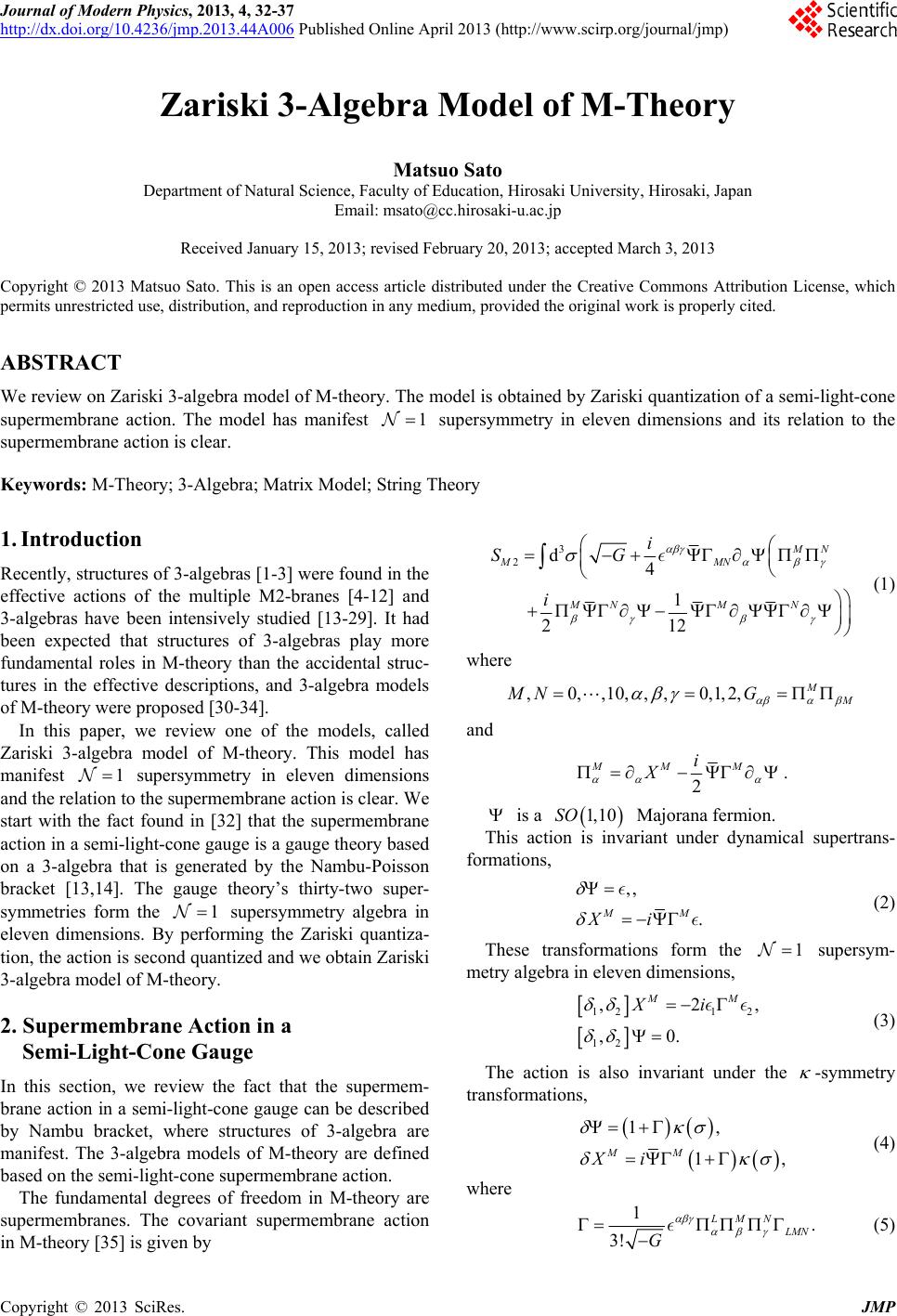 Journal of Modern Physics, 2013, 4, 32-37 http://dx.doi.org/10.4236/jmp.2013.44A006 Published Online April 2013 (http://www.scirp.org/journal/jmp) Zariski 3-Algebra Model of M-Theory Matsuo Sato Department of Natural Science, Faculty of Education, Hirosaki University, Hirosaki, Japan Email: [email protected]irosaki-u.ac.jp Received January 15, 2013; revised February 20, 2013; accepted March 3, 2013 Copyright © 2013 Matsuo Sato. This is an open access article distributed under the Creative Commons Attribution License, which permits unrestricted use, distribution, and reproduction in any medium, provided the original work is properly cited. ABSTRACT We review on Zariski 3-algebra model of M-theory. The model is obtained by Zariski quantization of a semi-light-cone supermembrane action. The model has manifest 1 supersymmetry in eleven dimensions and its relation to the supermembrane action is clear. Keywords: M-Theory; 3-Algebra; Matrix Model; String Theory 1. Introduction 3 2d4 1 212 MN MMN MNM N i SG i Recently, structures of 3-algebras [1-3] were found in the effective actions of the multiple M2-branes [4-12] and 3-algebras have been intensively studied [13-29]. It had been expected that structures of 3-algebras play more fundamental roles in M-theory than the accidental struc- tures in the effective descriptions, and 3-algebra models of M-theory w e re pr op osed [30-34] . In this paper, we review one of the models, called Zariski 3-algebra model of M-theory. This model has manifest 1 supersymmetry in eleven dimensions and the relation to the supermembrane action is clear. We start with the fact found in [32] that the supermembrane action in a semi-light-cone gauge is a gauge theory based on a 3-algebra that is generated by the Nambu-Poisson bracket [13,14]. The gauge theory’s thirty-two super- symmetries form the 1 supersymmetry algebra in eleven dimensions. By performing the Zariski quantiza- tion, the action is second quantized and we obtain Zariski 3-algebra model of M-theory. 2. Supermembrane Action in a Semi-Light-Cone Gauge In this section, we review the fact that the supermem- brane action in a semi-light-cone gauge can be described by Nambu bracket, where structures of 3-algebra are manifest. The 3-algebra models of M-theory are defined based on the semi-light-cone supermembrane action. The fundamental degrees of freedom in M-theory are supermembranes. The covariant supermembrane action in M-theory [35] is given by ,0,,10,,,0,1,2, M (1) where M MN G and 2 MM M i X . 1,10SO Majorana fermion. is a This action is invariant under dynamical supertrans- formations, ,, . MM Xi 1 (2) These transformations form the supersym- metry algebra in eleven dimensions, 121 2 12 ,2, ,0. MM Xi (3) The action is also invariant under the -symmetry transformations, 1, 1, MM Xi (4) where 1 3! LMN. L MN G (5) C opyright © 2013 SciRes. JMP 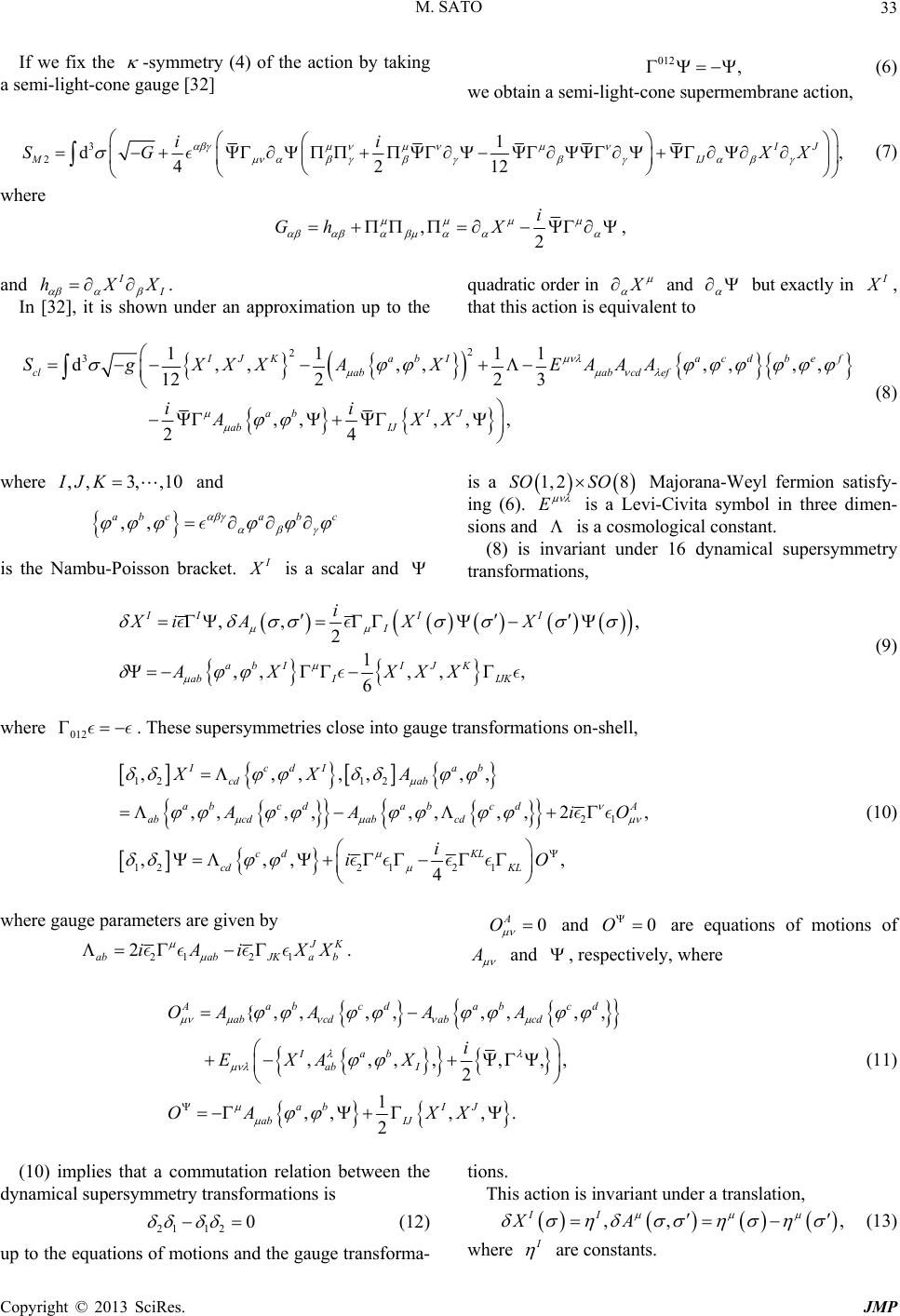 M. SATO 33 If we fix the -symmetry (4) of the action by taking a semi-light -cone gauge [32] 012 , (6) we obtain a semi-light-cone supermembrane action, 3 21 d , IJ MIJ ii SG XX 42 12 (7) where ,i Gh X , 2 I I X and I hX X In [32], it is shown under an approximation up to the quadratic order in . and but exactly in X , that this action is equivalent to 2 2 311 11 d,, ,,,,,, 1222 3 , ,, 24 ,, I JKabIacdbe f abab cdef I J ab IJ SgXXXAXEAAA ii AXX cl ab (8) where and ,,3, ,10IJK ,, abcab c is the Nambu-Poisson bracket. I X is a scalar and is a 1,2 8SO SO E Majorana-Weyl fermion satisfy- ing (6). is a Levi-Civita symbol in three dimen- sions and is a cosmological constant. (8) is invariant under 16 dynamical supersymmetry transformations, ,, , 21 ,,, ,, 6 III I I ab IIJK I IJK i Xi AXX AX XXX 012 ab (9) where . These supersymmetries close into gauge transformations on-shell, 12 12 21 122 121 ,,,,,,, ,,,,,,,,2, ,,, , 4 IcdI ab cd ab abcdab cdA abcdab cd cd KL cd KL XXA AiO i iO A (10) where gauge parameters are given by 0 A O 0O 212 1 2 J K ababJKa b iAi XX . and are equations of motions of A and , respectively, where ,, ,, , 2 1 ,,,,. 2 ab I abI J ab IJ EX A X OA XX {,,, ,,,, , ,, Aabcd abcd ab cdabcd Iab OA AAA i 2112 0 (11) (10) implies that a commutation relation between the dynamical supersymmetry transformations is (12) up to the equations of motions and the gauge transforma- tions. This action is invariant under a translation, ,, , II XA (13) I are constants. where Copyright © 2013 SciRes. JMP 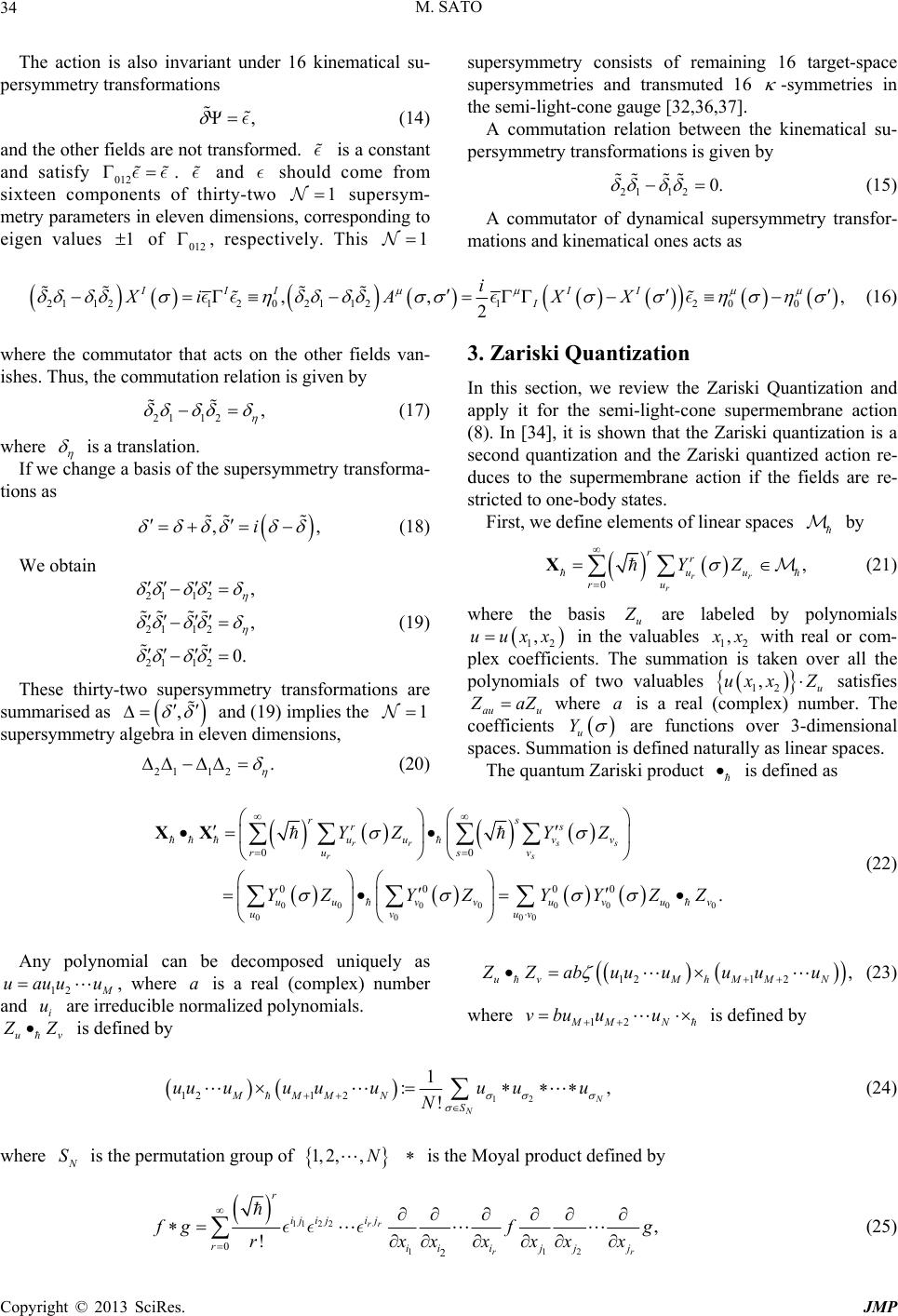 M. SATO 34 The action is also invariant under 16 kinematical su- persymmetry transformations , 1 (14) and the other fields are not transformed. is a constant and satisfy 012 . and should come from sixteen components of thirty-two supersymmetry consists of remaining 16 target-space supersymmetries and transmuted 16 -symmetries in the semi-light-cone gauge [32,36,37]. 2112 0. A commutation relation between the kinematical su- persymmetry transformations is given by supersym- metry parameters in eleven dimensions, corresponding to eigen values of , respectively. This 11 012 (15) A commutator of dynamical supersymmetry transfor- mations and kinematical ones acts as 21 1212021 121200 ,, , 2 III II I i A XX Xi 21 12, (16) where the commutator that acts on the other fields van- ishes. Thus, the commutation relation is given by (17) where is a translation. If we change a basis of the supersymmetry transforma- tions as ,,i (18) We obtain 21 12 21 12 12 , , 0. 21 , (19) These thirty-two supersymmetry transformations are summarised as 1 and (19) implies the supersymmetry algebra in eleven dimensions, 21 12. (20) 3. Zariski Quantization In this section, we review the Zariski Quantization and apply it for the semi-light-cone supermembrane action (8). In [34], it is shown that the Zariski quantization is a second quantization and the Zariski quantized action re- duces to the supermembrane action if the fields are re- stricted to one-body states. First, we define elements of linear spaces by rr uu YZ X0, rr r ru (21) where the basis u Z are labeled by polynomials ,uuxx, 12 in the valuables 12 x x ,uxx Z with real or com- plex coefficients. The summation is taken over all the polynomials of two valuables 12 u satisfies au u Z aZ where a is a real (complex) number. The coefficients Yu are functions over 3-dimensional spaces. Summation is defined naturally as linear spaces. The quantum Zariski product is defined as 00000000 0000 00 0000 . rrss rs rs rs uuv v ru sv uuv vuvuv uvuv YZ YZ YZYZ YYZZ XX (22) Any polynomial can be decomposed uniquely as 12 M 121 2, u vMhMMN ZZabuuuuu u 12MM N vbuuu uauu u u, where is a real (complex) number and are irreducible normalized polynomials. a i uv Z Z is define d by (23) where is defined by 12 121 21 :, !N N MMMN S uuuu uuuuu N (24) where N S 1, 2,,N is the perm utation gr ou p of is the Moyal product defined by 1122 112 2 , rr rr r ij ijij riiij jj 0! gfg rx xxxxx f (25) Copyright © 2013 SciRes. JMP 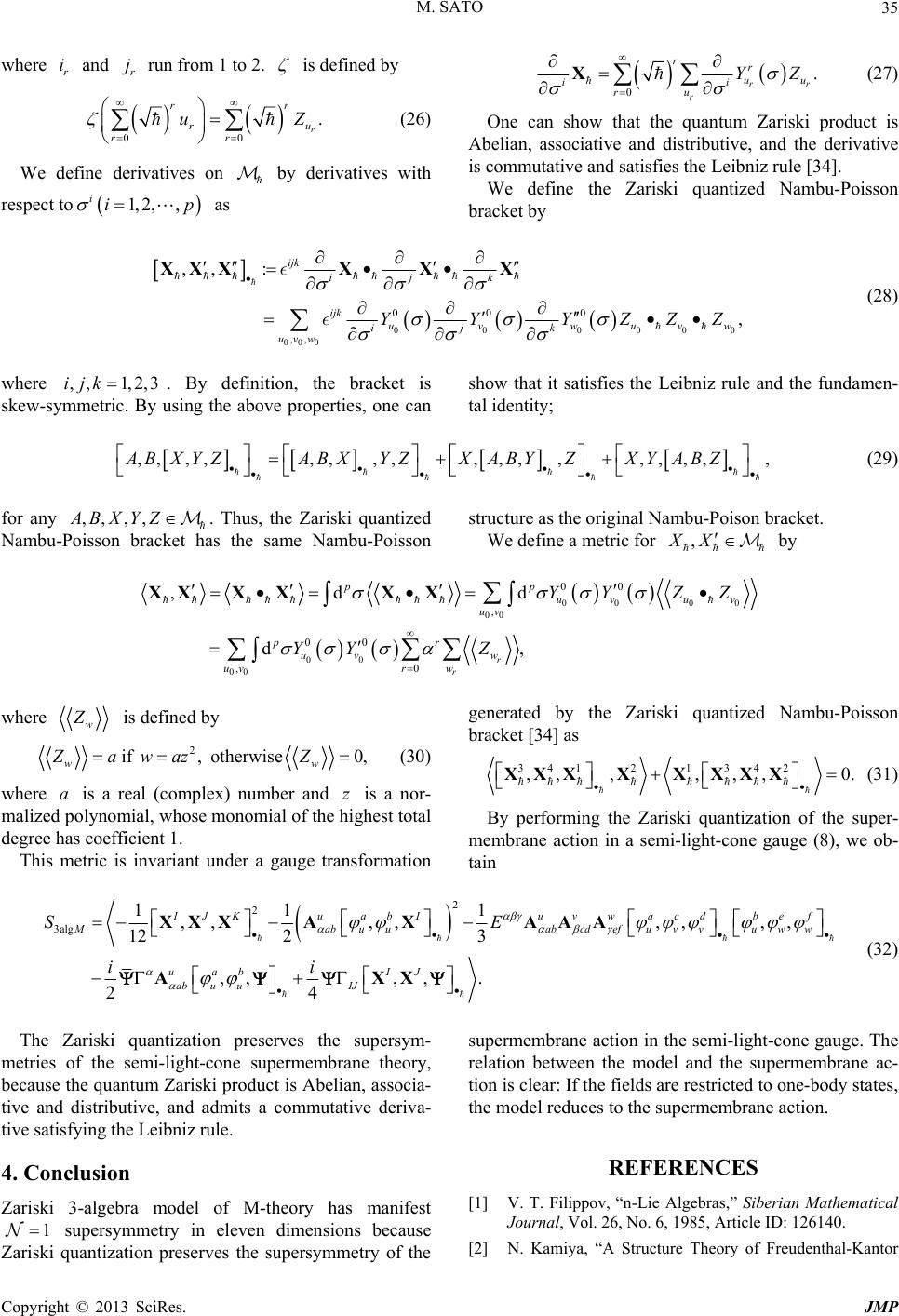 M. SATO 35 where and run from 1 to 2. r ir j is define d b y 00 . r rr ru uZ ,ip rr (26) We define derivatives on by derivatives with respect to as 1, 2, i 0. rr r rr uu ii ru YZ X (27) One can show that the quantum Zariski product is Abelian, associative and distributive, and the derivative is commutative and satisfies the Leibniz rule [34]. We define the Zariski quantized Nambu-Poisson bracket by 00 0000 000 000 ,, : , ijk ijk ijk uv wuvw ijk uvw YYYZZZ X XXX ,, 1,2,3ijk ,, ,,,Y ABZ ,XX ,, XX (28) where . By definition, the bracket is skew-symmetric. By using the above properties, one can show that it satisfies the Leibniz rule and the fundamen- tal identity; ,,,,,,,,, ,,,AB XYZABXYZXABYZX ,, ,,ABXYZ (29) for any . Thus, the Zariski quantized Nambu-Poisson bracket has the same Nambu-Poisson structure as the original Nambu-Poison brac k et. We define a metric for by 00 00 00 00 00 00 , 00 ,0 ,d d d, r r pp uv uv uv pr uv w uvr w YY ZZ YY Z XXXXX X where w Z is defined by 2 if, otherwise0, ww Zawaz Z az (30) where is a real (complex) number and is a nor- malized polynomial, whose monomial of the highest total degree has coefficient 1. This metric is invariant under a gauge transformation generated by the Zariski quantized Nambu-Poisson bracket [34] as 34121342 ,,,, ,,0. XXXXX XXX (31) By performing the Zariski quantization of the super- membrane action in a semi-light-cone gauge (8), we ob- tain 2 2 3alg 11 1 ,,,,,, ,, 12 23 IJKuabIuvwacdbef Mabuuabcdefuvvuww SE XXXAXA A A 1 ,, , ,. 24 ua b IJ abu uIJ ii AX X (32) The Zariski quantization preserves the supersym- metries of the semi-light-cone supermembrane theory, because the quantum Zariski product is Abelian, associa- tive and distributive, and admits a commutative deriva- tive satisfying the Leibniz rule. 4. Conclusion Zariski 3-algebra model of M-theory has manifest supersymmetry in eleven dimensions because Zariski quantization preserves the supersymmetry of the supermembrane action in the semi-light-cone gauge. The relation between the model and the supermembrane ac- tion is clear: If the fields are restricted to one-body states, the model reduces to the supermembrane action. REFERENCES [1] V. T. Filippov, “n-Lie Algebras,” Siberian Mathematical Journal, Vol. 26, No. 6, 1985, Article ID: 126140. [2] N. Kamiya, “A Structure Theory of Freudenthal-Kantor Copyright © 2013 SciRes. JMP  M. SATO 36 Triple Systems,” Journal of Algebra, Vol. 110, No. 1, 1987, pp. 108-123. doi:10.1016/0021-8693(87)90038-X [3] S. Okubo and N. Kamiya, “Quasi-Classical Lie Superal- gebras and Lie Supertriple Systems,” Communications in Algebra, Vol. 30, No. 8, 2002, pp. 3825-3850. [4] J. Bagger and N. Lambert, “Modeling Multiple M2- Branes,” Physical Review D, Vol. 75, No. 4, 2007, Article ID: 045020. doi:10.1103/PhysRevD.75.045020 [5] A. Gustavsson, “Algebraic Structures on Parallel M2- Branes,” Nuclear Physics B, Vol. 811, No. 1-2, 2009, pp. 66-76. doi:10.1016/j.nuclphysb.2008.11.014 [6] J. Bagger and N. Lambert, “Gauge Symmetry and Super- symmetry of Multiple M2-Branes,” Physical Review D, Vol. 77, No. 6, 2008, Article ID: 065008. doi:10.1103/PhysRevD.77.065008 [7] S. Mukhi and C. Papageorgakis, “M2 to D2,” Journal of High Energy Physics, Vol. 5, 2008, p. 85. [8] J. Gomis, G. Milanesi and J. G. Russo, “Bagger-Lambert Theory for General Lie Algebras,” Journal of High En- ergy Physics, Vol. 6, 2008, pp. 75. [9] S. Benvenuti, D. Rodriguez-Gomez, E. Tonni and H. Verlinde, “ = 8 Superconformal Gauge Theories and M2-Branes,” Journal of High Energy Physics, Vol. 1, 2009, p. 78. [10] P.-M. Ho, Y. Imamura and Y. Matsuo, “M2 to D2 Revis- ited,” Journal of High Energy Physics, Vol. 7, 2008, p. 3. [11] O. Aharony, O. Bergman, D. L. Jafferis and J. Maldacen a, “ = 6 Superconformal Chern-Simons-Matter Theories, M2-Branes and Their Gravity Duals,” Journal of High Energy Physics, Vol. 10, 2008, p. 91. [12] J. Bagger and N. Lambert, “Three-Algebras and = 6 Chern-Simons Gauge Theories,” Physical Review D, Vol. 79, No. 2, 2009, Article ID: 025002. doi:10.1103/PhysRevD.79.025002 [13] Y. Nambu, “Generalized Hamiltonian dynamics,” Physi- cal Review D, Vol. 7, No. 8, 1973, pp. 2405-2412. doi:10.1103/PhysRevD.7.2405 [14] H. Awata, M. Li, D. Minic and T. Yoneya, “On the Quan- tization of Nambu Brackets,” Journal of High Energy Physics, Vol. 2, 2001, p. 13. doi:10.1088/1126-6708/2001/02/013 [15] D. Minic, “M-Theory and Deformation Quantization,” 1999. arXiv:hep-th/9909022 [16] J. Figueroa-O’Farrill and G. Papadopoulos, “Pluecker- Type Relations for Orthogonal Planes,” Journal of Ge- ometry and Physics, Vol. 49, No. 3-4, 2004, pp. 294-331. doi:10.1016/S0393-0440(03)00093-7 [17] G. Papadopoulos, “M2-Branes, 3-Lie Algebras and Plu- cker Relations,” Journal of High Energy Physics, Vol. 5, 2008, p. 54. doi:10.1088/1126-6708/2008/05/054 [18] J. P. Gauntlett and J. B. Gutowski, “Constraining Maxi- mally Supersymmetric Membrane Actions,” Journal of High Energy Physics, Vol. 6, 2008, p. 53. doi:10.1088/1126-6708/2008/06/053 [19] D. Gaiotto and E. Witten, “Janus Configurations, Chern- Simons Couplings, and the Theta-Angle in = 4 Su- per Yang-Mills Theory,” 2010. arXiv:0804.2907[hep-th] [20] Y. Honma, S. Iso, Y. Sumitomo and S. Zhang, “Janus Field Theories from Multiple M2-Branes,” Physical Re- view D, Vol. 78, No. 2, 2008, Article ID: 025027. doi:10.1103/PhysRevD.78.025027 [21] K. Hosomichi, K.-M. Lee, S. Lee, S. Lee and J. Park, “ = 5, 6 Superconformal Chern-Simons Theories and M2-Branes on Orbifolds,” Journal of High Energy Phys- ics, Vol. 9, 2008, p. 2. doi:10.1088/1126-6708/2008/09/002 [22] M. Schnabl and Y. Tachikawa, “Classification of = 6 Superconformal Theories of ABJM Type,” 2010. arXiv:0807.1102[hep-th] [23] M. A. Bandres, A. E. Lipstein and J. H. Schwarz, “Ghost- Free Superconformal Action for Multiple M2-Branes,” Journal of High Energy Physics, Vol. 7, 2008, p. 117. doi:10.1088/1126-6708/2008/07/117 [24] P. de Medeiros, J. Figueroa-O’Farrill, E. Méndez-Escobar and P. Ritter, “On the Lie-Algebraic Origin of Metric 3- Algebras,” Communications in Mathematical Physics, Vol. 290, No. 3, 2009, pp. 871-902. doi:10.1007/s00220-009-0760-1 [25] S. A. Cherkis, V. Dotsenko and C. Saeman, “On Super- space Actions for Multiple M2-Branes, Metric 3-Algebras and Their Classification,” Physical Review D, Vol. 79, No. 8, 2009, Article ID: 086002. doi:10.1103/PhysRevD.79.086002 [26] P.-M. Ho, Y. Matsuo and S. Shiba, “Lorentzian Lie 3- Algebra and Toroidal Compactification of M/String The- ory,” 2003. arXiv:0901.2003[hep-th] [27] K. Lee and J. Park, “Three-Algebra for Supermembrane and Two-Algebra for Superstring,” 2009. arXiv:0902.2417[hep-th] [28] P. de Medeiros, J. Figueroa-O’Farrill, E. Mendez-Escobar and P. Ritter, “Metric 3-Lie Algebras for Unitary Bagger- Lambert Theori es,” Journal of High Energy Physics, Vol. 4, 2009, p. 37. [29] C. Castro, “On n-Ary Algebras, Branes and Polyvector Gauge Theories in Noncommutative Clifford Spaces,” Journal of Physics A, Vol. 43, No. 36, 2010, Article ID: 365201. doi:10.1088/1751-8113/43/36/365201 [30] M. Sato, “Covariant Formulation of M-Theory,” Interna- tional Journal of Modern Physics A, Vol. 24, No. 27, 2009, p. 5019. doi:10.1142/S0217751X09047661 [31] M. Sato, “On Supersymmetry of the Covariant 3-Algebra Model f or M-Theo ry, ” Journal of Modern Physics, Vol. 3 2012, p. 1813. doi:10.4236/jmp.2012.311226 [32] M. Sato, “Model of M-Theory with Eleven Matrices,” Journal of High Energy Physics, Vol. 7, 2010, p. 26. doi:10.1007/JHEP07(2010)026 [33] M. Sato, “Supersymmetry and the Discrete Light-Cone Quantization Limit of the Lie 3-Algebra Model of M-Theory,” Physical Review D, Vol. 85, No. 4, 2012, Ar- ticle ID: 046003. doi:10.1103/PhysRevD.85.046003 [34] M. Sato, “Zariski Quantization as Second Quantization,” Physical Review D, Vol. 85, No. 12, 2012, Article ID: 126012. doi:10.1103/PhysRevD.85.126012 Copyright © 2013 SciRes. JMP  M. SATO Copyright © 2013 SciRes. JMP 37 [35] E. Bergshoeff, E. Sezgin and P. K. Townsend, “Super- membranes and Eleven-Dimensional Supergravity,” Phy- sics Letters B, Vol. 189, No. 1-2, 1987, pp. 75-78. doi:10.1016/0370-2693(87)91272-X [36] T. Banks, N. Seiberg and S. Shenker, “Branes from Ma- trices,” Nuclear Physics B, Vol. 490, No. 1-2, 1997, pp. 91-106. doi:10.1016/S0550-3213(97)00105-3 [37] B. de Wit, J. Hoppe and H. Nicolai, “On the Quantum Mechanics of Supermembranes,” Nuclear Physics B, Vol. 305, No. 4, 1988, pp. 545-581. doi:10.1016/0550-3213(88)90116-2 |