

Paper Menu >>
Journal Menu >>
 Journal of Modern Physics, 2013, 4, 21-26 http://dx.doi.org/10.4236/jmp.2013.44A004 Published Online April 2013 (http://www.scirp.org/journal/jmp) The Higgs Boson in the Periodic System of Elementary Particles Ding-Yu Chung1, Ray Hefferlin2 1Utica, Michigan, USA 2Department of Physics, Southern Adventist University, Collegedale, USA Email: [email protected], [email protected] Received February 12, 2013; revised March 15, 2013; accepted March 27, 2013 Copyright © 2013 Ding-Yu Chung, Ray Hefferlin. This is an open access article distributed under the Creative Commons Attribution License, which permits unrestricted use, distribution, and reproduction in any medium, provided the original work is properly cited. ABSTRACT It is proposed that the observed Higgs Boson at the LHC is the Standard Model Higgs boson that adopts the existence of the hidden lepton condensate. The hidden lepton is in the forbidden lepton family, outside of the three lepton families of the Standard Model. Being forbidden, a single hidden lepton cannot exist alone; so it must exist in the lepton condensate as a composite of μ’ and μ’± hidden leptons and their corresponding antileptons. The calculated average mass of the hidden lep- ton condensate is 128.8 GeV in good agreements with the observed 125 or 126 GeV. The masses of the hidden lepton con- densate and all elementary particles including leptons, quarks, and gauge bosons are derived from the periodic system of elementary particles. The calculated constituent masses are in good agreement with the observed values by using only four known constants: the number of the extra spatial dimensions in the eleven-dimensional membrane, the mass of electron, the mass of Z boson, and the fine structure constant. Keywords: Higgs Boson; Periodic System; Elementary Particles 1. Introduction As described in “In Molecular Taxonomy: String, quark, hadron, nuclear, atomic and chemical molecule periodic or invariant systems” [1], chemists and physicists have accumulated vast libraries of data about the properties and atoms and molecules via the simplest to the most complex experiments; from Bohr to Schrödinger theory; and using back-of-the-envelope to supercomputer com- putation. Much of it is distilled into the periodic chart of the elements and models about the various molecular bonds. Though starting more recently, scientists have garnered as many or more numbers describing character- istics of nuclei, the essence of which is seen in the chart of the isotopes. Still more recently, the simplest funda- mental particle properties have been epitomized in the geometric patterns showing hadrons and their quark con- stituents. And now even string theory has produced a periodic system, such as the periodic system of elemen- tary particles [2,3]. At the LHC (Large Hadron Collider), the ATLAS and CMS experiments of CERN experiments observe a new particle in the mass region around 125 - 126 GeV with a high degree of certainty, and the decay modes and the spin of the new particle point to the Standard Model Higgs boson [4,5]. In this paper, the periodic system of elementary parti- cles based on string theory is used to describe the newly discovered Higgs boson at the LHC, and the calculated mass from this periodic system of elementary particles is in good agreement with the observed value. 2. The Periodic System of Elementary Particles The periodic system of elementary particles is based on the “überparticles” of our universe. An überparticle con- sists of two four dimensional particles each with its own set of seven “dimensional orbitals”. The seven dimen- sional orbitals represent originally [6] the seven extra spatial dimensions in the eleven dimensional membrane of string theory. In an überparticle, one four dimensional particle has the seven “principal dimensional orbitals”, while the other four dimensional particle has the seven “auxiliary dimensional orbitals” that are superimposed on the seven principal dimensional orbitals. In an überparticle, the auxiliary orbitals are dependent on the principal orbitals, so only one set of dimensional orbitals appears. The principal dimensional orbitals are mainly for leptons and C opyright © 2013 SciRes. JMP 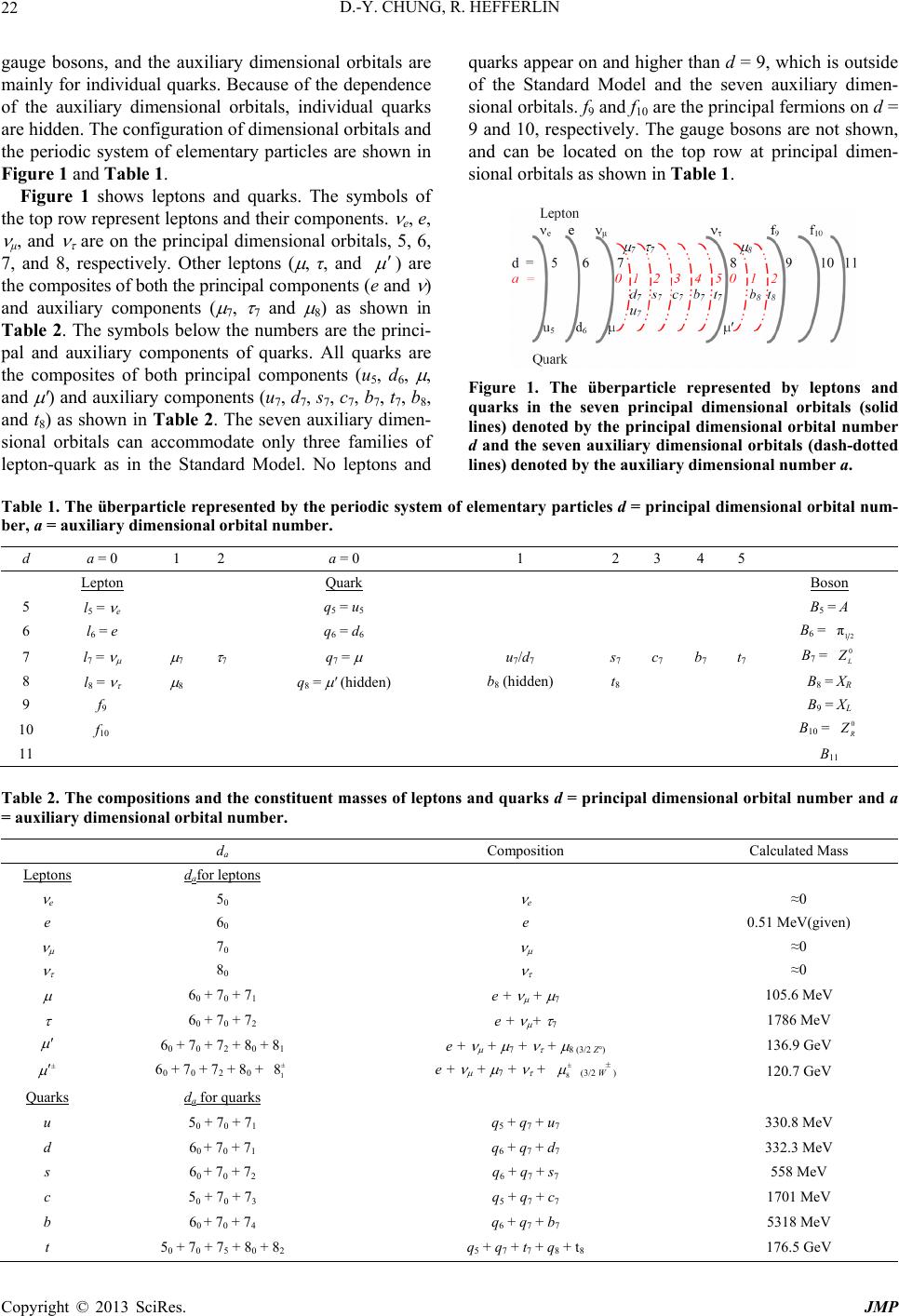 D.-Y. CHUNG, R. HEFFERLIN 22 gauge bosons, and the auxiliary dimensional orbitals are mainly for individual quarks. Because of the dependence of the auxiliary dimensional orbitals, individual quarks are hidden. The configuration of dimensional orbitals and the periodic system of elementary particles are shown in Figure 1 and Table 1. Figure 1 shows leptons and quarks. The symbols of the top row represent leptons and their components. e, e, μ, and are on the principal dimensional orbitals, 5, 6, 7, and 8, respectively. Other leptons ( , τ, and quarks appear on and higher than d = 9, which is outside of the Standard Model and the seven auxiliary dimen- sional orbitals. f9 and f10 are the principal fermions on d = 9 and 10, respectively. The gauge bosons are not shown, and can be located on the top row at principal dimen- sional orbitals as shown in Table 1. ) are the composites of both the principal components (e and ) and auxiliary components ( 7, 7 and 8) as shown in Table 2. The symbols below the numbers are the princi- pal and auxiliary components of quarks. All quarks are the composites of both principal components (u5, d6, , and ') and auxiliary components (u7, d7, s7, c7, b7, t7, b8, and t8) as shown in Table 2. The seven auxiliary dimen- sional orbitals can accommodate only three families of lepton-quark as in the Standard Model. No leptons and Figure 1. The überparticle represented by leptons and quarks in the seven principal dimensional orbitals (solid lines) denoted by the principal dimensional orbital number d and the seven auxiliary dimensional orbitals (dash-dotted lines) denoted by the auxiliary dimensional number a. Table 1. The überparticle represented by the periodic system of elementary particles d = principal dimensional orbital num- ber, a = auxiliary dimensional orbital number. d a = 0 1 2 a = 0 1 2 3 4 5 Lepton Quark Boson 5 l5 = e q5 = u5 B5 = A 6 l6 = e q6 = d6 B6 = 12 π 0 7 l7 = 7 7 q7 = u7/d7 s7 c7 b7 t7 B7 = L Z 8 l8 = 8 q8 = ' (hidden) b8 (hidden) t8 B8 = XR 9 f9 B9 = XL 10 f10 B10 = 0 R Z 11 B11 Table 2. The compositions and the constituent masses of leptons and quarks d = principal dimensional orbital number and a = auxiliary dimensional orbital number. da Composition Calculated Mass Leptons dafor leptons e 50 e ≈0 e 60 e 0.51 MeV(given) 70 ≈0 80 ≈0 60 + 70 + 71 e + + 7 105.6 MeV 60 + 70 + 72 e + + 7 1786 MeV 60 + 70 + 72 + 80 + 81 e + + 7 + + 8 (3/2 Z°) 136.9 GeV 1 8 8 60 + 70 + 72 + 80 + e + + 7 + + (3/2 W± ) 120.7 GeV Quarks da for quarks u 50 + 70 + 71 q5 + q7 + u7 330.8 MeV d 60 + 70 + 71 q6 + q7 + d7 332.3 MeV s 60 + 70 + 72 q6 + q7 + s7 558 MeV c 50 + 70 + 73 q5 + q7 + c7 1701 MeV b 60 + 70 + 74 q6 + q7 + b7 5318 MeV t 50 + 70 + 75 + 80 + 82 q5 + q7 + t7 + q8 + t8 176.5 GeV Copyright © 2013 SciRes. JMP 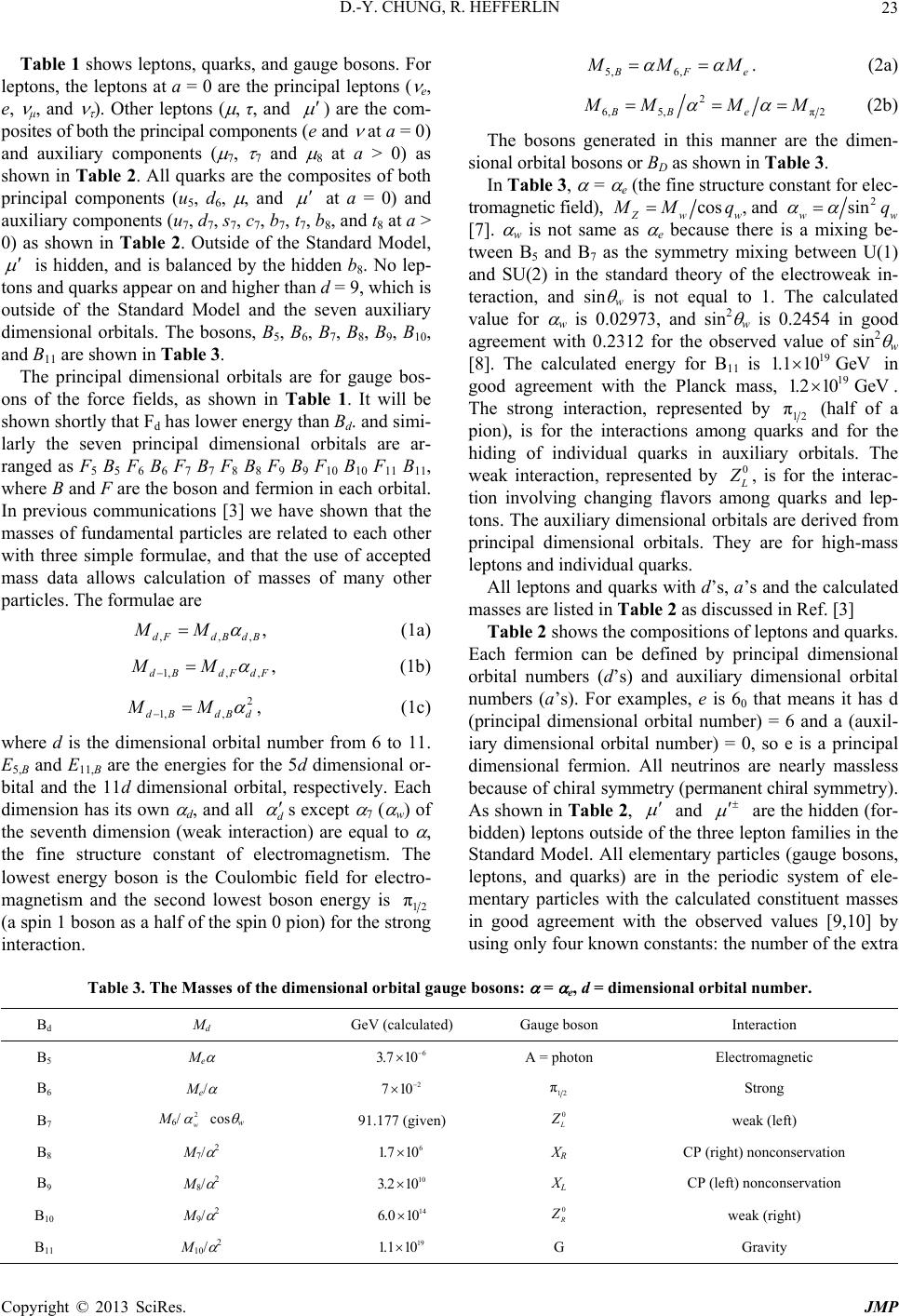 D.-Y. CHUNG, R. HEFFERLIN 23 Table 1 shows leptons, quarks, and gauge bosons. For leptons, the leptons at a = 0 are the principal leptons ( e, e, μ, and ). Other leptons ( , τ, and ) are the com- posites of both the principal components (e and at a = 0) and auxiliary components ( 7, 7 and 8 at a > 0) as shown in Table 2. All quarks are the composites of both principal components (u5, d6, , and at a = 0) and auxiliary components (u7, d7, s7, c7, b7, t7, b8, and t8 at a > 0) as shown in Table 2. Outside of the Standard Model, ,,, , dB dB MM is hidden, and is balanced by the hidden b8. No lep- tons and quarks appear on and higher than d = 9, which is outside of the Standard Model and the seven auxiliary dimensional orbitals. The bosons, B5, B6, B7, B8, B9, B10, and B11 are shown in Table 3. The principal dimensional orbitals are for gauge bos- ons of the force fields, as shown in Table 1. It will be shown shortly that Fd has lower energy than Bd. and simi- larly the seven principal dimensional orbitals are ar- ranged as F5 B5 F6 B6 F7 B7 F8 B8 F9 B9 F10 B10 F11 B11, where B and F are the boson and fermion in each orbital. In previous communications [3] we have shown that the masses of fundamental particles are related to each other with three simple formulae, and that the use of accepted mass data allows calculation of masses of many other particles. The formulae are dF ,, , dF dF MM (1a) 1,d B 2 1, , dB dBd MM (1b) , (1c) where d is the dimensional orbital number from 6 to 11. E5,B and E11,B are the energies for the 5d dimensional or- bital and the 11d dimensional orbital, respectively. Each dimension has its own d, and all d s except 7 ( w) of the seventh dimension (weak interaction) are equal to , the fine structure constant of electromagnetism. The lowest energy boson is the Coulombic field for electro- magnetism and the second lowest boson energy is 12 (a spin 1 boson as a half of the spin 0 pion) for the strong interaction. π 5, 6, M B Fe MM. (2a) 2 6, 5,π2 BB e MMM M (2b) The bosons generated in this manner are the dimen- sional orbital bosons or BD as shown in Table 3. In Table 3, = e (the fine structure constant for elec- tromagnetic field), cos Z ww M Mq 2 sin q , and ww 19 1. 110G eV 19 2 10GeV [7]. w is not same as e because there is a mixing be- tween B5 and B7 as the symmetry mixing between U(1) and SU(2) in the standard theory of the electroweak in- teraction, and sin w is not equal to 1. The calculated value for w is 0.02973, and sin2 w is 0.2454 in good agreement with 0.2312 for the observed value of sin2 w [8]. The calculated energy for B11 is in good agreement with the Planck mass, 1. . The strong interaction, represented by 12 (half of a pion), is for the interactions among quarks and for the hiding of individual quarks in auxiliary orbitals. The weak interaction, represented by π 0 L Z , is for the interac- tion involving changing flavors among quarks and lep- tons. The auxiliary dimensional orbitals are derived from principal dimensional orbitals. They are for high-mass leptons and individual quarks. All leptons and quarks with d’s, a’s and the calculated masses are listed in Table 2 as discussed in Ref. [3] Table 2 shows the compositions of leptons and quarks. Each fermion can be defined by principal dimensional orbital numbers (d’s) and auxiliary dimensional orbital numbers (a’s). For examples, e is 60 that means it has d (principal dimensional orbital number) = 6 and a (auxil- iary dimensional orbital number) = 0, so e is a principal dimensional fermion. All neutrinos are nearly massless because of chiral symmetry (permanent chiral symmetry). As shown in Table 2, and are the hidden (for- bidden) leptons outside of the three lepton families in the Standard Model. All elementary particles (gauge bosons, leptons, and quarks) are in the periodic system of ele- mentary particles with the calculated constituent masses in good agreement with the observed values [9,10] by using only four known constants: the number of the extra Table 3. The Masses of the dimensional orbital gauge bosons: = e, d = dimensional orbital number. Bd Md GeV (calculated) Gauge boson Interaction B5 Me 6 3.7 10 A = photon Electromagnetic B6 Me/ 2 710 12 π 2 w Strong B7 M6/ cos w 91.177 (given) 0 L Z weak (left) B8 M7/ 2 6 1. 710 10 3.210 14 6.0 100 XR CP (right) nonconservation B9 M8/ 2 XL CP (left) nonconservation B10 M9/ 2 R Z weak (right) B11 M10/19 1. 110 G Gravity 2 Copyright © 2013 SciRes. JMP 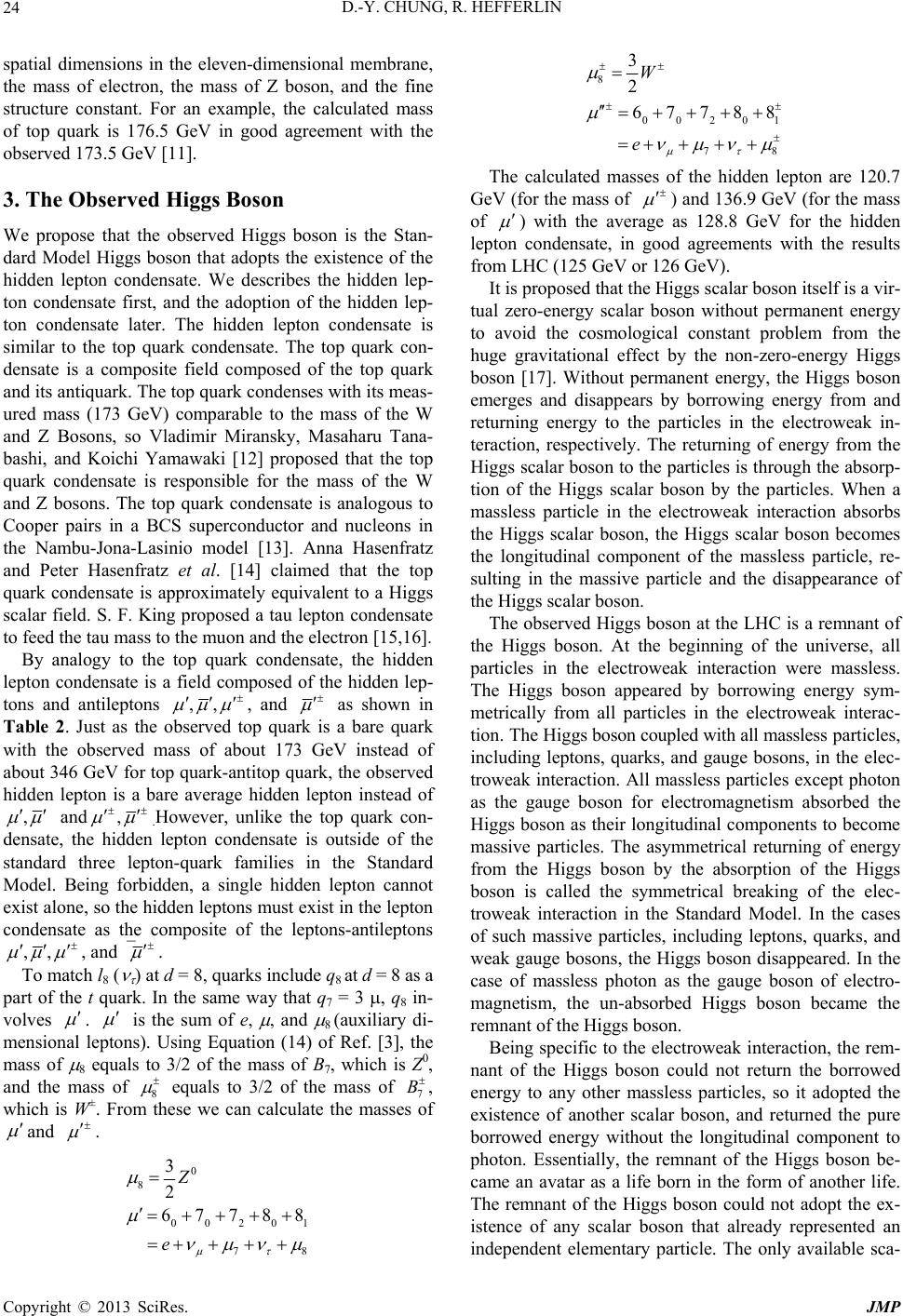 D.-Y. CHUNG, R. HEFFERLIN 24 ensions in thdimensional membrane, spatial dime eleven- 8 00201 78 3 2 67788 W e the mass of electron, the mass of Z boson, and the fine structure constant. For an example, the calculated mass of top quark is 176.5 GeV in good agreement with the observed 173.5 GeV [11]. 3. The Observed Higgs Boson We propose that the observed Higgs boson is the Stan- dard Model Higgs boson that adopts the existence of the hidden lepton condensate. We describes the hidden lep- ton condensate first, and the adoption of the hidden lep- ton condensate later. The hidden lepton condensate is similar to the top quark condensate. The top quark con- densate is a composite field composed of the top quark and its antiquark. The top quark condenses with its meas- ured mass (173 GeV) comparable to the mass of the W and Z Bosons, so Vladimir Miransky, Masaharu Tana- bashi, and Koichi Yamawaki [12] proposed that the top quark condensate is responsible for the mass of the W and Z bosons. The top quark condensate is analogous to Cooper pairs in a BCS superconductor and nucleons in the Nambu-Jona-Lasinio model [13]. Anna Hasenfratz and Peter Hasenfratz et al. [14] claimed that the top quark condensate is approximately equivalent to a Higgs scalar field. S. F. King proposed a tau lepton condensate to feed the tau mass to the muon and the electron [15,16]. By analogy to the top quark condensate, the hidden lepton condensate is a field composed of the hidden lep- tons and antileptons ,, , and as shown in Table 2. Just as the observed top quark is a bare quark with the observed mass of about 173 GeV instead of about 346 GeV for top quark-antitop quark, the observed hidden lepton is a bare average hidden lepton instead of , and, .However, unlike the top quark con- densate, the hidden lepton condensate is outside of the standard three lepton-quark families in the Standard Model. Being forbidden, a single hidden lepton cannot exist alone, so the hidden leptons must exist in the lepton condensate as the composite of the leptons-antileptons ,, , and . To match l8 ( ) at d = 8, quarks include qat d = 8 as a 8 part of the t quark. In the same way that q7 = 3 , q8 in- volves . is the sum of e, , and 8 (auxiliary di- mensional leptons). Using Equation (14) of Ref. [3], the mass of 8 equals to 3/2 of the mass of B7, which is Z0, and the mass of 8 equals to 3/2 of the mass of 7 B , which is W±. From these we can calculate the masses of and . 0 8 00 3 2 67 Z e 201 78 788 The calculated masses of the hidden lepton are 120.7 GeV (for the mass of ) and 136.9 GeV (for the mass of ) with the average as 128.8 GeV for the hidden lepton condensate, in good agreements with the results from LHC (125 GeV or 126 GeV). It is proposed that the Higgs scalar boson itself is a vir- tual zero-energy scalar boson without permanent energy to ct on the electroweak in- te s, and gauge bosons, in the elec- tro in the form of another life. Th avoid the cosmological constant problem from the huge gravitational effeby the non-zero-energy Higgs bos [17]. Without permanent energy, the Higgs boson emerges and disappears by borrowing energy from and returning energy to the particles in raction, respectively. The returning of energy from the Higgs scalar boson to the particles is through the absorp- tion of the Higgs scalar boson by the particles. When a massless particle in the electroweak interaction absorbs the Higgs scalar boson, the Higgs scalar boson becomes the longitudinal component of the massless particle, re- sulting in the massive particle and the disappearance of the Higgs scalar boson. The observed Higgs boson at the LHC is a remnant of the Higgs boson. At the beginning of the universe, all particles in the electroweak interaction were massless. The Higgs boson appeared by borrowing energy sym- metrically from all particles in the electroweak interac- tion. The Higgs boson coupled with all massless particles, including leptons, quark weak interaction. All massless particles except photon as the gauge boson for electromagnetism absorbed the Higgs boson as their longitudinal components to become massive particles. The asymmetrical returning of energy from the Higgs boson by the absorption of the Higgs boson is called the symmetrical breaking of the elec- troweak interaction in the Standard Model. In the cases of such massive particles, including leptons, quarks, and weak gauge bosons, the Higgs boson disappeared. In the case of massless photon as the gauge boson of electro- magnetism, the un-absorbed Higgs boson became the remnant of the Higgs boson. Being specific to the electroweak interaction, the rem- nant of the Higgs boson could not return the borrowed energy to any other massless particles, so it adopted the existence of another scalar boson, and returned the pure borrowed energy without the longitudinal component to photon. Essentially, the remnant of the Higgs boson be- came an avatar as a life born e remnant of the Higgs boson could not adopt the ex- istence of any scalar boson that already represented an independent elementary particle. The only available sca- Copyright © 2013 SciRes. JMP 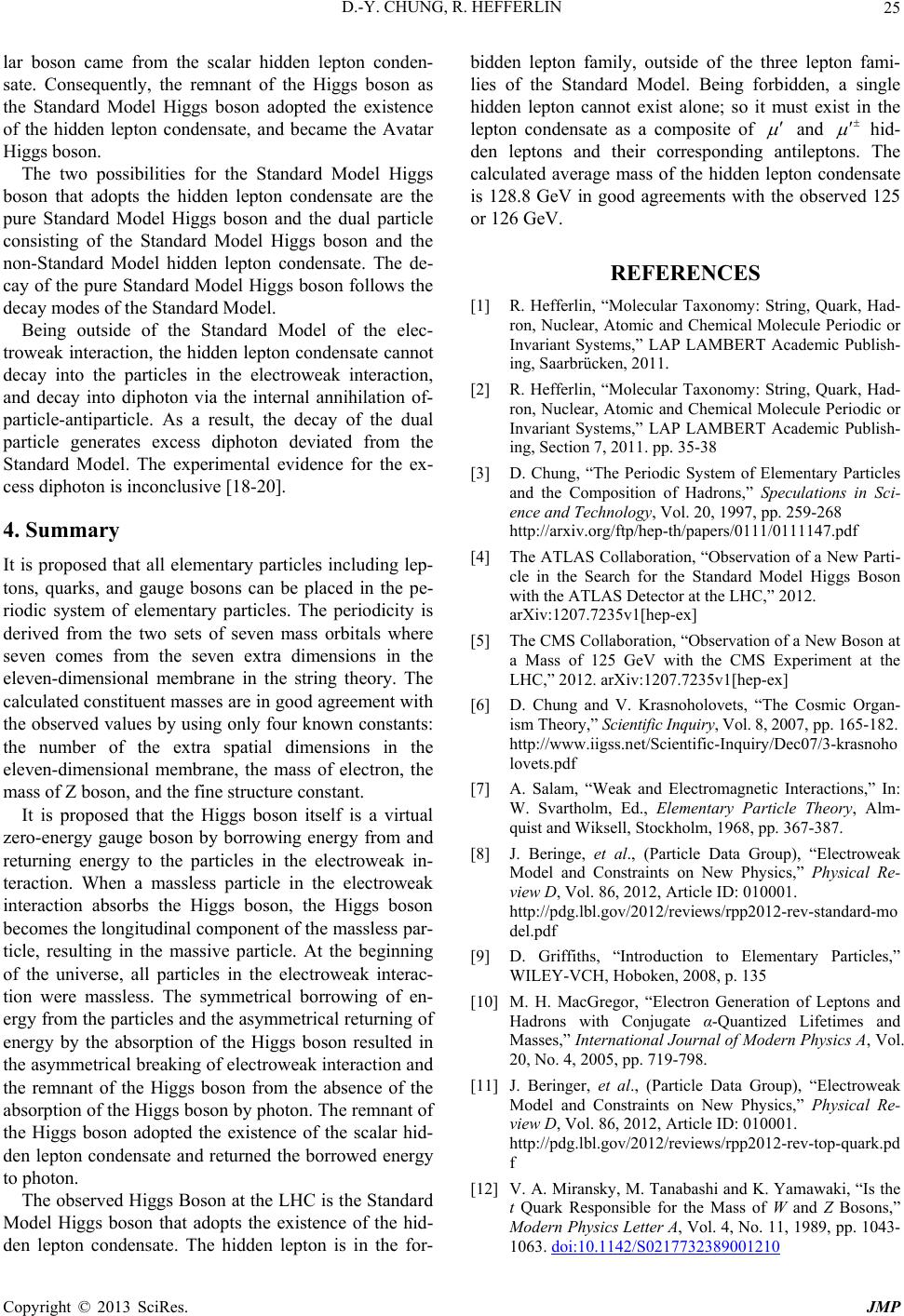 D.-Y. CHUNG, R. HEFFERLIN 25 lar boson came from the scalar hidden lepton conden- sate. Consequently, the remnant of the Higgs boson as the Standard Model Higgs boson adopted the existence of the hidden lepton condensate, and became the Avatar Higgs boson. The two possibilities for the Standard Model Higgs boson that adopts the hidden lepton condensate are the pure Standard Model Higgs boson and the dual particle consisting of the Standard Model Higgs boson and the non-Standard Model hidden lepton condensate. The de- cay of the pure Standard Model Higgs boson follows the decay modes of the Standard Model. vidence for th ce Being outside of the Standard Model of the elec- troweak interaction, the hidden lepton condensate cannot decay into the particles in the electroweak interaction, and decay into diphoton via the internal annihilation of- particle-antiparticle. As a result, the decay of the dual particle generates excess diphoton deviated from the Standard Model. The experimental ee ex- ss diphoton is inconclusive [18-20]. 4. Summary It is proposed that all elementary particles including lep- tons, quarks, and gauge bosons can be placed in the pe- riodic system of elementary particles. The periodicity is derived from the two sets of seven mass orbitals where seven comes from the seven extra dimensions in the al membrane in the string theory. The uent masses are in good agreement with gi of ensate as a composite of eleven-dimension calculated constit the observed values by using only four known constants: the number of the extra spatial dimensions in the eleven-dimensional membrane, the mass of electron, the mass of Z boson, and the fine structure constant. It is proposed that the Higgs boson itself is a virtual zero-energy gauge boson by borrowing energy from and returning energy to the particles in the electroweak in- teraction. When a massless particle in the electroweak interaction absorbs the Higgs boson, the Higgs boson becomes the longitudinal component of the massless par- ticle, resulting in the massive particle. At the benning the universe, all particles in the electroweak interac- tion were massless. The symmetrical borrowing of en- ergy from the particles and the asymmetrical returning of energy by the absorption of the Higgs boson resulted in the asymmetrical breaking of electroweak interaction and the remnant of the Higgs boson from the absence of the absorption of the Higgs boson by photon. The remnant of the Higgs boson adopted the existence of the scalar hid- den lepton condensate and returned the borrowed energy to photon. The observed Higgs Boson at the LHC is the Standard Model Higgs boson that adopts the existence of the hid- den lepton condensate. The hidden lepton is in the for- bidden lepton family, outside of the three lepton fami- lies of the Standard Model. Being forbidden, a single hidden lepton cannot exist alone; so it must exist in the lepton cond and hid- de lar Taxonomy: String, Quark, Had- ron, Nuclear, Atomic and Chemical Molecule Periodic or Invariant Systemic Publish- ing, Section 7, 2 /papers/0111/0111147.pdf ger, et al., (Particle Data Group), “Electroweak -rev-top-quark.pd , No. 11, 1989, pp. 1043- n leptons and their corresponding antileptons. The calculated average mass of the hidden lepton condensate is 128.8 GeV in good agreements with the observed 125 or 126 GeV. REFERENCES [1] R. Hefferlin, “Molecular Taxonomy: String, Quark, Had- ron, Nuclear, Atomic and Chemical Molecule Periodic or Invariant Systems,” LAP LAMBERT Academic Publish- ing, Saarbrücken, 2011. [2] R. Hefferlin, “Molecu ems,” LAP LAMBERT Acad 011. pp. 35-38 [3] D. Chung, “The Periodic System of Elementary Particles and the Composition of Hadrons,” Speculations in Sci- ence and Technology, Vol. 20, 1997, pp. 259-268 http://arxiv.org/ftp/hep-th [4] The ATLAS Collaboration, “Observation of a New Parti- cle in the Search for the Standard Model Higgs Boson with the ATLAS Detector at the LHC,” 2012. arXiv:1207.7235v1[hep-ex] [5] The CMS Collaboration, “Observation of a New Boson at a Mass of 125 GeV with the CMS Experiment at the LHC,” 2012. arXiv:1207.7235v1[hep-ex] [6] D. Chung and V. Krasnoholovets, “The Cosmic Organ- ism Theory,” Scientific Inquiry, Vol. 8, 2007, pp. 165-182. http://www.iigss.net/Scientific-Inquiry/Dec07/3-krasnoho lovets.pdf [7] A. Salam, “Weak and Electromagnetic Interactions,” In: W. Svartholm, Ed., Elementary Particle Theory, Alm- quist and Wiksell, Stockholm, 1968, pp. 367-387. [8] J. Beringe, et al., (Particle Data Group), “Electroweak Model and Constraints on New Physics,” Physical Re- view D, Vol. 86, 2012, Article ID: 010001. http://pdg.lbl.gov/2012/reviews/rpp2012-rev-standard-mo del.pdf [9] D. Griffiths, “Introduction to Elementary Particles,” WILEY-VCH, Hoboken, 2008, p. 135 [10] M. H. MacGregor, “Electron Generation of Leptons and Hadrons with Conjugate α-Quantized Lifetimes and Masses,” International Journal of Modern Physics A, Vol. 20, No. 4, 2005, pp. 719-798. [11] J. Berin Model and Constraints on New Physics,” Physical Re- view D, Vol. 86, 2012, Article ID: 010001. http://pdg.lbl.gov/2012/reviews/rpp2012 f [12] V. A. Miransky, M. Tanabashi and K. Yamawaki, “Is the t Quark Responsible for the Mass of W and Z Bosons,” Modern Physics Letter A, Vol. 4 1063. doi:10.1142/S0217732389001210 Copyright © 2013 SciRes. JMP  D.-Y. CHUNG, R. HEFFERLIN Copyright © 2013 SciRes. JMP 26 with Supe . 246-254. doi:10.1103/PhysRev.124.246 [13] Y. Nambu and G. Jona-Lasinio, “Dynamical Model of Elementary Particles Based on an Analogy conductivity, II,” Physical Review, Vol. 124, No. 1, 1961, pp r- [14] A. Hasenfratz, P. Hasenfratz, K. Jansen, J. Kuti and Y. Shen, “The Equivalence of the Top Quark Condensate and the Elementary Higgs Field,” Nuclear Physics B, Vol. 365, No. 1, 1991, pp. 79-97. doi:10.1016/0550-3213(91)90607-Y [15] S. F. King, “Four-Family Lepton Mixing,” Physical Re- view D, Vol. 46, 1992, pp. 4804-4807. [16] S. F. King, “Low Scale Technicolour at LEP,” Physics Letter B, Vol. 314, No. 3-4, 1993, pp. 364-370. doi:10.1016/0370-2693(93)91250-Q [17] S. Weinberg, “The Cosmological Constant Problem,” Review Modern Physics, Vol. 61, No. 1, 1989, pp. 1-23. doi:10.1103/RevModPhys.61.1 [18] P. P. Giardino, K. Kannike, M. Raidal and A. Strumia, “Is ations), “Search xcess in Higgs Decays to the Resonance at 125 GeV the Higgs Boson?” 2012. arXiv:1207.1347v1 [hep-ph] [19] K. R. Bland, (for the CDF, D0 Collabor for the Higgs boson in H- > γγ Decays in $p\bar{p}$ Col- lisions at 1.96 TeV,” 2012. arXiv:1110.1747v1[hep-ex] [20] M. Strassler, “CMS Sees No E Photons,” 2013. http://profmattstrassler.com/2013/03/14/cms-sees-no-exce ss-in-higgs-decays-to-photons/#more-5655 |