

Paper Menu >>
Journal Menu >>
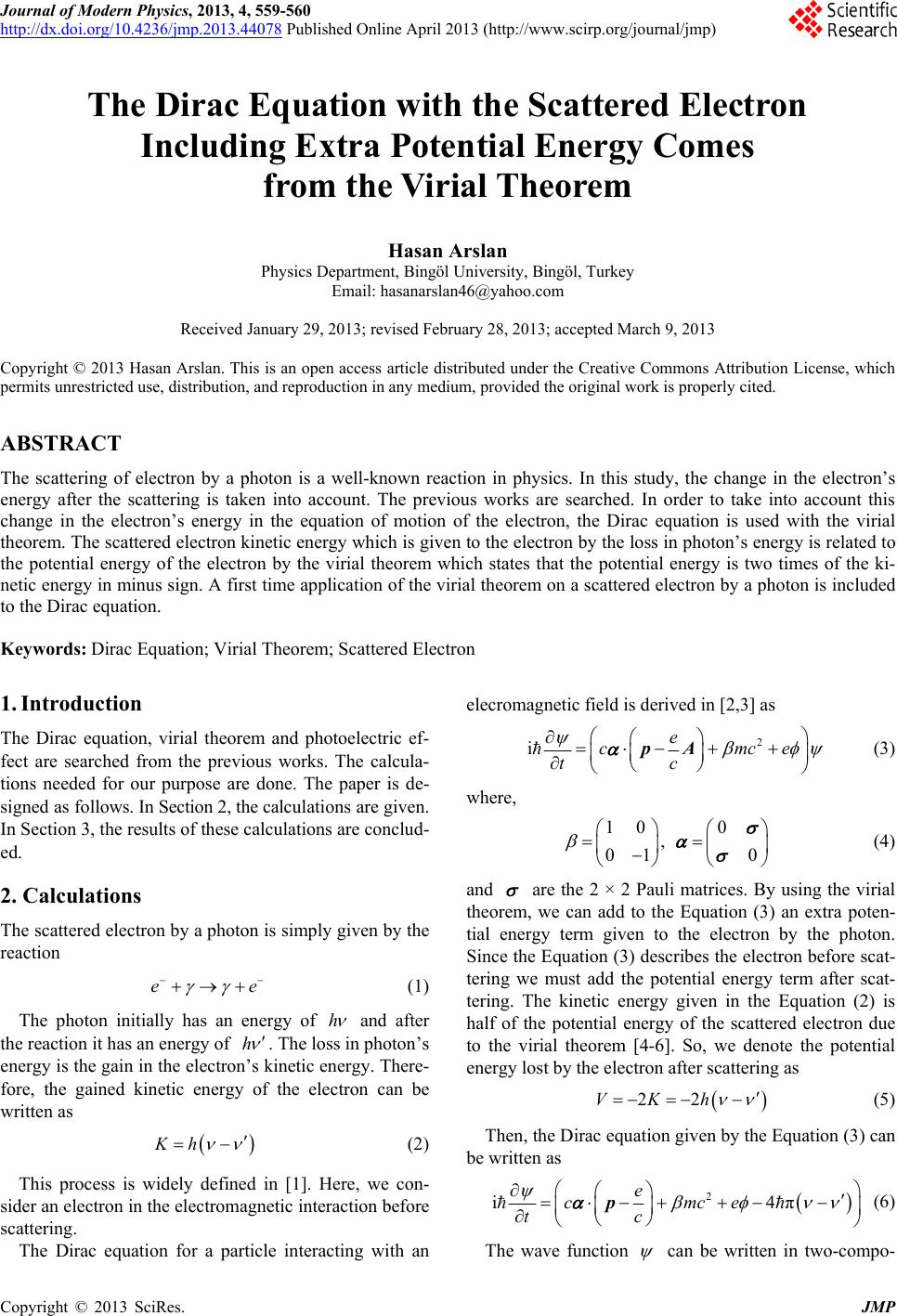 Journal of Modern Physics, 2013, 4, 559-560 http://dx.doi.org/10.4236/jmp.2013.44078 Published Online April 2013 (http://www.scirp.org/journal/jmp) The Dirac Equation with the Scattered Electron Including Extra Potential Energy Comes fr om the Virial Theorem Hasan Arslan Physics Department, Bingöl University, Bingöl, Turkey Email: [email protected] Received January 29, 2013; revised February 28, 2013; accepted March 9, 2013 Copyright © 2013 Hasan Arslan. This is an open access article distributed under the Creative Commons Attribution License, which permits unrestricted use, distribution, and reproduction in any medium, provided the original work is properly cited. ABSTRACT The scattering of electron by a photon is a well-known reaction in physics. In this study, the change in the electron’s energy after the scattering is taken into account. The previous works are searched. In order to take into account this change in the electron’s energy in the equation of motion of the electron, the Dirac equation is used with the virial theorem. The scattered electron kinetic energy which is given to the electron by the loss in photon’s energy is related to the potential energy of the electron by the virial theorem which states that the potential energy is two times of the ki- netic energy in minus sign. A first time application of the virial theorem on a scattered electron by a photon is included to the Dirac equation. Keywords: Dirac Equation; Virial Theorem; Scattered Electron 1. Introduction The Dirac equation, virial theorem and photoelectric ef- fect are searched from the previous works. The calcula- tions needed for our purpose are done. The paper is de- signed as follows. In Section 2, the calculations are given. In Section 3, the results of these calculations are conclud- ed. 2. Calculations The scattered electron by a photon is simply given by the reaction ee h (1) The photon initially has an energy of and after the reaction it has an energy of h Kh . The loss in photon’s energy is the gain in the electron’s kinetic energy. There- fore, the gained kinetic energy of the electron can be written as (2) This process is widely defined in [1]. Here, we con- sider an electron in the electromagnetic interaction before scattering. The Dirac equation for a particle interacting with an elecromagnetic field is derived in [2,3] as 2 ie cmce tc pA 10 0 , 01 0 (3) where, (4) and are the 2 × 2 Pauli matrices. By using the virial theorem, we can add to the Equation (3) an extra poten- tial energy term given to the electron by the photon. Since the Equation (3) describes the electron before scat- tering we must add the potential energy term after scat- tering. The kinetic energy given in the Equation (2) is half of the potential energy of the scattered electron due to the virial theorem [4-6]. So, we denote the potential energy lost by the electron after scattering as 22VKh (5) Then, the Dirac equation given by the Equation (3) can be written as 2 i4π e cmce tc p (6) can be written in two-compo- The wave function C opyright © 2013 SciRes. JMP 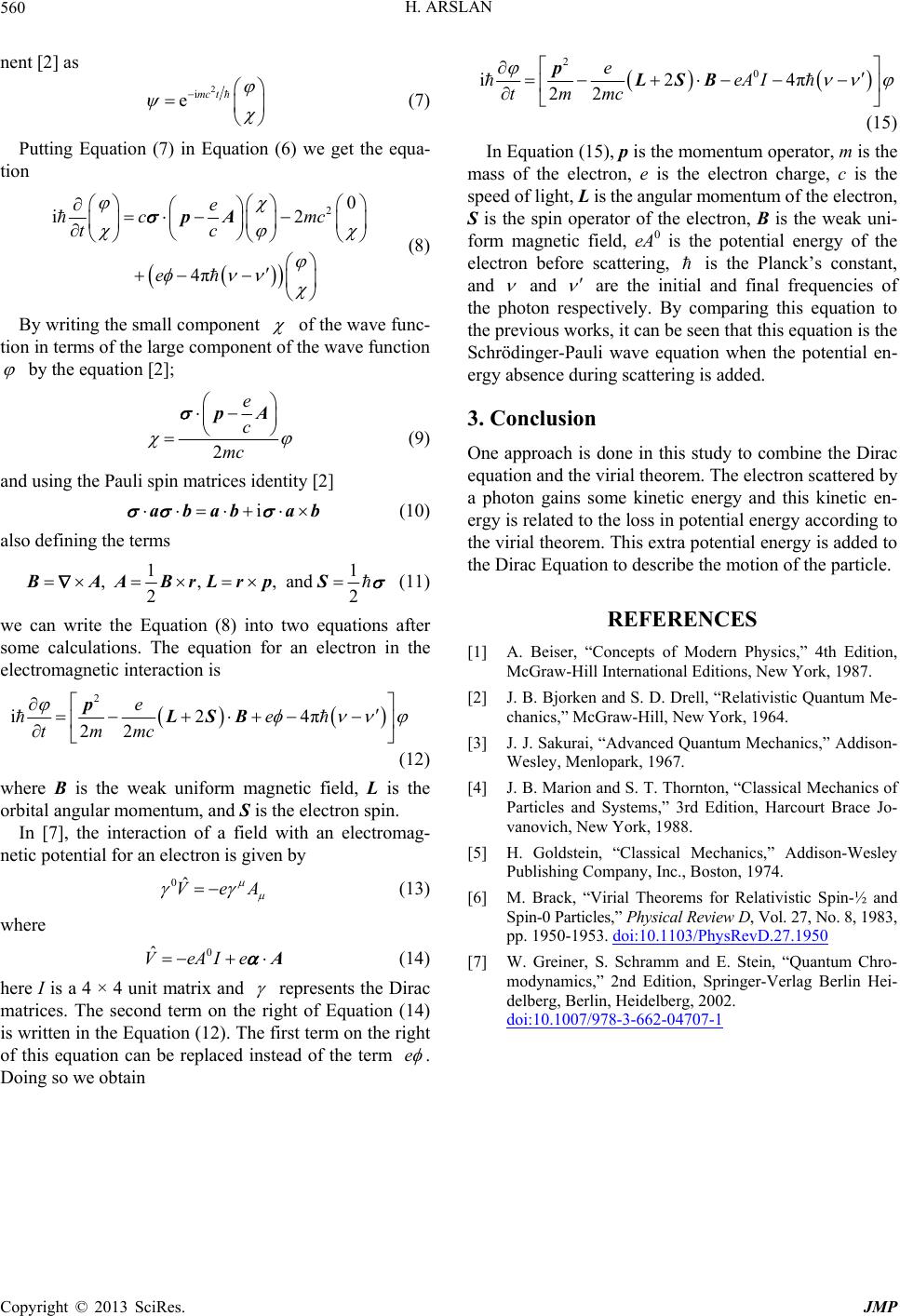 H. ARSLAN 560 nent [2] as 2 i emc t (7) Putting Equation (7) in Equation (6) we get the equa- tion i 4π e c tc e 20 2mc pA (8) By writing the small component of the wave func- tion in terms of the large component of the wave function by the equation [2]; 2 e c mc pA iab ab (9) and using the Pauli spin matrices identity [2] ab (10) also defining the terms 1 , , , a 2 BAABrLr1 nd 2 pS (11) we can write the Equation (8) into two equations after some calculations. The equation for an electron in the electromagnetic interaction is 2 i2 22 ee tmmc 4π pLSB 0ˆ VeA (12) where B is the weak uniform magnetic field, L is the orbital angular momentum, and S is the electron spin. In [7], the interaction of a field with an electromag- netic potential for an electron is given by 0 AIe A (13) where ˆ Ve (14) here I is a 4 × 4 unit matrix and represents the Dirac matrices. The second term on the right of Equation (14) is written in the Equation (12). The first term on the right of this equation can be replaced instead of the term e . Doing so we obtain 0 i24π 22 eA I tmmc 2e LSB (15) In Equation (15), p is the momentum operator, m m p is the ass of the electron, e is the electron charge, c is the speed of light, L is the angular momentum of the electron, S is the spin operator of the electron, B is the weak uni- form magnetic field, eA0 is the potential energy of the electron before scattering, is the Planck’s constant, and and are the initial and final frequencies of the poton reectively. By comparing this equation to the previous works, it can be seen that this equation is the Schrödinger-Pauli wave equation when the potential en- ergy absence during scattering is added. 3. Conclusion h sp in this study to combine the Dirac REFERENCES [1] A. Beiser, “Csics,” 4th Edition, e- ics,” Addison- nton, “Classical Mechanics of echanics,” Addison-Wesley tic Spin-½ and One approach is done equation and the virial theorem. The electron scattered by a photon gains some kinetic energy and this kinetic en- ergy is related to the loss in potential energy according to the virial theorem. This extra potential energy is added to the Dirac Equation to describe the motion of the particle. oncepts of Modern Phy McGraw-Hill International Editions, New York, 1987. [2] J. B. Bjorken and S. D. Drell, “Relativistic Quantum M chanics,” McGraw-Hill, New York, 1964. [3] J. J. Sakurai, “Advanced Quantum Mechan Wesley, Menlopark, 1967. [4] J. B. Marion and S. T. Thor Particles and Systems,” 3rd Edition, Harcourt Brace Jo- vanovich, New York, 1988. [5] H. Goldstein, “Classical M Publishing Company, Inc., Boston, 1974. [6] M. Brack, “Virial Theorems for Relativis Spin-0 Particles,” Physical Review D, Vol. 27, No. 8, 1983, pp. 1950-1953. doi:10.1103/PhysRevD.27.1950 [7] W. Greiner, S. Schramm and E. Stein, “Quantum Chro- modynamics,” 2nd Edition, Springer-Verlag Berlin Hei- delberg, Berlin, Heidelberg, 2002. doi:10.1007/978-3-662-04707-1 Copyright © 2013 SciRes. JMP |