

Paper Menu >>
Journal Menu >>
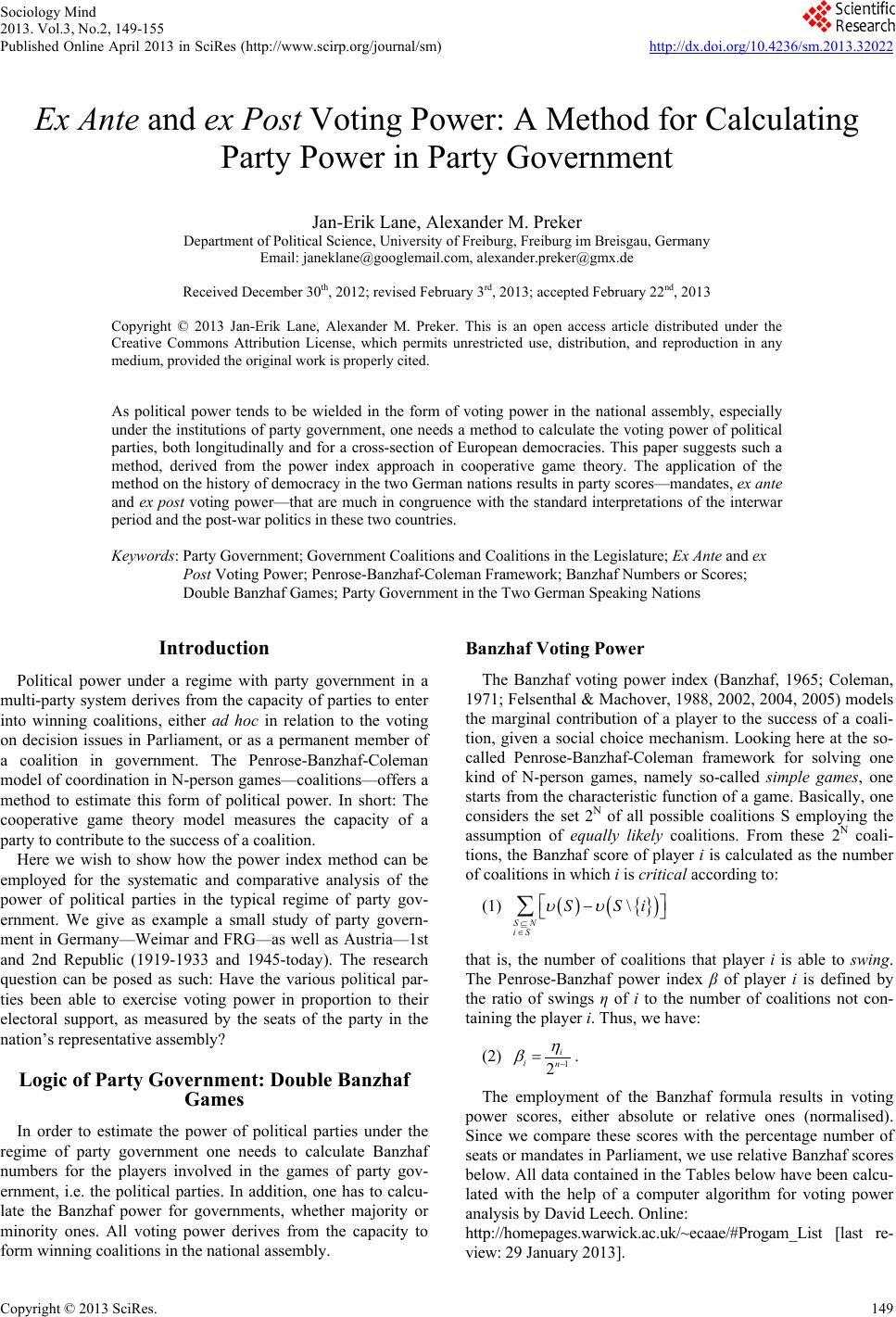 Sociology Mind 2013. Vol.3, No.2, 149-155 Published Online April 2013 in SciRes (http://www.scirp.org/journal/sm) http://dx.doi.org/10.4236/sm.2013.32022 Copyright © 2013 SciRes. 149 Ex Ante and ex Post Voting Power: A Method for Calculating Party Power in Party Government Jan-Erik Lane, Alexander M. Preker Department of Political Science, University of Freiburg, Freiburg im Breisgau, Germany Email: [email protected]m, [email protected] Received December 30th, 2012; revised February 3rd, 2013; accepted February 22nd, 2013 Copyright © 2013 Jan-Erik Lane, Alexander M. Preker. This is an open access article distributed under the Creative Commons Attribution License, which permits unrestricted use, distribution, and reproduction in any medium, provided the original work is properly cited. As political power tends to be wielded in the form of voting power in the national assembly, especially under the institutions of party government, one needs a method to calculate the voting power of political parties, both longitudinally and for a cross-section of European democracies. This paper suggests such a method, derived from the power index approach in cooperative game theory. The application of the method on the history of democracy in the two German nations results in party scores—mandates, ex ante and ex post voting power—that are much in congruence with the standard interpretations of the interwar period and the post-war politics in these two countries. Keywords: Party Government; Government Coalitions and Coalitions in the Legislature; Ex Ante and ex Post Voting Power; Penrose-Banzhaf-Coleman Framework; Banzhaf Numbers or Scores; Double Banzhaf Games; Party Government in the Two German Speaking Nations Introduction Political power under a regime with party government in a multi-party system derives from the capacity of parties to enter into winning coalitions, either ad hoc in relation to the voting on decision issues in Parliament, or as a permanent member of a coalition in government. The Penrose-Banzhaf-Coleman model of coordination in N-person games—coalitions—offers a method to estimate this form of political power. In short: The cooperative game theory model measures the capacity of a party to contribute to the success of a coalition. Here we wish to show how the power index method can be employed for the systematic and comparative analysis of the power of political parties in the typical regime of party gov- ernment. We give as example a small study of party govern- ment in Germany—Weimar and FRG—as well as Austria—1st and 2nd Republic (1919-1933 and 1945-today). The research question can be posed as such: Have the various political par- ties been able to exercise voting power in proportion to their electoral support, as measured by the seats of the party in the nation’s representative assembly? Logic of Party Government: Double Banzhaf Games In order to estimate the power of political parties under the regime of party government one needs to calculate Banzhaf numbers for the players involved in the games of party gov- ernment, i.e. the political parties. In addition, one has to calcu- late the Banzhaf power for governments, whether majority or minority ones. All voting power derives from the capacity to form winning coalitions in the national assembly. Banzhaf Voting Power The Banzhaf voting power index (Banzhaf, 1965; Coleman, 1971; Felsenthal & Machover, 1988, 2002, 2004, 2005) models the marginal contribution of a player to the success of a coali- tion, given a social choice mechanism. Looking here at the so- called Penrose-Banzhaf-Coleman framework for solving one kind of N-person games, namely so-called simple games, one starts from the characteristic function of a game. Basically, one considers the set 2N of all possible coalitions S employing the assumption of equally likely coalitions. From these 2N coali- tions, the Banzhaf score of player i is calculated as the number of coalitions in which i is critical according to: (1) \ SN iS SSi that is, the number of coalitions that player i is able to swing. The Penrose-Banzhaf power index β of player i is defined by the ratio of swings η of i to the number of coalitions not con- taining the player i. Thus, we have: (2) 1 2 i in . The employment of the Banzhaf formula results in voting power scores, either absolute or relative ones (normalised). Since we compare these scores with the percentage number of seats or mandates in Parliament, we use relative Banzhaf scores below. All data contained in the Tables below have been calcu- lated with the help of a computer algorithm for voting power analysis by David Leech. Online: http://homepages.warwick.ac.uk/~ecaae/#Progam_List [last re- view: 29 January 2013]. 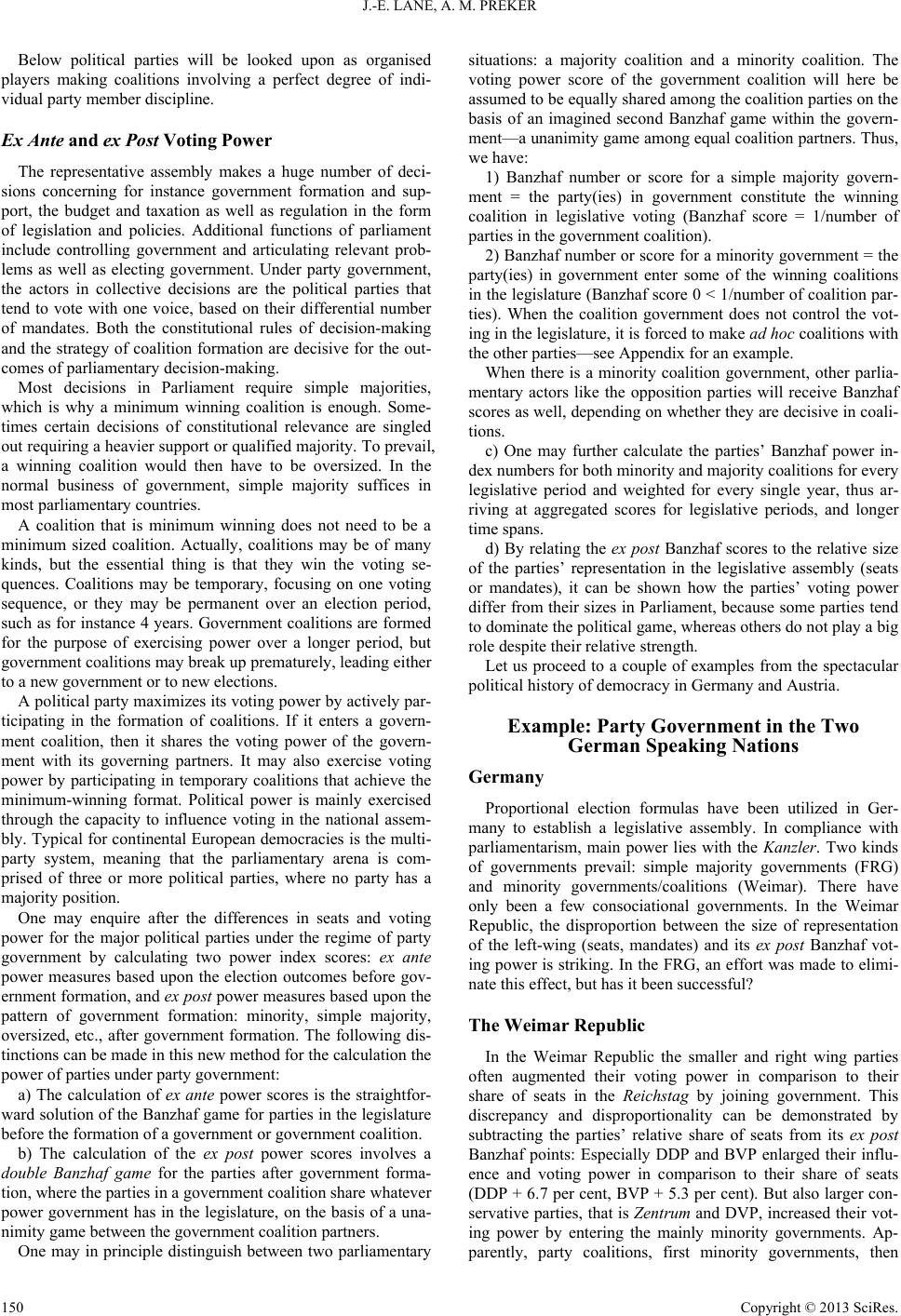 J.-E. LANE, A. M. PREKER Below political parties will be looked upon as organised players making coalitions involving a perfect degree of indi- vidual party member discipline. Ex Ante and ex Pos t Voting Power The representative assembly makes a huge number of deci- sions concerning for instance government formation and sup- port, the budget and taxation as well as regulation in the form of legislation and policies. Additional functions of parliament include controlling government and articulating relevant prob- lems as well as electing government. Under party government, the actors in collective decisions are the political parties that tend to vote with one voice, based on their differential number of mandates. Both the constitutional rules of decision-making and the strategy of coalition formation are decisive for the out- comes of parliamentary decision-making. Most decisions in Parliament require simple majorities, which is why a minimum winning coalition is enough. Some- times certain decisions of constitutional relevance are singled out requiring a heavier support or qualified majority. To prevail, a winning coalition would then have to be oversized. In the normal business of government, simple majority suffices in most parliamentary countries. A coalition that is minimum winning does not need to be a minimum sized coalition. Actually, coalitions may be of many kinds, but the essential thing is that they win the voting se- quences. Coalitions may be temporary, focusing on one voting sequence, or they may be permanent over an election period, such as for instance 4 years. Government coalitions are formed for the purpose of exercising power over a longer period, but government coalitions may break up prematurely, leading either to a new government or to new elections. A political party maximizes its voting power by actively par- ticipating in the formation of coalitions. If it enters a govern- ment coalition, then it shares the voting power of the govern- ment with its governing partners. It may also exercise voting power by participating in temporary coalitions that achieve the minimum-winning format. Political power is mainly exercised through the capacity to influence voting in the national assem- bly. Typical for continental European democracies is the multi- party system, meaning that the parliamentary arena is com- prised of three or more political parties, where no party has a majority position. One may enquire after the differences in seats and voting power for the major political parties under the regime of party government by calculating two power index scores: ex ante power measures based upon the election outcomes before gov- ernment formation, and ex post power measures based upon the pattern of government formation: minority, simple majority, oversized, etc., after government formation. The following dis- tinctions can be made in this new method for the calculation the power of parties under party government: a) The calculation of ex ante power scores is the straightfor- ward solution of the Banzhaf game for parties in the legislature before the formation of a government or government coalition. b) The calculation of the ex post power scores involves a double Banzhaf game for the parties after government forma- tion, where the parties in a government coalition share whatever power government has in the legislature, on the basis of a una- nimity game between the government coalition partners. One may in principle distinguish between two parliamentary situations: a majority coalition and a minority coalition. The voting power score of the government coalition will here be assumed to be equally shared among the coalition parties on the basis of an imagined second Banzhaf game within the govern- ment—a unanimity game among equal coalition partners. Thus, we have: 1) Banzhaf number or score for a simple majority govern- ment = the party(ies) in government constitute the winning coalition in legislative voting (Banzhaf score = 1/number of parties in the government coalition). 2) Banzhaf number or score for a minority government = the party(ies) in government enter some of the winning coalitions in the legislature (Banzhaf score 0 < 1/number of coalition par- ties). When the coalition government does not control the vot- ing in the legislature, it is forced to make ad hoc coalitions with the other parties—see Appendix for an example. When there is a minority coalition government, other parlia- mentary actors like the opposition parties will receive Banzhaf scores as well, depending on whether they are decisive in coali- tions. c) One may further calculate the parties’ Banzhaf power in- dex numbers for both minority and majority coalitions for every legislative period and weighted for every single year, thus ar- riving at aggregated scores for legislative periods, and longer time spans. d) By relating the ex post Banzhaf scores to the relative size of the parties’ representation in the legislative assembly (seats or mandates), it can be shown how the parties’ voting power differ from their sizes in Parliament, because some parties tend to dominate the political game, whereas others do not play a big role despite their relative strength. Let us proceed to a couple of examples from the spectacular political history of democracy in Germany and Austria. Example: Party Government in the Two German Speaking Nations Germany Proportional election formulas have been utilized in Ger- many to establish a legislative assembly. In compliance with parliamentarism, main power lies with the Kanzler. Two kinds of governments prevail: simple majority governments (FRG) and minority governments/coalitions (Weimar). There have only been a few consociational governments. In the Weimar Republic, the disproportion between the size of representation of the left-wing (seats, mandates) and its ex post Banzhaf vot- ing power is striking. In the FRG, an effort was made to elimi- nate this effect, but has it been successful? The Weimar Republic In the Weimar Republic the smaller and right wing parties often augmented their voting power in comparison to their share of seats in the Reic hstag by joining government. This discrepancy and disproportionality can be demonstrated by subtracting the parties’ relative share of seats from its ex post Banzhaf points: Especially DDP and BVP enlarged their influ- ence and voting power in comparison to their share of seats (DDP + 6.7 per cent, BVP + 5.3 per cent). But also larger con- servative parties, that is Zentrum and DVP, increased their vot- ing power by entering the mainly minority governments. Ap- parently, party coalitions, first minority governments, then Copyright © 2013 SciRes. 150 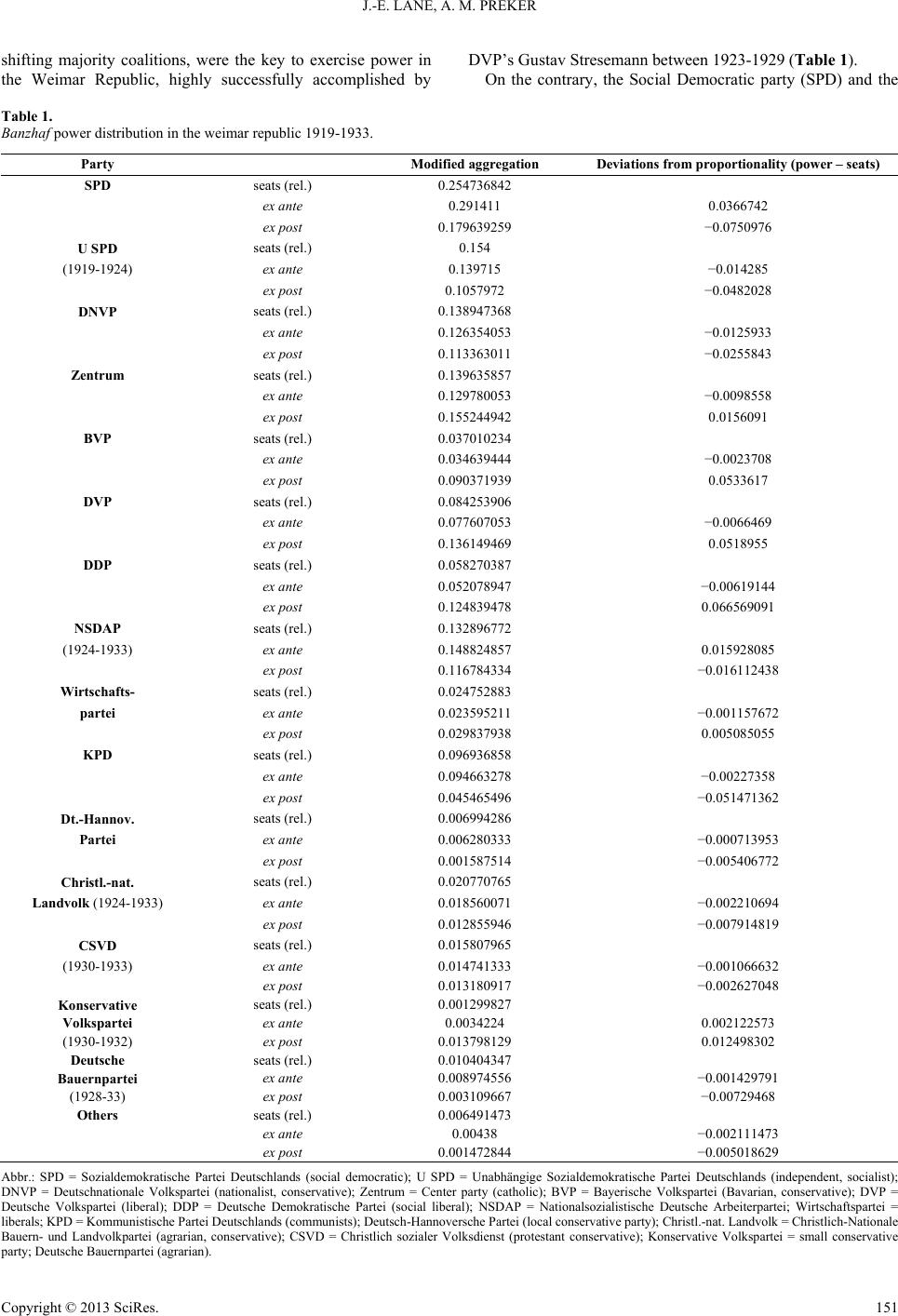 J.-E. LANE, A. M. PREKER Copyright © 2013 SciRes. 151 shifting majority coalitions, were the key to exercise power in the Weimar Republic, highly successfully accomplished by DVP’s Gustav Stresemann between 1923-1929 (Table 1). On the contrary, the Social Democratic party (SPD) and the Table 1. Banzhaf power distribution in the weimar republic 1919-1933. Party Modified aggregation Deviations from proportionality (power – seats) SPD seats (rel.) 0.254736842 ex ante 0.291411 0.0366742 ex post 0.179639259 −0.0750976 U SPD seats (rel.) 0.154 (1919-1924) ex ante 0.139715 −0.014285 ex post 0.1057972 −0.0482028 DNVP seats (rel.) 0.138947368 ex ante 0.126354053 −0.0125933 ex post 0.113363011 −0.0255843 Zentrum seats (rel.) 0.139635857 ex ante 0.129780053 −0.0098558 ex post 0.155244942 0.0156091 BVP seats (rel.) 0.037010234 ex ante 0.034639444 −0.0023708 ex post 0.090371939 0.0533617 DVP seats (rel.) 0.084253906 ex ante 0.077607053 −0.0066469 ex post 0.136149469 0.0518955 DDP seats (rel.) 0.058270387 ex ante 0.052078947 −0.00619144 ex post 0.124839478 0.066569091 NSDAP seats (rel.) 0.132896772 (1924-1933) ex ante 0.148824857 0.015928085 ex post 0.116784334 −0.016112438 Wirtschafts- seats (rel.) 0.024752883 partei ex ante 0.023595211 −0.001157672 ex post 0.029837938 0.005085055 KPD seats (rel.) 0.096936858 ex ante 0.094663278 −0.00227358 ex post 0.045465496 −0.051471362 Dt.-Hannov. seats (rel.) 0.006994286 Partei ex ante 0.006280333 −0.000713953 ex post 0.001587514 −0.005406772 Christl.-nat. seats (rel.) 0.020770765 Landvolk (1924-1933) ex ante 0.018560071 −0.002210694 ex post 0.012855946 −0.007914819 CSVD seats (rel.) 0.015807965 (1930-1933) ex ante 0.014741333 −0.001066632 ex post 0.013180917 −0.002627048 Konservative seats (rel.) 0.001299827 Volkspartei ex ante 0.0034224 0.002122573 (1930-1932) ex post 0.013798129 0.012498302 Deutsche seats (rel.) 0.010404347 Bauernpartei ex ante 0.008974556 −0.001429791 (1928-33) ex post 0.003109667 −0.00729468 Others seats (rel.) 0.006491473 ex ante 0.00438 −0.002111473 ex post 0.001472844 −0.005018629 Abbr.: SPD = Sozialdemokratische Partei Deutschlands (social democratic); U SPD = Unabhängige Sozialdemokratische Partei Deutschlands (independent, socialist); DNVP = Deutschnationale Volkspartei (nationalist, conservative); Zentrum = Center party (catholic); BVP = Bayerische Volkspartei (Bavarian, conservative); DVP = Deutsche Volkspartei (liberal); DDP = Deutsche Demokratische Partei (social liberal); NSDAP = Nationalsozialistische Deutsche Arbeiterpartei; Wirtschaftspartei = liberals; KPD = Kommunistische Partei Deutschlands (communists); Deutsch-Hannoversche Partei (local conservative party); Christl.-nat. Landvolk = Christlich-Nationale Bauern- und Landvolkpartei (agrarian, conservative); CSVD = Christlich sozialer Volksdienst (protestant conservative); Konservative Volkspartei = small conservative party; Deutsche Bauernpartei (agrarian). 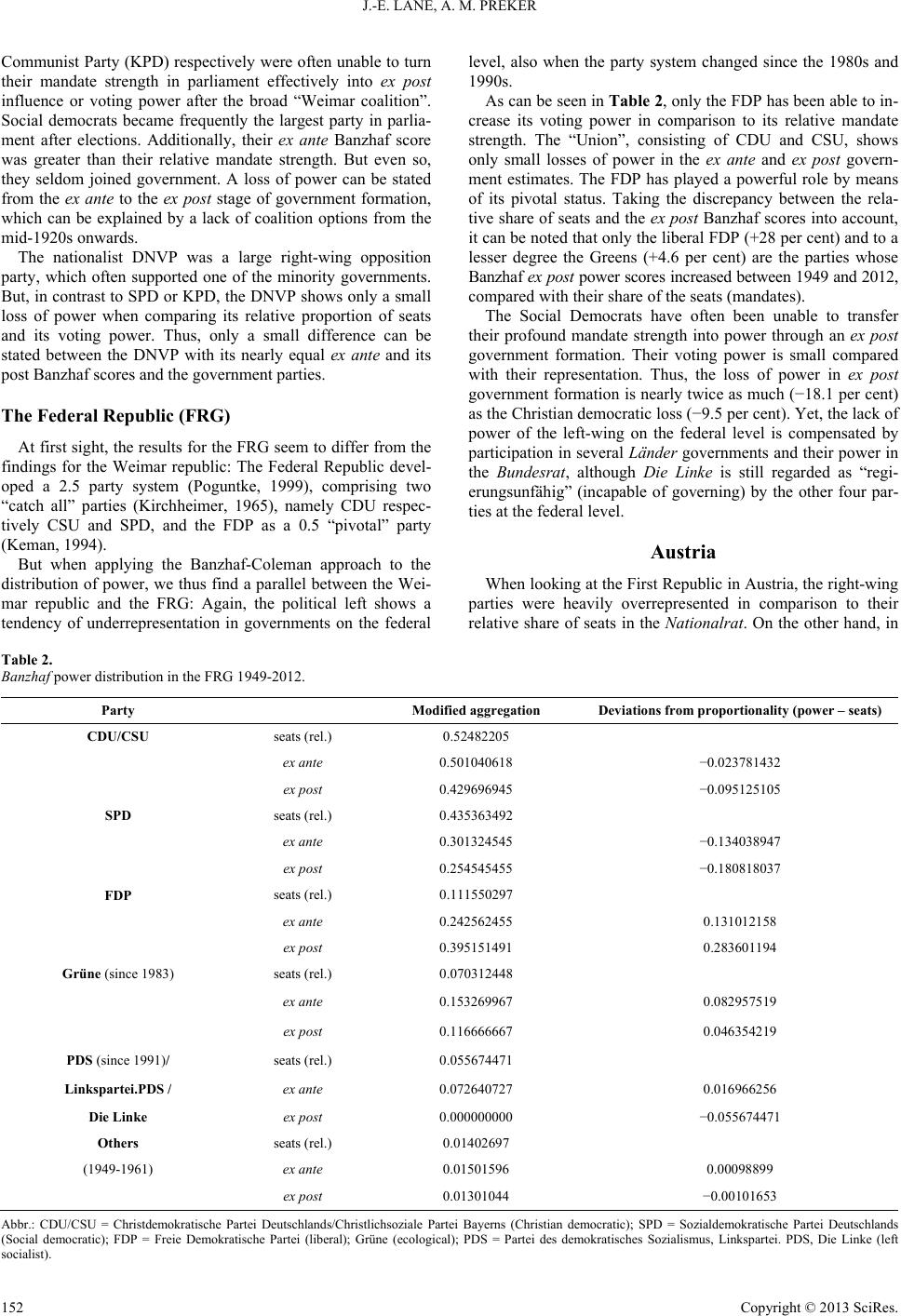 J.-E. LANE, A. M. PREKER Communist Party (KPD) respectively were often unable to turn their mandate strength in parliament effectively into ex post influence or voting power after the broad “Weimar coalition”. Social democrats became frequently the largest party in parlia- ment after elections. Additionally, their ex ante Banzhaf score was greater than their relative mandate strength. But even so, they seldom joined government. A loss of power can be stated from the ex ante to the ex post stage of government formation, which can be explained by a lack of coalition options from the mid-1920s onwards. The nationalist DNVP was a large right-wing opposition party, which often supported one of the minority governments. But, in contrast to SPD or KPD, the DNVP shows only a small loss of power when comparing its relative proportion of seats and its voting power. Thus, only a small difference can be stated between the DNVP with its nearly equal ex ante and its post Banzhaf scores and the government parties. The Federal Republic (FRG) At first sight, the results for the FRG seem to differ from the findings for the Weimar republic: The Federal Republic devel- oped a 2.5 party system (Poguntke, 1999), comprising two “catch all” parties (Kirchheimer, 1965), namely CDU respec- tively CSU and SPD, and the FDP as a 0.5 “pivotal” party (Keman, 1994). But when applying the Banzhaf-Coleman approach to the distribution of power, we thus find a parallel between the Wei- mar republic and the FRG: Again, the political left shows a tendency of underrepresentation in governments on the federal level, also when the party system changed since the 1980s and 1990s. As can be seen in Table 2, only the FDP has been able to in- crease its voting power in comparison to its relative mandate strength. The “Union”, consisting of CDU and CSU, shows only small losses of power in the ex ante and ex post govern- ment estimates. The FDP has played a powerful role by means of its pivotal status. Taking the discrepancy between the rela- tive share of seats and the ex post Banzhaf scores into account, it can be noted that only the liberal FDP (+28 per cent) and to a lesser degree the Greens (+4.6 per cent) are the parties whose Banzhaf ex post power scores increased between 1949 and 2012, compared with their share of the seats (mandates). The Social Democrats have often been unable to transfer their profound mandate strength into power through an ex post government formation. Their voting power is small compared with their representation. Thus, the loss of power in ex post government formation is nearly twice as much (−18.1 per cent) as the Christian democratic loss (−9.5 per cent). Yet, the lack of power of the left-wing on the federal level is compensated by participation in several Länder governments and their power in the Bundesrat, although Die Linke is still regarded as “regi- erungsunfähig” (incapable of governing) by the other four par- ties at the federal level. Austria When looking at the First Republic in Austria, the right-wing parties were heavily overrepresented in comparison to their relative share of seats in the Nationalrat. On the other hand, in Table 2. Banzhaf power distribution in the FRG 1949-2012. Party Modified aggregation Deviations from proportional ity (power – seats) CDU/CSU seats (rel.) 0.52482205 ex ante 0.501040618 −0.023781432 ex post 0.429696945 −0.095125105 SPD seats (rel.) 0.435363492 ex ante 0.301324545 −0.134038947 ex post 0.254545455 −0.180818037 FDP seats (rel.) 0.111550297 ex ante 0.242562455 0.131012158 ex post 0.395151491 0.283601194 Grüne (since 1983) seats (rel.) 0.070312448 ex ante 0.153269967 0.082957519 ex post 0.116666667 0.046354219 PDS (since 1991)/ seats (rel.) 0.055674471 Linkspartei.PDS / ex ante 0.072640727 0.016966256 Die Linke ex post 0.000000000 −0.055674471 Others seats (rel.) 0.01402697 (1949-1961) ex ante 0.01501596 0.00098899 ex post 0.01301044 −0.00101653 Abbr.: CDU/CSU = Christdemokratische Partei Deutschlands/Christlichsoziale Partei Bayerns (Christian democratic); SPD = Sozialdemokratische Partei Deutschlands (Social democratic); FDP = Freie Demokratische Partei (liberal); Grüne (ecological); PDS = Partei des demokratisches Sozialismus, Linkspartei. PDS, Die Linke (left socialist). Copyright © 2013 SciRes. 152 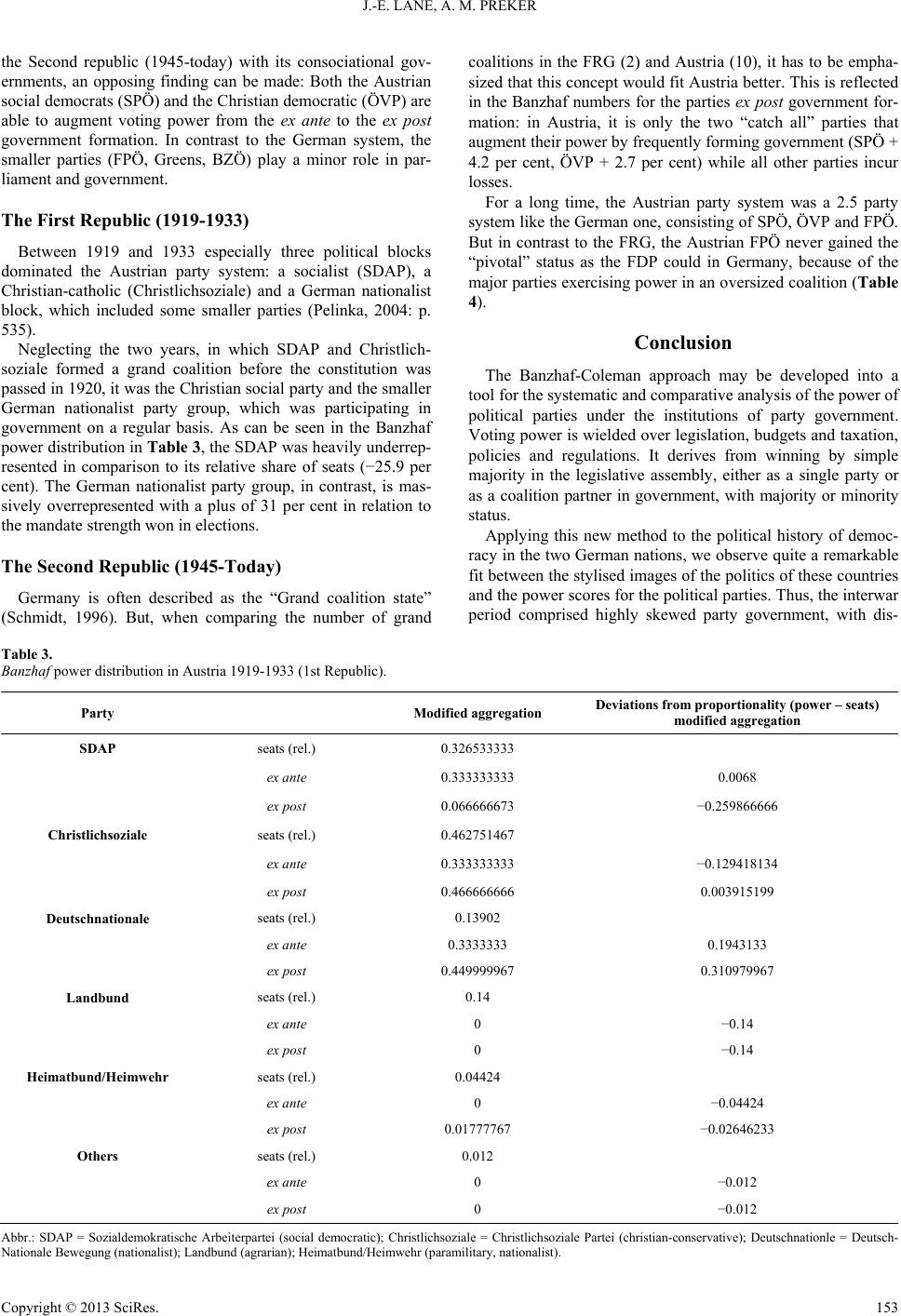 J.-E. LANE, A. M. PREKER the Second republic (1945-today) with its consociational gov- ernments, an opposing finding can be made: Both the Austrian social democrats (SPÖ) and the Christian democratic (ÖVP) are able to augment voting power from the ex ante to the ex post government formation. In contrast to the German system, the smaller parties (FPÖ, Greens, BZÖ) play a minor role in par- liament and government. The First Republic (1919-1933) Between 1919 and 1933 especially three political blocks dominated the Austrian party system: a socialist (SDAP), a Christian-catholic (Christlichsoziale) and a German nationalist block, which included some smaller parties (Pelinka, 2004: p. 535). Neglecting the two years, in which SDAP and Christlich- soziale formed a grand coalition before the constitution was passed in 1920, it was the Christian social party and the smaller German nationalist party group, which was participating in government on a regular basis. As can be seen in the Banzhaf power distribution in Table 3, the SDAP was heavily underrep- resented in comparison to its relative share of seats (−25.9 per cent). The German nationalist party group, in contrast, is mas- sively overrepresented with a plus of 31 per cent in relation to the mandate strength won in elections. The Second Republic (1945-Today) Germany is often described as the “Grand coalition state” (Schmidt, 1996). But, when comparing the number of grand coalitions in the FRG (2) and Austria (10), it has to be empha- sized that this concept would fit Austria better. This is reflected in the Banzhaf numbers for the parties ex post government for- mation: in Austria, it is only the two “catch all” parties that augment their power by frequently forming government (SPÖ + 4.2 per cent, ÖVP + 2.7 per cent) while all other parties incur losses. For a long time, the Austrian party system was a 2.5 party system like the German one, consisting of SPÖ, ÖVP and FPÖ. But in contrast to the FRG, the Austrian FPÖ never gained the “pivotal” status as the FDP could in Germany, because of the major parties exercising power in an oversized coalition (Table 4). Conclusion The Banzhaf-Coleman approach may be developed into a tool for the systematic and comparative analysis of the power of political parties under the institutions of party government. Voting power is wielded over legislation, budgets and taxation, policies and regulations. It derives from winning by simple majority in the legislative assembly, either as a single party or as a coalition partner in government, with majority or minority status. Applying this new method to the political history of democ- racy in the two German nations, we observe quite a remarkable fit between the stylised images of the politics of these countries and the power scores for the political parties. Thus, the interwar period comprised highly skewed party government, with dis- Table 3. Banzhaf power distribution in Austria 1919-1933 (1st Republic). Party Modified aggregation Deviations from proportionali ty (power – seats) modified a ggregati o n SDAP seats (rel.) 0.326533333 ex ante 0.333333333 0.0068 ex post 0.066666673 −0.259866666 Christlichsoziale seats (rel.) 0.462751467 ex ante 0.333333333 −0.129418134 ex post 0.466666666 0.003915199 Deutschnationale seats (rel.) 0.13902 ex ante 0.3333333 0.1943133 ex post 0.449999967 0.310979967 Landbund seats (rel.) 0.14 ex ante 0 −0.14 ex post 0 −0.14 Heimatbund/Heimwehr seats (rel.) 0.04424 ex ante 0 −0.04424 ex post 0.01777767 −0.02646233 Others seats (rel.) 0.012 ex ante 0 −0.012 ex post 0 −0.012 Abbr.: SDAP = Sozialdemokratische Arbeiterpartei (social democratic); Christlichsoziale = Christlichsoziale Partei (christian-conservative); Deutschnationle = Deutsch- Nationale Bewegung (nationalist); Landbund (agrarian); Heimatbund/Heimwehr (paramilitary, nationalist). Copyright © 2013 SciRes. 153 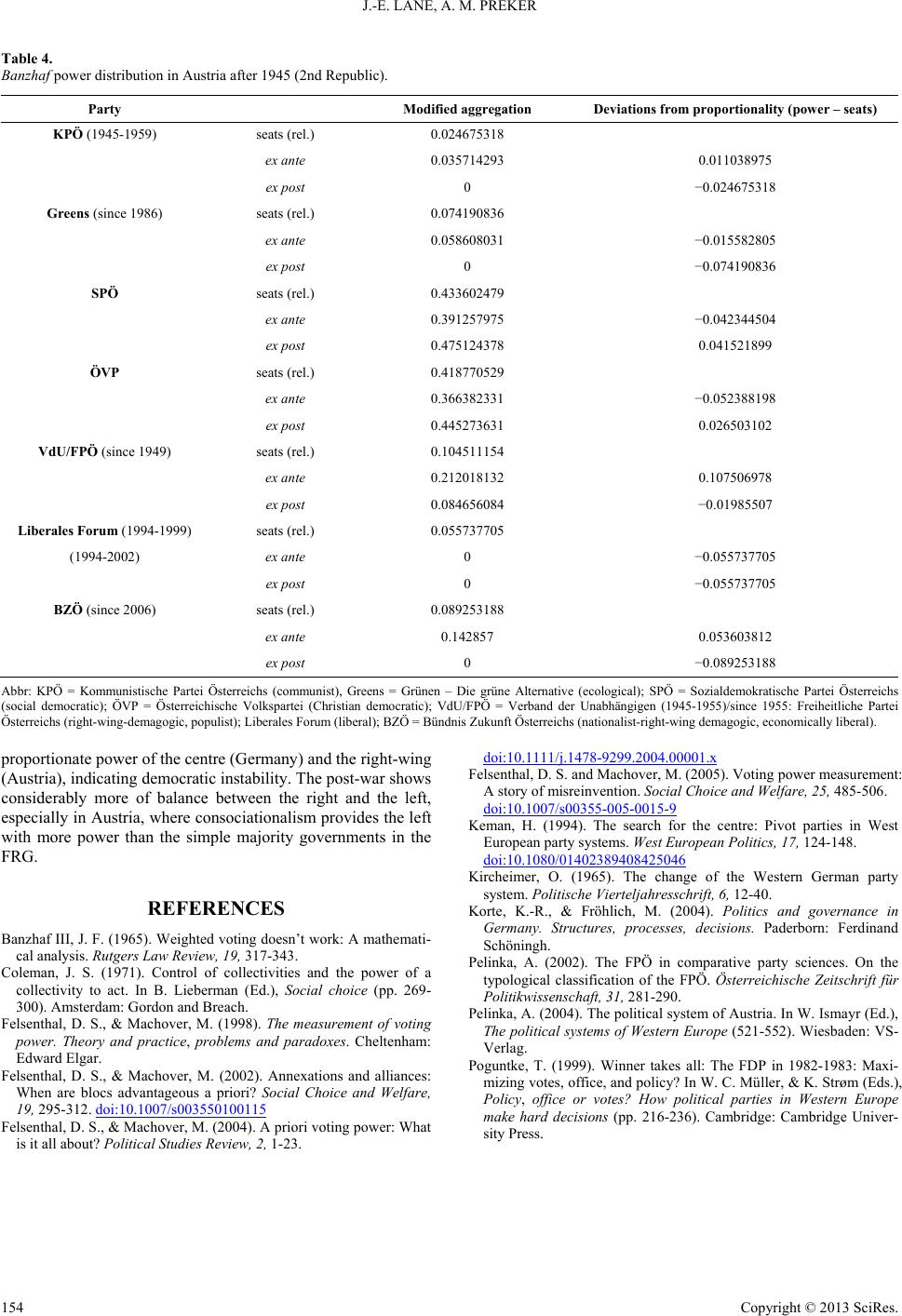 J.-E. LANE, A. M. PREKER Table 4. Banzhaf power distribution in Austria after 1945 (2nd Republic). Party Modified a g gregation De v ia tions from proportionality (p ower – seats) KPÖ (1945-1959) seats (rel.) 0.024675318 ex ante 0.035714293 0.011038975 ex post 0 −0.024675318 Greens (since 1986) seats (rel.) 0.074190836 ex ante 0.058608031 −0.015582805 ex post 0 −0.074190836 SPÖ seats (rel.) 0.433602479 ex ante 0.391257975 −0.042344504 ex post 0.475124378 0.041521899 ÖVP seats (rel.) 0.418770529 ex ante 0.366382331 −0.052388198 ex post 0.445273631 0.026503102 VdU/FPÖ (since 1949) seats (rel.) 0.104511154 ex ante 0.212018132 0.107506978 ex post 0.084656084 −0.01985507 Liberales Forum (1994-1999) seats (rel.) 0.055737705 (1994-2002) ex ante 0 −0.055737705 ex post 0 −0.055737705 BZÖ (since 2006) seats (rel.) 0.089253188 ex ante 0.142857 0.053603812 ex post 0 −0.089253188 Abbr: KPÖ = Kommunistische Partei Österreichs (communist), Greens = Grünen – Die grüne Alternative (ecological); SPÖ = Sozialdemokratische Partei Österreichs (social democratic); ÖVP = Österreichische Volkspartei (Christian democratic); VdU/FPÖ = Verband der Unabhängigen (1945-1955)/since 1955: Freiheitliche Partei Österreichs (right-wing-demagogic, populist); Liberales Forum (liberal); BZÖ = Bündnis Zukunft Österreichs (nationalist-right-wing demagogic, economically liberal). proportionate power of the centre (Germany) and the right-wing (Austria), indicating democratic instability. The post-war shows considerably more of balance between the right and the left, especially in Austria, where consociationalism provides the left with more power than the simple majority governments in the FRG. REFERENCES Banzhaf III, J. F. (1965). Weighted voting doesn’t work: A mathemati- cal analysis. Rutgers Law Review, 19, 317-343. Coleman, J. S. (1971). Control of collectivities and the power of a collectivity to act. In B. Lieberman (Ed.), Social choice (pp. 269- 300). Amsterdam: Gordon and Breach. Felsenthal, D. S., & Machover, M. (1998). The measurement of voting power. Theory and practice, problems and paradoxes. Cheltenham: Edward Elgar. Felsenthal, D. S., & Machover, M. (2002). Annexations and alliances: When are blocs advantageous a priori? Social Choice and Welfare, 19, 295-312. doi:10.1007/s003550100115 Felsenthal, D. S., & Machover, M. (2004). A priori voting power: What is it all about? Political Studies Review, 2, 1-23. doi:10.1111/j.1478-9299.2004.00001.x Felsenthal, D. S. and Machover, M. (2005). Voting power measurement: A story of misreinvention. Social Choice and Welfare, 25, 485-506. doi:10.1007/s00355-005-0015-9 Keman, H. (1994). The search for the centre: Pivot parties in West European party systems. West European Politics, 17, 124-148. doi:10.1080/01402389408425046 Kircheimer, O. (1965). The change of the Western German party system. Politische Vierteljahresschrift, 6, 12-40. Korte, K.-R., & Fröhlich, M. (2004). Politics and governance in Germany. Structures, processes, decisions. Paderborn: Ferdinand Schöningh. Pelinka, A. (2002). The FPÖ in comparative party sciences. On the typological classification of the FPÖ. Österreichische Zeitschrift für Politikwissenschaft, 31, 281-290. Pelinka, A. (2004). The political system of Austria. In W. Ismayr (Ed.), The political systems of Western Europe (521-552). Wiesbaden: VS- Verlag. Poguntke, T. (1999). Winner takes all: The FDP in 1982-1983: Maxi- mizing votes, office, and policy? In W. C. Müller, & K. Strøm (Eds.), Policy, office or votes? How political parties in Western Europe make hard decisions (pp. 216-236). Cambridge: Cambridge Univer- sity Press. Copyright © 2013 SciRes. 154 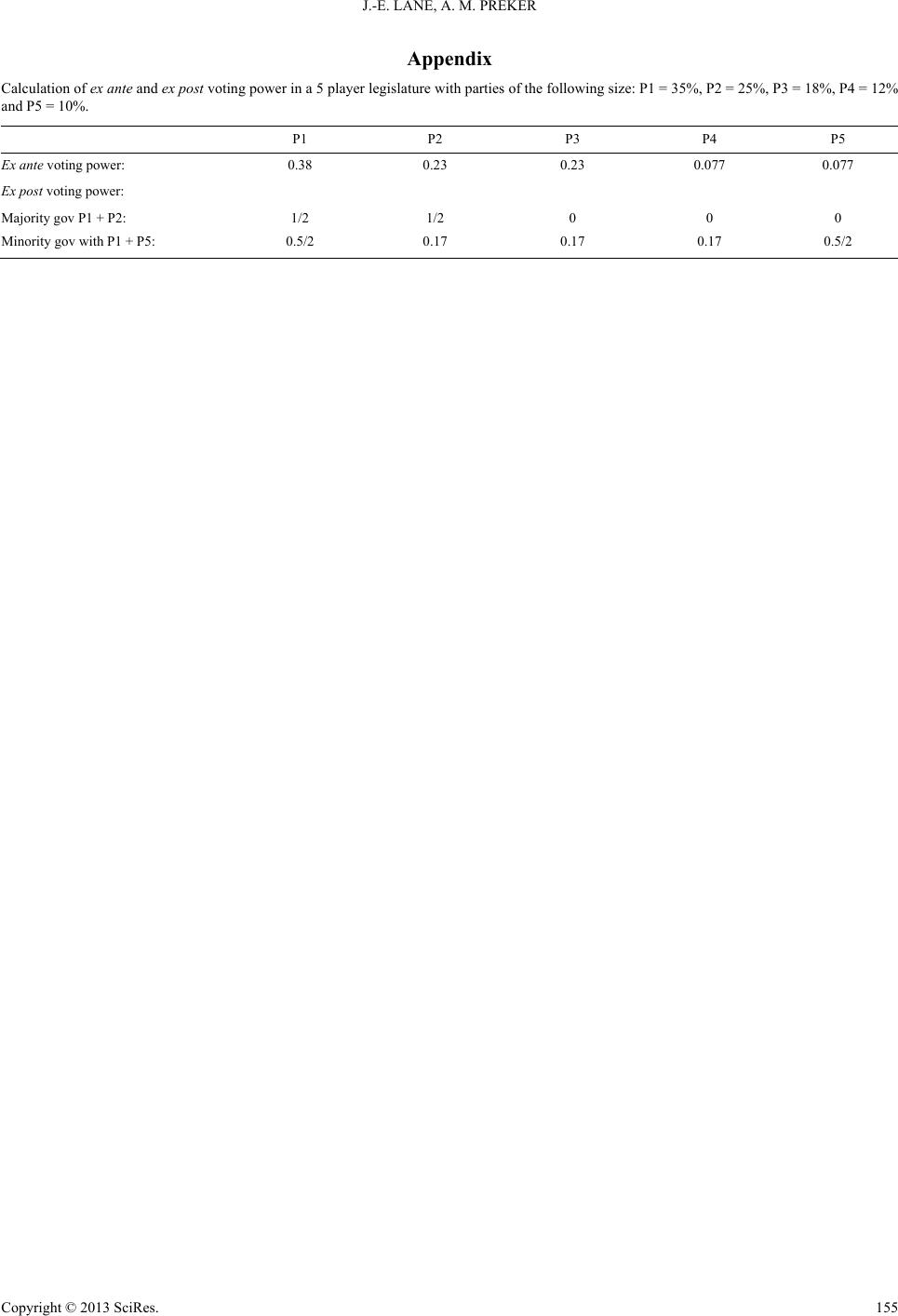 J.-E. LANE, A. M. PREKER Appendix Calculation of ex ante and ex post voting power in a 5 player legislature with parties of the following size: P1 = 35%, P2 = 25%, P3 = 18%, P4 = 12% and P5 = 10%. P1 P2 P3 P4 P5 Ex ante voting power: 0.38 0.23 0.23 0.077 0.077 Ex post voting power: Majority gov P1 + P2: 1/2 1/2 0 0 0 Minority gov with P1 + P5: 0.5/2 0.17 0.17 0.17 0.5/2 Copyright © 2013 SciRes. 155 |