

Paper Menu >>
Journal Menu >>
 Sociology Mind 2013. Vol.3, No.2, 131-136 Published Online April 2013 in SciRes (http://www.scirp.org/journal/sm) http://dx.doi.org/10.4236/sm.2013.32020 Copyright © 2013 SciRes. 131 Role of Religious Orientation in Predicting Marital Adjustment and Psychological Well-Being Taiebeh Yeganeh1*, Hassan Shaikhmahmoodi2 1Young Researchers Club, Tonekabon Branch, Islamic Azad University, Tonekabon, Iran 2Islamic Azad University, Tonekabon, Iran Email: *[email protected] Received October 25th, 2012; revised December 27th, 2012; accepted January 18th, 2013 Copyright © 2013 Taiebeh Yeganeh, Hassan Shaikhmahmoodi. This is an open access article distributed under the Creative Commons Attribution License, which permits unrestricted use, distribution, and reproduction in any medium, provided the original work is properly cited. Considering indices such as dynamism and complexity of modern societies, advances in psychology sci- ence, and increasing growth of spiritual needs of human against physical ones, also with respect to in- creasing rate of divorce in Iran, current research was done in order to study the relationship between Reli- gious Orientation and Marital Adjustment and Psychological Well-Being. The method of current research is descriptive-correlation. Statistic population includes all married teachers of Langroud city in 2012, which 150 individuals were selected as sample via multi level cluster sampling. Alport Religious Orienta- tion Scale (1950), Spanir Marital Adjustment Scale (1976) and Ryff Psychological Well-Being question- naire (1998) was used. Data analysis shows that there is meaningful relation between internal religious orientation and marital adjustment (p = .000, r = .436) and also between internal religious orientation and psychological well-being (p = .000, r = .506). In addition, results showed that internal religious orienta- tion is able to meaningful predictions of Marital Adjustment and Psychological Well-Being. These find- ings show that internal religious orientation can predict the psychological well-being and marital adjust- ment meaningfully. So from scientific dimension, application of religion with the meaning of inner faith is suggested in prevention and medical interferences in this area. Keywords: Psychological Well-Being; Marital Adjustment; Religious Orientation Introduction According to comprehensive role of religious in improving mental health and level of psychological well-being, impor- tance of spirituality and its growth in human being in recent decades has attracted attention of psychologists and psychia- trists (Kezdy et al., 2010; Aten & Worthington, 2009; Aten & Schenck, 2007). Many researches show that religious experi- ences have a great effect on Psychotherapy. At the same time, therapist schedule for making fundamental changes in charac- teristic structure of patients is related directly to these religious moods. In fact, religion as a mediator can effect on mental pro- cedures and evaluation of daily events. Thus some researchers believe that confronting stresses and social situations are facili- tated via religious believes. Furthermore, notice that attitudes of family members about religious will continuo and transfer reli- gious values and behaviors to other generations, thus relation between religious and family is considered an interactive one (Mehoney et al., 2001). Marital adjustment is harmony and sympathy between hus- band and wife in achieving common goals in life which lead to satisfaction from marriage. Marital adjustment let both sides ignore conflicts and solve them with a suitable method and achieve a positive feeling (Chen et al., 2007). Simply, marital adjustment is a method which two married person are adjusted with each other to keep their marriage (Bar-On & Parker, 2006). Importance of adjusted marital relationships is due to its role as one of the main factors in stability and strength of this rela- tionship (Gaal, 2005). Unclear and ambiguous condition of couples (Alois & Bruno, 2009), problems in social relationships, tendency toward social and moral delinquency and falling of cultural values between couples are some results of marital unadjustment. Spanier (1976) define it as procedure that its results are become clear via degreasing serious problems be- tween couples, interpersonal stresses, personal anxiety and increasing couples satisfaction from each other, stability and consultation about important marital problems (Gong, 2000). Halford et al. (2007) notice that effective factors on marital adjustment include: personal characteristics, situational factors and life events. Mutual love, take care each other, accept and understand each other and satisfying needs. Among these, reli- gious commitment as one of the basics of happy life is effective on marital adjustment. Many researches show these findings, as in Demaris et al. (2010) religiosity is reported to be the most important factor in marital adjustment and here results show that positive effect of religious in couples’ relationship is unde- niable. So undeniable role of religious commitment in achieving marital adjustment and goal in life, having positive relation with each other and totally, psychological well-being is clear. According to Ryff and Keyes’ pattern of psychological well- being (1995), there are 6 main basic factors as follows: purpose in life, positive relationship with others, personal growth, self *Corresponding author.  T. YEGANEH, H. SHAIKHMAHMOODI acceptance, autonomy, domination on environment. In this point of view, health is not the same as having no disease, in other word the emphasis is on “being well” instead of “being bad or ill” (Ryff et al., 2004). Characteristics such as adjust- ment, happiness, self confidence and other positive ones show healthy and psychological well-being. In this situation religious can be mentioned as a useful unifying principle and a big sup- port for mental health. World Health Organization (WHO) uses physical, mental social and spiritual aspects in his definition for human and the latest, spiritual, is said to be effective in growth and promotion of the man (American Psychiatric Association, 2000). Thus, spirituality is an important part of peoples’ life and has important effect on health and well-being. Previous researches in this filed show a stable relation between religious and psychological well-being. Result of the same researches such as Kezdi et al. (2010) reports that religious training in childhood will lead to tendency toward religion in teenagers and youths and has positive effects on their mental health. Findings of Williams (2010) express a strong relation between doing religious behavior and psychological well-being. Also, Koeing (2007) believes that mental and physical health of hu- man has positive relation with his spiritual life and those with higher religious commitment have higher adjustment in differ- ent conditions. Hills & Francis (2004) and Hackney & Sanders (2003) show that those who have stronger religious/ spiritual believes, achieve higher points in mental and physical tests. Faith, doing religious customs and attending related ceremonies prevent mental problems and with its therapeutic role, improve health level and psychological well-being. Considering indices such as dynamicity and complexity of modern societies, advances of psychology science, increasing growth of spiritual needs of human vs material one, also num- ber of divorces in Iran as a symbol of marital disorder (Halford et al., 2007). Iran is placed in 4th placed after US, Denmark and Egypt for the large number of divorces (Gholami & Beshlideh, 2012). Current research aims to study the relation between reli- gious orientation and marital adjustment and psychological well-being in order to determine the role of religious commit- ment and use it as a complement beside other psychological theories. Method The Sample and Sampling The method of current research is descriptive correlation. Statistical population includes all married teachers of Langrud City in 2012 year, which 150 of them selected as sample. First of all, the population was divided in to 5 geographical regions: North, South, Center, East and West via multi level cluster sampling (1 × 5 = 5). Then from each region, 3 schools were selected randomly (1 × 5 × 3 = 15). And finally, all teachers were gathered (1 × 5 × 3 × 10 = 150). Research Tools Allport Religious Orientation Scale: Allport and Ross in 1950 introduced this scale for evaluation of religious inward and outward orientation. Based on Allport theory, an inward- oriented religious is a comprehensive one with a organized principles, in other word it is a motivated comprehensive com- mitment which is a goal not a mean for that. On the other hand, outward-oriented religious is something for satisfying person needs such as position and security. This test with 21 question measures the inward- and outward-religious orientation. Pri- mary researches by Allport and Ross show that the Correlation between inward- and outward-orientation is .21. In Iran, Inter- nal Consistency for the test is reported as .71 by Jan Bozorgi (1999) and retest reliability as .74. Spanier Marital Adjustment Scale (D.A.S): Marital ad- justment was measured by Spanier Scale which consist of 23 multi choice questions (always agree, almost always agree, sometimes disagree, often disagree, almost always disagree, always disagree). Spanier calculated the reliability of the ques- tionnaire by Cronbach’s Alpha about .96 and the validity tested by Locke-Wallace Marital Adjustment Scale. The correlation coefficient of these two scales for married and divorced couples were .86 and .88, respectively. In other research by Spanier & Tampson, Cronbach’s Alpha was reported as .91. In Iran, Cronbach’s Alpha is .92 and Validity is .94 (Quoted by Yar- Mohammadyan, 2011). Carol Ryff Psychological Well-Being Questionnaire: It concludes 82 questions and measures 6 separate aspects of psychological well-being. Each question has 6 choices and reported Cronbach’s Alpha is .83 up to .92. Ryff (1989) study the reliability of the test by calculation of correlation coefficient of positive psychological performance (convergence validity) and negative psychological performance (divergence validity). Results show that there is positive mean- ingful correlation between 6 factors of this questionnaire and those who study the positive psychological performance (p < .001) and correlation domain is .25 up to .73 which con- firmed the validity. At the same time, there is negative mean- ingful correlation between 6 factors of this questionnaire and those who study the negative psychological performance with the range of −.03 to −.060. He also prove that these 6 factors are independent but with internal correlation (p < .001) and range of .32 up to .76 and measure the psychological well- being (Quoted by Maddahi, 2011). Result Analysis The data obtained in the research were analyzed by using appropriate statistical techniques, then explained and inter- preted by forming charts. Frequency calculations were made, “Pearson r Coefficient” and stepwise Multiple Regression was calculated. When the statistical data of the study were evaluated, the significance coefficient was taken as p < .01. Results Data analyze was done by Frequency, Mean, Standard devia- tion, Pierson Correlation Coefficient and Stepwise Multiple Regression. There were 150 participants and the age average and Std was (40.32 ± 7.28), respectively. Descriptive indexes of research variables are shown in Table 1. According to Table 1, there is a meaningful relation between inward religious orientation and marital adjustment (r = .436, p = .000) and inward religious orientation and psychological well-being (r = .506, p = .000) but there wasn’t any meaningful relation between outward religious orientation and any of vari- ables. Stepwise Multiple Regressions was used for determining the role of “inward religious orientation” in predicting “marital Copyright © 2013 SciRes. 132 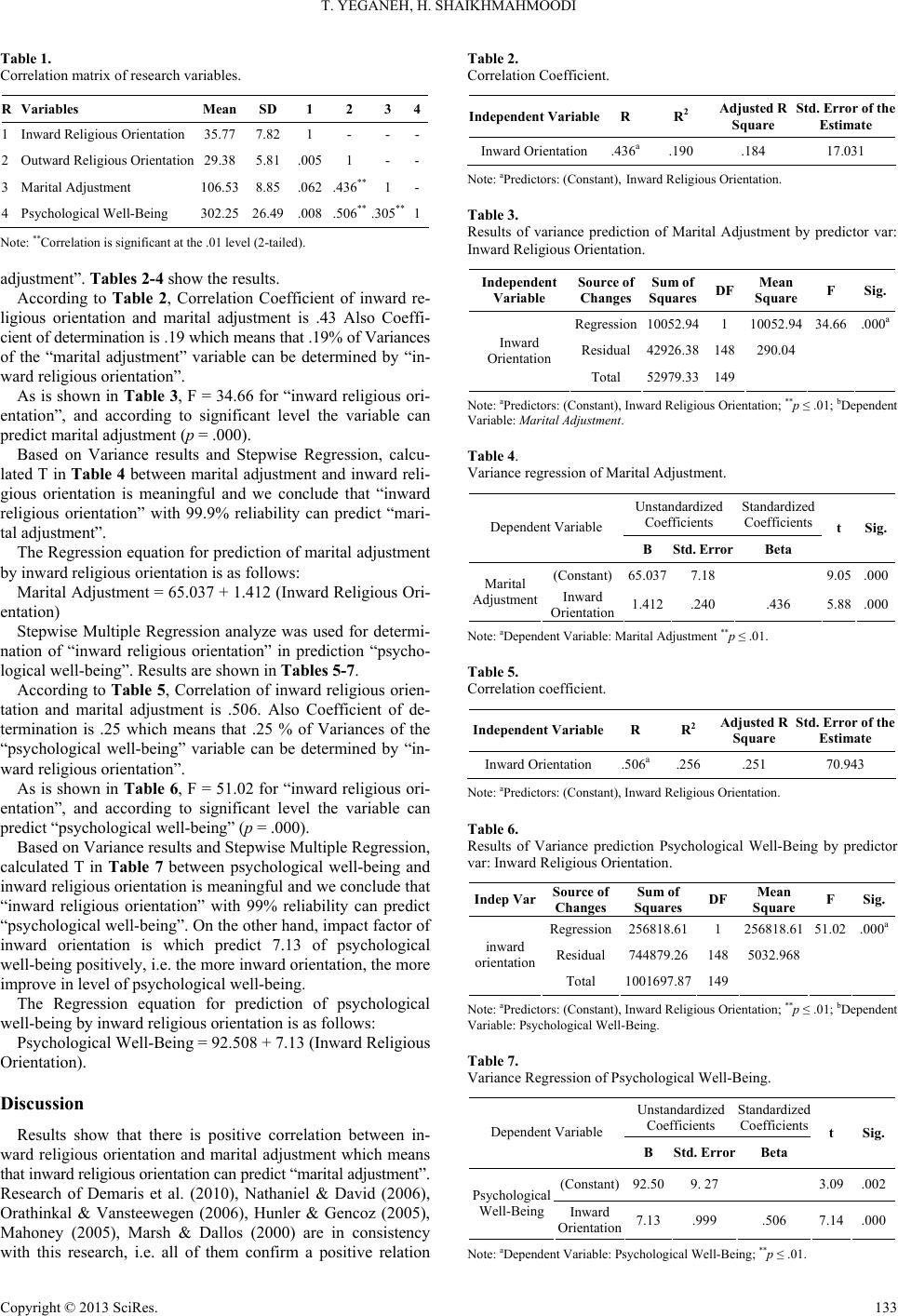 T. YEGANEH, H. SHAIKHMAHMOODI Table 1. Correlation matrix of research variables. R Variables MeanSD 1 2 3 4 1 Inward Religious Orientation 35.777.82 1 - - - 2 Outward Religious Orientation 29.385.81 .005 1 - - 3 Marital Adjustment 106.53 8.85 .062 .436** 1 - 4 Psychological Well-Being 302.25 26.49 .008 .506**.305** 1 Note: **Correlation is significant at the .01 level (2-tailed). adjustment”. Tables 2-4 show the results. According to Table 2, Correlation Coefficient of inward re- ligious orientation and marital adjustment is .43 Also Coeffi- cient of determination is .19 which means that .19% of Variances of the “marital adjustment” variable can be determined by “in- ward religious orientation”. As is shown in Table 3, F = 34.66 for “inward religious ori- entation”, and according to significant level the variable can predict marital adjustment (p = .000). Based on Variance results and Stepwise Regression, calcu- lated T in Table 4 between marital adjustment and inward reli- gious orientation is meaningful and we conclude that “inward religious orientation” with 99.9% reliability can predict “mari- tal adjustment”. The Regression equation for prediction of marital adjustment by inward religious orientation is as follows: Marital Adjustment = 65.037 + 1.412 (Inward Religious Ori- entation) Stepwise Multiple Regression analyze was used for determi- nation of “inward religious orientation” in prediction “psycho- logical well-being”. Results are shown in Tables 5-7. According to Table 5, Correlation of inward religious orien- tation and marital adjustment is .506. Also Coefficient of de- termination is .25 which means that .25 % of Variances of the “psychological well-being” variable can be determined by “in- ward religious orientation”. As is shown in Table 6, F = 51.02 for “inward religious ori- entation”, and according to significant level the variable can predict “psychological well-being” (p = .000). Based on Variance results and Stepwise Multiple Regression, calculated T in Table 7 between psychological well-being and inward religious orientation is meaningful and we conclude that “inward religious orientation” with 99% reliability can predict “psychological well-being”. On the other hand, impact factor of inward orientation is which predict 7.13 of psychological well-being positively, i.e. the more inward orientation, the more improve in level of psychological well-being. The Regression equation for prediction of psychological well-being by inward religious orientation is as follows: Psychological Well-Being = 92.508 + 7.13 (Inward Religious Orientation). Discussion Results show that there is positive correlation between in- ward religious orientation and marital adjustment which means that inward religious orientation can predict “marital adjustment”. Research of Demaris et al. (2010), Nathaniel & David (2006), Orathinkal & Vansteewegen (2006), Hunler & Gencoz (2005), Mahoney (2005), Marsh & Dallos (2000) are in consistency with this research, i.e. all of them confirm a positive relation Table 2. Correlation Coefficient. Independent VariableR R2 Adjusted R Square Std. Error of the Estimate Inward Orientation.436a.190 .184 17.031 Note: aPredictors: (Constant), Inward Religious Orientation. Table 3. Results of variance prediction of Marital Adjustment by predictor var: Inward Religious Orientation. Independent Variable Source of Changes Sum of Squares DF Mean Square F Sig. Regression10052.94 1 10052.94 34.66.000a Residual42926.38 148 290.04 Inward Orientation Total 52979.33 149 Note: aPredictors: (Constant), Inward Religious Orientation; **p ≤ .01; bDependent Variable: Marital Adjustment. Table 4. Variance regression of Marital Adjustment. Unstandardized Coefficients Standardized Coeffici ents Dependent Variable B Std. Error Beta t Sig. (Constant)65.0377.18 9.05.000 Marital Adjustment Inward Orientation 1.412.240 .436 5.88.000 Note: aDependent Variable: Marital Adjustment **p ≤ .01. Table 5. Correlation coefficient. R2 Independent VariableR Adjusted R Square Std. Error of the Estimate Inward Orientation .506a .256 .251 70.943 Note: aPredictors: (Constant), Inward Religious Orientation. Table 6. Results of Variance prediction Psychological Well-Being by predictor var: Inward Religious Orientation. Indep VarSource of Changes Sum of Squares DF Mean Square F Sig. Regression 256818.61 1 256818.61 51.02.000a Residual 744879.26 148 5032.968 inward orientation Total 1001697.87 149 Note: aPredictors: (Constant), Inward Religious Orientation; **p ≤ .01; bDependent Vriable: Psychological Well-Being. a Table 7. Variance Regression of Psychological Well-Being. Unstandardized Coefficients Standardized Coefficients Dependent Variable B Std. Error Beta t Sig. (Constant)92.509. 27 3.09.002 Psychological Well-BeingInward Orientation7.13.999 .506 7.14.000 Note: aDependent Variable: Psychological Well-Being; **p ≤ .01. Copyright © 2013 SciRes. 133  T. YEGANEH, H. SHAIKHMAHMOODI between religious commitment and marital adjustment. Allport & Ross (1967) believes that inward religious orienta- tion is comprehensive with organized principles. People with inward religious orientation believe their religious training honestly and their behaviour comes from their thought and esoteric science. On the reverse, outward religious orientation is a tool for satisfying needs such as position and security. In other word in outward religious orientation, religious is in con- cern about unhealthy needs and aspect of human so the more outward religious orientation increase, the more marital ad- justment growth. As religious give directions for life and be- lieves, can effect on marital life positively (Hunler & Gencoz, 2005). In marital life these directions include principles about sexual relationships, sex roles, self-sacrifice and solving con- flicts (Mahoney et al., 2003). Another aspect is effectiveness of religious on couple think- ing, i.e. people with higher religious commitment, probably may- be have more spiritual life (Mahoony, 2005). While a conflict appears, religious can appear in form of common values and concepts and solve the couples’ problems (Mahoney et al., 1999). From inter-personal point of view, religious customs enable person to control his anger physiologically and emotionally, also help him accept his responsibility while conflict appears. Religious provide situations that the person pay more attention to God and act as a support for both couples to avoid conflicts. Thus relationship with God is somehow an interactive role in marital adjustment. Another finding of current research is the positive meaning- ful correlation between inward religious orientation and psy- chological well-being which means that inward religious orien- tation can predict “psychological well-being”. Research of Newton & Mcintosh (2010), Williams (2010), Kezdy et al. (2010), Rodriguez & Henderson (2010), McCullough & Wil- loughby (2009), MacGregor (2008), Sorajjakol et al. (2008), Marks (2008) are in consistency with this research, i.e. all of them confirm a positive relation between religious commitment and psychological well-being. Allport believes that it is just inward religious orientation that improves mental health. Religious provide a suitable con- dition for answering basic questions of human such as identity and choosing life style in order to get perfection so contribute to adjustment and psychological well-being. In inward religious orientation person gain the pleasure of connecting to the source of perfection and promotion and motivated for promotion. This motivation encourages them for living better (Allport, 1950, 1963). Religious effect on improving level of psychological well- being can be expressed as providing a supportive space and “social unity source”. In fact religious increases level of self confidence, adjustment and self-esteem, which are basic factors of mental health and psychological well-being, via providing social support and understanding. Adler believes that comparison of human with the source of perfection and promotion is an important factor in psychologi- cal well-being, also accept the effect of religious in social en- vironment and express that it is more advanced than sciences as he thinks that religious motivated people more actively. Ac- cording to his point of view, religious and knowledge are the same for peoples only when knowledge can create the same enthusiasm as religious and provide the well-being of whole components of the society (Nelson & Jones, 1957; Nelson, 1990; Nielsen, 2001). Frankel define religious as a “search for final meaning” and believes that human nature consist of three components: spiri- tuality, freedom and responsibility and achieving to perfection is possible only through spirituality. He thinks that main role in promotion of person and society belongs to coordination be- tween physical, mental and religious aspect (Frankel, 1975). Religious behaviors and beliefs with positive effect make the life meaningful. Internal relaxation mechanism via religious happens through actions such as trust in God and worship which create hope and motivate person for positive attitude. Religious functions in facing with complex situations of life will be effective through feeling of belonging to an unlimited source of power, hope to God help, benefit from social support and having goal in live (Yang & Mao, 2007). Thus religious with important functions in peoples’ life such as relaxation, giving hope, create happiness, giving meaning to life and satis- faction is useful for improving psychological well-being. Another finding of current research is the positive meaning- ful correlation between marital adjustment and psychological well-being which is in consistency with researches of Vander- bleek et al. (2011), Yalcin BM, Karahan (2007), Stutzer et al. (2006), Wilson & Oswald (2005), DePaulo & Bella (2004), Diener et al. (2002). Vanderbleek et al. (2011) show that those couples which spent more times with each other and have common entertain- ment will have more verbal and emotional communication, therefore it affects their physical and psychological health. Yalcin & Karahan (2007) believe that training components of psychological well-being such as sympathy, responsibility and self-analysis increases marital adjustment. Adjustment between husband and wife let them avoid con- flicts and solve them in a proper way with common positive feelings and improve their level of psychological well-being (Chen et al., 2007). Emotional and psychological needs of per- son such as biological ones are created in family and satisfied or suppressed by family members’ reactions. In an adjusted marital relationship, satisfying mental and sexual needs is a basic factor in providing the most suitable condition for promo- tion and perfection of peoples’ well-being. According to the results of this research, commitment to reli- gious can create and promote level of marital adjustment and psychological well-being. Thus besides other common methods of prevention and treatment of psychological problems, impor- tant role of spirituality in marital adjustment and psychological well-being is become highlighted. As religious and spiritual treatment methods have not gained their proper scientific position, and then such researches are necessary. It is suggested that in future researches, level of re- ligiosity and other related factors to be evaluated in both wife and husband, also relation between religious orientation and marital adjustment and psychological well-being in other reli- gious and various faith to be studied. Acknowledgements We appreciate all who helped us in this research. REFERENCES Allport, G. W. (1950). The individual and his religion: A psychological interpretation. New York: Macmillan. Copyright © 2013 SciRes. 134  T. YEGANEH, H. SHAIKHMAHMOODI Allport, G. W. (1963). Behavioral science, religion, and mental health, Journal of Religion and Health, 2, 187-197. doi:10.1007/BF01533333 Allport, G. W., & Ross, J. M. (1967). Personal religious orientation and prejudice. Journal of Personality and So c ial Psychology, 5, 432-443. doi:10.1037/h0021212 Alois, S., & Bruno, S. F. (2009). Does marriage make people happy, or do happy people get married? The Journal of Socio-Economic, 35, 326-367. American Psychiatric Association (2000). Diagnostic and statistical manual of mental disorders (4th ed.). Washington DC: Heffner Me- dia Group, Inc.. Aten, D. J., & Worthington, E. L. (2009). Next steps for clinicians in religious and spiritual therapy: An endpiece. Journal of Clinical Psy- chology, 65, 224-229. doi:10.1002/jclp.20562 Aten, J. D., & Schenck, J. E. (2007). Reflections on religion and health research: An interview with Dr. Harold G. Koenig. Journal of Relig- ion and Health, 46, 183-190. doi:10.1007/s10943-006-9076-z Bar-On, R., & Parker, J. D. A. (2006). Handbook of emotional intelli- gence. San Francisco: Jossey-Boss. Chen, Z., Tanaka, N., Uji, M., Hiramura, H., & Shikai, N. (2007). The role of personalities in marital adjustment of Japanese couples. Journal of Social Behavioral and personality, 35, 561-572. doi:10.2224/sbp.2007.35.4.561 Demaris, A., Mahoney A., & Pargament K. I. (2010). Sanctification of marriage and general religiousness as buffers of the effects of marital inequity. Journal of Family Issues, 31, 1255-1278. DePaulo, B. M. (2004). The scientific study of people who are single: An annotated bibliography. Glendale, CA: Academic Advisory Board of Spectrum Institute, Research and Policy Division of the American Association for Single People (AASP). URL (last checked 1 May 2007). http://www.unmarriedamerica.org/Spectrum/Bibliography/contentsp age.htm Diener, E., Gohm, C. L., Suh, M., & Oishi, S. (2002). Similarity of the relation between marital status and subjective well being across cul- tures. Journal of Cross-Cultur al Psychology, 31, 419-436. doi:10.1177/0022022100031004001 Frankel, V. E. (1975). Man’s search for meaning. Boston: Beacon Press. Gaal, F. (2005). The role of differentiation of self and anxiety in pre- dicting marital adjustment following the death of an adult, married- child biological parent. Unpublished Doctoral Dissertation, Los An- gels, CA: Seton Hall University. Gholami, A., & Beshlideh. K. (2012). The effect of spiritual therapy on mental health of divorced women. Journal of Family Counseling & Psychotherapy, 1, 331-348. Gong, M. (2000). Does status inconsistency matter for marital quality? Journal of Family, 28, 152-161. Hackney, C. H., & Sanders, G. S. (2003). Religiosity and mental health: A meta-analysis of recent studies. Journal for the Scientific Study of Religion, 42, 43-55. doi:10.1111/1468-5906.t01-1-00160 Halford, W. K., Lizzio, A., Wilson, K. L., & Occhipinti, S. (2007). Does working at your marriage help? Couple relationship, self- regulation and satisfaction in the first 4 years of marriage. Journal of Family Psychology, 21, 185-194. doi:10.1037/0893-3200.21.2.185 Hills, P., & Francis, L. J. (2004). Primary Personality trait correlates religious practice and orientation. Personality and Individual Differ- ences, 36, 61-73. doi:10.1016/S0191-8869(03)00051-5 Hunler, O. S., & Gencoz, T. I. (2005). The effect of religiousness on marital satisfaction: Testing the mediator role of marital problem solving between religiousness and marital satisfaction. Contempo- rary Family Therapy, 27, 123-136. doi:10.1007/s10591-004-1974-1 Janbozorgi, M. (1999). Effectiveness of psychological therapy with and without the Islamic religious orientation on anxious and stress in students. Journal of Psychology, 2, 343-368. Kezdy, A., Martos, T., Boland, V., & Horváth, K. (2010). Religious doubts and mental health in adolescence and young adulthood: The association with religious attitudes. Journal of Adoles cence, 11, 1-9. Koenig, H. G. (2007). Spirituality and depression: A look at the evi- dence. Southern Medical Journal, 10, 737-739. doi:10.1097/SMJ.0b013e318073c68c MacGregor, C. A. (2008). Religious socialization and children’s prayer as cultural object: Boundary work in children’s 19th century Sunday school books. Poetics, 36, 435-449. doi:10.1016/j.poetic.2008.06.012 Maddahi, M., Samadzadeh, M., & Keykhayefarzaneh, M. M. (2011). The relationship between religious orientation and psychological well-being. Quarterly Journa l of Educational Psychology, 2, 53-63. Mahoney, A. (2005). Religion and conflict in marital and parent child relationship. Journal of Social Issues, 61, 689-706. doi:10.1111/j.1540-4560.2005.00427.x Mahoney, A., paragment, K. I., Swank, A. B., & Swank, N. (2003). Sanctification if family relationships. Review of Religious Research, 44, 220-236. doi:10.2307/3512384 Mahoney, A., Pargament, K. I., Jewell, T., Swank, A. B., Scott, E., Emery, E., & Rye, M. (1999). Marriage and the spiritual realm: The role of proximal and distal religious constructs in marital functioning. Journal of Family Psychology, 13, 321-338. doi:10.1037/0893-3200.13.3.321 Mahoney, A., Pargament, K., Swank, A., & Tarakeshvar, N. (2001). Religion in the home in the 1980s and 1990s: A meta-analytic review and conceptual analysis of religion, marriage and parenting. Journal of Family Psychology, 15, 559-596. Marks, L. D. (2008). Prayer and marital intervention: Asking for divine help … or professional trouble? Journal of Social and Clinical Psy- chology, 27, 678-685. doi:10.1521/jscp.2008.27.7.678 Marsh, R., & Dallos, R. (2000). Religious beliefs and practices and Catholic couples’ management of anger and conflict. Clinical Psy- chology and Psychotherapy, 7, 22-36. doi:10.1002/(SICI)1099-0879(200002)7:1<22::AID-CPP217>3.0.C O;2-R McCullough, M. E., & Willoughby, B. L. B. (2009). Religion, self- regulation, self-control: Associations, explanations, and implications. Psychological Bulletin, 135 , 69-93. doi:10.1037/a0014213 Nathaniel, M., & David, C. (2006). Family relation. Journal of Family Therapy, 34, 65-78. Nelson, M. O., & Jones, E. M. (1957). An application of the Q-Tech- nique to the study of religious concepts. Psychological Reports, 3, 293-297. doi:10.2466/pr0.1957.3.3.293 Nelson, P. B. (1990). Intrinsic/extrinsic religious orientation of the elderly: Relationship to depression and self-esteem. Journal of Ger- ontological Nursing, 16, 29-35. Newton, A. T., & McIntosh, D. N. (2010). Specific religious beliefs in a cognitive appraisal model of stress and coping. International Jour- nal for the Psychology of Religion, 20 , 39-58. doi:10.1080/10508610903418129 Nielsen, S. L., Johnson, W. B., & Ellis, A. (2001). Counseling and psychotherapy with religious persons: A rational emotive behavior therapy. Mahway, NJ: Elbaum. Orathinkal, J., & Vansteewegen, A. (2006). Religiosity and marital satisfaction. Contemporary Family Therapy, 28, 497-504. doi:10.1007/s10591-006-9020-0 Rodriguez, C. M., & Henderson, R. C. (2010). Who spares the road? Religious orientation, social conformity, and child abuse potential. Child Abuse & Neglect, 34, 84-94. doi:10.1016/j.chiabu.2009.07.002 Ryff, C. D., Singer, B. H., & Love, G. D., (2004). Positive health: Con- necting well-being with biology. Philosophical Transactions of the Royal Society of London B. Biological Sciences, 359, 1383-1394. doi:10.1098/rstb.2004.1521 Ryff, C. D., & Keyes C. L. M. (1995). The structure of psychological well-being revisited. Journal of Personality and Social Psychology, 69, 719-727. doi:10.1037/0022-3514.69.4.719 Sorajjakol, S., Aja, V., Chilson, B., Ramirez–Johnson, J., & Earll, A. (2008). Disconnection, depression and spirituality: A study of the role of spirituality and meaning in the lives of individuals with sever depression. Pastoral ps ychology, 56, 521-532. doi:10.1007/s11089-008-0125-2 Spanier, G., & Cole, C. (1976). Toward clarification and investigation of marital adjustment. International Journal of Sociology of the Family, 6, 121-146. Copyright © 2013 SciRes. 135  T. YEGANEH, H. SHAIKHMAHMOODI Copyright © 2013 SciRes. 136 Spanier, G. B. (1976). Measuring dyadic adjustment: New scales for assessing the quality of marriage and similar dyads. Journal of Mar- riage and the Family, 38, 15-28. doi:10.2307/350547 Stutzer, A., & Frey B. S., (2006). “Does marriage make people happy or do happy people get married? Journal of Socio-Economics, 35, 326-347. doi:10.1016/j.socec.2005.11.043 Vanderbleek, L., Robinson, E. H., Casado-Kehoe M, & Young, M. E. (2011). The relationship between play and couple satisfaction and stability. The Family Journal, 19, 132-139. doi:10.1177/1066480711399729 Williams, A. (2010). Spiritual therapeutic landscapes and healing: A case study of St. Anne de Beaupre, Quebec, Canada. Social Science & Medicine, 70, 1633-1640. doi:10.1016/j.socscimed.2010.01.012 Wilson, Ch. M., & Oswald., A. J. (2005). How does marriage affect physical and psychological health? A survey of the longitudinal evi- dence. www.findarticle.com Yalcin, B. M., & Karahan, T. F. (2007). Effects of a couple communi- cation program on marital adjustment. Journal of the American board of family medicine, 20, 36-44. doi:10.3122/jabfm.2007.01.060053 Yang, K. P., & Mao, X. Y. (2007). A study of nurses’ spiritual intelli- gence: A cross-sectional questionnaire survey. International Journal of Nursing Studies, 44, 999-1010. doi:10.1016/j.ijnurstu.2006.03.004 Yarmohammadyan, A., Bonakdarehashemi, N., & Asgari, K. (2011). The effect of emotional intelligence and life skills training on marital adjustment among young couples. Knowledge & Research in Applied Psychology, 12, 3-12. |