

Paper Menu >>
Journal Menu >>
 Advances in Bioscience and Biotechnology, 2013, 4, 539-542 ABB http://dx.doi.org/10.4236/abb.2013.44070 Published Online April 2013 (http://www.scirp.org/journal/abb/) Nickase-dependent isothermal DNA amplification Yan He1, Tao Jiang2* 1Department of Biochemistry, Institute of Biotechnology, University of South China, Hengyang, China 2Department of Genetics, Institute of Life Science & Technology, Huazhong University of Science & Technology, Wuhan, China Email: [email protected], *[email protected] Received 16 January 2013; revised 5 March 2013; accepted 5 April 2013 Copyright © 2013 Yan He, Tao Jiang. This is an open access article distributed under the Creative Commons Attribution License, which permits unrestricted use, distribution, and reproduction in any medium, provided the original work is properly cited. ABSTRACT We developed a nicking endonuclease dependent DNA amplification (NDA), using Nt.BstNBI to catalyze sin- gle-stranded nick on double-stranded DNA, and Bst DNA polymerase to make extension while sealing the nick and displacing the downstream strand. The dis- placed single-stranded DNA thereby serves as tem- plate for primers hybridization and extension, result- ing in exponential synthesis of target DNA under iso- thermal condition. Over 105 folds target DNA ampli- fication can be achieved in 30 minutes, generating DNA product suitable for both diagnosis and DNA cloning. This NDA strategy does not re- quire thermal cycling or prerequisite nucleotides modification, mak- ing it suitable for application in the field and at the point-of-care. Keywords: DNA Amplification; DNA Polymerase; Isothermal; Nickase; Strand Displacement 1. INTRODUCTION DNA amplification is essential to most biological re- search involving nucleic acid manipulation. The poly- merase chain reaction (PCR) has been a leading tech- nique and been widely used in both research and clinical diagnostics [1,2]. But the requirement for sophisticated equipments has limited its application in unspecialized laboratories. Several isothermal DNA amplification methods have been developed [3]. Strand displacement amplification (SDA) combines the ability of a regular restrictive en- donuclease to nick a half-modified double-stranded DNA (dsDNA) and the action of an exonuclease-deficient DNA polymerase to extend the 3’ end at the nick while displacing the downstream strand [4-6]. Loop-mediated isothermal amplification (LAMP) employs a DNA po- lymerase and a set of four specific primers that recognize six distinct sequences on the target DNA, generating cau- liflower-like stem-loop DNAs formed by annealing be- tween inverted repeats [7]. Reported in 2004, helicase- dependent amplification (HDA) uses a DNA helicase to separate dsDNA and generate single-stranded templates for primer hybridization and subsequent extension [8,9]. Most of the methods above need complex experimental procedures and their products are either too short to be used in further investigation or not compatible for clon- ing. Nicking endonuclease (nickase) is a group of restric- tive endonucleases that cleave only one strand of a dsDNA substrate [10,11]. It has been realized that they could be exploited in SDA [11-14] to replace the con- ventional restrictive enzymes, for which to make a nick on dsDNA, the cutting site must be half-modified. How- ever, successful reports on using nickase in SDA are rare, probably because of high background amplification [15]. In this report we demonstrate that, by carefully choosing reaction conditions, successful amplification of target DNA can be achieved with little background. The prod- ucts can be detected by gel electrophoresis and compati- ble with blunt-end cloning. This nickase-dependent am- plification (NDA) provides a simple isothermal reaction scheme, with over a hundred thousand folds amplifica- tion in thirty minutes. 2. MATERIAL AND METHODS 2.1. Material Lambda DNA and all enzymes were from New England Biolab. pUC18 DNA was from Fermentas. Human ge- nomic DNA was extracted from whole blood sample collected in the 1st affiliated hospital of University of South China, using a commercial kit from Sangong Shanghai, China. All oligonucleotides were from San- gong, Shanghai. *Corresponding author. OPEN ACCESS 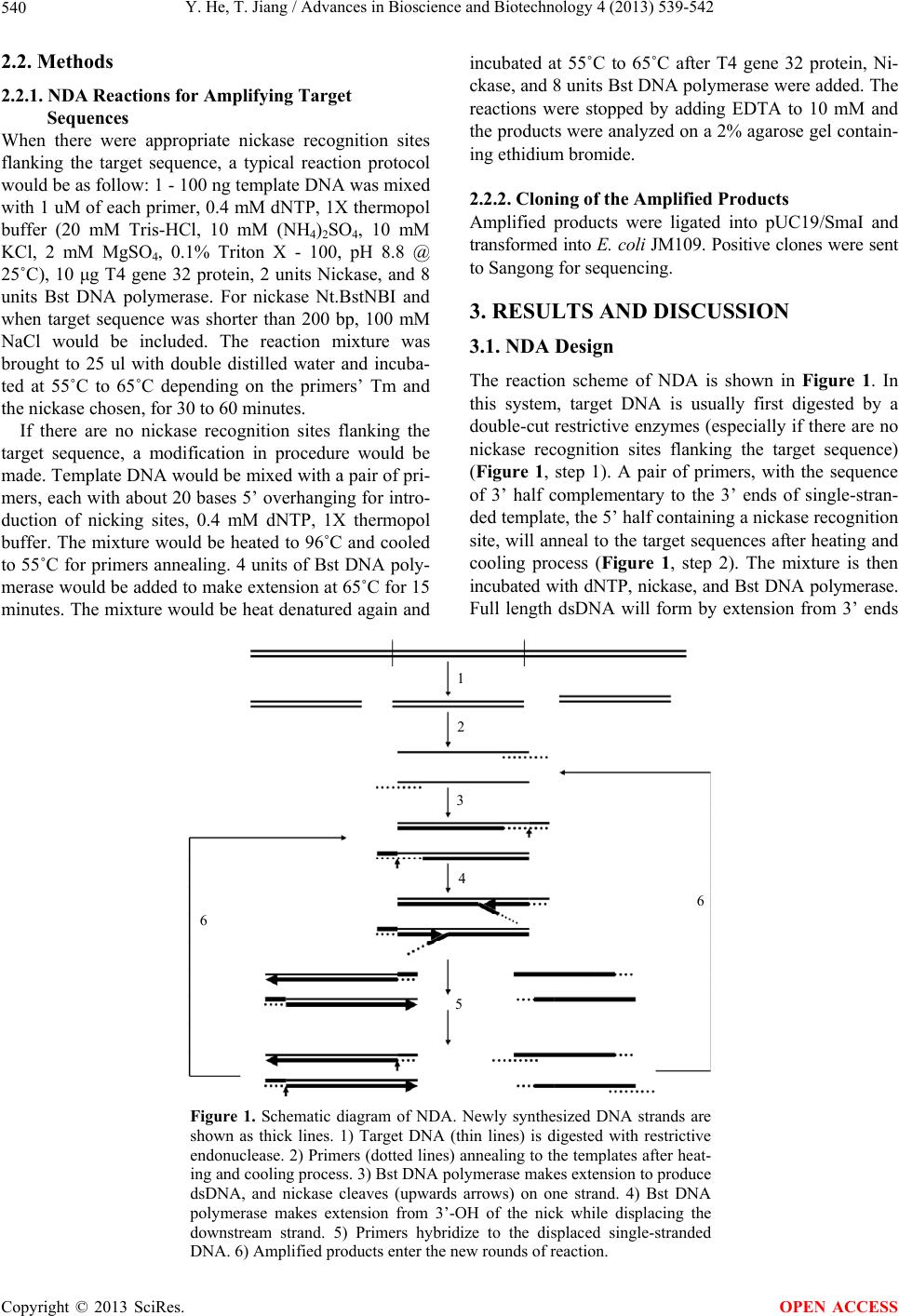 Y. He, T. Jiang / Advances in Bioscience and Biotechnology 4 (2013) 539-542 540 2.2. Methods 2.2.1. NDA Reactions for Amplifyi n g T ar get Sequences When there were appropriate nickase recognition sites flanking the target sequence, a typical reaction protocol would be as follow: 1 - 100 ng template DNA was mixed with 1 uM of each primer, 0.4 mM dNTP, 1X thermopol buffer (20 mM Tris-HCl, 10 mM (NH4)2SO4, 10 mM KCl, 2 mM MgSO4, 0.1% Triton X - 100, pH 8.8 @ 25˚C), 10 μg T4 gene 32 protein, 2 units Nickase, and 8 units Bst DNA polymerase. For nickase Nt.BstNBI and when target sequence was shorter than 200 bp, 100 mM NaCl would be included. The reaction mixture was brought to 25 ul with double distilled water and incuba- ted at 55˚C to 65˚C depending on the primers’ Tm and the nickase chosen, for 30 to 60 minutes. If there are no nickase recognition sites flanking the target sequence, a modification in procedure would be made. Template DNA would be mixed with a pair of pri- mers, each with about 20 bases 5’ overhanging for intro- duction of nicking sites, 0.4 mM dNTP, 1X thermopol buffer. The mixture would be heated to 96˚C and cooled to 55˚C for primers annealing. 4 units of Bst DNA poly- merase would be added to make extension at 65˚C for 15 minutes. The mixture would be heat denatured again and incubated at 55˚C to 65˚C after T4 gene 32 protein, Ni- ckase, and 8 units Bst DNA polymerase were added. The reactions were stopped by adding EDTA to 10 mM and the products were analyzed on a 2% agarose gel contain- ing ethidium bromide. 2.2.2. Cloning of the Amplified Products Amplified products were ligated into pUC19/SmaI and transformed into E. coli JM109. Positive clones were sent to Sangong for sequencing. 3. RESULTS AND DISCUSSION 3.1. NDA Design The reaction scheme of NDA is shown in Figure 1. In this system, target DNA is usually first digested by a double-cut restrictive enzymes (especially if there are no nickase recognition sites flanking the target sequence) (Figure 1, step 1). A pair of primers, with the sequence of 3’ half complementary to the 3’ ends of single-stran- ded template, the 5’ half containing a nickase recognition site, will anneal to the target sequences after heating and cooling process (Figure 1, step 2). The mixture is then incubated with dNTP, nickase, and Bst DNA polymerase. Full length dsDNA will form by extension from 3’ ends 5 4 3 2 1 6 6 Figure 1. Schematic diagram of NDA. Newly synthesized DNA strands are shown as thick lines. 1) Target DNA (thin lines) is digested with restrictive endonuclease. 2) Primers (dotted lines) annealing to the templates after heat- ing and cooling process. 3) Bst DNA polymerase makes extension to produce dsDNA, and nickase cleaves (upwards arrows) on one strand. 4) Bst DNA polymerase makes extension from 3’-OH of the nick while displacing the downstream strand. 5) Primers hybridize to the displaced single-stranded DNA. 6) Amplified products enter the new rounds of reaction. Copyright © 2013 SciRes. OPEN ACCESS 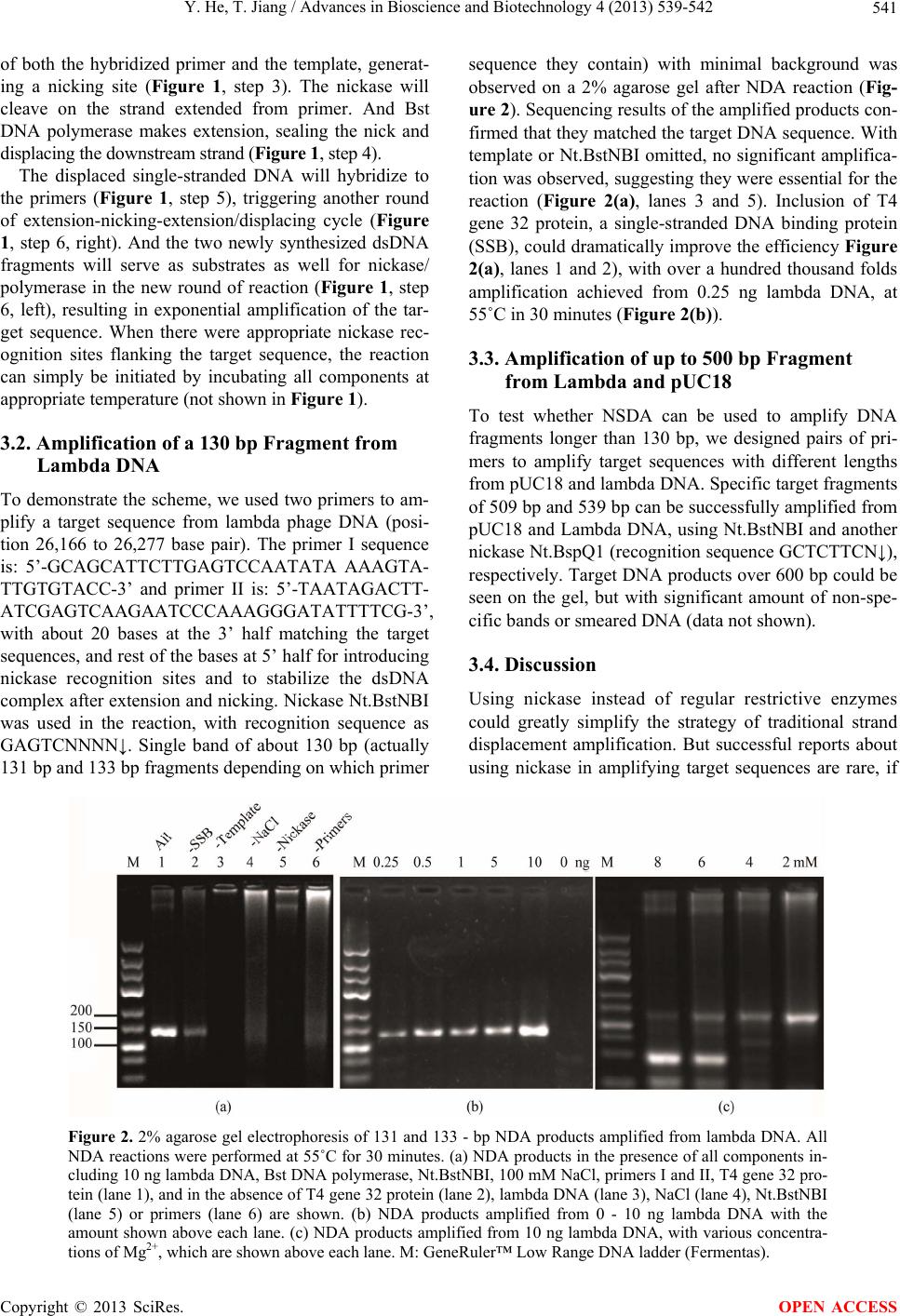 Y. He, T. Jiang / Advances in Bioscience and Biotechnology 4 (2013) 539-542 541 of both the hybridized primer and the template, generat- ing a nicking site (Figure 1, step 3). The nickase will cleave on the strand extended from primer. And Bst DNA polymerase makes extension, sealing the nick and displacing the downstream strand (Figur e 1, step 4). The displaced single-stranded DNA will hybridize to the primers (Figure 1, step 5), triggering another round of extension-nicking-extension/displacing cycle (Figure 1, step 6, right). And the two newly synthesized dsDNA fragments will serve as substrates as well for nickase/ polymerase in the new round of reaction (Figure 1, step 6, left), resulting in exponential amplification of the tar- get sequence. When there were appropriate nickase rec- ognition sites flanking the target sequence, the reaction can simply be initiated by incubating all components at appropriate temperature (not shown in Figure 1). 3.2. Amplification of a 130 bp Fragment from Lambda DNA To demonstrate the scheme, we used two primers to am- plify a target sequence from lambda phage DNA (posi- tion 26,166 to 26,277 base pair). The primer I sequence is: 5’-GCAGCATTCTTGAGTCCAATATA AAAGTA- TTGTGTACC-3’ and primer II is: 5’-TAATAGACTT- ATCGAGTCAAGAATCCCAAAGGGATATTTTCG-3’, with about 20 bases at the 3’ half matching the target sequences, and rest of the bases at 5’ half for introducing nickase recognition sites and to stabilize the dsDNA complex after extension and nicking. Nickase Nt.BstNBI was used in the reaction, with recognition sequence as GAGTCNNNN↓. Single band of about 130 bp (actually 131 bp and 133 bp fragments depending on which primer sequence they contain) with minimal background was observed on a 2% agarose gel after NDA reaction (Fig- ure 2). Sequencing results of the amplified products con- firmed that they matched the target DNA sequence. With template or Nt.BstNBI omitted, no significant amplifica- tion was observed, suggesting they were essential for the reaction (Figure 2(a), lanes 3 and 5). Inclusion of T4 gene 32 protein, a single-stranded DNA binding protein (SSB), could dramatically improve the efficiency Figure 2(a), lanes 1 and 2), with over a hundred thousand folds amplification achieved from 0.25 ng lambda DNA, at 55˚C in 30 minutes (Figure 2(b)). 3.3. Amplification of up to 500 bp Fragment from Lambda and pUC18 To test whether NSDA can be used to amplify DNA fragments longer than 130 bp, we designed pairs of pri- mers to amplify target sequences with different lengths from pUC18 and lambda DNA. Specific target fragments of 509 bp and 539 bp can be successfully amplified from pUC18 and Lambda DNA, using Nt.BstNBI and another nickase Nt.BspQ1 (recognition sequence GCTCTTCN↓), respectively. Target DNA products over 600 bp could be seen on the gel, but with significant amount of non-spe- cific bands or smeared DNA (data not shown). 3.4. Discussion Using nickase instead of regular restrictive enzymes could greatly simplify the strategy of traditional strand displacement amplification. But successful reports about using nickase in amplifying target sequences are rare, if Figure 2. 2% agarose gel electrophoresis of 131 and 133 - bp NDA products amplified from lambda DNA. All NDA reactions were performed at 55˚C for 30 minutes. (a) NDA products in the presence of all components in- cluding 10 ng lambda DNA, Bst DNA polymerase, Nt.BstNBI, 100 mM NaCl, primers I and II, T4 gene 32 pro- tein (lane 1), and in the absence of T4 gene 32 protein (lane 2), lambda DNA (lane 3), NaCl (lane 4), Nt.BstNBI (lane 5) or primers (lane 6) are shown. (b) NDA products amplified from 0 - 10 ng lambda DNA with the amount shown above each lane. (c) NDA products amplified from 10 ng lambda DNA, with various concentra- tions of Mg2+, which are shown above each lane. M: GeneRuler™ Low Range DNA ladder (Fermentas). Copyright © 2013 SciRes. OPEN ACCESS  Y. He, T. Jiang / Advances in Bioscience and Biotechnology 4 (2013) 539-542 542 any. Based on our experiences, a possible reason might be the high background in the reaction involving nickase and Bst DNA polymerase. Zyrina et al. also reported that Nt.BstNBI stimulates highly efficient template-indepen- dent DNA synthesis by Bst DNA polymerase, with the mechanism unclear [15]. As we demonstrated here, that the background synthesis could be minimized by adjust- ing reaction conditions, namely by lowering [Mg2+] to 2 mM, increase the amount of Bst DNA polymerase, and use as little as possible the nickase. Combination of 8 units of Bst DNA polymerase and 2 units of nickase with 2 mM Mg2+ presence was the optimal condition which efficiently generated specific products with very little background. [Mg2+] higher than 2 mM would generate smeared DNA or non-specific bands (Figure 2(c)). Re- versal polymerase/nickase ratio had similar results (data not shown). It was known that Mg2+ is necessary for ca- talytic activity of restrictive enzymes, which can bind both cognate and non-cognate sequences with similar af- finity, although showing various Mg2+ binding activity. We hypothesize that the background DNA synthesis may result from non-specific sequence recognition and diges- tion by nickase, which happens when nickase activity is too high and would serve as infinite “seeds” for amplifi- cation by polymerase. Using less nickase and lower amount of [Mg2+] would minimize the occurrence of non-specific templates for polymerase, and hence minimize the back- ground. We demonstrated here that nicking endonuclease and Bst DNA polymerase can be successfully combined in amplifying specific target DNA with little background. Our ongoing efforts are applying NDA in DNA tem- plates with high GC content, which can be difficult for PCR amplification. 4. ACKNOWLEDGEMENTS This work was supported by Research Fund of University of South China, grant number #504XJQ04002. We thank Dr. Weiwen Cai from Baylor College Medicine for instructive suggestion and comment in manuscript preparation. REFERENCES [1] Saiki, R.K., Gelfand, D.H., Stoffel, S., Scharf, S.J., Hi- guchi, R., Horn, G.T., Mullis, K.B. and Erlich, H.A. (1988) Primer-directed enzymatic amplification of DNA with a thermostable DNA polymerase. Science, 239, 487- 491. doi:10.1126/science.2448875 [2] Taylor, G.R. and Robinson, P. (1998) The polymerase chain reaction, from functional genomics to high-school practical classes. Current Opinion Biotechnology, 9, 35- 42. doi:10.1016/S0958-1669(98)80081-5 [3] Gill, P. and Ghaemi, A. (2008) Nucleic acid isothermal amplification technologies—A review. Nucleosides Nu- cleotides Nucleic Acids, 27, 224-243. doi:10.1080/15257770701845204 [4] Walker, G.T., Little, M.C., Nadeau, J.G. and Shank, D.D. (1992) Isothermal in vitro amplification of DNA by a re- striction enzyme/DNA polymerase system. Proceedings of National Academic Science of the USA, 89, 392-396. doi:10.1073/pnas.89.1.392 [5] Walker, G.T., Fraiser, M.S., Schram, J.L., Little, M.C., Nadeau, J.G. and Malinowski, D.P. (1992) Strand displace- ment amplification—An isothermal, in vitro DNA ampli- fication technique. Nucleic Acids Research, 20, 1691- 1696. doi:10.1093/nar/20.7.1691 [6] Walker, G.T. (1993) Empirical aspects of strand displace- ment amplification. PCR Methods Application, 3, 1-6. doi:10.1101/gr.3.1.1 [7] Notomi, T., Okayama, H., Masubuchi, H., Yonekawa, T., Watanabe, K., Amino, N. and Hase, T. (2000) Loop-me- diated isothermal amplification of DNA. Nucleic Acids Research, 28, e63. doi:10.1093/nar/28.12.e63 [8] Vincent, M., Xu, Y. and Kong, H. (2004) Helicase-depen- dent isothermal DNA amplification. EMBO Rep, 5, 795- 800. doi:10.1038/sj.embor.7400200 [9] An, L., Tang, W., Ranalli, T.A., Kim, H.J., Wytiaz, J. and Kong, H. (2005) Characterization of a thermostable UvrD helicase and its participation in helicase-dependent ampli- fication. Journal of Biological Chemistry, 280, 28952- 28958. doi:10.1074/jbc.M503096200 [10] Kong, H., Higgins, L., Dalton, M., Kucera, R. and Schild- kraut, I. (2001) Cloning and producing the N.BstNBI ni- cking endonuclease. US Patent No. 6191267. [11] Chan, S.H., Zhu, Z., Van Etten, J.L. and Xu, S.Y. (2004) Cloning of CviPII nicking and modification system from chlorella virus NYs-1 and application of Nt.CviPII in ran- dom DNA amplification. Nucleic Acids Research, 32, 6187-6199. doi:10.1093/nar/gkh958 [12] Van Ness, J., Galas, D. and Van Ness, L. (2006) Nucleic acid amplification using nicking agents. US Patent No. 7112423. [13] Kucera, R. (2007) Genome amplification. International Patent No. WO/2007/056173. [14] Yao, Z. and Lidgard, G. (2008) Method for rapid, single- step strand displacement amplification of nucleic acids. International Patent No. WO/2008/066979. [15] Zyrina, N.V., Zheleznaya, L.A., Dvoretsky, E.V., Vasil- iev, V.D., Chernov, A. and Matvienko, N.I. (2007) N.BspD6I DNA nickase strongly stimulates template-independent synthesis of non-palindromic repetitive DNA by Bst DNA polymerase. Biological Chemistry, 388, 367-372. doi:10.1515/BC.2007.043 Copyright © 2013 SciRes. OPEN ACCESS |