

Paper Menu >>
Journal Menu >>
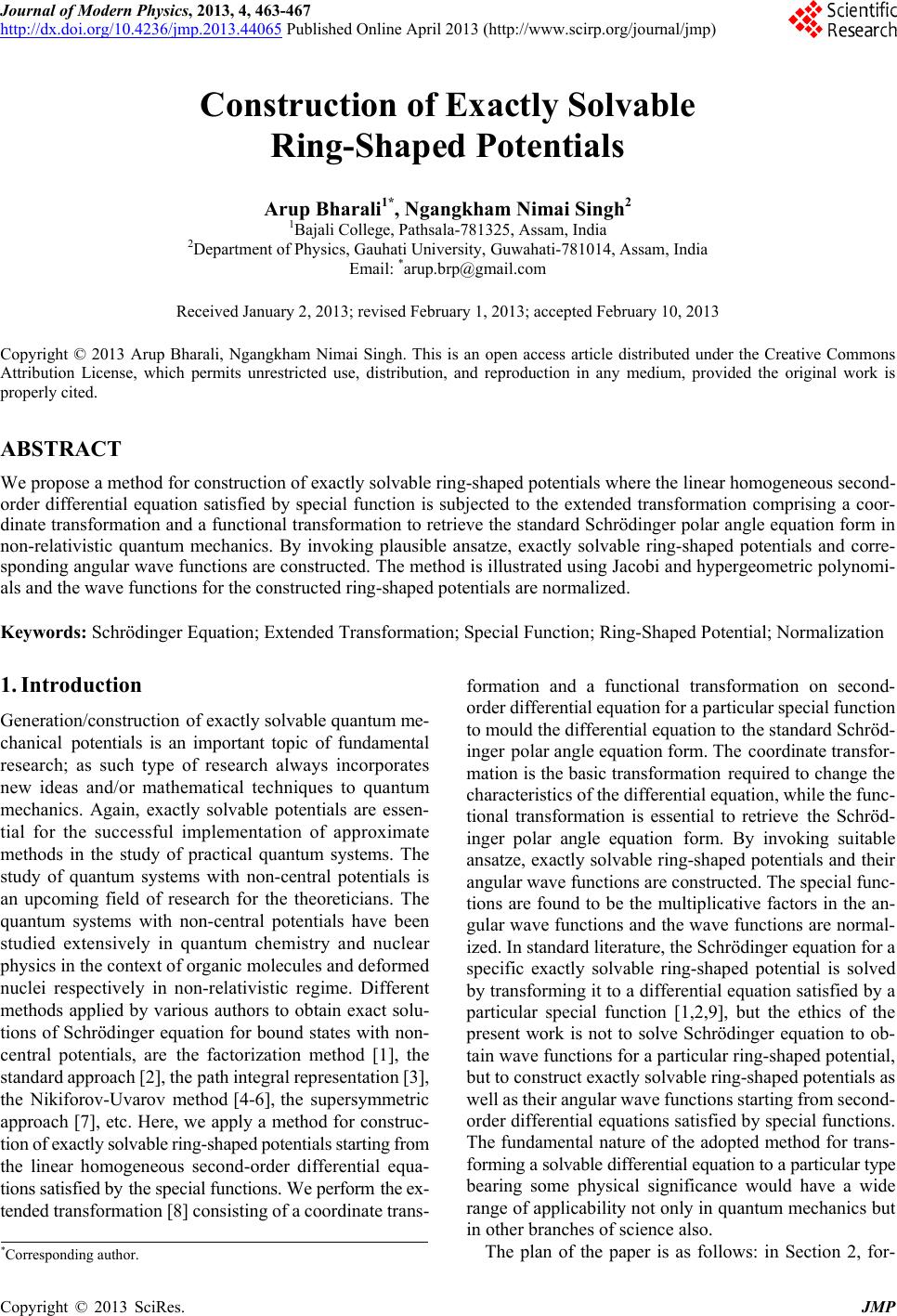 Journal of Modern Physics, 2013, 4, 463-467 http://dx.doi.org/10.4236/jmp.2013.44065 Published Online April 2013 (http://www.scirp.org/journal/jmp) Construction of Exactly Solvable Ring-Shaped Potentials Arup Bharali1*, Ngangkham Nimai Singh2 1Bajali College, Pathsala-781325, Assam, India 2Department of Physics, Gauhati University, Guwahati-781014, Assam, India Email: *[email protected] Received January 2, 2013; revised February 1, 2013; accepted February 10, 2013 Copyright © 2013 Arup Bharali, Ngangkham Nimai Singh. This is an open access article distributed under the Creative Commons Attribution License, which permits unrestricted use, distribution, and reproduction in any medium, provided the original work is properly cited. ABSTRACT We propose a method for construction of exactly solvable ring-shaped potentials where the linear homogeneous second- order differential equation satisfied by special function is subjected to the extended transformation comprising a coor- dinate transformation and a functional transformation to retrieve the standard Schrödinger polar angle equation form in non-relativistic quantum mechanics. By invoking plausible ansatze, exactly solvable ring-shaped potentials and corre- sponding angular wave functions are constructed. The method is illustrated using Jacobi and hypergeometric polynomi- als and the wave functions for the constructed ring-shaped potentials are normalized. Keywords: Schrödinger Equation; Extended Transformation; Special Function; Ring-Shaped Potential; Normalization 1. Introduction formation and a functional transformation on second- order differential equation for a particular special function to mould the differential equation to the standard Schröd- inger polar angle equation form. The coordinate transfor- mation is the basic transformation required to change the characteristics of the differential equation, while the func- tional transformation is essential to retrieve the Schröd- inger polar angle equation form. By invoking suitable ansatze, exactly solvable ring-shaped potentials and their angular wave functions are constructed. The special func- tions are found to be the multiplicative factors in the an- gular wave functions and the wave functions are normal- ized. In standard literature, the Schrödinger equation for a specific exactly solvable ring-shaped potential is solved by transforming it to a differential equation satisfied by a particular special function [1,2,9], but the ethics of the present work is not to solve Schrödinger equation to ob- tain wave functions for a particular ring-shaped potential, but to construct exactly solvable ring-shaped potentials as well as their angular wave functions starting from second- order differential equations satisfied by special functions. The fundamental nature of the adopted method for trans- forming a solvable differential equation to a particular type bearing some physical significance would have a wide range of applicability not only in quantum mechanics but in other branches of science also. Generation/construction of exactly solvable quantum me- chanical potentials is an important topic of fundamental research; as such type of research always incorporates new ideas and/or mathematical techniques to quantum mechanics. Again, exactly solvable potentials are essen- tial for the successful implementation of approximate methods in the study of practical quantum systems. The study of quantum systems with non-central potentials is an upcoming field of research for the theoreticians. The quantum systems with non-central potentials have been studied extensively in quantum chemistry and nuclear physics in the context of organic molecules and deformed nuclei respectively in non-relativistic regime. Different methods applied by various authors to obtain exact solu- tions of Schrödinger equation for bound states with non- central potentials, are the factorization method [1], the standard approach [2], the path integral representation [3], the Nikiforov-Uvarov method [4-6], the supersymmetric approach [7], etc. Here, we apply a method for construc- tion of exactly solvable ring-shaped potentials starting from the linear homogeneous second-order differential equa- tions satisfied by the special functions. We perform the ex- tended transformation [8] consisting of a coordinate trans- The plan of the paper is as follows: in Section 2, for- *Corresponding author. C opyright © 2013 SciRes. JMP 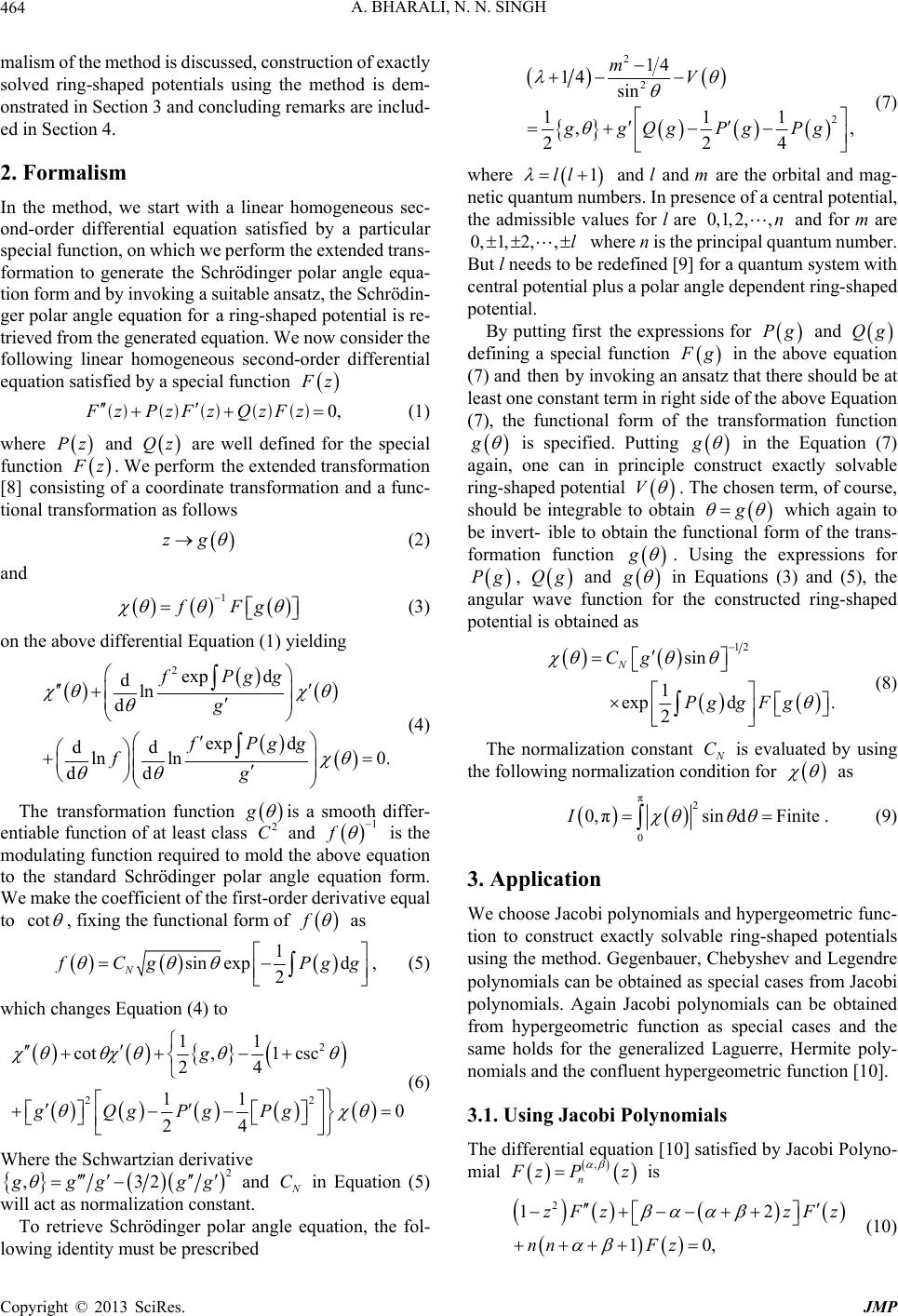 A. BHARALI, N. N. SINGH 464 malism of the method is discussed, construction of exactly solved ring-shaped potentials using the method is dem- onstrated in Section 3 and concluding remarks are includ- ed in Section 4. 2. Formalism In the method, we start with a linear homogeneous sec- ond-order differential equation satisfied by a particular special function, on which we perform the extended trans- formation to generate the Schrödinger polar angle equa- tion form and by invoking a suitable ansatz, the Schrödin- ger polar angle equation for a ring-shaped potential is re- trieved from the generated equation. We now consider the following linear homogeneous second-order differential equation satisfied by a special function F z 0,QzFz Qz Fz PzFz (1) where and are well defined for the special function Pz F z zg . We perform the extended transformation [8] consisting of a coordinate transformation and a func- tional transformation as follows 1 fFg (2) and (3) on the above differential Equation (1) yielding 0. g gg g 2exp d dln d exp d dd ln ln dd fPg g fP fg (4) The transformation function is a smooth differ- entiable function of at least class and 2 C 1 f is the modulating function required to mold the above equation to the standard Schrödinger polar angle equation form. We make the coefficient of the first-order derivative equal to cot , fixing the functional form of f as 1d 2 sin exp N f Cg Pgg , (5) which changes Equation (4) to 2 11 cot,1 cs 24 11 24 g gQgPgP 2 2 c 0g (6) Where the Schwartzian derivative 3 2 , 2 g gg g g and N C in Equation (5) will act as normalization constant. To retrieve Schrödinger polar angle equation, the fol- lowing identity must be prescribed 2 2 2 14 14 sin 111 ,, 224 mV ggQgPgPg (7) 1ll where 0,1, 2,, n 0, 1, 2,, l and l and m are the orbital and mag- netic quantum numbers. In presence of a central potential, the admissible values for l are and for m are Pg where n is the principal quantum number. But l needs to be redefined [9] for a quantum system with central potential plus a polar angle dependent ring-shaped potential. By putting first the expressions for and Qg defining a special function F g in the above equation (7) and then by invoking an ansatz that there should be at least one constant term in right side of the above Equation (7), the functional form of the transformation function g g is specified. Putting in the Equation (7) again, one can in principle construct exactly solvable ring-shaped potential V . The chosen term, of course, should be integrable to obtain g which again to be invert- ible to obtain the functional form of the trans- formation function g . Using the expressions for Pg , Qg and g in Equations (3) and (5), the angular wave function for the constructed ring-shaped potential is obtained as 12 sin 1 exp d. 2 N Cg Pgg F g (8) The normalization constant N C is evaluated by using the following normalization condition for as π 2 0 0, πsin dFiniteI , n . (9) 3. Application We choose Jacobi polynomials and hypergeometric func- tion to construct exactly solvable ring-shaped potentials using the method. Gegenbauer, Chebyshev and Legendre polynomials can be obtained as special cases from Jacobi polynomials. Again Jacobi polynomials can be obtained from hypergeometric function as special cases and the same holds for the generalized Laguerre, Hermite poly- nomials and the confluent hypergeometric function [10]. 3.1. Using Jacobi Polynomials The differential equation [10] satisfied by Jacobi Polyno- mial zP z is F 2 12 10, zFz zFz nnF z (10) Copyright © 2013 SciRes. JMP 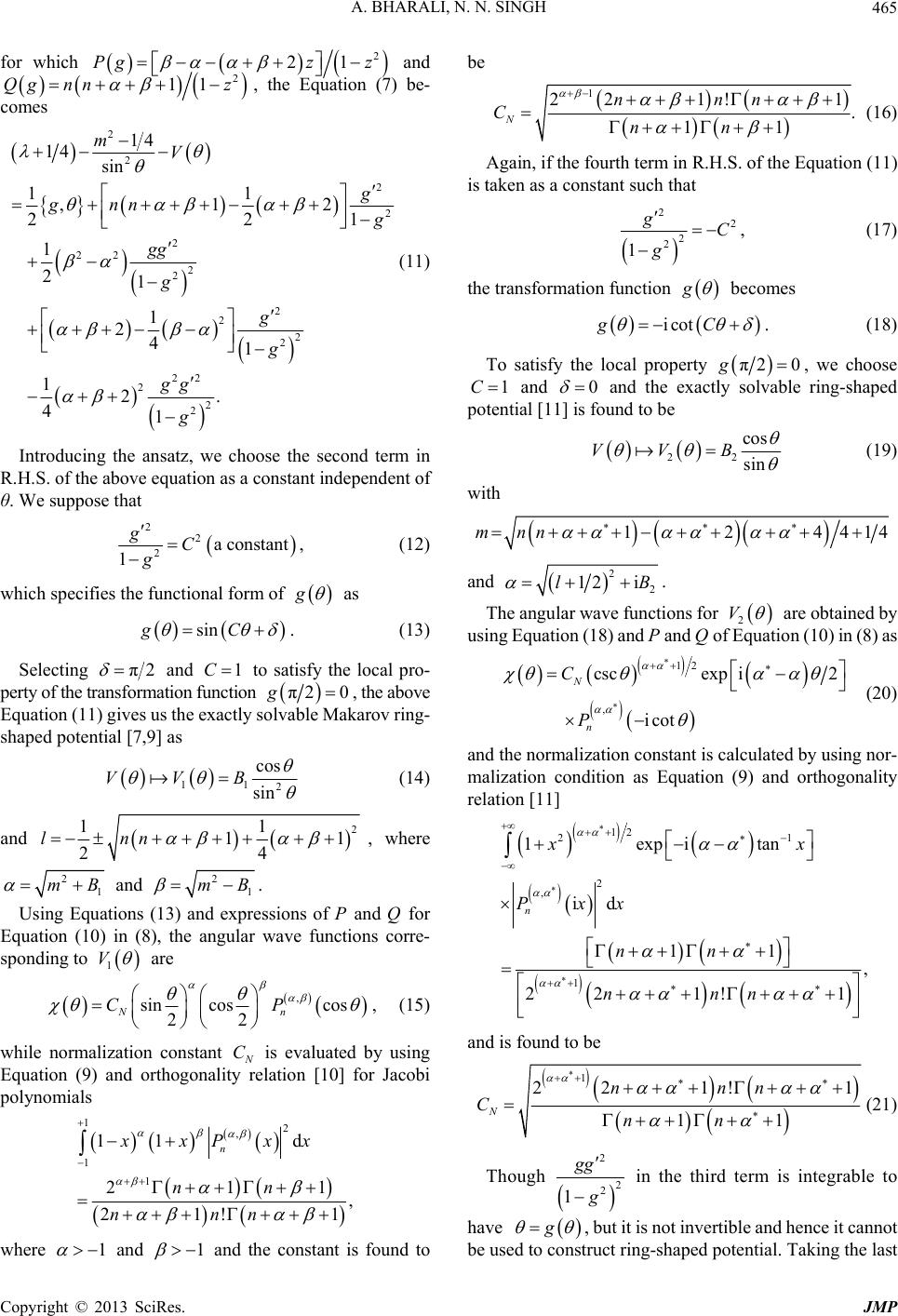 A. BHARALI, N. N. SINGH 465 for which 2 21z z Pg and 2 11Qg nnz , the Equation (7) be- comes 2 2 2 22 2 2 2 2 2 2 22 2 2 2 14 14 sin 11 ,1 22 1 21 1 241 12. 41 mV gnn 2 2 2 1 g g gg g g g gg g (11) Introducing the ansatz, we choose the second term in R.H.S. of the above equation as a constant independent of θ. We suppose that a constant g 2 2 2 1 gC g , (12) which specifies the functional form of as sin Cg . (13) Selecting π2 and C1 to satisfy the local pro- perty of the transformation function π20g , the above Equation (11) gives us the exactly solvable Makarov ring- shaped potential [7,9] as 11 2 cos sin BVV (14) and 2 1 11 1 24 ln n , where 2 1 mB and 2 1 mB 1 V . Using Equations (13) and expressions of P and Q for Equation (10) in (8), the angular wave functions corre- sponding to are ,cos n P sin cos 22 N C , (15) while normalization constant N C is evaluated by using Equation (9) and orthogonality relation [10] for Jacobi polynomials 1 , 1 1 11 21 21 n xxP nn 2 d 1 , ! 1 xx nn n where 1 and 1 and the constant is found to be 1 22 1!1 . 11 N nnn Cnn (16) Again, if the fourth term in R.H.S. of the Equation (11) is taken as a constant such that 2 2 2 2 1 gC g g , (17) the transformation function becomes icotgC . (18) To satisfy the local property π20g 1C , we choose and 0 and the exactly solvable ring-shaped potential [11] is found to be 22 cos sin VVB (19) with 124414mnn and 2 2 12 ilB V . The angular wave functions for 2 are obtained by using Equation (18) and P and Q of Equation (10) in (8) as 12 , cscexp i2 icot N n C P (20) and the normalization constant is calculated by using nor- malization condition as Equation (9) and orthogonality relation [11] 12 21 2 , 1 1expitan id 11 , 22 1!1 n xx Pxx nn nnn and is found to be 1 22 1!1 11 N nnn Cnn (21) Though 2 2 2 1 gg g in the third term is integrable to g have , but it is not invertible and hence it cannot be used to construct ring-shaped potential. Taking the last Copyright © 2013 SciRes. JMP 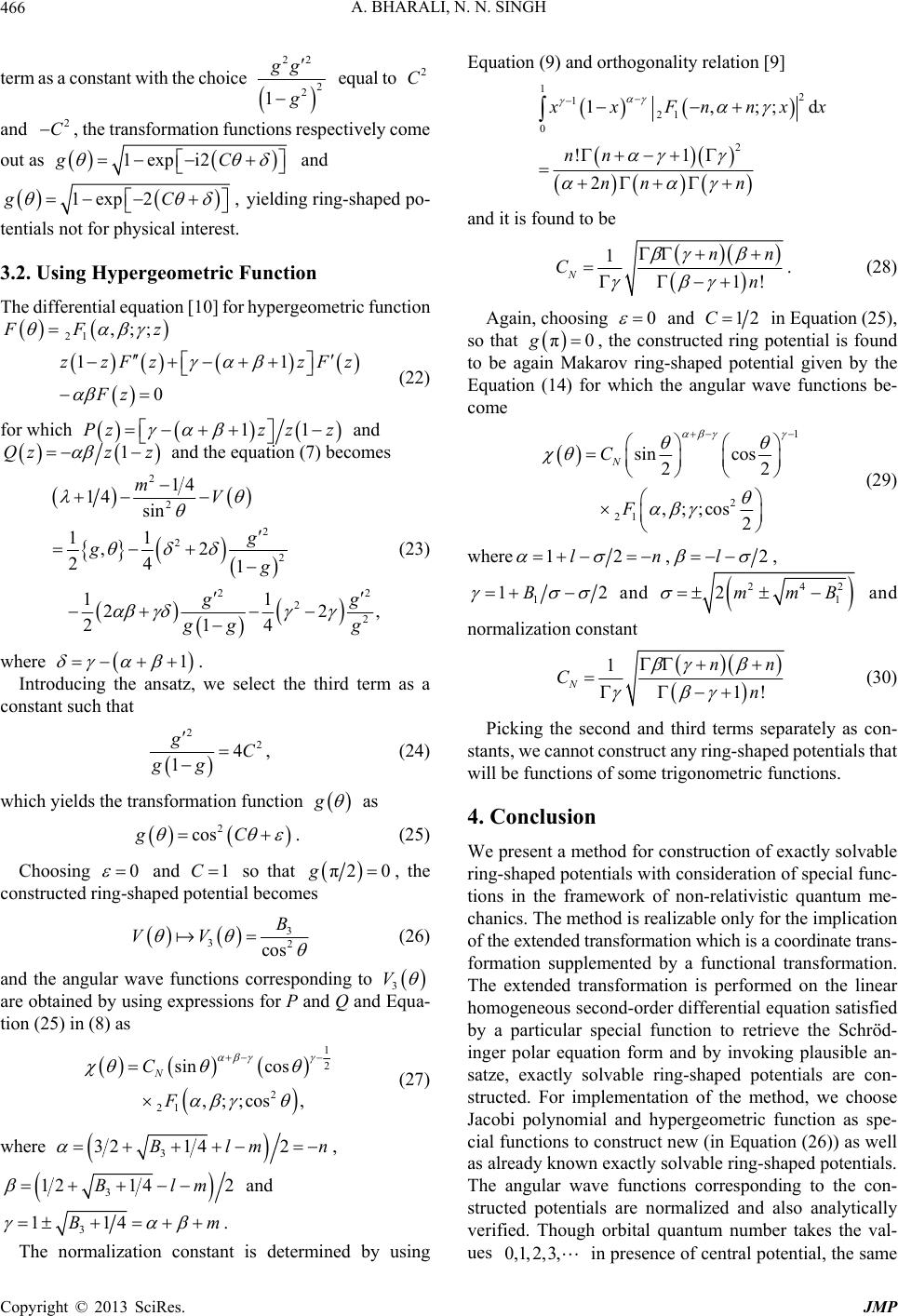 A. BHARALI, N. N. SINGH 466 term as a constant with the choice 22 1 g eq and 2 C, the transformation ftions respectively come 2 2 g gual to 2 C unc out a s 1exp i2Cg and 1exp 2gC , yieldihaped po- tentials not for physical interes etric function ng ring-s t. 3.2. Using Hypergeometric Function The differential equation [10] for hypergeom 21 ,;; F Fz 0 zz Fz Fz 11zFz (22) for which 11 P zzzz and 1Qz comes z z and the equation (7) be 2 2 2 2 2 22 2 2 14 sin 11 ,2 24 1 11 22 , 214 m g g g 14 V g g gg g (23) 1 . g the ansatz,e select the third term as a where ducinIntro w constant such that 2 2 4 1 gC gg , (24) which yields the transformnction g ation fu as 2 cosgC . (25) oosing 0 Ch and 1C so that π20g , the constructed riaped potential become ng-sh s 3 B VV 32 cos (26) and the angular wave functions corresponding to V3 are obtained by using expressions for P and Q and - tion (25) in (8) as Equa 1 2 2 cos ;cos , 21 sin ,; N C F (27) where 3 32 14Bl 2mn , 3 2 142Blm and 1 3 11 4Bm . The normalization constant is determined by using Equation (9) and orthogonality relation [9] 12 1 21 0 1,;;d 2 !1 2 x xFnnxx nn nn n and it is found to be 1 1! nn n N C . (28) Again, choosing 0 and 12C in so that Equation (25), π0g , the constructed ring potential is found tov rined pote be again Makarog-shapntial given by the Equation (14) for which the angular wave functions be- come 1 sin cosC 2 21 22 ,; ;cos 2 N F (29) where 12ln ,2l , 1 12B and 242 1 2mmB and tion constant normaliza 1 1! nn n N C (30) Picking the second and third terms sep stants, we cannot construct any ring-shaped potentials that w We present a method for construction of exactly solvable ith consideration of special func- arately as con- ill be functions of some trigonometric functions. 4. Conclusion ring-shaped potentials w tions in the framework of non-relativistic quantum me- chanics. The method is realizable only for the implication of the extended transformation which is a coordinate trans- formation supplemented by a functional transformation. The extended transformation is performed on the linear homogeneous second-order differential equation satisfied by a particular special function to retrieve the Schröd- inger polar equation form and by invoking plausible an- satze, exactly solvable ring-shaped potentials are con- structed. For implementation of the method, we choose Jacobi polynomial and hypergeometric function as spe- cial functions to construct new (in Equation (26)) as well as already known exactly solvable ring-shaped potentials. The angular wave functions corresponding to the con- structed potentials are normalized and also analytically verified. Though orbital quantum number takes the val- ues 0,1, 2,3, in presence of central potential, the same Copyright © 2013 SciRes. JMP  A. BHARALI, N. N. SINGH Copyright © 2013 SciRes. JMP 467 ed potenti [1] J. Sadeghi and B. Pourhassan, “Exact Solution of the Non-Central M Ring-Shaped Lik Potential by th,” Electronic Jour- cal Chemistry, Vol. 48, No. 4, 2010, pp. 876-882. quantum number will depend on both magnetic quantum number and characteristic constants in presence of ring- shapals. Again, some unphysical potential are also come up in the calculations and new technique is re- quired to make them physical. Laguerre, Hermite, Roma- novski polynomials, etc. can also be utilized in the me- thod to construct ring-shaped potentials. The proposed method has also the capability for construction of central potentials in non-relativistic regime and the essence of the method of converting a soluble differential equation to another differential equation of practical interest can be extrapolated to other branches of physics. REFERENCES odified Kratzer Plus a e Factorization Method e nal of Theoretical Physics, Vol. 5, No. 17, 2008, pp. 193- 202. [2] M. Zhang, B. An and H. Guo-Qing, “Exact Solutions of a New Coulomb Ring-Shaped Potential,” Journal of Ma- themati doi:10.1007/s10910-010-9715-1 [3] L. Chetouani, L. Guechi and T. F. Hammann, “Exact Path Integral for the Ring Potential,” Physics Letters A, Vol. 125, No. 6-7, 1987, pp. 277-281. [4] M. Zhang, G. Sun and S. Dong, “Exactly Complete Solu- tions of the Schrödinger Equation with a Spherically Har- monic Oscillatory Ring-Shaped Potential,” Physics Let- ters A, Vol. 374, No. 5, 2010, pp. 704-708. doi:10.1016/j.physleta.2009.11.072 [5] S. Ikhdair, “Exact Solutions of the D-Dimens dinger Equation for a Pseudo-Coulom ional Schrö- b Potential Plus Ring- Manning-Rosen Potential Plus s Letters A, Vol. 269, No. 2-3, Shaped Potential,” Chinese Journal of Physics, Vol. 46, No. 3, 2008, pp. 291-306. [6] A. Antia, N. Ikot and L. Akpatio, “Exact Solutions of the Schrödinger Equation with a Ring-Shaped Like Potential by Nikiforov-Uvarov Me- thod,” European Journal of Scientific Research, Vol. 45, No. 1, 2010 pp. 107-118. [7] B. Gonul and I. Zorba, “Supersymmetric Solutions of Non- Central Potentials,” Physic 2000, pp. 83-88. doi:10.1016/S0375-9601(00)00252-8 [8] S. A. S. Ahmed, “A Transformation Method of Generat- ing Exact Analytic Solutions of the Schrödinger Equa- tion,” International Journal of Theoretical Physics, Vol. 36, No. 8, 1997, pp. 1893-1905. doi:10.1007/BF02435851 [9] C. Chen, C. Liu and F. Lu, “Exact Solutions of Schrödin- ger Equation for the Makarov Potential,” Physics Letters A, Vol. 374, No. 11-12, 2010, pp. 1346-1349. doi:10.1016/j.physleta.2010.01.018 [10] M. Abramowitz and I. A. Stegun, “Handbook o matical Functions,” Dover Publicatio f Mathe- ns, New York, 1978. [11] D. E. Alvarez-Castillo and M. Kirchbach, “Exact Spec- trum and Wave Functions of the Hyperbolic Scarf Poten- tial in Terms of Finite Romanovski Polynomials,” Revista Mexicana de Fisica, Vol. E53, No. 2, 2007, pp. 143-154. |