

Paper Menu >>
Journal Menu >>
 Creative Education 2013. Vol.4, No.4, 259-262 Published Online April 2013 in SciRes (http://www.scirp.org/journal/ce) DOI:10.4236/ce.2013.44038 The Textbook Analysis on Multiplication: The Case of Japan, Singapore and Thailand Suttharat Boonlerts1, Maitree Inprasitha2,3 1Department of Mathematics Education, Faculty of Education, Khon Kaen University, Khon Kaen, Thailand 2Center for Research in Mathematics Education, Khon Kaen University , Khon Kaen, Thailand 3Centre of Excellence in Mathematics, Commis s i o n of Higher Education in Thailand (CHE), Bangkok, Thailand Email: [email protected] Received January 29th, 2013; revised February 28th, 2013; accepted March 15th, 2013 Copyright © 2013 Suttharat Boonlerts, Maitree Inprasitha. This is an open access article distributed under the Creative Commons Attribution License, which permits unrestricted use, distribution, and reproduction in any medium, provided the original work is properly c ite d. This paper analyzes the presentation of multiplication in elementary textbooks from Japan, Singapore and Thailand. The methodology consisted of content analysis comparing the overall structure and sequence of topics and how to introduce the meaning of multiplication. We identified both similarities and differences among the three countries. Keywords: Multiplication; Mathematics Textbook; Content Analysis; Comparative Study Introduction This paper presents an analysis of the presentation of multi- plication in elementary textbooks from Japan, Singapore, and Thailand. Textbooks from these Asian countries were targeted because these counties represent different levels of perform- ances in the TIMSS (1995, 1999, 2003, 2007); Singaporean and Japanese students performed well, while Thai students per- formed poorly. Thus, this study is aimed at investigating the features of textbooks, which Fan & Zhu (2007) mentioned that the teachers and students used with an underlying belief that textbooks played an important role in the process of teaching and learning. Various researches have revealed that the teaching ap- proaches adopted by classroom teachers and embodied in text- books used in their classrooms are often highly alike (e.g. Bierhoff, 1996; Brown, 1973; Fan & Kealey, 2000; Fujii, 2001; Fan & Zhu, 2007). “Multiplication” was widely discussed among the mathe- matics education research groups as a difficult topic in the cur- riculum (Anghileri, 1989; Bell et al., 1989; Graeber & Tanen- haus, 1993; Behr et al., 1994; Confrey & Smith, 1995; Chung & Lew, 2007; Mulligan & Mitchelmore, 1997; Irwin, 2004). Gelman (1999) suggested that multiplicative concepts are not among the naïve mathematical concepts learned by all. Piaget (1985, 1987 cited in Irwin, 2004) asserted that multiplication is more complex than addition, as it involves implicit quantifica- tion. Students who operate multiplicatively know that there is a certain quantity in each of the numbers multiplied, but do not need to refer to the individual items or numbers in a group. The study examined elementary textbooks from Grades 1 - 3, and similarities and differences in the presentation of multipli- cation in elementary mathematics textbooks in three countries were documented. It addressed the following question: When and how is multiplication introduced and developed? Method In this section, the study describes the selection of textbooks chosen for examination and the conceptual frameworks used to analyze the presentation of multiplication in these books. Selection of Textbooks Three elementary mathematics textbook series from Japan, Singapore, and Thailand were chosen for this study. These three countries come from East Asia and South East Asia. Singapore is one of the Asian countries where the students always score well. In 1995, 1999 and 2003, students from Sin- gapore were ranked number one in the world and fell to third place in 1997. Japanese students ranked 3rd in 1995, 5th in 1999, 3rd in 2003 and 5th in 2007. Thai students ranked 22nd in 1995, 27th in 1999, and 29th in 2007 respectively. The over- all score consistently was below average in every assessment despite the changing composition of participating countries with each study (TIMSS, 1995, 1999, 2003, 2007). Thailand sets a national curriculum, and a single textbook se- ries is used throughout the country. The Ministry of Education distributes the mathematics textbooks used in Thailand, which is developed by the Institute for the Promotion of Teaching Science and Technology (IPST). Japan also sets a national curriculum, but six commercial textbook series are available for use in the schools (Alajmi, 2011). In Japan, private companies publish the textbooks, which are based on the Course of Study and the Accompanying Teaching Guide published by the Ministry of Education (Isoda, 2010). All textbooks must pass through the textbook authoriza- tion process that is overseen by the Textbook Authorization Council. At present, there six publishers offer mathematics textbooks for elementary and a lower range of secondary schools (Shimizu & Watanabe, 2010). Copyright © 2013 SciRe s . 259  S. BOONLERTS, M. INPRASIT HA Singapore is similar to many other Asian countries; the Min- istry of Education (MOE) develops and issues a national mathematics curriculum (syllabus), and all schools are required to follow the syllabus in teaching, learning, and assessment. Accordingly, textbooks must align with the syllabus. All school textbooks in Singapore first must be reviewed and approved by an evaluation committee appointed by the Ministry of Educa- tion (Fan, 2010). For Japan and Singapore, textbooks in this study were se- lected from one publishing company and based on their wide use by schools. These Japan textbooks were translated into the Thai Language in 2009. This Thai version has been in use in the 22 Schools participating in the Research project. The Sin- gapore textbooks, which are published in English, have been used in some Thai bilingual schools In total, the following 14 mathematics textbooks from the three countries were examined in this study: in Japan, five Mathematics for Elementary School for grades 1 - 3 published by Gakkoh Tosho were selected; in Singapore, six “My Pals Are Here” (2nd ed.), published by Marshall Cavendish Education (2010) were selected for first to third Grades, in Thailand, three mathematics textbooks are provided for first to third Grades and published by IPST. Conceptual Frameworks Two conceptual frameworks were used to analyze the pres- entation of multiplication in mathematics textbooks through content analysis reported Son & Senk (2010). These analyses focused on aspects of the textbooks Overall structure (number of units or lessons and sequence of topics) The analysis of the textbooks’ content focused on the prob- lem situations in multiplication in each textbook. Using Greer’s the classes of situations involving multiplication and division of integers: equal groups, multiplication comparison, Cartesian product, and rectangular area (Table 1). This study analyzed problems in the entire textbook. Results The study examines the overall structure and sequence of topics in the textbooks and the general format of each lesson. The Overall Structure and Sequence of Topics In each country, all the textbooks in grades 1 - 3 present number and operation (addition subtraction, multiplication, division of whole number), geometry (shape, volume, length, mass) and table and graph. Only the Singapore series contains different content in the textbook such as fractions, area and perimeter, perpendicular and parallel lines. The Thai textbooks present a chapter on multiplication in each grade (2nd and 3rd grades) and have one chapter that be related, is review, word problem and making problem of addi- tion, subtraction, multiplication and division. Singapore and Japanese textbooks consist of several chapters in each grade. For example, Japanese textbooks for second grade consists of (1): expression as a multiplication sentence, multiplication (2): The 2×, 5×, 3× 4× multiplication table, multiplication (3): the 6×,7×,8×,9×, 1× multiplication table, and multiplication (4): multiplication game, multiplication table. Similarly, Singapore textbooks consist of several chapters for multiplication in each grade. The Japanese and Thai textbooks begin teaching multiplica- tion in the second grade whereas Singapore textbooks introduce multiplication in the first grade. In the Japanese second grade textbooks, the sequences of topics in multiplication are: learning unit 1; the meaning of multiplication, multiplication sentence, unit 2: the multiplica- tion tables of 2, 5, 3, 4, unit 3: multiplication tables of 6, 7, 8, 9, 1, and unit 4: multiplication table, multiplication game. In sum- mary, the learning units of multiplication are organized as the meaning of multiplication, multiplicands, multipliers, and mul- tiplication table. The laws of calculation (commutative, asso- ciative, and distributive), algorithm and the rules of multiplica- tion are introduced in the elementary mathematics textbooks. In the Singapore textbooks, the meaning of multiplication is introduced through the use of equal-sized groups and arrays. The chapter is divided into small topic, such as in first grade, making multiplication stories and solving word problems. In second grade, the meaning of multiplication is defined by re- lating to whole number system through many representations, including equal-sized groups, array, and equal “jumps” on number line for multiplication. Students learn the basic multi- plication facts and computation. Singapore textbooks follow the following sequences: the topic of multiplication tables of 2, 3, 4, 5 and 10 in second grade and multiplication tables of 6, 7, 8 and 9 in third grade. They use the properties of addition and multi- plication (commutative, associative and distributive properties, without being named) to multiply in the whole numbers system and apply increasingly sophisticated strategies with these prop- erties to solve multiplication and division problems involving the basic facts. By comparing the variety of solution strategies, students set multiplication and division as inverse operations. Thai textbooks begin teaching multiplication in the second grade. There are 46 pages in the chapter on multiplication, with the introduction of the meaning of multiplication making up approximately 8.7% and the procedural rules of multiplication takes up 50%. In the third grade the emphasis is on procedural rules and obtaining results (Table 2). Thai textbooks have a sequence of topic of multiplication tables of 2, 3, 4, 5, 6, 7, 8 and 9 in the second grade. In second grade and third grades they emphasize procedural calculation. Meaning Given to Multiplication The content analysis of the multiplication content found that Japanese, Singapore and Thai textbooks have similar and dif- ferent issues in the sequence of introducing multiplication, meaning of multiplication. It can be summarized as follows (Table 3). Singapore and Thai mathematics textbooks are similar in in- troducing the meaning of multiplication through equal group with repeated addition, while Japanese mathematics textbooks start with presenting the description of multiplication through equal group, then presenting repeated addition later. Discussion The results of the content analysis indicate that Japanese textbooks devoted more pages to multiplication than Thai and Singapore textbooks. However, the percentage of pages is not enough to justify the importance of multiplication topic in the textbook. Other aspects of the textbook were analyzed. While Singapore textbooks begin teaching multiplication in the first grade, Thai and Japanese textbooks begin in the second grade. Japanese and Singapore mathematics textbooks emphasized the Copyright © 2013 SciRe s . 260 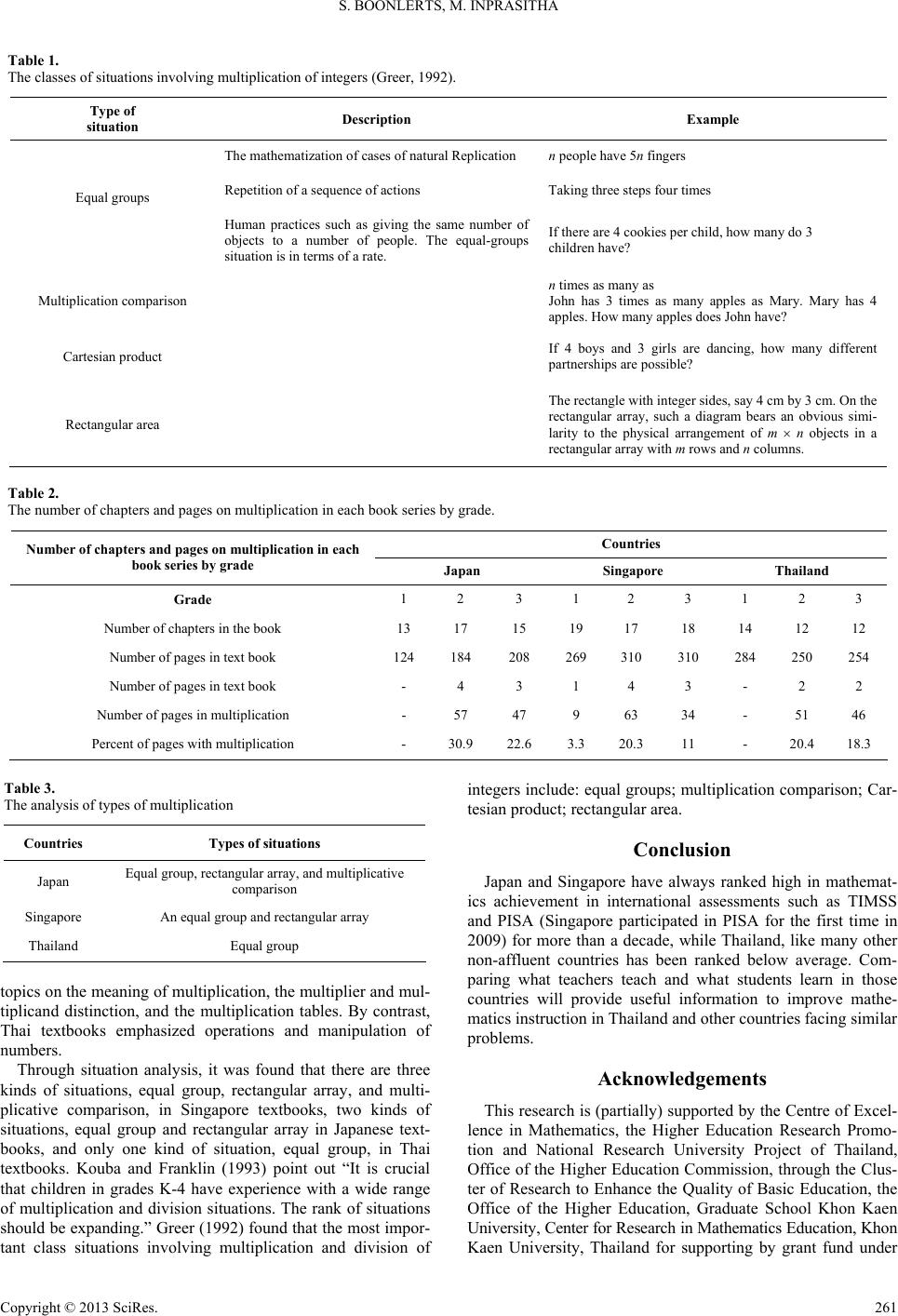 S. BOONLERTS, M. INPRASIT HA Copyright © 2013 SciRe s . 261 Table 1. The classes of situations involving multiplication of integers (Greer, 1992). Type of situation Description Example The mathematization of cases of natural Replication n people have 5n fingers Repetition of a sequence of actions Taking three s teps four times Equal grou ps Human practices such as giving the same number of objects to a number of people. The equal-groups situation is in terms of a rate. If there are 4 cookies per child, how many do 3 children have? Multiplication comparison n times as many as John has 3 times as many apples as Mary. Mary has 4 apples. How many apples does John have? Cartesian product If 4 boys and 3 girls are dancing, how many different partnerships are possible? Rectangular area The rectangle with integer side s , say 4 cm by 3 cm. On the rectangular array, such a diagram bears an obvious simi- larity to the physical arrangement of m n objects in a rectangular array with m rows and n columns. Table 2. The number of ch apters and pages on mul tiplication in each book series by grade. Countries Number of chapters and pages on multiplication in each book ser i es by grade Japan Singapore Thailand Grade 1 2 3 1 2 3 1 2 3 Number of chapters in the bo ok 13 17 15 19 17 18 14 12 12 Number of pages in text book 124 184 208 269 310 310 284 250 254 Number of pages in text book - 4 3 1 4 3 - 2 2 Number of pages in multiplicatio n - 57 47 9 63 34 - 51 46 Percent of pages with multiplication - 30.9 22.6 3.3 20.3 11 - 20.4 18.3 Table 3. The analysis of types of multiplication Countries Types of situatio ns Japan Equal grou p , rectangular array, and multiplica ti ve comparison Singapore An equal gro up and recta ng ul ar array Thailand Equal group topics on the meaning of multiplication, the multiplier and mul- tiplicand distinction, and the multiplication tables. By contrast, Thai textbooks emphasized operations and manipulation of numbers. Through situation analysis, it was found that there are three kinds of situations, equal group, rectangular array, and multi- plicative comparison, in Singapore textbooks, two kinds of situations, equal group and rectangular array in Japanese text- books, and only one kind of situation, equal group, in Thai textbooks. Kouba and Franklin (1993) point out “It is crucial that children in grades K-4 have experience with a wide range of multiplication and division situations. The rank of situations should be expanding.” Greer (1992) found that the most impor- tant class situations involving multiplication and division of integers include: equal groups; multiplication comparison; Car- tesian product; rectangular area. Conclusion Japan and Singapore have always ranked high in mathemat- ics achievement in international assessments such as TIMSS and PISA (Singapore participated in PISA for the first time in 2009) for more than a decade, while Thailand, like many other non-affluent countries has been ranked below average. Com- paring what teachers teach and what students learn in those countries will provide useful information to improve mathe- matics instruction in Thailand and other countries facing similar problems. Acknowledgements This research is (partially) supported by the Centre of Excel- lence in Mathematics, the Higher Education Research Promo- tion and National Research University Project of Thailand, Office of the Higher Education Commission, through the Clus- ter of Research to Enhance the Quality of Basic Education, the Office of the Higher Education, Graduate School Khon Kaen University, Center for Research in Mathematics Education, Khon Kaen University, Thailand for supporting by grant fund under  S. BOONLERTS, M. INPRASIT HA the program Strategic Scholarships for Frontier Research Net- work for the Ph.D. Program Thai Doctoral degree Commission for this research REFERENCES Alajmi, A. (2011). How do elementary textbooks address fraction? A review of mathematics textbooks in the USA, Japan, and Kuwait. Educational Studies in Mathematics, 79, 239-261. doi:10.1007/s10649-011-9342-1 Anghileri, J. (1989). An investigation of young children’s understand- ing of multiplication. Educational Studies in Mathematics, 20, 367- 385. doi:10.1007/BF00315607 Behr, M., Harel, G., Post, T., & Lesh, R. (1994). Units of quantity: A conceptual basis common to additive and multi plicative structures. In G. Harel, & J. Confrey (Eds.), The development of multiplicative reasoning in the learning of mathematics (pp. 121-176). Albany, NY: State University of New York Press. Bell, A., Greer, B., Grimison, L., & Mangan, C. (1989). Children’s performance on multiplicative word problems: Elements of a de- scriptive theory. Journal for Research in Mathematics Education, 20, 434-449. doi:10.2307/749419 Bierhoff, H. (1996). Laying the foundations of numeracy: A compari- son of primary school textbooks in Britain, Germany and Switzer- land. Teaching Mathematics and its Applications, 15, 141-160. doi:10.1093/teamat/15.4.141 Brown, J. K. (1973). Textbook use by teachers and students of geome- try and second-year algebra. Doctoral Dissertation, Urbana: Univer- sity of Illinois. Confrey, J., & Smith, E. (1995). Splitting, covariation, and their role in the development of exponential functions. Journal of Research in Mathematics Education, 26, 66-86. doi:10.2307/749228 Chung, I., & Lew, H.-C. (2007). Comparing Korean and US third grade elementary student conceptual understanding of basic multiplication facts. In J. H. Woo, H. C. Lew, K. S. Park, & D. Y. Seo (Eds.), Pro- ceeding of the 31st International Conference of the International Group for the Psychology of Mathematics Education, Volume 2 (pp. 161-168). Seoul: The Korea Society of Educational Studies in Mathe- matics. Fan, L. H., & Kaeley, G. S. (2000). The influence of textbook on teach- ing strategies: An empirical study. Mid-Western Educational Re- searcher, 13, 2-9. Fan, L. H., & Zhu, Y. (2007). Representation of problem-solving pro- cedures: A comparative look at China, Singapore and US mathemat- ics textbooks. Educational Studies in Mathematics, 66, 61-75. doi:10.1007/s10649-006-9069-6 Fan, L. H. (2010). Principle and processes for publishing textbooks and alignment with standards: A case in Singapore. In The APEC Con- ference on Replicating Exemplary Practices in Mathematics Educa- tion (pp. ). Surat Thani: The Internatio n a l School of Tourism. Fujii, T. (2001). The changing winds in Japanese mathematics educa- tion. URL (last checked 19 June 2002). http://www.nctm.org/dialogues/2001-11/20011105.htm Gelman, R. (1999). Naïve mathematics. In R. A. Wilson, & F. C. Keil (Eds.), The MIT encyclopaedia of the cognitive sciences (pp. 575- 577). Cambridge, MA: MIT Press. Graeber, A. O., & Tanenhaus, E. (1993). Multiplication and division: From whole number to rational numbers. In T. Owens (Ed.), Re- search ideas for the classroom middle grade mathematics (pp. 99- 117). New York: Macmillan Publishing Company. Greer, B. (1992). Multiplication and division as models of situations. In D. A. Grouws (Ed.), Handbook of research on mathematics teaching and learning (pp. 276-295). New York: Macmillan Publishing Com- pany. Irwin, K.C. (2004). Multiplicative strategies of New Zealand secondary school students. In M. J. Høines, & A. B. Fuglestad (Eds.), Proceed- ing of the 28th International Conference of the International Group for the Psychology of Mathematics Education, Volume 3 (pp. 111- 116). Norway: Bengen University College. Isoda, M. (2010). Elementary school teaching guide for the Japanese course of study: Mathematics (Grade 1 - 6) with the English transla- tion on the opposite page. URL (last checked 1 December2011). http://e-archives.criced.tsukuba.ac.jp/data/doc/pdf/2010/08/20100805 4956.pdf Kouba, V. L., & Franklin, K. (1993). Multiplication and division: Sense making and meaning. In J. Jansen (Eds.), Research ideas for the classroom early childhood mathematics (pp. 103-126). New York: Macmillan Publishing Company. Mulligan, J. T., & Mitchelmore, M. C. (1997). Young children’s intui- tive models of multiplication and division. Journal for Research in Mathematics Education, 28, 309-331. Shimizu, S., & Watanabe, T. (2010). Principle and processes for pub- lishing textbooks and alignment with standards: A case in Japan. The APEC Conference on Replicating Exemplary Practices in Mathe- matics Education (pp. 1-6). Surat Thani: The International School of Tourism. Piaget, J. (1987). Possibility and necessity. Minneapolis: University of Minnesota Press. Tosho, G. (2005). Mathematics for elementary school for first grade. Tokyo: Gakkoh Tosho Co., Ltd. Marshall Cavendish Education (2010). My PALS are here! For first grade. Singapore: T imes Publishing Limited. Ministry of Education (2007). Mathematics textbook for first grade. Bangkok: Kurusapha. Copyright © 2013 SciRe s . 262 |