

Paper Menu >>
Journal Menu >>
 Modern Plastic Surgery, 2013, 3, 68-70 http://dx.doi.org/10.4236/mps.2013.32013 Published Online April 2013 (http://www.scirp.org/journal/mps) A Rare Complication: Perioral Burn Related to Electrocautery Use during Adenotonsillectomy Erkun Tuncer1, Sadık Şentürk2 1Department of Otolaryngology—Head and Neck Surgery, Mevlana (Rumi) University Hospital, Konya, Turkey; 2Department of Plastic and Reconstructive Surgery, Mevlana (Rumi) University Hospital, Konya, Turkey. Email: [email protected], [email protected] Received February 22nd, 2013; revised March 25th, 2013; accepted April 1st, 2013 Copyright © 2013 Erkun Tuncer, Sadık Şentürk. This is an open access article distributed under the Creative Commons Attribution License, which permits unrestricted use, distribution, and reproduction in any medium, provided the original work is properly cited. ABSTRACT Electrocautery is frequently used for incisions and bleeding control during adenotonsillectomy which is one of the most commonly performed pediatric surgical procedures. Although cases of perioral burn related to electrocautery use are rarely reported complications in literature, they account for a significant portion of malpractice lawsuits. The use of insulated surgical tools and lip protective equipment, careful surgery, and the frequent control of surgical equipment may decrease the number of this complication. This study examines whether a rarely reported complication related to perioral burn is indeed rarely seen or whether there are problems in reporting the real rates because it is evaluated to be a case of malpractice, and the protective factors that will prevent this problem. Consequently, it is underlined that this complication, which is more frequently seen than it is reported, should be a part of preoperative information process and the consent form. Keywords: Burn; Adenotonsillectomy; Tonsillectomy; Malpractice; Perioral Burn 1. Introduction The most frequently reported complications related to adenotonsillectomy, which is one of the most commonly performed pediatric surgical procedures, include bleed- ing, pain, dehydration, fever, airway obstruction related to edema, nasopharyngeal stenosis, voice change, and velopharyngeal insufficiency [1,2-4]. The rate of perioral burns after adenotonsillectomy is between 0.01% and 0.04% according to literature [5-7]. Although cases of perioral burn related to electrocautery use are rarely re- ported complications in literature, they account for a sig- nificant portion of malpractice lawsuits [1]. The use of insulated surgical tools and lip protective equipment, careful surgery, and the frequent control of surgical equipment may decrease the number of this complication [7,8]. Although perioral burn cases have been rarely re- ported, different stages of this complication is frequently seen and therefore we believe that perioral burn as a complication should be included in the preoperative in- formation process and in the content of the consent form. 2. Case Report A 10-year-old male patient presented with a complaint of deep injury on his lip. The patient’s physical examination demonstrated that he had a third-degree burn of about 2 cm in size covering the skin, mucosa, and the orbicular muscle on his lower lip’s right comissure and he was hospitalized for treatment (Figure 1). The patient’s me- dical history revealed that he had had an adenotonsillec- tomy procedure performed under general anesthesia be- cause of chronic adenotonsillitis at another medical cen- ter 3 weeks before his presentation at our clinic. His rou- tine pre-op lab results were normal. The necrotic tissue on the lower lip was debrided under general anesthesia and the oral mucosa was repaired with 5-0 absorbable suture. Following the repair of the orbicularis oris muscle, which was dissected on both sides of the defect, with 4-0 absorbable suture, the skin was primarily closed with 6-0 polypropylene suture. The patient’s post-op course was without any problems and the result was satisfactory (Figure 2). 3. Discussion Perioral burn is a rarely reported complication (0.01% - 0.04%) when its incidence rate is compared to complica- tions like bleeding, pain, dehydration, fever, airway ob- struction related to edema, nasopharyngeal stenosis, voice Copyright © 2013 SciRes. MPS 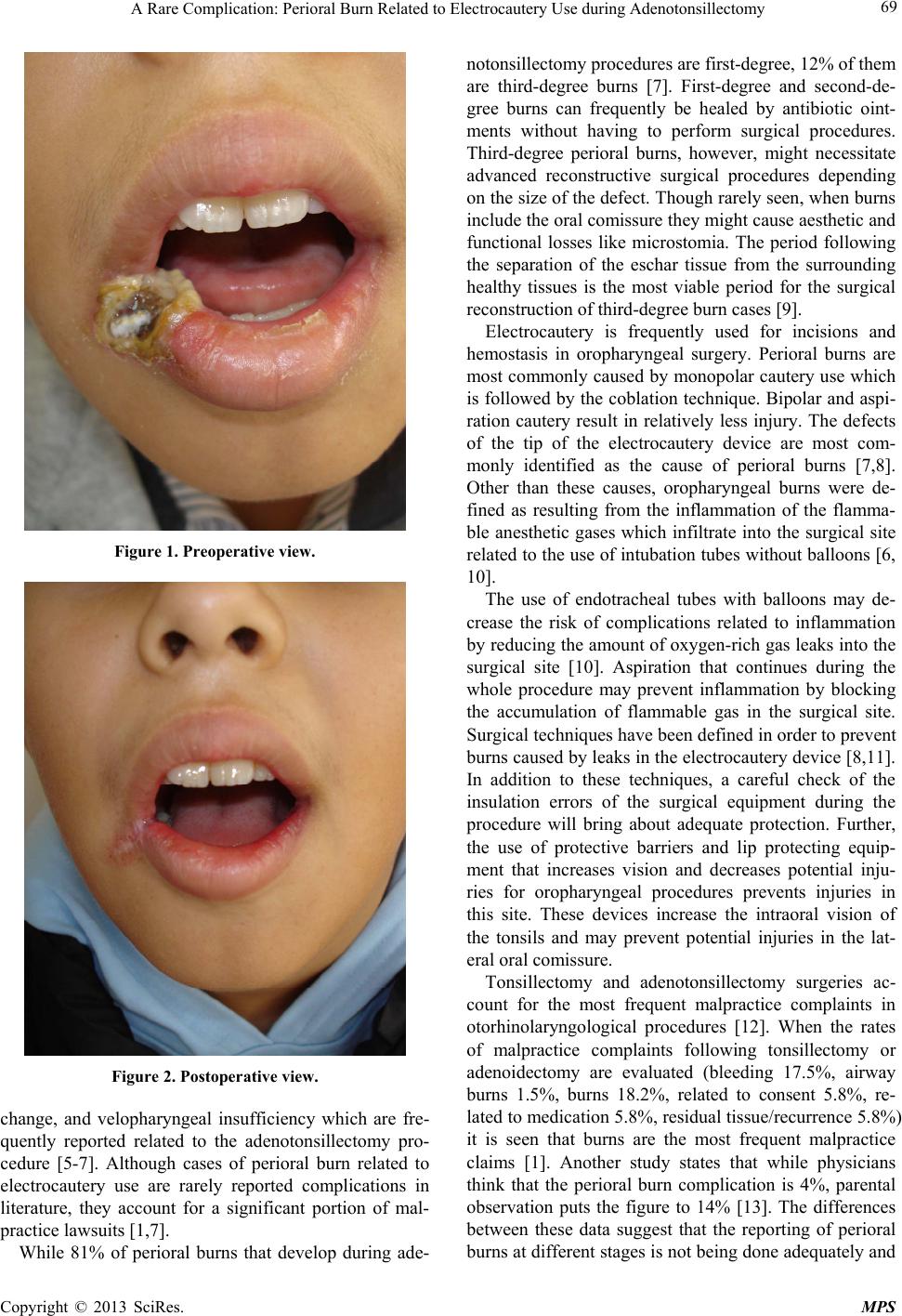 A Rare Complication: Perioral Burn Related to Electrocautery Use during Adenotonsillectomy 69 Figure 1. Preoperative view. Figure 2. Postoperative view. change, and velopharyngeal insufficiency which are fre- quently reported related to the adenotonsillectomy pro- cedure [5-7]. Although cases of perioral burn related to electrocautery use are rarely reported complications in literature, they account for a significant portion of mal- practice lawsuits [1,7]. While 81% of perioral burns that develop during ade- notonsillectomy procedures are first-degree, 12% of them are third-degree burns [7]. First-degree and second-de- gree burns can frequently be healed by antibiotic oint- ments without having to perform surgical procedures. Third-degree perioral burns, however, might necessitate advanced reconstructive surgical procedures depending on the size of the defect. Though rarely seen, when burns include the oral comissure they might cause aesthetic and functional losses like microstomia. The period following the separation of the eschar tissue from the surrounding healthy tissues is the most viable period for the surgical reconstruction of third-degree burn cases [9]. Electrocautery is frequently used for incisions and hemostasis in oropharyngeal surgery. Perioral burns are most commonly caused by monopolar cautery use which is followed by the coblation technique. Bipolar and aspi- ration cautery result in relatively less injury. The defects of the tip of the electrocautery device are most com- monly identified as the cause of perioral burns [7,8]. Other than these causes, oropharyngeal burns were de- fined as resulting from the inflammation of the flamma- ble anesthetic gases which infiltrate into the surgical site related to the use of intubation tubes without balloons [6, 10]. The use of endotracheal tubes with balloons may de- crease the risk of complications related to inflammation by reducing the amount of oxygen-rich gas leaks into the surgical site [10]. Aspiration that continues during the whole procedure may prevent inflammation by blocking the accumulation of flammable gas in the surgical site. Surgical techniques have been defined in order to prevent burns caused by leaks in the electrocautery device [8,11]. In addition to these techniques, a careful check of the insulation errors of the surgical equipment during the procedure will bring about adequate protection. Further, the use of protective barriers and lip protecting equip- ment that increases vision and decreases potential inju- ries for oropharyngeal procedures prevents injuries in this site. These devices increase the intraoral vision of the tonsils and may prevent potential injuries in the lat- eral oral comissure. Tonsillectomy and adenotonsillectomy surgeries ac- count for the most frequent malpractice complaints in otorhinolaryngological procedures [12]. When the rates of malpractice complaints following tonsillectomy or adenoidectomy are evaluated (bleeding 17.5%, airway burns 1.5%, burns 18.2%, related to consent 5.8%, re- lated to medication 5.8%, residual tissue/recurrence 5.8%) it is seen that burns are the most frequent malpractice claims [1]. Another study states that while physicians think that the perioral burn complication is 4%, parental observation puts the figure to 14% [13]. The differences between these data suggest that the reporting of perioral burns at different stages is not being done adequately and Copyright © 2013 SciRes. MPS 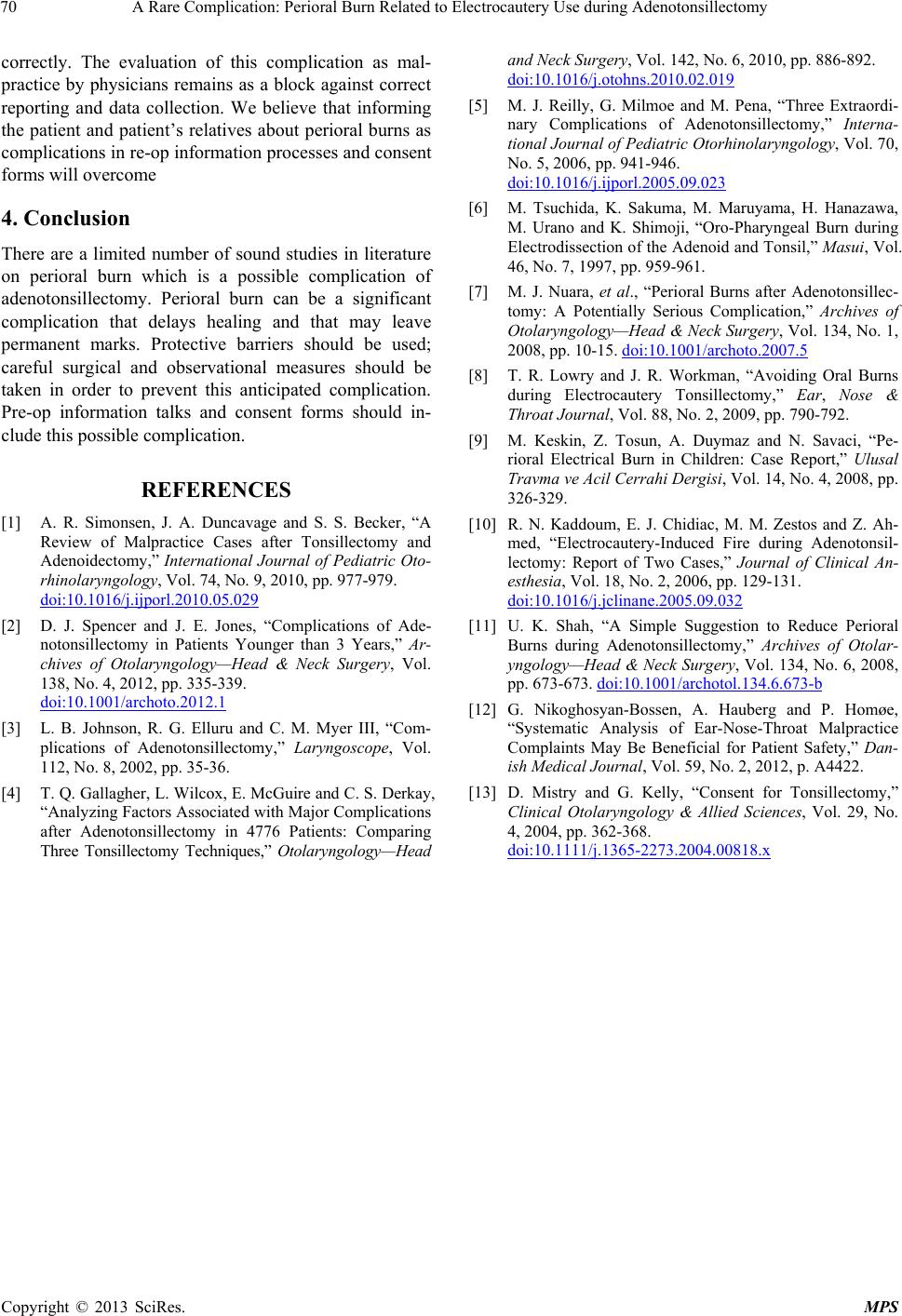 A Rare Complication: Perioral Burn Related to Electrocautery Use during Adenotonsillectomy Copyright © 2013 SciRes. MPS 70 correctly. The evaluation of this complication as mal- practice by physicians remains as a block against correct reporting and data collection. We believe that informing the patient and patient’s relatives about perioral burns as complications in re-op information processes and consent forms will overcome 4. Conclusion There are a limited number of sound studies in literature on perioral burn which is a possible complication of adenotonsillectomy. Perioral burn can be a significant complication that delays healing and that may leave permanent marks. Protective barriers should be used; careful surgical and observational measures should be taken in order to prevent this anticipated complication. Pre-op information talks and consent forms should in- clude this possible complication. REFERENCES [1] A. R. Simonsen, J. A. Duncavage and S. S. Becker, “A Review of Malpractice Cases after Tonsillectomy and Adenoidectomy,” International Journal of Pediatric Oto- rhinolaryngology, Vol. 74, No. 9, 2010, pp. 977-979. doi:10.1016/j.ijporl.2010.05.029 [2] D. J. Spencer and J. E. Jones, “Complications of Ade- notonsillectomy in Patients Younger than 3 Years,” Ar- chives of Otolaryngology—Head & Neck Surgery, Vol. 138, No. 4, 2012, pp. 335-339. doi:10.1001/archoto.2012.1 [3] L. B. Johnson, R. G. Elluru and C. M. Myer III, “Com- plications of Adenotonsillectomy,” Laryngoscope, Vol. 112, No. 8, 2002, pp. 35-36. [4] T. Q. Gallagher, L. Wilcox, E. McGuire and C. S. Derkay, “Analyzing Factors Associated with Major Complications after Adenotonsillectomy in 4776 Patients: Comparing Three Tonsillectomy Techniques,” Otolaryngology—Head and Neck Surgery, Vol. 142, No. 6, 2010, pp. 886-892. doi:10.1016/j.otohns.2010.02.019 [5] M. J. Reilly, G. Milmoe and M. Pena, “Three Extraordi- nary Complications of Adenotonsillectomy,” Interna- tional Journal of Pediatric Otorhinolaryngology, Vol. 70, No. 5, 2006, pp. 941-946. doi:10.1016/j.ijporl.2005.09.023 [6] M. Tsuchida, K. Sakuma, M. Maruyama, H. Hanazawa, M. Urano and K. Shimoji, “Oro-Pharyngeal Burn during Electrodissection of the Adenoid and Tonsil,” Masui, Vol. 46, No. 7, 1997, pp. 959-961. [7] M. J. Nuara, et al., “Perioral Burns after Adenotonsillec- tomy: A Potentially Serious Complication,” Archives of Otolaryngology—Head & Neck Surgery, Vol. 134, No. 1, 2008, pp. 10-15. doi:10.1001/archoto.2007.5 [8] T. R. Lowry and J. R. Workman, “Avoiding Oral Burns during Electrocautery Tonsillectomy,” Ear, Nose & Throat Journal, Vol. 88, No. 2, 2009, pp. 790-792. [9] M. Keskin, Z. Tosun, A. Duymaz and N. Savaci, “Pe- rioral Electrical Burn in Children: Case Report,” Ulusal Travma ve Acil Cerrahi Dergisi, Vol. 14, No. 4, 2008, pp. 326-329. [10] R. N. Kaddoum, E. J. Chidiac, M. M. Zestos and Z. Ah- med, “Electrocautery-Induced Fire during Adenotonsil- lectomy: Report of Two Cases,” Journal of Clinical An- esthesia, Vol. 18, No. 2, 2006, pp. 129-131. doi:10.1016/j.jclinane.2005.09.032 [11] U. K. Shah, “A Simple Suggestion to Reduce Perioral Burns during Adenotonsillectomy,” Archives of Otolar- yngology—Head & Neck Surgery, Vol. 134, No. 6, 2008, pp. 673-673. doi:10.1001/archotol.134.6.673-b [12] G. Nikoghosyan-Bossen, A. Hauberg and P. Homøe, “Systematic Analysis of Ear-Nose-Throat Malpractice Complaints May Be Beneficial for Patient Safety,” Dan- ish Medical Journal, Vol. 59, No. 2, 2012, p. A4422. [13] D. Mistry and G. Kelly, “Consent for Tonsillectomy,” Clinical Otolaryngology & Allied Sciences, Vol. 29, No. 4, 2004, pp. 362-368. doi:10.1111/j.1365-2273.2004.00818.x |