

Paper Menu >>
Journal Menu >>
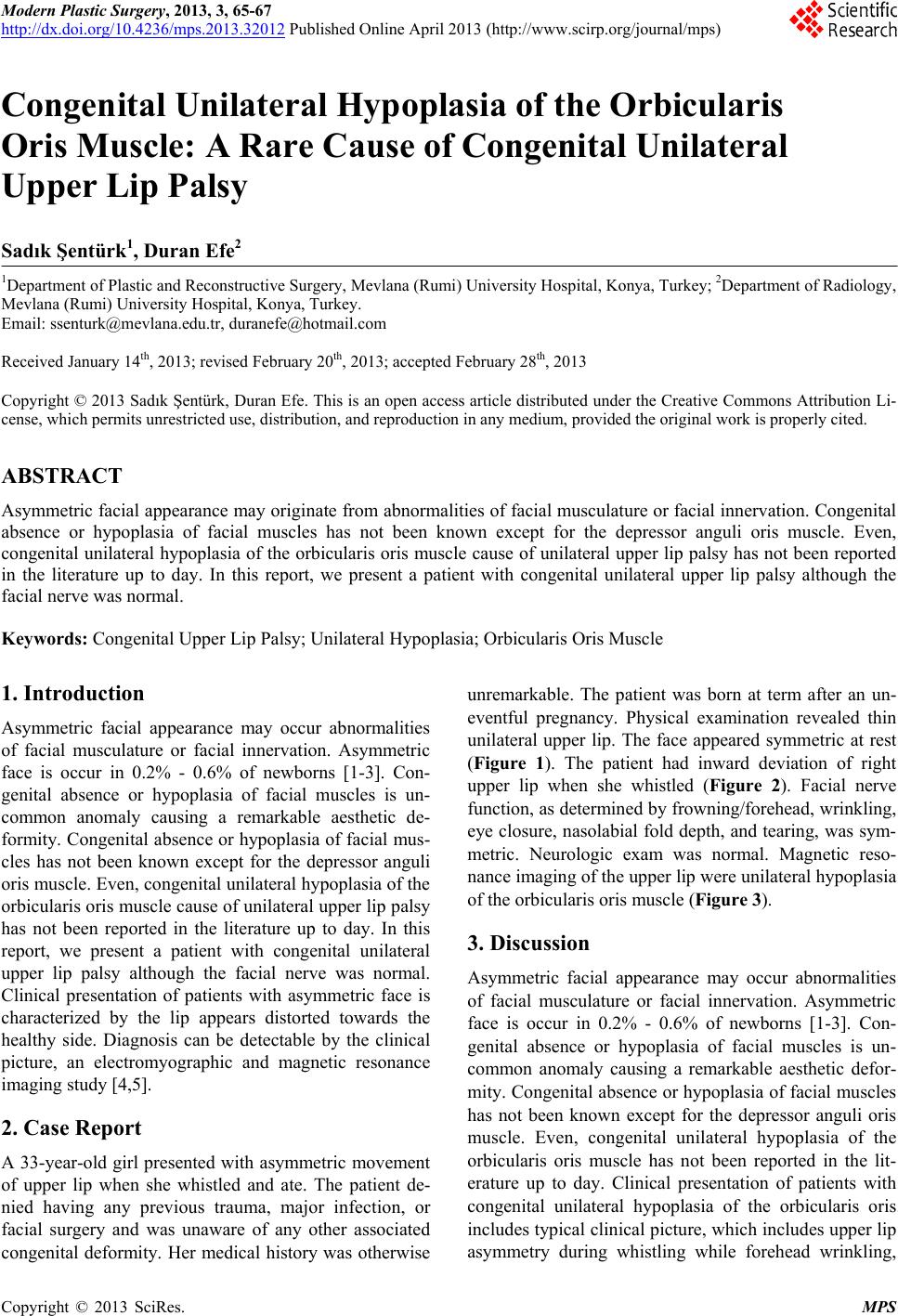 Modern Plastic Surgery, 2013, 3, 65-67 http://dx.doi.org/10.4236/mps.2013.32012 Published Online April 2013 (http://www.scirp.org/journal/mps) 65 Congenital Unilateral Hypoplasia of the Orbicularis Oris Muscle: A Rare Cause of Congenital Unilateral Upper Lip Palsy Sadık Şentürk1, Duran Efe2 1Department of Plastic and Reconstructive Surgery, Mevlana (Rumi) University Hospital, Konya, Turkey; 2Department of Radiology, Mevlana (Rumi) University Hospital, Konya, Turkey. Email: [email protected], [email protected] Received January 14th, 2013; revised February 20th, 2013; accepted February 28th, 2013 Copyright © 2013 Sadık Şentürk, Duran Efe. This is an open access article distributed under the Creative Commons Attribution Li- cense, which permits unrestricted use, distribution, and reproduction in any medium, provided the original work is properly cited. ABSTRACT Asymmetric facial appearance may originate from abnormalities of facial musculature or facial innervation. Congenital absence or hypoplasia of facial muscles has not been known except for the depressor anguli oris muscle. Even, congenital unilateral hypoplasia of the orbicularis oris muscle cause of unilateral upper lip palsy has not been reported in the literature up to day. In this report, we present a patient with congenital unilateral upper lip palsy although the facial nerve was normal. Keywords: Congenital Upper Lip Palsy; Unilateral Hypoplasia; Orbicularis Oris Muscle 1. Introduction Asymmetric facial appearance may occur abnormalities of facial musculature or facial innervation. Asymmetric face is occur in 0.2% - 0.6% of newborns [1-3]. Con- genital absence or hypoplasia of facial muscles is un- common anomaly causing a remarkable aesthetic de- formity. Congenital absence or hypoplasia of facial mus- cles has not been known except for the depressor anguli oris muscle. Even, congenital unilateral hypoplasia of the orbicularis oris muscle cause of unilateral upper lip palsy has not been reported in the literature up to day. In this report, we present a patient with congenital unilateral upper lip palsy although the facial nerve was normal. Clinical presentation of patients with asymmetric face is characterized by the lip appears distorted towards the healthy side. Diagnosis can be detectable by the clinical picture, an electromyographic and magnetic resonance imaging study [4,5]. 2. Case Report A 33-year-old girl presented with asymmetric movement of upper lip when she whistled and ate. The patient de- nied having any previous trauma, major infection, or facial surgery and was unaware of any other associated congenital deformity. Her medical history was otherwise unremarkable. The patient was born at term after an un- eventful pregnancy. Physical examination revealed thin unilateral upper lip. The face appeared symmetric at rest (Figure 1). The patient had inward deviation of right upper lip when she whistled (Figure 2). Facial nerve function, as determined by frowning/forehead, wrinkling, eye closure, nasolabial fold depth, and tearing, was sym- metric. Neurologic exam was normal. Magnetic reso- nance imaging of the upper lip were unilateral hypoplasia of the orbicularis oris muscle (Figure 3). 3. Discussion Asymmetric facial appearance may occur abnormalities of facial musculature or facial innervation. Asymmetric face is occur in 0.2% - 0.6% of newborns [1-3]. Con- genital absence or hypoplasia of facial muscles is un- common anomaly causing a remarkable aesthetic defor- mity. Congenital absence or hypoplasia of facial muscles has not been known except for the depressor anguli oris muscle. Even, congenital unilateral hypoplasia of the orbicularis oris muscle has not been reported in the lit- erature up to day. Clinical presentation of patients with congenital unilateral hypoplasia of the orbicularis oris includes typical clinical picture, which includes upper lip asymmetry during whistling while forehead wrinkling, Copyright © 2013 SciRes. MPS 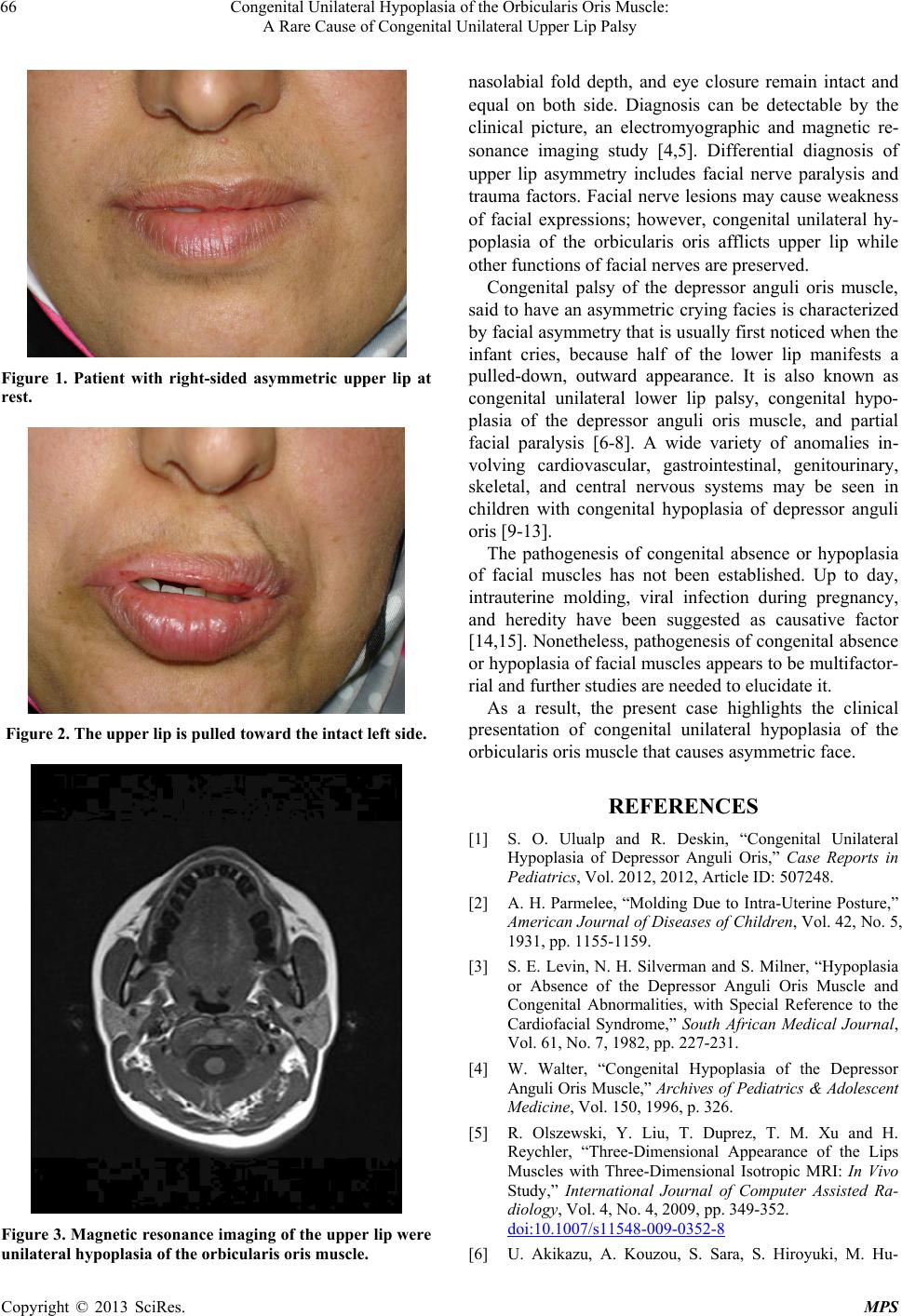 Congenital Unilateral Hypoplasia of the Orbicularis Oris Muscle: A Rare Cause of Congenital Unilateral Upper Lip Palsy 66 Figure 1. Patient with right-sided asymmetric upper lip at rest. Figure 2. The upper lip is pulled toward the intact left side. Figure 3. Magnetic resonance imaging of the upper lip were unilateral hypoplasia of the orbicularis oris muscle. nasolabial fold depth, and eye closure remain intact and equal on both side. Diagnosis can be detectable by the clinical picture, an electromyographic and magnetic re- sonance imaging study [4,5]. Differential diagnosis of upper lip asymmetry includes facial nerve paralysis and trauma factors. Facial nerve lesions may cause weakness of facial expressions; however, congenital unilateral hy- poplasia of the orbicularis oris afflicts upper lip while other functions of facial nerves are preserved. Congenital palsy of the depressor anguli oris muscle, said to have an asymmetric crying facies is characterized by facial asymmetry that is usually first noticed when the infant cries, because half of the lower lip manifests a pulled-down, outward appearance. It is also known as congenital unilateral lower lip palsy, congenital hypo- plasia of the depressor anguli oris muscle, and partial facial paralysis [6-8]. A wide variety of anomalies in- volving cardiovascular, gastrointestinal, genitourinary, skeletal, and central nervous systems may be seen in children with congenital hypoplasia of depressor anguli oris [9-13]. The pathogenesis of congenital absence or hypoplasia of facial muscles has not been established. Up to day, intrauterine molding, viral infection during pregnancy, and heredity have been suggested as causative factor [14,15]. Nonetheless, pathogenesis of congenital absence or hypoplasia of facial muscles appears to be multifactor- rial and further studies are needed to elucidate it. As a result, the present case highlights the clinical presentation of congenital unilateral hypoplasia of the orbicularis oris muscle that causes asymmetric face. REFERENCES [1] S. O. Ulualp and R. Deskin, “Congenital Unilateral Hypoplasia of Depressor Anguli Oris,” Case Reports in Pediatrics, Vol. 2012, 2012, Article ID: 507248. [2] A. H. Parmelee, “Molding Due to Intra-Uterine Posture,” American Journal of Diseases of Children, Vol. 42, No. 5, 1931, pp. 1155-1159. [3] S. E. Levin, N. H. Silverman and S. Milner, “Hypoplasia or Absence of the Depressor Anguli Oris Muscle and Congenital Abnormalities, with Special Reference to the Cardiofacial Syndrome,” South African Medical Journal, Vol. 61, No. 7, 1982, pp. 227-231. [4] W. Walter, “Congenital Hypoplasia of the Depressor Anguli Oris Muscle,” Archives of Pediatrics & Adolescent Medicine, Vol. 150, 1996, p. 326. [5] R. Olszewski, Y. Liu, T. Duprez, T. M. Xu and H. Reychler, “Three-Dimensional Appearance of the Lips Muscles with Three-Dimensional Isotropic MRI: In Vivo Study,” International Journal of Computer Assisted Ra- diology, Vol. 4, No. 4, 2009, pp. 349-352. doi:10.1007/s11548-009-0352-8 [6] U. Akikazu, A. Kouzou, S. Sara, S. Hiroyuki, M. Hu- Copyright © 2013 SciRes. MPS 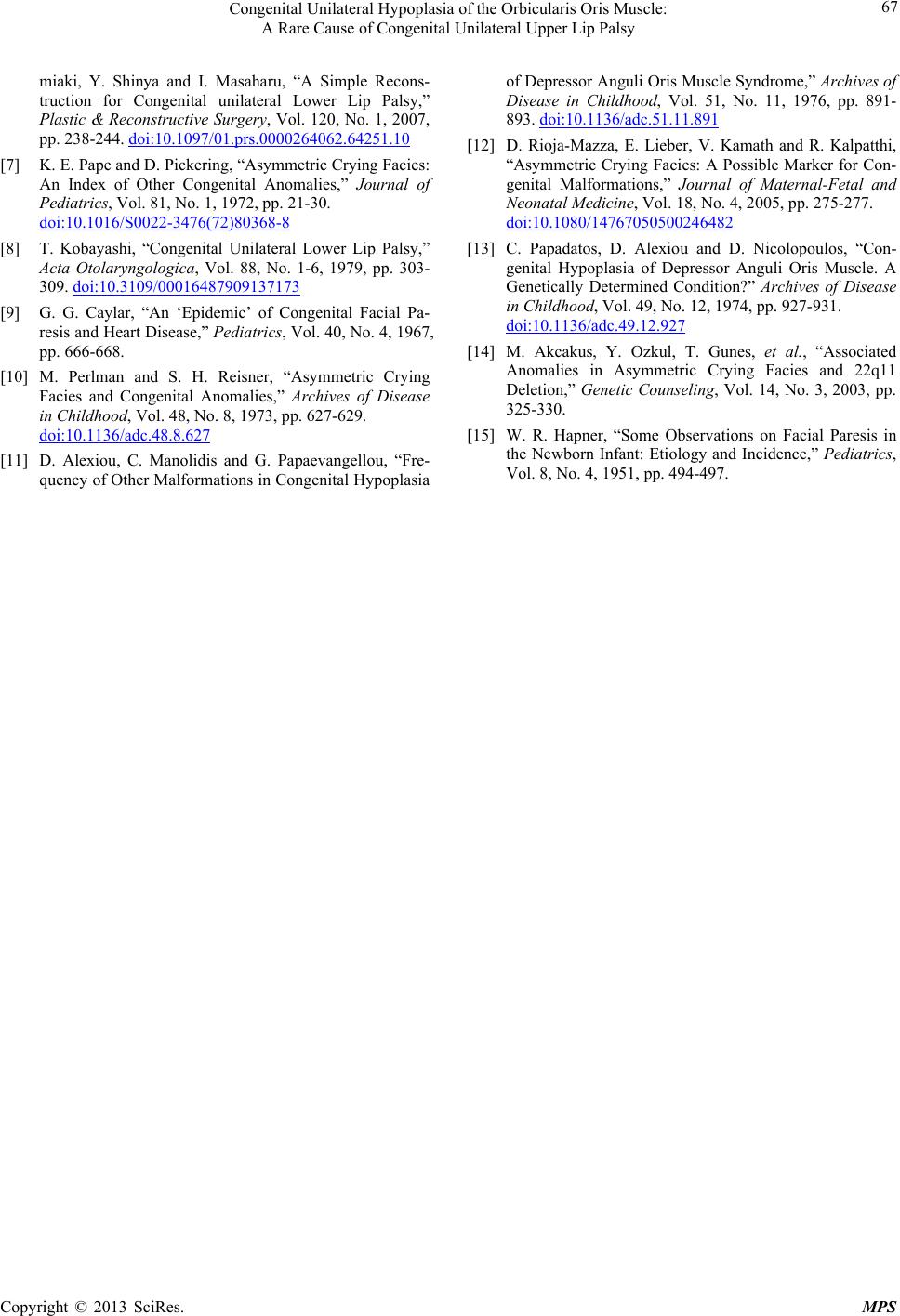 Congenital Unilateral Hypoplasia of the Orbicularis Oris Muscle: A Rare Cause of Congenital Unilateral Upper Lip Palsy Copyright © 2013 SciRes. MPS 67 miaki, Y. Shinya and I. Masaharu, “A Simple Recons- truction for Congenital unilateral Lower Lip Palsy,” Plastic & Reconstructive Surgery, Vol. 120, No. 1, 2007, pp. 238-244. doi:10.1097/01.prs.0000264062.64251.10 [7] K. E. Pape and D. Pickering, “Asymmetric Crying Facies: An Index of Other Congenital Anomalies,” Journal of Pediatrics, Vol. 81, No. 1, 1972, pp. 21-30. doi:10.1016/S0022-3476(72)80368-8 [8] T. Kobayashi, “Congenital Unilateral Lower Lip Palsy,” Acta Otolaryngologica, Vol. 88, No. 1-6, 1979, pp. 303- 309. doi:10.3109/00016487909137173 [9] G. G. Caylar, “An ‘Epidemic’ of Congenital Facial Pa- resis and Heart Disease,” Pediatrics, Vol. 40, No. 4, 1967, pp. 666-668. [10] M. Perlman and S. H. Reisner, “Asymmetric Crying Facies and Congenital Anomalies,” Archives of Disease in Childhood, Vol. 48, No. 8, 1973, pp. 627-629. doi:10.1136/adc.48.8.627 [11] D. Alexiou, C. Manolidis and G. Papaevangellou, “Fre- quency of Other Malformations in Congenital Hypoplasia of Depressor Anguli Oris Muscle Syndrome,” Archives of Disease in Childhood, Vol. 51, No. 11, 1976, pp. 891- 893. doi:10.1136/adc.51.11.891 [12] D. Rioja-Mazza, E. Lieber, V. Kamath and R. Kalpatthi, “Asymmetric Crying Facies: A Possible Marker for Con- genital Malformations,” Journal of Maternal-Fetal and Neonatal Medicine, Vol. 18, No. 4, 2005, pp. 275-277. doi:10.1080/14767050500246482 [13] C. Papadatos, D. Alexiou and D. Nicolopoulos, “Con- genital Hypoplasia of Depressor Anguli Oris Muscle. A Genetically Determined Condition?” Archives of Disease in Childhood, Vol. 49, No. 12, 1974, pp. 927-931. doi:10.1136/adc.49.12.927 [14] M. Akcakus, Y. Ozkul, T. Gunes, et al., “Associated Anomalies in Asymmetric Crying Facies and 22q11 Deletion,” Genetic Counseling, Vol. 14, No. 3, 2003, pp. 325-330. [15] W. R. Hapner, “Some Observations on Facial Paresis in the Newborn Infant: Etiology and Incidence,” Pediatrics, Vol. 8, No. 4, 1951, pp. 494-497. |