

Paper Menu >>
Journal Menu >>
 Vol.2, No.10, 1085-1089 (2010) Natural Science http://dx.doi.org/10.4236/ns.2010.210135 Copyright © 2010 SciRes. OPEN ACCESS New experimental constraints: implications for petrogenesis of charnockite of dioritic composition Rajib Kar1, Samarendra Bhattacharya2* 1Jagannath Kishore College, Purulia, India; 2Indian Statistical Institute, Kolkata, India; *Corresponding Author: [email protected]. Received 13 August 2010; revised 16 September 2010; accepted 21 September 2010. ABSTRACT Hornblende-dehydration melting experiments at high temperatures (> 950oC) indicate change of melt composition from tonalite/granodiorite to quartz-diorite; clinopyroxene instead of hornbl- ende as the residual phase and change in melt- ing reaction from peritectic hornblende-dehydr- ation to eutectic clinopyroxene-orthopyroxene- plagioclase. In the light of these experimental results, petrogenesis of a charnockite pluton of homogeneous dioritic composition in the East- ern Ghats Belt, India, can be explained as melt- ing at high-temperatures (> 950oC). Negative Sr and Eu anomalies further indicate plagioclase as a major residual phase, consistent with melt- ing at high-temperatures (> 950oC). Keywords: Dioritic charnockite; Residual clinopyroxene; Residual plagioclase; Eutectic melting 1. INTRODUCTION It is quite common that large-scale charnockitic bod- ies are of variable composition from tonalite to granodi- orite, and sometimes even dioritic composition is report- ed [1]. On the other hand, petrogenesis of massif-type charnockites have been variously described: a) mantle- derived and differentiated melt [2]; b) high-temperature melting of dry granulite facies rocks [3]; c) more mafic varieties as mantle-derived melts [4]; d) product of hornblende-dehydration melting in the deep crust [5]. New melting experiments provide constraints on the petrogenesis of charnockitic rocks of dioritic composi- tion. From the Jenapore area in the Eastern Ghats Belt, India, charnockite-massif was described as the product of hornblende-dehydration melting under granulite fa- cies conditions, and with residual hornblende. There the two-pyroxene granulites occur as minor patches and bands and were explained as peritectic segregates [5]. A stock-like body of charnockite (pluton) occurs in the same locale, a few kilometer to the south (Lat: 20o46' N; Long: 86o05' E). In contrast to the charnockite-massif, it is of more mafic and homogeneous composition at the outcrop-scale and commonly has both orthopyroxene and clinopyroxene. In the present communication we present geochemical data from the charnockite pluton and in the light of new experimental constraints explain its origin by melting at high-temperatures (≥ 950oC). 2. EXPERIMENTAL CONSTRAINTS The selected results of the hornblende-dehydration melting experiments is presented in Figure 1. The melts of 900oC and 925oC are tonalitic (normative Qtz / Plag > 0.25) and those above 950oC are quartz dioritic (norma- tive Qtz / Plag < 0.25) in composition. The melt compo- sition changes from corundum normative to diopside nor- mative when temperature increases from 925oC to 950oC. Also there is gradual decrease of plagioclase proportion with temperature rise. Moreover, the orthopyroxene and clinopyroxene are subequal in proportion at 900oC, and orthopyroxene gradually decreases in proportion to a trace amount at 1100oC. These results suggest that the nature of melting reaction changes from hornblende breakdown reaction at 925oC to eutectic clinopyroxene- orthopyroxene-plagioclase melting reaction at 950oC [6]. 3. CHARNOCKITE PLUTON The charnockite pluton at Jenapore is a relatively ho- mogeneous body of two-pyroxene granulite, unlike those occurring as minor bands and patches within the massif- type charnockite described from the area to the north [5]. Also as distinct from those within massif-type charnoc- kite garnet is absent, while clinopyroxene is much more abundant than orthopyroxene (Table 1). 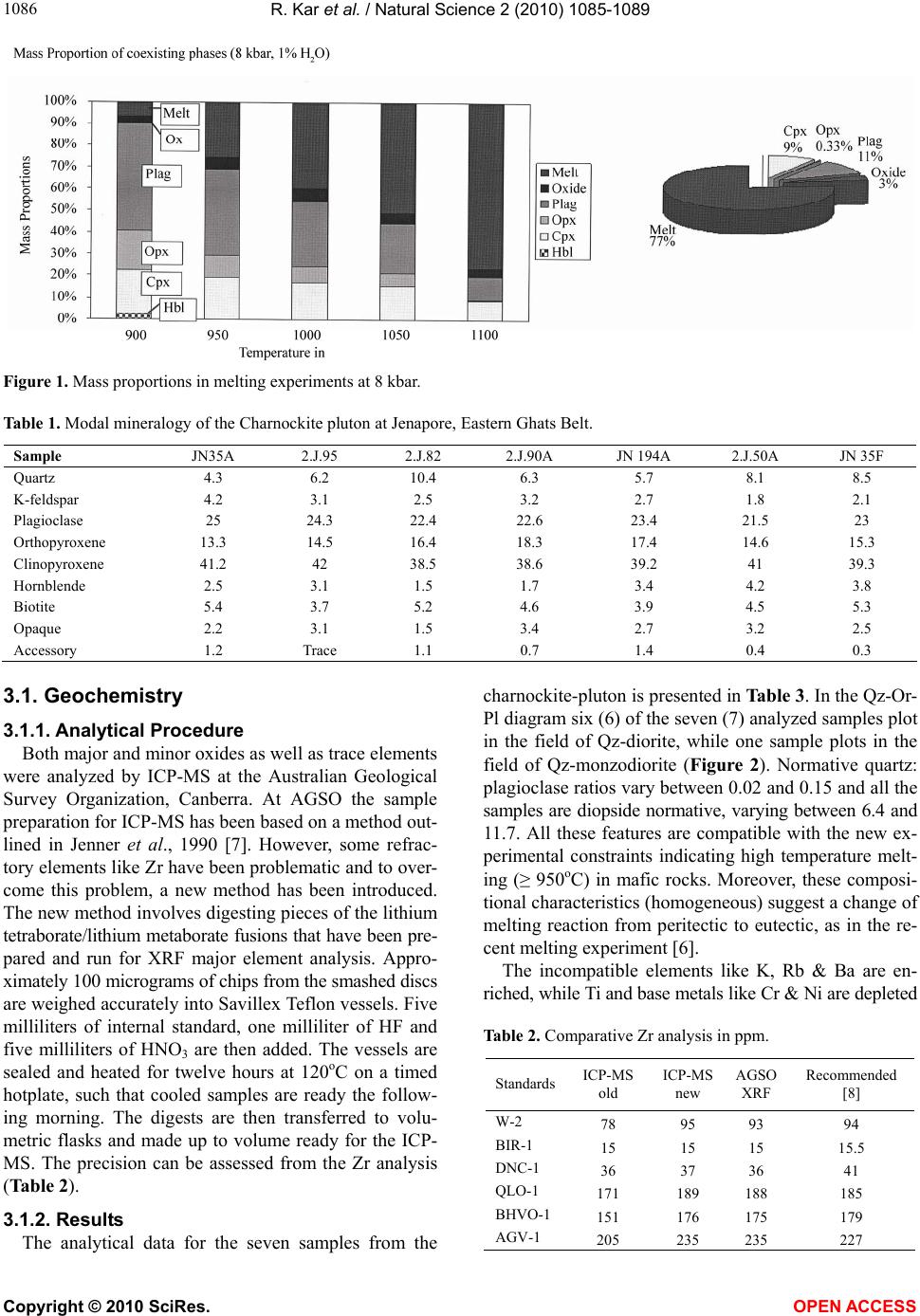 R. Kar et al. / Natural Science 2 (2010) 1085-1089 Copyright © 2010 SciRes. OPEN ACCESS 1086 Figure 1. Mass proportions in melting experiments at 8 kbar. Table 1. Modal mineralogy of the Charnockite pluton at Jenapore, Eastern Ghats Belt. Sample JN35A 2.J.95 2.J.82 2.J.90A JN 194A 2.J.50A JN 35F Quartz 4.3 6.2 10.4 6.3 5.7 8.1 8.5 K-feldspar 4.2 3.1 2.5 3.2 2.7 1.8 2.1 Plagioclase 25 24.3 22.4 22.6 23.4 21.5 23 Orthopyroxene 13.3 14.5 16.4 18.3 17.4 14.6 15.3 Clinopyroxene 41.2 42 38.5 38.6 39.2 41 39.3 Hornblende 2.5 3.1 1.5 1.7 3.4 4.2 3.8 Biotite 5.4 3.7 5.2 4.6 3.9 4.5 5.3 Opaque 2.2 3.1 1.5 3.4 2.7 3.2 2.5 Accessory 1.2 Trace 1.1 0.7 1.4 0.4 0.3 3.1. Geochemistry 3.1.1. Analytical Procedure Both major and minor oxides as well as trace elements were analyzed by ICP-MS at the Australian Geological Survey Organization, Canberra. At AGSO the sample preparation for ICP-MS has been based on a method out- lined in Jenner et al., 1990 [7]. However, some refrac- tory elements like Zr have been problematic and to over- come this problem, a new method has been introduced. The new method involves digesting pieces of the lithium tetraborate/lithium metaborate fusions that have been pre- pared and run for XRF major element analysis. Appro- ximately 100 micrograms of chips from the smashed discs are weighed accurately into Savillex Teflon vessels. Five milliliters of internal standard, one milliliter of HF and five milliliters of HNO3 are then added. The vessels are sealed and heated for twelve hours at 120oC on a timed hotplate, such that cooled samples are ready the follow- ing morning. The digests are then transferred to volu- metric flasks and made up to volume ready for the ICP- MS. The precision can be assessed from the Zr analysis (Table 2). 3.1.2. Results The analytical data for the seven samples from the charnockite-pluton is presented in Table 3. In the Qz-Or- Pl diagram six (6) of the seven (7) analyzed samples plot in the field of Qz-diorite, while one sample plots in the field of Qz-monzodiorite (Figure 2). Normative quartz: plagioclase ratios vary between 0.02 and 0.15 and all the samples are diopside normative, varying between 6.4 and 11.7. All these features are compatible with the new ex- perimental constraints indicating high temperature melt- ing (≥ 950oC) in mafic rocks. Moreover, these composi- tional characteristics (homogeneous) suggest a change of melting reaction from peritectic to eutectic, as in the re- cent melting experiment [6]. The incompatible elements like K, Rb & Ba are en- riched, while Ti and base metals like Cr & Ni are depleted Table 2. Comparative Zr analysis in ppm. Standards ICP-MS old ICP-MS new AGSO XRF Recommended [8] W-2 78 95 93 94 BIR-1 15 15 15 15.5 DNC-1 36 37 36 41 QLO-1 171 189 188 185 BHVO-1 151 176 175 179 AGV-1 205 235 235 227 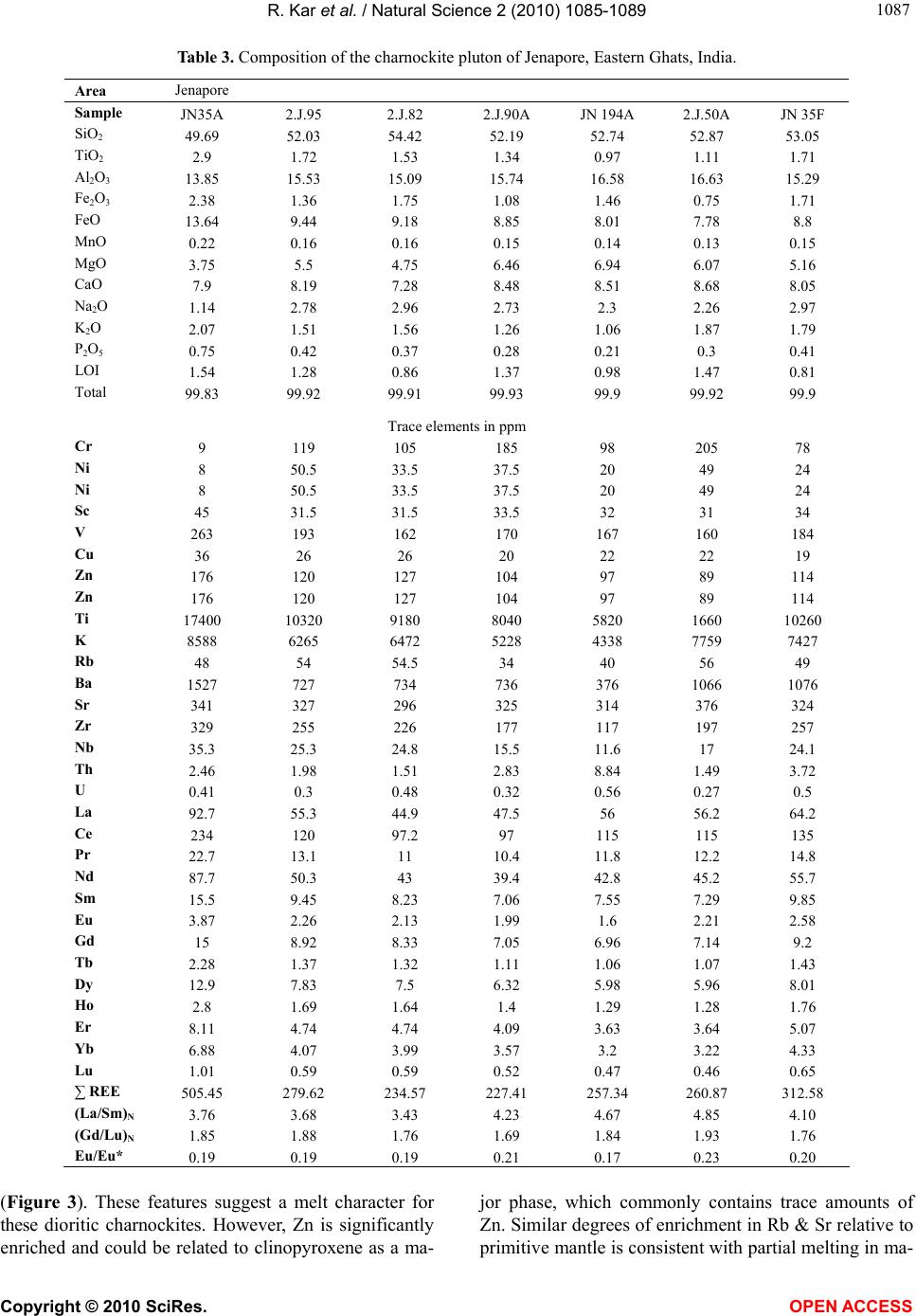 R. Kar et al. / Natural Science 2 (2010) 1085-1089 Copyright © 2010 SciRes. OPEN ACCESS 108 1087 Table 3. Composition of the charnockite pluton of Jenapore, Eastern Ghats, India. Area Jenapore Sample JN35A 2.J.95 2.J.82 2.J.90A JN 194A 2.J.50A JN 35F SiO2 49.69 52.03 54.42 52.19 52.74 52.87 53.05 TiO2 2.9 1.72 1.53 1.34 0.97 1.11 1.71 Al2O3 13.85 15.53 15.09 15.74 16.58 16.63 15.29 Fe2O3 2.38 1.36 1.75 1.08 1.46 0.75 1.71 FeO 13.64 9.44 9.18 8.85 8.01 7.78 8.8 MnO 0.22 0.16 0.16 0.15 0.14 0.13 0.15 MgO 3.75 5.5 4.75 6.46 6.94 6.07 5.16 CaO 7.9 8.19 7.28 8.48 8.51 8.68 8.05 Na2O 1.14 2.78 2.96 2.73 2.3 2.26 2.97 K2O 2.07 1.51 1.56 1.26 1.06 1.87 1.79 P2O5 0.75 0.42 0.37 0.28 0.21 0.3 0.41 LOI 1.54 1.28 0.86 1.37 0.98 1.47 0.81 Total 99.83 99.92 99.91 99.93 99.9 99.92 99.9 Trace elements in ppm Cr 9 119 105 185 98 205 78 Ni 8 50.5 33.5 37.5 20 49 24 Ni 8 50.5 33.5 37.5 20 49 24 Sc 45 31.5 31.5 33.5 32 31 34 V 263 193 162 170 167 160 184 Cu 36 26 26 20 22 22 19 Zn 176 120 127 104 97 89 114 Zn 176 120 127 104 97 89 114 Ti 17400 10320 9180 8040 5820 1660 10260 K 8588 6265 6472 5228 4338 7759 7427 Rb 48 54 54.5 34 40 56 49 Ba 1527 727 734 736 376 1066 1076 Sr 341 327 296 325 314 376 324 Zr 329 255 226 177 117 197 257 Nb 35.3 25.3 24.8 15.5 11.6 17 24.1 Th 2.46 1.98 1.51 2.83 8.84 1.49 3.72 U 0.41 0.3 0.48 0.32 0.56 0.27 0.5 La 92.7 55.3 44.9 47.5 56 56.2 64.2 Ce 234 120 97.2 97 115 115 135 Pr 22.7 13.1 11 10.4 11.8 12.2 14.8 Nd 87.7 50.3 43 39.4 42.8 45.2 55.7 Sm 15.5 9.45 8.23 7.06 7.55 7.29 9.85 Eu 3.87 2.26 2.13 1.99 1.6 2.21 2.58 Gd 15 8.92 8.33 7.05 6.96 7.14 9.2 Tb 2.28 1.37 1.32 1.11 1.06 1.07 1.43 Dy 12.9 7.83 7.5 6.32 5.98 5.96 8.01 Ho 2.8 1.69 1.64 1.4 1.29 1.28 1.76 Er 8.11 4.74 4.74 4.09 3.63 3.64 5.07 Yb 6.88 4.07 3.99 3.57 3.2 3.22 4.33 Lu 1.01 0.59 0.59 0.52 0.47 0.46 0.65 ∑ REE 505.45 279.62 234.57 227.41 257.34 260.87 312.58 (La/Sm)N 3.76 3.68 3.43 4.23 4.67 4.85 4.10 (Gd/Lu)N 1.85 1.88 1.76 1.69 1.84 1.93 1.76 Eu/Eu* 0.19 0.19 0.19 0.21 0.17 0.23 0.20 (Figure 3). These features suggest a melt character for these dioritic charnockites. However, Zn is significantly enriched and could be related to clinopyroxene as a ma- jor phase, which commonly contains trace amounts of Zn. Similar degrees of enrichment in Rb & Sr relative to primitive mantle is consistent with partial melting in ma- 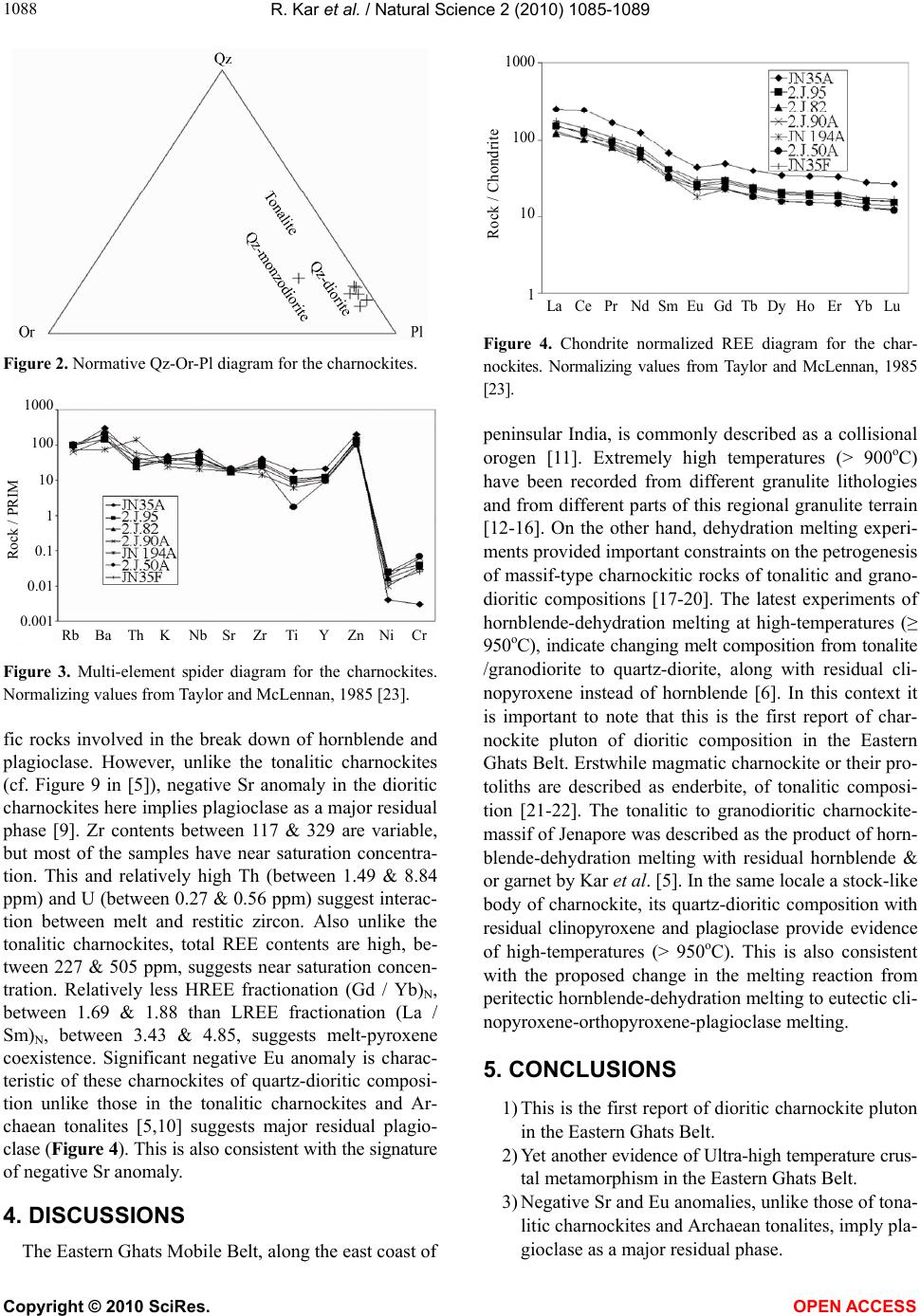 R. Kar et al. / Natural Science 2 (2010) 1085-1089 Copyright © 2010 SciRes. OPEN ACCESS 1088 Figure 2. Normative Qz-Or-Pl diagram for the charnockites. Rock / PRIM 1000 100 10 1 0.1 0.01 0.001 Rb Ba Th K Nb Sr Zr Ti Y Zn Ni Cr Figure 3. Multi-element spider diagram for the charnockites. Normalizing values from Taylor and McLennan, 1985 [23]. fic rocks involved in the break down of hornblende and plagioclase. However, unlike the tonalitic charnockites (cf. Figure 9 in [5]), negative Sr anomaly in the dioritic charnockites here implies plagioclase as a major residual phase [9]. Zr contents between 117 & 329 are variable, but most of the samples have near saturation concentra- tion. This and relatively high Th (between 1.49 & 8.84 ppm) and U (between 0.27 & 0.56 ppm) suggest interac- tion between melt and restitic zircon. Also unlike the tonalitic charnockites, total REE contents are high, be- tween 227 & 505 ppm, suggests near saturation concen- tration. Relatively less HREE fractionation (Gd / Yb)N, between 1.69 & 1.88 than LREE fractionation (La / Sm)N, between 3.43 & 4.85, suggests melt-pyroxene coexistence. Significant negative Eu anomaly is charac- teristic of these charnockites of quartz-dioritic composi- tion unlike those in the tonalitic charnockites and Ar- chaean tonalites [5,10] suggests major residual plagio- clase (Figure 4). This is also consistent with the signature of negative Sr anomaly. 4. DISCUSSIONS The Eastern Ghats Mobile Belt, along the east coast of Rock / Chondrite La Ce Pr Nd Sm Eu Gd Tb Dy Ho Er Yb Lu 1000 100 10 1 Figure 4. Chondrite normalized REE diagram for the char- nockites. Normalizing values from Taylor and McLennan, 1985 [23]. peninsular India, is commonly described as a collisional orogen [11]. Extremely high temperatures (> 900oC) have been recorded from different granulite lithologies and from different parts of this regional granulite terrain [12-16]. On the other hand, dehydration melting experi- ments provided important constraints on the petrogenesis of massif-type charnockitic rocks of tonalitic and grano- dioritic compositions [17-20]. The latest experiments of hornblende-dehydration melting at high-temperatures (≥ 950oC), indicate changing melt composition from tonalite /granodiorite to quartz-diorite, along with residual cli- nopyroxene instead of hornblende [6]. In this context it is important to note that this is the first report of char- nockite pluton of dioritic composition in the Eastern Ghats Belt. Erstwhile magmatic charnockite or their pro- toliths are described as enderbite, of tonalitic composi- tion [21-22]. The tonalitic to granodioritic charnockite- massif of Jenapore was described as the product of horn- blende-dehydration melting with residual hornblende & or garnet by Kar et al. [5]. In the same locale a stock-like body of charnockite, its quartz-dioritic composition with residual clinopyroxene and plagioclase provide evidence of high-temperatures (> 950oC). This is also consistent with the proposed change in the melting reaction from peritectic hornblende-dehydration melting to eutectic cli- nopyroxene-orthopyroxene-plagioclase melting. 5. CONCLUSIONS 1) This is the first report of dioritic charnockite pluton in the Eastern Ghats Belt. 2) Yet another evidence of Ultra-high temperature crus- tal metamorphism in the Eastern Ghats Belt. 3) Negative Sr and Eu anomalies, unlike those of tona- litic charnockites and Archaean tonalites, imply pla- gioclase as a major residual phase.  R. Kar et al. / Natural Science 2 (2010) 1085-1089 Copyright © 2010 SciRes. OPEN ACCESS 108 1089 6. ACKNOWLEDGEMENTS Melting experiments at the Petrological Laboratory of the Zurich In- stitute was supported by a Swiss Federal Fellowship to RK. Analytical data by ICP-MS were acquired by courtesy Dr. J.W. Sheraton. REFERENCES [1] Young, D.N., Zhao, J.X., Ellis, D.J. and McCulloch, M.T. (1997) Geochemical and Sr-Nd isotopic mapping of source provinces for the Mawson charnockites, east Ant- arctica: Implications for Proterozoic tectonics and Gond- wana reconstruction. Precambrian Research, 86, 1-19. [2] Subba Rao, M.V. and Divakara Rao, V. (1988) Chemical constraints on the origin of the charnockites in the East- ern Ghat Mobile Belt, India. Chemical Geology, 69, 37- 48. [3] Zhao, J., Ellis, D.J., Kilpatrick, J.A. and McCulloch, M.T. (1997) Geochemical and Sr-Nd isotopic study of char- nockites and related rocks in the northern Prince Charles Mountain, East Antarctica. Precambrian Research, 81, 37-66. [4] Sheraton, J.W, Tindle, A.G. and Tingey, R.J. (1996) Geo- chemistry, origin, and tectonic setting of granitic rocks of the Prince Charles Mountains, Antarctica. Australian Journal of Geology & Geophysics, 16, 345-370. [5] Kar, R., Bhattacharya, S. and Sheraton, J.W. (2003) Horn- blende dehydration melting in mafic rocks and the link between massif-type charnockite and associated granu- lites, Eastern Ghats Granulite Belt, India. Contributions to Mineralalogy and Petrology, 145 , 707-729. [6] Kar, R. (2010) Melting experiments in the NCFMASH system at 8 kbar: Implications for the origin of mafic granulites. Indian Journal of Geology, Special Issue on Geodynamic Regimes, Global tectonics and evolution of Precambrian cratonic basins in India, 80, 71-80. [7] Jenner, G.A., Longerich, H.P., Jackson, S.E. and Fryer, B. J. (1990) ICP-MS a powerfull tool for high-precision trace element analysis in earth science: Evidence from analysis of selected USGS reference samples. Chemical Geology, 83, 133-148. [8] Govindaraju, K. (1994) 1994 compilation of working values and sample description for 383 geostandards. Geo- standards Newsletter, 18, 1-158. [9] Tarney, J., Wyborn, L.E.A., Sheraton, J.W. and Wyborn, D. (1987) Trace element differences between Archaean, proterozoic and phanerozoic crustal components: Impli- cations for crustal growth processes. In: Ashwal, L.D. Ed., Workshop on the Growth of Continental Crust, Lu- nar and Planetary Institute, 139-140. [10] Nutman, A.P., McGregor, V.R., Friend, C.R.L., Bennet, V. C. and Kinny, P.D. (1996) Itsaq gneiss complex of south- ern west Greenland; the world’s most extensive record of early crustal evolution (3,900-3,600 Ma). Precambrian Research, 78, 1-39. [11] Santosh, M., Maruyama, S. and Sato, K. (2009) Anatomy of a Cambrian suture in Gondwana: Pacific-type orogeny in southern India? Gondwana Research, 16, 321-341. [12] Lal, R.K., Ackermand, D. and Upadhyay, H. (1987) P- T-X relationships deduced from corona textures in sap- phirine-spinel-quartz assemblages from Paderu, southern India. Journal of Petrology, 28, 1139-1168. [13] Dasgupta, S., Sengupta, P., Fukuoka, M. and Bhattacharya, P.K. (1991) Mafic granulites in the Eastern Ghats, India: Further evidence for extremely high temperature crustal metamorphism. Journal of Geology, 99, 124-133. [14] Bhowmik, S.K., Dasgupta, S., Hoernes, S. and Bhatta- charya, P.K. (1995) Extremely high-temperature calcare- ous granulites from the Eastern Ghats, India: Evidence for isobaric cooling, fluid buffering, and terminal chan- nelized fluid flow. Europian Journal of Mineralogy, 7, 689-703. [15] Sen, S.K., Bhattacharya, S. and Acharyya, A. (1995) A multi-stage pressure-temperature record in the Chilka La- ke granulites: The epitome of the metamorphic evolution of Eastern Ghats, India? Journal of Metamorphic Geol- ogy, 13, 287-298. [16] Bhattacharya, S. and Kar, R. (2002) High-temperature dehydration melting and decompressive P-T path in a granulite complex from the Eastern Ghats, India. Con- tributions to Mineralogy and Petrology, 143, 175-191. [17] Patino Douce, A.E. and Beard, J.S. (1995) Dehydration melting of biotite gneiss and quartz amphibolite from 3 to 15 kbar. Journal of Petrology, 36, 707-738. [18] Springer, W. and Seck, H.A. (1997) Partial fusion of ba- sic granulites at 5 to 15 kbar: Implications for the origin of TTG magmas. Contributions to Mineralogy and Pe- trology, 127, 30-45. [19] Lopez, S. and Castro, A. (2001) Determination of the fliud-absent solidus and supersolidus phase relationships of MORB-derived amphibolites in the range 4-14 kbar. American Mineralogist, 86, 1396-1403. [20] Sisson, T.W., Ratajeski, K. and Hankins, W.B. (2005) Vo- luminous granitic magmas from common basaltic sources. Contributions to Mineralogy and Petrology, 148, 635- 661. [21] Rickers, K., Mezger, K. and Raith, M. (2001) Evolution of the continental crust in the Proterozoic Eastern Ghats Belt, India and new constraints for Rodinia reconstruc- tion: Implications from Sm-Nd, Rb-Sr and Pb-Pb iso- topes. Precambrian Research, 112, 183-210. [22] Bhui, U.K., Sengupta, P. and Sengupta, P. (2007) Phase relations in mafic dykes and their host rocks from Kon- dapalle, Andhra Pradesh, India: Implications for the time- depth trajectory of the Paleoproterozoic (late Archean?) granulites from southern Eastern Ghats Belt. Precam- brian Research, 156, 153-174. [23] Taylor, S.R. and McLennan, S.M. (1985) The continental crust: Its composition and evolution. Blackwell, Oxford. |