

Paper Menu >>
Journal Menu >>
 International Journal of Astronomy and Astrophysics, 2013, 3, 29-33 http://dx.doi.org/10.4236/ijaa.2013.31004 Published Online March 2013 (http://www.scirp.org/journal/ijaa) Approximate Kepler’s Elliptic Orbits with the Relativistic Effects Leilei Jia Department of Electrical Engineering, Guilin College of Aerospace Technology, Guilin, China Email: [email protected] Received December 10, 2012; revised January 13, 2013; accepted January 21, 2013 ABSTRACT Beginning with a Lagrangian, we derived an approximate relativistic orbit equation which describes relativistic correc- tions to Keplerian orbits. The critical angular moment to guarantee the existence of periodic orbits is determined. An approximate relativistic Kepler’s elliptic orbit is illustrated by numerical simulation via a second-order perturbation method of averaging. Keywords: Kepler’s Elliptic Orbits; The Relativistic Kepler Problem; Unboundedness; Averaging 1. Introduction Kepler problem is one of the fundamental problems of orbital mechanics [1,2], which has been studied widely [3-5]. It is regarded as a special case of two-body prob- lems [6], where one body is assumed to be fixed at the origin-say, for example, it is so massive, like the Sun, that to the first approximation it does not move. The Ke- pler’s elliptic orbit is a conic section of the Kepler’s equation in polar coordinates with the form ,0 1 1cos c r r ef e , (1) where is the eccentricity and the angle e f is often called the true anomaly. Such elliptic orbits are of im- portance on describing dynamics of orbital mechanics in celestial mechanics and astrophysics. When dealing with particles moving at speed close to that of light it may be important to take into account the relativistic effects [7-12]. There have been several at- tempts to obtain the orbit solution for a classical relativ- istic two-body system interacting electromagnetically, and the concentric circular motion of two classical rela- tivistic point charges interacting electromagnetically had been described [13-16]. In this paper, using a perturba- tion techniques of averaging we will give the approxi- mate Kepler’s ellipse orbits for the Kepler problem with the special relativistic effects. In our results, we will show that once the relativistic contribution to Kepler problem is considered, the Kepler’s ellipse orbit may be destroyed. However, they perhaps maintain the original characteristics for a long time. The paper is organized as follows. Firstly, the Lagran- gian equations of motion of the relativistic Kepler prob- lem are deduced, and the elliptic periodic orbits and un- bounded orbits of equations are determined. Secondly, by the near-identity transformation, a good approximation of the Kepler’s elliptic orbits is obtained via averaging of the angle. An example is given to illustrate the applica- tion of the result. Finally, we conclude our results. 2. Periodic and Unbounded Orbits of the Relativisti c K e pl e r P roblem Under relativistic effects, a particle of mass orbiting a central mass m M is commonly described by the Lagrangian in the polar coordinates [17-21] 2222 GMm Lmccrr r (2) where is Newton’s universal gravitational constant and is the speed of light in vacuum. Then the La- grangian equations of motion are given by G c 222 2 2 222 2 dd dd 1 , 1 LL r tr rtrr c r rr c (3) 2 2222 dd 0. dd 1 LL r tt rr c (4) At this moment it is convenient to introduce the relativistic linear momentum [22] p C opyright © 2013 SciRes. IJAA  L. L. JIA 30 2222 1 r p rr c (5) and Equation (4) implies the conservation of the rela- tivistic angle momentum , an arbitrary constant of integration, 2 2222 . 1 r rrc (6) By a simply algebraic computation, we have 22 22 2 22 22 2 , . crp r cr pr c rcr pr (7) Substituting (7) into (3) and together with (5), it yields that 22 22 2 2 2 222 22 2 , . crp r cr pr cG pr rcrpr M (8) Note that Equation (8) have periodic orbits if and on- ly if the relativistic angle momentum is large enou- gh, precisely, : cGM c . In fact, the derivation of the relativistic linear momentum always be nega- tive when the opposite direction of inequality holds, since p 222 222 2 1 1 1. c p rcr pr GM r G M For example, the mass of Sun, the Newton’s universal gravitational constant and the speed of the light are taken to be and , respectively, then the periodic orbits exist only for 3011 312 1.989 10kg,6.670 10mkgsMG 81 2.99810 ms 11 1 4.425 10 s. c Since the change of the polar coordinates preserve the symplectic form, Equation (8) retains the Hamilton structure with the Hamiltonian 22 22 2 ,. c Hrpcr pr r GM r (9) The curve of level set with the Hamiltonian 22222 ,, 1,HrphhcGMc defines the “energy” of the Kepler system (8). When 2222 1hc GMc2 , the curve of level set reduces to an elliptic equilibrium point 22 22 ,1 GM rp cc ,0 of Equations (8), which is corresponding to the circle of Keplerian orbits of the form (1) with . At the same time, every curve of level set with 0e 2 22222 1,hcGMc c is corresponding to a periodic orbit of Equation (8). In case of 2,hc r , the orbits become unbounded and insect the -axis only one time. The orbits in the phase plane ,rp for Equation (8) are depicted in Figure 1 using the parameters mentioned above. 3. Approximate Kepler’s Elliptic Orbits In previous section, we find that the large relativistic an- gle momentum is necessary and sufficient to guaran- tee the existence of the periodic orbits. At the same time, also as a constant of integration can be taken arbitrar- ily large. Consequently, in this section we will assume that is so large that 22 22 1. GM c In the following, with this assumption by the method of averaging, we will show that for a long time the orbit on the ,r plane is an approximate Kepler elliptic orbits. The averaged method has been used widely [23-26]. Together with (7) and (8), by successive applications of the chain rule, we get 2 d dd dd dd rpr rp tt r d , (10) 2 2 22 d1 dd 1 dd d prGMp p tt r cc . (11) So it follows that 22 2 2 dd 1, d d ccc c rrr r rrr r (12) where 2 c rG M. Let 1, , c rr , then we obtain that 22 2 2 d11 d 1. (13) Copyright © 2013 SciRes. IJAA 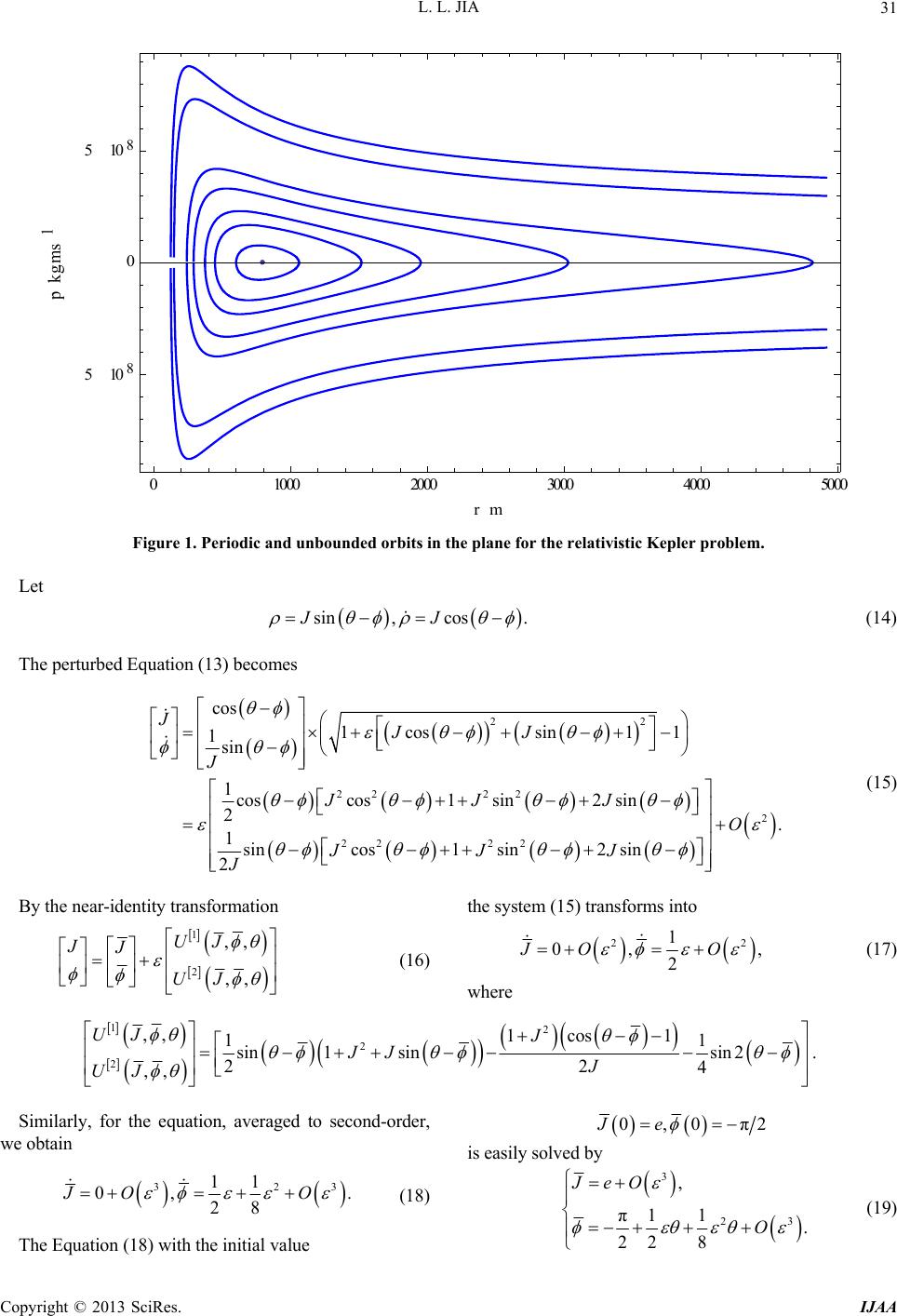 L. L. JIA Copyright © 2013 SciRes. IJAA 31 0 100 0 200 0 300 0 400 0 500 0 5 10 8 0 5 10 8 r m pkg.ms 1 Figure 1. Periodic and unboun de d orbits in the plane for the relativistic Kepler proble m. Let sin, cos.JJ (14) The perturbed Equation (13) becomes 22 22 22 2 22 22 cos 1cossin 11 1sin 1coscos1sin2 sin 2. 1sincos1sin2 sin 2 JJJ J JJJ O JJJ J (15) the system (15) transforms into By the near-identity transformation 1 2 ,, ,, UJ JJ UJ 2 1 0, 2 JO O 2 , (17) (16) where 12 2 2 ,, 1cos 1 11 sin1sinsin 2 22 ,, UJ J JJ J UJ 4 . 0,0 π2Je Similarly, for the equation, averaged to second-order, we obtain is easily solved by 3 2 , π11 . 228 JeO O 3 (19) 32 11 0, 3 28 JO O. (18) The Equation (18) with the initial value 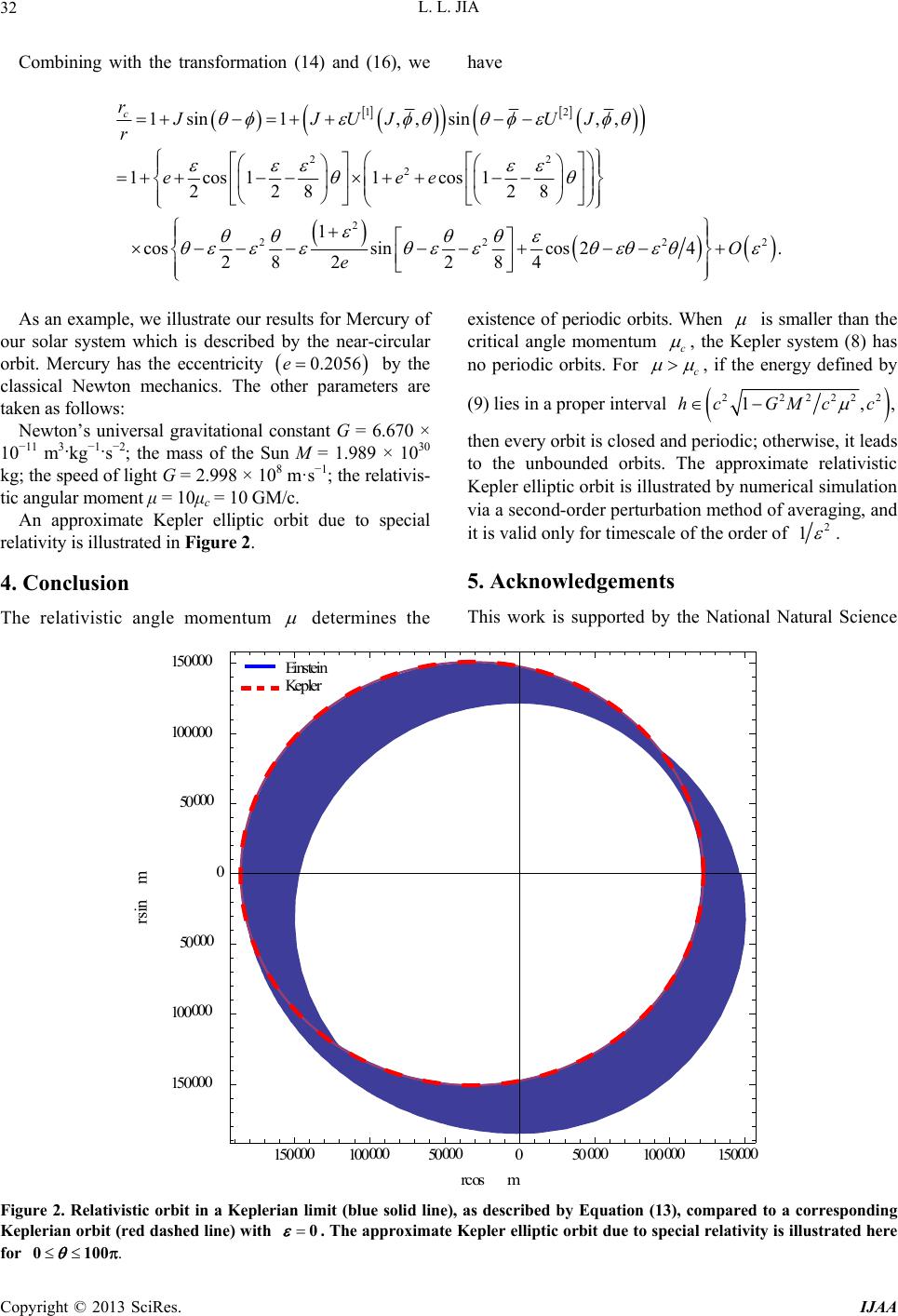 L. L. JIA 32 Combining with the transformation (14) and (16), we have 12 22 2 2 222 1sin1, ,sin, , 1cos11cos1 22828 1 cossincos 24. 28 2284 c rJJUJ UJ r eee O e 2 As an example, we illustrate our results for Mercury of our solar system which is described by the near-circular orbit. Mercury has the eccentricity by the classical Newton mechanics. The other parameters are taken as follows: 0.2056e Newton’s universal gravitational constant G = 6.670 × 10⁻¹¹ m 3·kg−1·s−2; the mass of the Sun M = 1.989 × 1030 kg; the speed of light G = 2.998 × 10⁸ m·s−1; the relativis- tic angular moment μ = 10μc = 10 GM/c. An approximate Kepler elliptic orbit due to special relativity is illustrated in Figure 2. 4. Conclusion The relativistic angle momentum determines the existence of periodic orbits. When is smaller than the critical angle momentum c , the Kepler system (8) has no periodic orbits. For c , if the energy defined by (9) lies in a proper interval 2 22222 1,hcGMc c , then every orbit is closed and periodic; otherwise, it leads to the unbounded orbits. The approximate relativistic Kepler elliptic orbit is illustrated by numerical simulation via a second-order perturbation method of averaging, and it is valid only for timescale of the order of 2 1 . 5. Acknowledgements This work is supported by the National Natural Science Einst ein Kepl e r 15000 0 10000 0 5000 0 0 50 00 0 100 00 0 15 0 00 0 150000 10 0 00 0 5 0 00 0 0 5 0 00 0 100000 15 0 00 0 rcos m rsin m Figure 2. Relativistic orbit in a Keplerian limit (blue solid line), as described by Equation (13), compared to a corresponding Keplerian orbit (red dashed line) with 0 . The approximate Kepler elliptic orbit due to special relativity is illustrated here for .0 100 Copyright © 2013 SciRes. IJAA  L. L. JIA 33 Foundation of China (Grant No. 11226130 and No. 11261013). REFERENCES [1] R. Bate, D. Mueller and J. White, “Fundamentals of As- trodynamics,” Dover Publications, New York, 1971. [2] S. C. Bell, “A numerical Solution of the Relativistic Ke- pler Problem,” Computers in Physics, Vol. 9, No. 3, 2001, pp. 281-285. doi:10.1063/1.168530 [3] P. Amster, J. Haddad, R. Oterga and A. J. Urena, “Perio- dic Motions in Forced Problems of Kepler Type,” Non- linear Differential Equations and Applications, Vol. 18, No. 6, 2011, pp. 649-657. doi:10.1007/s00030-011-0111-8 [4] A. Fonda, R. Toader, and P. J. Torres, “Periodic Motions in a Gravitational Central Field with a Rotating External Force,” Celestial Mechanics and Dynamical Astronomy, Vol. 113, No. 3, 2012, pp. 335-342. doi:10.1007/s10569-012-9428-9 [5] X. GongOu, X. MingJie and Y. YaTian, “Kepler Problem in Hamiltonian Formulation Discussed from Topological Viewpoint,” Chinese Physics Letters, Vol. 22, No. 7, 2005, pp. 1573-1575. doi:10.1088/0256-307X/22/7/004 [6] K. Meyer and G. Hall, “Introduction to Hamiltonian Dy- namical Systems and the N-Body Problem,” Springer, New York, 1992. [7] R. G. Cawley, “Motion of a Charged Light Like Particle in an External Field,” Journal of Mathematical Physics, Vol. 380, No. 14, 1967, pp. 2092-2096. [8] T. E. Phipps, “Mercury’s Precession according to Special Relativity,” American Journal of physics, Vol. 54, No. 3, 1986, pp. 245-247. [9] C. Sigismondi, “Astrometry and Relativity,” Nuovo Ci- mento B Serie, Vol. 120, No. 10, 2005, pp. 1169-1180. [10] N. Jun, “Unification of General Relativity with Quantum Field Theory,” Chinese Physics Letters, Vol. 28, No. 11, 2011, p. 110401. doi:10.1088/0256-307X/28/11/110401 [11] F. JianHui, “Study of the Lie Symmetries of a Relativistic Variable Mass System,” Chinese Physics, Vol. 11, No. 4, 2002, pp. 313-318. doi:10.1088/1009-1963/11/4/301 [12] F. J. Hui and Z. Song-Qing, “Noether’s Theorem of a Rotational Relativistic Variable Mass System,” Chinese Physics, Vol. 11, No. 5, 2002, pp. 445-449. doi:10.1088/1009-1963/11/5/307 [13] O. Coskun, “The Solutions of the Classical Relativistic Two-Body Equation,” Turkish Journal of Physics, Vol. 22, No. 2, 2002, pp. 107-114. [14] A. Schild, “Electromagnetic Two-Body Problem,” Physi- cal Review, Vol. 131, No. 6, 1963, pp. 2762-2766. doi:10.1103/PhysRev.131.2762 [15] C. M. Andersen and H. C. Baeyer, “Circular Orbits in Classical Relativistic Two-Body Systems,” Annals of Physics, Vol. 60, No. 1, 1970, pp. 67-84. doi:10.1016/0003-4916(70)90482-3 [16] P. Cordero and G. C. Ghirardi, “Dynamics for Classical Relativistic Particles: Circular Orbit Solutions and the Nonrelativistic Limit,” Journal of Mathematical Physics, Vol. 14, No. 7, 1973, pp. 815-822. doi: 10.1063/1.1666401 [17] T. J. Lemmon and A. R. Mondragon, “Alternative Deri- vation of the Relativistic Contribution to Perihelia Pre- cession,” American Journal of Physics, Vol. 77, No. 10, 2009, pp. 890-893. doi:10.1119/1.3159611 [18] J. M. Potgieter, “An Exact Solution for the Horizontal Deflection of a Falling Object,” American Journal of Physics, Vol. 51, No. 3, 1983, pp. 257-258. doi:10.1119/1.13275 [19] Y. S. Huang and C. L. Lin, “A Systematic Method to Determine the Lagrangian Directly from the Equations of Motion,” American Journal of Physics, Vol. 70, No. 7, 2002, pp. 741-743. doi:10.1119/1.1475331 [20] B. Coleman, “Special Relativity Dynamics without a Priori Momentum Conservation,” European Journal of Physics, Vol. 26, No. 4, 2005, pp. 647-650. doi:10.1088/0143-0807/26/4/010 [21] P. Smith and R. C. Smith, “Mechanics,” John Wiley & Sons Ltd., Chichester, 1990. [22] P. J. Torres, A. J. Urena and M. Zamora, “Periodic and Quasi-Periodic Motions of a Relativistic Particle under a Central Force Field,” Bulletin London Mathematical Society, 2012, pp. 1-13. doi: 10.1112/blms/bds076 [23] Q. Liu and D. Qian, “Construction of Modulated Ampli- tude Waves via Averaging in Collisionally Inhomogene- ous Bose-Einstein Condensates,” Journal of Nonlinear Mathematical Physics, Vol. 19, No. 2, 2012, Article ID: 1250017. doi:10.1142/S1402925112500179 [24] Q. Liu, and D. Qian, “Modulated Amplitude Waves with Nonzero Phases in Bose-Einstein Condensates,” Journal of Mathematical Physics, Vol. 52, No. 8, 2011, Article ID: 082702. doi:10.1063/1.3623415 [25] L. Jia, L. Sun and J. Li, “Modulational Instability in Nonlinear Optics,” Journal of Jiangxi Normal University (Natural Science Edition), Vol. 14, No. 3, 2012, pp. 271- 275. [26] J. A. Sanders, F. Verhulst and J. Murdock, “Averaging Methods in Nonlinear Dynamical Systems,” Springer, New York, 2007. Copyright © 2013 SciRes. IJAA |