

Paper Menu >>
Journal Menu >>
 Vol.2, No.10, 1079-1084 (2010) Natural Science http://dx.doi.org/10.4236/ns.2010.210134 Copyright © 2010 SciRes. OPEN ACCESS Secular evolution of continental crust: recorded from massif-type charnockites of Eastern Ghats belt, India Samarendra Bhattacharya1, Ashwini Kumar Chaudhary2* 1Indian Statistical Institute, Kolkata, India; 2Indian Institute of Technology, Roorkee, India; *Corresponding Author: [email protected]. Received 15 July 2010; revised 18 August 2010; accepted 23 August 2010. ABSTRACT It is reasonably well established that the Earth has substantially cooled from the Archean to the present and hence the sites, rates and pro- cesses of crust formation must have changed through geologic time. Archean and Proterozoic granitic rocks are the principal record of such changes. Massif-type charnockites in the East- ern Ghats granulite belt, India, of Archean and Proterozoic ages mirror the changing condi- tions and/or processes of continental crust for- mation. Though both can be explained by de- hydration melting of mafic rocks, the conditions differ. Potasium and rubidium rich Proterozoic charnockites have significant negative Eu ano- maly indicating melting at shallow depths in the stability field of plagioclase. In contrast, sodium and strontium rich Archean charnockites with less LREE enrichment and less depletion in Eu indicate melting at greater depths in the stability field of garnet or amphibole. Keywords: Secular changes; Continental crust; Massif-charnockites; Eastern Ghats 1. INTRODUCTION The continental crust comprising byouant quartzo- feldspathic materials are difficult to destroy by subduc- tion and hence can be considered as the principal record of crustal evolution through geologic time. New conti- nental crust may form magmatically from underlying mantle. However, mantle melting products are predomi- nantly basaltic, whereas continental crust is andesitic which can not be extracted directly from melting of man- tle-peridotite. Continental crust formation therefore re- quires a second stage/or event of fractional crystalliza- tion [1] or remelting of basaltic magma [2]. Although there remains considerable debate on the processes of crust formation in the Archean compared to those operating in the later period (post-Archean), significant differences in key geochemical features have been documented between Archean and later granitic rocks [3-5]. Moreover, tec- tonic setting for Archean magmatism as exemplified by TTG remains unresolved. Partial melting may have taken place in subducted slabs [6,7] or in underplated basalt beneath thickened crust or oceanic plateau [8]. TTG suites of Archean greenstone belts are taken as the Ar- chean continental crust, while large varieties of Protero- zoic granitic plutons represent the Proterozoic continen- tal crust (cf. Table 3 in [2]). These authors have pre- sented extensive discussion on these differences from a Granitic perspective and their possible implications on the changing processes and or conditions of crust forma- tion from Archean to Proterozoic times. Eastern Ghats granulite belt, India, comprises massif- type charnockite as a major component in the regional granulite terrane, and there is unambiguous evidence of different generation of such charnockites. Archaean char- nockites have been described from northern margin against Singhbhum craton and western margin against Bastar craton [9-11]. Some of the massif-type charnockite suites in the central part of the granulite belt record only Proterozoic ages [12,13]. Although, some workers have described magmatic charnockites from the Eastern Ghats, presumably as mantle-derived melt [14], it is difficult to postulate silicic melts directly from mantle-melting. On the other hand, some workers consider enderbitic char- nockites of the Eastern Ghats belt as metamorphosed igneous precursors and commonly describe them as “now enderbite” [15]. Here again, the question of felsic igneous rocks directly derived from mantle remains un- resolved. Dehydration melting experiments have demon- strated that silicic melts of tonalitic, granodioritic and granitic compositions are produced at 8-10 Kbar, and ≥ 850℃ from mafic rocks [16-18]. The massif-type char- nockites in the Eastern Ghats belt are of variable compo- sition and P-T conditions of granulite facies metamor- phism are comparable to the experimental constraints as mentioned above [19,20]. Thus a remelting of mantle- 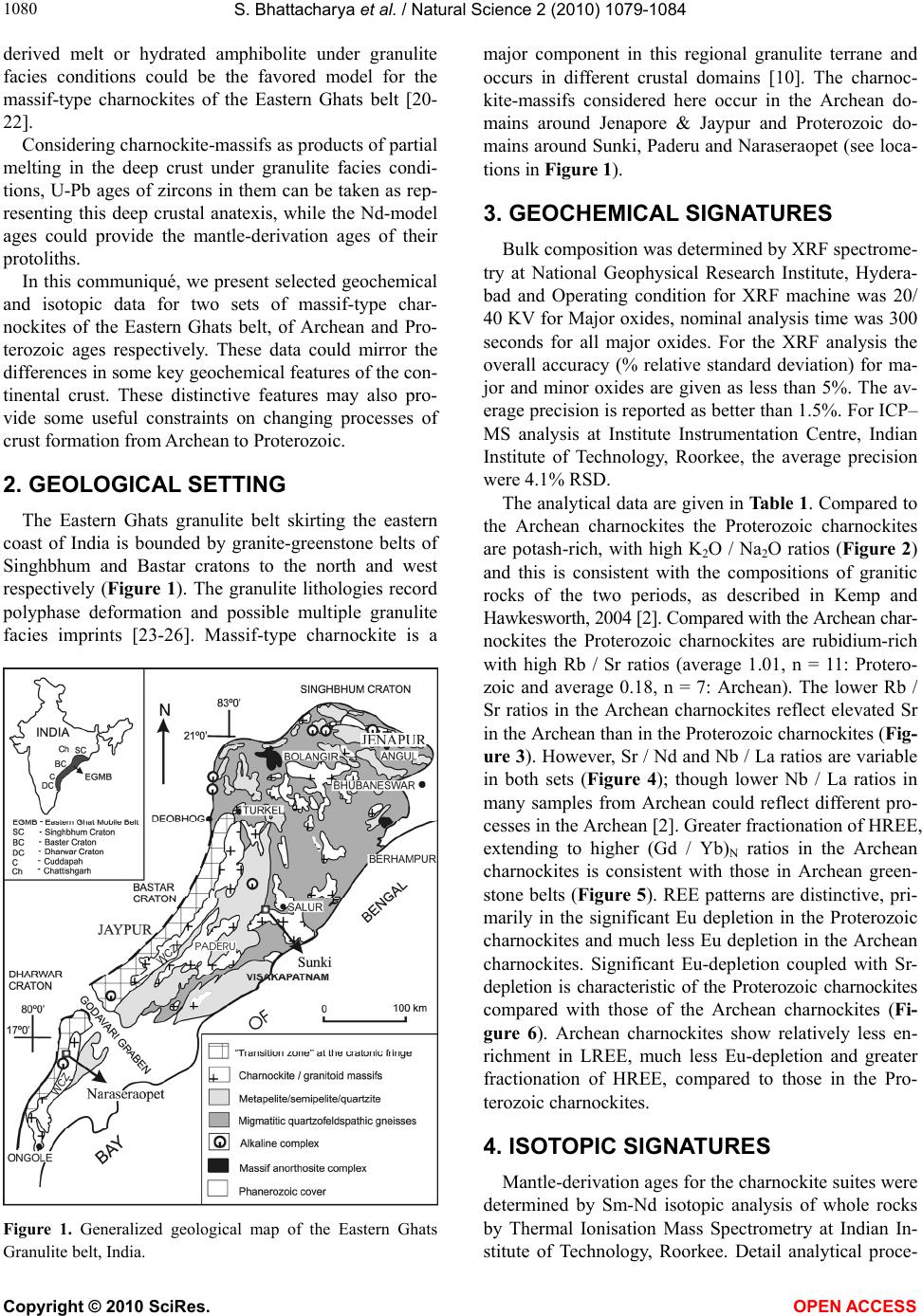 S. Bhattacharya et al. / Natural Science 2 (2010) 1079-1084 Copyright © 2010 SciRes. OPEN ACCESS 1080 derived melt or hydrated amphibolite under granulite facies conditions could be the favored model for the massif-type charnockites of the Eastern Ghats belt [20- 22]. Considering charnockite-massifs as products of partial melting in the deep crust under granulite facies condi- tions, U-Pb ages of zircons in them can be taken as rep- resenting this deep crustal anatexis, while the Nd-model ages could provide the mantle-derivation ages of their protoliths. In this communiqué, we present selected geochemical and isotopic data for two sets of massif-type char- nockites of the Eastern Ghats belt, of Archean and Pro- terozoic ages respectively. These data could mirror the differences in some key geochemical features of the con- tinental crust. These distinctive features may also pro- vide some useful constraints on changing processes of crust formation from Archean to Proterozoic. 2. GEOLOGICAL SETTING The Eastern Ghats granulite belt skirting the eastern coast of India is bounded by granite-greenstone belts of Singhbhum and Bastar cratons to the north and west respectively (Figure 1). The granulite lithologies record polyphase deformation and possible multiple granulite facies imprints [23-26]. Massif-type charnockite is a Figure 1. Generalized geological map of the Eastern Ghats Granulite belt, India. major component in this regional granulite terrane and occurs in different crustal domains [10]. The charnoc- kite-massifs considered here occur in the Archean do- mains around Jenapore & Jaypur and Proterozoic do- mains around Sunki, Paderu and Naraseraopet (see loca- tions in Figure 1). 3. GEOCHEMICAL SIGNATURES Bulk composition was determined by XRF spectrome- try at National Geophysical Research Institute, Hydera- bad and Operating condition for XRF machine was 20/ 40 KV for Major oxides, nominal analysis time was 300 seconds for all major oxides. For the XRF analysis the overall accuracy (% relative standard deviation) for ma- jor and minor oxides are given as less than 5%. The av- erage precision is reported as better than 1.5%. For ICP– MS analysis at Institute Instrumentation Centre, Indian Institute of Technology, Roorkee, the average precision were 4.1% RSD. The analytical data are given in Table 1. Compared to the Archean charnockites the Proterozoic charnockites are potash-rich, with high K2O / Na2O ratios (Figure 2) and this is consistent with the compositions of granitic rocks of the two periods, as described in Kemp and Hawkesworth, 2004 [2]. Compared with the Archean char- nockites the Proterozoic charnockites are rubidium-rich with high Rb / Sr ratios (average 1.01, n = 11: Protero- zoic and average 0.18, n = 7: Archean). The lower Rb / Sr ratios in the Archean charnockites reflect elevated Sr in the Archean than in the Proterozoic charnockites (Fig- ure 3). However, Sr / Nd and Nb / La ratios are variable in both sets (Figure 4); though lower Nb / La ratios in many samples from Archean could reflect different pro- cesses in the Archean [2]. Greater fractionation of HREE, extending to higher (Gd / Yb)N ratios in the Archean charnockites is consistent with those in Archean green- stone belts (Figure 5). REE patterns are distinctive, pri- marily in the significant Eu depletion in the Proterozoic charnockites and much less Eu depletion in the Archean charnockites. Significant Eu-depletion coupled with Sr- depletion is characteristic of the Proterozoic charnockites compared with those of the Archean charnockites (Fi- gure 6). Archean charnockites show relatively less en- richment in LREE, much less Eu-depletion and greater fractionation of HREE, compared to those in the Pro- terozoic charnockites. 4. ISOTOPIC SIGNATURES Mantle-derivation ages for the charnockite suites were determined by Sm-Nd isotopic analysis of whole rocks by Thermal Ionisation Mass Spectrometry at Indian In- stitute of Technology, Roorkee. Detail analytical proce- 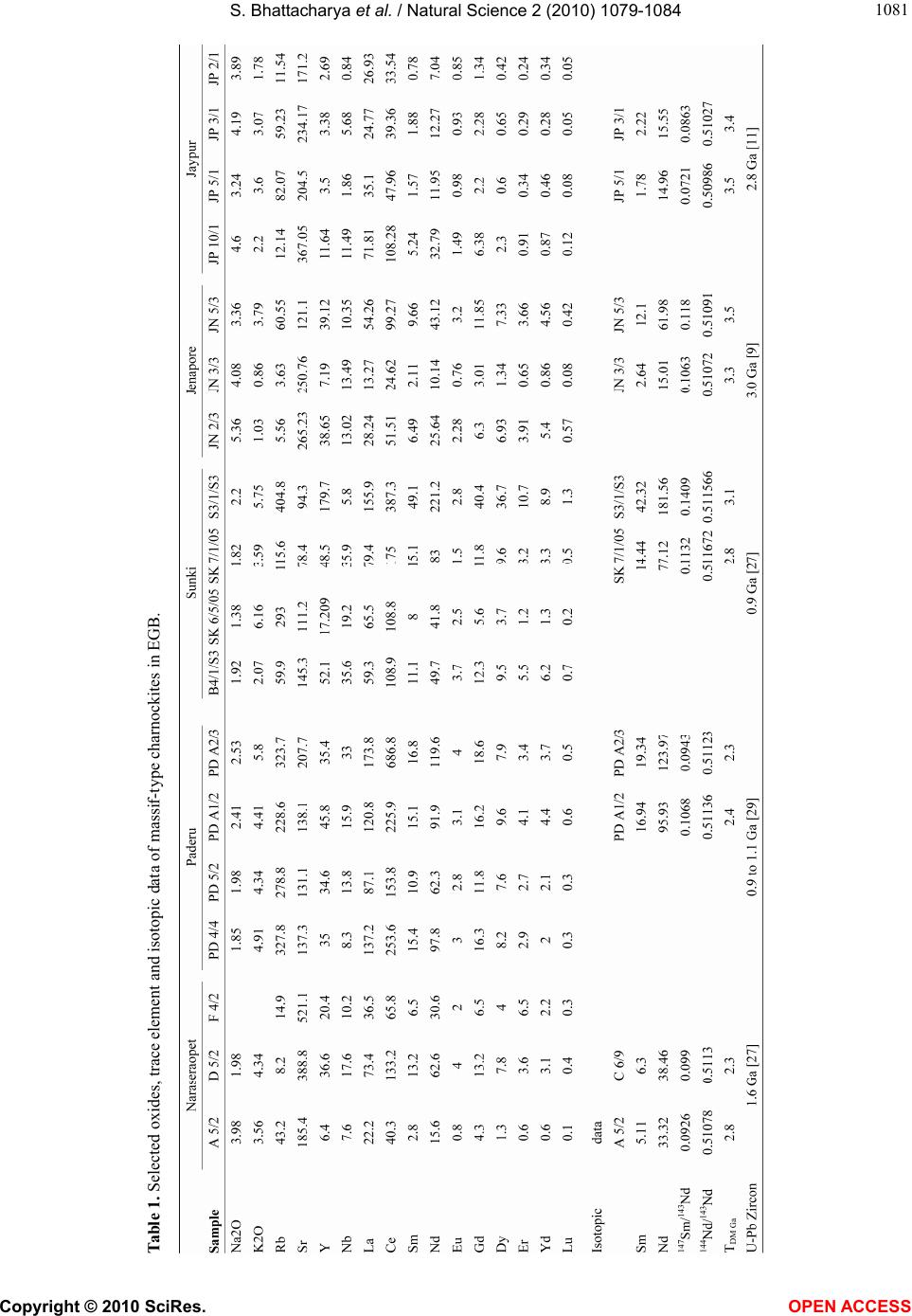 S. Bhattacharya et al. / Natural Science 2 (2010) 1079-1084 Copyright © 2010 SciRes. OPEN ACCESS 108 1081 Table 1. Selected oxides, trace element and isotopic data of massif-type charnockites in EGB. 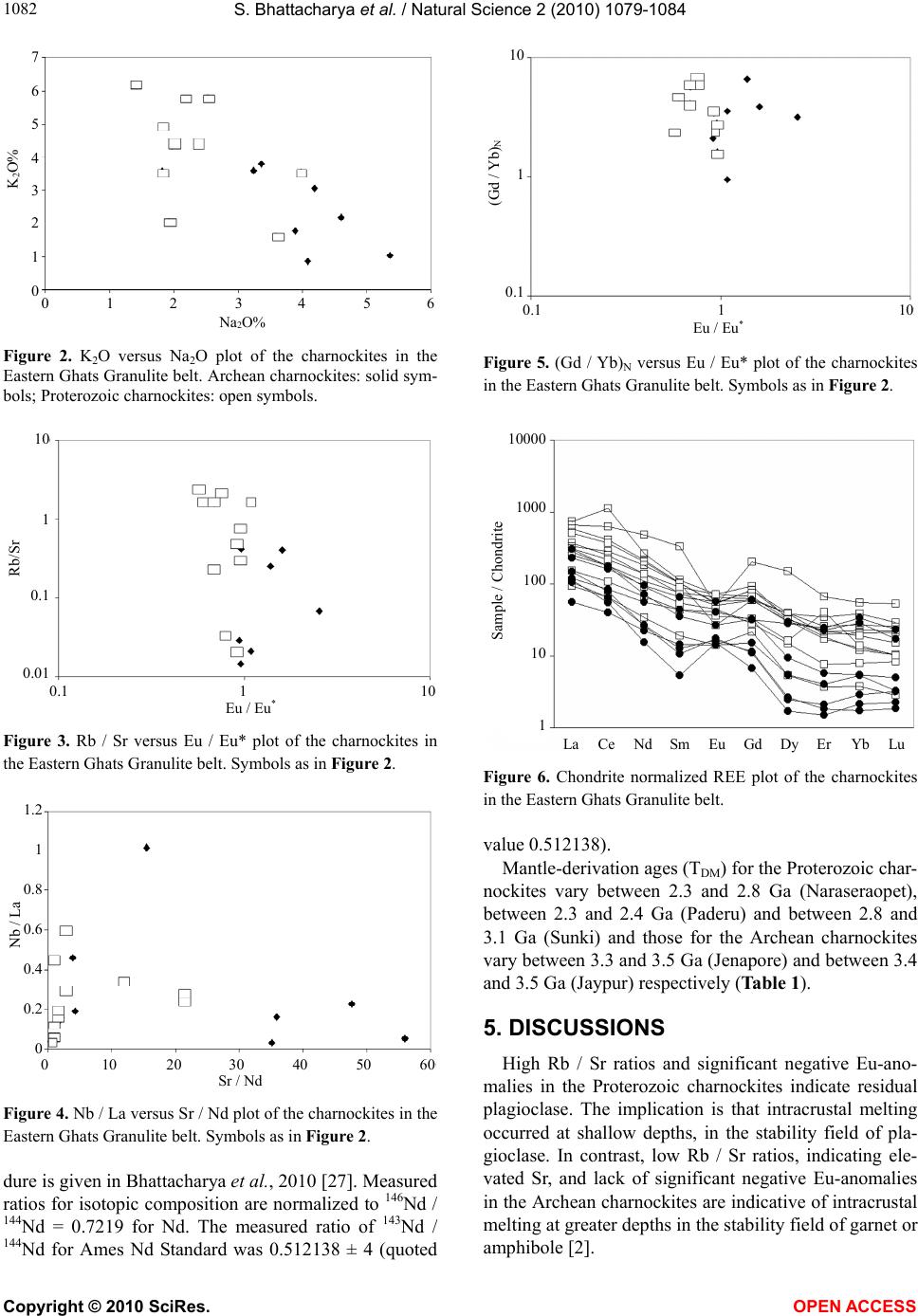 S. Bhattacharya et al. / Natural Science 2 (2010) 1079-1084 Copyright © 2010 SciRes. OPEN ACCESS 1082 7 6 5 4 3 2 1 0 K 2 O% 0 1 2 3 4 5 6 Na 2 O% Figure 2. K 2O versus Na2O plot of the charnockites in the Eastern Ghats Granulite belt. Archean charnockites: solid sym- bols; Proterozoic charnockites: open symbols. 10 1 0.1 0.01 Rb/Sr 0.1 1 10 Eu / Eu * Figure 3. Rb / Sr versus Eu / Eu* plot of the charnockites in the Eastern Ghats Granulite belt. Symbols as in Figure 2. 1.2 1 0.8 0.6 0.4 0.2 0 Nb / La Sr / Nd 0 10 20 30 40 50 60 Figure 4. Nb / La versus Sr / Nd plot of the charnockites in the Eastern Ghats Granulite belt. Symbols as in Figure 2. dure is given in Bhattacharya et al., 2010 [27]. Measured ratios for isotopic composition are normalized to 146Nd / 144Nd = 0.7219 for Nd. The measured ratio of 143Nd / 144Nd for Ames Nd Standard was 0.512138 ± 4 (quoted 10 1 0.1 (Gd / Yb) N 0.1 1 10 Eu / Eu * Figure 5. (Gd / Yb)N versus Eu / Eu* plot of the charnockites in the Eastern Ghats Granulite belt. Symbols as in Figure 2. Sample / Chondrite 10000 1000 100 10 1 La Ce Nd Sm Eu Gd Dy Er Yb Lu Figure 6. Chondrite normalized REE plot of the charnockites in the Eastern Ghats Granulite belt. value 0.512138). Mantle-derivation ages (TDM) for the Proterozoic char- nockites vary between 2.3 and 2.8 Ga (Naraseraopet), between 2.3 and 2.4 Ga (Paderu) and between 2.8 and 3.1 Ga (Sunki) and those for the Archean charnockites vary between 3.3 and 3.5 Ga (Jenapore) and between 3.4 and 3.5 Ga (Jaypur) respectively (Table 1). 5. DISCUSSIONS High Rb / Sr ratios and significant negative Eu-ano- malies in the Proterozoic charnockites indicate residual plagioclase. The implication is that intracrustal melting occurred at shallow depths, in the stability field of pla- gioclase. In contrast, low Rb / Sr ratios, indicating ele- vated Sr, and lack of significant negative Eu-anomalies in the Archean charnockites are indicative of intracrustal melting at greater depths in the stability field of garnet or amphibole [2].  S. Bhattacharya et al. / Natural Science 2 (2010) 1079-1084 Copyright © 2010 SciRes. OPEN ACCESS 108 1083 Large discrepancies between crystallization ages (of anatectic charnockitic melt), given by U-Pb zircon ages reported in the literature (Table 1) and mantle derivation ages given by TDM for the Proterozoic charnockites con- firm that older crustal material was present within the source regions of the charnockitic magma [28]. This is in contrast to the relatively little time gap between crystal- lization ages and Nd-model ages for the Archean char- nockites, similar to those observed in Archean TTGs. 6. CONCLUSIONS These differences in the geochemical and isotopic sig- natures between Archean and Proterozoic charnockites reflect different conditions of crust formation rather than different processes: both can be explained by dehydra- tion melting of hydrated basalt or amphibolite under granulite facies conditions; but Proterozoic charnockites at shallower depths (in plagioclase-stability field) than Archean charnockites (in garnet or amphibole-stability field). 7. ACKNOWLEDGEMENTS Indian Statistical Institute, Kolkata provided the infrastructural fa- cilities. Financial support was provided by the Department of Science and Technology, Government of India, in the form of a research pro- ject. REFERENCES [1] Soesoo, A. (2000) Fractional crystallization of mantle- derived melts as a mechanism for some I-type granite petrogenesis: An example from the Lachlan Fold Belt, Australia. Journal of Geological Society, 157, 135-149. [2] Kemp, A.I.S. and Hawkesworth, C.J. (2004) Granitic perspectives on the Generation and secular evolution of the continental crust. Treatise on Geochemistry, 3, 349- 411. [3] Taylor, S.R. and McLennan, S.M. (1985) The continental crust: Its composition and evolution. Blackwell Publish- ing, Oxford. [4] Taylor, S.R. and McLennan, S.M. (1995) The geochemi- cal evolution of the continental crust. Reviews of Geo- physics, 33, 241-265. [5] Rudnick, R.L. and Gao, S. (2004) Composition of the continental crust. Treatise on Geochemistry, 3, 1-65. [6] Condie, K.C. (1998) Episodic continental growth and supercontinents: A mantle avalanche connection? Earth and Planetary Science Letters, 163, 97-108. [7] Martin, H. (1995) Archean grey gneisses and genesis of continental crust. In: Condie, K.C. Ed., Archean Crustal Evolution, Elsevier, Netherlands, 205-260. [8] Whalen, J.B., Percival, J.A., McNiccol, V.J. and Long- staffe, F.J. (2002) A mainly crustal origin for tonalitic granitoid rocks, superior province, Canada: Implications for late archean tectonomagmatic processes. Journal of Petrology, 43, 1551-1570. [9] Bhattacharya, S., Kar, R., Misra, S. and Teixeira, W. (2001) Early Archaean continental crust in the Eastern Ghats granulite belt, India: Isotopic evidence from a charno- ckite suite. Geological Magazine, 138, 609-618. [10] Rickers, K., Mezger, K. and Raith, M. (2001) Evolution of the continental crust in the Proterozoic Eastern Ghats belt, India and new constraints for Rodinia reconstruction: Implications from Sm-Nd, Rb-Sr and Pb-Pb isotopes. Precambrian Research, 112, 183-210. [11] Kovach, V.P., Simmat, R., Rickers, K., Berezhnaya, N.G., Salnikova, E.B., Dobmeier, C., Raith, M.M., Yakovleva, S.Z. and Kotov, A.B. (2001) The western charnockite zone of the Eastern Ghats belt, India: An independent crustal province of late Archean (2.8 Ga) and Paleopro- terozoic (1.7-1.6 Ga) terrains. Gond Research, 4, 666-667. [12] Mezger, K. and Cosca, M.A. (1999) The thermal history of the Eastern Ghats belt (India) as revealed by U-Pb and 40Ar / 39Ar dating of metamorphic and magmatic miner- als: Implications for the SWEAT correlation. Precam- brian Research, 94, 251-271. [13] Simmat, R. and Raith, M.M. (2008) U-Th-Pb monazite geochronometry of the Eastern Ghats Belt, India: Timing and spatial disposition of poly-metamorphism. Precam- brian Research, 162, 16-39. [14] Subba Rao, M.V. and Divakara Rao, V. (1988) Chemical constraints on the origin of the charnockites in the East- ern Ghat Mobile belt, India. Chemical Geology, 69, 37-48. [15] Bhui, U.K., Sengupta, P. and Sengupta, P. (2007) Phase relations in mafic dykes and their host rocks from Kon- dapalle, Andhra Pradesh, India: Implications for the time- depth trajectory of the Paleoproterozoic (late Archean?) granulites from southern Eastern Ghats belt. Precam- brian Research, 156, 153-174. [16] Wolf, M.B. and Wyllie, P.J. (1994) Dehydration melting of amphibolite at 10 Kbar: Effects of temperature and time. Contributions to Mineralogy and Petrology, 115, 369-383. [17] Patino Douce, A.E. and Beard, J.S. (1995) Dehydration melting of biotite gneiss and quartz amphibolite from 3 to 15 Kbar. Journal of Petrology, 36, 707-738. [18] V’ielzeuf, D. and Schmidt, M.W. (2001) Melting rela- tions in hydrous systems revisited: Application to meta- pelites, metagreywackes and metabasalts. Contributions to Mineralogy and Petrology, 141, 251-267. [19] Bhattacharya, S. (2003) Dehydration melting in mafic rocks in the Eastern Ghats Belt, India: Implications for variable composition of charnockitic melt and heteroge- neity of source rocks. Geological Society of India, 52, 131-144. [20] Kar, R., Bhattacharya, S. and Sheraton, J.W. (2003) Hornblende dehydration melting in mafic rocks and the link between massif-type charnockite and associated granulites, Eastern Ghats Granulite Belt, India. Contribu- tions to Mineralogy and Petrology, 145, 707-729. [21] Foley, S., Tiepolo, M. and Vannucci, R. (2002) Growth of early continental crust in subduction zones controlled by melting of amphibolite. Nature, 417, 837-840. [22] Bhattacharya, S. (2010) Review: The charnockite prob- lem: A twenty-first century perspective. Natural Science, 2, 402-408. [23] Halden, N.M., Bowes, D.R. and Dash, B. (1982) Struc-  S. Bhattacharya et al. / Natural Science 2 (2010) 1079-1084 Copyright © 2010 SciRes. OPEN ACCESS 1084 tural evolution of migmatites in a granulite facies terrane: Precambrian crystalline complex of Angul, Orissa, India. Transactions of the Royal Society, 73, 109-118. [24] Bhattacharya, S. (1997) Evolution of Eastern Ghats gra- nulite belt of India in a compressional tectonic regime and juxtaposition against Iron Ore craton of singhbhum by oblique collision-transpression. Proceedings of Indian Academy of Sciences, 106, 65-75. [25] Sen, S.K., Bhattacharya, S. and Acharyya, A. (1995) A multi-stage pressure-temperature record in the Chilka Lake granulites: The epitome of the metamorphic evolu- tion of Eastern Ghats. Journal of Metamorphic Geology, 13, 287-298. [26] Dasgupta, S. and Sengupta, P. (2003) Indo-Antarctic cor- relation: A perspective from the Eastern Ghats Granulite belt, India. Geological Society, 206, 131-144. [27] Bhattacharya, S., Das, P., Chaudhary, A.K. and Saw, A.K. (2010) Mafic granulite xenoliths in the Eastern Ghats Granulite belt: Implications for lower crustal processes in the southeastern Indian Peninsula. Indian Journal of Ge- ology, 80, 55-69. [28] McCulloch, M.T. and Chappel, B.W. (1982) Nd isotopic characteristics of S- and I-type granites. Earth and Plane- tary Science Letters, 58, 51-64. [29] Bhattacharya, S., Kar, R., Teixeira, W. and Basei, M. (2003) High-temperature crustal anatexis in a clockwise P-T path: Isotopic evidence from a granulite-granitoid suite in the Eastern Ghats belt, India. Journal of the Geo- logical Society, 160, 39-46. |