

Paper Menu >>
Journal Menu >>
 Journal of Quantum Information Science, 2013, 3, 23-26 http://dx.doi.org/10.4236/jqis.2013.31006 Published Online March 2013 (http://www.scirp.org/journal/jqis) A Resolution of Cosmic Dark Energy via a Quantum Entanglement Relativity Theory Mohamed S. El Naschie Department of Physics, Faculty of Science, University of Alexandria, Alexandria, Egypt Email: [email protected] Received January 22, 2013; revised Februa ry 26, 2013; accepted March 9, 2013 ABSTRACT A new quantum gravity formula accurately predicting the actually measured cosmic energy content of the universe is presented. Thus, by fusing Hardy’s quantum entanglement and Einstein’s energy formula, we have de facto unified relativity and quantum mechanics in a single equatio n applicab le to predictin g the en erg y of the en tire univ erse. In addi- tion, the equation could be seen as a simple scaling of Einstein’s celebrated equation when multiplied by a scaling parameter 2 Emc 2 5 , where 5 is Hardy’s quantum entanglement and 51 2 . Further- more, 51 2 22.18033989 could be approximated to 1 22 and thus may be interpreted as the inverse of the compactified bosonic strings dimension . 26 422 Keywords: Golden Mean; Quantum Entanglement; Probabilistic Quantum Entanglement; Quantum Relativity Energy Formula 1. Introduction By way of indirectly equating the fundamental equation of the probability of quantum entanglement with that of Einstein’s maximal energy of special relativity, an exact intersection between relativity and quantum mechanics is obtained. The quintessential result of this quantitative intersection is an effective quantum gravity formula re- lating energy (E) to mass (m) and speed of light (c): 2 2 1 1. 21 QR QR Emc m 2 c (1) The formula generalizes Einstein’s famous equation via simple multiplication by 2 EmcQR . Setting 0 or 3 in 2 1 1 21 QR Newton’s kinetic energy, 2 12Emvc is obtained while 3 4 or 3 , where 125 1 leads to Einstein’s non quantum but relativistic formula . Finally and most importantly, setting 2 Emc or 1 in mc 2 22 1 1 21 QR Emc QR , we obtain the effective quantum gravity formula 25 2 22.18033989 2 QR mc Em c 5 where is the well- known Hardy probability of quantum entanglement. Fig- ures 1 and 2 summarize the basic assumption and main results of the present analysis. 2. Preliminary Remarks It is well known that at the esoterically small scale of the Planck length 33 ~10 cml , the feeble gravity which can normally be ignored as far as quantum mechanics and the standard model of particle physics is concerned [1-4], becomes important again and comparable in strength to that of the rest of the fundamental forces, i.e. electromagnetic force, weak force and strong force [3-9 ]. On the other hand and as could be reasoned using Wit- ten’s T-duality [3,4], at the other extreme of unimagina- bly large distance comparable to the Hubble radius [6-11] the effect of quantum corrections accumulate (see Fig- ures 1 and 2) and relativity could not ignore the quantum [7-9]. In other words the beauty of Einstein’s relativity must be a candidate for major overhaul when the quantum mechanical effect of entanglement is taken into account [12,13]. In the present work we develop the 2 Emc C opyright © 2013 SciRes. JQIS 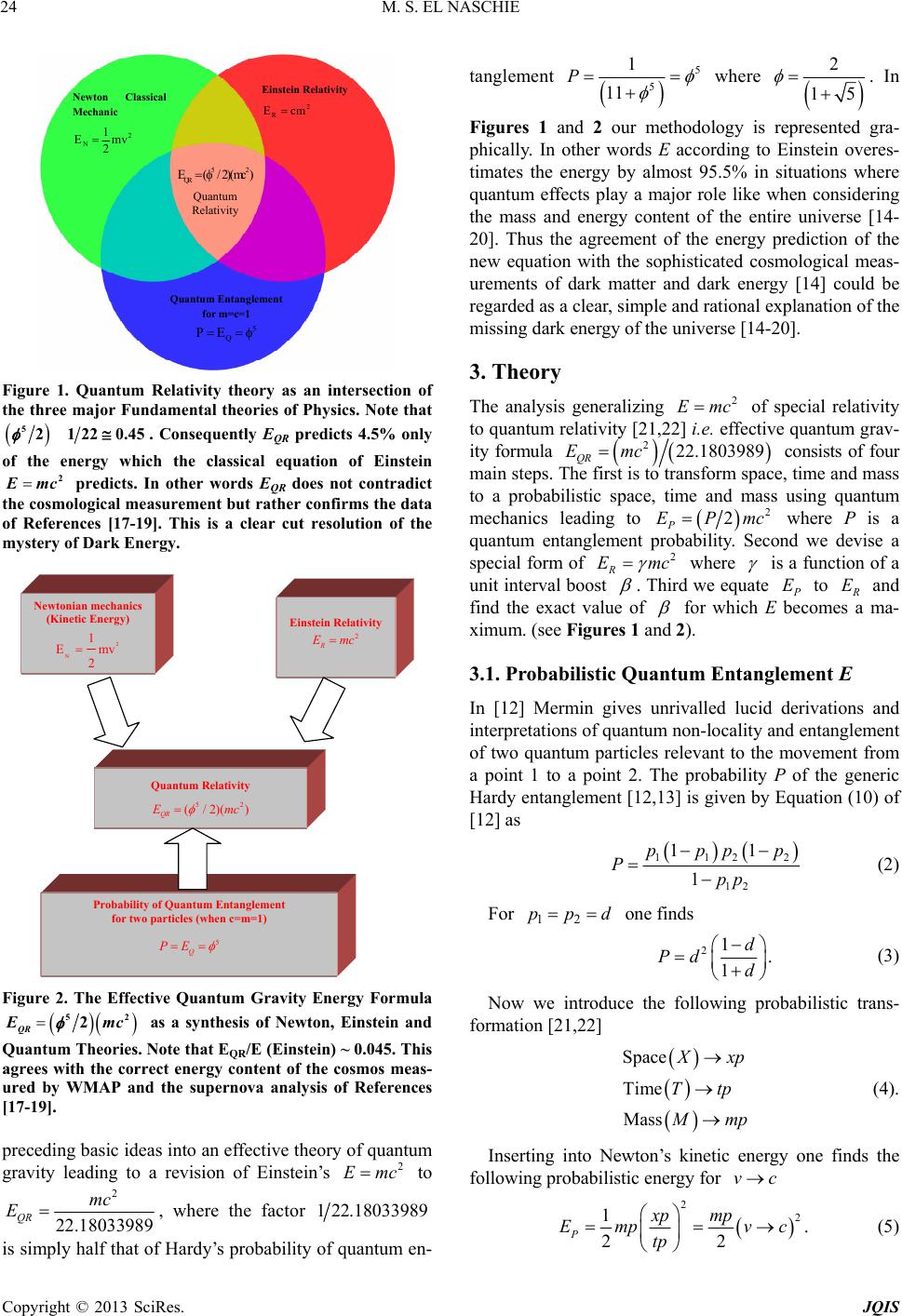 M. S. EL NASCHIE 24 Newton Classical Mechanic 2 N1 Emv 2 Einstein Relativity 2 R Ecm 52 QR E(/2)(mc) Quantum Relativity Quantum Entanglement for m =c =1 5 Q PE Figure 1. Quantum Relativity theory as an intersection of the three major Fundamental theori es of Physics. Note that 521 220.45 . Consequently EQR predicts 4.5% only of the energy which the classical equation of Einstein 2 E mc predicts. In other words EQR does not contradict the cosmological measurement but rather confirms the data of References [17-19]. This is a clear cut resolution of the mystery of Dark Energy. Newtonian mechanics (Kinetic Energy) 2 N 1 Emv 2 Einstein Relativity 2 R Emc Quantum Rel a tivity 52 (/2)() QR Emc Probability of Quantum Entanglement for two particles (when c=m=1) 5 Q PE Figure 2. The Effective Quantum Gravity Energy Formula 5 2 QR 2 E mc as a synthesis of Newton, Einstein and Quantum Theories. Note that EQR/E (Einstein) ~ 0.045. This agrees with the correct energy content of the cosmos meas- ured by WMAP and the supernova analysis of References [17-19]. preceding basic ideas into an effective theory of quantum gravity leading to a revision of Einstein’s to 2 Emc 2 22.18033989 QR mc E, where the factor 122.18033989 is simply half that of Hardy’s probability of quantum en- tanglement 5 5 1 11 P where 2 15 . In Figures 1 and 2 our methodology is represented gra- phically. In other words E according to Einstein overes- timates the energy by almost 95.5% in situations where quantum effects play a major role like when considering the mass and energy content of the entire universe [14- 20]. Thus the agreement of the energy prediction of the new equation with the sophisticated cosmological meas- urements of dark matter and dark energy [14] could be regarded as a clear, simple and rational explanation of the missing dark energy of the universe [14-20]. 3. Theory The analysis generalizing of special relativity to quantum relativity [21,22] i.e. effec tive quan tum grav - ity formula 2 Emc 222.1803989Emc QR consists of four main steps. The first is to transform space, time and mass to a probabilistic space, time and mass using quantum mechanics leading to 2 2 P EPmc 2 mc where P is a quantum entanglement probability. Second we devise a special form of R where E is a function of a unit interval boost . Third we equate P E to R E and find the exact value of for which E becomes a ma- xi mum. (see Figures 1 and 2). 3.1. Probabilistic Quantum Entanglement E In [12] Mermin gives unrivalled lucid derivations and interpretations of quantum non-locality and entanglement of two quantum particles relevant to the movement from a point 1 to a point 2. The probability P of the generic Hardy entanglement [12,13] is given by Equation (10) of [12] as 1122 12 11 1 pppp Ppp (2) For dpp 21 one finds 21. 1 d Pd d (3) Now we introduce the following probabilistic trans- formation [2 1, 22] Space Time Mass X xp Ttp M mp (4). Inserting into Newton’s kinetic energy one finds the following probabilistic energy for v c 22 1. 22 Pxp mp Empvc tp (5) Copyright © 2013 SciRes. JQIS  M. S. EL NASCHIE 25 That means [12,13] 2 11 . 21 Pd Ed mc d 2 (6) 3.2. Relativistic E From relativity theory we are familiar with three phe- nomenological effects namely: 1) time delineation; 2) rod shortening; and 3) mass increase when the velocity v tends to the speed of light c [21,22]. Theoretically all the three effects are beyond doubt while exper imentally th ere is reasonable evidence for the reality of all these effects [21,22]. Now we introduce an unspecified boost 1 and anti boost 1 in conjunction with the following sp ace, time and mass transformation akin to Lorentz trans- formation [2 1- 23]. 1 1 1 xx tt mm (7). Consequently Newton’s “Relativistic” kinetic energy becomes 2 2 2 1 111 1 2121 R Emc mc 2 . (8) 3.3. Determining the Magnitude Probabilistic Quantum Entanglement d and the Relativistic The next step in our strategy to arrive at an effective quantum gravity E is to require that both P E and R E be equal (for further elucidation, see Figures 1 and 2). That means P R EE (9) Therefore we have 2 22 21 1. 21 21 mcd mc dd (10) Clearly this is only possible for d and inserting back in (9) one finds that 2 21 1 11 (11) This leads to a simple quadratic equation 210, (12) with the well known and rather expected solution 12 1 , (13) where 51 2 is the golden mean as in the work of Mermin [12] and Styer [13]. 3.4. The Quantum Relativity Energy Formula Now we have reached the fourth and final step to obtain the generalization of to an effective quantum gravity formula by setting 2 Emcd in the correspond- ing expression and find that 22 52 23 22 2 11 21 1 22 22.18033989 quantumentanglement2 QR Emc mc mc mc Pm c (14). 4. Discussion, Conclusion and Future Work Looking closely at our generalization of to 2 Emc 2 22.18033989 QR mc E, we notice that the integer approxi- mation 222 QR Emc (15) is amenable to different simple interpretations of which we give two obvious ones. Firstly, the factor 22 can be intuitively viewed as what remains of the 26 dimensions of string spacetime of the original bosonic strong interac- tion theory after subtracting Einstein’s 4 dimensions [1,3,4]. Then, the 26 422 dimensions “dilute” the energy content of the cosmos and reduce it from 100% to 10022% i.e. to ~4.5%, in full agreement with the well known cosmological measurement of the three 2011 Nobel Laureates [18,19]. Secondly, we cou ld interp ret the factor 22 as the 11 elementary gauge bosons of the stan- dard model not included in Einstein’s one photon degree of freedom theory [21-23]. It is well known that the standard model is based on 3211SUSU U2 , while in 1905 Einstein knew only one of the 12 namely the photon leaving the rest out in one way or another [21,22]. Adding super-symmetric partners, this leads to (2) (11) = 22. See Refe rences [1, 3]. There are numerous other intuitive as well as strictly mathematical ways to show that 52 2 QR Em c is in- deed the correct energy formula that includes both the relativistic as well as the quantum effects in one equation which was analyzed by the present author. REFERENCES [1] P. Davies, “The New Physics,” Cambridge University Copyright © 2013 SciRes. JQIS  M. S. EL NASCHIE Copyright © 2013 SciRes. JQIS 26 Press, Cambridge, 1989. [2] P. Halpern, “The Great Beyond: Higher Dimensions, Pa- rallel Universes and the Extraordinary Search for a The- ory of Everything,” John Wiley & Son Inc., Hoboken, 2004. [3] R. Penrose, “The Road to Reality,” Jonathan Cape, Lon- don, 2004. [4] M. Kaku, “Introduction to Superstrings and M-Theory,” Springer, New York, 1999. doi:10.1007/978-1-4612-0543-2 [5] B. Booss-Bavnbek, et al., “New Paths towards Quantum Gravity,” Lecture Notes in Physics, Springer, 2010. [6] B. G. Sidharth, “Frontiers of Fundamental Physics,” Uni- versity Press, Hyderabad, 2007, pp. 1-32. [7] J. Mageuijo, “Faster than the Speed of Light,” William Heinemann, London, 2003. [8] L. Nottale, “Fractal Space-Time and Microphysics: To- wards a Theory of Scale Relativity,” World Scientific, Singapore, 1998. [9] L. Smolin, “Three Roads to Quantum Gravity,” Weiden- feld and Nicolson, London, 2000. [10] P. Steinhardt and N. Turok, “Endless Universe,” Weiden- feld and Nicolson, London, 2007. [11] Y. Baryshev and P. Teerikorpi, “Discovery of Cosmic fractals,” World Scientific, New Jersey, 2002. [12] D. Mermin, “Quantum Mysteries Refined,” American Jour- nal of Physics, Vol. 62, No. 10, 1994, pp. 880-887. doi:10.1119/1.17733 [13] D. F. Styer, “The Strange World of Quantum Mechanics,” Cambridge University Press, Cambridge, 2000, pp. 54-55. [14] L. Amendola and S. Tsujikawa, “Dark Energy: Theory and Observations,” Cambridge University Press, Cambridge, 2010. [15] R. Panek, “Dark Energy: The Biggest Mystery in the Uni- verse,” 2010. http:/www.smithsonianmagazine.com/science.Nature/Dark- Energy [16] Planck-Spacecraft, “Wikipedia,” 2012. http://en.wikipedia.org/wiki/planck [17] E. Komatsu, et al. (WMAP Collaboration), “Seven Years Wilkinson Microwave Anisotropy probe (WMAP) Ob- servations: Cosmological interpretation,” The Astrophy- sical Journal Supplement Serie s, Vol. 192, No. 2, 2011, p . 18. doi:10.1088/0067-0049/192/2/18 [18] A. G. Reiss, et al. (Supernova Search Team Collabora- tions), “Observation Evidence from Supernova for an Accelerating Universe and a Cosmological Constant,” Th e Astronomical Journal, Vol. 116, No. 3, 19 98, pp. 1009- 1038. doi:10.1086/300499 [19] S. Perlmutter, et al. (Supernova Cosmology Project Col- laboration), “Measurements of Omega and Lambda from 42 High-Redshift Supernova,” The Astronomical Journal, Vol. 517, No. 2, 1999, pp. 565-585. doi:10.1086/307221 [20] C. Toni, “Dark Matter, Dark Energy and the Fate of Ein- stein’s Theory of Gravity,” AMS Graduate Student Blog. Mathgrablog.williams.edu/dark-matter-darkenergy= fate-eins - teins-theory=gravity/#print [21] W. Rindler, “Relativity,” Oxford University Press, Ox- ford, 2001, pp. 111-112. [22] W. Rindler, “General Relativity before Special Relativity: An Unconventional Overview of Relativity Theory,” Ame- rican Journal of Physics, Vol. 62, No. 10, 1994, p. 887. [23] J. Mageuijo and L. Smolin, “Lorentz Invariance with an Invariant Energy Scale,” 18 December 2001, arXiv: hep- th/0112090V2. |