

Paper Menu >>
Journal Menu >>
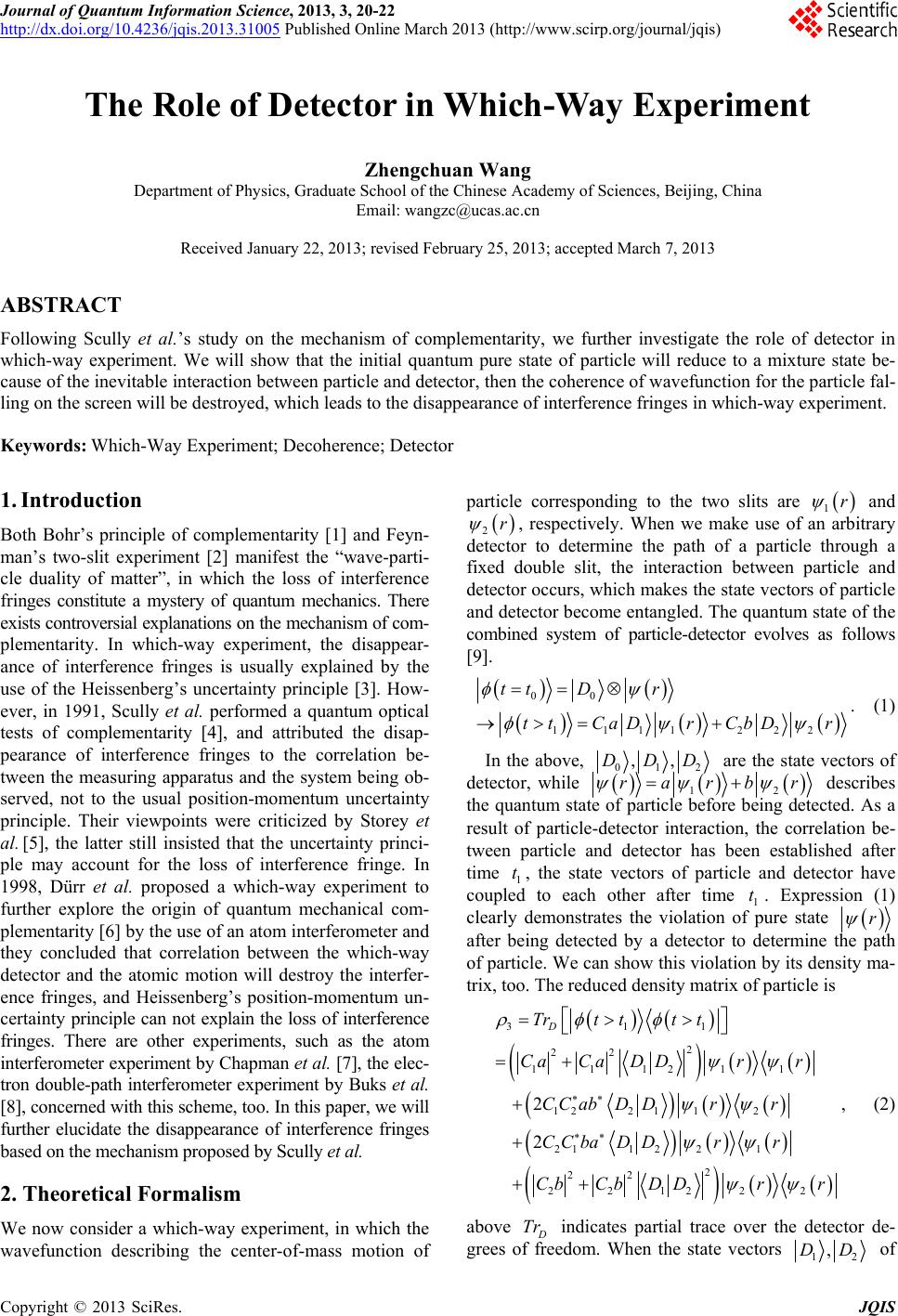 Journal of Quantum Information Science, 2013, 3, 20-22 http://dx.doi.org/10.4236/jqis.2013.31005 Published Online March 2013 (http://www.scirp.org/journal/jqis) The Role of Detector in Which-Way Experiment Zhengchuan Wang Department of Physics, Graduate School of the Chinese Academy of Sciences, Beijing, China Email: [email protected] Received January 22, 2013; revised Februa ry 25, 2013; accepted March 7, 2013 ABSTRACT Following Scully et al.’s study on the mechanism of complementarity, we further investigate the role of detector in which-way experiment. We will show that the initial quantum pure state of particle will reduce to a mixture state be- cause of the inevitable interaction b etween particle and detector, then the coherence of wavefunction for the particle fal- ling on the screen will be destroyed, which leads to the disappearance of interference fringes in which-way experiment. Keywords: Which-Way Experiment; Decoherence; Detector 1. Introduction Both Bohr’s principle of complementarity [1] and Feyn- man’s two-slit experiment [2] manifest the “wave-parti- cle duality of matter”, in which the loss of interference fringes constitute a mystery of quantum mechanics. There exists cont roversial expl anations on the mech anism of co m- plementarity. In which-way experiment, the disappear- ance of interference fringes is usually explained by the use of the Heissenberg’s uncertainty principle [3]. How- ever, in 1991, Scully et al. performed a quantum optical tests of complementarity [4], and attributed the disap- pearance of interference fringes to the correlation be- tween the measuring apparatus and the system being ob- served, not to the usual position-momentum uncertainty principle. Their viewpoints were criticized by Storey et al. [5], the latter still insisted that the uncertainty princi- ple may account for the loss of interference fringe. In 1998, Dürr et al. proposed a which-way experiment to further explore the origin of quantum mechanical com- plementarity [6] by the use of an atom interferometer and they concluded that correlation between the which-way detector and the atomic motion will destroy the interfer- ence fringes, and Heissenberg’s position-momentum un- certainty principle can not explain the loss of interference fringes. There are other experiments, such as the atom interferometer experiment by Chapman et al. [7], the elec- tron double-path interferometer experiment by Buks et al. [8], concerned with this scheme, too. In this paper, we will further elucidate the disappearance of interference fringes based on the mechanism proposed by Scully et al. 2. Theoretical Formalism We now consider a which-way experiment, in which the wavefunction describing the center-of-mass motion of particle corresponding to the two slits are 1r and 2r , respectively. When we make use of an arbitrary detector to determine the path of a particle through a fixed double slit, the interaction between particle and detector occurs, which makes the state vectors of particle and detector become entangled. The quantum state of the combined system of particle-detector evolves as follows [9]. 00 1111 222 tt Dr ttCaDr CbDr . (1) In the above, 012 ,,DDD are the state vectors of detector, while 12 rarbr describes the quantum state of particle before being detected. As a result of particle-detector interaction, the correlation be- tween particle and detector has been established after time 1, the state vectors of particle and detector have coupled to each other after time 1 t. Expression (1) clearly demonstrates the violation of pure state t r after being detected by a detector to determine the path of particle. We can show this violation b y its density ma- trix, too. The reduced density matrix of particle is 311 2 22 111211 122 112 211 221 2 22 221222 2 2 D Trtttt CaCaDDrr CC abDDrr CCbaD Drr CbCbD Drr , (2) above D Tr indicates partial trace over the detector de- grees of freedom. When the state vectors 12 ,DD of C opyright © 2013 SciRes. JQIS 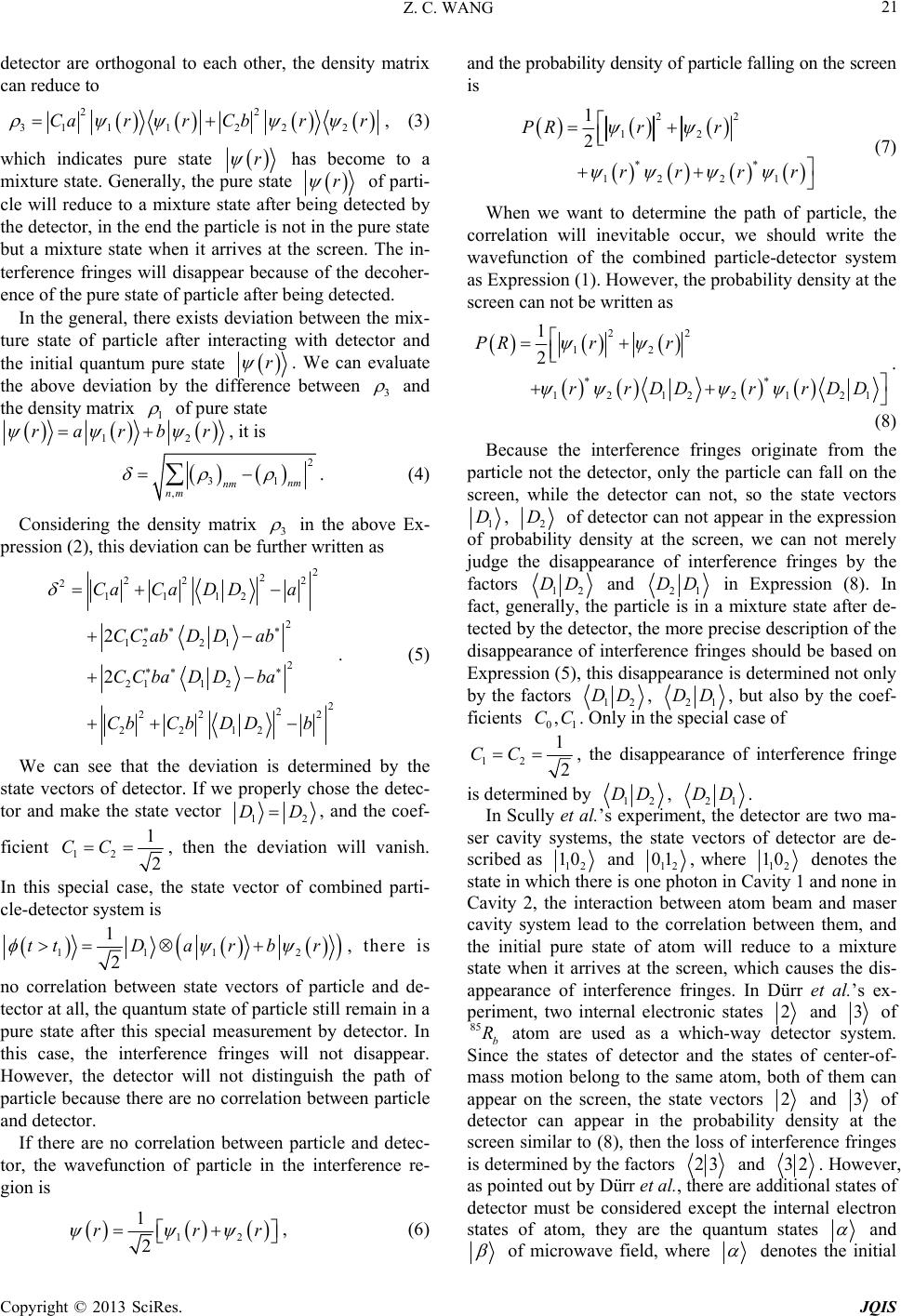 Z. C. WANG 21 detector are orthogonal to each other, the density matrix can reduce to 22 31 11222 Carr Cbrr , (3) which indicates pure state r has become to a mixture state. Generally, the pure state r of parti- cle will reduce to a mixture state after being detected by the detector, in the end th e particle is not in the pure state but a mixture state when it arrives at the screen. The in- terference fringes will disappear because of the decoher- ence of the pure state of particle after being detected. In the general, there exists deviation between the mix- ture state of particle after interacting with detector and the initial quantum pure state r . We can evaluate the above deviation by the difference between 3 and the density matrix 1 of pure state 12 rarbr , it is 2 31 ,nm nm nm . (4) Considering the density matrix 3 in the above Ex- pression (2), this deviation can be further written as 2 2 22 2 21112 2 122 1 2 211 2 2 2 22 2212 2 2 CaCaDDa C CabDDab C C baDDba CbCbDDb 2 . (5) We can see that the deviation is determined by the state vectors of detector. If we properly chose the detec- tor and make the state vector 1 DD2 , and the coef- ficient 12 1 2 CC , then the deviation will vanish. In this special case, the state vector of combined parti- cle-detector system is 1112 1 2 ttDarbr , there is no correlation between state vectors of particle and de- tector at all, the quantum state of particle still remain in a pure state after this special measurement by detector. In this case, the interference fringes will not disappear. However, the detector will not distinguish the path of particle because there are no correlation between particle and detector. If there are no correlation between particle and detec- tor, the wavefunction of particle in the interference re- gion is 12 1 2 rr and the probability density of particle falling on the screen is 22 12 12 21 1 2 PRr r rr rr (7) When we want to determine the path of particle, the correlation will inevitable occur, we should write the wavefunction of the combined particle-detector system as Expression (1). However, the probability density at the screen can not be written as 22 12 12122121 1 2 PRr r rrDDrrDD . (8) Because the interference fringes originate from the particle not the detector, only the particle can fall on the screen, while the detector can not, so the state vectors 1 D, 2 D of detector can not appear in the expression of probability density at the screen, we can not merely judge the disappearance of interference fringes by the factors 12 DD and 21 DD in Expression (8). In fact, generally, the particle is in a mixture state after de- tected by the detector, the more precise description of the disappearance of interference fringes should be based on Expression (5), this disappearance is determined not only by the factors 12 DD , 21 DD, but also by the coef- ficients . Only in the special case of 01 ,CC 12 1 2 CC , the disappearance of interference fringe is determined by 12 DD , 21 DD. In Scully et al.’s experiment, the detector are two ma- ser cavity systems, the state vectors of detector are de- scribed as 12 10 and 12 01 , where 12 10 denotes the state in which there is one photon in Cav ity 1 and none in Cavity 2, the interaction between atom beam and maser cavity system lead to the correlation between them, and the initial pure state of atom will reduce to a mixture state when it arrives at the screen, which causes the dis- appearance of interference fringes. In Dürr et al.’s ex- periment, two internal electronic states 2 and 3 of atom are used as a which-way detector system. Since the states of detector and the states of center-of- mass motion belong to the same atom, both of them can appear on the screen, the state vectors 85 b R 2 and 3 of detector can appear in the probability density at the screen similar to (8), then the loss of interferen ce fringes is determined by the factors 23 and 32 . However, as pointed out by Dürr et al., there are additional states of detector must be considered except the internal electron states of atom, they are the quantum states and of microwave field, where denotes the initial r , (6) Copyright © 2013 SciRes. JQIS 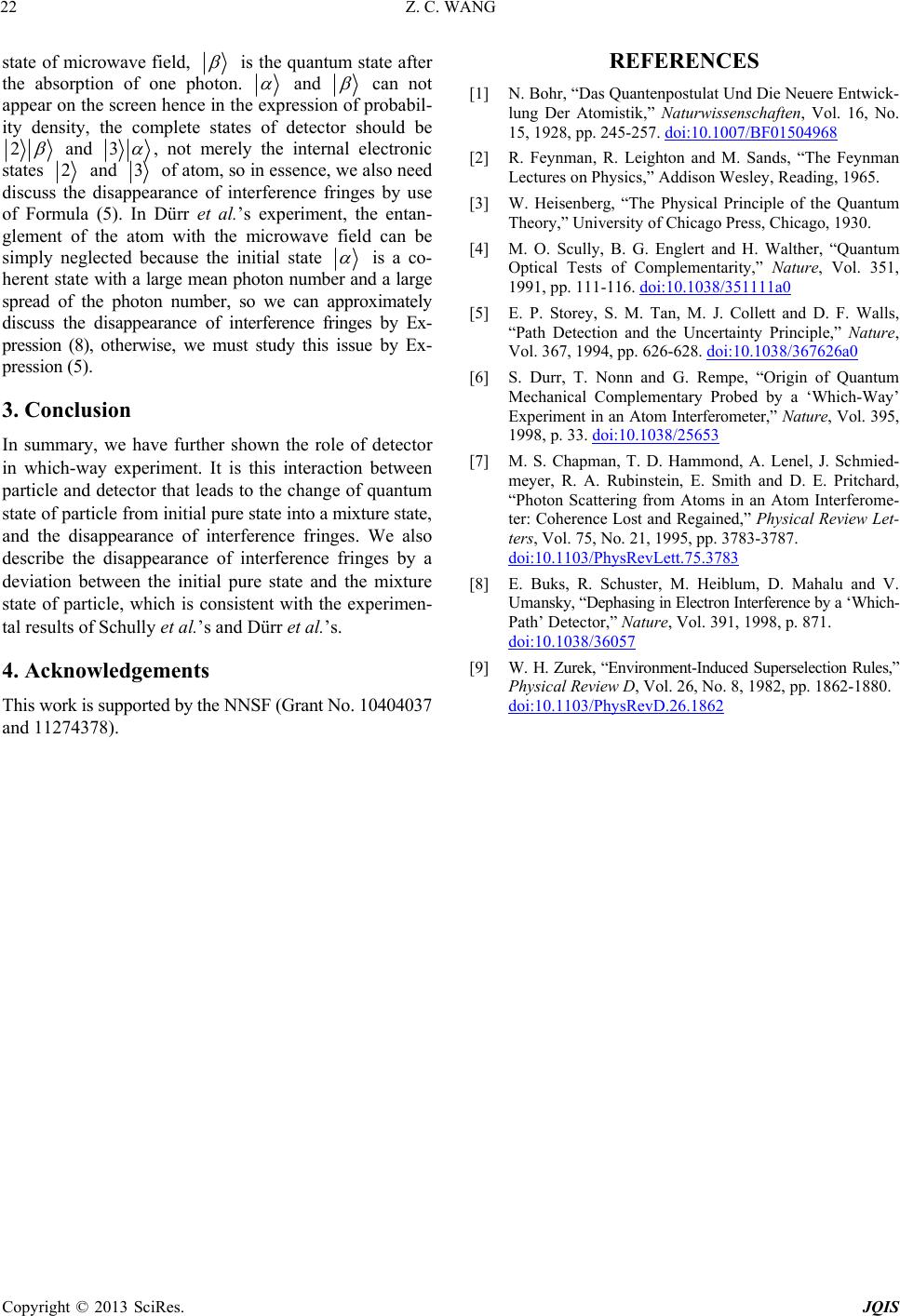 Z. C. WANG Copyright © 2013 SciRes. JQIS 22 REFERENCES state of microwave field, is the quantum state after the absorption of one photon. and can not appear on the screen hence in the expression of probabil- ity density, the complete states of detector should be 2 and 3 , not merely the internal electronic states 2 and 3 of atom, so in essence, we also need discuss the disappearance of interference fringes by use of Formula (5). In Dürr et al.’s experiment, the entan- glement of the atom with the microwave field can be simply neglected because the initial state is a co- he rent state with a large mean photon number and a large spread of the photon number, so we can approximately discuss the disappearance of interference fringes by Ex- pression (8), otherwise, we must study this issue by Ex- pression (5). [1] N. Bohr, “Das Quantenpostulat Und Die Neuere Entwick- lung Der Atomistik,” Naturwissenschaften, Vol. 16, No. 15, 1928, pp. 245-257. doi:10.1007/BF01504968 [2] R. Feynman, R. Leighton and M. Sands, “The Feynman Lectures on Physics,” Addison Wesley, Reading, 1965. [3] W. Heisenberg, “The Physical Principle of the Quantum Theory,” University of Chicago Press, Chicago, 1930. [4] M. O. Scully, B. G. Englert and H. Walther, “Quantum Optical Tests of Complementarity,” Nature, Vol. 351, 1991, pp. 111-116. doi:10.1038/351111a0 [5] E. P. Storey, S. M. Tan, M. J. Collett and D. F. Walls, “Path Detection and the Uncertainty Principle,” Nature, Vol. 367, 1994, pp. 626-628. doi:10.1038/367626a0 [6] S. Durr, T. Nonn and G. Rempe, “Origin of Quantum Mechanical Complementary Probed by a ‘Which-Way’ Exp eriment in an Atom Interferometer,” Nature, Vol. 395, 1998, p. 33. doi:10.1038/25653 3. Conclusion In summary, we have further shown the role of detector in which-way experiment. It is this interaction between particle and detector that leads to the change of quantum state of particle from initial pure state into a mixture state, and the disappearance of interference fringes. We also describe the disappearance of interference fringes by a deviation between the initial pure state and the mixture state of particle, which is consistent with the experimen- tal results of Schully et al.’s and Dürr et al.’s. [7] M. S. Chapman, T. D. Hammond, A. Lenel, J. Schmied- meyer, R. A. Rubinstein, E. Smith and D. E. Pritchard, “Photon Scattering from Atoms in an Atom Interferome- ter: C oherence Lost and Regained ,” Physical Review Let- ters, Vol. 75, No. 21, 1995, pp. 3783-3787. doi:10.1103/PhysRevLett.75.3783 [8] E. Buks, R. Schuster, M. Heiblum, D. Mahalu and V. Um ansky, “Dephasing in Electron Interference by a ‘Which- Path’ Detector,” Nature, Vol. 391, 1998, p. 871. doi:10.1038/36057 4. Acknowledgements [9] W. H. Zurek, “Environment-Induced Superselection Rules,” Physical Review D, Vol. 26, No. 8, 1982, pp. 1862-1880. doi:10.1103/PhysRevD.26.1862 This work is supported by the NNSF (Grant No. 10404037 and 11274378). |