

Paper Menu >>
Journal Menu >>
 Journal of Quantum Information Science, 2013, 3, 10-15 http://dx.doi.org/10.4236/jqis.2013.31003 Published Online March 2013 (http://www.scirp.org/journal/jqis) Thermodynamic Properties and Decoherence of a Central Electron Spin of Atom Coupled to an Anti-Ferromagnetic Spin Bath Martin Tchoffo, Georges Collince Fouokeng*, Lukong Cornelius Fai, Mathurin Esouague Ateuafack Mesoscopic and Multilayer Structures Laboratory, Department of Physics, Faculty of Science, University of Dschang, Dschang, Cameroon Email: *[email protected] Received December 30, 2012; revised January 31, 2013; accepted February 9, 2013 ABSTRACT The decoherence of a central electron spin of an atom coupled to an anti-ferromagnetic spin bath in the presence of a time varying B-Field (VBF) is investigated applying the Holstein-Primak off and Bloch transformations approaches. The Boltzmann entropy and the specific heat capacity at a given temperature are obtained and show the correlation of the coupling of the spin bath and the electron spin of the central atom. At low frequencies, the coherence of the coupled system is dominated by the magnetic field intensity. At low VBF intensity, there is decrease in entropy and heat capac- ity at increase external magnetic field that show the decoherence suppression of the central electron spin atom. The crossing observed in the specific heat capacity corresponds to the critical field point of the system which repre- sents the point of transition from the anti-ferromagnetic system to the ferromagnetic one. C B Keywords: Entropy; Specific Heat Capacity; Varying B-Field; Decoherence 1. Introduction Thermodynamic properties of Quantum systems have become very attractive due to their potential applications in thermoelectric devices [1], tunneling and decoherence [2,3]. Thermodynamic properties of quantum systems now aid in the investigation of the dynamical entropy [4-8]. Recently, different definitions of specific heat are discussed [9] and the entropy for a quantum oscillator in an arbitrary heat bath at finite temperature is examined [10-12]. Experiments [13,14] show the feasibility of pro- cessing Quantum Information (QI) via the manipulation of optically excited electron spins [15] in Diamond. De- coherence of electron spins coupled to nuclear spin baths in quantum dots or solid-state impurity centers [16] is crucial in spin-based Quantum Information (QI) process- ing [17], magnetic resonance spectroscopy [18,19], and magnetometry [20]. Recent quantum technologies show that the relevant environments are of nanometer size [16- 19] and therefore their quantum nature is enhanced. Quan- tum nuclear spin bath, in contrast to classical noises, possessed to a great extent controllability and surpris- ingly coherence recovery of an electron spin [21-23]. The central-spin model, or Gaudin model, describes one spin coupled to N − 1 bath spins via both isotropic and ani- sotropic Heisenberg interactions, including a constant magnetic field [24-27]. Decoherence leads to suppression of spin tunneling in magnetic molecules and nanoparti- cles [28,29] and also destroys the Kondo effect in a dis- sipationless manner [30]. Decoherence may be investi- gated with the help of the spin-echo-like techniques [31] or spin wave approximation. Extension of the spin-echo- like approach to quantum computations is known as the “bang-bang control” [32]. In this paper, our objective is to evaluate the influence of the external parallel VBF on the thermodynamic pro- perties and Decoherence tailoring of a Central electron spin of atom coupled to an anti-ferromagnetic spin bath by the SWA method and compare our results with those obtained via the partition function [4]. The organization of the paper is as follows: in Section 2, we present a brief description of the theoretical ap- proach used and the model for simulation of open many- spin systems. In Section 3, we evaluate the thermody- namic properties of the Central electron spin of atom coupl- ed to an Anti-ferromagnetic spin bath and then conclude our findings in Section 4. 2. Theoretical Approach and the Model Hamiltonian The theoretical description of decoherence have been *Corresponding author. C opyright © 2013 SciRes. JQIS  M. TCHOFFO ET AL. 11 studied numerically [33] and show that the evolution of the central spin system from its initial pure state 0 to the final mixed state, along with the corresponding trans- formation of the environment, is a very difficult problem of quantum theory. For some more complex models, dif- ferent approximations can be employed, such as the Mar- kov approximation [34]. A special case of environment consisting of uncoupled oscillators, so-called “boson bath”, is also rather well understood theoretically [35]. The bo- son bath description though applicable for many types of environment [36], is not universal. The boson bath model is not applicable for the decoherence caused by an envi- ronment made of spins [33]. The most direct approach to study the spin-bath decoherence is to simulate numeri- cally the evolution of the whole compound system by di- rectly solving the time-dependent Schrödinger equation [33]. This approach allows us to avoid any kind of ap- proximation, except for the obvious limitation on the to- tal number of spins models [33]. To make such simula- tions feasible, high-performance computational schemes are needed. The simulation method based on the Cheby- shev’s polynomial expansion [35,36] was used in [33]. The spin wave approximation method was also used in [26,27]. Both approaches are applicable when the Ham- iltonian is not explicitly dependent on time. In this work, we use a spin wave approximation by the Holstein-Pri- makoff and the Fourier transformation method. ψ Let us consider a system of quantum spins describ- ed by N H and initially described by0 H : SSBB H HH H (2.1) where 0 z SB H gBS (2.2) the Hamiltonian of the central spin atom, 0 0, zzz SBa ib i i J , H SSS N (2.3) the Hamiltonian of the interaction of the central spin with the spin bath ,,, ,, ,, , z B aibib ja jBAai ij z BAbj j HJSSSSgBB S gBBS δδ δδ i (2.4) The spin-bath Hamiltonian; g is the gyromagnetic fac- tor, B μ the Bohr magneton, J0 the coupling constant, J the exchange interaction and 0cosBB t is the VBF applied in the direction and -z b a the pulsa- tion of the VBF. The effects of the next nearest neighbor interactions are neglected. We assumed that the spin structure of the environment may be divided into two in- terpenetrating sub-lattices and with the property that all nearest neighbors of an atom on lie on and vice versa. and ,bi represents the spin op- erators of and atom on sub-lattice and b. The field A is anisotropic and assumed to be positive which approximates the effect of the crystal anisotropy of the energy with the property of tending for positive magnetic moment a b ,ai S j S th i B th a B to align the spins on sub-lattice in the positive az direction and spins on sub-lattice in the negative bz direction. Using the reduce Hol- stein-Primakoff and Bogoliubov transformations [17], we have the reduced Hamiltonian 0 z SB H gBS (2.5) 0 z k 0 J SB k k H Sm n N (2.6) 0 B kkk k kk H En m (2.7) where k is the frequency of the magnon in the system and the energy of a central spin atom. The factors kkk ω 0 β E m β and kkk are respectively the total number of magnons on the branch b and . From Equation (2.6), we see that if the two branches of the Network have the same number of magnons, the Hamil- tonian SB nαα a H vanish then there will be no coupling be- tween the Network and the Networkb. In this case the behavior of the system depends totally on the driven external field. a 3. Thermodynamic Properties of a Central Electron Spin of Atom Coupled to an Anti-Ferromagnetic Spin Bath In this section, we find the Boltzmann entropy and the specific heat capacity to show the influence of the ani- sotropy of the field that characterize the anti-ferromag- netic environment and the VBF on the dynamic of the central electron spin system. We suppose that our system is in a canonical ensemble [37] .To attempt to evaluate the dynamical properties of the considered system, the statistical sum is needed. Let 0 be the zero-point en- ergy of the system obtained considering the harmonic approximation given by, E 1 21 KK K 0kk Em ii (3.8) with the mode of vibrations and k the atom mass of the crystal, the statistical sum of the system has the form: km 0B exp Z EKT (3.9) where B K is the Boltzmann constant and the abso- lute temperature. With the help of the Helmholtz free energy T F , ln B F KT Z (3.10) Copyright © 2013 SciRes. JQIS 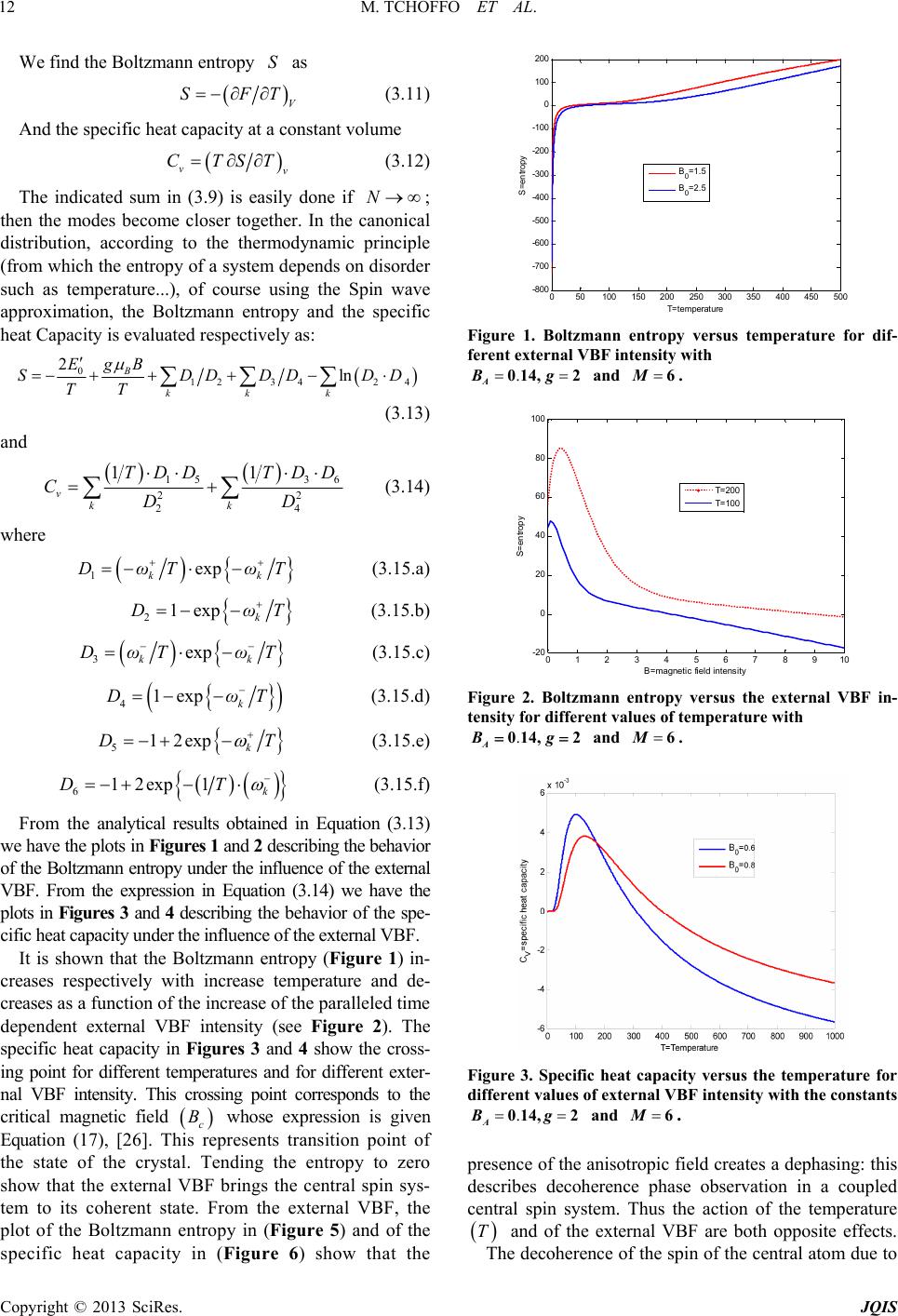 M. TCHOFFO ET AL. 12 We find the Boltzmann entropy as S V SFT (3.11) And the specific heat capacity at a constant volume vv CTST (3.12) The indicated sum in (3.9) is easily done if ; then the modes become closer together. In the canonical distribution, according to the thermodynamic principle (from which the entropy of a system depends on disorder such as temperature...), of course using the Spin wave approximation, the Boltzmann entropy and the specific heat Capacity is evaluated respectively as: N 0 12342 4 2ln B kkk EgB SDDDDD TT D (3.13) and 15 36 2 24 11 v kk TDD TDD CDD 2 (3.14) where 1exp k DωTωT k (3.15.a) 21exp k DωT (3.15.b) 3exp k DωTωT k (3.15.c) 41exp k DωT (3.15.d) 512expk D T (3.15.e) 612exp 1k DT (3.15.f) From the analytical results obtained in Equation (3.13) we have the plots in Figures 1 and 2 describing the behavior of the Boltzmann entropy under the influence of the external VBF. From the expression in Equation (3.14) we have the plots in Figures 3 and 4 describing the behavior of the spe- cific heat capacity under the influence of the external VBF. It is shown that the Boltzmann entropy (Figure 1) in- creases respectively with increase temperature and de- creases as a function of the increase of the paralleled time dependent external VBF intensity (see Figure 2). The specific heat capacity in Figures 3 and 4 show the cross- ing point for different temperatures and for different exter- nal VBF intensity. This crossing point corresponds to the critical magnetic field whose expression is given Equation (17), [26]. This represents transition point of the state of the crystal. Tending the entropy to zero show that the external VBF brings the central spin sys- tem to its coherent state. From the external VBF, the plot of the Boltzmann entropy in (Figure 5) and of the specific heat capacity in (Figure 6) show that the c B 050100150 200250 300 350400 450500 -800 -700 -600 -500 -400 -300 -200 -100 0 100 200 T=t em perature S=entropy B 0 =1.5 B 0 =2.5 Figure 1. Boltzmann entropy versus temperature for dif- ferent external VBF intensity with . 0 14,2 A Bg and M6. 0 1 23 45 6 78 910 -20 0 20 40 60 80 100 B=magnetic field intensity S= ent ropy T=200 T=100 Figure 2. Boltzmann entropy versus the external VBF in- tensity for different values of temperature with .0 14,2 A Bg and M6. Figure 3. Specific heat capacity versus the temperature for different values of external VBF intensity with the constants .0 14,2 A Bg and M6. presence of the anisotropic field creates a dephasing: this describes decoherence phase observation in a coupled central spin system. Thus the action of the temperature T and of the external VBF are both opposite effects. The decoherence of the spin of the central atom due to Copyright © 2013 SciRes. JQIS 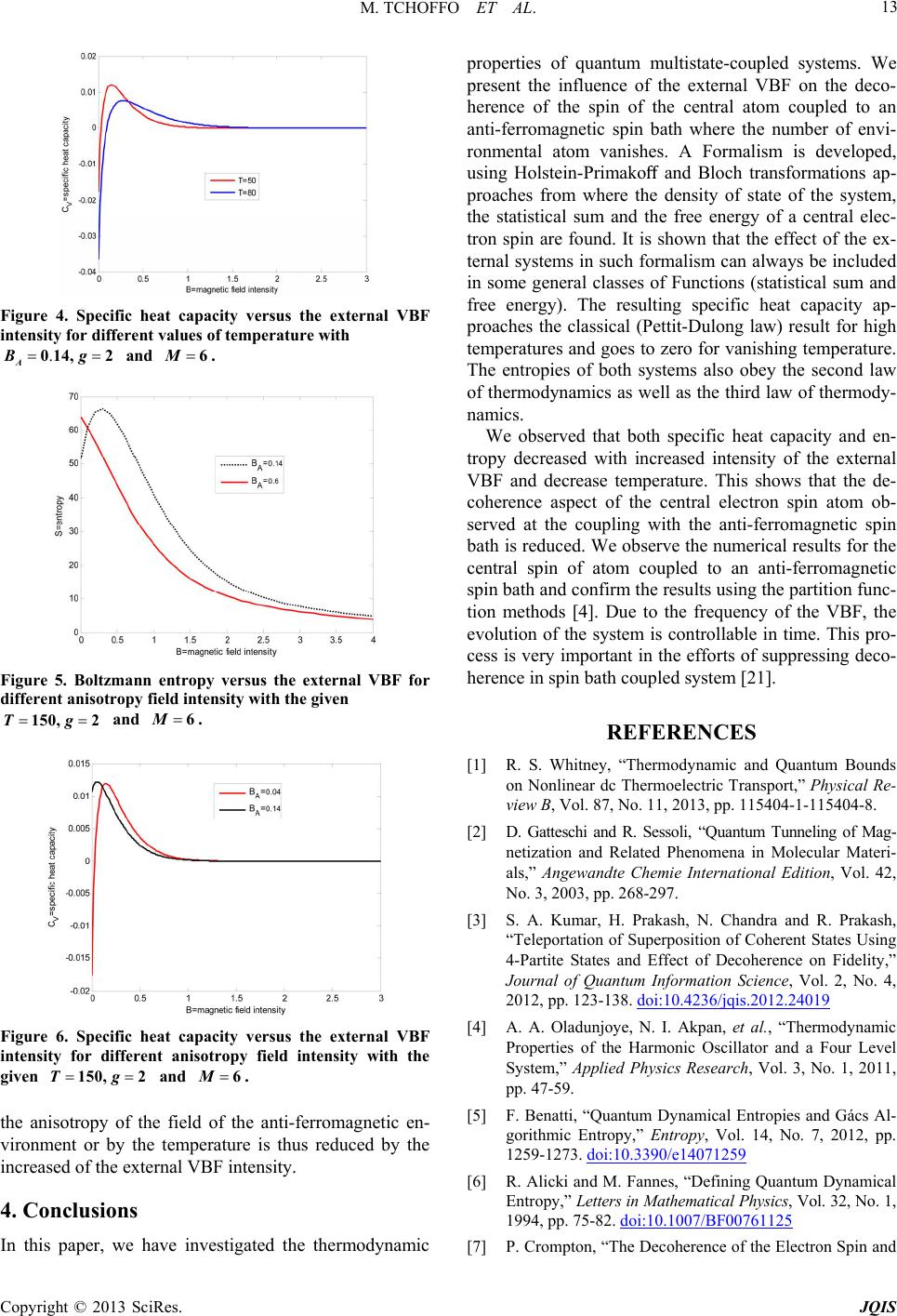 M. TCHOFFO ET AL. 13 Figure 4. Specific heat capacity versus the external VBF intensity for different values of temperature with and . .0 14,2 A BgM6 Figure 5. Boltzmann entropy versus the external VBF for different anisotropy field intensity with the given and . 150, 2Tg M6 Figure 6. Specific heat capacity versus the external VBF intensity for different anisotropy field intensity with the given and 150, 2Tg M6. the anisotropy of the field of the anti-ferromagnetic en- vironment or by the temperature is thus reduced by the increased of the external VBF intensity. 4. Conclusions In this paper, we have investigated the thermodynamic properties of quantum multistate-coupled systems. We present the influence of the external VBF on the deco- herence of the spin of the central atom coupled to an anti-ferromagnetic spin bath where the number of envi- ronmental atom vanishes. A Formalism is developed, using Holstein-Primakoff and Bloch transformations ap- proaches from where the density of state of the system, the statistical sum and the free energy of a central elec- tron spin are found. It is shown that the effect of the ex- ternal systems in such formalism can always be included in some general classes of Functions (statistical sum and free energy). The resulting specific heat capacity ap- proaches the classical (Pettit-Dulong law) result for high temperatures and goes to zero for vanishing temperature. The entropies of both systems also obey the second law of thermodynamics as well as the third law of thermody- namics. We observed that both specific heat capacity and en- tropy decreased with increased intensity of the external VBF and decrease temperature. This shows that the de- coherence aspect of the central electron spin atom ob- served at the coupling with the anti-ferromagnetic spin bath is reduced. We observe the numerical results for the central spin of atom coupled to an anti-ferromagnetic spin bath and confirm the results using the partition func- tion methods [4]. Due to the frequency of the VBF, the evolution of the system is controllable in time. This pro- cess is very important in the efforts of suppressing deco- herence in spin bath coupled system [21]. REFERENCES [1] R. S. Whitney, “Thermodynamic and Quantum Bounds on Nonlinear dc Thermoelectric Transport,” Physical Re- view B, Vol. 87, No. 11, 2013, pp. 115404-1-115404-8. [2] D. Gatteschi and R. Sessoli, “Quantum Tunneling of Mag- netization and Related Phenomena in Molecular Materi- als,” Angewandte Chemie International Edition, Vol. 42, No. 3, 2003, pp. 268-297. [3] S. A. Kumar, H. Prakash, N. Chandra and R. Prakash, “Teleportation of Superposition of Coherent States Using 4-Partite States and Effect of Decoherence on Fidelity,” Journal of Quantum Information Science, Vol. 2, No. 4, 2012, pp. 123-138. doi:10.4236/jqis.2012.24019 [4] A. A. Oladunjoye, N. I. Akpan, et al., “Thermodynamic Properties of the Harmonic Oscillator and a Four Level System,” Applied Physics Research, Vol. 3, No. 1, 2011, pp. 47-59. [5] F. Benatti, “Quantum Dynamical Entropies and Gács Al- gorithmic Entropy,” Entropy, Vol. 14, No. 7, 2012, pp. 1259-1273. doi:10.3390/e14071259 [6] R. Alicki and M. Fannes, “Defining Quantum Dynamical Entropy,” Letters in Mathematical Physics, Vol. 32, No. 1, 1994, pp. 75-82. doi:10.1007/BF00761125 [7] P. Crompton, “The Decoherence of the Electron Spin and Copyright © 2013 SciRes. JQIS  M. TCHOFFO ET AL. 14 Meta-Stability of 13C Nuclear Spins in Diamond,” En- tropy, Vol. 13, No. 5, 2011, pp. 949-965. doi:10.3390/e13050949 [8] L. Accardi, M. Ohya and N. Watanabe, “Dynamical En- tropy through Quantum Markov Chains,” Open Systems & Information Dynamics, Vol. 4, No. 1, 1997, pp. 71-87. doi:10.1023/A:1009609602126 [9] H. N. Wu, G. Z. Wei, P. Zhang, G. Y. Yi and W. J. Gong, “Thermodynamic Properties of the Mixed Spin-1/2 and Spin-1 Ising Chain with both Longitudinal and Transverse Single-Ion Anisotropies,” Journal of Magnetism and Mag- netic Materials, Vol. 322, No. 21, 2010, pp. 3502-3507. doi:10.1016/j.jmmm.2010.06.053 [10] A. W. Rost, S. A. Grigera, J. A. N. Bruin, R. S. Perry, D. Tian, S. Raghu, S. A. Kivelson and A. P. Mackenzie, “Ther- modynamics of Phase Formation in the Quantum Critical Metal Sr3Ru2O7,” Proceedings of the National Academy of Sciences of the United States of America, Vol. 108, No. 40, 2011, pp. 16549-16553. [11] B. Frescha and G. J. Morob, “Emergence of Equilibrium Thermodynamic Properties in Quantum Pure States. II. Analysis of a Spin Model System,” Journal of Chemical Physics, Vol. 133, No. 3, 2010, Article ID: 034510. doi:10.1063/1.3456000 [12] G. Ingold, P. Hanggi and P. Talkner, “Specific Heat Ano- malies of Open Quantum Systems,” Physical Review E, Vol. 79, No. 6, 2009, Article ID: 061105. doi:10.1103/PhysRevE.79.061105 [13] L. Childress, M. V. G. Dutt, J. M. Taylor, A. S. Zibrov, F. Jelezko, J. Wrachtrup, P. R. Hemmer and M. D. Lukin, “Coherent Dynamics of Coupled Electron and Nuclear Spin Qubits in Diamond,” Science, Vol. 314, No. 5797, 2006, pp. 281-285. doi:10.1126/science.1131871 [14] S. Takahashi, R. Hanson, J. Van Tol, M. S. Sherwin and D. D. Awschalom, “Quenching Spin Decoherence in Dia- mond through Spin Bath Polarization,” Physical Review Letters, Vol. 101, No. 4, 2008, Article ID: 047601. doi:10.1103/PhysRevLett.101.047601 [15] M. D. Lukin and A. Imamoglu, “Nonlinear Optics and Quantum Entanglement of Ultraslow Single Photons,” Phy- sical Review Letters, Vol. 84, No. 7, 2000, pp. 1419-1422. doi:10.1103/PhysRevLett.84.1419 [16] D. Press, K. de Greve, P. L. McMahon, T. D. Ladd, B. Friess, C. Schneider, M. Kamp, S. Höfling, A. Forchel and Y. Ya-Mamoto, “Ultrafast Optical Spin Echo in a Sin- gle Quantum Dot,” Nature Photonics, Vol. 4, No. 6, 2010, pp. 367-370. doi:10.1038/nphoton.2010.83 [17] T. D. Ladd, F. Jelezko, R. Laflamme, Y. Nakamura, C. Monroe and J. L. O’Brien, “Quantum Computers,” Nature, Vol. 464, 2010, pp. 45-53. doi:10.1038/nature08812 [18] J. Du, X. Rong, N. Zhao, Y. Wang, J. Yang and R. B. Liu, “Preserving Electron Spin Coherence in Solids by Optimal Dynamical Decoupling,” Nature, Vol. 461, No. 7268, 2009, pp. 1265-1268. doi:10.1038/nature08470 [19] C. A. Ryan, J. S. Hodges and D. G. Cory, “Robust De- coupling Techniques to Extend Quantum Coherence in Dia- mond,” Physical Review Letters, Vol. 105, No. 20, 2010, Article ID: 200402. doi:10.1103/PhysRevLett.105.200402 [20] N. Zhao, J. Honert, et al., “Sensing Single Remote Nuclear Spins,” Nature Nanotechnology, Vol. 7, No. 10, 2012, pp. 657-662. [21] W. Yang and R. B. Liu, “Quantum Many-Body Theory of Qubit Decoherence in a Finite-Size Spin Bath,” Physical Review B, Vol. 78, No. 8, 2008, Article ID: 085315. doi:10.1103/PhysRevB.78.085315 [22] W. Yao, R. B. Liu and L. J. Sham, “Restoring Coherence Lost to a Slow Interacting Mesoscopic Spin Bath,” Physi- cal Review Letters, Vol. 98, No. 5, 2007, Article ID: 077602. [23] J. M. Taylor, C. M. Marcus and M. D. Lukin, “Long- Lived Memory for Mesoscopic Quantum Bits,” Physical Review Letters, Vol. 90, No. 20, 2003, Article ID: 206803. ddoi:10.1103/PhysRevLett.90.206803 [24] M. Bortz and J. Stolze, “Spin and Entanglement Dynam- ics in the Central-Spin Model with Homogeneous Cou- plings,” Journal of Statistical Mechanics: Theory and Ex- periment, Vol. 2007, 2007, Article ID: P06018. doi:10.1088/1742-5468/2007/06/P06018 [25] J. Lages, V. V. Dobrovitski, M. I. Katsnelson, H. A. De Raedt and B. N. Harmon, “Decoherence by a Chaotic Many-Spin Bath,” Physical Review E, Vol. 72, No. 2, 2005, Article ID: 026225. doi:10.1103/PhysRevE.72.026225 [26] X.-Z. Yuan, H.-S. Goan and K.-D. Zhu, “Influence of an External Magnetic Field on the Decoherence of a Central Spin Coupled to an Antiferromagnetic Environment,” New Journal of Physics, Vol. 9, 2007, p. 219. doi:10.1088/1367-2630/9/7/219 [27] M. Tchoffo, G. C. Fouokeng, et al., “Effect of the Vari- able B-Field on the Dynamic of a Central Electron Spin Coupled to an Anti-Ferromagnetic Qubit Bath,” World Journal of Condensed Matter Physics, Vol. 2, No. 4, 2012, pp. 246-256. doi:10.4236/wjcmp.2012.24042 [28] L. Gunther and B. Barbara, “Quantum Tunneling of Mag- netization—QTM’94,” Kluwer, Dordrecht, 1995. [29] K. Saito, S. Miyashita and H. De Raedt, “Effects of the Environment on Nonadiabatic Magnetization Process in Uniaxial Molecular Magnets at Very Low Temperatures,” Physical Review B, Vol. 60, No. 21, 1999, pp. 14553- 14556. doi:10.1103/PhysRevB.60.14553 [30] M. I. Katsnelson, V. V. Dobrovitski, H. A. De Raedt and B. N. Harmon, “Destruction of the Kondo Effect by a Local Measurement,” Physical Letters A, Vol. 318, No. 4-5, 2003, pp. 445-451. doi:10.1016/j.physleta.2003.08.046 [31] C. P. Slichter, “Principles of Magnetic Resonance,” 3rd Edition, Springer Verlag, Berlin, Heidelberg, New York, 1992. [32] L. Viola, E. Knill and S. Lloyd, “Dynamical Decoupling of Open Quantum Systems,” Physical Review Letters, Vol. 82, No. 12, 1999, pp. 2417-2421. doi:10.1103/PhysRevLett.82.2417 [33] V. V. Dobrovitski, H. A. De Raedt, M. Katsnelson and B. N. Harmon, “Numerical Simulations of Decoherence Sup- pression in Open Quantum Spin Systems,” HAIT Journal Copyright © 2013 SciRes. JQIS  M. TCHOFFO ET AL. Copyright © 2013 SciRes. JQIS 15 of Science and Engineering, Vol. 1, No. 3, 2004, pp. 586- 597. [34] V. Privman, “Initial Decoherence of Open Quantum Sys- tems,” Journal of Statistical Physics, Vol. 110, No. 3-6, 2003, pp. 957-970. [35] H. Tal-Ezer and R. Kosloff, “An Accurate and Efficient Scheme for Propagating the Time Dependent Schrödinger Equation,” Journal of Chemical Physics, Vol. 81, No. 9, 1984, p. 3967. doi:10.1063/1.448136 [36] R. Kosloff, “Propagation Methods for Quantum Molecu- lar Dynamics,” Annual Review of Physical Chemistry, Vol. 45, 1994, pp. 145-178. doi:10.1146/annurev.pc.45.100194.001045 [37] J. Schliemann, A. V. Khaetskii and D. Loss, “Spin Decay and Quantum Parallelism,” Physical Review B, Vol. 66, No. 24, 2003, Article ID: 245303. doi:10.1103/PhysRevB.66.245303 |