

Paper Menu >>
Journal Menu >>
 Low Carbon Economy, 2013, 4, 45-50 http://dx.doi.org/10.4236/lce.2013.41005 Published Online March 2013 (http://www.scirp.org/journal/lce) 45 Hybrid Vehicle (City Bus) Optimal Power Management for Fuel Economy Benchmarking Boukehili Adel, Youtong Zhang, Chengqun Ni, Jutang Wei Low Emission Vehicle Research Laboratory, Beijing Institute of Technology, Beijing, China. Email: [email protected] Received January 5th, 2013; revised February 12th, 2013; accepted Febru ary 20th, 2013 ABSTRACT In this paper a global optimization method (dynamic programming) is used to find the optimal power management in hybrid electric city bus for the obj ective to reduce the fuel consu mption. Knowing that when using a global op timization method the results cannot be used in real-time con trol; because we need to know the entire vehicle speed in advance to perform the optimization, but in spite of that this method is very useful to make a benchmark for hybrid electric city buses fuel economy and to judge the effectiveness and improve real-time control strategies. Finally results of optimal power management are shown and discussed. Keywords: Hybrid Vehicle; Power Management; Fuel Economy; Optimization; Dynamic Programming 1. Introduction The study of ground vehicles has taken a tremendous in- terest in recent years due to the increased price of fuel and emission stringent laws. In this way, Hybrid Electric Vehicles (HEV) seems to be the most promising short- term solution and is under enthusiastic development by many automotive companies. An HEV adds an electric motor to the conven tional powertrain, which helps to im- prove fuel economy by engine downsizing, load leveling, and regenerative braking. A downsized engine has better fuel efficiency and smaller heat loss. The reduced engine power is compensated by the electric motor. Load level- ing can be achieved by adding the electric motor, which enables the engine to operate more efficiently, indepen- dent from the road load. Regenerative braking allows the electric machine to capture part of the vehicle kinetic energy. Power management strategies for parallel HEVs can be classified into three categories. The first type uses he u- ristic control techniques such as control rules [1], fuzzy logic [2,3] or neural networks [4] for estimation and con- trol algorithm development. The second approach is b as ed on static optimization methods [5-7]. Generally, electric power is translated into an equivalent amount of fuel rate in order to calculate the overall fuel cost. The optimiza- tion scheme and figures out the proper split between the two energy sources using steady-state efficiency maps. The third type of HEV control algrithms considers the dynamic nature of the system when performing the opti- mization [8,9]. Furthermore, the optimization is with re- spect to a time horizon, rather than for an instant in time. In general, power split algorithms resulting from dyna- mic optimization approaches are more accurate, but are computationally more intensive. In this paper we use the dynamic programming me- thod to solve the problem of optimal power management in a HEV, for that reason the reference speed should be known in advance to solve the problem; thus we use a simple reference speed (not a normalized drive cycle), this reference speed contains linear acceleration and de- celeration and constant speed in order to facilitate the in- terpretation. 2. System Specification 2.1. System Structure and Modeling The hybrid vehicle structure is a parallel single shaft to- pology, which utilizes a PMSM motor placed before the transmission and coupled with the diesel engine via clu- tch. The engine, motor and battery are modeled using ex- perimental data (efficiency maps for engine and motor) and an equivalent electric circuit for the battery with ex- perimental data. 2.2. Problem Formulation In this paper we seek to find the optimal power split be- tween engine and electric motor in HEV in order to achieve minimum fuel consumption, this is a problem of optimal control; for that reason we need to define the cri- terion of optimization the constraints and the state equa- Copyright © 2013 SciRes. LCE  Hybrid Vehicle (City Bus) Optimal Power Management for Fuel Economy Benchmarking 46 tion. 2.2.1. Criterion The criterion of optimization also known as the cost function or the objective function is the function that we seek to minimize, which is the fuel consumption in this case 0 Minimize , N i J CTeiwei Ts (1) 2.2.2. Cons tr a i nts In a parallel single shaft hybrid powertrain topology, the sum of engine and motor torque must be instantaneously equal to the torque demand described in the engine shaft. and the engine and motor speeds are proportional to the wheel speed by the final drive and gearbox ratios. Also we must constrain the engine and motor torque to make sure that they do not exceed their maximum torques and finally constrain the battery state of charge to remain be- tween two limits denoted as SOCmax and SOCmin. Con- straining the battery SOC in this way helps to prolong its life, the constraints are described by the equations below: TdiTe iTm i ifitiw iwe iwmi ,min ,maxwewe iwe ,min ,maxTeTe iTe ,min ,maxwmwm iwm ,min ,maxTmTm iTm SOC1 SOCSOC2i 2.2.3. St ate Equation The state equation gives the variation of the energy sto red in the battery (X) as a function of the electric power fur- nished by this battery. In discrete time this variation is described by 1, X iXiPewmiTmi Ts (2) 2.2.4. Limit Condition In order to be able to perform the optimization the zone of acceptable solution must be closed, which leads to constraining the battery SOC to converge to a known limit, this limit is described by SOCfinal, in our article a limit condition u sed is described by: SOCfinal SOCinitial 80% (3) 3. Principal of the Method of Dynamic Programming Dynamic Programming (DP) is a powerful mathematical technique developed to solve dynamic optimization pro- blems. The advantage is that it can easily handle the con- straints and nonlinearity of the problem while obtaining a globally optimal solution. The DP technique is based on Bellman’s Principle of Optimality, which states that the optimal policy can be obtained if we first solve a one stage sub problem involving only the last stage and then gradually extend to sub-problems involving the last two stages, last three… etc. until the entire problem is solved (backward method). In this manner, the overall dynamic optimization problem can be decomposed into a sequen ce of simpler minimization problems [10]. In HEV the sequence of choices represents the power split between the internal combustion engine and the el e c t r i c moto r a t s u c c e s s i v e t i me s t e p s . T h e ob j ec t i v e func- tion can be fuel consumption, emissions, or any other de- sign objective. The set of choices at each instant is de- termined by considering the state of each powertrain com- ponent and the total power requested by the driver. Given the current vehicle speed and the driver’s demand (ac- celerator position); the controller determines the total power that should be delivered to the wheels. Then, using maps of the components and feedback on their present state, it also determines the maximum and minimum power that each energy source can deliver. If the power demand equals or exceeds the total available power from both sources, there is no choice to be made: each of them should be used at the maximum of its capabilities. Oth- erwise, there are infinite combinations such that the sum of the power from engine and motor equals the power demand. In most algorithms, including dynamic program- ming, instead of considering this continuum of solutions, a discrete number is selected and evaluated. The number of solution candidates that can be considered is a com- promise between the computational capabilities and the accuracy of the result: in fact, the minimum cost may not exactly coincide with one of the selected points, but the closer these are to each other, the better the approxima- tion of the optimal solution. Once the grid of possible power splits, or solution candidates, is created associat- ing a cost to each of the solution candidates, the optimal cost is calculated for each grid point, and stored in a ma- trix of costs. When the entire cycle has been examined, the path with the lowest total cost represents the optimal solution (Figure 1). 3.1. Torque Demand Calculation As we said before, this method requires the knowledge of the whole reference speed in advance to precede the op- timization; thus; after knowing the speed, we can calcu- late the power demand and also the torque demand (since both engine and motor run at the same speed) in each sample time using the wheel speed and its derivatives as shown below: Energy of the power source (Engine and Motor) Copyright © 2013 SciRes. LCE  Hybrid Vehicle (City Bus) Optimal Power Management for Fuel Economy Benchmarking 47 Figure 1. A grid with small number of discretization, the elementary costs and the optimal path are shown. d EsTd wet Energy of rotation of different inertia plus energy of translation of the vehicle (kinetic energy) 2222 1111 12 123 2222 EkEkJweJwtJwM V Energy to overcome resistant forces ddErFaerVtFrollVt 2 1 2 FaerCdA V 12 F rollMCrCr V So after neglecting the energy lost by friction and damping we get: 12Es =Ek+Ek+Er That means: 222 2 2 111 d123 222 1 dd 2 1 12d2 Td wetJweJwtJw CAVVt M CrCrVVtM V The derivation by time gives us the equation below 22 22 dd111 d12 3 dd222 11 dd 22 1 2d Td wetJweJwtJw tt 2 M VCAVV MCrCrVVt t After derivation and arrangement we get this last dif- ferential equation 22 22 232 d 321 d 1 21 2 w JMRifJitif Jt Td it if M CrRwCdARwR MCr it if This last equation gives a relation between wheel an- gular speed w and torque demand: .TdTe Tm 3.2. Creation of the Grid of Acceptable Solution If we have the reference speed in advance, we can know the wheel speed wi at any sample time; this means that we can know the torque demand TdiTe iTm i at any sample time, but the goal in this paper is to decide how much is and in each sample time. ()Te i()Tm i To make that choice we should define the grid of all possible solution that satisfy the constraints discussed be- fore, for that we suppose that and XX are maximum and minimum battery charge that can possibly be achi- eved. 1, X iXiPewmiTmiTs 1(), X iXiPewmiTmiTs By the same logic and if we start from the last point (backward) we can find the max i mu m b a t t e r y ener g y that make the system converge to SOC limit described in (3). 1, X biXbiPewmi TmiTs 1, X biXbiPewmi TmiTs It is obvious that the grid of possible solution is lim- ited by: minmax(,,1) XXXbX maxmin( ,,2) X XXbX After defining the zone of possible solution (Figure 2) and using a sample time (Ts = 1 s) and a sample of bat- tery energy (dx = 500 J) to make a mesh, knowing that the number of samples of battery energy in a time ()ni ()ti iTs is described by the integer value plus one Figure 2. Zone of possible solution over the reference speed. Copyright © 2013 SciRes. LCE 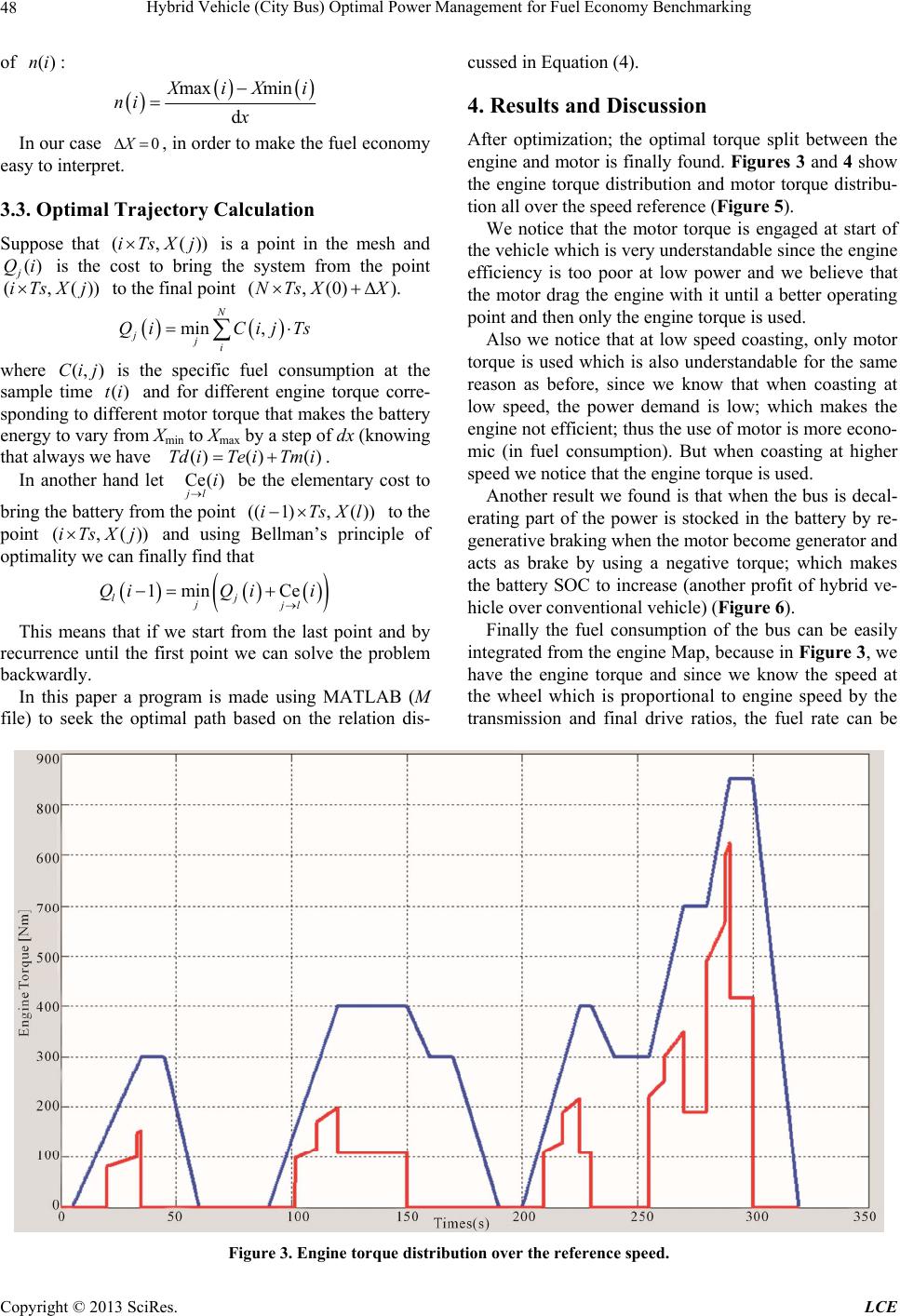 Hybrid Vehicle (City Bus) Optimal Power Management for Fuel Economy Benchmarking Copyright © 2013 SciRes. LCE 48 cussed in Equation (4). of : ()ni max min d X iX i ni x 4. Results and Discussion After optimization; the optimal torque split between the engine and motor is finally found. Figures 3 and 4 show the engine torque distribution and motor torque distribu- tion all over the speed reference (Figure 5). In our case , in order to make the fuel economy easy to interpret. 0X 3.3. Optimal Trajectory Calculation We notice that the motor torque is engaged at start of the vehicle which is very understandable since the engine efficiency is too poor at low power and we believe that the motor drag the engine with it until a better operating point and then only the engine torque is used. Suppose that is a point in the mesh and is the cost to bring the system from the point to the final point (, (iTsXj )) )) ). )) () j Qi (,iTs (Xj(, (0)NTsX X min , N jji Qi CijTs Also we notice that at low speed coasting, only motor torque is used which is also understandable for the same reason as before, since we know that when coasting at low speed, the power demand is low; which makes the engine not efficient; thus the use of motor is more eco no- mic (in fuel consumption). But when coasting at higher speed we notice that the engine torque is used. where is the specific fuel consumption at the sample time and for different engine torque corre- sponding to different motor torque that makes the battery energy to vary from Xmin to Xmax by a step of dx (knowing that always we have . (, )Cij ()ti ()()()TdiTe iTm i Ce()iIn another hand let be the elementary cost to jlAnother result we found is that when the bus is decal- erating part of the power is stocked in the battery by re- generative braking when the motor become generator and acts as brake by using a negative torque; which makes the battery SOC to increase (another profit of hybrid ve- hicle over conventional vehicle) (Fi gure 6). bring the battery from the point to the point and using Bellman’s principle of optimality we can finally find that ((1), ())iTsXl (, (iTsXj 1min Ce lj jjl QiQi i Finally the fuel consumption of the bus can be easily integrated from the engine Map, because in Figure 3, we have the engine torque and since we know the speed at the wheel which is proportional to engine speed by the transmission and final drive ratios, the fuel rate can be This means that if we start from the last point and by recurrence until the first point we can solve the problem backwardly. In this paper a program is made using MATLAB (M file) to seek the optimal path based on the relation dis- Figure 3. Engine torque distr ibution over the referenc e spe ed. 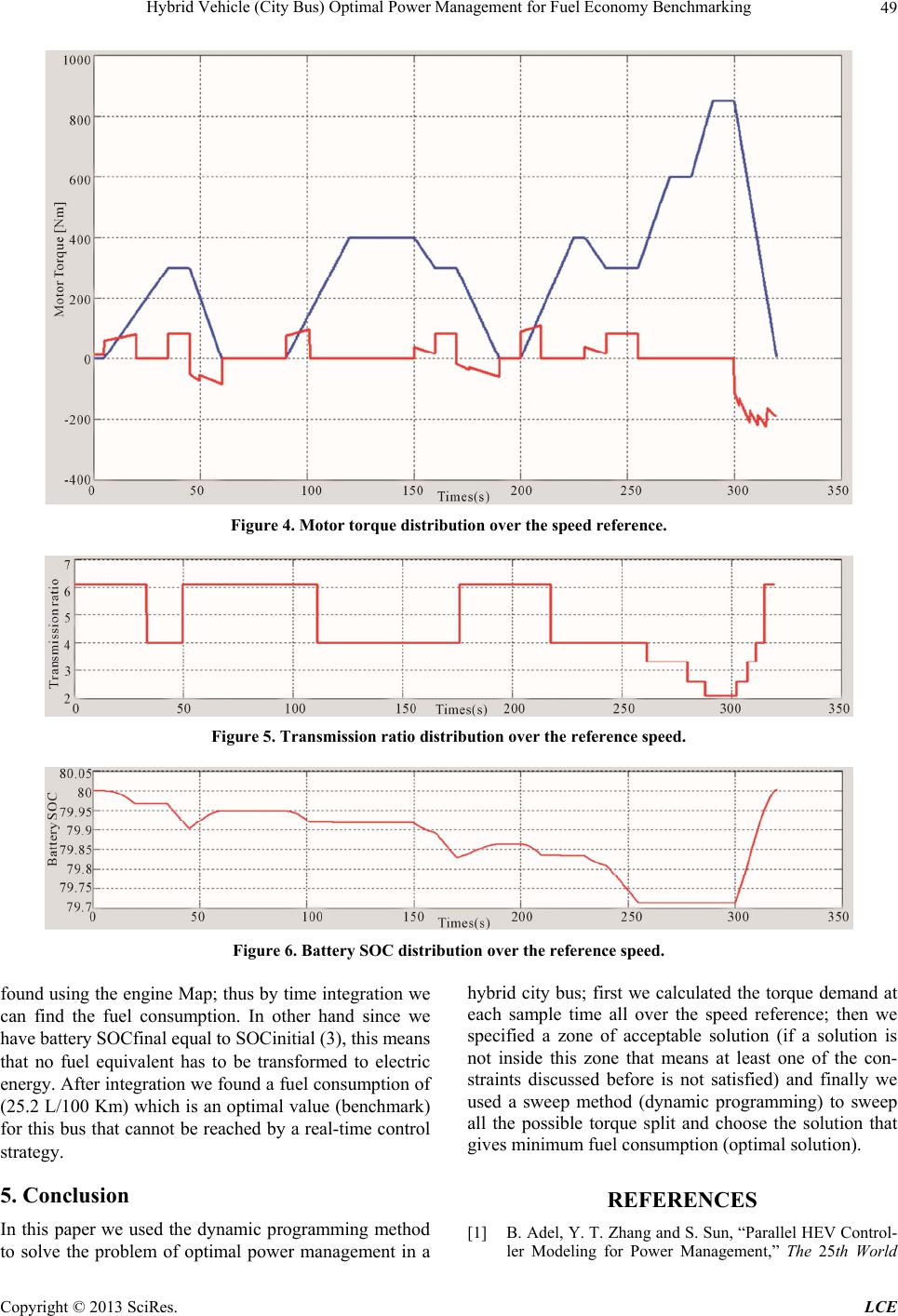 Hybrid Vehicle (City Bus) Optimal Power Management for Fuel Economy Benchmarking 49 Figure 4. Motor torque distribution over the speed reference. Figure 5. Transmission ratio distribution over the reference speed. Figure 6. Battery SOC distribution over the reference speed. found using the engine Map; thus by time integration we can find the fuel consumption. In other hand since we have battery SOCfinal equal to SOCinitial (3), this means that no fuel equivalent has to be transformed to electric energy. After in tegration we found a fuel consumptio n of (25.2 L/100 Km) which is an optimal value (benchmark) for this bus that cannot be reached by a real-time control strategy. 5. Conclusion In this paper we used the dynamic programming method to solve the problem of optimal power management in a hybrid city bus; first we calculated the torque demand at each sample time all over the speed reference; then we specified a zone of acceptable solution (if a solution is not inside this zone that means at least one of the con- straints discussed before is not satisfied) and finally we used a sweep method (dynamic programming) to sweep all the possible torque split and choose the solution that gives minimum fuel consumption (optimal solution). REFERENCES [1] B. Adel, Y. T. Zhang and S. Sun, “Parallel HEV Control- ler Modeling for Power Management,” The 25th World Copyright © 2013 SciRes. LCE 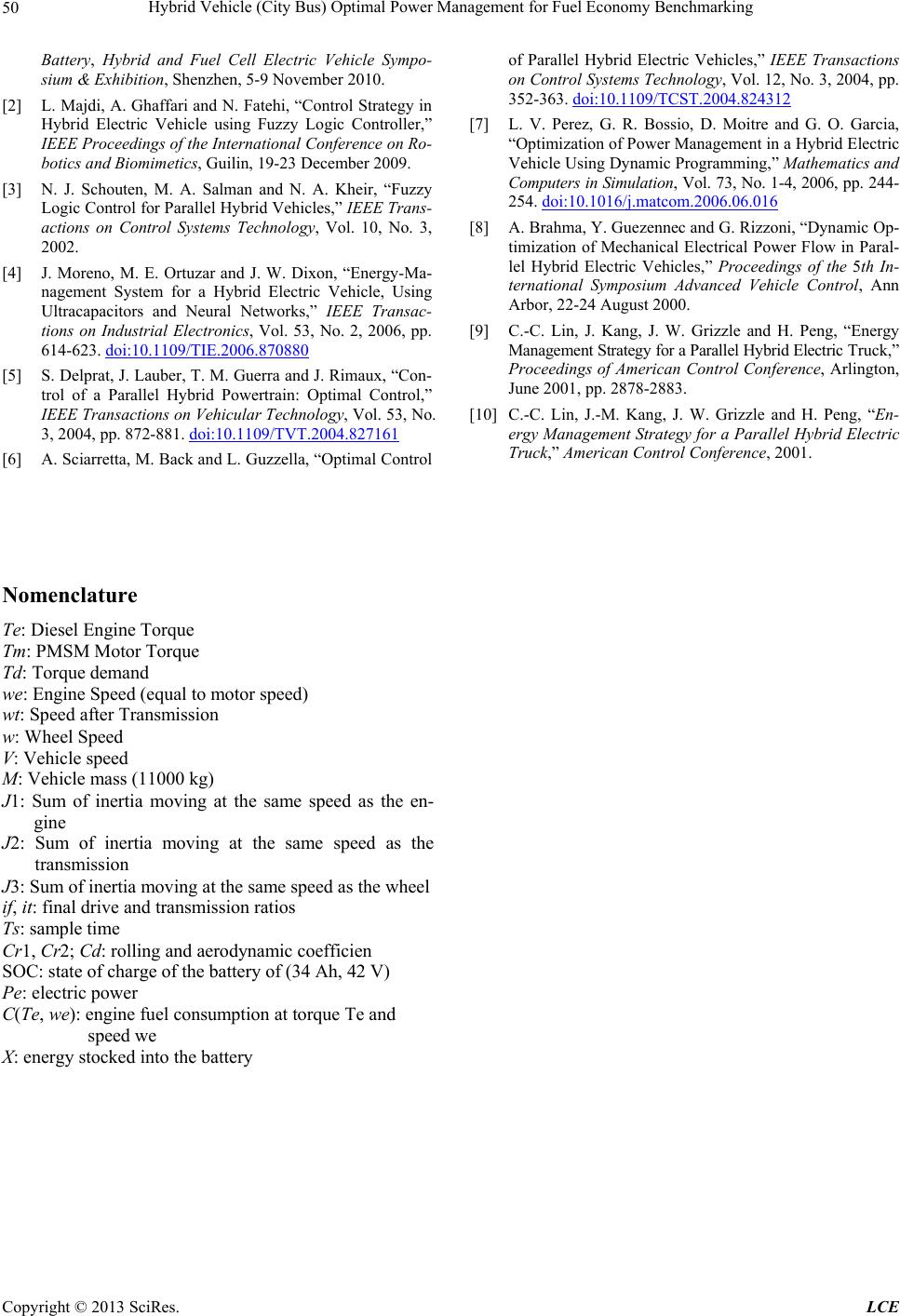 Hybrid Vehicle (City Bus) Optimal Power Management for Fuel Economy Benchmarking 50 Battery, Hybrid and Fuel Cell Electric Vehicle Sympo- sium & Exhibition, Shenzhen, 5-9 November 2010. [2] L. Majdi, A. Ghaffari and N. Fatehi, “Control Strategy in Hybrid Electric Vehicle using Fuzzy Logic Controller,” IEEE Proceedings of the International Conference on Ro- botics and Biomimetics, Guilin, 19-23 December 2009. [3] N. J. Schouten, M. A. Salman and N. A. Kheir, “Fuzzy Logic Control for Parallel Hybrid Vehicles,” IEEE Trans- actions on Control Systems Technology, Vol. 10, No. 3, 2002. [4] J. Moreno, M. E. Ortuzar and J. W. Dixon, “Energy-Ma- nagement System for a Hybrid Electric Vehicle, Using Ultracapacitors and Neural Networks,” IEEE Transac- tions on Industrial Electronics, Vol. 53, No. 2, 2006, pp. 614-623. doi:10.1109/TIE.2006.870880 [5] S. Delprat, J. Lauber, T. M. Guerra and J. Rima ux, “Con- trol of a Parallel Hybrid Powertrain: Optimal Control,” IEEE Transactions on Vehicular Technology, Vol. 53, No. 3, 2004, pp. 872-881. doi:10.1109/TVT.2004.827161 [6] A. Sciarretta, M. Back and L. Guzzella, “Optimal Control of Parallel Hybrid Electric Vehicles,” IEEE Transactions on Control Systems Technology, Vol. 12, No. 3, 2004, pp. 352-363. doi:10.1109/TCST.2004.824312 [7] L. V. Perez, G. R. Bossio, D. Moitre and G. O. Garcia, “Optimization of Power Management in a Hybrid Electric Vehicle Using Dynamic Programming,” Mathematics and Computers in Simulation, Vol. 7 3, No. 1-4, 2006, pp. 244- 254. doi:10.1016/j.matcom.2006.06.016 [8] A. Brahma, Y. Guezennec and G. Rizzoni, “Dynamic Op- timization of Mechanical Electrical Power Flow in Paral- lel Hybrid Electric Vehicles,” Proceedings of the 5th In- ternational Symposium Advanced Vehicle Control, Ann Arbor, 22-24 August 2000. [9] C.-C. Lin, J. Kang, J. W. Grizzle and H. Peng, “Energy Management Str ategy for a Paral l el Hy brid Elect ri c T ruck , ” Proceedings of American Control Conference, Arlington, June 2001, pp. 2878-2883. [10] C.-C. Lin, J.-M. Kang, J. W. Grizzle and H. Peng, “En- ergy Management Strategy for a Parallel Hybrid Electric Truck,” American Control Conference, 2001. Nomenclature Te: Diesel Engine Torque Tm: PMSM Motor Torque Td: Torque demand we: Engine Speed (equal to motor speed) wt: Speed after Transmission w: Wheel Speed V: Vehicle speed M: Vehicle mass (11000 kg) J1: Sum of inertia moving at the same speed as the en- gine J2: Sum of inertia moving at the same speed as the transmission J3: Sum of inertia moving at the same speed as the wheel if, it: final drive and transmission ratios Ts: sample time Cr1, Cr2; Cd: rolling and aerodynamic coefficien SOC: state of charge of the battery of (34 Ah, 42 V) Pe: electric power C(Te, we): engine fuel consumption at torque Te and speed we X: energy stocked into the battery Copyright © 2013 SciRes. LCE |