

Paper Menu >>
Journal Menu >>
 Journal of Cosmetics, Dermatological Sciences and Applications, 2013, 3, 117-120 http://dx.doi.org/10.4236/jcdsa.2013.31017 Published Online March 2013 (http://www.scirp.org/journal/jcdsa) 117 Treatment of Recalcitrant Viral Warts with Photodynamic Therapy with Mal and Red Light Montserrat Fernández Guarino*, Antonio Harto, Pedro Jaén Dermatology Departament, Hospital Universitario Ramón y Cajal, Madrid, Spain. Email: *[email protected] Received January 21st, 2013; revised February 23rd, 2013; accepted March 4th, 2013 ABSTRACT Background: Photodynamic therapy (PDT) is a treatment for non-melanoma skin cancer. In recent years, its use has expanded to new indications. Viral warts (VW) are some of the most promising. Methods: A retrospective, descriptive, observational study was carried out. Patients who did not respond to cryotherapy were selected and were occluded with methyl aminolevulinate (MAL) for three hours and they were illuminated with red light. Tolerance to treatment was evaluated using a visual analog scale for pain (from 0 to 10). Results: A total of 15 patients with 134 VW were treated. A complete response was obtained in 13 of 15 patients (87%) and in 127 of 134 lesions (95%). The mean number of sessions was 3.1 (range 1 to 6) and the average pain score was 3.1 (range 0 to 8). Conclusions: PDT is a treatment that offers good results in the treatment of VW that are resistant to routine treatment. The treatment was well tolerated in our patient group. Keywords: Photodynamic Therapy; Viral Warts; Red Light 1. Background Photodynamic therapy (PDT) is a technique that is increasingly being used for off-label indications. Viral warts (VW) are one of the most promising indications. Previous studies indicate clearances of between 42% - 92% of lesions with aminolevulinic acid (ALA) and different incoherent light sources [1,2]. The primary li- mitation of this treatment is pain. 2. Objective The purpose of our study was to evaluate the results of PDT in the treatment of VW with methyl aminole-vu- linate (MAL) and red light and to evaluate treatment tolerance. 3. Material and Methods A retrospective, descriptive, observational study was carried out. Patients who did not respond to at least one correctly-applied routine treatment, always including cryotherapy, were selected. After curettage of the lesions, MAL was occluded for 3 hours and illuminated with red light (Aktilite®, 630 nm, 37 J/cm2, 8 minutes). Three sessions were applied, once per week for three weeks. The patient rested for three-week and another three-week cycle was applied (once per week) until a response was obtained. Afterwards, patients were subjected to quar- terly follow-up for one year without treatment. Pain was measured after each session using a visual analog scale of 0 to 10. 4. Results A total of 15 patients with 134 VW were treated (Table 1) A complete response was obtained in 13 of 15 patients (87%) and in 127 of 134 lesions (95%), see Figures 1 and 2. The mean number of sessions was 3.1 (range 1 to 6) and the average pain score was 3.1 (range 0 to 8). 5. Discussion VW is a common pathology that is treated with kera- tolytics, cryotherapy, electrocoagulation and antimitotic agents (podophyllin, bleomycin, retinoids). More re- cently, new therapeutic approximations have been used with immunomodulators such as imiquimod cream, laser or PDT. Cryotherapy continues to be the most widely used treatment due to its simplicity, safety, speed, effi- cacy and low cost. However, it is not uncommon to en- counter persistent VWs despite multiple cryotherapy ses- sions. There are several mechanisms of action that explain the antiviral properties of PDe HPV-infected T. First, th *Corresponding author. Copyright © 2013 SciRes. JCDSA 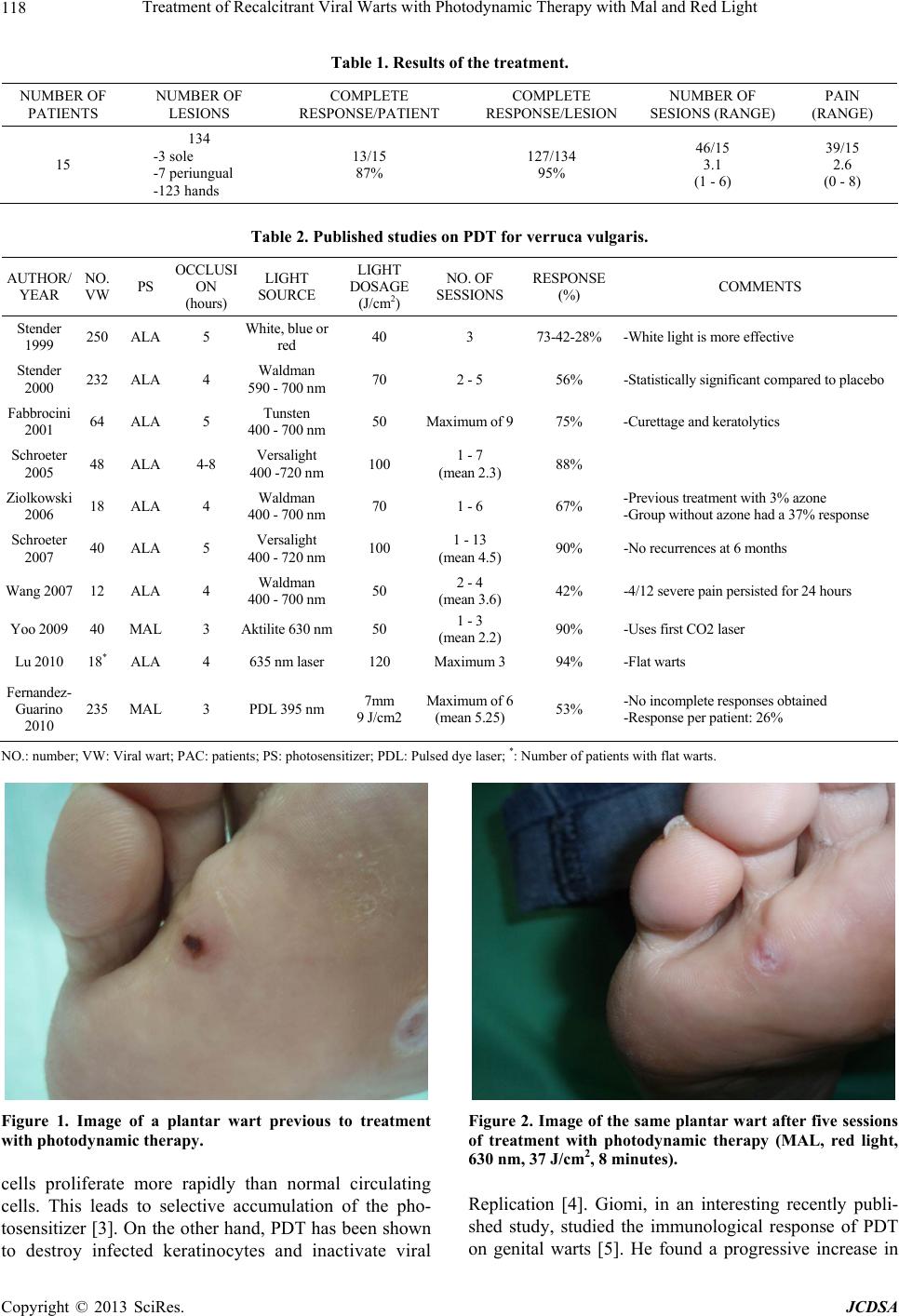 Treatment of Recalcitrant Viral Warts with Photodynamic Therapy with Mal and Red Light 118 Table 1. Results of the treatment. NUMBER OF PATIENTS NUMBER OF LESIONS COMPLETE RESPONSE/PATIENT COMPLETE RESPONSE/LESION NUMBER OF SESIONS (RANGE) PAIN (RANGE) 15 134 -3 sole -7 periungual -123 hands 13/15 87% 127/134 95% 46/15 3.1 (1 - 6) 39/15 2.6 (0 - 8) Table 2. Published studies on PDT for verruca vulgaris. AUTHOR/ YEAR NO. VW PS OCCLUSI ON (hours) LIGHT SOURCE LIGHT DOSAGE (J/cm2) NO. OF SESSIONS RESPONSE (%) COMMENTS Stender 1999 250 ALA 5 White, blue or red 40 3 73-42-28% -White light is more effective Stender 2000 232 ALA 4 Waldman 590 - 700 nm 70 2 - 5 56% -Statistically significant compared to placebo Fabbrocini 2001 64 ALA 5 Tunsten 400 - 700 nm 50 Maximum of 975% -Curettage and keratolytics Schroeter 2005 48 ALA 4-8 Versalight 400 -720 nm 100 1 - 7 (mean 2.3) 88% Ziolkowski 2006 18 ALA 4 Waldman 400 - 700 nm 70 1 - 6 67% -Previous treatment with 3% azone -Group without azone had a 37% response Schroeter 2007 40 ALA 5 Versalight 400 - 720 nm 100 1 - 13 (mean 4.5) 90% -No recurrences at 6 months Wang 2007 12 ALA 4 Waldman 400 - 700 nm 50 2 - 4 (mean 3.6) 42% -4/12 severe pain persisted for 24 hours Yoo 2009 40 MAL 3 Aktilite 630 nm 50 1 - 3 (mean 2.2) 90% -Uses first CO2 laser Lu 2010 18* ALA 4 635 nm laser 120 Maximum 394% -Flat warts Fernandez- Guarino 2010 235 MAL 3 PDL 395 nm 7mm 9 J/cm2 Maximum of 6 (mean 5.25)53% -No incomplete responses obtained -Response per patient: 26% NO.: number; VW: Viral wart; PAC: patients; PS: photosensitizer; PDL: Pulsed dye laser; *: Number of patients with flat warts. Figure 1. Image of a plantar wart previous to treatment with photodynamic therapy. cells proliferate more rapidly than normal circulating cells. This leads to selective accumulation of the pho- tosensitizer [3]. On the other hand, PDT has been shown to destroy infected keratinocytes and inactivate viral Figure 2. Image of the same plantar wart after five sessions of treatment with photodynamic therapy (MAL, red light, 630 nm, 37 J/cm2, 8 minutes). Replication [4]. Giomi, in an interesting recently publi- shed study, studied the immunological response of PDT on genital warts [5]. He found a progressive increase in Copyright © 2013 SciRes. JCDSA  Treatment of Recalcitrant Viral Warts with Photodynamic Therapy with Mal and Red Light 119 perilesional CD4 T-lymphocytes during the first month. These findings appear to suggest that there is an ability of PDT to induce a specific immune response. There are several published studies on the use of PDT in VW (see Table 2) [2,6-14]. These studies found an efficacy of 42% - 90%. The first studies were by Stender [6,7] ALA and found that white light is more effective than red or blue. The majority of studies use ALA as the photosensitizer and long wave light sources and red surroundings in order to achieve greater penetration. One of the studies uses a diode laser with a very good res- ponse in flat warts (94%) [13] and another uses a pulsed dye laser in verruca vulgaris with a more moderate res- ponse [14]. All used repeated sessions in order to achieve a response in the lesions and all noted that the use of ablative methods prior to PDT (keratolytics, azone, CO2 laser) increases the response to treatment by favoring penetration of the photosensitizer and the light source. [10,11,14] Few studies had a long patient follow-up. Only one evaluated the response at 6 months [2]. Our results are good if we compare them to the published literature, though our study included a small patient series. Without a doubt, the most limiting factor for treating VWs with PDT is the pain, which occurs in all treatment modalities, and leads to discontinuing the session in up to 20% of patients. [15] The pain is characteristically in- tense and persists for up to 24 hours after treatment. It is very notable that patients tolerated the pain well in [16] our study (mean pain of 3.1) versus previous publications. When we begin to apply PDT in the treatment of VW, we select laser as the light source in order to try and improve tolerance to treatment [14]. However, we have achieved better tolerance with red light. PDT with MAL and red light is a promising treatment that is well tolerated in the management of VWs that are resistant to standard treatments. Nevertheless, there are few studies of adequate sample size and design that sup- port its scientific evidence, so new studies on this subject are needed. REFERENCES [1] I. M. Stender, J. Lock-Anderson and H. C. Wulf, “Recal- citrant Hand and Foot Warts Successfully Treated with Photodynamic Therapy with Topical Aminolaevulinic Acid: A Pilot Study,” Journal of Clinical & Experimental Dermatology, Vol. 24, No. 3, 1999, pp. 154-159. doi:10.1046/j.1365-2230.1999.00441.x [2] C. A. Schroeter, L. Kaas, J. J. Waterval, P. M. Bos and H. A. Neumann, “Successful Treatment of Periungual Warts Using Photodynamic Therapy: A Pilot Study,” Journal of the European Academy of Dermatology and Venereology, Vol. 21, No. 9, 2007, pp. 1170-1174. [3] E. V. Ross, R. Romero, N. Kollias, C. Crum and R. R. Anderson, “Selectivity of Protoporphyrin IX Fluorescence for Condylomata after Topical Application of 5-Aminol- aevulinic Acid: Implications for Photodynamic Treat- ment,” British Journal of Dermatology, Vol. 137, No. 5, 1997, pp. 736-742. doi:10.1111/j.1365-2133.1997.tb01110.x [4] J. North, H. Neyndorff, D. King and J. G. Levy, “Viral Inactivation in Blood and Red Cell Concentrations with Benzoporphyrin Derivative,” Blood Cells, Vol. 18, No. 1, 1992, pp. 129-139. doi:10.1111/j.1365-2133.2010.10089.x [5] B. Giomi, F. Pagnini, A. Cappuccini, B. Bianchi, L. Ti- radritti and G. Zuccati, “Immunological Activity of Photo- dynamic Therapy of Genital Warts,” British Journal of Dermatology, Vol. 164, No. 2, 2011, pp. 448-451. [6] I. M. Stender, J. Lock-Anderson and H. C. Wulf, “Recal- citrant Hand and Foot Warts Successfully Treated with Photodynamic Therapy with 5-Aminolaevulinic Acid. A Pilot Study,” Journal of Clinical & Experimental Der- matology Research, Vol. 24, No. 3, 1999, pp. 154-159. doi:10.1046/j.1365-2230.1999.00441.x [7] I. M. Stender, R. Na, H. Fogh, C. Gluud and H. C. Wulf, “Photodynamic Therapy with 5 Aminolaevulinic Acid Placebo for Recalcitrant Foot and Hand Warts: Random- ized Double Blind Trial,” Lancet, Vol. 355, No. 9208, 2000, pp. 963-966.| doi:10.1016/S0140-6736(00)90013-8 [8] G. Fabbrocini, M. P. Constanzo, A. M. Riccardo, M. Quarto, A. Colasanti, G. Roberti, et al., “Photodynamic Therapy with Topical 5-Aminolaevulinic Acid for the Treatment of Plantar Warts,” Journal of Photochemistry and Photobiology B, Vol. 61, No. 1, 2001, pp. 30-34. doi:10.1016/S1011-1344(01)00141-5 [9] C. A. Schroeter, J. Pleunis, V. N. Tot Pannerden, T. Re- inneke and H. A. Neumann, “Photodynamic Therapy: New Treatment for Therapy Resistant Plantar Warts,” Der- matologic Surgery, Vol. 31, No. 1, 2005, pp. 71-75. doi:10.1111/j.1524-4725.2005.31011 [10] P. Ziolkowski, B. J. Osiecka, M. Siewinski, A. Brono- wicz, J. Ziolkowska and H. Gerber-Leszczyszyn, “Pre- treatment of Plantar Warts with Azone Enhaces the Ef- fects of 5-Aminolaevulinic Acid Photodynamic Therapy,” Journal of Environmental Pathology Toxicology and On- cology, Vol. 25, No. 1-2, 2006, pp. 403-409. doi:10.1615/JEnvironPatholToxicolOncol.v25.i1-2.250 [11] C. A. Schroeter, L. Kaas, J. J. Waterval, P. M. Bos and H. A. Neumann, “Successful Treatment of Periungual Warts Using Photodynamic Therapy: A Pilot Study,” Journal of the European Academy of Dermatology and Venereology, Vol. 21, No. 9, 2007, pp. 1170-1174. [12] Y. S. Wang, Y. K. Tay, C. Kwok and E. Tan, “Photody- namic Therapy with 20% Aminolevulinic Acid for the Treatment of Recalcitrant Viral Warts in an Asian Popu- lation,” International Journal of Dermatology, Vol. 46, No. 11, 2007, pp. 1180-1184. doi:10.1111/j.1365-4632.2007.03210.x [13] K. H. Yoo, B. J. Kim and M. N. Kim, “Enhanced Effi- cacy of Photodynamic Therapy with Methyl-5-Aminol- aevulinic Acid in Recalcitrant Periungual Warts after Ab- lative Carbon Dioxide Fractional Laser: A Pilot Study,” Dermatologic Surgery, Vol. 35, No. 12, 2009, pp. 1927- Copyright © 2013 SciRes. JCDSA  Treatment of Recalcitrant Viral Warts with Photodynamic Therapy with Mal and Red Light Copyright © 2013 SciRes. JCDSA 120 1932. doi:10.1111/j.1524-4725.2009.01307.x [14] Y. G. Lu, J. J. Wi, Y. He, H. Z. Yang and Y. D. Yang, “Efficacy of Topical Aminolevulinic Acid Photodynamic Therapy for the Treatment of Verruca Planae,” Photo- medicine and Laser Surgery, Vol. 28, No. 4, 2010, pp. 561-563. doi:10.1089/pho.2009.2566 [15] M. Fernández-Guarino, A. Harto and P. Jaen, “Treatment of Recalcitrant Viral Warts with Pulsed Dye Laser MAL- PDT,” Journal of Dermatological Treatment, Vol. 22, No. 4, 2011, pp. 226-228. [16] I. M. Stender, F. M. Borgbjerg, J. Villumsen, J. Lock- Andersen and H. C. Wulf, “Pain Induced by Photody- namic Therapy of Warts,” Photodermatology, Photoim- munology & Photomedicine, Vol. 22, No. 6, 2006, pp. 304- 309. doi:10.1111/j.1600-0781.2006.00259.x |