

Paper Menu >>
Journal Menu >>
 Advances in Infectious Diseases, 2013, 3, 44-49 http://dx.doi.org/10.4236/aid.2013.31005 Published Online March 2013 (http://www.scirp.org/journal/aid) Rapid Identification of Methicillin Resistant Staphylococcus aureus Using Real Time PCR* Said Abbadi1,2#, Hamdy Youssef1, Dalal Nemenqani3, Ahmed S. Abdel-Moneim1,4 1Microbiology Department, College of Medicine, Taif University, Al-Taif, Saudi Arabia; 2Microbiology Department, Faculty of Medicine, Suez Canal University, Ismailia, Egypt; 3Pathology Department, College of Medicine, Taif University, Taif University, Al-Taif, Saudi Arabia; 4Virology Department, Faculty of Veterinary Medicine, Beni-Suef University, Beni-Suef, Egypt. Email: #[email protected] Received December 6th, 2012; revised January 8th, 2013; accepted February 1st, 2013 ABSTRACT Screening for colonization with methicillin resistant Staphylococcus aureas (MRSA) is a key aspect of infection control to limit the nosocomial spread of this organism. Current methods for the detection of MRSA in clinical microbiology laboratories using conventional methods is time consuming. In this research we are trying to evaluate the use of real time PCR for the detection of MRSA. The PCR assay was evaluated in clinical isolates of MRSA (n = 45) and methicil- lin susceptible Staphylococcus aureas MSSA (n = 10). The diagnostic values of the assay showed high sensitivity and specificity. This real-time PCR assay proved to be a fast, sensitive and specific tool for MRSA detection in a routine microbiological laboratory. Real-time PCR now is available in all laboratories so its use in identification of MRSA will help in shortening the period for MRSA identification and will help in the success of infection control programs in hos- pitals. Keywords: Diagnosis; MRSA; Rapid Detection; Real-Time PCR; Staphylococcus aureus 1. Introduction Staphylococci are ubiquitous colonizers of human or ani- mal skin and mucous membranes causing a variety of syndromes. Staphylococcus aureus can cause nosocomial and community-acquired infections ranging from mild conditions, such as skin and soft tissue infections, to se- vere, life-threatening sepsis [1]. Strains of methicillin- resistant S. aureus (MRSA) were first detected in the early 1960s, shortly after methicillin came into clinical use [2]. During the past decade, an increase in the num- ber of Methicillin resistant Staphylococcus aureus (MRSA) cases has been widespread globally among healthy com- munity [3]. The mechanisms responsible for this resis- tance are diverse, and hundreds of resistance genes have been characterized in both Gram-negative and Gram- positive species. A core function of all bacteriology labo- ratories is to determine the antibiotic susceptibilities of bacterial isolates and to detect the resistance phenotypes conferred by these resistant genes. If a panel of agents in a particular antibiotic class is tested, the interpretative reading of the resulting patterns of resistance or suscepti- bility often suggests the underlying resistance mecha- nisms, predicts second-line drugs to be tested and pro- vides extended knowledge for decisions in antimicrobial therapy as well as infection control. Methicillin resis- tance in Staphylococcus is mainly mediated by the over- production of PBP2a, an additional modified penicillin binding protein (PBP) with low affinity for β-lactam an- tibiotics. The mecA gene, the structural determinant that encodes PBP2a, is therefore considered as a useful mo- lecular marker of putative methicillin resistance in S. aureus [4]. The mecA gene can be detected by PCR, which is considered the gold-standard test to identify methicillin resistance [5]. The results of the conventional culture-based screening methods with cultivation, identi- fication and antimicrobial susceptibility testing take 48 to 72 hr. Rapid detection of a specific resistance mechanism in a molecular test allows clinicians avoiding potentially inappropriate treatment options. To rapidly detect methi- cillin-resistant Staphylococcus aureus (MRSA) nasal co- lonization in patients, clinical microbiology laboratories should select either PCR methods or selective agar- based methods. Several chromogenic and differenttial MRSA selective agars have been shown to yield results within 18 to 24 hr [6]. In contrast, PCR methods can yield results in 2 to 3 hr. Antibiotic resistance genes pro- vide important targets for molecular detection techniques [7]. Although molecular assays provide a quick identifi- cation of MRSA colonization as the results of the test can *No conflict of interest to declare. #Corresponding author. Copyright © 2013 SciRes. AID  Rapid Identification of Methicillin Resistant Staphylococcus aureus Using Real Time PCR 45 be available within a few hours, these methods are ex- pensive. However, quick MRSA screening tests prevent unnecessary procedures as well as the spread of MRSA in case of colonized patients and thus reducing the over- all hospital costs. It should be noticed that molecular biological techniques, such as DNA sequencing, or the use of DNA microarray technology [3], could provide more accurate identification and classification tool, but such techniques are difficult to apply in a routine clinical laboratory. A rapid, conventional and automated identi- fication method based on phenotypic characters is a more practical approach for the daily clinical laboratory pro- cedures. The current study aimed to evaluate the use of real time PCR in detection of methicillin resistant Staphylo- coccus aureus (MRSA) and to trace the dynamics of ge- notypic changes and the shifts in the levels of suscepti- bility to antibiotics of MRSA isolated from patients in King Abdel Aziz Hospital, Al-Taif, Saudi Arabia during the period from Jan. to Jun. 2012. 2. Materials and Methods 2.1. Bacterial Isolates Fifty five strains of S. aureus were collected during the period from Jan. to Jun. 2012 from different departments of King Abdel Aziz Hospital, Al-Taif, Saudi Arabia. The strains were tested phenotypically and genotypically for the detection of MRSA. Thirty strains were collected from surgical wounds, 7 from sputum, 6 from blood, 5 from nasal swabs, 5 from skin and 2 from abdominal fluid. All isolates were identified according to colonial and microscopical morphology, catalase and coagulase production. The 55 strains were tested also by real-time PCR to identify MRSA isolates. 2.2. Culture Conditions and Media The clinical isolates were first plated onto Columbia blood agar plates and incubated at 37˚C for 24 h. Identi- fication of the MRSA strains was performed by standard procedures including colony morphology, catalase reac- tion and coagulase activity [8]. 2.3. Antimicrobial Susceptibility Test 2.3.1. Detection of Oxacillin Resistance by Phenotypic Method Characteristic colonies that were identified as S. aureus were tested for oxacillin resistance by using Mueller- Hinton agar and Disc-diffusion test according to NCCLS guidelines [9]. 2.3.2. Antimicrobial Susceptibility Test to Other Drugs Antimicrobial susceptibility test to a range of antimicro- bial agents was performed using the following discs (aug- mentin, cotrimoxazole, fusidic acid, gentamicin, erythro- mycin, ciprofloxacin, clindamycin, amikacin, cepha lo- thin, linezolid, teicoplanin and vancomycin). The pro- cedure was performed by adopting the Kirby-Bauer disc diffusion method using Muller-Hinton broth and agar and antibiotic discs according to NCCLS guidelines [9]. 2.3.3. Detection of Oxacillin Resistance by Genotypic Method 2.3.3.1. DNA Extraction DNA was extracted from different bacterial isolates us- ing DNA extraction kit (Koma Bioteck Inc., Korea). Briefly, the bacterial pellet from each isolate was re-sus- pended in 200 μl lysozyme reaction solution (20 mg/ml lysozyme, 20 mM Tris-HCl pH 8, 2 mM EDTA, 1.2% triton) and incubated for 30 min at 37˚C. The sample was then incubated with proteinase K 20 µl and lysis buffer 200 µl at 60˚C for 30 min. and then further incubated at 95˚C for 15 min. Absolute ethyl alcohol 200 µl was then added to each sample, vortexed then loaded into XPTG mini column in a collection tube. The tubes were centri- fuged at 13,000 rpm for 1 min. and the flow was dis- carded. The column was then washed twice then dried for 3 min at 13,000 rpm before the DNA was eluted in new clean sterile tube using 100 µl of sterile double dis- tilled water. 2.3.3.2. Real-Time PCR The real-time PCR assay was performed using comer- cial TaqMan hydrolysis probe based MERSA real time PCR detection kit (Liferiver, Shanghai, China) in Ep- pendorf Mastercycler® eprealplex. The detection of the amplified MERSA DNA amplicon was performed in fluorimeter channel FAM with the fluorescent quencher BHQ1. Amplification reactions were performed accord- ing to the in a volume of 25 µl containing 2.5 µl of DNA template, 21.5 µl reaction mix, 0.4 µl enzyme mix, 1 µl internal control according to the manufacturer’s instruc- tions. The cycling conditions included: 37˚C for 2 min, an initial denaturation step at 94˚C for 2 min followed by 40-cycles consisted of heating at 93˚C for 15 sec and annealing/elongation step at 60˚C for 1 min. 3. Results Fifty five strains of S. aureus were collected during the period from Jan. to Jun. 2012 from different departments of King Abdel Aziz Hospital, Al-Taif, Saudi Arabia. Thirty strains were collected from surgical wounds, 7 from sputum, 6 from blood, 5 from nasal swabs, 5 from skin, and 2 from abdominal fluid as shown in (Table 1). The most frequent isolation of the S. aureus in relation to the age was noted in the age group of 21 - 40 years (40%), followed by those in the age group of 41 - 60 Copyright © 2013 SciRes. AID 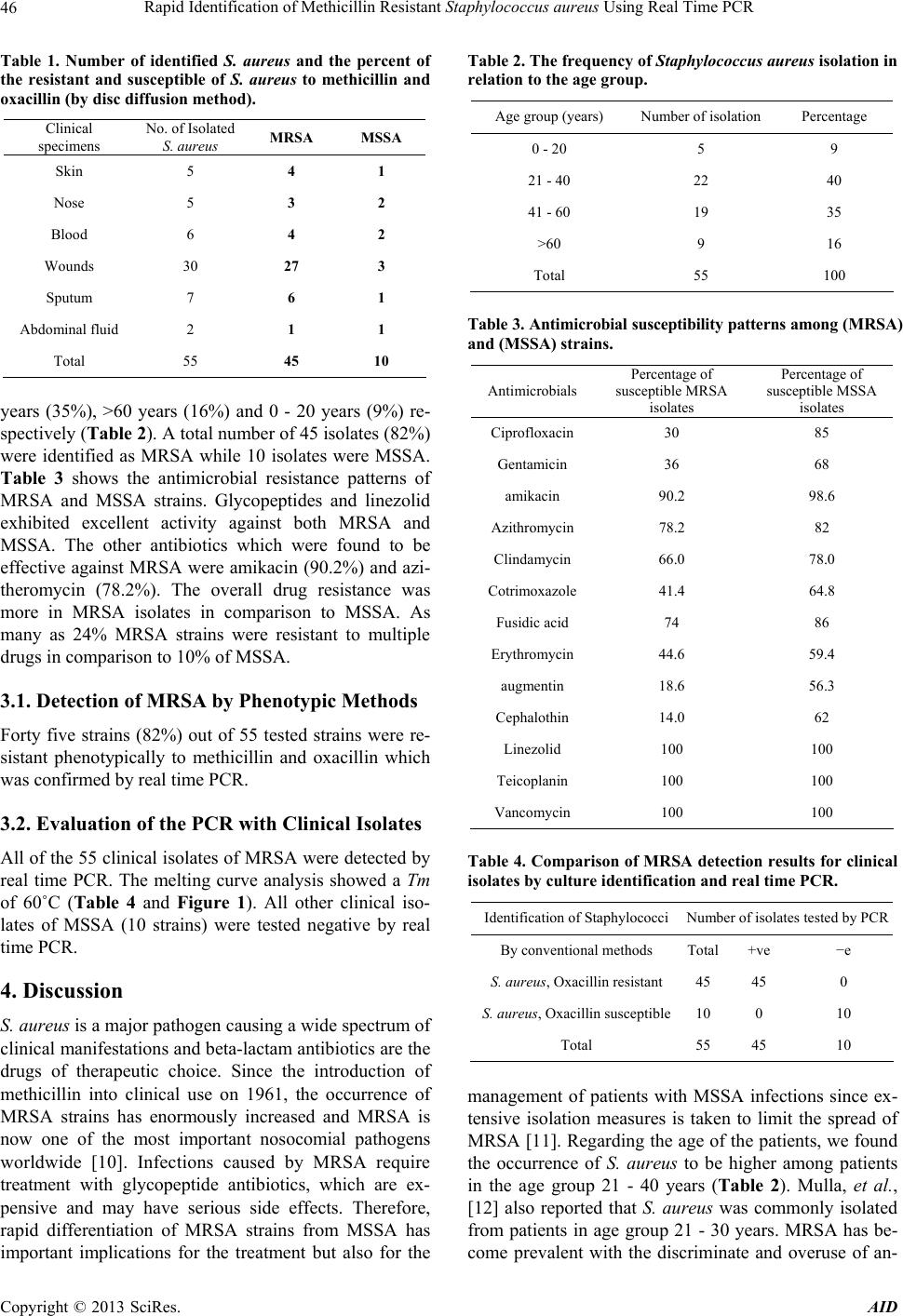 Rapid Identification of Methicillin Resistant Staphylococcus aureus Using Real Time PCR 46 Table 1. Number of identified S. aureus and the percent of the resistant and susceptible of S. aureus to methicillin and oxacillin (by disc diffusion method). Clinical specimens No. of Isolated S. aureus MRSA MSSA Skin 5 4 1 Nose 5 3 2 Blood 6 4 2 Wounds 30 27 3 Sputum 7 6 1 Abdominal fluid 2 1 1 Total 55 45 10 years (35%), >60 years (16%) and 0 - 20 years (9%) re- spectively (Table 2). A total number of 45 isolates (82%) were identified as MRSA while 10 isolates were MSSA. Table 3 shows the antimicrobial resistance patterns of MRSA and MSSA strains. Glycopeptides and linezolid exhibited excellent activity against both MRSA and MSSA. The other antibiotics which were found to be effective against MRSA were amikacin (90.2%) and azi- theromycin (78.2%). The overall drug resistance was more in MRSA isolates in comparison to MSSA. As many as 24% MRSA strains were resistant to multiple drugs in comparison to 10% of MSSA. 3.1. Detection of MRSA by Phenotypic Methods Forty five strains (82%) out of 55 tested strains were re- sistant phenotypically to methicillin and oxacillin which was confirmed by real time PCR. 3.2. Evaluation of the PCR with Clinical Isolates All of the 55 clinical isolates of MRSA were detected by real time PCR. The melting curve analysis showed a Tm of 60˚C (Table 4 and Figure 1). All other clinical iso- lates of MSSA (10 strains) were tested negative by real time PCR. 4. Discussion S. aureus is a major pathogen causing a wide spectrum of clinical manifestations and beta-lactam antibiotics are the drugs of therapeutic choice. Since the introduction of methicillin into clinical use on 1961, the occurrence of MRSA strains has enormously increased and MRSA is now one of the most important nosocomial pathogens worldwide [10]. Infections caused by MRSA require treatment with glycopeptide antibiotics, which are ex- pensive and may have serious side effects. Therefore, rapid differentiation of MRSA strains from MSSA has important implications for the treatment but also for the Table 2. The frequency of Staphylococcus aureus isolation in relation to the age group. Age group (years) Number of isolation Percentage 0 - 20 5 9 21 - 40 22 40 41 - 60 19 35 >60 9 16 Total 55 100 Table 3. Antimicrobial susceptibility patterns among ( MR SA ) and (MSSA) strains. Antimicrobials Percentage of susceptible MRSA isolates Percentage of susceptible MSSA isolates Ciprofloxacin 30 85 Gentamicin 36 68 amikacin 90.2 98.6 Azithromycin 78.2 82 Clindamycin 66.0 78.0 Cotrimoxazole 41.4 64.8 Fusidic acid 74 86 Erythromycin 44.6 59.4 augmentin 18.6 56.3 Cephalothin 14.0 62 Linezolid 100 100 Teicoplanin 100 100 Vancomycin 100 100 Table 4. Comparison of MRSA detection results for clinical isolates by culture identification and real time PCR. Identification of StaphylococciNumber of isolates tested by PCR By conventional methods Total +ve −e S. aureus, Oxacillin resistant 45 45 0 S. aureus, Oxacillin susceptible10 0 10 Total 55 45 10 management of patients with MSSA infections since ex- tensive isolation measures is taken to limit the spread of MRSA [11]. Regarding the age of the patients, we found the occurrence of S. aureus to be higher among patients in the age group 21 - 40 years (Table 2). Mulla, et al., [12] also reported that S. aureus was commonly isolated from patients in age group 21 - 30 years. MRSA has be- come prevalent with the discriminate and overuse of an- Copyright © 2013 SciRes. AID 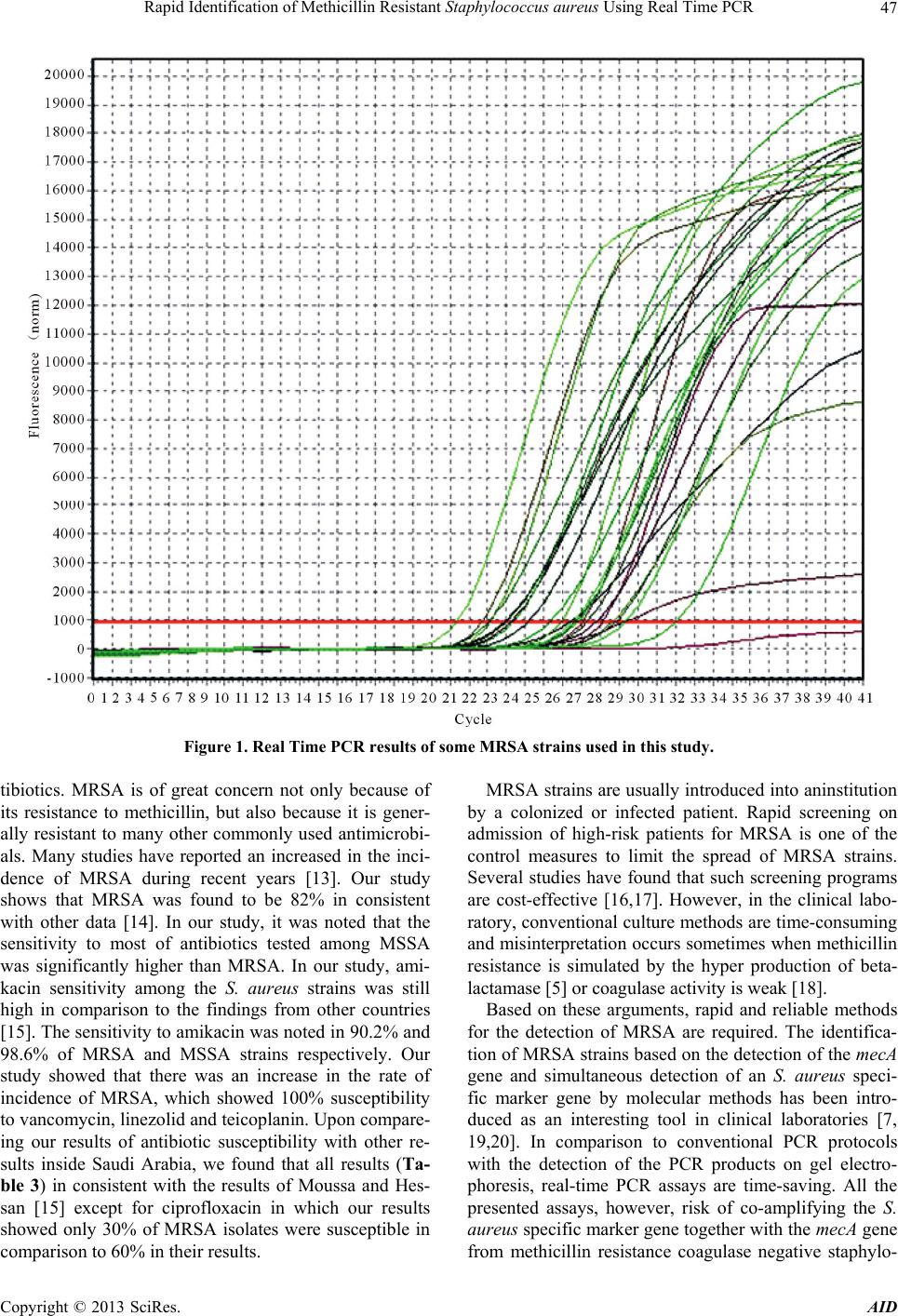 Rapid Identification of Methicillin Resistant Staphylococcus aureus Using Real Time PCR Copyright © 2013 SciRes. AID 47 Figure 1. Real Time PCR results of some MRSA strains used in this study. MRSA strains are usually introduced into aninstitution by a colonized or infected patient. Rapid screening on admission of high-risk patients for MRSA is one of the control measures to limit the spread of MRSA strains. Several studies have found that such screening programs are cost-effective [16,17]. However, in the clinical labo- ratory, conventional culture methods are time-consuming and misinterpretation occurs sometimes when methicillin resistance is simulated by the hyper production of beta- lactamase [5] or coagulase activity is weak [18]. tibiotics. MRSA is of great concern not only because of its resistance to methicillin, but also because it is gener- ally resistant to many other commonly used antimicrobi- als. Many studies have reported an increased in the inci- dence of MRSA during recent years [13]. Our study shows that MRSA was found to be 82% in consistent with other data [14]. In our study, it was noted that the sensitivity to most of antibiotics tested among MSSA was significantly higher than MRSA. In our study, ami- kacin sensitivity among the S. aureus strains was still high in comparison to the findings from other countries [15]. The sensitivity to amikacin was noted in 90.2% and 98.6% of MRSA and MSSA strains respectively. Our study showed that there was an increase in the rate of incidence of MRSA, which showed 100% susceptibility to vancomycin, linezolid and teicoplanin. Upon compare- ing our results of antibiotic susceptibility with other re- sults inside Saudi Arabia, we found that all results (Ta- ble 3) in consistent with the results of Moussa and Hes- san [15] except for ciprofloxacin in which our results showed only 30% of MRSA isolates were susceptible in comparison to 60% in their results. Based on these arguments, rapid and reliable methods for the detection of MRSA are required. The identifica- tion of MRSA strains based on the detection of the mecA gene and simultaneous detection of an S. aureus speci- fic marker gene by molecular methods has been intro- duced as an interesting tool in clinical laboratories [7, 19,20]. In comparison to conventional PCR protocols with the detection of the PCR products on gel electro- phoresis, real-time PCR assays are time-saving. All the presented assays, however, risk of co-amplifying the S. aureus specific marker gene together with the mecA gene from methicillin resistance coagulase negative staphylo- 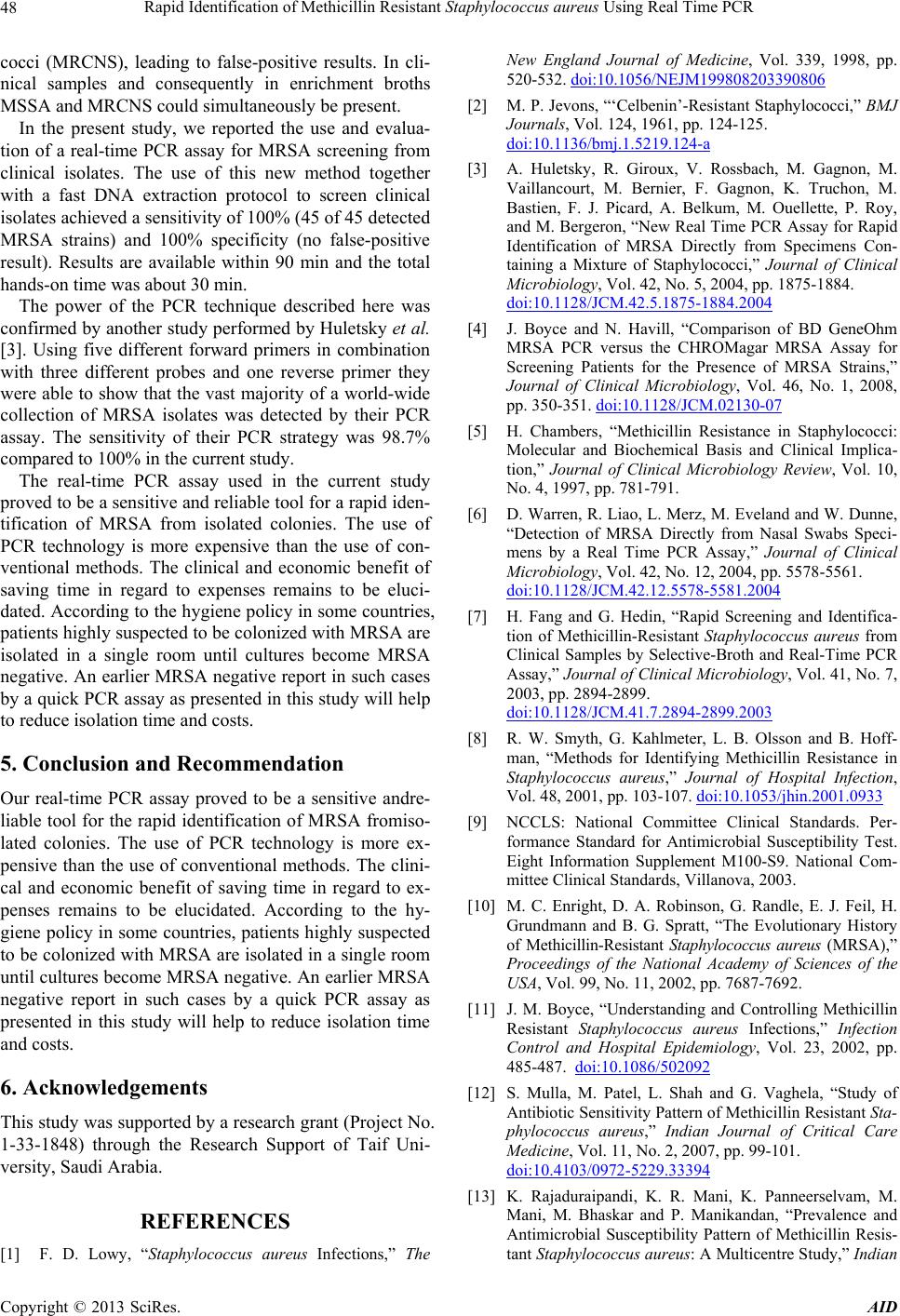 Rapid Identification of Methicillin Resistant Staphylococcus aureus Using Real Time PCR 48 cocci (MRCNS), leading to false-positive results. In cli- nical samples and consequently in enrichment broths MSSA and MRCNS could simultaneously be present. In the present study, we reported the use and evalua- tion of a real-time PCR assay for MRSA screening from clinical isolates. The use of this new method together with a fast DNA extraction protocol to screen clinical isolates achieved a sensitivity of 100% (45 of 45 detected MRSA strains) and 100% specificity (no false-positive result). Results are available within 90 min and the total hands-on time was about 30 min. The power of the PCR technique described here was confirmed by another study performed by Huletsky et al. [3]. Using five different forward primers in combination with three different probes and one reverse primer they were able to show that the vast majority of a world-wide collection of MRSA isolates was detected by their PCR assay. The sensitivity of their PCR strategy was 98.7% compared to 100% in the current study. The real-time PCR assay used in the current study proved to be a sensitive and reliable tool for a rapid iden- tification of MRSA from isolated colonies. The use of PCR technology is more expensive than the use of con- ventional methods. The clinical and economic benefit of saving time in regard to expenses remains to be eluci- dated. According to the hygiene policy in some countries, patients highly suspected to be colonized with MRSA are isolated in a single room until cultures become MRSA negative. An earlier MRSA negative report in such cases by a quick PCR assay as presented in this study will help to reduce isolation time and costs. 5. Conclusion and Recommendation Our real-time PCR assay proved to be a sensitive andre- liable tool for the rapid identification of MRSA fromiso- lated colonies. The use of PCR technology is more ex- pensive than the use of conventional methods. The clini- cal and economic benefit of saving time in regard to ex- penses remains to be elucidated. According to the hy- giene policy in some countries, patients highly suspected to be colonized with MRSA are isolated in a single room until cultures become MRSA negative. An earlier MRSA negative report in such cases by a quick PCR assay as presented in this study will help to reduce isolation time and costs. 6. Acknowledgements This study was supported by a research grant (Project No. 1-33-1848) through the Research Support of Taif Uni- versity, Saudi Arabia. REFERENCES [1] F. D. Lowy, “Staphylococcus aureus Infections,” The New England Journal of Medicine, Vol. 339, 1998, pp. 520-532. doi:10.1056/NEJM199808203390806 [2] M. P. Jevons, “‘Celbenin’-Resistant Staphylococci,” BMJ Journals, Vol. 124, 1961, pp. 124-125. doi:10.1136/bmj.1.5219.124-a [3] A. Huletsky, R. Giroux, V. Rossbach, M. Gagnon, M. Vaillancourt, M. Bernier, F. Gagnon, K. Truchon, M. Bastien, F. J. Picard, A. Belkum, M. Ouellette, P. Roy, and M. Bergeron, “New Real Time PCR Assay for Rapid Identification of MRSA Directly from Specimens Con- taining a Mixture of Staphylococci,” Journal of Clinical Microbiology, Vol. 42, No. 5, 2004, pp. 1875-1884. doi:10.1128/JCM.42.5.1875-1884.2004 [4] J. Boyce and N. Havill, “Comparison of BD GeneOhm MRSA PCR versus the CHROMagar MRSA Assay for Screening Patients for the Presence of MRSA Strains,” Journal of Clinical Microbiology, Vol. 46, No. 1, 2008, pp. 350-351. doi:10.1128/JCM.02130-07 [5] H. Chambers, “Methicillin Resistance in Staphylococci: Molecular and Biochemical Basis and Clinical Implica- tion,” Journal of Clinical Microbiology Review, Vol. 10, No. 4, 1997, pp. 781-791. [6] D. Warren, R. Liao, L. Merz, M. Eveland and W. Dunne, “Detection of MRSA Directly from Nasal Swabs Speci- mens by a Real Time PCR Assay,” Journal of Clinical Microbiology, Vol. 42, No. 12, 2004, pp. 5578-5561. doi:10.1128/JCM.42.12.5578-5581.2004 [7] H. Fang and G. Hedin, “Rapid Screening and Identifica- tion of Methicillin-Resistant Staphylococcus aureus from Clinical Samples by Selective-Broth and Real-Time PCR Assay,” Journal of Clinical Microbiology, Vol. 41, No. 7, 2003, pp. 2894-2899. doi:10.1128/JCM.41.7.2894-2899.2003 [8] R. W. Smyth, G. Kahlmeter, L. B. Olsson and B. Hoff- man, “Methods for Identifying Methicillin Resistance in Staphylococcus aureus,” Journal of Hospital Infection, Vol. 48, 2001, pp. 103-107. doi:10.1053/jhin.2001.0933 [9] NCCLS: National Committee Clinical Standards. Per- formance Standard for Antimicrobial Susceptibility Test. Eight Information Supplement M100-S9. National Com- mittee Clinical Standards, Villanova, 2003. [10] M. C. Enright, D. A. Robinson, G. Randle, E. J. Feil, H. Grundmann and B. G. Spratt, “The Evolutionary History of Methicillin-Resistant Staphylococcus aureus (MRSA),” Proceedings of the National Academy of Sciences of the USA, Vol. 99, No. 11, 2002, pp. 7687-7692. [11] J. M. Boyce, “Understanding and Controlling Methicillin Resistant Staphylococcus aureus Infections,” Infection Control and Hospital Epidemiology, Vol. 23, 2002, pp. 485-487. doi:10.1086/502092 [12] S. Mulla, M. Patel, L. Shah and G. Vaghela, “Study of Antibiotic Sensitivity Pattern of Methicillin Resistant Sta- phylococcus aureus,” Indian Journal of Critical Care Medicine, Vol. 11, No. 2, 2007, pp. 99-101. doi:10.4103/0972-5229.33394 [13] K. Rajaduraipandi, K. R. Mani, K. Panneerselvam, M. Mani, M. Bhaskar and P. Manikandan, “Prevalence and Antimicrobial Susceptibility Pattern of Methicillin Resis- tant Staphylococcus aureus: A Multicentre Study,” Indian Copyright © 2013 SciRes. AID  Rapid Identification of Methicillin Resistant Staphylococcus aureus Using Real Time PCR Copyright © 2013 SciRes. AID 49 Journal of Medical Microbiology, Vol. 24, No. 1, 2006, pp. 34-38. doi:10.4103/0255-0857.19892 [14] I. M. Moussa and A. M. Hessan, “Rapid Detection of Community Acquired-Methicillin Resistance Staphyloco- ccus aureus recovered from King Saudi Arabia,” African Journal of Microbiology Research, Vol. 4, No. 24, 2010, pp. 2804-2810. [15] S. Vidhani, P. L. Mehndiratta, and M. D. Mathur, “Study of Methicillin Resistant Staphyloccusaureus Isolates from High Risk Patients,” Indian Journal of Medical Microbi- ology, Vol. 19, No. 2, 2001, pp. 13-16. [16] T. B. Karchmer, L. J. Durbin, B. M. Simonton and B. M. Farr, “Cost-Effectiveness of Active Surveillance Cultures and Contact/Droplet Precautions for Control of Methicil- lin Resistant Staphylococcus aureus,” Journal of Hospital Infection, Vol. 51, No. 2, 2002, pp. 126-132. doi:10.1053/jhin.2002.1200 [17] G. Papia, M. Louie, A. Tralla, C. Johnson, V. Collins and A. E. Simor, “Screening High-Risk Patients for Methicil- lin-Resistant Staphylococcus aureus on Admission to the Hospital: Is It Cost Effective?” Infection Control and Hospital Epidemiology, Vol. 20, No. 47, 1999, pp. 473- 477. [18] J. M. Fournier, A. Boutonnier and A. Bouvet, “Staphylo- coccus aureus Strains Which Are Not Identified by Rapid Agglutination Methods Are of Capsular Serotype 5,” Journal of Clinical Microbiology, Vol. 27, No. 6, 1989, pp. 1372-1374. [19] A. J. Grisold, E. Leitner, G. Muhlbauer, E. Marth and H. H. Kessler, “Detection of Methicillin-Resistant Staphylo- coccus aureus and Simultaneous Confirmation by Auto- mated Nucleic Acid Extraction and Real-Time PCR,” Journal of Clinical Microbiology, Vol. 40, No. 7, 2002, pp. 2392-2397. doi:10.1128/JCM.40.7.2392-2397.2002 [20] T. Y. Tan, S. Corden, R. Barnes and B. Cookson, “Rapid Identification of Methicillin-Resistant Staphylococcus au- reus from Positive Blood Cultures by Real-Time Fluore- scence PCR,” Journal of Clinical Microbiology, Vol. 39, No. 12, 2001, pp. 4529-4531. doi:10.1128/JCM.39.12.4529-4531.2001 |