

Paper Menu >>
Journal Menu >>
 Creative Education 2013. Vol.4, No.3, 217-222 Published Online March 2013 in SciRes (http://www.scirp.org/journal/ce) DOI:10.4236/ce.2013.43032 A Review of Canadian Medical School Conflict of Interest Policies Michael G. R. Beyaert, Jatinder Takhar*, David Dixon, Margaret Steele, Leanna Isserlin, Carla Garcia, Ian J. Pereira, Jason Eadie Continuing Professional Development , Schulich School of Medi c i n e and Dentistry, The University of Wes te rn Ontario, London, Canada Email: *[email protected] Received January 3rd, 2013; revised February 8th, 2013; accepted February 19th, 2013 Background: Growing evidence of behavioral bias has caused a surge of interest in the area of Conflict of Interest (COI) within the medical community. The present study sought to evaluate the landscape of Faculty of Medicine COI policies among Canadian medical schools using an evaluation system adapted from the AMSA PharmFree Scorecard. Methods: The authors contacted leaders at the CPD/CME offices of all 17 Canadian medical schools in 2011 to determine how many had formal policies guiding interac- tion with the pharmaceutical industry. Existing policies were evaluated based on 16 criteria developed by a steering committee. A Policy Score was calculated and a letter grade assigned for each of the existing policies. Results: At the time of review, roughly 35% of the Canadian medical schools had faculty-wide COI policy/guidelines, half of which had been implemented. Other policies are currently in development. Policy Scores ranged from 25.00% to 70.83% with a Mean Policy Score of 52.08%. Policies that were implemented all scored higher than those that were not implemented. Additionally, several strengths and weaknesses among policies were identified. Conclusions: Canadian schools have recognized that COI and bias have become a serious issue and are taking steps toward its management. The authors propose that the CMFS employ a system similar to the AMSA Scorecard to evaluate progress in a longitudinal study. Keywords: Conflict of Interest; Policy Evaluation; Continuing Medical Education; Continuing Professional Development; Quality Control Introduction Conflict of Interest (COIs) are becoming increasingly rele- vant to the medical field. A COI may be defined as “a set of conditions in which professional judgment concerning a pri- mary interest (such as a patient’s welfare or the validity of re- search) tends to be unduly influenced by a secondary interest (such as financial gain)” (Thompson, 1999). Interactions with the pharmaceutical industry begin early during medical educa- tion, shaping behaviour that continues well into practice (Wazana, 2000; Institute of Medicine, 2009). Residents ex- posed to pharmaceutical representatives during training are more likely to be skewed towards industry values (Zipkin & Steinman, 2005) and are more likely to recall misinformation about the company’s and its competitors’ products (Wazana, 2000). However, these biases may be attenuated by the intro- duction of more stringent policies. A Canadian study demon- strated that residents trained under policies that restricted inter- action with pharmaceutical representatives were more skeptical about information provided by pharmaceutical representatives compared to residents trained under non-restrictive policies (McCormick et al., 2001). Although the majority of practicing physicians dismiss the notion that interaction with the industry introduces bias, their behaviour is influenced in a number of ways. Notably, physic- cians and their organizations are more likely to prescribe a company’s products for up to two years following a direct in- teraction (Wazana, 2000). COI among authors of popular North American and European clinical practice guidelines are preva- lent (Choudry et al., 2002; Neuman et al., 2011), and many guidelines recommend products sold by the companies with which authors have ties (Choudry et al., 2002). Gifts may also alter physicians’ abilities to weigh information (Dana & Loewenstein, 2003). Although drug samples are considered by many to be the most appropriate incentive from industry (Mor- gan et al., 2006), it has been demonstrated that a correlation exists between access to drug samples and prescription rates of that product (Adair & Holmgren, 2005). Conflict of interest extends beyond clinical practice. Nearly one quarter of medical research performed at academic institu- tions is at least partially funded by the pharmaceutical industry (Bekelman et al., 2003). Industry funding influences study de- sign, execution, reporting, access to data, and publication of results (Lexchin et al., 2008). Industry-sponsored research de- sign tends to be less objective (Rochon et al., 2011) and is more likely to yield results favouring the sponsor (Bekelman et al., 2003; Lexchin et al., 2003). Among Canadian academic medi- cal centers, definitions of what constitutes a COI in research is variable with many potential conflicts often being excluded (Lexchin et a l., 2008). It has been estimated that industry spent $57.7 billion Ame- rican dollars on promotion in 2004. This figure represents near- ly 25% of industry sales and double the amount spent on re- search and development. Perhaps more alarming is that 80% of promotional spending was spent marketing to physicians (Gan- *Corresponding autho r. Copyright © 2013 SciRe s . 217  M. G. R. BEYAERT E T AL. gon & Lexchin, 2008). Of large concern is that COIs are often self-reported. A recent study found that physicians disclose only 20.7% of directly related payments from industry and 50.0% of indirectly related payments (Okike et al., 2009). In an attempt to persuade academic medical centers to ma- nage COI, a number of American groups have published re- commendations for more stringent regulation of physician-in- dustry relationships (Brennan et al., 2006; AAMC, 2008; AMSA, 2012). In 2008, the American Association of Medical Colleges (AAMC) Task Force released an assessment of COI policies from academic medical centers across America and made recommendations for improvements (AAMC, 2008). Using similar criteria, the American Medical Student Asso- ciation (AMSA) continues to monitor and grade COI policies of academic medical centers in the United States using their PharmFree Scorecard. Criteria from six COI domains (Gifts and Individual Financial Relationships with Industry; Pharma- ceutical Samples; Purchasing and Formularies; Industry Sales Representatives; Education; and Enforcement) are given scores ranging from 1 (weak or no policy) to 3 (strong policy). The cumulative score of these domains, excluding Enforcement, is used to determine a percentage score out of a maximum 15 points. The 2011-2012 report concluded that 67% of American medical schools have policies scoring A (score of 85% or higher) or B (score of 70% or higher). This is a significant im- provement from 19%, 30% and 51% of schools in 2008, 2009, and 2010, respectively (AMSA, 2012). It is conceivable that implementation of the AMSA scorecard has raised awareness about the issue of COI and contributed to improvements in medical school COI policies. However, Chimonas et al. evalua- ted American medical school COI policies using their own method and found that half of those surveyed had poor or non-existent COI policies (Chimonas et al., 2011). In Canada, physicians are encouraged to follow Canadian Medical Association (CMA)’s “Guidelines for Physicians in Interactions with Industry” (CMA, 2007). These guidelines apply to all physicians, residents, and medical organizations in Canada, including the College of Family Physicians of Canada (CFPC) and the Royal College of Physicians and Surgeons of Canada (RCPSC). Although the Association of Faculties of Medicine of Canada (AFMC) has not issued its own policy guiding interactions between industry and Canadian medical schools, it endorsed the AAMC report on “Industry Funding of Medical Education” (AAMC, 2008). To address the issue of COI in Canadian medical education, the AMFC created the Standing Committee on Continuing Professional Development (SCCPD). This committee brought leaders from the 17 Canadian medical schools’ Continuing Professional Development (CPD)/Continuing Medical Educa- tion (CME) offices together at a national meeting to discuss relations between industry and CPD/CME. The SCCPD Work- ing Group on Industry Relations issued a position paper urging Canadian medical schools to develop individual COI policies, and provided consensus statements to help guide the creation of such policies (SCCPD, 2010). The Canadian Federation of Medical Students (CFMS) has also called upon Canadian medical schools to develop policies in collaboration with their medical student societies and educate medical students about appropriate industry relationships. Their report briefly ad- dresses COI policies and guidelines from a number of organiza- tions, including the CMA and the Faculties of Medicine at the University of Toronto and the University of Ottawa (CFMS, 2011). As a result of these initiatives, increasing attention has been paid to COI documents among Canadian universities. In 2008, Williams-Jones and MacDonald evaluated COI policies from thirteen of Canada’s largest and most prominent universities for readability and content. The authors found that most schools' policies had low readability, using complex legal language to focus on prohibitions and mitigate institutional liability, rather than providing readers with clear definitions of COI, examples of what constitutes COI, and procedures for addressing COI (Williams-Jones & MacDonald, 2008). More recently in 2012, Mathieu et al. applied a modified version of the AMSA Pharm- Free Scorecard to COI policies from Canadian universities with medical schools. The authors found that Canadian universities studied scored very poorly, with all but one receiving overall grades of D or F. However, it is important to note that this study evaluated university-wide COI policies from univer- sities with medical schools rather than investigating policies specific to the Faculties of Medicine. Many of the weaknesses in policies could be attributed to evaluation of general univer- sity-wide COI policies using AMSA’s grading scheme, which was developed specifically for medical school COI policies (Mathieu et al., 2012). To the best of our knowledge, no comprehensive assessment of Faculty of Medicine COI policies from all 17 Canadian medical schools has been performed. The present study sought to raise awareness about this issue by evaluating the landscape of medical school COI policies in Canada using a scoring sys- tem similar to the AMSA PharmFree Scorecard. Methods The associate and vice deans of CPD/CME offices of all 17 Canadian medical schools were contacted in August 2011 to determine which schools had developed formal COI policies and whether these policies had been implemented. CPD/CME leaders were contacted because they are currently taking the lead on these issues as the majority of policies are vetted through these offices. Existing policies, which were all available within the public domain, were obtained from each Faculty of Medicine’s web- site for evaluation. University-wide policies were excluded from analysis because they were not developed specifically for the physician community. Once policies were obtained, a steering committee was formed to discuss policy evaluation. This committee consisted of the Associate Dean of CPD, the Vice Dean of Hospital and Interfaculty Relations, educators from various disciplines within the Schulich School of Medi- cine, a resident representative, and a medical student represen- tative. The committee created criteria and a scoring system for policy evaluation based on relevant COI criteria commonly found in the literature. The criteria selected for evaluation in- cluded all areas of the AMSA PharmFree Scorecard as well as additional areas deemed important by the committee (Chimonas et al., 2011; AMSA, 2012; Mathieu et al., 2012). Policies were reviewed and graded by a single scorer and calculations were verified independently by a second reviewer. The scorer was not blinded to the identities of medical schools. Each policy was evaluated based on the strength of each crite- rion using a four-point scale reported by Mathieu et al. (2012), which was adapted from the AMSA PharmFree Scorecard (AMSA, 2012). The scoring scale was follows: 0 points for a Copyright © 2013 SciRe s . 218 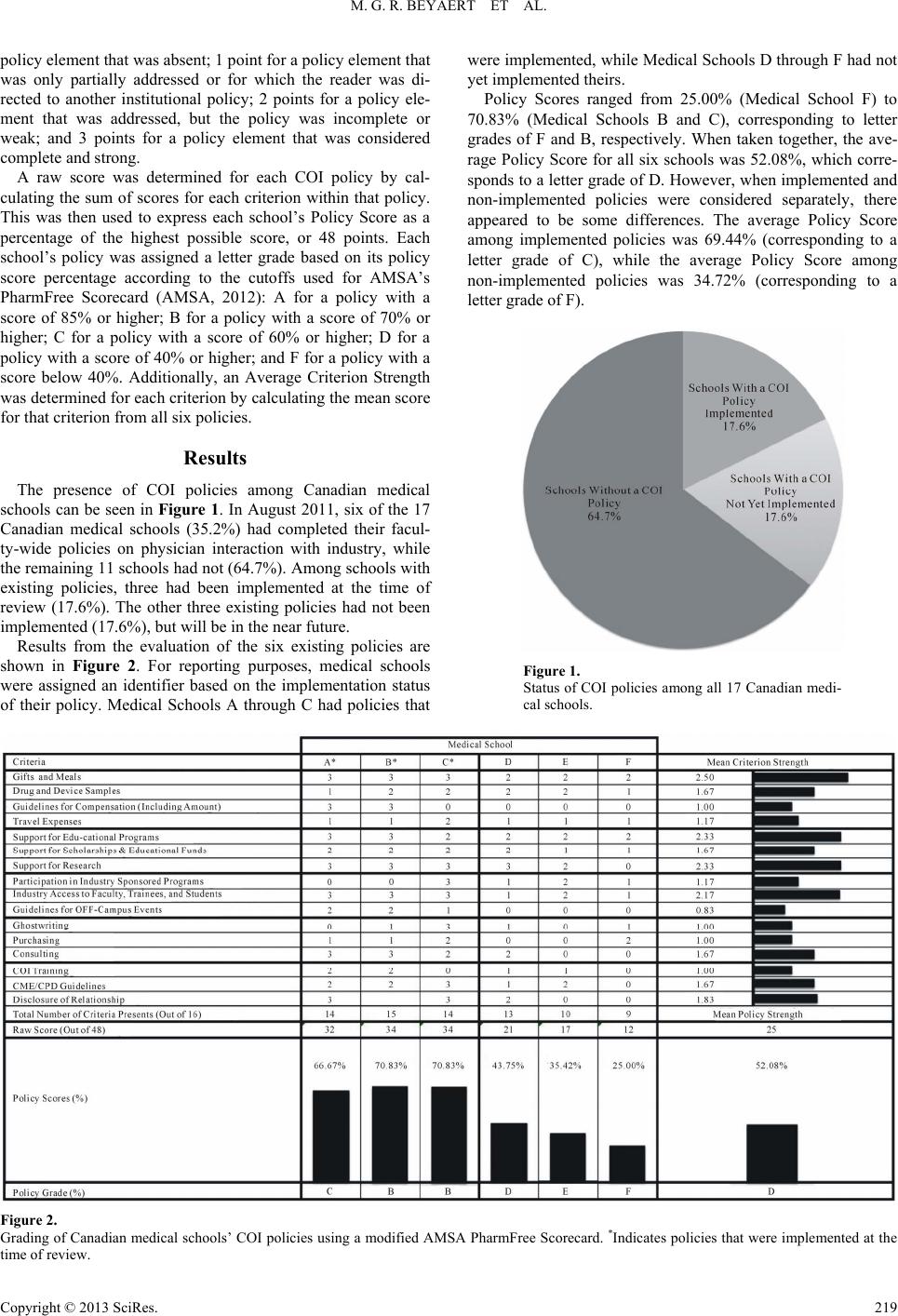 M. G. R. BEYAERT ET AL. Copyright © 2013 SciRe s . 219 policy element that was absent; 1 point for a policy element that was only partially addressed or for which the reader was di- rected to another institutional policy; 2 points for a policy ele- ment that was addressed, but the policy was incomplete or weak; and 3 points for a policy element that was considered complete and strong. were implemented, while Medical Schools D through F had not yet implemented theirs. Policy Scores ranged from 25.00% (Medical School F) to 70.83% (Medical Schools B and C), corresponding to letter grades of F and B, respectively. When taken together, the ave- rage Policy Score for all six schools was 52.08%, which corre- sponds to a letter grade of D. However, when implemented and non-implemented policies were considered separately, there appeared to be some differences. The average Policy Score among implemented policies was 69.44% (corresponding to a letter grade of C), while the average Policy Score among non-implemented policies was 34.72% (corresponding to a letter grade of F). A raw score was determined for each COI policy by cal- culating the sum of scores for each criterion within that policy. This was then used to express each school’s Policy Score as a percentage of the highest possible score, or 48 points. Each school’s policy was assigned a letter grade based on its policy score percentage according to the cutoffs used for AMSA’s PharmFree Scorecard (AMSA, 2012): A for a policy with a score of 85% or higher; B for a policy with a score of 70% or higher; C for a policy with a score of 60% or higher; D for a policy with a score of 40% or higher; and F for a policy with a score below 40%. Additionally, an Average Criterion Strength was determined for each criterion by calculating the mean score for that criterion from all six policies. Results The presence of COI policies among Canadian medical schools can be seen in Figure 1. In August 2011, six of the 17 Canadian medical schools (35.2%) had completed their facul- ty-wide policies on physician interaction with industry, while the remaining 11 schools had not (64.7%). Among schools with existing policies, three had been implemented at the time of review (17.6%). The other three existing policies had not been implemented (17.6%), but will be in the near future. Results from the evaluation of the six existing policies are shown in Figure 2. For reporting purposes, medical schools were assigned an identifier based on the implementation status of their policy. Medical Schools A through C had policies that Figure 1. Status of COI policies among all 17 Canadian medi- cal schools. Figure 2. Grading of Canadian medical schools’ COI policies using a modified AMSA PharmFree Scorecard. *Indicates policies that were implemented at the time of revi ew. 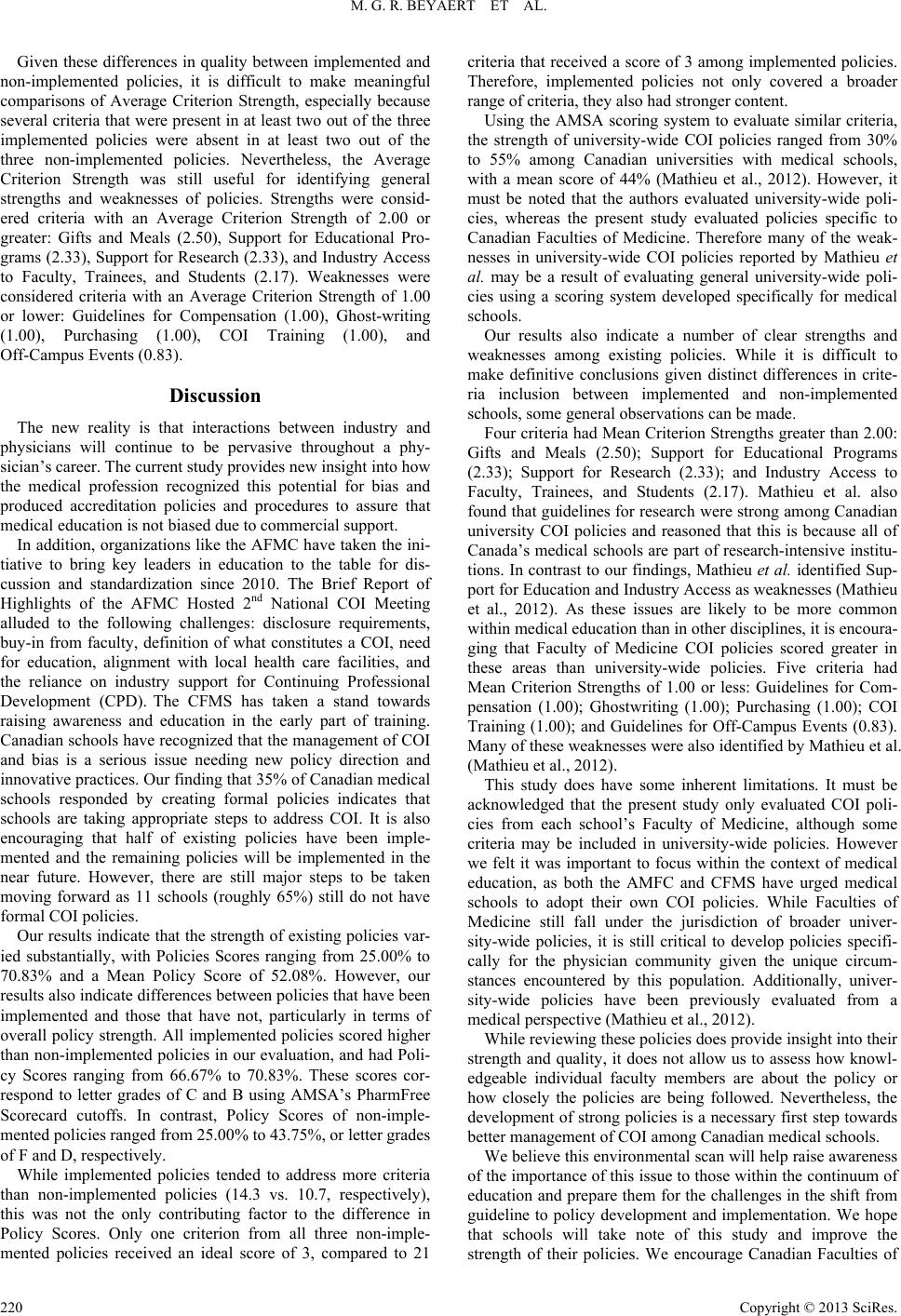 M. G. R. BEYAERT E T AL. Given these differences in quality between implemented and non-implemented policies, it is difficult to make meaningful comparisons of Average Criterion Strength, especially because several criteria that were present in at least two out of the three implemented policies were absent in at least two out of the three non-implemented policies. Nevertheless, the Average Criterion Strength was still useful for identifying general strengths and weaknesses of policies. Strengths were consid- ered criteria with an Average Criterion Strength of 2.00 or greater: Gifts and Meals (2.50), Support for Educational Pro- grams (2.33), Support for Research (2.33), and Industry Access to Faculty, Trainees, and Students (2.17). Weaknesses were considered criteria with an Average Criterion Strength of 1.00 or lower: Guidelines for Compensation (1.00), Ghost-writing (1.00), Purchasing (1.00), COI Training (1.00), and Off-Campus Events (0.83). Discussion The new reality is that interactions between industry and physicians will continue to be pervasive throughout a phy- sician’s career. The current study provides new insight into how the medical profession recognized this potential for bias and produced accreditation policies and procedures to assure that medical education is not biased due to commercial support. In addition, organizations like the AFMC have taken the ini- tiative to bring key leaders in education to the table for dis- cussion and standardization since 2010. The Brief Report of Highlights of the AFMC Hosted 2nd National COI Meeting alluded to the following challenges: disclosure requirements, buy-in from faculty, definition of what constitutes a COI, need for education, alignment with local health care facilities, and the reliance on industry support for Continuing Professional Development (CPD). The CFMS has taken a stand towards raising awareness and education in the early part of training. Canadian schools have recognized that the management of COI and bias is a serious issue needing new policy direction and innovative practices. Our finding that 35% of Canadian medical schools responded by creating formal policies indicates that schools are taking appropriate steps to address COI. It is also encouraging that half of existing policies have been imple- mented and the remaining policies will be implemented in the near future. However, there are still major steps to be taken moving forward as 11 schools (roughly 65%) still do not have formal COI policies. Our results indicate that the strength of existing policies var- ied substantially, with Policies Scores ranging from 25.00% to 70.83% and a Mean Policy Score of 52.08%. However, our results also indicate differences between policies that have been implemented and those that have not, particularly in terms of overall policy strength. All implemented policies scored higher than non-implemented policies in our evaluation, and had Poli- cy Scores ranging from 66.67% to 70.83%. These scores cor- respond to letter grades of C and B using AMSA’s PharmFree Scorecard cutoffs. In contrast, Policy Scores of non-imple- mented policies ranged from 25.00% to 43.75%, or letter grades of F and D, respectively. While implemented policies tended to address more criteria than non-implemented policies (14.3 vs. 10.7, respectively), this was not the only contributing factor to the difference in Policy Scores. Only one criterion from all three non-imple- mented policies received an ideal score of 3, compared to 21 criteria that received a score of 3 among implemented policies. Therefore, implemented policies not only covered a broader range of criteria, they also had stronger content. Using the AMSA scoring system to evaluate similar criteria, the strength of university-wide COI policies ranged from 30% to 55% among Canadian universities with medical schools, with a mean score of 44% (Mathieu et al., 2012). However, it must be noted that the authors evaluated university-wide poli- cies, whereas the present study evaluated policies specific to Canadian Faculties of Medicine. Therefore many of the weak- nesses in university-wide COI policies reported by Mathieu et al. may be a result of evaluating general university-wide poli- cies using a scoring system developed specifically for medical schools. Our results also indicate a number of clear strengths and weaknesses among existing policies. While it is difficult to make definitive conclusions given distinct differences in crite- ria inclusion between implemented and non-implemented schools, some general observations can be made. Four criteria had Mean Criterion Strengths greater than 2.00: Gifts and Meals (2.50); Support for Educational Programs (2.33); Support for Research (2.33); and Industry Access to Faculty, Trainees, and Students (2.17). Mathieu et al. also found that guidelines for research were strong among Canadian university COI policies and reasoned that this is because all of Canada’s medical schools are part of research-intensive institu- tions. In contrast to our findings, Mathieu et al. identified Sup- port for Education and Industry Access as weaknesses (Mathieu et al., 2012). As these issues are likely to be more common within medical education than in other disciplines, it is encoura- ging that Faculty of Medicine COI policies scored greater in these areas than university-wide policies. Five criteria had Mean Criterion Strengths of 1.00 or less: Guidelines for Com- pensation (1.00); Ghostwriting (1.00); Purchasing (1.00); COI Training (1.00); and Guidelines for Off-Campus Events (0.83). Many of these weaknesses were also identified by Mathieu et al. (Mathieu et al., 2012). This study does have some inherent limitations. It must be acknowledged that the present study only evaluated COI poli- cies from each school’s Faculty of Medicine, although some criteria may be included in university-wide policies. However we felt it was important to focus within the context of medical education, as both the AMFC and CFMS have urged medical schools to adopt their own COI policies. While Faculties of Medicine still fall under the jurisdiction of broader univer- sity-wide policies, it is still critical to develop policies specifi- cally for the physician community given the unique circum- stances encountered by this population. Additionally, univer- sity-wide policies have been previously evaluated from a medical perspective (Mathieu et al., 2012). While reviewing these policies does provide insight into their strength and quality, it does not allow us to assess how knowl- edgeable individual faculty members are about the policy or how closely the policies are being followed. Nevertheless, the development of strong policies is a necessary first step towards better management of COI among Canadian medical schools. We believe this environmental scan will help raise awareness of the importance of this issue to those within the continuum of education and prepare them for the challenges in the shift from guideline to policy development and implementation. We hope that schools will take note of this study and improve the strength of their policies. We encourage Canadian Faculties of Copyright © 2013 SciRe s . 220  M. G. R. BEYAERT ET AL. Medicine to learn from the experiences of other schools in the development and implementation of their COI policies. Addi- tionally, several excellent suggestions have been provided in the literature. Notably, Smith and Williams-Jones made exem- plary recommendations for the development of COI policies in Canada (Smith & Williams-Jones, 2009). Our goal is that a similar system to the AMSA PharmFree Scorecard will be put in place in Canada to grade medical school COI policies and track the progress in a continuous lon- gitudinal initiative. AMSA has achieved great success with their initiative in the US, as the overall quality of medical school COI policies has improved every year since the introdu- ction of their scoring system (AMSA, 2012). We believe simi- lar success can be achieved in Canada. We propose that this could be done by some of the organizations in the National COI group such as CFMS, a Canadia n organization similar to AMSA, in collaboration with academic CME/CPD offices in Canada. In conclusion there are important lessons learnt from this early study, that is sharing of experiences in implementing these policies through education in Canadian medical schools would be beneficial through a national COI group. There is ongoing need to identify appropriate management of COI’s and bias through educational strategies in all academic institutions. Academic health sciences centers should ensure that any and all partnerships between themselves and industry serve the best interest of patients. Using information gleaned from this study for longitudinal evaluation and continuous quality improvement in education is the vital next step. Acknowledgements The authors are pleased to acknowledge the assistance of Larissa Husarewy c h in the submission of this manuscript. REFERENCES Adair, R. F., & Holmgren, L. R. (2005). Do drug samples influence resident prescribing behavior? A randomized trial. The American Journal of Medicine, 1 1 8 , 881-884. doi:10.1016/j.amjmed.2005.02.031 Association of American Medical Colleges (AAMC) (2008). Industry funding of medical education: report of an AAMC task force. URL (last checked 2 March 2013). https://members.aamc.org/eweb/upload/Industry%20Funding%20of %20Medical%20Education.pdf American Medical Student Association (AMSA) (2012). AMSA Pharm- Free scorecard 2011-201 2 . URL (last checked 2 March 2013). http://www.amsascorecard.org Bekelman, J. E., Li, Y., & Gross, C. P. (2003). Scope and impact of financial conflicts of interest in biomedical research: A systematic review. Journal of the American Medical Association, 289, 454-465. doi:10.1001/jama.289.4.454 Brennan, T. A., Rothman, D. J., Blank, L., Blumenthal, D. , Chimonas, S. C., Cohen, J. J., Goldman, J., Kassirer, J. P., Kimball, H., Naugh- ton, J., & Smelser, N. (2006). Health industry practices that create conflicts of interest. A policy proposal for academic medical centers. Journal of the American Medical Association, 295, 429-433. doi:10.1001/jama.295.4.429 Canadian Foundation of Medical Students (CFMS) (2011). Defining the relationship: An evidence based review and recommendations on the role of industry funding in medical schools. URL (last checked 2 March 2013). http://www.cfms.org/attachments/article/163/cfms_industry_funding _working_group_paper.pdf Canadian Medical Association (CMA) (2007). Guidelines for physic- cians in interactions with industry: CMA Policy. URL (last checked 2 March 2013). http://policybase.cma.ca/dbtw-wpd/Policypdf/PD08-01.pdf Chimonas, S., Patterson, L., Raveis, V. H., & Rothman, D. J. (2011). Managing conflicts of interest in clinical care: A national survey of policies at US medical schools. Academic Medicine, 86, 293-299. doi:10.1097/ACM.0b013e3182087156 Choudhry, N. K., Stelfox, H. T., & Detsky, A. S. (2002). Relationships between authors of clinical practice guidelines and the pharmaceuti- cal industry. Journal of the American Medical Association, 287, 612- 617. doi:10.1001/jama.287.5.612 Dana, J., & Loewenstein, G. (2003) A social science perspective on gifts to physicians from industry. Journal of the American Medical Association, 290, 252-255. doi:10.1001/jama.290.2.252 Gangon, M. A., & Lexchin, J. (2008). The cost of pushing pills: A new estimate of pharmaceutical promotion expenditure in the United States. PLOS Medicine, 5, 29- 33. Institutes of Medicine (IOM) (2009). Conflict of interest in medical research, education, and practice. URL (last checked 2 March 2013). http://www.nap.edu/catalog.php?record_id=12598 Lexchin, J., Bero, L. A., Djubegovic, B., & Clark, O. (2003). Pharma- ceutical industry sponsorship and research outcome and quality: Sys- tematic review. BMJ, 326, 1167-1170. doi:10.1136/bmj.326.7400.1167 Lexchin, J., Sekeres, M., Gold, J., Ferris, L.E., Kalkar, S. R., Wu, W., Van Laethem, M., Chan, A. W., Mohen , D., Maskalyk, M. J., Taback, N., & Rochon, P. A. (2008). National evaluation of policies on indi- vidual financial conflicts of interest in Canadian academic health science centers. Journal of General Internal Medicine, 23, 1896-1903. doi:10.1007/s11606-008-0752-4 Mathieu, G., Smith, E., Potvin, M. J., & Williams-Jones, B. (2012). Conflict of interest policies at Canadian universities and medical schools: Some lessons learned from the AMSA PharmFree Score- card. Bioethique Online, 1, 1-11. McCormick, B. B., Tomlinson, G., Brill-Edwards, P., & Detsky, A. S. (2001). Effect of restricting contact between pharmaceutical com- pany representatives and internal medicine residents on post training attitudes and behavior. Journal of the American Medical Association, 286, 1994-1999. doi:10.1001/jama.286.16.1994 Morgan, M. A., Dana, J., Loewenstein, G., Zinberg, S., & Schulkin, J. (2006). Interactions of doctors with the pharmaceutical industry. Journal of Medical Ethics, 32, 559-563. doi:10.1136/jme.2005.014480 Neuman, J., Korenstein, D., Ross, J. S., & Keyhani, S. (2011). Preva- lence of financial conflicts of interest among panel members pro- ducing clinical practice guidelines in Canada and United States: Cross sectional study. BMJ, 343, d5621. doi:10.1136/bmj.d5621 Okike, K., Kocher, M. S., Wei, E. X., Mehl man, C. T., & Bhan dari, M. (2009). Accuracy of conflict-of-interest disclosures reported by phy- sicians. The New England Journal of Me d i c i n e , 361, 1466-1474. doi:10.1056/NEJMsa0807160 Rochon, P. A., Sekeres, M., Hoey, J., Lexchin, J., Ferris, L. E., Moher, D., Wu, W., Kalkar, S. R., Van Laethem, M., Gruneir, A., Gold, J., Maskalyk, J., Streiner, D. L., Taback, N., & Chan, A. W. (2011). In- vestigator experiences with financial conflicts of interest in clinical trials. Trials, 12, 1-9. doi:10.1186/1745-6215-12-9 Smith, E., & Williams-Jones, B (2009). Legalistic or inspirational? Comparing university conflict of interest policies. Higher Education Policy, 22, 433-459. doi:10.1057/hep.2009.3 Standing Committee on Continuing Professional Development (SCCPD) (2010). SCCPD position paper on the role of industry in univer- sity-based CME/CPD Offices and Industry Relations. URL (last che- cked 2 March 2013). http://www.afmc.ca/pdf/committees/SCCPD_Position_Paper_on_Ro le_of_Industry_in_University_Based_CME-CPD_Dec%201_2010.p df Thompson, D. (1993). Understanding financial conflicts of interest. New England Journal of Medici ne, 329, 573-576. doi:10.1056/NEJM199308193290812 Wazana, A. (2000). Physicians and the pharmaceutical industry. Is a Copyright © 2013 SciRe s . 221  M. G. R. BEYAERT ET AL. Copyright © 2013 SciRe s . 222 gift every just a gift? Journal of the American Medical Association, 283, 373-380. doi:10.1001/jama.283.3.373 Williams-Jones, B., & MacDonald, C. (2008). Conflict of interest poli- cies at Canadian universities: clarity and content. Journal of Aca- demic Ethics, 6, 79-90. doi:10.1007/s10805-007-9052-6 Zipkin, D. A., & Steinman, M. A. (2005). Interactions between phar- maceutical representatives and doctors in training: A thematic review. Journal of General Internal Medicine, 20, 777-786. doi:10.1111/j.1525-1497.2005.0134.x |