

Paper Menu >>
Journal Menu >>
 Psychology 2013. Vol.4, No.3, 165-168 Published Online March 2013 in SciRes (http://www.scirp.org/journal/psych) http://dx.doi.org/10.4236/psych.2013.43024 Copyright © 2013 SciRes. 165 Object-Spatial Imagery Types of Japanese College Students Masahiro Kawahara1, Kazuo Matsuoka2 1University Education Center, Iwate University, Morioka, Japan 2Department of Faculty of Humanities and Social Sciences, Iwate University, Morioka, Japan Email: [email protected] Received December 24th, 2012; revised January 21st, 2013; accepted February 18th, 2013 This study investigated the object-spatial imagery types found among Japanese college students. First, we examined the descriptive statistics of the Japanese version of the Object-Spatial Imagery Questionnaire object-spatial imagery scales, which measure respondents’ tendencies with respect to object-spatial im- agery types. Although the means of these subscales were lower than those of the original versions, the raw score distributions and gender differences were similar to those obtained using the original version. Addi- tionally, we compared imagery types among students in seven different academic departments. Specifi- cally, the results showed specific patterns of imagery type among students in each department, indicating that the object-spatial imagery type model is applicable to Japanese college students and that individual imagery type data would be helpful for career guidance. Keywords: Object-Spatial Imagery Style; Object Imagery Type; Spatial Imagery Type Introduction Cognitive neuroscience and behavior research have demon- strated that visual imagery processing comprises two processes: object and spatial imagery processing (Farah, Hammond, Le- vine, & Calvanio, 1998; Kosslyn, 1994; Levine, Warach, & Farah, 1985; Ungerleider & Mishkin, 1982). These processes can be distinguished from each other both anatomically and functionally. Object imagery processing is activated when par- ticipants process objects or scenes in terms of color, shape, size, and brightness; this type of processing is linked to the ventral system. Spatial imagery processing is activated when partici- pants process object location, movement, spatial relations, and transformations; this type of processing is linked to the dorsal system. These two processing pathways of visual imagery in the brain have also been associated with individual differences in visual imagery processing. Recently, the research group of Kozhevnikov (Blajenkova, Kozhevnikov, & Motes, 2006; Blazhenkova & Kozhevnikov, 2010; Kozhevnikov, Kosslyn, & Shephard, 2005; Kozhevnikov, Blazhenkova, & Becker, 2010) proposed a new model of cognitive style (object-spatial im- agery style) for preferences with respect to visual imagery. This new cognitive style model divides people into object imagers and spatial imagers. Object imagers tend to create colorful, pictorial, high-resolution images of individual objects or scenes; they perform very well on object measures (e.g., the Degraded Pictures Test [DPT]). Spatial imagers tend to use imagery to represent object locations and movement and spatial relations among objects; they have an advantage on spatial imagery tests (e.g., the Mental Rotation Test [MRT]). Blajenkova et al. (2006) recently developed the Object-Spa- tial Imagery Questionnaire (OSIQ) as a tool for measuring in- dividuals’ object-spatial imagery type. Research using the OSIQ has reported that scores on the OSIQ’s object imagery scale were specifically related to performance on object visu- alization tests or imagery questionnaires, such as the DPT or the Vividness of Visual Imagery Questionnaire (VVIQ), whereas scores on the OSIQ’s spatial imagery scale were spe- cifically related to performance on spatial imagery tests, such as the Paper Folding Test (PFT) or MRT (Blajenkova et al., 2006, Blazhenkova & Kozhevnikov, 2010). These imagery types have also been associated with interpretations of kinematics graphs and appreciation of abstract art (Blazhenkova & Kozhevnikov, 2010). Additionally, neuroimaging research has revealed dif- ferences in brain activity between object imagers and spatial imagers while they imagined that they were creating line draw- ings of common objects, such as pianos or pairs of scissors (Motes, Malach, & Kozhevnikov, 2008). Furthermore, educational research has reported that object imagery plays a crucial role in creative thinking among visual artists (Kassels, 1991; Rosenberg, 1987), and spatial imagery is important for performance in professions such as machine de- sign and engineering (Hegarty & Waller, 2005; Smith, 1964). Recently, Blazhenkova and Kozhevnkov (2010) showed that students majoring in visual arts succeeded on object measures such as the DPT or the VVIQ but performed poorly on spatial imagery tasks such as the MRT or the PFT, whereas students majoring in science showed the opposite performance pattern. These results suggested that individual imagery abilities relate to individual aptitude in specialized areas. However, there are large differences in cognitive style be- tween Asians and Europeans/Americans (Nisbett, Peng, Choi, & Norenzayan, 2001; Sternberg, 1997). Therefore, it is neces- sary to determine whether the cognitive style model of ob- ject-spatial imagery type obtained from participants in Europe and America may be applicable to Japanese individuals. The primary goal of the present study is to investigate object-spatial imagery type in Japanese college students. Additionally, if im- agery type is associated with college major or academic per- formance, then individual tendencies with respect to imagery type might be helpful for vocational guidance and education. 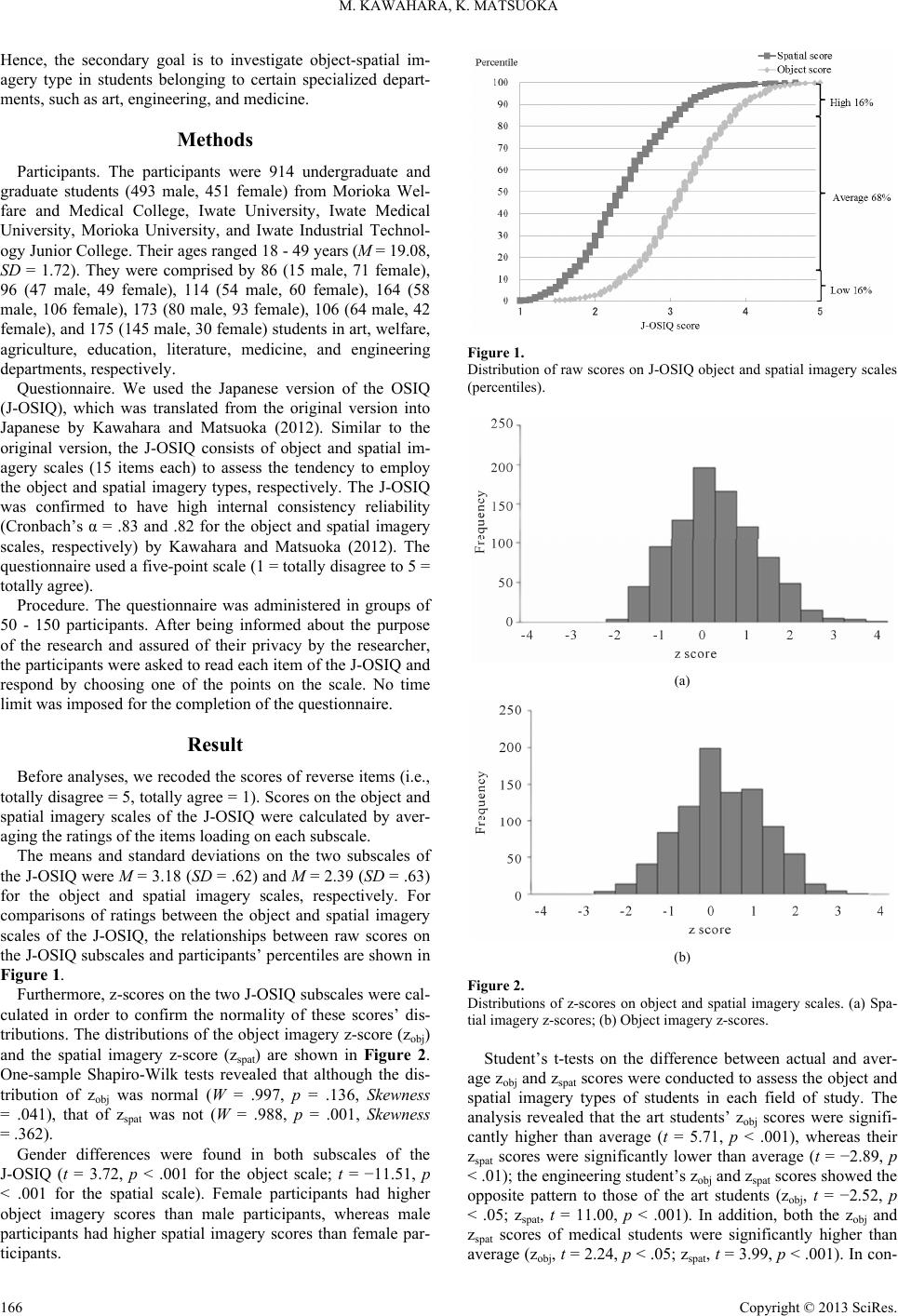 M. KAWAHARA, K. MATSUOKA Hence, the secondary goal is to investigate object-spatial im- agery type in students belonging to certain specialized depart- ments, such as art, engineering, and medicine. Methods Participants. The participants were 914 undergraduate and graduate students (493 male, 451 female) from Morioka Wel- fare and Medical College, Iwate University, Iwate Medical University, Morioka University, and Iwate Industrial Technol- ogy Junior College. Their ages ranged 18 - 49 years (M = 19.08, SD = 1.72). They were comprised by 86 (15 male, 71 female), 96 (47 male, 49 female), 114 (54 male, 60 female), 164 (58 male, 106 female), 173 (80 male, 93 female), 106 (64 male, 42 female), and 175 (145 male, 30 female) students in art, welfare, agriculture, education, literature, medicine, and engineering departments, respectively. Questionnaire. We used the Japanese version of the OSIQ (J-OSIQ), which was translated from the original version into Japanese by Kawahara and Matsuoka (2012). Similar to the original version, the J-OSIQ consists of object and spatial im- agery scales (15 items each) to assess the tendency to employ the object and spatial imagery types, respectively. The J-OSIQ was confirmed to have high internal consistency reliability (Cronbach’s α = .83 and .82 for the object and spatial imagery scales, respectively) by Kawahara and Matsuoka (2012). The questionnaire used a five-point scale (1 = totally disagree to 5 = totally agree). Procedure. The questionnaire was administered in groups of 50 - 150 participants. After being informed about the purpose of the research and assured of their privacy by the researcher, the participants were asked to read each item of the J-OSIQ and respond by choosing one of the points on the scale. No time limit was imposed for the completion of the questionnaire. Result Before analyses, we recoded the scores of reverse items (i.e., totally disagree = 5, totally agree = 1). Scores on the object and spatial imagery scales of the J-OSIQ were calculated by aver- aging the ratings of the items loading on each subscale. The means and standard deviations on the two subscales of the J-OSIQ were M = 3.18 (SD = .62) and M = 2.39 (SD = .63) for the object and spatial imagery scales, respectively. For comparisons of ratings between the object and spatial imagery scales of the J-OSIQ, the relationships between raw scores on the J-OSIQ subscales and participants’ percentiles are shown in Figure 1. Furthermore, z-scores on the two J-OSIQ subscales were cal- culated in order to confirm the normality of these scores’ dis- tributions. The distributions of the object imagery z-score (zobj) and the spatial imagery z-score (zspat) are shown in Figure 2. One-sample Shapiro-Wilk tests revealed that although the dis- tribution of zobj was normal (W = .997, p = .136, Skewness = .041), that of zspat was not (W = .988, p = .001, Skewness = .362). Gender differences were found in both subscales of the J-OSIQ (t = 3.72, p < .001 for the object scale; t = −11.51, p < .001 for the spatial scale). Female participants had higher object imagery scores than male participants, whereas male participants had higher spatial imagery scores than female par- ticipants. Figure 1. Distribution of raw scores on J-OSIQ object and spatial imagery scales (percentiles). (a) (b) Figure 2. Distributions of z-scores on object and spatial imagery scales. (a) Spa- tial imagery z-scores; (b) Object imagery z-scores. Student’s t-tests on the difference between actual and aver- age zobj and zspat scores were conducted to assess the object and spatial imagery types of students in each field of study. The analysis revealed that the art students’ zobj scores were signifi- cantly higher than average (t = 5.71, p < .001), whereas their zspat scores were significantly lower than average (t = −2.89, p < .01); the engineering student’s zobj and zspat scores showed the opposite pattern to those of the art students (zobj, t = −2.52, p < .05; zspat, t = 11.00, p < .001). In addition, both the zobj and zspat scores of medical students were significantly higher than average (zobj, t = 2.24, p < .05; zspat, t = 3.99, p < .001). In con- Copyright © 2013 SciRes. 166 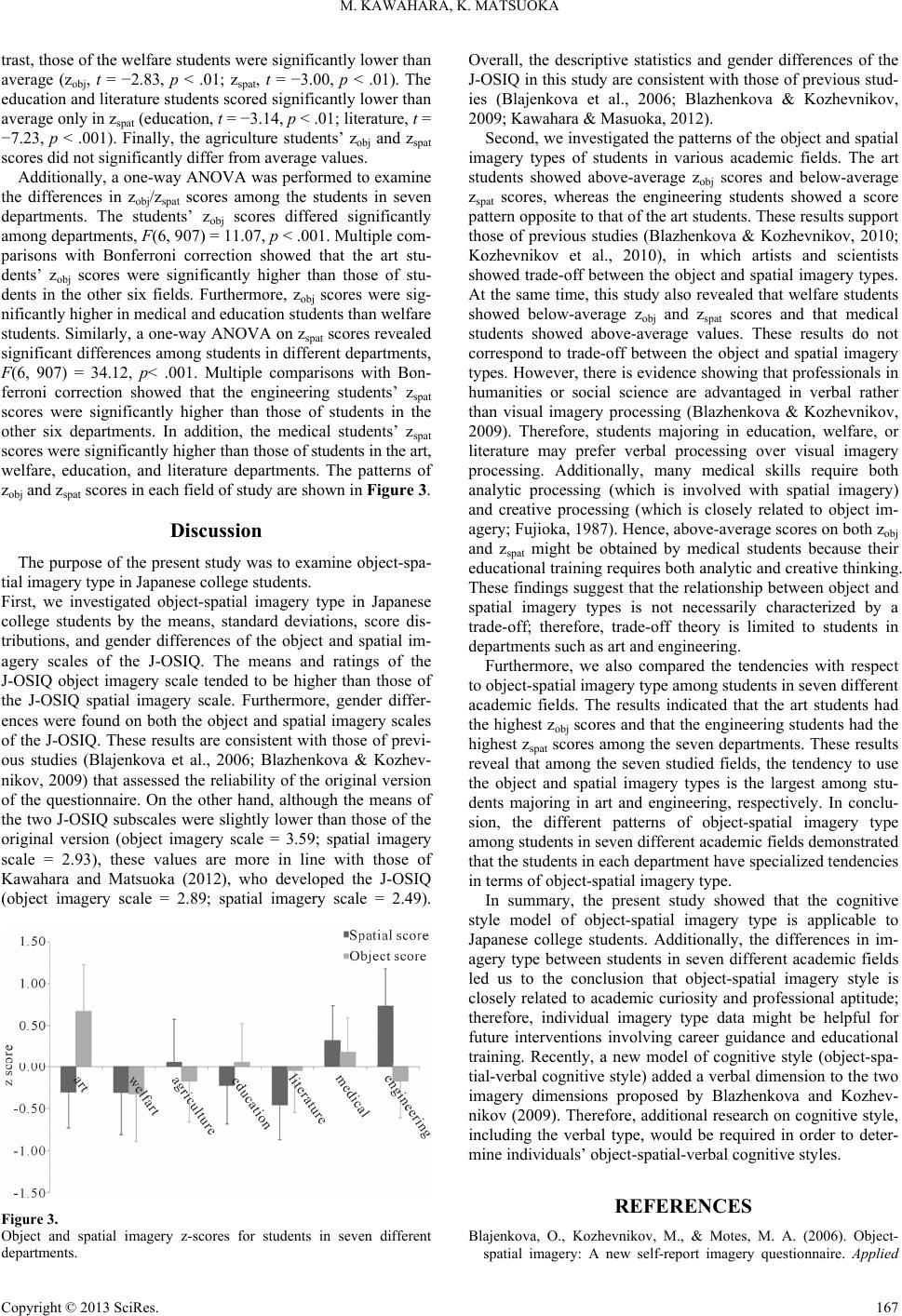 M. KAWAHARA, K. MATSUOKA trast, those of the welfare students were significantly lower than average (zobj, t = −2.83, p < .01; zspat, t = −3.00, p < .01). The education and literature students scored significantly lower than average only in zspat (education, t = −3.14, p < .01; literature, t = −7.23, p < .001). Finally, the agriculture students’ zobj and zspat scores did not significantly differ from average values. Additionally, a one-way ANOVA was performed to examine the differences in zobj/zspat scores among the students in seven departments. The students’ zobj scores differed significantly among departments, F(6, 907) = 11.07, p < .001. Multiple com- parisons with Bonferroni correction showed that the art stu- dents’ zobj scores were significantly higher than those of stu- dents in the other six fields. Furthermore, zobj scores were sig- nificantly higher in medical and education students than welfare students. Similarly, a one-way ANOVA on zspat scores revealed significant differences among students in different departments, F(6, 907) = 34.12, p< .001. Multiple comparisons with Bon- ferroni correction showed that the engineering students’ zspat scores were significantly higher than those of students in the other six departments. In addition, the medical students’ zspat scores were significantly higher than those of students in the art, welfare, education, and literature departments. The patterns of zobj and zspat scores in each field of study are shown in Figure 3. Discussion The purpose of the present study was to examine object-spa- tial imagery type in Japanese college students. First, we investigated object-spatial imagery type in Japanese college students by the means, standard deviations, score dis- tributions, and gender differences of the object and spatial im- agery scales of the J-OSIQ. The means and ratings of the J-OSIQ object imagery scale tended to be higher than those of the J-OSIQ spatial imagery scale. Furthermore, gender differ- ences were found on both the object and spatial imagery scales of the J-OSIQ. These results are consistent with those of previ- ous studies (Blajenkova et al., 2006; Blazhenkova & Kozhev- nikov, 2009) that assessed the reliability of the original version of the questionnaire. On the other hand, although the means of the two J-OSIQ subscales were slightly lower than those of the original version (object imagery scale = 3.59; spatial imagery scale = 2.93), these values are more in line with those of Kawahara and Matsuoka (2012), who developed the J-OSIQ (object imagery scale = 2.89; spatial imagery scale = 2.49). Figure 3. Object and spatial imagery z-scores for students in seven different departments. Overall, the descriptive statistics and gender differences of the J-OSIQ in this study are consistent with those of previous stud- ies (Blajenkova et al., 2006; Blazhenkova & Kozhevnikov, 2009; Kawahara & Masuoka, 2012). Second, we investigated the patterns of the object and spatial imagery types of students in various academic fields. The art students showed above-average zobj scores and below-average zspat scores, whereas the engineering students showed a score pattern opposite to that of the art students. These results support those of previous studies (Blazhenkova & Kozhevnikov, 2010; Kozhevnikov et al., 2010), in which artists and scientists showed trade-off between the object and spatial imagery types. At the same time, this study also revealed that welfare students showed below-average zobj and zspat scores and that medical students showed above-average values. These results do not correspond to trade-off between the object and spatial imagery types. However, there is evidence showing that professionals in humanities or social science are advantaged in verbal rather than visual imagery processing (Blazhenkova & Kozhevnikov, 2009). Therefore, students majoring in education, welfare, or literature may prefer verbal processing over visual imagery processing. Additionally, many medical skills require both analytic processing (which is involved with spatial imagery) and creative processing (which is closely related to object im- agery; Fujioka, 1987). Hence, above-average scores on both zobj and zspat might be obtained by medical students because their educational training requires both analytic and creative thinking. These findings suggest that the relationship between object and spatial imagery types is not necessarily characterized by a trade-off; therefore, trade-off theory is limited to students in departments such as art and engineering. Furthermore, we also compared the tendencies with respect to object-spatial imagery type among students in seven different academic fields. The results indicated that the art students had the highest zobj scores and that the engineering students had the highest zspat scores among the seven departments. These results reveal that among the seven studied fields, the tendency to use the object and spatial imagery types is the largest among stu- dents majoring in art and engineering, respectively. In conclu- sion, the different patterns of object-spatial imagery type among students in seven different academic fields demonstrated that the students in each department have specialized tendencies in terms of object-spatial imagery type. In summary, the present study showed that the cognitive style model of object-spatial imagery type is applicable to Japanese college students. Additionally, the differences in im- agery type between students in seven different academic fields led us to the conclusion that object-spatial imagery style is closely related to academic curiosity and professional aptitude; therefore, individual imagery type data might be helpful for future interventions involving career guidance and educational training. Recently, a new model of cognitive style (object-spa- tial-verbal cognitive style) added a verbal dimension to the two imagery dimensions proposed by Blazhenkova and Kozhev- nikov (2009). Therefore, additional research on cognitive style, including the verbal type, would be required in order to deter- mine individuals’ object-spatial-verbal cognitive styles. REFERENCES Blajenkova, O., Kozhevnikov, M., & Motes, M. A. (2006). Object- spatial imagery: A new self-report imagery questionnaire. Applied Copyright © 2013 SciRes. 167  M. KAWAHARA, K. MATSUOKA Copyright © 2013 SciRes. 168 Cognitive Psychology, 20, 239-263. doi:10.1002/acp.1182 Blazhenkova, O., & Kozhevnikov, M. (2009). The new object-spa- tial-verbal cognitive style model: Theory and measurement. Applied Cognitive Psychology, 23, 638-663. doi:10.1002/acp.1473 Blazhenkova, O., & Kozhevnikov, M. (2010). Visual-object ability: A new dimension of non-verbal intelligence. Cognition, 117, 276-301. doi:10.1016/j.cognition.2010.08.021 Farah, M. J., Hammond, K. M., Levine, D. N., & Calvanio, R. (1988). Visual and spatial mental imagery: Dissociable systems of represen- tations. Cognitive Psychology, 20, 439-462. doi:10.1016/0010-0285(88)90012-6 Fujioka, H. (1987). Vocational preference and cognitive modes of university students. The Journal of Educational Technology, 9, 53- 62. Hegarty, M., & Waller, D. A. (2005). Individual differences in spatial abilities. In P. Shah, & A. Miyake (Eds.), The Cambridge handbook of visuospatial thinking (pp. 121-169). Cambridge: Cambridge Uni- versity Press. Kassels, S. (1991). Transforming imagery into art: A study of the life and work of Georgia O’Keeffe. In R. G. Kunzendorf (Ed.), Mental imagery (pp. 45-52). New York: Plenum Press. Kawahara, M., & Matsuoka, K. (2012).Development of a Japanese version of the Object-Spatial Imagery Questionnaire. Interdiscipli- nary Information Sciences, 18 , 13-18. doi:10.4036/iis.2012.13 Kosslyn, S. M. (1994). Image and brain: The resolution of the imagery debate. Cambridge: MIT Press. Kozhevnikov, M., Blazhenkova, O., & Becker, M. (2010). Trade-off in object versus spatial visualization abilities: Restriction in the devel- opment of visual processing resources. Psychonomic Bulletin & Re- view, 17, 29-35. doi:10.3758/PBR.17.1.29 Kozhevnikov, M., Kosslyn, S., & Shephard, J. (2005). Spatial versus object visualizers: A new characterization of visual cognitive style. Memory and Cognition, 33, 710-726. doi:10.3758/BF03195337 Levine, D. N., Warach, J., & Farah, M. J. (1985). Two visual systems in mental imagery: Dissociation of “what” and “where” in imagery disorders due to bilateral posterior cerebral lesions. Neurology, 35, 1010-1018. doi:10.1212/WNL.35.7.1010 Motes, M. A., Malach, R., & Kozhevnikov, M. (2008). Object-process- ing neural efficiency differentiates object from spatial visualizers. NeuroReport, 19, 1727-1731. doi:10.1097/WNR.0b013e328317f3e2 Nisbett, R. E., Peng, K., Choi, I., & Norenzayan, A. (2001). Culture and systems of thought: Holistic versus analytic cognition. Psychological Review, 108, 291-310. doi:10.1037//0033-295X.108.2.291 Rosenberg, H. S. (1987). Visual artists and imagery. Imagination, Cog- nition, and Personalit y, 7, 77-93. doi:10.2190/AVJ5-N24B-P7MC-HR4R Smith, I. M. (1964). Spatial ability: Its educational and social signifi- cance. London: University of London Press. Sternberg, T. J. (1997). Thinking styles. Cambridge: Cambridge Uni- versity Press. Ungerleider, L. G., & Mishkin, M. (1982). Two cortical visual systems. In D. J. Ingle, M. A. Goodale, & R. J. W. Mansfield (Eds.), Analysis of visual behavior (pp. 549-586). Cambridge: MIT Press. |