

Paper Menu >>
Journal Menu >>
 Engineering, 2013, 5, 309-315 http://dx.doi.org/10.4236/eng.2013.53042 Published Online March 2013 (http://www.scirp.org/journal/eng) Experimental Research on Spontaneous Combustion Tendency of High Volatile Blended Coals Jinfeng Ma1, Fei Shao2, Junrui Shi1, Zhijia Xue1, Shuqun Wang1, Hongtao Li1, Huangxin Zhang1 1Department of Energy and Power, Shenyang Institute of Engineering, Shenyang, China 2MI Ninth Design & Research Institute Co., Ltd., Changchun, China Email: [email protected] Received August 18, 2012; revised January 25, 2013; accepted February 3, 2013 ABSTRACT Experiment of oxidation characteristics with slow velocity of high volatile blended coals was investigated in the sur- roundings of low oxygen conditions, which gives three kinetic factors in the step of low temperature through the meth- ods of thermo gravimetric analysis, the Coats-Redfern integration and Achar-Brindley-Sharp-Wendworth. The results of calculation show that activation energy and pre-exponential factor increase with the reaction process, and tendency of spontaneous combustion of the blended coal have changed. The experimental results show that the type of absorbing oxygen is mainly physical adsorption and calorific value is very small during increasing weight. Volatile of blended coal releases before single coal and combustion temperature of blended coal is between one and other single coals. If the oxygen content is below 16% in the milling system, explosion-proof effect on high volatile blended coal can be ob- tained. Keywords: Thermogravimetric Analysis; High Volatile; Blended Coal; Kinetic Theory; Oxidation Characteristics 1. Introduction Adding inert medium in power station boiler system can reduce the oxygen concentration and realize the inhibi- tion of combustion reaction. It can also eliminate the pulverized coal spontaneous combustion and ignition source. In a word, it is a very effective method of pre- venting explosion. Referring to high volatile pulverized coal explosion-proof standards of other countries, China regulates that explosion protection index of oxygen vol- ume share is less than 14%. Considering the drying re- quirements of lignite, bituminous coal boiler burning with lignite is difficult to meet explosion index above, so research on oxidation characteristics of high volatile blended coal in the surroundings of low oxygen atmos- phere is carried on in this paper. Long-term accumulation of coal powder in powder system after slow oxidation may be spontaneous ignition. Many domestic scholars have studied coal oxidation and pyrolysis characteristics. Aiming at the particle size with 150 μm and oxygen concentration with 21%, research of coal oxidation spontaneous combustion begins, which is carried on in reference [1-3]. Coal powder of 20 - 60 μm in the powder plant boiler is in the majority, reference [4-8] studies about only the pulverized coal under the inert condition of pyrolysis, the combustion characteris- tics and burnout characteristics under the condition of high temperature and oxidation on the particle size range of coal powder, while slow oxidation spontaneous com- bustion characteristics of blended coal under the condi- tion of low temperature and low oxygen are not in-depth study. Aiming at high volatile Huolinhe lignite and three kinds of typical northeast bituminous coal preparation of mixed coal, according to high volatile coal explosion- proof technology index at home and abroad [9,10], the application of thermal analysis technology develops slow oxidation experiment in the surroundings of low oxygen atmosphere with 12%, 14% and 16% oxygen and dy- namic analysis, and it is concluded that oxidation char- acteristics parameters of coal and dynamic parameters of characterization of pulverized coal self-ignition orienta- tion, that is for slow oxidation experiment research in oxygen atmosphere, providing theoretical basis for ex- plosion-proof design and operation of bituminous coal boiler burning with lignite. 2. Experimental Part The experiment is conducting in the SMP/PF7548/MET/ 600W thermal analysis instrument from Swiss MET- TLER TOLEDO—United States (China) Company. Be- fore pulverized coal in the coal preparation System go into the boiler, the oxidation and pyrogenation process of C opyright © 2013 SciRes. ENG  J. F. MA ET AL. 310 the accumulated powder belongs to slow oxidation py- rogenation process. In order to achieve coal oxidation exothermic information, experiment carried on variable heating rate with heating slowly in low temperature, and heating fast in high temperature [3]. 25˚C - 200˚C at heating rate of 2˚C·mi n –1 and 200˚C - 650˚C at heating rate of 10˚C·min–1 were selected, the oxygen concentra- tion was 12%, 14% and 16% in the experiment. Coal samples are from Huolinhe lignite (HLH), Fuxin bitumi- nous coal (FX), Fushun bituminous coal (FSH) and Tiefa bituminous coal (TF).The average particle size is 53 μm. The results of coal quality analysis are in Table 1. The number and composition of blended coal are in Table 2. 3. The Experiment Results and Analysis The trends of Thermogravimetric analysis (TG), Differ- ential thermogravimetric analysis (DTG) and Differential scanning calorimetry (DSC) curves are same. The chart 1 is an example of blended coal which gives experimental results of heat analysis in 16% oxygen concentration from Figure 1. Figure 2 shows variation diagram of coal oxidation characteristic parameters with the change of oxygen concentration. According to the references [11,12], coal oxidation proc- ess are divided into 5 stages, that are water evaporation and desorption weightlessness stage (initial temperature ~T1); oxygen absorption and weight gain (T1 - Ts); ther- mal decomposition (Ts - T i); combustion (Ti - T2) and burnout (T > T2); in which Tl is the completion of water evaporation and desorption temperature; Ts is volatiliza- tion separating temperature; Ti is ignition temperature; T2 is the corresponding temperature of complete combustion. The experiment studies low temperature oxidation of coal, so the 3 stages are not considered after the step. From the Figure 1, in the step of water evaporation and desorption, the environment temperature is quite low and coal oxygen molecules between the collision and contact in the slow condition and activated molecules in coal are very few. Reaction rate between coal and oxy- gen is very slow. Damage of the original key coal and new material production become quite difficult. Moisture and inherent moisture of coal have been evaporated, also gas absorption in coal is desorption. Coal sample is ab- sorbed in oxygen when water evaporats, owing to water evaporation loss weight is greater than the oxygen gain weight, TG curves showed a downward trend. DSC curve is negative, and the stage of coal sample is in the absorbing state. In the step of oxygen absorption and weight increasing, temperature of pulverized coal increases and the chance of binding collisions between oxygen and coal increases and activated molecule increases and chemical reaction speeds up. Because of water evaporation and desorption, the pulverized coal porosity and free surface increase, and pulverized coal is absorbed in oxygen fast, TG curve is a tendency of rising. If chemical oxygen and chemical reaction of oxygen consumption are mainly in the stage, heat will increase, DSC curves rises with oxidation tem- perature rising. But in Figure 1, DSC curve drops first with the increase of temperature, DSC curve showed a Table 1. The analysis results of coal samples. Element analysis (%) Industrial analysis (%) Coal samples Car H ar O ar N ar S ar M ad A ad V ad F ad HLH 37.73 2.64 10.37 0.64 0.31 7.28 21.93 34.32 36.47 FSH 38.11 2.39 9.51 0.73 0.3 1.69 31.50 34.50 32.31 FX 42.71 2.72 8.77 0.5 0.9 5.99 24.49 30.00 39.52 TF 42.24 2.61 10.0 0.61 0.39 3.95 33.80 27.52 34.73 Table 2. Composition and tag of blended coals. Blended coal number HLH FSH TF FX 1# 70% 30% 0 0 2# 50% 50% 0 0 3# 70% 0 0 30% 4# 50% 0 0 50% 5# 70% 0 30% 0 6# 50% 0 50% 0 Copyright © 2013 SciRes. ENG 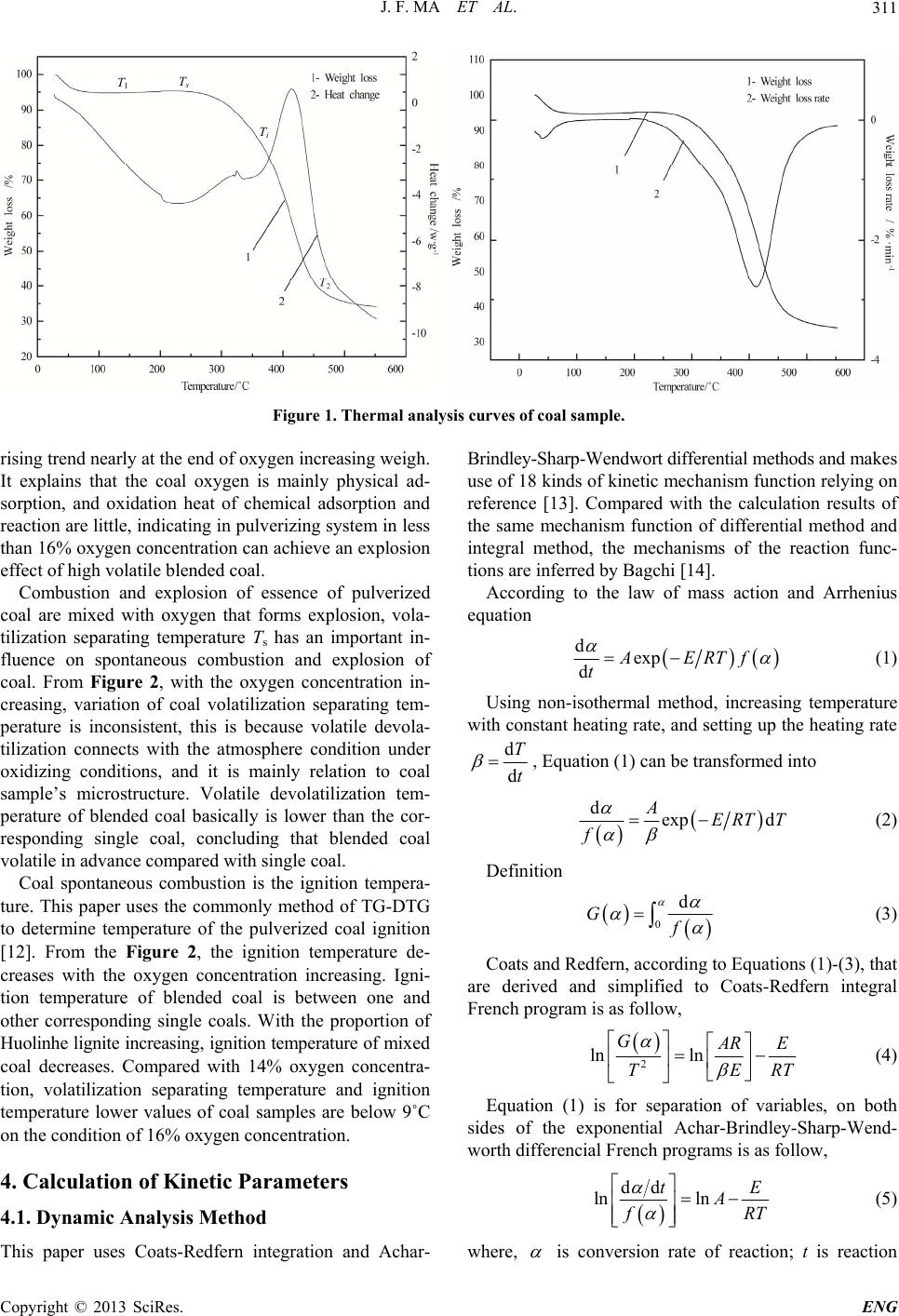 J. F. MA ET AL. 311 T i T s T 1 Figure 1. Thermal analysis curves of coal sample. rising trend nearly at the end of oxygen increasing weigh. It explains that the coal oxygen is mainly physical ad- sorption, and oxidation heat of chemical adsorption and reaction are little, indicating in pulverizing system in less than 16% oxygen concentration can achieve an explosion effect of high volatile blended coal. Combustion and explosion of essence of pulverized coal are mixed with oxygen that forms explosion, vola- tilization separating temperature Ts has an important in- fluence on spontaneous combustion and explosion of coal. From Figure 2, with the oxygen concentration in- creasing, variation of coal volatilization separating tem- perature is inconsistent, this is because volatile devola- tilization connects with the atmosphere condition under oxidizing conditions, and it is mainly relation to coal sample’s microstructure. Volatile devolatilization tem- perature of blended coal basically is lower than the cor- responding single coal, concluding that blended coal volatile in advance compared with single coal. Coal spontaneous combustion is the ignition tempera- ture. This paper uses the commonly method of TG-DTG to determine temperature of the pulverized coal ignition [12]. From the Figure 2, the ignition temperature de- creases with the oxygen concentration increasing. Igni- tion temperature of blended coal is between one and other corresponding single coals. With the proportion of Huolinhe lignite increasing, ignition temperature of mixed coal decreases. Compared with 14% oxygen concentra- tion, volatilization separating temperature and ignition temperature lower values of coal samples are below 9˚C on the condition of 16% oxygen concentration. 4. Calculation of Kinetic Parameters 4.1. Dynamic Analysis Method This paper uses Coats-Redfern integration and Achar- Brindley-Sharp-Wendwort differential methods and makes use of 18 kinds of kinetic mechanism function relying on reference [13]. Compared with the calculation results of the same mechanism function of differential method and integral method, the mechanisms of the reaction func- tions are inferred by Bagchi [14]. According to the law of mass action and Arrhenius equation dexp dAERTf t (1) Using non-isothermal method, increasing temperature with constant heating rate, and setting up the heating rate d d T t , Equation (1) can be transformed into dexp d AERT T f (2) Definition 0 d Gf (3) Coats and Redfern, according to Equations (1)-(3), that are derived and simplified to Coats-Redfern integral French program is as follow, 2 ln ln G A RE ERT T (4) Equation (1) is for separation of variables, on both sides of the exponential Achar-Brindley-Sharp-Wend- worth differencial French programs is as follow, dd ln ln t AE f RT (5) where, is conversion rate of reaction; t is reaction Copyright © 2013 SciRes. ENG 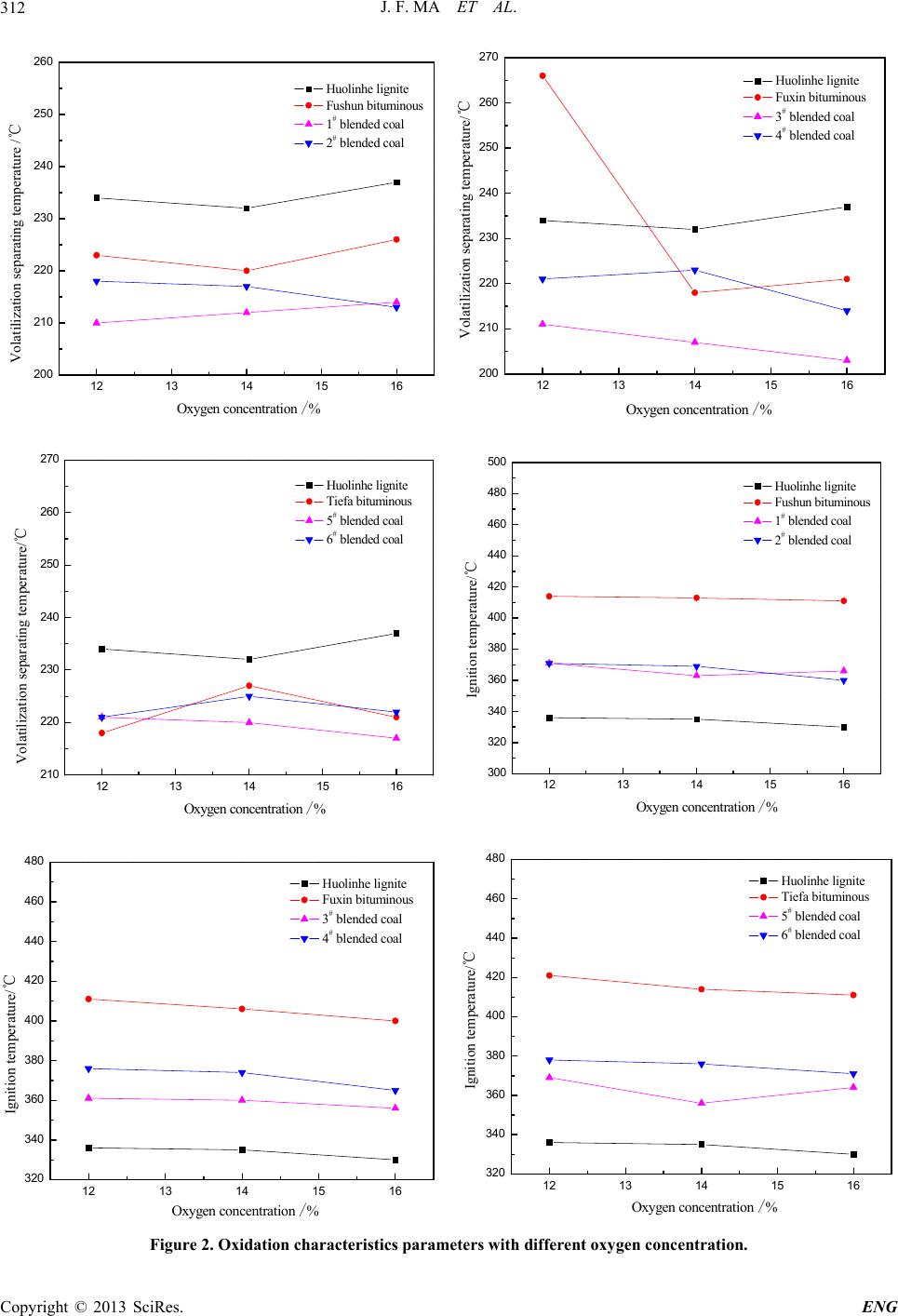 J. F. MA ET AL. 312 12 13 14 15 16 200 210 220 230 240 250 260 Volatilization separating temperature /℃ Oxygen concentration /% Huolinhe lignite Fushun bituminous 1# blended coal 2# blended coal 12 13 14 15 16 200 210 220 230 240 250 260 2 7 0 Huolinhe lignite Fuxin bituminous 3# blended coal 4# blended coal Oxygen concentration /% Volatilization separating temperature/℃ 12 13 14 15 16 210 220 230 240 250 260 270 Oxygen concentration /% Huolinhe lignite Tiefa bituminous 5# blended coal 6# blended coal Volatilization separating temperature/℃ 12 13 14 15 16 300 320 340 360 380 400 420 440 460 480 500 Huolinhe lignite Fushun bituminous 1# blended coal 2# blended coal Oxygen concentration /% Ignition temperature/℃ 12 13 14 15 16 320 340 360 380 400 420 440 460 480 Oxygen concentration /% Huolinhe lignite Fuxin bituminous 3# blended coal 4# blended coal Ignition temperature/℃ 12 13 1415 16 320 340 360 380 400 420 440 460 480 Huolinhe lignite Tiefa bituminous 5# blended coal 6# blended coal Oxygen concentration /% Ignition temperature/℃ Figure 2. Oxidation characteristics parameters with dif f erent oxygen concentration. Copyright © 2013 SciRes. ENG 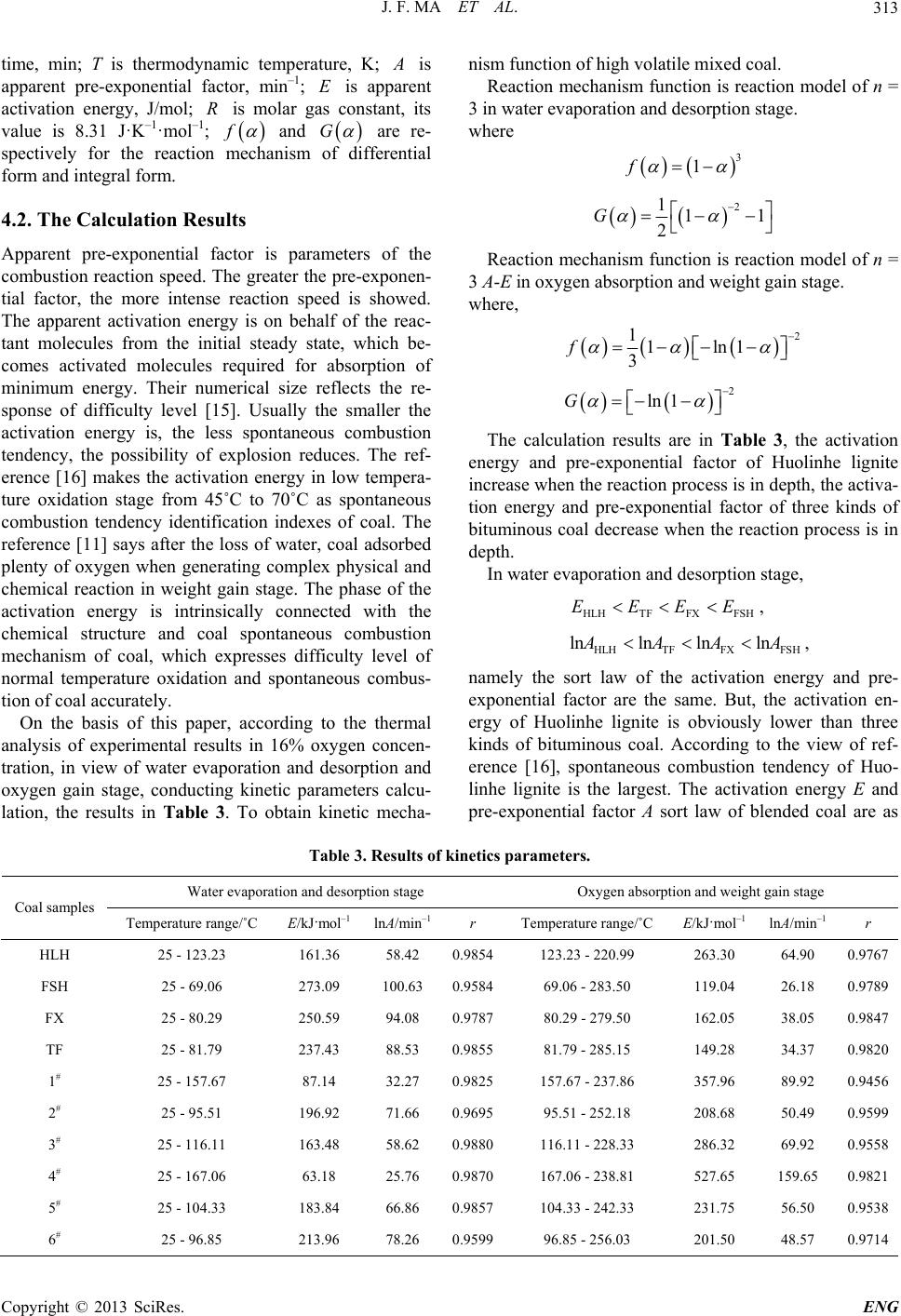 J. F. MA ET AL. 313 time, min; T is thermodynamic temperature, K; A is apparent pre-exponential factor, min–1; is apparent activation energy, J/mol; is molar gas constant, its value is 8.31 J·K–1·mol–1; E R f and G are re- spectively for the reaction mechanism of differential form and integral form. 4.2. The Calculation Results Apparent pre-exponential factor is parameters of the combustion reaction speed. The greater the pre-exponen- tial factor, the more intense reaction speed is showed. The apparent activation energy is on behalf of the reac- tant molecules from the initial steady state, which be- comes activated molecules required for absorption of minimum energy. Their numerical size reflects the re- sponse of difficulty level [15]. Usually the smaller the activation energy is, the less spontaneous combustion tendency, the possibility of explosion reduces. The ref- erence [16] makes the activation energy in low tempera- ture oxidation stage from 45˚C to 70˚C as spontaneous combustion tendency identification indexes of coal. The reference [11] says after the loss of water, coal adsorbed plenty of oxygen when generating complex physical and chemical reaction in weight gain stage. The phase of the activation energy is intrinsically connected with the chemical structure and coal spontaneous combustion mechanism of coal, which expresses difficulty level of normal temperature oxidation and spontaneous combus- tion of coal accurately. On the basis of this paper, according to the thermal analysis of experimental results in 16% oxygen concen- tration, in view of water evaporation and desorption and oxygen gain stage, conducting kinetic parameters calcu- lation, the results in Table 3. To obtain kinetic mecha- nism function of high volatile mixed coal. Reaction mechanism function is reaction model of n = 3 in water evaporation and desorption stage. where 3 1f 2 111 2 G Reaction mechanism function is reaction model of n = 3 A-E in oxygen absorption and weight gain stage. where, 2 11ln1 3 f 2 ln 1G The calculation results are in Table 3, the activation energy and pre-exponential factor of Huolinhe lignite increase when the reaction process is in depth, the activa- tion energy and pre-exponential factor of three kinds of bituminous coal decrease when the reaction process is in depth. In water evaporation and desorption stage, HLH TF FX FSH EEEE , HLH TF FXFSH lnln lnln A AAA , namely the sort law of the activation energy and pre- exponential factor are the same. But, the activation en- ergy of Huolinhe lignite is obviously lower than three kinds of bituminous coal. According to the view of ref- erence [16], spontaneous combustion tendency of Huo- linhe lignite is the largest. The activation energy E and pre-exponential factor A sort law of blended coal are as Table 3. Results of kinetics parameters. Water evaporation and desorption stage Oxygen absorption and weight gain stage Coal samples Temperature range/˚C E/kJ·mol–1 lnA/min–1 r Temperature range/˚C E/kJ·mol–1 lnA/min–1r HLH 25 - 123.23 161.36 58.42 0.9854123.23 - 220.99 263.30 64.90 0.9767 FSH 25 - 69.06 273.09 100.63 0.958469.06 - 283.50 119.04 26.18 0.9789 FX 25 - 80.29 250.59 94.08 0.978780.29 - 279.50 162.05 38.05 0.9847 TF 25 - 81.79 237.43 88.53 0.985581.79 - 285.15 149.28 34.37 0.9820 1# 25 - 157.67 87.14 32.27 0.9825157.67 - 237.86 357.96 89.92 0.9456 2# 25 - 95.51 196.92 71.66 0.969595.51 - 252.18 208.68 50.49 0.9599 3# 25 - 116.11 163.48 58.62 0.9880116.11 - 228.33 286.32 69.92 0.9558 4# 25 - 167.06 63.18 25.76 0.9870167.06 - 238.81 527.65 159.65 0.9821 5# 25 - 104.33 183.84 66.86 0.9857104.33 - 242.33 231.75 56.50 0.9538 6# 25 - 96.85 213.96 78.26 0.959996.85 - 256.03 201.50 48.57 0.9714 Copyright © 2013 SciRes. ENG 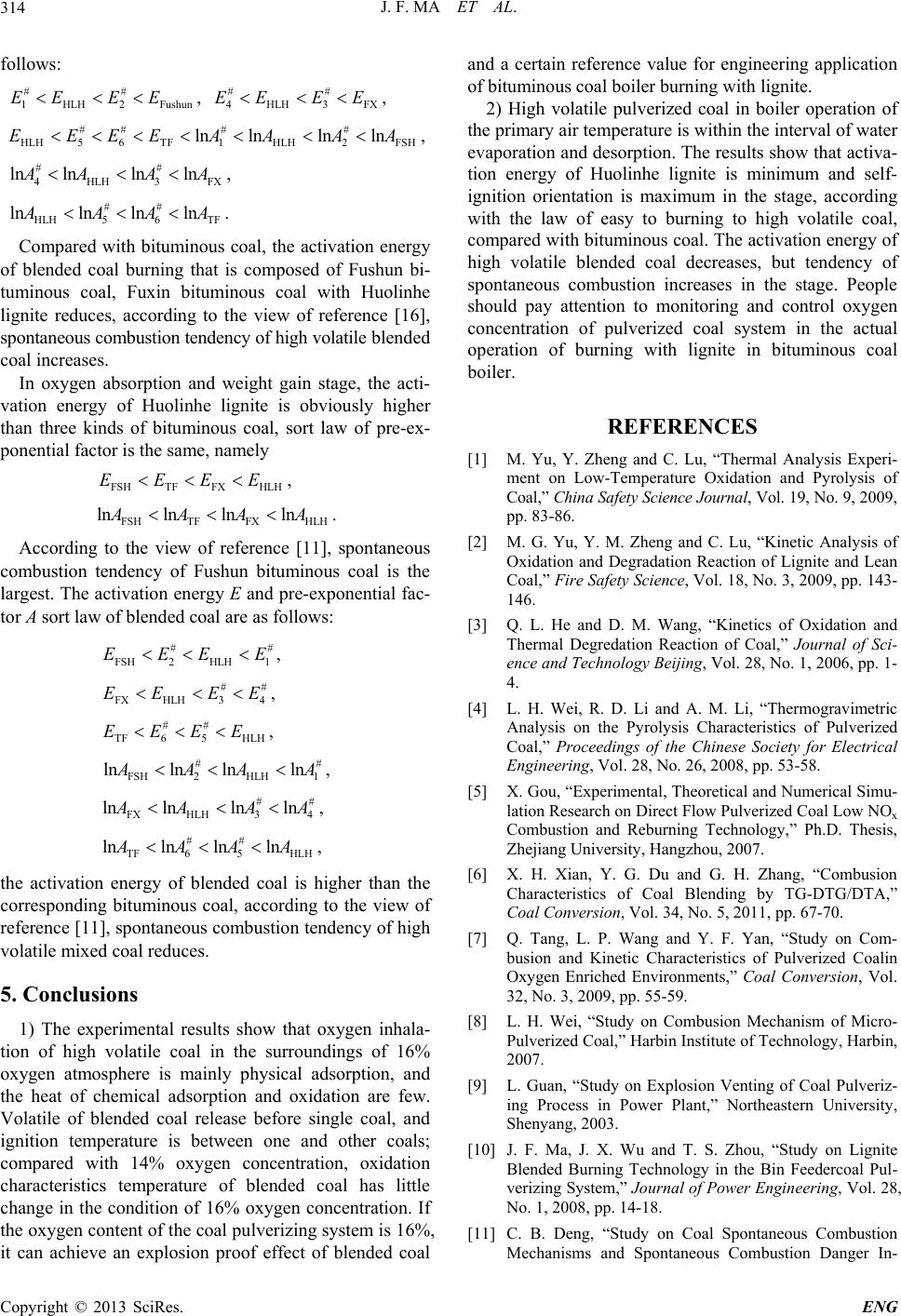 J. F. MA ET AL. 314 follows: ## 1HLH 2Fushun EE EE , , ## 4HLH3F EE EE X FX ## ## HLH 56TF1HLH2FSH ln lnlnlnE EEEAAAA , ## 4HLH3 ln lnlnln A AAA, ## HLH 56TF lnln ln ln A AAA . Compared with bituminous coal, the activation energy of blended coal burning that is composed of Fushun bi- tuminous coal, Fuxin bituminous coal with Huolinhe lignite reduces, according to the view of reference [16], spontaneous combustion tendency of high volatile blended coal increases. In oxygen absorption and weight gain stage, the acti- vation energy of Huolinhe lignite is obviously higher than three kinds of bituminous coal, sort law of pre-ex- ponential factor is the same, namely FSHTF FXHLH EEEE, FSHTF FX HLH lnln lnln A AAA . According to the view of reference [11], spontaneous combustion tendency of Fushun bituminous coal is the largest. The activation energy E and pre-exponential fac- tor A sort law of blended coal are as follows: ## FSH2HLH 1 EEEE, ## FX HLH 34 EE EE , ## TF 65HLH EEEE , ## FSH2HLH 1 lnln lnln A AA A, ## FX HLH 34 lnlnln ln A AAA it can achieve an explosion proof effect of blended coal eration of th REFERENCES [1] M. Yu, Y. Zhlysis Experi- Y. M. Zheng and C. Lu, “Kinetic Analysis of He and D. M. Wang, “Kinetics of Oxidation and H. Wei, R. D. Li and A. M. Li, “Thermogravimetric al Simu- ang, “Combusion Com- busion Mechanism of Micro- n, “Study on Explosion Venting of Coal Pulveriz- u and T. S. Zhou, “Study on Lignite Coal Spontaneous Combustion Mechanisms and Spontaneous Combustion Danger In- , ## TF 65HLH lnln ln lnAAAA , the activation energy of blended coal is higher than the corresponding bituminous coal, according to the view of reference [11], spontaneous combustion tendency of high volatile mixed coal reduces. 5. Conclusions 1) The experimental results show that oxygen inhala- tion of high volatile coal in the surroundings of 16% oxygen atmosphere is mainly physical adsorption, and the heat of chemical adsorption and oxidation are few. Volatile of blended coal release before single coal, and ignition temperature is between one and other coals; compared with 14% oxygen concentration, oxidation characteristics temperature of blended coal has little change in the condition of 16% oxygen concentration. If the oxygen content of the coal pulverizing system is 16%, and a certain reference value for engineering application of bituminous coal boiler burning with lignite. 2) High volatile pulverized coal in boiler op e primary air temperature is within the interval of water evaporation and desorption. The results show that activa- tion energy of Huolinhe lignite is minimum and self- ignition orientation is maximum in the stage, according with the law of easy to burning to high volatile coal, compared with bituminous coal. The activation energy of high volatile blended coal decreases, but tendency of spontaneous combustion increases in the stage. People should pay attention to monitoring and control oxygen concentration of pulverized coal system in the actual operation of burning with lignite in bituminous coal boiler. eng and C. Lu, “Thermal Ana ment on Low-Temperature Oxidation and Pyrolysis of Coal,” China Safety Science Journal, Vol. 19, No. 9, 2009, pp. 83-86. [2] M. G. Yu, Oxidation and Degradation Reaction of Lignite and Lean Coal,” Fire Safety Science, Vol. 18, No. 3, 2009, pp. 143- 146. [3] Q. L. Thermal Degredation Reaction of Coal,” Journal of Sci- ence and Technology Beijing, Vol. 28, No. 1, 2006, pp. 1- 4. [4] L. Analysis on the Pyrolysis Characteristics of Pulverized Coal,” Proceedings of the Chinese Society for Electrical Engineering, Vol. 28, No. 26, 2008, pp. 53-58. [5] X. Gou, “Experimental, Theoretical and Numeric lation Research on Direct Flow Pulverized Coal Low NOx Combustion and Reburning Technology,” Ph.D. Thesis, Zhejiang University, Hangzhou, 2007. [6] X. H. Xian, Y. G. Du and G. H. Zh Characteristics of Coal Blending by TG-DTG/DTA,” Coal Conversion, Vol. 34, No. 5, 2011, pp. 67-70. [7] Q. Tang, L. P. Wang and Y. F. Yan, “Study on busion and Kinetic Characteristics of Pulverized Coalin Oxygen Enriched Environments,” Coal Conversion, Vol. 32, No. 3, 2009, pp. 55-59. [8] L. H. Wei, “Study on Com Pulverized Coal,” Harbin Institute of Technology, Harbin, 2007. [9] L. Gua ing Process in Power Plant,” Northeastern University, Shenyang, 2003. [10] J. F. Ma, J. X. W Blended Burning Technology in the Bin Feedercoal Pul- verizing System,” Journal of Power Engineering, Vol. 28, No. 1, 2008, pp. 14-18. [11] C. B. Deng, “Study on Copyright © 2013 SciRes. ENG  J. F. MA ET AL. 315 dex,” Liaoning Technical University, Fuxin, 2006. [12] X. Y. Ge, “Experimental Research on Oxidation Kinetics of Coal Based on Thermal Analysis Technology,” Anhui University of Science and Technology, Huainan, 2009. [13] R. Z. Hu and Q. Z. Shi, “Kinetics of Thermal Analysis,” Science Press, Beijing, 2001. [14] T. P. Bagchi, P. K. Agarwal and R. D. Gunn, “Calcula- tion of Thermal Explosion Limits,” Thermochimca Acta 57-X , No. 51, 1981, pp. 175-176. doi:10.1016/0040-6031(81)851 ua University Press, Wang and X. X. Zhong, “Tendency of [15] Y. Z. Li, “Thermal Analysis,” Tsingh Beijing, 1987. [16] W. Lu, D. M. Spontaneous Combustion of Coal Based on Activation Energy,” Journal of China University of Minin g and Tec h- nology, Vol. 35, No. 2, 2006, pp. 201-205. Copyright © 2013 SciRes. ENG |