

Paper Menu >>
Journal Menu >>
 Food and Nutrition Sciences, 2013, 4, 282-288 http://dx.doi.org/10.4236/fns.2013.43038 Published Online March 2013 (http://www.scirp.org/journal/fns) Effect of Soaking Temperature on Physical and Functional Properties of Parboiled Rice Cultivars Grown in Temperate Region of India Shabir Ahmad Mir, Sowriappan John Don Bosco* Department of Food Science and Technology, Pondicherry University, Puducherry, India. Email: *[email protected] Received January 2nd, 2013; revised February 2nd, 2013; accepted March 10th, 2013 ABSTRACT The physical and functional properties of seven parboiled rice cultivars (Jehlum, K-332, Koshar, Pusa-3, SKAU-345, SKAU-382 and SR-1) were investigated at different soaking temperatures of 60˚C, 70˚C and 80˚C and it was compared with the brown raw rice of the respective cultivars. Parboiling was observed to decrease L* value and increase a* and b* values. The hardness of rice was significantly increased after parboiling and varied among the cultivars with the highest in Jehlum. Parboiling resulted in the decrease of pasting parameters with the increase in soaking temperature from 60˚C to 80˚C. The pasting characteristics of parboiled rice sample showed the typical behaviour having high initial viscosity, but lower peak viscosity in comparison to raw rice. The water absorption index and water solubility indices were subsequently increased with the increase in soaking temperature. Keywords: Rice; Parboiling; Hardness; Color; Pasting Properties 1. Introduction Rice parboiling is a hydrothermal process consisting of soaking, heating and drying operations modifying the qualitative and processing behaviour of rice [1,2]. Soak- ing is a hydration process in which the diffusion con- trolled water uptake migrates into the rice kernel [3] and subsequent heating leads to irreversible swelling and fu- sion of starch granules. The starch granules are gelati- nized and retrograded as a result various changes occur in rice, which play an important role in the subsequent processing operations, such as storage, milling, cooking and in eating qualities [4]. With the spectrum of changes involved in parboiling, the quality of parboiled rice is an important aspect to examine so as to ensure that the end-quality of the prod- uct fulfils the specific preferences by specific users. Par- boiled rice is harder in texture and takes longer time to cook than raw rice [5]. The proper interpretation of re- sults of the rice processability indicators could provide a new classification of rice cultivars fulfilling food indus- try needs. From the industrial standpoint, it is a realistic approach to simplify rice cultivars categorization in order to control the rice quality. Rice is an important starchy cereal crop having wider applications for novel foods such as snack products, bev- erages, puddings, processed meats, salad dressings and gluten free breads [6] in addition to the cooked rice. The hydrothermal treated flour may find utility in products like soups and sauces due to low tendency to retrograde [7]. These novel foods usually require rice flours of hav- ing known functional properties, which are known to influence the characteristics of food systems [8]. The pasting profile is the most important characteristic and has been used to predict the end-use quality of various food products. On parboiling, considerable changes oc- cur in the pasting parameters due to the order-disorder transitions taking place at the molecular level [1,9]. India has different geographical areas with diverse cli- matic conditions. Kashmir Valley lying in northern part of India comprises the extreme western of Himalayas (32.44˚N and 74.54˚E) and belongs to the temperate zone. The cultivation of rice extends from the area having alti- tude 1600 m above the mean sea level and grown only once in year, because of the extreme climatic conditions. Evaluation properties of parboiled rice lead to better un- derstanding of the behaviour changes during the proc- essing. Therefore, the objective of this investigation was to evaluate and compare the effect of parboiling on physical and functional properties of seven different rice cultivars grown in Kashmir Valley. *Corresponding author. Copyright © 2013 SciRes. FNS  Effect of Soaking Temperature on Physical and Functional Properties of Parboiled Rice Cultivars Grown in Temperate Region of India 283 2. Materials and Methods 2.1. Sample Procurement Seven rice cultivars including Jehlum, K-332, Koshar, Pusa-3, SKAU-345, SKAU-382 and SR-1, which are prevalent in the temperate region of Kashmir Valley, were obtained from Sher-e-Kashmir University of Agri- culture Science and Technology, Shalimar, Jammu and Kashmir, India. The grains were dried, cleaned manually and foreign matters such as stones, straw and dirt were removed. The dried and cleaned paddy samples were dehusked in a THU-34A Stake Testing Rice Husker (Stake, Japan) to obtain brown rice. 2.2. Preparation of Parboiled Brown Rice Parboiling was done by soaking the paddy in hot water at temperatures 60˚C, 70˚C and 80˚C ± 2˚C in thermostatic water bath for 6 hours and dried in hot air oven at 40˚C. The dried and cleaned paddy samples were dehusked in a THU-34A Stake Testing Rice Husker (Stake, Japan) to obtain parboiled brown rice. A portion of each sample was ground into flour in a laboratory grain mill. The whole kernels and flour samples were stored in polypro- pylene pouches for further analysis. 2.3. Hydration The water absorption characteristics of paddy was deter- mined by taking 10 g of paddy sample of each cultivar and placed in 250 ml of distilled water at three different soaking temperatures of 60˚C, 70˚C and 80˚C. The sam- ples were removed at predetermined time interval of 10 min up to 3 hrs. The soaked samples were blotted with paper towels to remove residual surface moisture and then reweighed. The increase in sample mass during soaking in water was considered to be an increase in moisture content of sample. 2.4. Color The color of raw and parboiled brown rice were deter- mined by CIE color scales L*, a* and b* using Hunter Lab digital colorimeter (Model D25M, Hunter Associates Laboratory, Reston, VA). Where L* indicates the degree of lightness or darkness of the sample extended from 0 (black) to 100 (white), a* and b* indicates degree of redness (+a) to greenness (−a) and whereas b* indicates the degree of yellowness (+b) to blueness (−b) respec- tively. 2.5. Hardness Hardness of the rice grain was measured by using Tex- ture Analyzer (TA-HD, Stable Micro Systems Ltd, Sur- rey, UK). A single compression force-versus time pro- gram was used to compress single rice grain along the thickness at a test speed of 0.10 mm/sec and return to its original position. The original clearance between the probe and the base in load cell of the instrument was fixed at 8 mm, so that when the probe moved down it would com- press the test sample kept horizontally on the base to a distance of 0.500 mm. program was set to move the probe at 1.0 mm/min in both pre-test and post-test phases. A 5 mm diameter stainless steel probe (P/5) was used to compress a single grain. The test was repeated 5 times from the same sample lot, for all the seven cultivars. The peak force indicated by the force time curve was taken as the maximum compressive force/hardness. 2.6. Pasting Properties The pasting characteristic of rice flour samples was de- termined using Rapid Visco Analyzer (Starch master 2, Newport Scientific Pty. Ltd, Warriewood, Australia). 3 g of rice flour sample (13 g/100g moisture basis) was weighed in RVA canister and 25 ml of water was added. The prepared slurry in the canister was heated to 50˚C and stirred at 160 rpm for 10 s to enable the complete dispersion. The slurry was held to 50˚C for 1 min and temperature was raised to 95˚C over 7.5 min. and then held at 95 ˚C for 5 min. The slurry was then cooled at 50˚C in 7.5 min, and then held at 50˚C for 2 min. Pasting parameters including peak viscosity (PV), viscosity at the end of hold time at 95˚C or hot paste viscosity (HPV), final viscosity (FV) at the end of cooling, breakdown (BD = PV – HPV), setback (SB = FV – HPV) and past- ing temperature were recorded. 2.7. Water Absorption Index (WAI) and Water Solubility (WS) For the measurement of WAI, 2.5 g of flour sample was suspended in 30 ml distilled water in previously weighed 50 ml centrifuge tube, stirred intermittently over a 30 min period at 30˚C and then centrifuged at 3000 g for 10 min. After pouring the supernatant into a tarred evapo- rating dish the gel was weighed. The WS was determined from the amount of dry sample weight recovered by evaporating the supernatant from flour water absorption experiment. Wet sediment weight Water absorption indexDry sediment weight Dry supernatent weight Water solubility100 Dry sample weight 2.8. Statistical Analysis The date reported in all the tables is the average value of Copyright © 2013 SciRes. FNS 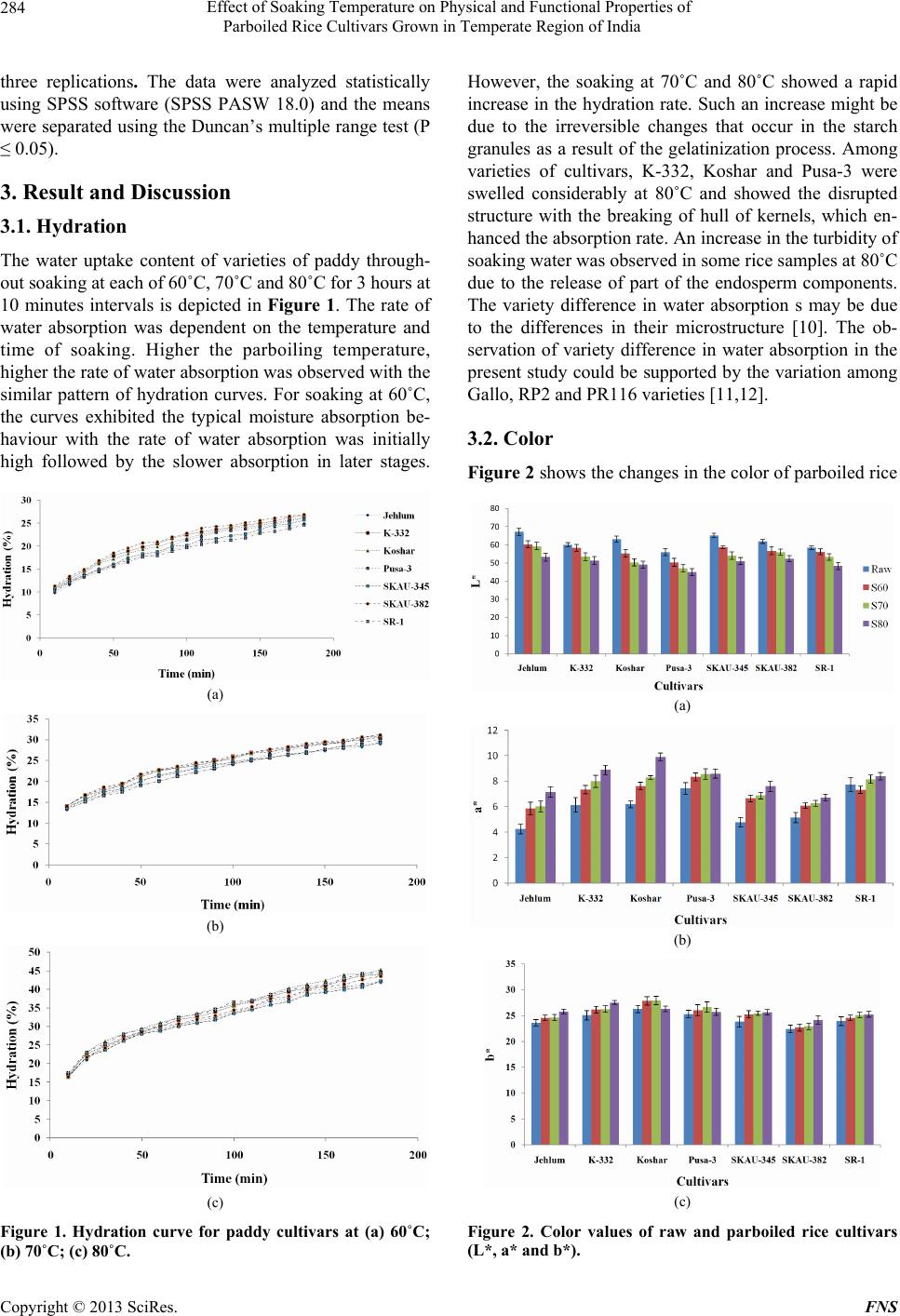 Effect of Soaking Temperature on Physical and Functional Properties of Parboiled Rice Cultivars Grown in Temperate Region of India 284 three replications. The data were analyzed statistically using SPSS software (SPSS PASW 18.0) and the means were separated using the Duncan’s multiple range test (P ≤ 0.05). 3. Result and Discussion 3.1. Hydration The water uptake content of varieties of paddy through- out soaking at each of 60˚C, 70˚C and 80˚C for 3 hours at 10 minutes intervals is depicted in Figure 1. The rate of water absorption was dependent on the temperature and time of soaking. Higher the parboiling temperature, higher the rate of water absorption was observed with the similar pattern of hydration curves. For soaking at 60˚C, the curves exhibited the typical moisture absorption be- haviour with the rate of water absorption was initially high followed by the slower absorption in later stages. (a) (b) (c) Figure 1. Hydration curve for paddy cultivars at (a) 60˚C; (b) 70˚C; (c) 80˚C. However, the soaking at 70˚C and 80˚C showed a rapid increase in the hydration rate. Such an increase might be due to the irreversible changes that occur in the starch granules as a result of the gelatinization process. Among varieties of cultivars, K-332, Koshar and Pusa-3 were swelled considerably at 80˚C and showed the disrupted structure with the breaking of hull of kernels, which en- hanced the absorption rate. An increase in the turbidity of soaking water was observed in some rice samples at 80˚C due to the release of part of the endosperm components. The variety difference in water absorption s may be due to the differences in their microstructure [10]. The ob- servation of variety difference in water absorption in the present study could be supported by the variation among Gallo, RP2 and PR116 varieties [11,12]. 3.2. Color Figure 2 shows the changes in the color of parboiled rice (a) (b) (c) Figure 2. Color values of raw and parboiled rice cultivars (L*, a* and b*). Copyright © 2013 SciRes. FNS 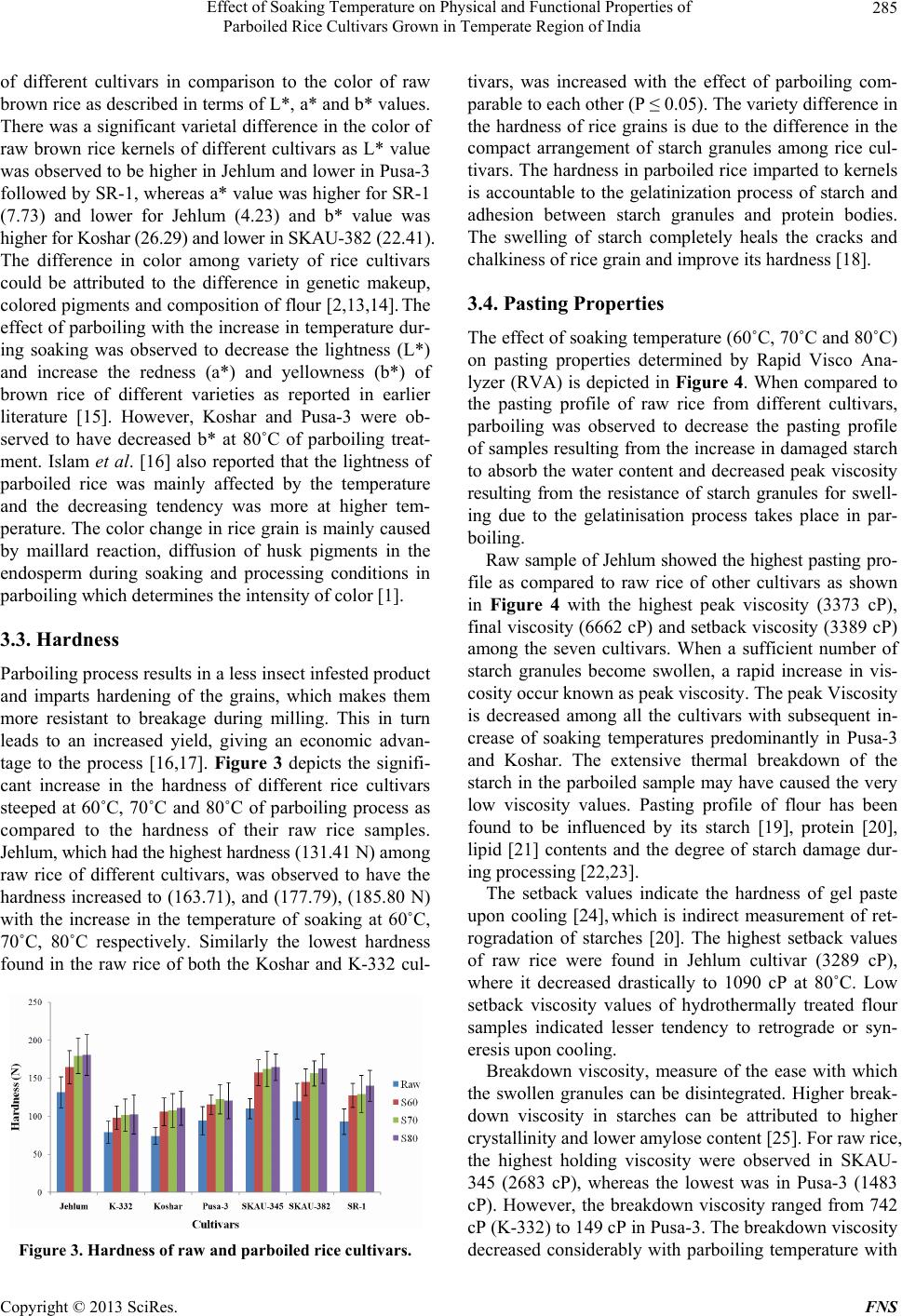 Effect of Soaking Temperature on Physical and Functional Properties of Parboiled Rice Cultivars Grown in Temperate Region of India 285 of different cultivars in comparison to the color of raw brown rice as described in terms of L*, a* and b* values. There was a significant varietal difference in the color of raw brown rice kernels of different cultivars as L* value was observed to be higher in Jehlum and lower in Pusa-3 followed by SR-1, whereas a* value was higher for SR-1 (7.73) and lower for Jehlum (4.23) and b* value was higher for Koshar (26.29) and lower in SKAU-382 (22.41). The difference in color among variety of rice cultivars could be attributed to the difference in genetic makeup, colored pigments and composition of flour [2,13,14]. The effect of parboiling with the increase in temperature dur- ing soaking was observed to decrease the lightness (L*) and increase the redness (a*) and yellowness (b*) of brown rice of different varieties as reported in earlier literature [15]. However, Koshar and Pusa-3 were ob- served to have decreased b* at 80˚C of parboiling treat- ment. Islam et al. [16] also reported that the lightness of parboiled rice was mainly affected by the temperature and the decreasing tendency was more at higher tem- perature. The color change in rice grain is mainly caused by maillard reaction, diffusion of husk pigments in the endosperm during soaking and processing conditions in parboiling which determines the intensity of color [1]. 3.3. Hardness Parboiling process results in a less insect infested product and imparts hardening of the grains, which makes them more resistant to breakage during milling. This in turn leads to an increased yield, giving an economic advan- tage to the process [16,17]. Figure 3 depicts the signifi- cant increase in the hardness of different rice cultivars steeped at 60˚C, 70˚C and 80˚C of parboiling process as compared to the hardness of their raw rice samples. Jehlum, which had the highest hardness (131.41 N) among raw rice of different cultivars, was observed to have the hardness increased to (163.71), and (177.79), (185.80 N) with the increase in the temperature of soaking at 60˚C, 70˚C, 80˚C respectively. Similarly the lowest hardness found in the raw rice of both the Koshar and K-332 cul- Figure 3. Hardness of raw and parboiled rice cultivars. tivars, was increased with the effect of parboiling com- parable to each other (P ≤ 0.05). The variety difference in the hardness of rice grains is due to the difference in the compact arrangement of starch granules among rice cul- tivars. The hardness in parboiled rice imparted to kernels is accountable to the gelatinization process of starch and adhesion between starch granules and protein bodies. The swelling of starch completely heals the cracks and chalkiness of rice grain and improve its hardness [18]. 3.4. Pasting Properties The effect of soaking temperature (60˚C, 70˚C and 80˚C) on pasting properties determined by Rapid Visco Ana- lyzer (RVA) is depicted in Figure 4. When compared to the pasting profile of raw rice from different cultivars, parboiling was observed to decrease the pasting profile of samples resulting from the increase in damaged starch to absorb the water content and decreased peak viscosity resulting from the resistance of starch granules for swell- ing due to the gelatinisation process takes place in par- boiling. Raw sample of Jehlum showed the highest pasting pro- file as compared to raw rice of other cultivars as shown in Figure 4 with the highest peak viscosity (3373 cP), final viscosity (6662 cP) and setback viscosity (3389 cP) among the seven cultivars. When a sufficient number of starch granules become swollen, a rapid increase in vis- cosity occur known as peak viscosity. The peak Viscosity is decreased among all the cultivars with subsequent in- crease of soaking temperatures predominantly in Pusa-3 and Koshar. The extensive thermal breakdown of the starch in the parboiled sample may have caused the very low viscosity values. Pasting profile of flour has been found to be influenced by its starch [19], protein [20], lipid [21] contents and the degree of starch damage dur- ing processing [22,23]. The setback values indicate the hardness of gel paste upon cooling [24], which is indirect measurement of ret- rogradation of starches [20]. The highest setback values of raw rice were found in Jehlum cultivar (3289 cP), where it decreased drastically to 1090 cP at 80˚C. Low setback viscosity values of hydrothermally treated flour samples indicated lesser tendency to retrograde or syn- eresis upon cooling. Breakdown viscosity, measure of the ease with which the swollen granules can be disintegrated. Higher break- down viscosity in starches can be attributed to higher crystallinity and lower amylose content [25]. For raw rice, the highest holding viscosity were observed in SKAU- 345 (2683 cP), whereas the lowest was in Pusa-3 (1483 cP). However, the breakdown viscosity ranged from 742 cP (K-332) to 149 cP in Pusa-3. The breakdown viscosity decreased considerably with parboiling temperature with Copyright © 2013 SciRes. FNS 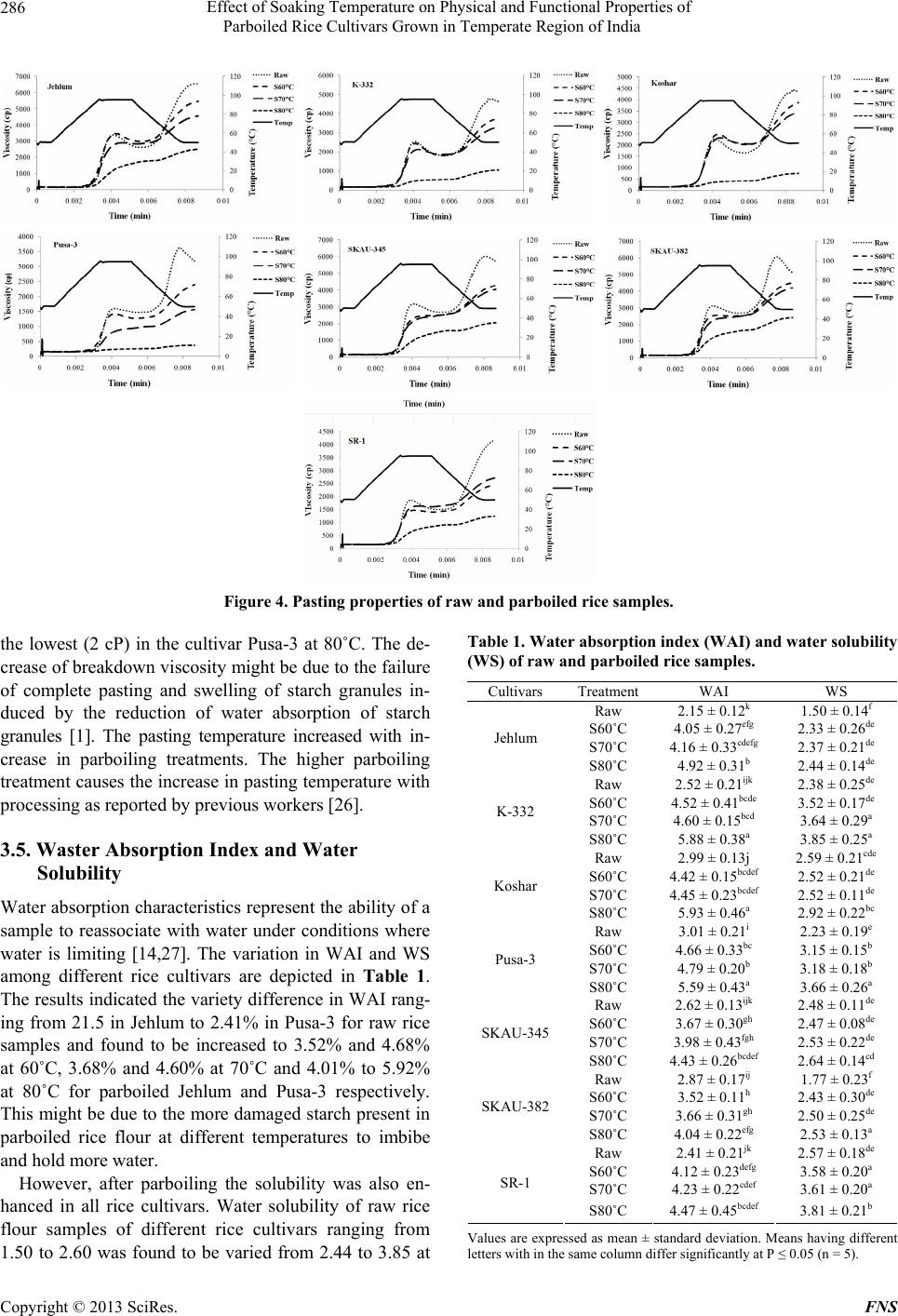 Effect of Soaking Temperature on Physical and Functional Properties of Parboiled Rice Cultivars Grown in Temperate Region of India Copyright © 2013 SciRes. FNS 286 Figure 4. Pasting properties of raw and parboiled rice samples. Table 1. Water absorption index (WAI) and water solubility (WS) of raw and parboiled rice samples. the lowest (2 cP) in the cultivar Pusa-3 at 80˚C. The de- crease of breakdown viscosity might be due to the failure of complete pasting and swelling of starch granules in- duced by the reduction of water absorption of starch granules [1]. The pasting temperature increased with in- crease in parboiling treatments. The higher parboiling treatment causes the increase in pasting temperature with processing as reported by previous workers [26]. Cultivars TreatmentWAI WS Raw 2.15 ± 0.12k 1.50 ± 0.14f S60˚C 4.05 ± 0.27efg 2.33 ± 0.26de S70˚C 4.16 ± 0.33cdefg 2.37 ± 0.21de Jehlum S80˚C 4.92 ± 0.31b 2.44 ± 0.14de Raw 2.52 ± 0.21ijk 2.38 ± 0.25de S60˚C 4.52 ± 0.41bcde 3.52 ± 0.17de S70˚C 4.60 ± 0.15bcd 3.64 ± 0.29a K-332 S80˚C 5.88 ± 0.38a 3.85 ± 0.25a Raw 2.99 ± 0.13j 2.59 ± 0.21cde S60˚C 4.42 ± 0.15bcdef 2.52 ± 0.21de S70˚C 4.45 ± 0.23bcdef 2.52 ± 0.11de Koshar S80˚C 5.93 ± 0.46a 2.92 ± 0.22bc Raw 3.01 ± 0.21i 2.23 ± 0.19e S60˚C 4.66 ± 0.33bc 3.15 ± 0.15b S70˚C 4.79 ± 0.20b 3.18 ± 0.18b Pusa-3 S80˚C 5.59 ± 0.43a 3.66 ± 0.26a Raw 2.62 ± 0.13ijk 2.48 ± 0.11de S60˚C 3.67 ± 0.30gh 2.47 ± 0.08de S70˚C 3.98 ± 0.43fgh 2.53 ± 0.22de SKAU-345 S80˚C 4.43 ± 0.26bcdef 2.64 ± 0.14cd Raw 2.87 ± 0.17ij 1.77 ± 0.23f S60˚C 3.52 ± 0.11h 2.43 ± 0.30de S70˚C 3.66 ± 0.31gh 2.50 ± 0.25de SKAU-382 S80˚C 4.04 ± 0.22efg 2.53 ± 0.13a Raw 2.41 ± 0.21jk 2.57 ± 0.18de S60˚C 4.12 ± 0.23defg 3.58 ± 0.20a S70˚C 4.23 ± 0.22cdef 3.61 ± 0.20a SR-1 S80˚C 4.47 ± 0.45bcdef 3.81 ± 0.21b 3.5. Waster Absorption Index and Water Solubility Water absorption characteristics represent the ability of a sample to reassociate with water under conditions where water is limiting [14,27]. The variation in WAI and WS among different rice cultivars are depicted in Table 1. The results indicated the variety difference in WAI rang- ing from 21.5 in Jehlum to 2.41% in Pusa-3 for raw rice samples and found to be increased to 3.52% and 4.68% at 60˚C, 3.68% and 4.60% at 70˚C and 4.01% to 5.92% at 80˚C for parboiled Jehlum and Pusa-3 respectively. This might be due to the more damaged starch present in parboiled rice flour at different temperatures to imbibe and hold more water. However, after parboiling the solubility was also en- hanced in all rice cultivars. Water solubility of raw rice flour samples of different rice cultivars ranging from 1.50 to 2.60 was found to be varied from 2.44 to 3.85 at Values are expressed as mean ± standard deviation. Means having different letters with in the same column differ significantly at P ≤ 0.05 (n = 5). 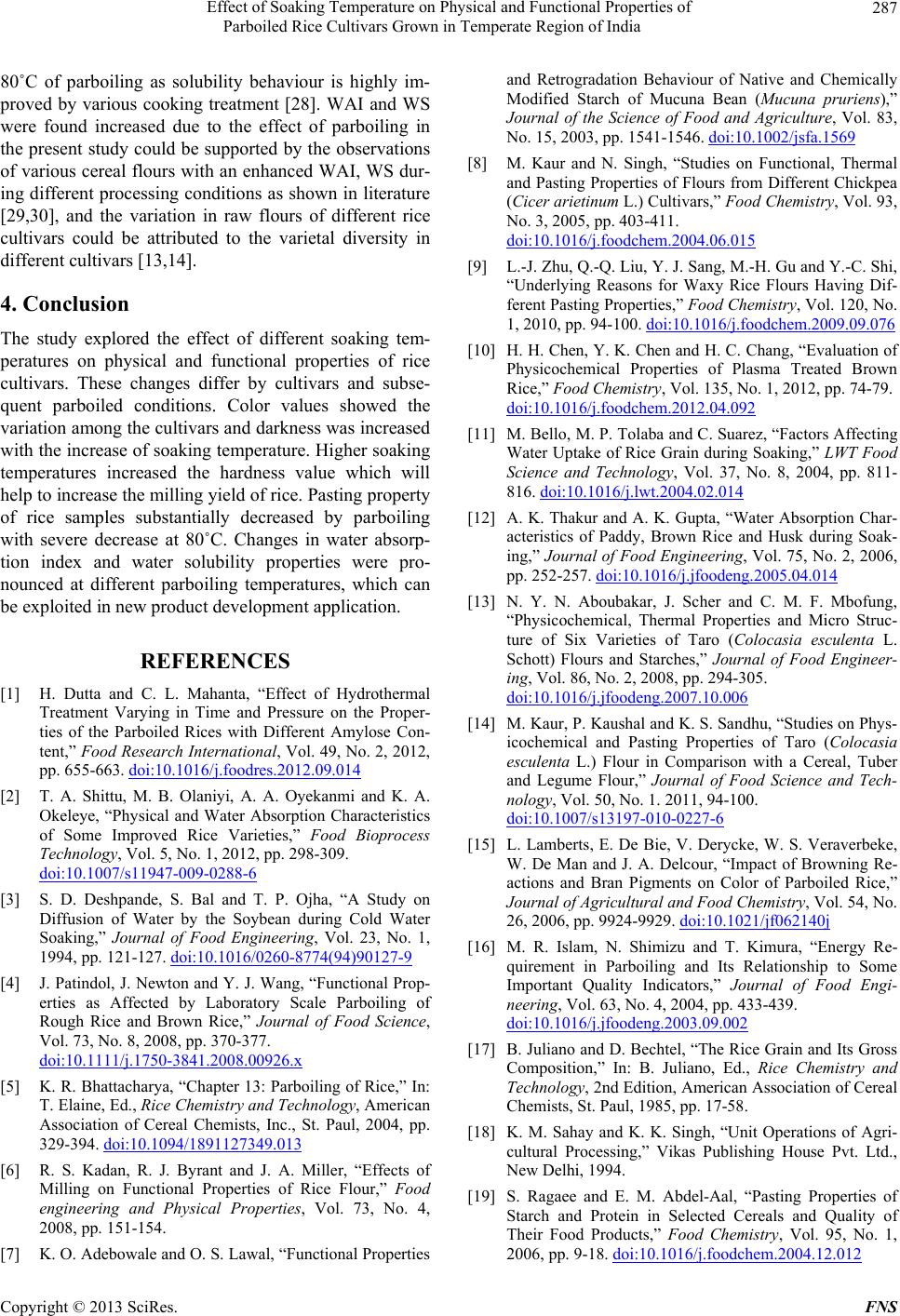 Effect of Soaking Temperature on Physical and Functional Properties of Parboiled Rice Cultivars Grown in Temperate Region of India 287 80˚C of parboiling as solubility behaviour is highly im- proved by various cooking treatment [28]. WAI and WS were found increased due to the effect of parboiling in the present study could be supported by the observations of various cereal flours with an enhanced WAI, WS dur- ing different processing conditions as shown in literature [29,30], and the variation in raw flours of different rice cultivars could be attributed to the varietal diversity in different cultivars [13,14]. 4. Conclusion The study explored the effect of different soaking tem- peratures on physical and functional properties of rice cultivars. These changes differ by cultivars and subse- quent parboiled conditions. Color values showed the variation among the cultivars and darkness was increased with the increase of soaking temperature. Higher soaking temperatures increased the hardness value which will help to increase the milling yield of rice. Pasting property of rice samples substantially decreased by parboiling with severe decrease at 80˚C. Changes in water absorp- tion index and water solubility properties were pro- nounced at different parboiling temperatures, which can be exploited in new product development application. REFERENCES [1] H. Dutta and C. L. Mahanta, “Effect of Hydrothermal Treatment Varying in Time and Pressure on the Proper- ties of the Parboiled Rices with Different Amylose Con- tent,” Food Research International, Vol. 49, No. 2, 2012, pp. 655-663. doi:10.1016/j.foodres.2012.09.014 [2] T. A. Shittu, M. B. Olaniyi, A. A. Oyekanmi and K. A. Okeleye, “Physical and Water Absorption Characteristics of Some Improved Rice Varieties,” Food Bioprocess Technology, Vol. 5, No. 1, 2012, pp. 298-309. doi:10.1007/s11947-009-0288-6 [3] S. D. Deshpande, S. Bal and T. P. Ojha, “A Study on Diffusion of Water by the Soybean during Cold Water Soaking,” Journal of Food Engineering, Vol. 23, No. 1, 1994, pp. 121-127. doi:10.1016/0260-8774(94)90127-9 [4] J. Patindol, J. Newton and Y. J. Wang, “Functional Prop- erties as Affected by Laboratory Scale Parboiling of Rough Rice and Brown Rice,” Journal of Food Science, Vol. 73, No. 8, 2008, pp. 370-377. doi:10.1111/j.1750-3841.2008.00926.x [5] K. R. Bhattacharya, “Chapter 13: Parboiling of Rice,” In: T. Elaine, Ed., Rice Chemistry and Technology, American Association of Cereal Chemists, Inc., St. Paul, 2004, pp. 329-394. doi:10.1094/1891127349.013 [6] R. S. Kadan, R. J. Byrant and J. A. Miller, “Effects of Milling on Functional Properties of Rice Flour,” Food engineering and Physical Properties, Vol. 73, No. 4, 2008, pp. 151-154. [7] K. O. Adebowale and O. S. Lawal, “Functional Properties and Retrogradation Behaviour of Native and Chemically Modified Starch of Mucuna Bean (Mucuna pruriens),” Journal of the Science of Food and Agriculture, Vol. 83, No. 15, 2003, pp. 1541-1546. doi:10.1002/jsfa.1569 [8] M. Kaur and N. Singh, “Studies on Functional, Thermal and Pasting Properties of Flours from Different Chickpea (Cicer arietinum L.) Cultivars,” Food Chemistry, Vol. 93, No. 3, 2005, pp. 403-411. doi:10.1016/j.foodchem.2004.06.015 [9] L.-J. Zhu, Q.-Q. Liu, Y. J. Sang, M.-H. Gu and Y.-C. Shi, “Underlying Reasons for Waxy Rice Flours Having Dif- ferent Pasting Properties,” Food Chemistry, Vol. 120, No. 1, 2010, pp. 94-100. doi:10.1016/j.foodchem.2009.09.076 [10] H. H. Chen, Y. K. Chen and H. C. Chang, “Evaluation of Physicochemical Properties of Plasma Treated Brown Rice,” Food Chemistry, Vol. 135, No. 1, 2012, pp. 74-79. doi:10.1016/j.foodchem.2012.04.092 [11] M. Bello, M. P. Tolaba and C. Suarez, “Factors Affecting Water Uptake of Rice Grain during Soaking,” LWT Food Science and Technology, Vol. 37, No. 8, 2004, pp. 811- 816. doi:10.1016/j.lwt.2004.02.014 [12] A. K. Thakur and A. K. Gupta, “Water Absorption Char- acteristics of Paddy, Brown Rice and Husk during Soak- ing,” Journal of Food Engineering, Vol. 75, No. 2, 2006, pp. 252-257. doi:10.1016/j.jfoodeng.2005.04.014 [13] N. Y. N. Aboubakar, J. Scher and C. M. F. Mbofung, “Physicochemical, Thermal Properties and Micro Struc- ture of Six Varieties of Taro (Colocasia esculenta L. Schott) Flours and Starches,” Journal of Food Engineer- ing, Vol. 86, No. 2, 2008, pp. 294-305. doi:10.1016/j.jfoodeng.2007.10.006 [14] M. Kaur, P. Kaushal and K. S. Sandhu, “Studies on Phys- icochemical and Pasting Properties of Taro (Coloc asia esculenta L.) Flour in Comparison with a Cereal, Tuber and Legume Flour,” Journal of Food Science and Tech- nology, Vol. 50, No. 1. 2011, 94-100. doi:10.1007/s13197-010-0227-6 [15] L. Lamberts, E. De Bie, V. Derycke, W. S. Veraverbeke, W. De Man and J. A. Delcour, “Impact of Browning Re- actions and Bran Pigments on Color of Parboiled Rice,” Journal of Agricultural and Food Chemistry, Vol. 54, No. 26, 2006, pp. 9924-9929. doi:10.1021/jf062140j [16] M. R. Islam, N. Shimizu and T. Kimura, “Energy Re- quirement in Parboiling and Its Relationship to Some Important Quality Indicators,” Journal of Food Engi- neering, Vol. 63, No. 4, 2004, pp. 433-439. doi:10.1016/j.jfoodeng.2003.09.002 [17] B. Juliano and D. Bechtel, “The Rice Grain and Its Gross Composition,” In: B. Juliano, Ed., Rice Chemistry and Technology, 2nd Edition, American Association of Cereal Chemists, St. Paul, 1985, pp. 17-58. [18] K. M. Sahay and K. K. Singh, “Unit Operations of Agri- cultural Processing,” Vikas Publishing House Pvt. Ltd., New Delhi, 1994. [19] S. Ragaee and E. M. Abdel-Aal, “Pasting Properties of Starch and Protein in Selected Cereals and Quality of Their Food Products,” Food Chemistry, Vol. 95, No. 1, 2006, pp. 9-18. doi:10.1016/j.foodchem.2004.12.012 Copyright © 2013 SciRes. FNS  Effect of Soaking Temperature on Physical and Functional Properties of Parboiled Rice Cultivars Grown in Temperate Region of India Copyright © 2013 SciRes. FNS 288 [20] I. S. M. Zaidul, N. A. N. Norulaini, A. K. M. Omar, H. Yamauchi and T. Noda, “RVA Analysis of Mixtures of Wheat Flour and Potato, Sweet Potato, Yam and Cassava Starches,” Carbohydrate Polymer, Vol. 69, No. 2, 2007, pp. 784-791. doi:10.1016/j.carbpol.2007.02.021 [21] P. L. Russell, “The Aging of Gels from Starches of Dif- ferent Amylose/Amylopectin Content Studied by Differ- ential Scanning Calorimetry,” Journal of Cereal Science, Vol. 6, No. 2, 1987, pp. 147-158. doi:10.1016/S0733-5210(87)80051-6 [22] T. O. Osungbaro, “Effect of Fermentation Period on Amy- lose Content and Textural Characteristics of “Ogi” (A Fermented Maize Porridge),” Journal of Fermentation and Bioengineering, Vol. 70, No. 1, 1990, pp. 22-25. doi:10.1016/0922-338X(90)90024-Q [23] M. O. Onitilo, L. O. Sanni, I. Daniel, B. Maziya-Dixon and A. Dixon, “Physicochemical and Functional Proper- ties of Native Starches from Cassava Varieties in South- west Nigeria,” Journal of Food, Agriculture and Envi- ronment, Vol. 5, No. 3, 2007, pp. 108-114. [24] I. Lee, G. Y. We, D. E. Kim, Y. S. Cho, M. R. Yoon, M. Shin and S. Ko, “Classification of Rice Cultivars Based on Cluster Analysis of Hydration and Pasting Properties of Their Starches,” LWT—Food Science and Technology, Vol. 48, No. 2, 2012, pp. 164-168. doi:10.1016/j.lwt.2012.03.002 [25] N. Singh, N. Inouchi and K. Nishinari, “Structural, Ther- mal and Viscoelastic Characteristics of Starches Sepa- rated from Normal, Sugary and Waxy Maize,” Food Hy- drocolloids, Vol. 20, No. 6, 2006, pp. 923-935. doi:10.1016/j.foodhyd.2005.09.009 [26] T. Swasdisevi, W. Sriariyakula, W. Tia and S. Soponron- narit, “Effect of Pre-Steaming on Production of Partially Parboiled Using Hot Air Fluidization Technique,” Jour- nal of Food Engineering, Vol. 96, No. 3, 2010, pp. 455- 462. doi:10.1016/j.jfoodeng.2009.08.026 [27] U. Singh, “Functional Properties of Grain Legume Flours,” Journal of Food Science and Technology, Vol. 38, No. 3, 2001, pp. 191-199. [28] D. Jones, R. Chinnaswamy, Y. Tan and M. Hanna, “Phy- siochemical Properties of Ready-to-Eat Breakfast Cere- als,” Cerea l Foods World, Vol. 45, No. 4, 2000, pp. 164- 168. [29] M. Mariotti, C. Alamprese, M. A. Pagani and M. Lucis- ano, “Effect of Puffing on Ultrastructure and Physical Characteristics of Cereal Grains and Flours,” Journal of Cereal Science, Vol. 43, No. 1, 2006, pp. 47-56. doi:10.1016/j.jcs.2005.06.007 [30] B. K. Baik, J. Powers and L. T. Nguyen, “Extrusion of Regular and Waxy Barley Flours for Production of Ex- panded Cereals,” Cereal Chemistry, Vol. 81, No. 1, 2004, pp. 94-99. doi:10.1094/CCHEM.2004.81.1.94 |