

Paper Menu >>
Journal Menu >>
 Journal of Cancer Therapy, 2013, 4, 448-451 http://dx.doi.org/10.4236/jct.2013.43A054 Published Online March 2013 (http://www.scirp.org/journal/jct) Successful Treatment of Elderly Diffuse Large B-Cell Lymphoma with Central Nervous System Recurrence by Rituximab, Ranimusutine, Ifosfamide, Procarbazine, Dexamethasone, and Etoposide Therap y Junya Miyahara1, Naoki Takezako1, Miyuki Wagatsuma2, Kiyoe Midorikawa2, Ichiro Fukuda3, Satoshi Noto1, Ikuo Saito4, Kazuaki Yamada2, Akiyoshi Miwa5, Naohiro Sekiguchi1* 1Division of Hematology, National Hospital Organization Disaster Medical Center, Tokyo, Japan; 2Division of Pathology, National Hospital Organization Disaster Medical Center, Japan; 3Division of Radiology, National Hospital Organization Disaster Medical Center, Japan; 4Division of Pathology, National Hospital Organization Sagamihara Hospital, Sagamihara, Japan; 5Hematology Divi- sion, National Center for Global Health and Medicine, Japan. Email: *[email protected] Received January 11th, 2013; revised January 25th, 2013; accepted February 4th, 2013 ABSTRACT The prognosis of CD20-positive (CD20+) diffuse large B-cell lymphoma (DLBCL) with central nervous system (CNS) recurrence is still poor. A standard treatment for CD20+ DLBCL with CNS recurrence in elderly patients has not been established mainly due to adverse effects. We previously reported the efficacy and safety of MIND-E (ranimustine, ifosfamide, procarbazine, dexamethasone, and etoposide) therapy for elderly CD20+ DLBCL patients with CNS recur- rence. Here, we report the use of R-MIND-E therapy (rituximab, ranimustine, ifosfamide, procarbazine, dexamethasone and etoposide) in an elderly CD20+ DLBCL patient with CNS recurrence. The patient achieved a complete response according to Revised Response Criteria for Malignant Lymphoma, and treatment-related toxicity was tolerable. R-MIND-E therapy may be a feasible and useful treatment option for elderly CD20+ DLBCL patients with CNS recur- rence. Keywords: Diffuse Large B-Cell Lymphoma; Central Nervous System Recurrence; Rituximab; MIND-E 1. Introduction The prognosis of CD20-positive (CD20+) diffuse large B-cell lymphoma (DLBCL) has been improved by com- bining CHOP therapy (cyclophosphamide, doxorubicin, vincristine, and predonisone) and rituximab, a chimeric monoclonal antibody against the CD20 B-cell antigen [1]. However, the prognosis of CD20+ DLBCL with central nervous system (CNS) recurrence is still poor [2]. Whole brain irradiation or high dose chemotherapy including methotrexate (MTX) and cytarabine is useful for younger patients; however, these therapies are not appropriate for elderly CD20+ DLBCL patients with CNS recurrence be- cause of treatment-related toxicities including leukoen- cephalopathy. We previously reported the efficacy and safety of MIND-E therapy (ranimustine (MCNU), ifosfa- mide (IFO), procarbazine (PCZ), dexamethasone (DEX), and etoposide (ETP)) (Table 1(a)). On the other hand, we did not use rituximab in the study [3]. Recently, regard- ing primary CNS lymphoma (PCNSL), intravenous ri- tuximab in addition to combined chemotherapy has been accepted as the standard treatment strategy [4-7]. Fur- thermore, CNS recurrence of systemic DLBCL is usually premonitory symptom of systemic recurrence, therefore, administration of rituximab in the salvage therapy may be considered as prevention for systemic reoccurrence. Here, we report a case of an elderly CD20+ DLBCL pa- tient with CNS recurrence treated with R-MIND-E ther- apy. 2. Case Report A 69-year-old male was admitted to our hospital in March 2010 because of right hemilateral sensory distur- bance, short-term memory disturbance, alexia, and agra- phia. He had been diagnosed with CD20+ primary tes- ticular DLBCL in 2005, and underwent orchidectomy, 6 cycles of CHOP therapy, irradiation, and intrathecal in- jection for CNS prophylaxis. He achieved a complete response (CR). T2 weighted magnetic resonance imaging *Corresponding author. Copyright © 2013 SciRes. JCT 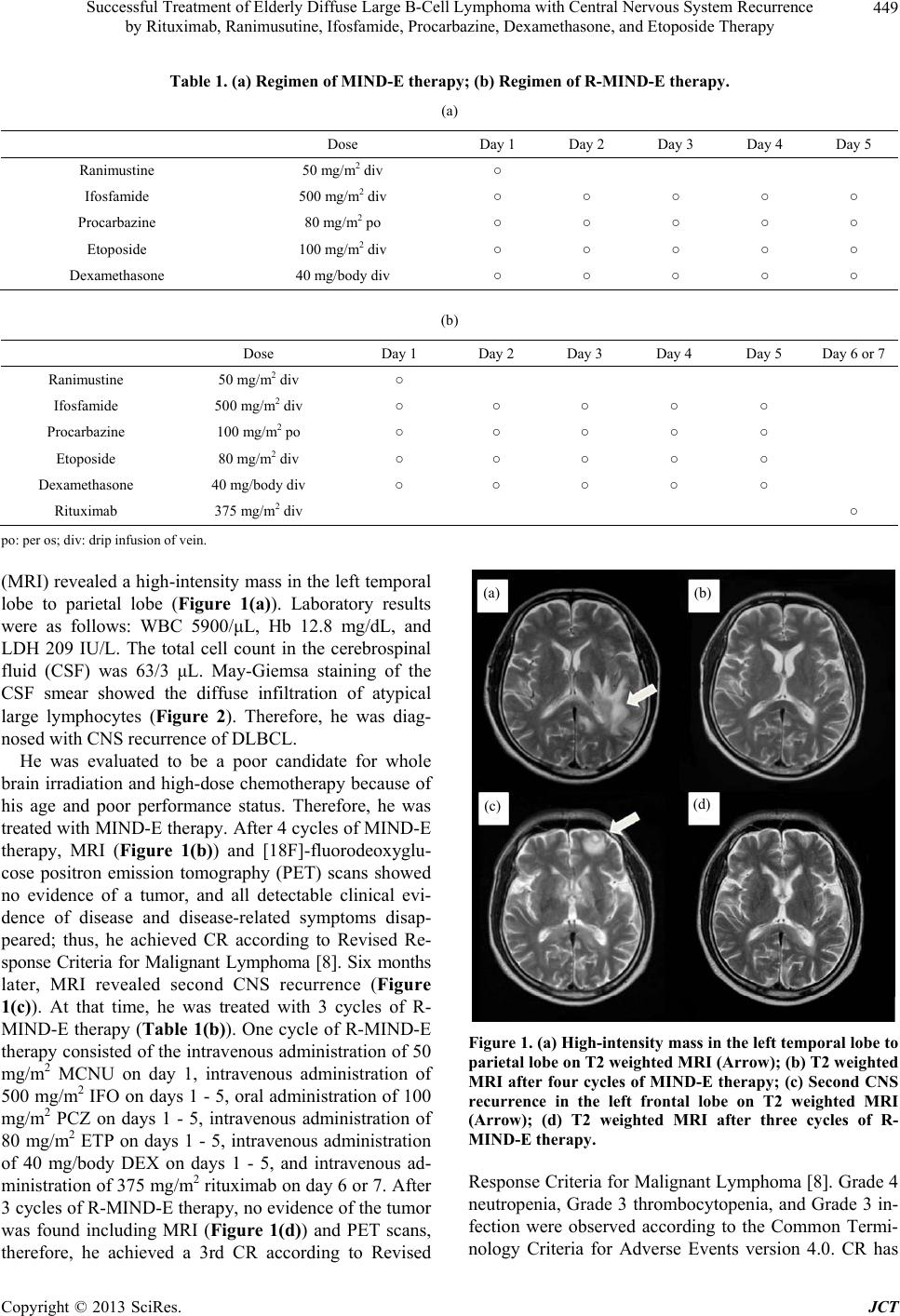 Successful Treatment of Elderly Diffuse Large B-Cell Lymphoma with Central Nervous System Recurrence by Rituximab, Ranimusutine, Ifosfamide, Procarbazine, Dexamethasone, and Etoposide Therapy 449 Table 1. (a) Regimen of MIND-E therapy; (b) Regimen of R-MIND-E therapy. (a) Dose Day 1 Day 2 Day 3 Day 4 Day 5 Ranimustine 50 mg/m2 div ○ Ifosfamide 500 mg/m2 div ○ ○ ○ ○ ○ Procarbazine 80 mg/m2 po ○ ○ ○ ○ ○ Etoposide 100 mg/m2 div ○ ○ ○ ○ ○ Dexamethasone 40 mg/body div ○ ○ ○ ○ ○ (b) Dose Day 1 Day 2 Day 3 Day 4 Day 5 Day 6 or 7 Ranimustine 50 mg/m2 div ○ Ifosfamide 500 mg/m2 div ○ ○ ○ ○ ○ Procarbazine 100 mg/m2 po ○ ○ ○ ○ ○ Etoposide 80 mg/m2 div ○ ○ ○ ○ ○ Dexamethasone 40 mg/body div ○ ○ ○ ○ ○ Rituximab 375 mg/m2 div ○ po: per os; div: drip infusion of vein. (MRI) revealed a high-intensity mass in the left temporal lobe to parietal lobe (Figure 1(a)). Laboratory results were as follows: WBC 5900/μL, Hb 12.8 mg/dL, and LDH 209 IU/L. The total cell count in the cerebrospinal fluid (CSF) was 63/3 μL. May-Giemsa staining of the CSF smear showed the diffuse infiltration of atypical large lymphocytes (Figure 2). Therefore, he was diag- nosed with CNS recurrence of DLBCL. He was evaluated to be a poor candidate for whole brain irradiation and high-dose chemotherapy because of his age and poor performance status. Therefore, he was treated with MIND-E therapy. After 4 cycles of MIND-E therapy, MRI (Figure 1(b)) and [18F]-fluorodeoxyglu- cose positron emission tomography (PET) scans showed no evidence of a tumor, and all detectable clinical evi- dence of disease and disease-related symptoms disap- peared; thus, he achieved CR according to Revised Re- sponse Criteria for Malignant Lymphoma [8]. Six months later, MRI revealed second CNS recurrence (Figure 1(c)). At that time, he was treated with 3 cycles of R- MIND-E therapy (Table 1(b)). One cycle of R-MIND-E therapy consisted of the intravenous administration of 50 mg/ m2 MCNU on day 1, intravenous administration of 500 mg/m2 IFO on days 1 - 5, oral administration of 100 mg/ m2 PCZ on days 1 - 5, intravenous administration of 80 mg/m2 ETP on days 1 - 5, intravenous administration of 40 mg/body DEX on days 1 - 5, and intravenous ad- ministration of 375 mg/m2 rituximab on day 6 or 7. After 3 cycles of R-MIND-E therapy, no evidence of the tumor was found including MRI (Figure 1(d)) and PET scans, therefore, he achieved a 3rd CR according to Revised (a) (b) (c) (d) Figure 1. (a) High-intensity mass in the left temporal lobe to parietal lobe on T2 weighted MRI (Arrow); (b) T2 weighted MRI after four cycles of MIND-E therapy; (c) Second CNS recurrence in the left frontal lobe on T2 weighted MRI (Arrow); (d) T2 weighted MRI after three cycles of R- MIND-E therapy. Response Criteria for Malignant Lymphoma [8]. Grade 4 neutropenia, Grade 3 thrombocytopenia, and Grade 3 in- fection were observed according to the Common Termi- nology Criteria for Adverse Events version 4.0. CR has Copyright © 2013 SciRes. JCT 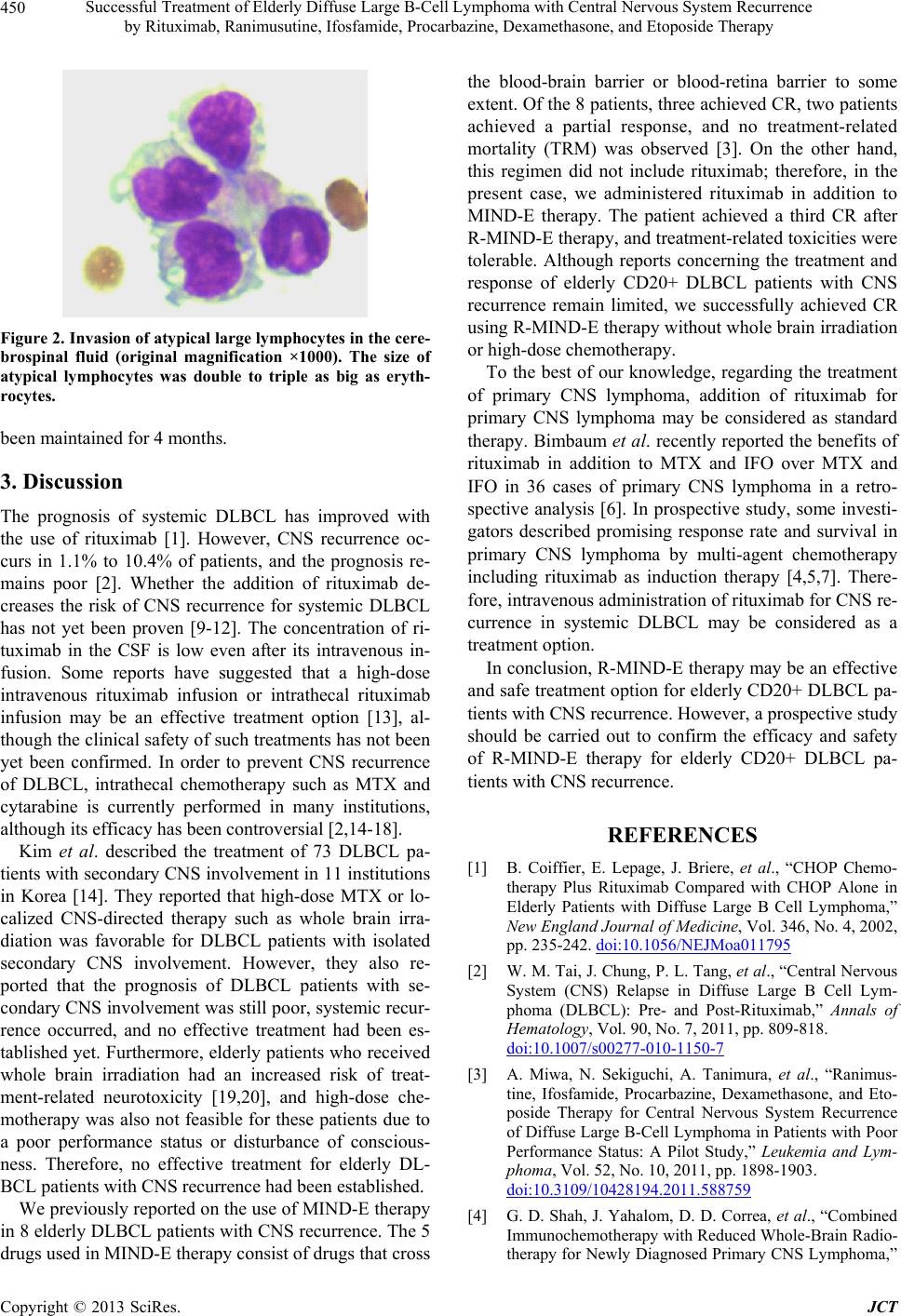 Successful Treatment of Elderly Diffuse Large B-Cell Lymphoma with Central Nervous System Recurrence by Rituximab, Ranimusutine, Ifosfamide, Procarbazine, Dexamethasone, and Etoposide Therapy 450 Figure 2. Invasion of atypical large lymphocytes in the cere- brospinal fluid (original magnification ×1000). The size of atypical lymphocytes was double to triple as big as eryth- rocytes. been maintained for 4 months. 3. Discussion The prognosis of systemic DLBCL has improved with the use of rituximab [1]. However, CNS recurrence oc- curs in 1.1% to 10.4% of patients, and the prognosis re- mains poor [2]. Whether the addition of rituximab de- creases the risk of CNS recurrence for systemic DLBCL has not yet been proven [9-12]. The concentration of ri- tuximab in the CSF is low even after its intravenous in- fusion. Some reports have suggested that a high-dose intravenous rituximab infusion or intrathecal rituximab infusion may be an effective treatment option [13], al- though the clinical safety of such treatments has not been yet been confirmed. In order to prevent CNS recurrence of DLBCL, intrathecal chemotherapy such as MTX and cytarabine is currently performed in many institutions, although its efficacy has been controversial [2,14-18]. Kim et al. described the treatment of 73 DLBCL pa- tients with secondary CNS involvement in 11 institutions in Korea [14]. They reported that high-dose MTX or lo- calized CNS-directed therapy such as whole brain irra- diation was favorable for DLBCL patients with isolated secondary CNS involvement. However, they also re- ported that the prognosis of DLBCL patients with se- condary CNS involvement was still poor, systemic recur- rence occurred, and no effective treatment had been es- tablished yet. Furthermore, elderly patients who received whole brain irradiation had an increased risk of treat- ment-related neurotoxicity [19,20], and high-dose che- motherapy was also not feasible for these patients due to a poor performance status or disturbance of conscious- ness. Therefore, no effective treatment for elderly DL- BCL patients with CNS recurrence had been established. We previously reported on the use of MIND-E therapy in 8 elderly DLBCL patients with CNS recurrence. The 5 drugs used in MIND-E therapy consist of drugs that cross the blood-brain barrier or blood-retina barrier to some extent. Of the 8 patients, three achieved CR, two patients achieved a partial response, and no treatment-related mortality (TRM) was observed [3]. On the other hand, this regimen did not include rituximab; therefore, in the present case, we administered rituximab in addition to MIND-E therapy. The patient achieved a third CR after R-MIND-E therapy, and treatment-related toxicities were tolerable. Although reports concerning the treatment and response of elderly CD20+ DLBCL patients with CNS recurrence remain limited, we successfully achieved CR using R-MIND-E therapy without whole brain irradiation or high-dose chemotherapy. To the best of our knowledge, regarding the treatment of primary CNS lymphoma, addition of rituximab for primary CNS lymphoma may be considered as standard therapy. Bimbaum et al. recently reported the benefits of rituximab in addition to MTX and IFO over MTX and IFO in 36 cases of primary CNS lymphoma in a retro- spective analysis [6]. In prospective study, some investi- gators described promising response rate and survival in primary CNS lymphoma by multi-agent chemotherapy including rituximab as induction therapy [4,5,7]. There- fore, intravenous administration of rituximab for CNS re- currence in systemic DLBCL may be considered as a treatment option. In conclusion, R-MIND-E therapy may be an effective and safe treatment option for elderly CD20+ DLBCL pa- tients with CNS recurrence. However, a prospective study should be carried out to confirm the efficacy and safety of R-MIND-E therapy for elderly CD20+ DLBCL pa- tients with CNS recurrence. REFERENCES [1] B. Coiffier, E. Lepage, J. Briere, et al., “CHOP Chemo- therapy Plus Rituximab Compared with CHOP Alone in Elderly Patients with Diffuse Large B Cell Lymphoma,” New England Journal of Medicine, Vol. 346, No. 4, 2002, pp. 235-242. doi:10.1056/NEJMoa011795 [2] W. M. Tai, J. Chung, P. L. Tang, et al., “Central Nervous System (CNS) Relapse in Diffuse Large B Cell Lym- phoma (DLBCL): Pre- and Post-Rituximab,” Annals of Hematology, Vol. 90, No. 7, 2011, pp. 809-818. doi:10.1007/s00277-010-1150-7 [3] A. Miwa, N. Sekiguchi, A. Tanimura, et al., “Ranimus- tine, Ifosfamide, Procarbazine, Dexamethasone, and Eto- poside Therapy for Central Nervous System Recurrence of Diffuse Large B-Cell Lymphoma in Patients with Poor Performance Status: A Pilot Study,” Leukemia and Lym- phoma, Vol. 52, No. 10, 2011, pp. 1898-1903. doi:10.3109/10428194.2011.588759 [4] G. D. Shah, J. Yahalom, D. D. Correa, et al., “Combined Immunochemotherapy with Reduced Whole-Brain Radio- therapy for Newly Diagnosed Primary CNS Lymphoma,” Copyright © 2013 SciRes. JCT  Successful Treatment of Elderly Diffuse Large B-Cell Lymphoma with Central Nervous System Recurrence by Rituximab, Ranimusutine, Ifosfamide, Procarbazine, Dexamethasone, and Etoposide Therapy Copyright © 2013 SciRes. JCT 451 Journal of Clinical Oncology, Vol. 25, No. 30, 2007, pp. 4730-4735. doi:10.1200/JCO.2007.12.5062 [5] R. C. Curry, D. Correa, J. J. Raizer, et al., “Consolidation Reduced Dose Whole Brain Radiotherapy (rdWBRT) Following Methotrexate, Rituximab, Procarbazine, Vin- cristine, Cytarabine (R-MPV-A) for Newly Diagnosed Primary CNS Lymphoma (PCNSL): Final Results and Long-Term Outcome,” Journal of Clinical Oncology, Vol. 30, No. 15, 2012, p. 2006. [6] T. Bimbaum, E. A. Stadler, L. V. Baumgarten and A. Straube, “Rituximab Significantly Improves Complete Re- sponse Rate in Patients with Primary CNS Lymphoma,” Journal of Neurooncology, Vol. 109, No. 2, 2012, pp. 285-291. doi:10.1007/s11060-012-0891-7 [7] M. J. Wieduwilt, F. Valles, S. Issa, et al., “Immuno- chemotherapy with Intensive Consolidation for Primary CNS Lymphoma: A Pilot Study and Prognostic Assess- ment by Diffusion-Weighted MRI,” Clincal Cancer Re- search, Vol. 18, No. 4, 2012, pp. 1146-1155. doi:10.1158/1078-0432.CCR-11-0625 [8] B. D. Cheson, B. Pfistner, M. E. Juweid, et al., “Revised Response Criteria for Malignant Lymphoma,” Journal of Clinical Oncology, Vol. 25, No. 5, 2007, pp. 579-586. doi:10.1200/JCO.2006.09.2403 [9] D. Villa, J. M. Connors, T. N. Shenkier, et al., “Incidence and Risk Factors for Central Nervous System Relapse in Patients with Diffuse Large B-Cell Lymphoma: The Im- pact of the Addition of Rituximab to CHOP Chemother- apy,” Annals of Oncology, Vol. 21, No. 5, 2010, pp. 1046-1052. doi:10.1093/annonc/mdp432 [10] P. Feugier, J. M. Virion, H. Tilly, et al., “Incidence and Risk Factors for Central Nervous System Occurrence in Elderly Patients with Diffuse Large-B-Cell Lymphoma: Influence of Rituximab,” Annals of Oncology, Vol. 15, No. 1, 2004, pp. 129-133. doi:10.1093/annonc/mdh013 [11] Y. Shimizu, K. Notohara and Y. Ueda, “Diffuse Large B-Cell Lymphoma with Central Nervous System Relapse: Prognosis and Risk Factors According to Retrospective Analysis from a Single-Center Experience,” International Journal of Hematology, Vol. 89, No. 5, 2009, pp. 577- 583. doi:10.1007/s12185-009-0289-2 [12] R. Kridel and P. Dietrich, “Prevention of CNS Relapse in Diff Use Large B-Cell Lymphoma,” The Lancet Oncol- ogy, Vol. 12, No. 13, 2011, pp. 1258-1266. doi:10.1016/S1470-2045(11)70140-1 [13] A. Harjunpaa, T. Wiklund, J. Collan, et al., “Complement Activation in Circulation and Central Nervous System after Rituximab (Anti-CD20) Treatment of B-Cell Lym- phoma,” Leukemia and Lymphoma, Vol. 42, No. 4, 2001, pp. 731-738. doi:10.3109/10428190109099335 [14] S. J. Kim, S. Y. Oh, J. S. Kim, et al., “Secondary Central Nervous System (CNS) Involvement in Patients with Dif- fuse Large B-Cell Lymphoma: A Therapeutic Dilemma,” Annals of Hematology, Vol. 90, No. 5, 2011, pp. 539-546. doi:10.1007/s00277-010-1104-0 [15] A. Kumar, A Vanderplas, A. S. LaCasce, et al., “Lack of Benefit of Central Nervous System Prophylaxis for Dif- fuse Large B-Cell Lymphoma in the Rituximab Era,” Cancer, Vol. 118, No. 11, 2012, pp. 2944-2951. doi:10.1002/cncr.26588 [16] N. Schmitz, S. Zeynalova, M. Loeffler, et al., “Response: Intrathecal Methotrexate and Central Nervous System Events,” Blood, Vol. 114, No. 9, 2009, pp. 1999-2000. doi:10.1182/blood-2009-06-226076 [17] J. S. Abramson, M. Hellmann, J. A. Barnes, et al., “In- travenous Methotrexate as Central Nervous System (CNS) Prophylaxis Is Associated with a Low Risk of CNS Re- currence in High-Risk Patients with Diffuse Large B-Cell Lymphoma,” Cancer, Vol. 116, No. 18, 2010, pp. 4283- 4290. doi:10.1002/cncr.25278 [18] Q. A. Hill and R. G. Owen, “CNS Prophylaxis in Lym- phoma: Who to Target and What Therapy to Use,” Blood Reviews, Vol. 20, No. 6, 2006, pp. 319-332. doi:10.1016/j.blre.2006.02.001 [19] N. D. Doolittle, L. E. Abrey, T. N. Shenkier, et al. , “Brain Parenchyma Involvement as Isolated Central Nervous system Relapse of Systemic Non-Hodgkin Lymphoma an International Primary CNS Lymphoma Collaborative Group Report,” Blood, Vol. 111, No. 3, 2008, pp. 1085- 1093. doi:10.1182/blood-2007-07-101402 [20] A. M. P. Omuro, L. M. DeAngelis, Yahalom J., et al., “Chemoradiotherapy for Primary CNS Lymphoma an In- tent-to-Treat Analysis with Complete Follow-Up,” Neu- rology, Vol. 64, No. 1, 2005, pp. 69-74. doi:10.1212/01.WNL.0000148641.98241.5E |