

Paper Menu >>
Journal Menu >>
 Chinese Studies 2013. Vol.2, No.1, 68-76 Published Online February 2013 in SciRes (http://www.scirp.org/journal/chnstd) http://dx.doi.org/10.4236/chnstd.2013.21010 Copyright © 2013 SciRes. 68 Measurement of Peasants’ Satisfaction with the Compensation for Land Acquisition in the Chinese Mainland in the Last Thirty Years Wang Xinliang Department of Economic and Management, Zhejiang Water Conservancy and Hydropower College, Hangzhou, China Email: [email protected] Received September 24th, 2012; revised October 26th, 2012; accepted November 3rd, 2012 Based on theories and documents, initial quantization table of peasants’ land acquisition compensation satisfaction has been developed. It consists of compensation standard, compensation procedure, compen- sation mode, and compensation distribution. Through on-spot interviews and pre-tested questionnaires, the final scale is determined. After the questionnaire surveys and primary component analysis, ultimately, we conclude that compensation degree, compensation procedure, and compensation mode are the main dimensions of the peasants’ satisfaction with the compensation for land acquisition. This reliable operat- ing tool makes up for the limits of situational specificity and shortcoming of recognition inconsistence of land acquisition compensation from the current bibliography, and promotes in-depth research and theori- zations of land-acquisition compensation. Keywords: Land Acquisition; Compensation Satisfaction; Compensation Degree; Compensation Procedure; Compensation Mode Introduction The essence of land acquisition is the redistribution of land property among the peasants whose lands are acquisitioned by the government. Other members of the village, land developers, and such local administrations, as village cadres, township and counties all tried their best to maximize their own benefits. In the existing property right and institutional framework, gov- ernment’s forcible land acquisition act does not protect famers’ wish. This leads to endless disputes. Yu Jianrong 于建嵘 pointed out that rural land disputes had replaced tax disputes and currently become the main reason for peasants’ rights pro- tests, Yu observed that this was mainly because governmental acquisition of lands was practiced without peasants’ permission, or the compensation was too low, or government embezzled the compensation. In large number and often in passive situations, peasants, as a vulnerable group, are the main stakeholders of land. Obtaining the least interests, peasants become the most dissatisfied group. What are the specific elements of the peasants’ satisfaction with land-acquisition compensation and what’s the degree of the satisfaction? Theoretical Basis The Compensation Satisfaction Theory Satisfaction has long been an important indicator of man- agement science, especially in psychology research. Each gen- eration of management masters has come up with their own theories and models. F. W. Taylor “the father of scientific management” already established a prototype of the idea of satisfaction. Herzberg uses two-factor theory to further inquire which factors lead to job satisfaction and dissatisfaction. P. C. Smith’s (1969) Equity Model extends and expands the satisfaction theory. He thinks that people will compare the in- vestment and reward ratio. If their investment and reward ratio are equal with others’, they will feel fair. Conversely, if the self ratio is far behind others’, they will feel unfair and unsatisfied. R. A. Ash (1965) points out that everyone has the output which is obtained from work and the input faith which is essential to achieve these outputs. These studies have laid a foundation for follow-up compensation satisfaction research. The Development of Compensation Satisfaction A number of researchers have deepened the satisfaction the- ory. The Lawler (1971) discrepancy model points out that peo- ple will compare the actual reward with what they should be paid, and the results will affect their pay satisfaction. According to the Modified Discrepancy Model by Heneman and Schwab (1985) salary satisfaction should consist of four dimensions, namely, “salary”, “pay and promotion”, “salary policy and management”, and “welfare”. Their model has changed the view that salary satisfaction is a single surface structure. The first to discover the problem is Dreher (1988), who studied the salary and welfare satisfaction of “common guarantee scope and employee costs borne” with the sample of 1433 police officers. There were no specific differences ob- -served among the officers, though they found that welfare actually had influence over welfare and salary satisfaction. Another forerunner is Henmeman (1988) who conducted re- searches on all the four satisfaction factors. Heneman (1988) examined the relationship between job performance compensa-  WANG X. L. tion and compensation satisfaction based on a research sample of 104 hospital staff. He found that there would be some dif- ferences using different survey methods, just the same as Drehe et al. had found. The third to find this problem is Miceli et al. (1991). Their study of the compensation system satisfaction (structure and management) features a sample of 2000 manag- ers, who were divided into several levels according to their positions. The study found that the view on salary system fair- ness influenced organizational justice. External comparisons play an important role in determining satisfaction rather than salary system. At the same time, the study further notes that a high level executive force makes the salary system fairer. A compensation satisfaction research review for the last 30 years finds two obvious phenomena. First, people almost al- ways use the same satisfaction content and variables related to work. For example, Ronan and Organ (1973) investigated how work experience, age, education, gender, organizational capac- ity, and the actual wage influence salary satisfaction. At the same time, Rice et al. (1990) did the same research with almost the same variables. But there are also differences between their researches. For example, a study does not regard it as organiza- tion ability, but in another study it is often regarded as a part of the organization ability. And some of other same routine vari- ables have been used for many years. Second, most of the stud- ies only concentrate on the pay satisfaction, much to the negli- gence of raise, benefits, compensation system structure, and management satisfaction. But some researchers investigated some or all the four factors. The satisfaction theory is not only applied in the field of hu- man resource management, and government departments, but also in public administration, health, science and technology education. The Measurement of Compensation Satisfaction At the beginning, most methods measuring satisfaction adopted one-dimensional method—Minnesota satisfaction ques- tionnaire (Minnesota Weiss et al., 1967) and job satisfaction index (Smith et al., 1967), Later on the main satisfaction model (Dyer & Theriault, 1976; Lawler, 1971) came to be is multidi- mensional model. Heneman (1985) believes that either the theory of compensa- tion satisfaction or actual measurement of the compensation satisfaction can help researchers understand the causes and results of satisfaction. He and Schwab, developed and validated a multidimensional method which was used to measure satis- faction, namely pay satisfaction questionnaire (Pay Satisfaction Questionnaire, PSQ). Because of the satisfactory results, they turned to remuneration related subjects and methods to do con- ducted more research (Heneman & Schwab, 1985). Some re- searchers have verified the correctness and reliability of the PSQ (Judge & Wellbourne, 1994; Mulvey et al., 1991). But there is at least one non-western researcher that questioned the validity of these four factors (Lam, 1998). The study by Lam in Hong Kong illustrated that there are only two factors—salary and welfare—connected to the compensation satisfaction. Ever since, people went on with some more investigations. But most of the research is on the PSQ dimension (Ash et al., 1990; Chrraher, 1991; Buckley, 1996; Carraher et al., 2004; Carraher & Scarpello, 1993; Mulvey et al., 1990; Orpen & Bonnici, 1987; Lance & Scarpello, 1989; Scarpello et al., 1988). As regards the differences between compensation satisfaction measurement and compensation satisfaction theoretical results, almost eve- ryone predicts on the pay level while neglecting the factors that can influence satisfaction, such as salary, benefits and compen- sation management system and structure. P. Feuille (1974) found that after controlling distributive justice, the interpreta- tion difference of distributive justice (18.8%) on pay satisfac- tion is two times larger than procedural (8.7%). Dreher (1981) shows that the relationship between distributive justice (0.78) and salary satisfaction is greater than procedural justice (0.42). Miceli et al. (2000) also come to the same conclusion. In his research on university instructors’ satisfaction, Wu Xiaoyi 吴 小易 (2006) finds it obvious that justice in salary assessment procedure plays an important part in satisfaction effect. There have also been some empirical studies that have investigated the moderating variables and intermediary variable mechanism. Scarpello (1988) found that procedural justice was a condition- ing variable through which fair distribution influences satisfac- tion behavior. Lawler (1971) found that fair distribution influ- enced organizational commitment through compensation, but procedural justice on salary satisfaction had no direct effect on it, and that procedural justice just influenced the organization commitment through satisfaction with supervisor. Smith (1969) points out that compensation level, compensation structure, and pay grade have a great effect on salary satisfaction, and there is positive relation between salary level and salary satisfaction. Derher (1981) also shows that the real wage and salary satisfac- tion among the correlation coefficient is 0.28, but the propor- tion of wage growth and salary satisfaction among the correla- tion coefficient is 0.07. Initially the research of satisfaction or satisfaction measure- ment in the Chinese mainland is was focused on service Indus- try, such as the satisfaction change of bank service, the satisfac- tion in retail area of domestic and foreign brands, the tourism satisfaction in ecological tourism, rural tourism, ancient vil- lages tourism, and so on. Later, their inquisition extended to the satisfaction with government service such as administrative services, public projects. In recent years, there are a lot of sat- isfaction researches related to peasants, including studies of peasant life, medical insurance, rural public goods, employment, and so on. Informed by foreign research, the research method used by the scholars gradually changes from quantitative re- search to qualitative research. In conclusion, in terms of ap- proach methodology, variables, and measurement dimensions the present study acknowledges important inspiration from those research projects. The Conceptual Model and Research Hypothesis Modeling The reason why peasants are not satisfied and why there are lots of disputes is summarized below and shown in Table 1. The first is compensation standard. Of all the 44 documents related to land compensation issues, there are 36 (i.e. 81.8%) based on compensation standard of land acquisition and re- garding the low compensation standard as the main reason for the dissatisfaction of the peasants. Zhu Mingfen 朱明芬 (2003); Kong Xiangzhi 孔祥智, Wang Zhiqiang 王志强 (2004); Lu Qian 陆迁, Ye Xiaowen 叶小雯 (2005), Zhong Shuiying 钟 水映 (2007), Qian Zhonghao 钱忠好, Ma Kai 马凯 (2007), Zhao Wei 赵伟, Zhang Zhengfeng 张正峰 (2009), and Lin Copyright © 2013 SciRes. 69 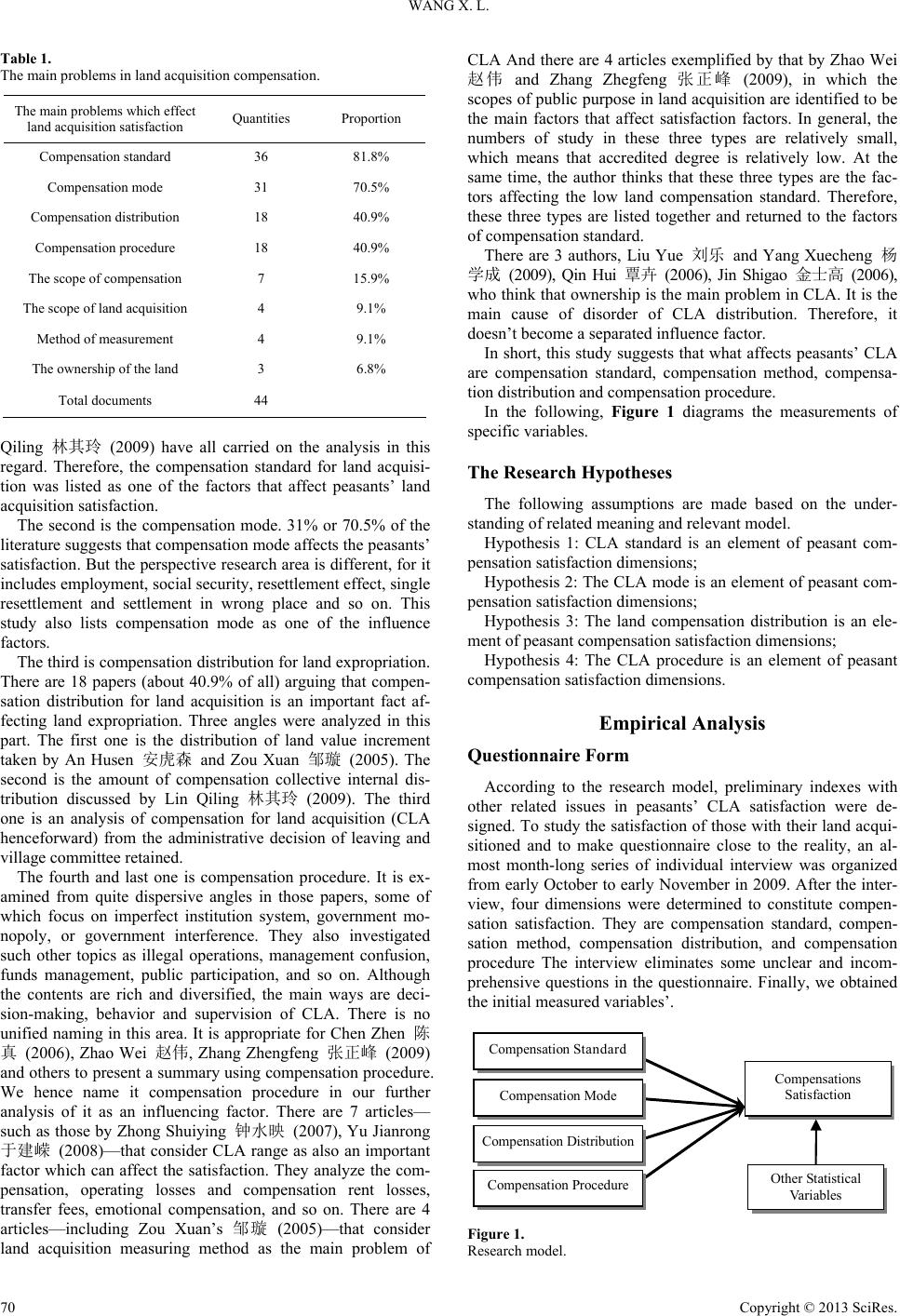 WANG X. L. Table 1. The main problems in land acquisition compensation. The main problems which effect land acquisition satisfaction Quantities Proportion Compensation standard 36 81.8% Compensation mode 31 70.5% Compensation distribution 18 40.9% Compensation procedure 18 40.9% The scope of compensation 7 15.9% The scope of land acquisition 4 9.1% Method of measurement 4 9.1% The ownership of the land 3 6.8% Total documents 44 Qiling 林其玲 (2009) have all carried on the analysis in this regard. Therefore, the compensation standard for land acquisi- tion was listed as one of the factors that affect peasants’ land acquisition satisfaction. The second is the compensation mode. 31% or 70.5% of the literature suggests that compensation mode affects the peasants’ satisfaction. But the perspective research area is different, for it includes employment, social security, resettlement effect, single resettlement and settlement in wrong place and so on. This study also lists compensation mode as one of the influence factors. The third is compensation distribution for land expropriation. There are 18 papers (about 40.9% of all) arguing that compen- sation distribution for land acquisition is an important fact af- fecting land expropriation. Three angles were analyzed in this part. The first one is the distribution of land value increment taken by An Husen 安虎森 and Zou Xuan 邹璇 (2005). The second is the amount of compensation collective internal dis- tribution discussed by Lin Qiling 林其玲 (2009). The third one is an analysis of compensation for land acquisition (CLA henceforward) from the administrative decision of leaving and village committee retained. The fourth and last one is compensation procedure. It is ex- amined from quite dispersive angles in those papers, some of which focus on imperfect institution system, government mo- nopoly, or government interference. They also investigated such other topics as illegal operations, management confusion, funds management, public participation, and so on. Although the contents are rich and diversified, the main ways are deci- sion-making, behavior and supervision of CLA. There is no unified naming in this area. It is appropriate for Chen Zhen 陈 真 (2006), Zhao Wei 赵伟, Zhang Zhengfeng 张正峰 (2009) and others to present a summary using compensation procedure. We hence name it compensation procedure in our further analysis of it as an influencing factor. There are 7 articles— such as those by Zhong Shuiying 钟水映 (2007), Yu Jianrong 于建嵘 (2008)—that consider CLA range as also an important factor which can affect the satisfaction. They analyze the com- pensation, operating losses and compensation rent losses, transfer fees, emotional compensation, and so on. There are 4 articles—including Zou Xuan’s 邹璇 (2005)—that consider land acquisition measuring method as the main problem of CLA And there are 4 articles exemplified by that by Zhao Wei 赵伟 and Zhang Zhegfeng 张正峰 (2009), in which the scopes of public purpose in land acquisition are identified to be the main factors that affect satisfaction factors. In general, the numbers of study in these three types are relatively small, which means that accredited degree is relatively low. At the same time, the author thinks that these three types are the fac- tors affecting the low land compensation standard. Therefore, these three types are listed together and returned to the factors of compensation standard. There are 3 authors, Liu Yue 刘乐 and Yang Xuecheng 杨 学成 (2009), Qin Hui 覃卉 (2006), Jin Shigao 金士高 (2006), who think that ownership is the main problem in CLA. It is the main cause of disorder of CLA distribution. Therefore, it doesn’t become a separated influence factor. In short, this study suggests that what affects peasants’ CLA are compensation standard, compensation method, compensa- tion distribution and compensation procedure. In the following, Figure 1 diagrams the measurements of specific variables. The Research Hypotheses The following assumptions are made based on the under- standing of related meaning and relevant model. Hypothesis 1: CLA standard is an element of peasant com- pensation satisfaction dimensions; Hypothesis 2: The CLA mode is an element of peasant com- pensation satisfaction dimensions; Hypothesis 3: The land compensation distribution is an ele- ment of peasant compensation satisfaction dimensions; Hypothesis 4: The CLA procedure is an element of peasant compensation satisfaction dimensions. Empirical Analysis Questionnaire Form According to the research model, preliminary indexes with other related issues in peasants’ CLA satisfaction were de- signed. To study the satisfaction of those with their land acqui- sitioned and to make questionnaire close to the reality, an al- most month-long series of individual interview was organized from early October to early November in 2009. After the inter- view, four dimensions were determined to constitute compen- sation satisfaction. They are compensation standard, compen- sation method, compensation distribution, and compensation procedure The interview eliminates some unclear and incom- prehensive questions in the questionnaire. Finally, we obtained the initial measured variables’. Compensations Satisfaction Compensation Mode Compensation Standard Compensation Distribution Compensation ProcedureOther Statistical Va r i ab les Figure 1. Research model. Copyright © 2013 SciRes. 70 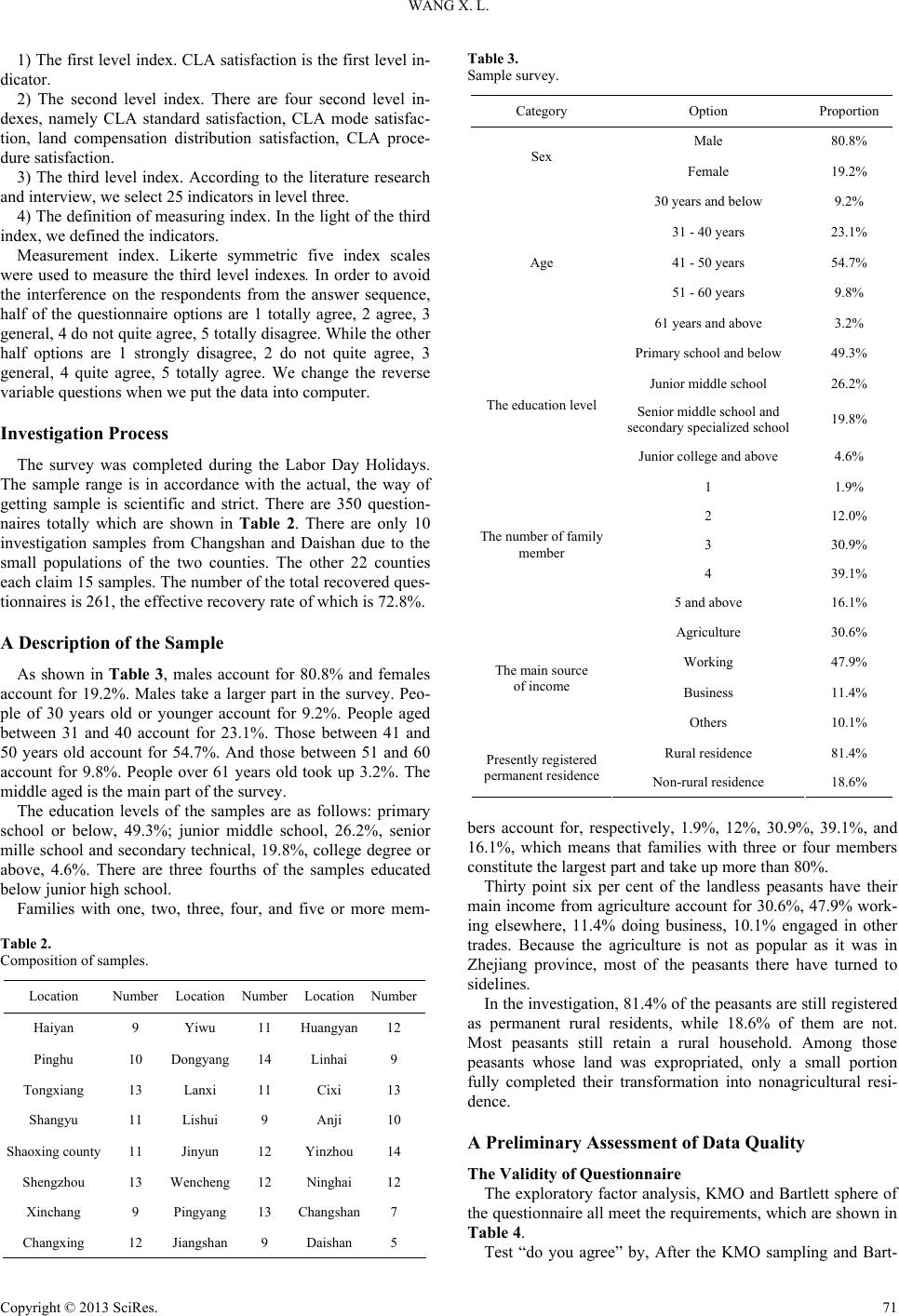 WANG X. L. 1) The first level index. CLA satisfaction is the first level in- dicator. 2) The second level index. There are four second level in- dexes, namely CLA standard satisfaction, CLA mode satisfac- tion, land compensation distribution satisfaction, CLA proce- dure satisfaction. 3) The third level index. According to the literature research and interview, we select 25 indicators in level three. 4) The definition of measuring index. In the light of the third index, we defined the indicators. Measurement index. Likerte symmetric five index scales were used to measure the third level indexes. In order to avoid the interference on the respondents from the answer sequence, half of the questionnaire options are 1 totally agree, 2 agree, 3 general, 4 do not quite agree, 5 totally disagree. While the other half options are 1 strongly disagree, 2 do not quite agree, 3 general, 4 quite agree, 5 totally agree. We change the reverse variable questions when we put the data into computer. Investigati on Process The survey was completed during the Labor Day Holidays. The sample range is in accordance with the actual, the way of getting sample is scientific and strict. There are 350 question- naires totally which are shown in Table 2. There are only 10 investigation samples from Changshan and Daishan due to the small populations of the two counties. The other 22 counties each claim 15 samples. The number of the total recovered ques- tionnaires is 261, the effective recovery rate of which is 72.8%. A Description of the Sample As shown in Table 3, males account for 80.8% and females account for 19.2%. Males take a larger part in the survey. Peo- ple of 30 years old or younger account for 9.2%. People aged between 31 and 40 account for 23.1%. Those between 41 and 50 years old account for 54.7%. And those between 51 and 60 account for 9.8%. People over 61 years old took up 3.2%. The middle aged is the main part of the survey. The education levels of the samples are as follows: primary school or below, 49.3%; junior middle school, 26.2%, senior mille school and secondary technical, 19.8%, college degree or above, 4.6%. There are three fourths of the samples educated below junior high school. Families with one, two, three, four, and five or more mem- Table 2. Composition of samples. Location Number LocationNumber LocationNumber Haiyan 9 Yiwu 11 Huangyan12 Pinghu 10 Dongyang14 Linhai 9 Tongxiang 13 Lanxi 11 Cixi 13 Shangyu 11 Lishui 9 Anji 10 Shaoxing county 11 Jinyun 12 Yinzhou14 Shengzhou 13 Wencheng12 Ninghai 12 Xinchang 9 Pingyang13 Changshan7 Changxing 12 Jiangshan9 Daishan 5 Table 3. Sample survey. Category Option Proportion Male 80.8% Sex Female 19.2% 30 years and below 9.2% 31 - 40 years 23.1% 41 - 50 years 54.7% 51 - 60 years 9.8% Age 61 years and above 3.2% Primary school and below 49.3% Junior middle school 26.2% Senior middle school and secondary specialized school 19.8% The education level Junior college and above 4.6% 1 1.9% 2 12.0% 3 30.9% 4 39.1% The number of family member 5 and above 16.1% Agriculture 30.6% Working 47.9% Business 11.4% The main source of income Others 10.1% Rural residence 81.4% Presently registered permanent residenceNon-rural residence 18.6% bers account for, respectively, 1.9%, 12%, 30.9%, 39.1%, and 16.1%, which means that families with three or four members constitute the largest part and take up more than 80%. Thirty point six per cent of the landless peasants have their main income from agriculture account for 30.6%, 47.9% work- ing elsewhere, 11.4% doing business, 10.1% engaged in other trades. Because the agriculture is not as popular as it was in Zhejiang province, most of the peasants there have turned to sidelines. In the investigation, 81.4% of the peasants are still registered as permanent rural residents, while 18.6% of them are not. Most peasants still retain a rural household. Among those peasants whose land was expropriated, only a small portion fully completed their transformation into nonagricultural resi- dence. A Preliminary Assessment of Data Quality The Validity of Questionnaire The exploratory factor analysis, KMO and Bartlett sphere of the questionnaire all meet the requirements, which are shown in Table 4. Test “do you agree” by, After the KMO sampling and Bart- Copyright © 2013 SciRes. 71 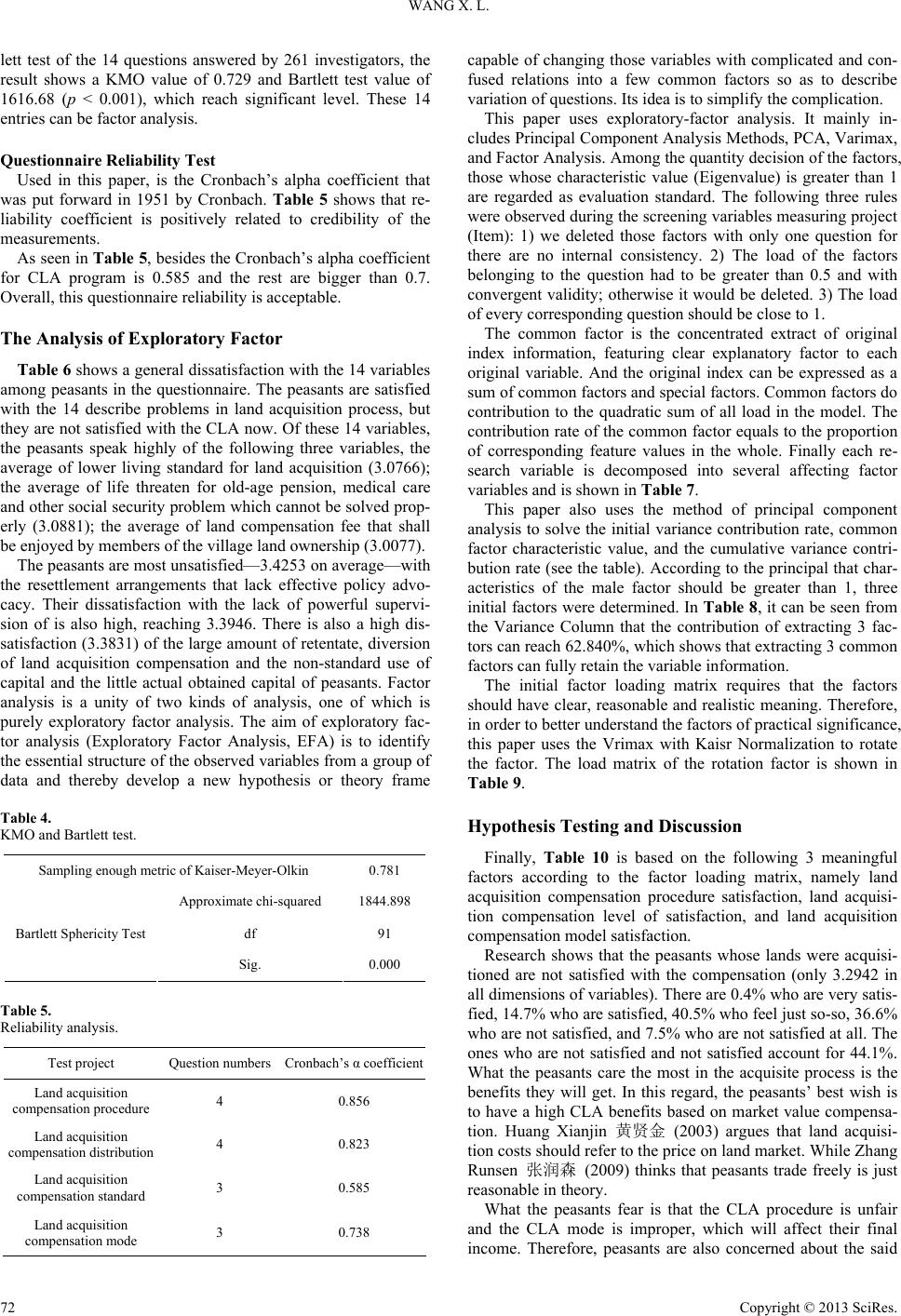 WANG X. L. lett test of the 14 questions answered by 261 investigators, the result shows a KMO value of 0.729 and Bartlett test value of 1616.68 (p < 0.001), which reach significant level. These 14 entries can be factor analysis. Questionnaire Reliability Test Used in this paper, is the Cronbach’s alpha coefficient that was put forward in 1951 by Cronbach. Table 5 shows that re- liability coefficient is positively related to credibility of the measurements. As seen in Table 5, besides the Cronbach’s alpha coefficient for CLA program is 0.585 and the rest are bigger than 0.7. Overall, this questionnaire reliability is acceptable. The Analysis of Exploratory Factor Table 6 shows a general dissatisfaction with the 14 variables among peasants in the questionnaire. The peasants are satisfied with the 14 describe problems in land acquisition process, but they are not satisfied with the CLA now. Of these 14 variables, the peasants speak highly of the following three variables, the average of lower living standard for land acquisition (3.0766); the average of life threaten for old-age pension, medical care and other social security problem which cannot be solved prop- erly (3.0881); the average of land compensation fee that shall be enjoyed by members of the village land ownership (3.0077). The peasants are most unsatisfied—3.4253 on average—with the resettlement arrangements that lack effective policy advo- cacy. Their dissatisfaction with the lack of powerful supervi- sion of is also high, reaching 3.3946. There is also a high dis- satisfaction (3.3831) of the large amount of retentate, diversion of land acquisition compensation and the non-standard use of capital and the little actual obtained capital of peasants. Factor analysis is a unity of two kinds of analysis, one of which is purely exploratory factor analysis. The aim of exploratory fac- tor analysis (Exploratory Factor Analysis, EFA) is to identify the essential structure of the observed variables from a group of data and thereby develop a new hypothesis or theory frame Table 4. KMO and Bartlett test. Sampling enough metric of Kaiser-Meyer-Olkin 0.781 Approximate chi-squared 1844.898 df 91 Bartlett Sphericity Test Sig. 0.000 Table 5. Reliability analysis. Test project Question numbers Cronbach’s α coefficient Land acquisition compensation procedure 4 0.856 Land acquisition compensation distribution 4 0.823 Land acquisition compensation standard 3 0.585 Land acquisition compensation mode 3 0.738 capable of changing those variables with complicated and con- fused relations into a few common factors so as to describe variation of questions. Its idea is to simplify the complication. This paper uses exploratory-factor analysis. It mainly in- cludes Principal Component Analysis Methods, PCA, Varimax, and Factor Analysis. Among the quantity decision of the factors, those whose characteristic value (Eigenvalue) is greater than 1 are regarded as evaluation standard. The following three rules were observed during the screening variables measuring project (Item): 1) we deleted those factors with only one question for there are no internal consistency. 2) The load of the factors belonging to the question had to be greater than 0.5 and with convergent validity; otherwise it would be deleted. 3) The load of every corresponding question should be close to 1. The common factor is the concentrated extract of original index information, featuring clear explanatory factor to each original variable. And the original index can be expressed as a sum of common factors and special factors. Common factors do contribution to the quadratic sum of all load in the model. The contribution rate of the common factor equals to the proportion of corresponding feature values in the whole. Finally each re- search variable is decomposed into several affecting factor variables and is shown in Table 7. This paper also uses the method of principal component analysis to solve the initial variance contribution rate, common factor characteristic value, and the cumulative variance contri- bution rate (see the table). According to the principal that char- acteristics of the male factor should be greater than 1, three initial factors were determined. In Table 8, it can be seen from the Variance Column that the contribution of extracting 3 fac- tors can reach 62.840%, which shows that extracting 3 common factors can fully retain the variable information. The initial factor loading matrix requires that the factors should have clear, reasonable and realistic meaning. Therefore, in order to better understand the factors of practical significance, this paper uses the Vrimax with Kaisr Normalization to rotate the factor. The load matrix of the rotation factor is shown in Table 9. Hypothesis Testing and Discussion Finally, Table 10 is based on the following 3 meaningful factors according to the factor loading matrix, namely land acquisition compensation procedure satisfaction, land acquisi- tion compensation level of satisfaction, and land acquisition compensation model satisfaction. Research shows that the peasants whose lands were acquisi- tioned are not satisfied with the compensation (only 3.2942 in all dimensions of variables). There are 0.4% who are very satis- fied, 14.7% who are satisfied, 40.5% who feel just so-so, 36.6% who are not satisfied, and 7.5% who are not satisfied at all. The ones who are not satisfied and not satisfied account for 44.1%. What the peasants care the most in the acquisite process is the benefits they will get. In this regard, the peasants’ best wish is to have a high CLA benefits based on market value compensa- tion. Huang Xianjin 黄贤金 (2003) argues that land acquisi- tion costs should refer to the price on land market. While Zhang Runsen 张润森 (2009) thinks that peasants trade freely is just reasonable in theory. What the peasants fear is that the CLA procedure is unfair and the CLA mode is improper, which will affect their final income. Therefore, peasants are also concerned about the said Copyright © 2013 SciRes. 72 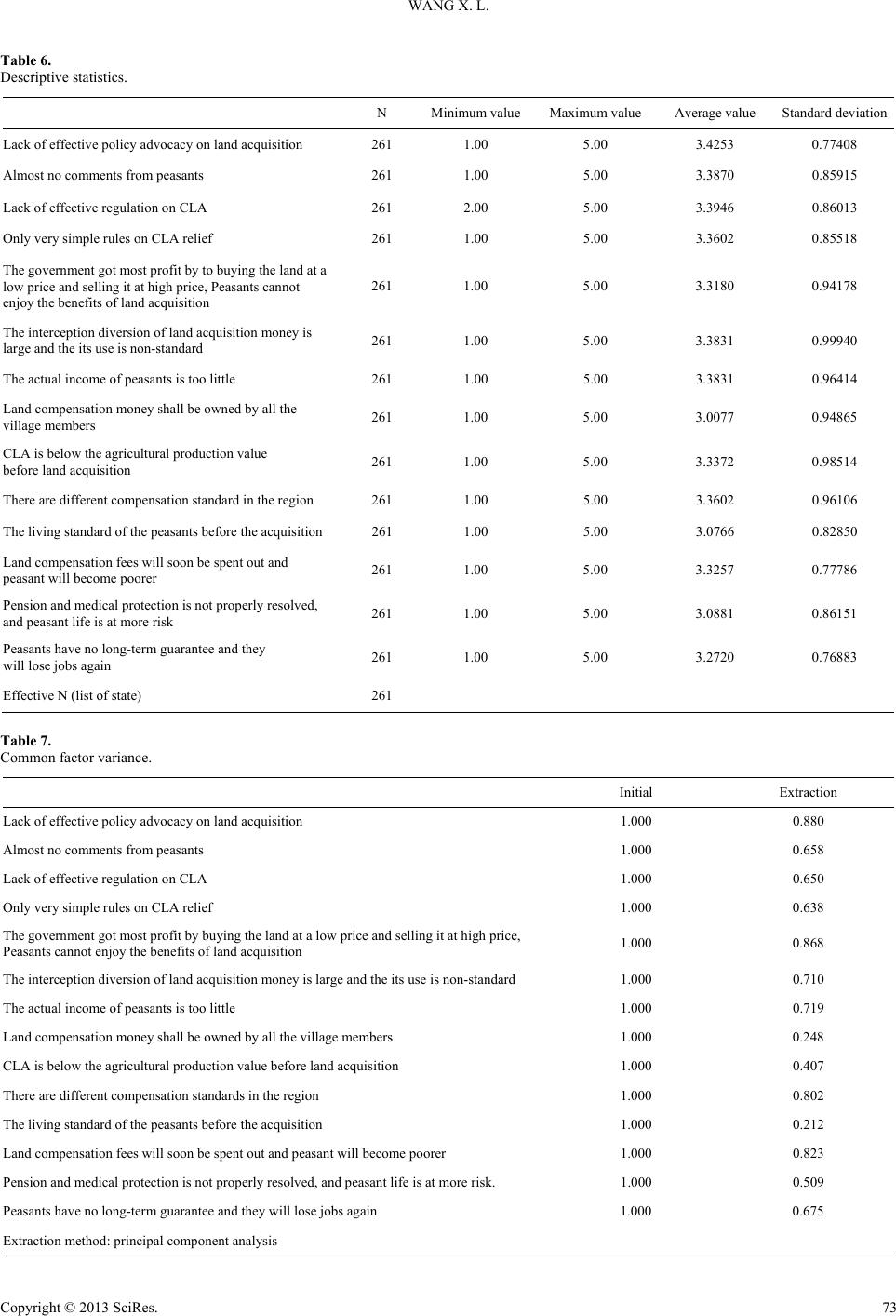 WANG X. L. Copyright © 2013 SciRes. 73 Table 6. Descriptive statistics. N Minimum value Maximum value Average value Standard deviation Lack of effective policy advocacy on land acquisition 261 1.00 5.00 3.4253 0.77408 Almost no comments from peasants 261 1.00 5.00 3.3870 0.85915 Lack of effective regulation on CLA 261 2.00 5.00 3.3946 0.86013 Only very simple rules on CLA relief 261 1.00 5.00 3.3602 0.85518 The government got most profit by to buying the land at a low price and selling it at high price, Peasants cannot enjoy the benefits of land acquisition 261 1.00 5.00 3.3180 0.94178 The interception diversion of land acquisition money is large and the its use is non-standard 261 1.00 5.00 3.3831 0.99940 The actual income of peasants is too little 261 1.00 5.00 3.3831 0.96414 Land compensation money shall be owned by all the village members 261 1.00 5.00 3.0077 0.94865 CLA is below the agricultural production value before land acquisition 261 1.00 5.00 3.3372 0.98514 There are different compensation standard in the region 261 1.00 5.00 3.3602 0.96106 The living standard of the peasants before the acquisition 261 1.00 5.00 3.0766 0.82850 Land compensation fees will soon be spent out and peasant will become poorer 261 1.00 5.00 3.3257 0.77786 Pension and medical protection is not properly resolved, and peasant life is at more risk 261 1.00 5.00 3.0881 0.86151 Peasants have no long-term guarantee and they will lose jobs again 261 1.00 5.00 3.2720 0.76883 Effective N (list of state) 261 Table 7. Common factor variance. Initial Extraction Lack of effective policy advocacy on land acquisition 1.000 0.880 Almost no comments from peasants 1.000 0.658 Lack of effective regulation on CLA 1.000 0.650 Only very simple rules on CLA relief 1.000 0.638 The government got most profit by buying the land at a low price and selling it at high price, Peasants cannot enjoy the benefits of land acquisition 1.000 0.868 The interception diversion of land acquisition money is large and the its use is non-standard 1.000 0.710 The actual income of peasants is too little 1.000 0.719 Land compensation money shall be owned by all the village members 1.000 0.248 CLA is below the agricultural production value before land acquisition 1.000 0.407 There are different compensation standards in the region 1.000 0.802 The living standard of the peasants before the acquisition 1.000 0.212 Land compensation fees will soon be spent out and peasant will become poorer 1.000 0.823 Pension and medical protection is not properly resolved, and peasant life is at more risk. 1.000 0.509 Peasants have no long-term guarantee and they will lose jobs again 1.000 0.675 Extraction method: principal component analysis 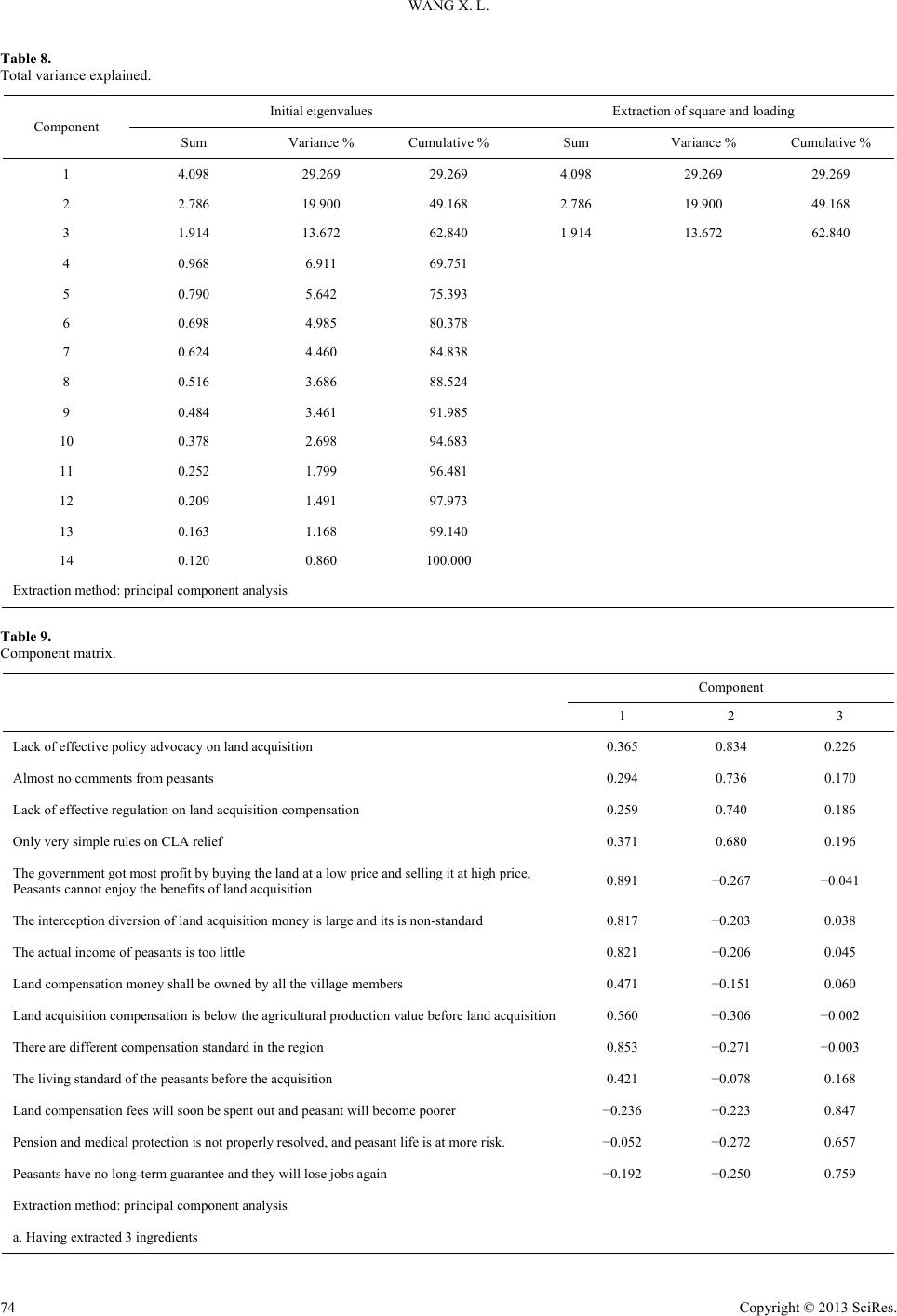 WANG X. L. Table 8. Total variance explained. Initial eigenvalues Extraction of square and loading Component Sum Variance % Cumulative % Sum Variance % Cumulative % 1 4.098 29.269 29.269 4.098 29.269 29.269 2 2.786 19.900 49.168 2.786 19.900 49.168 3 1.914 13.672 62.840 1.914 13.672 62.840 4 0.968 6.911 69.751 5 0.790 5.642 75.393 6 0.698 4.985 80.378 7 0.624 4.460 84.838 8 0.516 3.686 88.524 9 0.484 3.461 91.985 10 0.378 2.698 94.683 11 0.252 1.799 96.481 12 0.209 1.491 97.973 13 0.163 1.168 99.140 14 0.120 0.860 100.000 Extraction method: principal component analysis Table 9. Component matrix. Component 1 2 3 Lack of effective policy advocacy on land acquisition 0.365 0.834 0.226 Almost no comments from peasants 0.294 0.736 0.170 Lack of effective regulation on land acquisition compensation 0.259 0.740 0.186 Only very simple rules on CLA relief 0.371 0.680 0.196 The government got most profit by buying the land at a low price and selling it at high price, Peasants cannot enjoy the benefits of land acquisition 0.891 −0.267 −0.041 The interception diversion of land acquisition money is large and its is non-standard 0.817 −0.203 0.038 The actual income of peasants is too little 0.821 −0.206 0.045 Land compensation money shall be owned by all the village members 0.471 −0.151 0.060 Land acquisition compensation is below the agricultural production value before land acquisition0.560 −0.306 −0.002 There are different compensation standard in the region 0.853 −0.271 −0.003 The living standard of the peasants before the acquisition 0.421 −0.078 0.168 Land compensation fees will soon be spent out and peasant will become poorer −0.236 −0.223 0.847 Pension and medical protection is not properly resolved, and peasant life is at more risk. −0.052 −0.272 0.657 Peasants have no long-term guarantee and they will lose jobs again −0.192 −0.250 0.759 Extraction method: principal component analysis a. Having extracted 3 ingredients Copyright © 2013 SciRes. 74 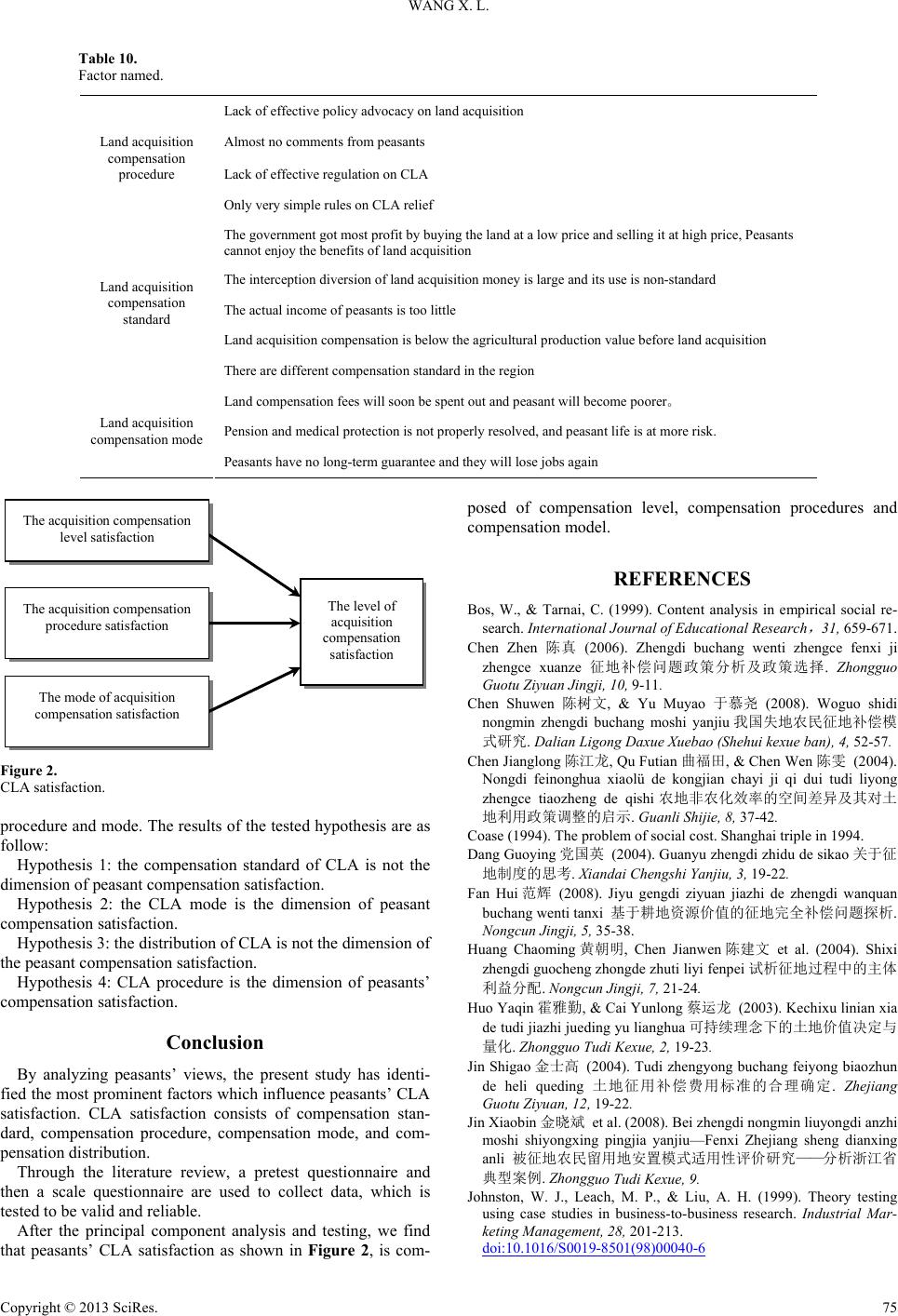 WANG X. L. Copyright © 2013 SciRes. 75 Table 10. Factor named. Lack of effective policy advocacy on land acquisition Almost no comments from peasants Lack of effective regulation on CLA Land acquisition compensation procedure Only very simple rules on CLA relief The government got most profit by buying the land at a low price and selling it at high price, Peasants cannot enjoy the benefits of land acquisition The interception diversion of land acquisition money is large and its use is non-standard The actual income of peasants is too little Land acquisition compensation is below the agricultural production value before land acquisition Land acquisition compensation standard There are different compensation standard in the region Land compensation fees will soon be spent out and peasant will become poorer。 Pension and medical protection is not properly resolved, and peasant life is at more risk. Land acquisition compensation mode Peasants have no long-term guarantee and they will lose jobs again The level of acquisition compensation satisfaction The acquisition compensation level satisfaction The acquisition compensation procedure satisfaction The mode of acquisition compensation satisfaction Figure 2. CLA satisfaction. procedure and mode. The results of the tested hypothesis are as follow: Hypothesis 1: the compensation standard of CLA is not the dimension of peasant compensation satisfaction. Hypothesis 2: the CLA mode is the dimension of peasant compensation satisfaction. Hypothesis 3: the distribution of CLA is not the dimension of the peasant compensation satisfaction. Hypothesis 4: CLA procedure is the dimension of peasants’ compensation satisfaction. Conclusion By analyzing peasants’ views, the present study has identi- fied the most prominent factors which influence peasants’ CLA satisfaction. CLA satisfaction consists of compensation stan- dard, compensation procedure, compensation mode, and com- pensation distribution. Through the literature review, a pretest questionnaire and then a scale questionnaire are used to collect data, which is tested to be valid and reliable. After the principal component analysis and testing, we find that peasants’ CLA satisfaction as shown in Figure 2, is com- posed of compensation level, compensation procedures and compensation model. REFERENCES Bos, W., & Tarnai, C. (1999). Content analysis in empirical social re- search. International Journal of Educational Research , 31, 659-671. Chen Zhen 陈真 (2006). Zhengdi buchang wenti zhengce fenxi ji zhengce xuanze 征地补偿问题政策分析及政策选择. Zhongguo Guotu Ziyuan Jingji, 10, 9-11. Chen Shuwen 陈树文, & Yu Muyao 于慕尧 (2008). Woguo shidi nongmin zhengdi buchang moshi yanjiu我国失地农民征地补偿模 式研究. Dalian Ligong Daxue Xuebao (Shehui kexue ban), 4, 52-57. Chen Jianglong陈江龙, Qu Futian 曲福田, & Chen Wen陈雯 (2004). Nongdi feinonghua xiaolü de kongjian chayi ji qi dui tudi liyong zhengce tiaozheng de qishi农地非农化效率的空间差异及其对土 地利用政策调整的启示. Guanli Shijie, 8, 37-42. Coase (1994). The problem of social cost. Shanghai triple in 1994. Dang Guoying党国英 (2004). Guanyu zhengdi zhidu de sikao关于征 地制度的思考. Xiandai Chengshi Yanjiu, 3, 19-22. Fan Hui范辉 (2008). Jiyu gengdi ziyuan jiazhi de zhengdi wanquan buchang wenti tanxi 基于耕地资源价值的征地完全补偿问题探析. Nongcun Jingji, 5, 35-38. Huang Chaoming黄朝明, Chen Jianwen陈建文 et al. (2004). Shixi zhengdi guocheng zhongde zhuti liyi fenpei试析征地过程中的主体 利益分配. Nongcun Jingji, 7, 21-24. Huo Yaqin霍雅勤, & Cai Yunlong 蔡运龙 (2003). Kechixu linian xia de tudi jiazhi jueding yu lianghua可持续理念下的土地价值决定与 量化. Zhongguo Tudi Kexue, 2, 19-23. Jin Shigao金士高 (2004). Tudi zhengyong buchang feiyong biaozhun de heli queding 土地征用补偿费用标准的合理确定. Zhejiang Guotu Ziyuan, 12, 19-22. Jin Xiaobin 金晓斌 et al. (2008). Bei zhengdi nongmin liuyongdi anzhi moshi shiyongxing pingjia yanjiu—Fenxi Zhejiang sheng dianxing anli 被征地农民留用地安置模式适用性评价研究——分析浙江省 典型案例. Zhongguo Tudi Kexue, 9. Johnston, W. J., Leach, M. P., & Liu, A. H. (1999). Theory testing using case studies in business-to-business research. Industrial Mar- keting Management, 28, 201-213. doi:10.1016/S0019-8501(98)00040-6  WANG X. L. Kong Xiangzhi 孔祥智, & Wang Zhiqiang 王志强 (2004). Woguo chengzhenhua jincheng zhong shidi nongmin de buchang我国城镇 化进程中失地农民的补偿 Jingji Lilun yu Jingji Guanli, 5. Kong Xiangzhi 孔祥智 (2007). Shidi nongmi “shouchang yiyuan” yingxiang yinsu de shizheng fenxi失地农民“受偿意愿”影响因素的 实证分析. Shanxi Caijing Daxue Xuebao, 6. Lei Shifeng雷仕凤, & Zhong shuiying钟水映 (2005). Zhengdi bu- chang de kunjing yu duice 征地补偿的困境与对策. Zhongguo Gaige, 6. Li Fanrong李繁荣 (2006). Woguo zhengdi guocheng zhong de tudi shouyi fenpei zhidu fenxi我国征地过程中的土地收益分配制度分 析. Shanxi Caijing Daxue Xuebao, 2. Li Mingyue李明月, & Jiang Hua江华 (2007). Shidi nongmin liudi anzhi fangshi yanjiu 失地农民留地安置方式研究. Jingji Tizhi Gaige, 2. Li Mingyue李明月, & Hu Zhuzhi胡竹枝 (2008). Shidi nongmin anzhi yiyuan ji qi yingxiang yinsu: Guangzhou gean失地农民安置意愿及 其影响因素: 广州个案. Gaige, 5. Liu Yue 刘乐, & Yang Xuecheng 杨学成 (2009). Kaifaqu shidi nongmin buchang anzhi ji shengcun zhuangkuang yanjiu—Yi Taian shi gaoxin jishu chanye kaifaqu weili开发区失地农民补偿安置及 生存状况研究——以泰安市高新技术产业开发区为例. Zhongguo Tudi Kexue, 4. Lin Qiling林其玲 (2009). Woguo zhengdi buchang zhidu wenti fenxi 我国征地补偿制度问题分析. Nongcun Jingji Wenti, 10. Liu Yaling 刘亚玲 (2005). Anzhao shichang jingji banfa queding zhengdi buchang biaozhun按照市场经济办法确定征地补偿标准. Jingji Xuejia, 3. Luo Yujie罗玉洁, & He Shanshan 何珊珊 (2009). Tudi zhengyong de shichanghua buchang moshi yanjiu土地征用的市场化补偿模式研 究. Zhongguo Jingji Daokan, 16. Lu Hongsheng陆红生, & Han Tongkui韩桐魁 (2003). Guanyu tudi zhengyong zhidu gaige ruogan wenti de sikao关于土地征用制度改 革若干问题的思考. Huazhong Nongye Daxue Xuebao (Shehui ke- xue ban), 1. Qian Zhonghao钱忠好, & Ma Kai马凯 (2007). Woguo chengxiang feinongjianshe yongdi shichang: Longduan, fenge yu zhenghe我国 城乡非农建设用地市场: 垄断、分割与整合. Guanli Shijie, 6. Qin Hui覃卉 (2006). Woguo tudi zhengshou chengxu de wanshan我 国土地征收程序的完善. Gaige yu Zhanlue, 1. Ruan Xingwen 阮兴文 (2008). 构建征地补偿的正当程序规制. Kaifang Baodao, 1. Schuster, C. (2004). A note on the interpretation of weighted kappa and its relations to other rater agreement statistics.Educational and Psy- chological Measurement, 64, 243-253. doi:10.1177/0013164403260197 Shen Shouyu 沈守愚 (2002). Tudi faxue tonglong土地法学通论. Beijing: Zhongguo Dadi Chubanshe. Wang Hui 汪晖, & Huang Zuhui 黄祖辉 (2004). Gonggong liyi, zhengdi fanwei yu gongping buchang—Cong liangge tudi touji anli tanqi 公共利益、征地范围与公平补偿——从两个土地投机案例谈 起. Jingji Xue (Jikan), 4. Wang Yibai王亦白 (2006). Tudi quanshu zhengyi tiaochu jizhi xu jianquan 土地权属争议调处机制需健全. Zhongguo Tudi, 6. Wang Mingxiang王明祥 (2003). Zhengdi buchang anzhi xianzhuang ji gaijin tujing 征地补偿安置现状及改进途径. Zhongguo Tudi, 6. Wang Shiquan 王世全 (2006). Tudi zhengyong zhong liyi fenpei qianxi 土地征用中利益分配浅析. Zhongguo Fangdichan, 10. Wang Shiquan王修达 (2008). Zhengdi buchang anzhi zhong de gua yu bujun征地补偿安置中的寡与不均. Zhongguo Nongcun Jingji, 2. Wang Weilin 王伟林, Huang Xianjin 黄贤金, & Chen Zhigang 陈志刚 (2009). Fada diqu nonghu bei zhengdi yiyuan ji yingxiang yinsu— Jiyu Suzhou nonghu diaocha de shizheng yanjiu发达地区农户被征 地意愿及其影响因素——基于苏州农户调查的实证研究. Zhong- guo Tudi Kexue, 4. Xiao Yi肖屹, Qian Zhonghao钱忠好, & Qu Futian曲福田 (2009). Nongmin tudi chanquan renzhi yu zhengdi zhidu gaige yanjiu—Jiyu Jiangsu, Jiangxi liangsheng 401 hu nongmin de diaocha yanjiu农民 土地产权认知与征地制度改革研究——基于江苏、江西两省 401 户农民的调查研究. Jingji Tizhi Gaige, 2. Wu Minglong吴明隆 (2008). SPSS caozuo yu yingyong—Wenjuan tongji fenxi shiwu SPSS 操作与应用——问卷统计分析实务. Taichung: Wunan Tushu Chuban Gongsi. Yang Chunxi杨春禧 (2005). Lun zhengdi chengxu gaige yu hexie shehui goujian 论征地程序改革与和谐社会构建. Shehui Kexue Yanjiu, 5. Yin, R. K. (1994). Case study research: Design and method. New York: Sage Publications. Yu Jianrong 于建嵘 (2008). Tudi ying zhenzheng chengwei tongmin de caichan土地应真正成为农民的财产. Huazhong Shifan Daxue Xuebao (Renwen shehui kexue ban), 2. Yu Miao于淼, & Wu Jianping伍建平 (2006). Zhejiang Jiaxing “yi tudi huan baozhang” de jingyan ji qi fansi浙江嘉兴“以土地换保障” 的经验及其反思. Zhongguo Nongye Daxue Xuebao (Shehui kexue ban), 2. Zhang Xiaoling张晓玲, Lu Hai yuan卢海元, & Mi Hong米红 (2006). Bei zhengdi Nongmin pinkun fengxuan ji anzhi cuoshi yanjiu被征地 农民贫困风险及安置措施研究. Zhongguo Tudi Kexue, 1. Zhang Quanjing, 张全景, & Wang Wanmao王万茂 (2003). Woguo tudi zhengyong zhidu de lilun kaocha ji gaige sikao 我国土地征用制 度的理论考察及改革思考. Jingji Dili, 6. Zhang Shuhuan张术环 (2005). Chanquan, nongdi chanquan, nongdi chanquan zhidu 产权、农地产权、农地产权制度. Xueshu Luntan, 3. Zhang Xingbin张兴斌, & Qi En齐恩 (2007). Pingzhengdi buchang biaozhun cunzai de wenti ji xiangying duice平征地补偿标准存在的 问题及相应对策. Tianjin Shangxueyuan Xuebao, 4. Zhong Shuiying 钟水映, & Li Kui 李魁 (2008). Zhengdi anzhi ma- nyidu shizheng fenxi征地安置满意度实证分析. Zhongguo Tudi Kexue, 6. Zhou Qiren 周其仁 (2004). Nongdi chanquanyu zhengdi zhidu— Zhongguo chengshihua mianlin de zhongda xuanze农地产权与征地 制度——中国城市化面临的重大选择. Jingji Xue (Jikan), 4. Zhu Mingfen朱明芬 (2003). Zhejiang shidi nongmin liyi baozhang xianzhuang diaocha ji duice浙江失地农民利益保障现状调查及对 策. Zhongguo Nongcun Jingji, 3. Copyright © 2013 SciRes. 76 |