

Paper Menu >>
Journal Menu >>
 J. Biomedical Science and Engineering, 2013, 6, 232-235 JBiSE http://dx.doi.org/10.4236/jbise.2013.62A028 Published Online February 2013 (http://www.scirp.org/journal/jbise/) Ezetimibe completely replaced LDL-apheresis for the treatment of familial hypercholesterolemia and coronary artery disease after CABG—A case report Ikuo Yokoyama1,2,3 1Department of Cardiovascular Medicine, Clinical Research Center, Sanno Medical Center Hospital, International University of Health and Welfare, Tokyo, Japan 2Department of Cardiovascular Medicine, Clinical Research Center, Sanno Hospital, International University of Health and Welfare, Tokyo, Japa n 3Department of Cardiovascular Medicine, Department of Metabolic Diseases, Graduate School of Medicine University of Tokyo, Tokyo, Japa n Email: [email protected] Received 7 November 2012; revised 8 December 2012; accepted 15 December 2012 ABSTRACT Intensive treatment of hyperlipidemia is an important factor in the prevention of cardiovascular disease. Among several therapies, statins are well recognized as playing a central role, although low density lipopro- tein bound cholesterol-apheresis can be used to treat very severe cases of familial hypercholesterolemia. However, statins are not always effective on their own and, recently, ezetimibe has emerged as a unique anti- hypercholesterolemic drug that acts as a cholesterol transporter inhibitor; its role is only partially under- stood. I experienced rare case that appeared to benefit from ezetimibe therapy, and report them as they help increase our knowledge of this novel drug. Keywords: Ezetimibe; Familial Hypercholesterolemia; Statins; LDL-Apheresis; Coronary Artery Disease 1. INTRODUCTION The effectiveness of anti-hyperlidemia therapy for pre- venting cardiovascular events [1-5] and inducing the regression of coronary artery stenosis [6] has been dem- onstrated. Multicenter trials have indicated that hy- droxymethylglutaryl co enzyme A reductase inhibitors, or statins, aid in preventing coronary artery disease (CAD) [2-5]. Furthermore, statin has been reported to be more effective for reducing the incidence of ischemic events than percutaneous transluminal coronary revascularisa- tion therapy [7]. However, and despite the fact that stat- ins are currently the mainstay of dyslipidemia manage- ment, their efficacy in preventing a cardiovascular event has limitations. This is because statin s may exert adverse effects by restoring cholesterol levels via an enhance- ment of the reuptake of cholesterol and/or altered cho- lesterol derived from small intestines. Recently, ezeti- mibe has emerged as a new class of lipid-lowering drug, which acts via the inhibition o f Niemann-Pick C1 Like 1 (NPC1L1), a protein that is localized in jejunal entero- cytes [8]. Combination therapy of ezetimibe and statins has been shown to b e highly effective in the treatment of hypercholesterolemia [9]. However, to date it has not been established whether ezetimibe combined with statin therapy has a much stronger effect than that of low den- sity lipoprotein bound cholesterol (LDL)-apheresis, which is recognized as the most effective therapy for hyperlipidemia [10,11]. Recently, I experienced a rare case in which ezetimibe appeared to have an effective role, in place of LDL-apheresis, in a patient with familial hypercholesterolemia (FH) and CAD who had undergone a coronary artery bypass graft (CABG). I report the case here. 2. CASE This case concerned a 60-year-old male patient who was admitted to the University of Tokyo Hospital from his local clinic to treat FH. As the patient had a family his- tory of severe hypercholesterolemia (3 of 5 brothers had hypercholesterolemia) and CAD (one brother had CAD), he was tested for the existence of CAD using rest to dipyridamole stress myocardial perfusion positron emis- sion tomography (PET) (Headtome IV Shimadzu Corp & Ltd., Kyoto, Japan) and 13N-ammonia. The PET study revealed that this patient was at high risk for CAD, and because a subsequent coronary angiography showed the presence of 3-vessel disease, he underwent CABG. After CABG, the patient was treated with pravastatin (20 mg) for the secondary prevention of CAD. However, the pravastatin failed to treat his hypercholesterolemia ap- OPEN ACCESS 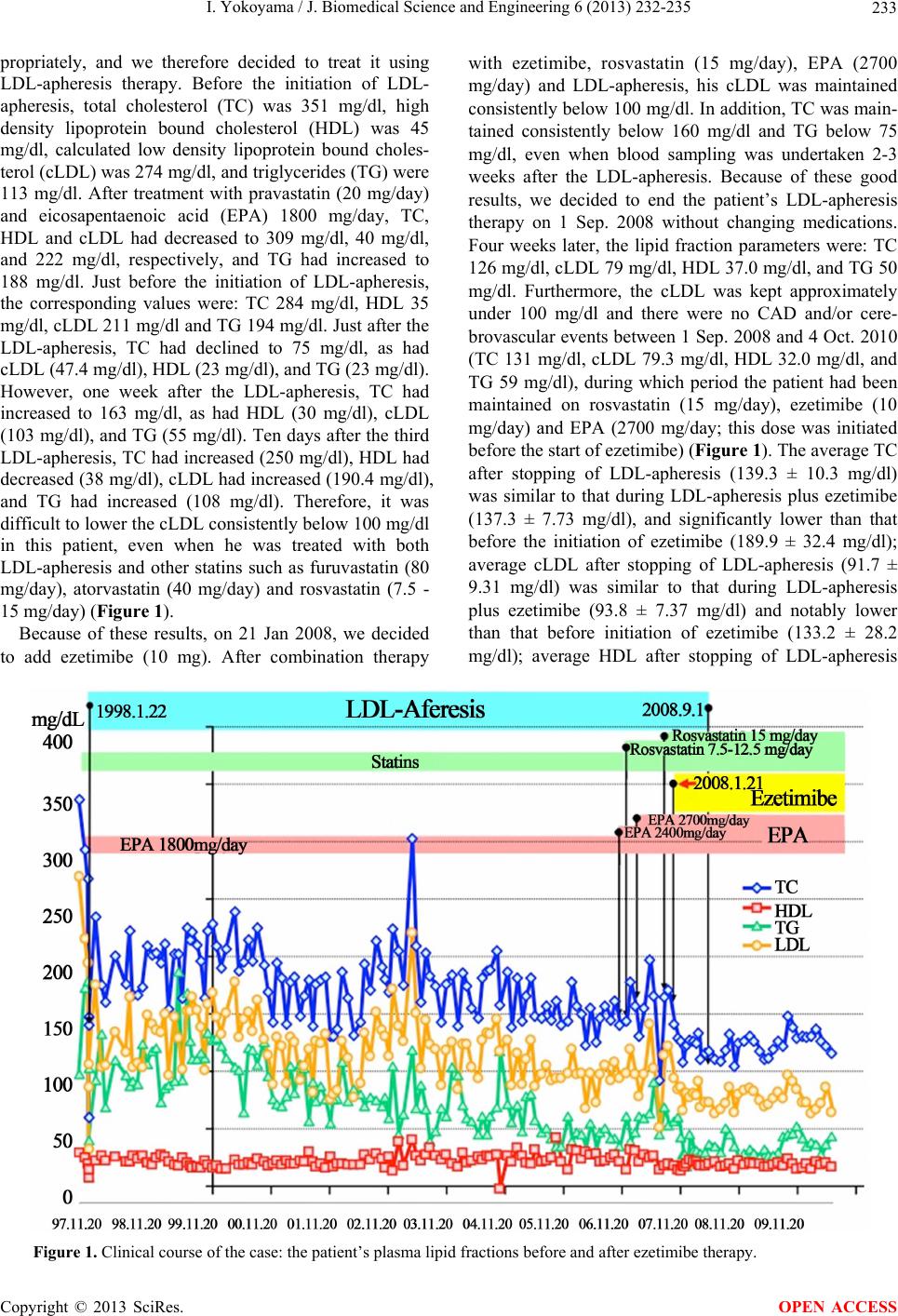 I. Yokoyama / J. Biomedical Science and Engineering 6 (2013) 232-235 233 propriately, and we therefore decided to treat it using LDL-apheresis therapy. Before the initiation of LDL- apheresis, total cholesterol (TC) was 351 mg/dl, high density lipoprotein bound cholesterol (HDL) was 45 mg/dl, calculated low density lipoprotein bound choles- terol (cLDL) was 274 mg/dl, and triglycerides (TG) were 113 mg/dl. After treatment with pravastatin (20 mg/day) and eicosapentaenoic acid (EPA) 1800 mg/day, TC, HDL and cLDL had decreased to 309 mg/dl, 40 mg/dl, and 222 mg/dl, respectively, and TG had increased to 188 mg/dl. Just before the initiation of LDL-apheresis, the corresponding values were: TC 284 mg/dl, HDL 35 mg/dl, cLDL 211 mg/dl and TG 194 mg/dl. Just af ter the LDL-apheresis, TC had declined to 75 mg/dl, as had cLDL (47.4 mg/dl), HDL (23 mg/dl), and TG (2 3 mg/dl). However, one week after the LDL-apheresis, TC had increased to 163 mg/dl, as had HDL (30 mg/dl), cLDL (103 mg/dl), and TG (55 mg/dl). Ten days after the third LDL-apheresis, TC had increased (250 mg/dl), HDL had decreased (38 mg/dl), cLDL had increased (190.4 mg/dl), and TG had increased (108 mg/dl). Therefore, it was difficult to lower the cLDL cons istently below 100 mg/dl in this patient, even when he was treated with both LDL-apheresis and other statins such as furuvastatin (80 mg/day), atorvastatin (40 mg/day) and rosvastatin (7.5 - 15 mg/day) (Figure 1). Because of these results, on 21 Jan 2008, we decided to add ezetimibe (10 mg). After combination therapy with ezetimibe, rosvastatin (15 mg/day), EPA (2700 mg/day) and LDL-apheresis, his cLDL was maintained consistently below 100 mg/dl. In add ition, TC was main- tained consistently below 160 mg/dl and TG below 75 mg/dl, even when blood sampling was undertaken 2-3 weeks after the LDL-apheresis. Because of these good results, we decided to end the patient’s LDL-apheresis therapy on 1 Sep. 2008 without changing medications. Four weeks later, the lipid fraction parameters were: TC 126 mg/dl, cLDL 79 mg/dl, HDL 37.0 mg/dl, and TG 50 mg/dl. Furthermore, the cLDL was kept approximately under 100 mg/dl and there were no CAD and/or cere- brovascular even ts between 1 Sep. 2008 and 4 Oct. 2010 (TC 131 mg/dl, cLDL 79.3 mg/dl, HDL 32.0 mg/dl, and TG 59 mg/dl), during which period the patient had been maintained on rosvastatin (15 mg/day), ezetimibe (10 mg/day) and EPA (2700 mg/day; this dose was initiated before the start of ezetimibe) (Figure 1). The average TC after stopping of LDL-apheresis (139.3 ± 10.3 mg/dl) was similar to that during LDL-apheresis plus ezetimibe (137.3 ± 7.73 mg/dl), and significantly lower than that before the initiation of ezetimibe (189.9 ± 32.4 mg/dl); average cLDL after stopping of LDL-apheresis (91.7 ± 9.31 mg/dl) was similar to that during LDL-apheresis plus ezetimibe (93.8 ± 7.37 mg/dl) and notably lower than that before initiation of ezetimibe (133.2 ± 28.2 mg/dl); average HDL after stopping of LDL-apheresis Figure 1. Clinical course of the case: the patient’s plasma lipid fractions before and after ezetimibe therapy. Copyright © 2013 SciRes. OPEN ACCESS 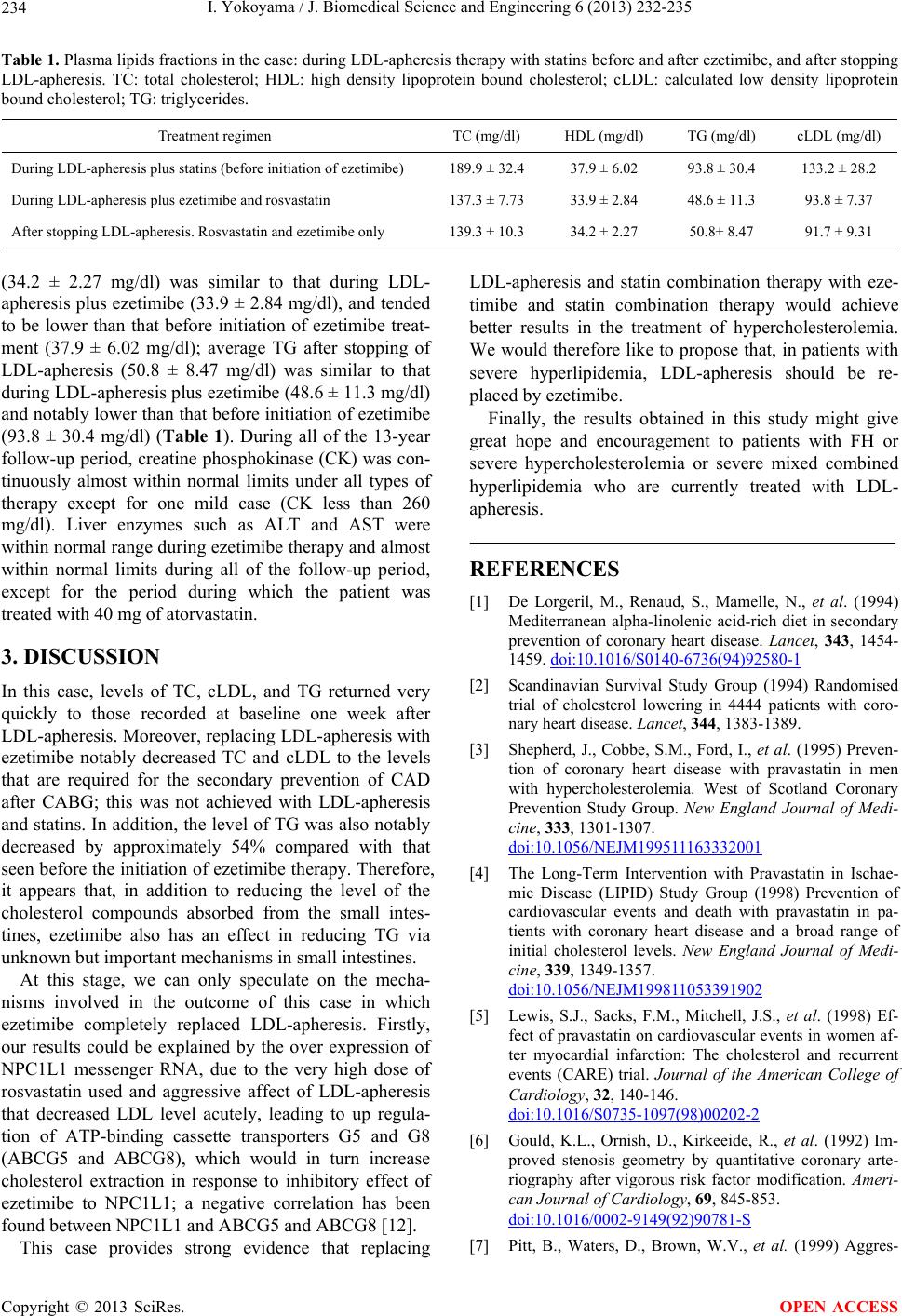 I. Yokoyama / J. Biomedical Science and Engineering 6 (2013) 232-235 234 Table 1. Plasma lipids fractions in the case: during LDL-apheresis therapy with statins before and after ezetimibe, and after stopping LDL-apheresis. TC: total cholesterol; HDL: high density lipoprotein bound cholesterol; cLDL: calculated low density lipoprotein bound cholesterol; TG: triglycerides. Treatment regimen TC (mg/dl) HDL (mg/dl) TG (mg/dl) cLDL (mg/dl) During LDL-apheresis plus statins (before initiation of ezetimibe) 189.9 ± 32.4 37.9 ± 6.02 93.8 ± 30.4 133.2 ± 28.2 During LDL-apheresis plus ezetimibe and rosvastatin 137.3 ± 7.73 33.9 ± 2.84 48.6 ± 11.3 93.8 ± 7.37 After stopping LDL-apheresis. Rosvastatin and ezetimibe only 139.3 ± 10.3 34.2 ± 2.27 50.8± 8.47 91.7 ± 9.31 (34.2 ± 2.27 mg/dl) was similar to that during LDL- apheresis plus ezetimibe (33.9 ± 2.84 mg/dl), and tended to be lower than that before initiation of ezetimibe treat- ment (37.9 ± 6.02 mg/dl); average TG after stopping of LDL-apheresis (50.8 ± 8.47 mg/dl) was similar to that during LDL-apheresis plus ezetimibe (48.6 ± 11.3 mg/dl) and notably lower than that before initiation of ezetimibe (93.8 ± 30.4 mg/dl) (Table 1). During all of the 13-year follow-up period, creatine phosphokinase (CK) was con- tinuously almost within normal limits under all types of therapy except for one mild case (CK less than 260 mg/dl). Liver enzymes such as ALT and AST were within normal range dur ing ezetimibe therapy and almost within normal limits during all of the follow-up period, except for the period during which the patient was treated with 40 mg of atorvastatin. 3. DISCUSSION In this case, levels of TC, cLDL, and TG returned very quickly to those recorded at baseline one week after LDL-apheresis. Moreover, replacing LDL-apheresis with ezetimibe notably decreased TC and cLDL to the levels that are required for the secondary prevention of CAD after CABG; this was not achieved with LDL-apheresis and statins. In addition, the level of TG was also notably decreased by approximately 54% compared with that seen before the initiation of ezetimibe therapy. Therefore, it appears that, in addition to reducing the level of the cholesterol compounds absorbed from the small intes- tines, ezetimibe also has an effect in reducing TG via unknown but important mechanisms in small intestines. At this stage, we can only speculate on the mecha- nisms involved in the outcome of this case in which ezetimibe completely replaced LDL-apheresis. Firstly, our results could be explained by the over expression of NPC1L1 messenger RNA, due to the very high dose of rosvastatin used and aggressive affect of LDL-apheresis that decreased LDL level acutely, leading to up regula- tion of ATP-binding cassette transporters G5 and G8 (ABCG5 and ABCG8), which would in turn increase cholesterol extraction in response to inhibitory effect of ezetimibe to NPC1L1; a negative correlation has been found between NPC1L1 and ABCG5 and ABCG8 [12]. This case provides strong evidence that replacing LDL-apheresis and statin combination therapy with eze- timibe and statin combination therapy would achieve better results in the treatment of hypercholesterolemia. We would therefore like to propose that, in patients with severe hyperlipidemia, LDL-apheresis should be re- placed by ezetimibe. Finally, the results obtained in this study might give great hope and encouragement to patients with FH or severe hypercholesterolemia or severe mixed combined hyperlipidemia who are currently treated with LDL- apheresis. REFERENCES [1] De Lorgeril, M., Renaud, S., Mamelle, N., et al. (1994) Mediterranean alpha-linolenic acid-rich diet in secondary prevention of coronary heart disease. Lancet, 343, 1454- 1459. doi:10.1016/S0140-6736(94)92580-1 [2] Scandinavian Survival Study Group (1994) Randomised trial of cholesterol lowering in 4444 patients with coro- nary heart disease. Lancet, 344, 1383-1389. [3] Shepherd, J., Cobbe, S.M., Ford, I., et al. (1995) Preven- tion of coronary heart disease with pravastatin in men with hypercholesterolemia. West of Scotland Coronary Prevention Study Group. New England Journal of Medi- cine, 333, 1301-1307. doi:10.1056/NEJM199511163332001 [4] The Long-Term Intervention with Pravastatin in Ischae- mic Disease (LIPID) Study Group (1998) Prevention of cardiovascular events and death with pravastatin in pa- tients with coronary heart disease and a broad range of initial cholesterol levels. New England Journal of Medi- cine, 339, 1349-1357. doi:10.1056/NEJM199811053391902 [5] Lewis, S.J., Sacks, F.M., Mitchell, J.S., et al. (1998) Ef- fect of pravastatin on cardiovascular events in women af- ter myocardial infarction: The cholesterol and recurrent events (CARE) trial. Journal of the American College of Cardiology, 32, 140-146. doi:10.1016/S0735-1097(98)00202-2 [6] Gould, K.L., Ornish, D., Kirkeeide, R., et al. (1992) Im- proved stenosis geometry by quantitative coronary arte- riography after vigorous risk factor modification. Ameri- can Journal of Cardiology, 69, 845-853. doi:10.1016/0002-9149(92)90781-S [7] Pitt, B., Waters, D., Brown, W.V., et al. (1999) Aggres- Copyright © 2013 SciRes. OPEN ACCESS  I. Yokoyama / J. Biomedical Science and Engineering 6 (2013) 232-235 235 sive lipid-lowering therapy compared with angioplasty in stable coronary artery disease. Atorvastatin versus revas- cularization treatment investigators. New England Jour- nal of Medicine, 341, 70-76. doi:10.1056/NEJM199907083410202 [8] Ge, L., Wang, J., Qi, W., et al. (2008) The cholesterol absorption inhibitor ezetimibe acts by blocking the sterol- induced internalization of NPC1L1. Cell Metabolism, 7, 508-519. doi:10.1016/j.cmet.2008.04.001 [9] Stein, E., Stender, S., Mata, P., et al. (2004) Achieving lipoprotein goals in patients at high risk with severe hy- percholesterolemia: Efficacy and safety of ezetimibe co- administered with atorvastatin. American Heart Journal, 148, 447-455. doi:10.1016/j.ahj.2004.03.052 [10] Gordon, B.R., Kelsey, S.F., Dau, P.C., et al. (1998) Long-term effects of low-density lipoprotein apheresis using an automated dextran sulfate cellulose adsorption system. Liposorber Study Group. American Journal of Cardiology, 81, 407-411. doi:10.1016/S0002-9149(97)00947-8 [11] Thompson, G.R., Barbir, M., Davies, D., et al. (2010) Efficacy criteria and cholesterol targets for LDL aphere- sis. Atherosclerosis, 208, 317-321. doi:10.1016/j.atherosclerosis.2009.06.010 [12] Lally, S., Tan, C.Y., Owens, D. and Tomkin, G.H. (2006) Messenger RNA levels of genes involved in dysregula- tion of postprandial lipoproteins in type 2 diabetes: The role of Niemann-Pick C1-like 1, ATP-binding cassette, transporters G5 and G8, and of microsomal triglyceride transfer protein. Diabetologia, 49, 1008-1016. doi:10.1007/s00125-006-0177-8 Copyright © 2013 SciRes. OPEN ACCESS |